
Lecture No 46
Modified Put Butterfly
Rohan Sharma (Coach)
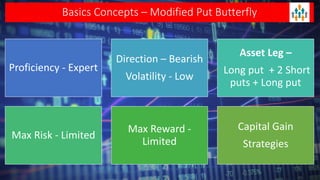
Basics Concepts – Modified Put Butterfly
Proficiency - Expert
Direction – Bearish
Volatility - Low
Asset Leg –
Long put + 2 Short
puts + Long put
Max Risk - Limited
Max Reward -
Limited
Capital Gain
Strategies
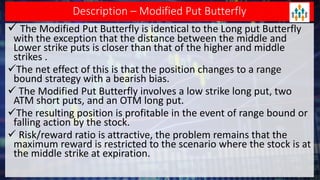
Description – Modified Put Butterfly
 The Modified Put Butterfly is identical to the Long put Butterfly
with the exception that the distance between the middle and
Lower strike puts is closer than that of the higher and middle
strikes .
The net effect of this is that the position changes to a range
bound strategy with a bearish bias.
 The Modified Put Butterfly involves a low strike long put, two
ATM short puts, and an OTM long put.
The resulting position is profitable in the event of range bound or
falling action by the stock.
 Risk/reward ratio is attractive, the problem remains that the
maximum reward is restricted to the scenario where the stock is at
the middle strike at expiration.
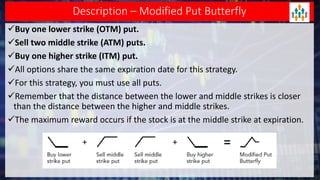
Description – Modified Put Butterfly
Buy one lower strike (OTM) put.
Sell two middle strike (ATM) puts.
Buy one higher strike (ITM) put.
All options share the same expiration date for this strategy.
For this strategy, you must use all puts.
Remember that the distance between the lower and middle strikes is closer
than the distance between the higher and middle strikes.
The maximum reward occurs if the stock is at the middle strike at expiration.
Steps to Trading a Modified Put Butterfly
Steps In
Choose from stocks with adequate liquidity, preferably over 500,000 Average
Daily Volume (ADV).
Try to ensure that the trend is range bound and identify a clear area of
support.
•Steps Out
Manage your position according to the rules defined in your Trading Plan.
If the stock falls below your stop loss below the current stock price, then
unravel the entire position.
You can unravel the position just before expiration—remember to include all
the commissions in your calculations.
Context - Modified Put Butterfly
Outlook
With modified butterflies, your profile is direction neutral to
moderately bearish—you expect a moderate rise.
Rationale
With modified butterflies, you are looking to execute a potentially
high yielding trade at very low cost, where your maximum profits
occur if the stock finishes at the middle strike price at expiration.
You are anticipating moderately low volatility in the stock price.
Context - Modified Put Butterfly
Net Position
This is a net debit trade, although the net cost is
typically low.
Your maximum risk is the net debit of the bought and
sold options.
Your maximum reward is the difference between
adjacent strike prices less the net debit.
Context - Modified Put Butterfly
Effect of Time Decay
Time decay is helpful to this position when it is profitable and
harmful when the position is unprofitable.
When you enter the trade, typically the stock price will be in the
profitable area of the risk profile, so from that perspective, time
decay harms the position.
Time Period to Trade
Month or Less
Breakeven [Lower strike + max risk]
Exiting the Trade - Modified Put Butterfly
Exiting the Position
 With this strategy, you can simply unravel the spread by buying
back the options you sold and selling the options you bought in the
first place.
Advanced traders may leg up and down or only partially unravel the
spread as the underlying asset fluctuates up and down.
Mitigating a Loss
Unravel the trade as described previously.
Advanced traders may choose to only partially unravel the spread
leg-by-leg and create alternative risk profiles.
Advantages and Disadvantages
Advantages
Profit from a range bound stock for very little cost.
Capped and low risk.
Comparatively high risk/reward ratio if the stock remains range
bound.
Disadvantages
The higher profit potential comes with a narrow range between the
wing strikes.
The higher profit potential only comes nearer expiration.
Bid/Ask Spread can adversely affect the quality of the trade.
Real Time Example
Rohan Sharma (Coach)
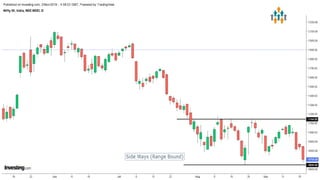
Price Movement
Position on Charts
Rohan Sharma (Coach)
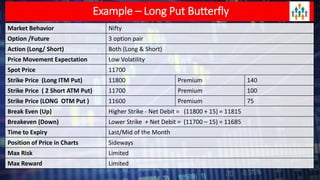
Example – Long Put Butterfly
Market Behavior Nifty
Option /Future 3 option pair
Action (Long/ Short) Both (Long & Short)
Price Movement Expectation Low Volatility
Spot Price 11700
Strike Price (Long ITM Put) 11800 Premium 140
Strike Price ( 2 Short ATM Put) 11700 Premium 100
Strike Price (LONG OTM Put ) 11600 Premium 75
Break Even (Up) Higher Strike - Net Debit = (11800 + 15) = 11815
Breakeven (Down) Lower Strike + Net Debit = (11700 – 15) = 11685
Time to Expiry Last/Mid of the Month
Position of Price in Charts Sideways
Max Risk Limited
Max Reward Limited
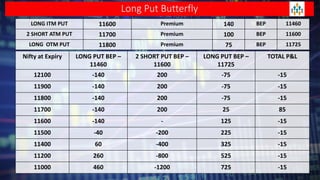
Long Put Butterfly
LONG ITM PUT 11600 Premium 140 BEP 11460
2 SHORT ATM PUT 11700 Premium 100 BEP 11600
LONG OTM PUT 11800 Premium 75 BEP 11725
Nifty at Expiry LONG PUT BEP –
11460
2 SHORT PUT BEP –
11600
LONG PUT BEP –
11725
TOTAL P&L
12100 -140 200 -75 -15
11900 -140 200 -75 -15
11800 -140 200 -75 -15
11700 -140 200 25 85
11600 -140 - 125 -15
11500 -40 -200 225 -15
11400 60 -400 325 -15
11200 260 -800 525 -15
11000 460 -1200 725 -15

Lecture no 46 modified put butterfly

  • 1.
    Lecture No 46 ModifiedPut Butterfly Rohan Sharma (Coach)
  • 2.
    Basics Concepts –Modified Put Butterfly Proficiency - Expert Direction – Bearish Volatility - Low Asset Leg – Long put + 2 Short puts + Long put Max Risk - Limited Max Reward - Limited Capital Gain Strategies
  • 3.
    Description – ModifiedPut Butterfly  The Modified Put Butterfly is identical to the Long put Butterfly with the exception that the distance between the middle and Lower strike puts is closer than that of the higher and middle strikes . The net effect of this is that the position changes to a range bound strategy with a bearish bias.  The Modified Put Butterfly involves a low strike long put, two ATM short puts, and an OTM long put. The resulting position is profitable in the event of range bound or falling action by the stock.  Risk/reward ratio is attractive, the problem remains that the maximum reward is restricted to the scenario where the stock is at the middle strike at expiration.
  • 4.
    Description – ModifiedPut Butterfly Buy one lower strike (OTM) put. Sell two middle strike (ATM) puts. Buy one higher strike (ITM) put. All options share the same expiration date for this strategy. For this strategy, you must use all puts. Remember that the distance between the lower and middle strikes is closer than the distance between the higher and middle strikes. The maximum reward occurs if the stock is at the middle strike at expiration.
  • 5.
    Steps to Tradinga Modified Put Butterfly Steps In Choose from stocks with adequate liquidity, preferably over 500,000 Average Daily Volume (ADV). Try to ensure that the trend is range bound and identify a clear area of support. •Steps Out Manage your position according to the rules defined in your Trading Plan. If the stock falls below your stop loss below the current stock price, then unravel the entire position. You can unravel the position just before expiration—remember to include all the commissions in your calculations.
  • 6.
    Context - ModifiedPut Butterfly Outlook With modified butterflies, your profile is direction neutral to moderately bearish—you expect a moderate rise. Rationale With modified butterflies, you are looking to execute a potentially high yielding trade at very low cost, where your maximum profits occur if the stock finishes at the middle strike price at expiration. You are anticipating moderately low volatility in the stock price.
  • 7.
    Context - ModifiedPut Butterfly Net Position This is a net debit trade, although the net cost is typically low. Your maximum risk is the net debit of the bought and sold options. Your maximum reward is the difference between adjacent strike prices less the net debit.
  • 8.
    Context - ModifiedPut Butterfly Effect of Time Decay Time decay is helpful to this position when it is profitable and harmful when the position is unprofitable. When you enter the trade, typically the stock price will be in the profitable area of the risk profile, so from that perspective, time decay harms the position. Time Period to Trade Month or Less Breakeven [Lower strike + max risk]
  • 9.
    Exiting the Trade- Modified Put Butterfly Exiting the Position  With this strategy, you can simply unravel the spread by buying back the options you sold and selling the options you bought in the first place. Advanced traders may leg up and down or only partially unravel the spread as the underlying asset fluctuates up and down. Mitigating a Loss Unravel the trade as described previously. Advanced traders may choose to only partially unravel the spread leg-by-leg and create alternative risk profiles.
  • 10.
    Advantages and Disadvantages Advantages Profitfrom a range bound stock for very little cost. Capped and low risk. Comparatively high risk/reward ratio if the stock remains range bound. Disadvantages The higher profit potential comes with a narrow range between the wing strikes. The higher profit potential only comes nearer expiration. Bid/Ask Spread can adversely affect the quality of the trade.
  • 11.
  • 12.
    Price Movement Position onCharts Rohan Sharma (Coach)
  • 14.
    Example – LongPut Butterfly Market Behavior Nifty Option /Future 3 option pair Action (Long/ Short) Both (Long & Short) Price Movement Expectation Low Volatility Spot Price 11700 Strike Price (Long ITM Put) 11800 Premium 140 Strike Price ( 2 Short ATM Put) 11700 Premium 100 Strike Price (LONG OTM Put ) 11600 Premium 75 Break Even (Up) Higher Strike - Net Debit = (11800 + 15) = 11815 Breakeven (Down) Lower Strike + Net Debit = (11700 – 15) = 11685 Time to Expiry Last/Mid of the Month Position of Price in Charts Sideways Max Risk Limited Max Reward Limited
  • 15.
    Long Put Butterfly LONGITM PUT 11600 Premium 140 BEP 11460 2 SHORT ATM PUT 11700 Premium 100 BEP 11600 LONG OTM PUT 11800 Premium 75 BEP 11725 Nifty at Expiry LONG PUT BEP – 11460 2 SHORT PUT BEP – 11600 LONG PUT BEP – 11725 TOTAL P&L 12100 -140 200 -75 -15 11900 -140 200 -75 -15 11800 -140 200 -75 -15 11700 -140 200 25 85 11600 -140 - 125 -15 11500 -40 -200 225 -15 11400 60 -400 325 -15 11200 260 -800 525 -15 11000 460 -1200 725 -15