Marketing planning, ads and promotions


Product and Brand Management (23C630)
Ch. 2, Ch. 11 & Ch. 12
September, 20th

Giuseppe Pedeliento, University of Bergamo (Italy)
Visiting Aalto University School of Economics,
Department of Marketing
Ch. 2

MARKETING PLANNING


        2
Marketing Plan


    A marketing plan is a written
      document containing the
     guidelines for the business
    center’s marketing programs
      and allocations over the
         planning period.
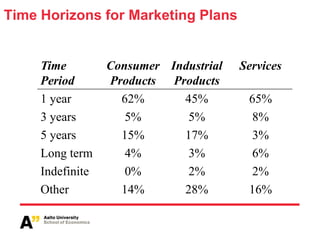
Time Horizons for Marketing Plans


     Time         Consumer Industrial   Services
     Period       Products Products
     1 year         62%      45%         65%
     3 years         5%       5%         8%
     5 years        15%      17%         3%
     Long term       4%       3%         6%
     Indefinite      0%       2%         2%
     Other          14%      28%         16%
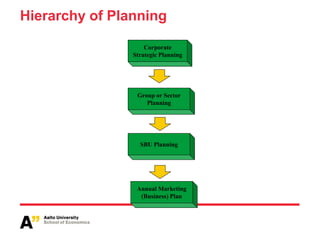
Hierarchy of Planning

                    Corporate
                Strategic Planning


                 Group or Sector
                    Planning


                  SBU Planning


                 Annual Marketing
                  (Business) Plan
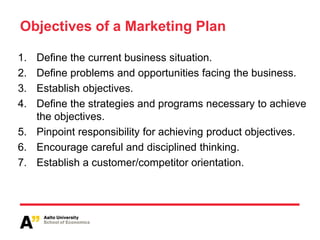
Objectives of a Marketing Plan

1. Define the current business situation.
2. Define problems and opportunities facing the business.
3. Establish objectives.
4. Define the strategies and programs necessary to achieve
   the objectives.
5. Pinpoint responsibility for achieving product objectives.
6. Encourage careful and disciplined thinking.
7. Establish a customer/competitor orientation.
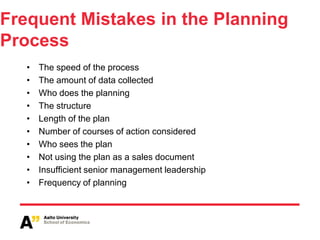
Frequent Mistakes in the Planning
Process
   •   The speed of the process
   •   The amount of data collected
   •   Who does the planning
   •   The structure
   •   Length of the plan
   •   Number of courses of action considered
   •   Who sees the plan
   •   Not using the plan as a sales document
   •   Insufficient senior management leadership
   •   Frequency of planning
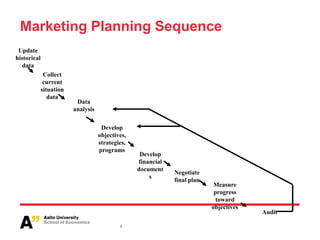
Marketing Planning Sequence
 Update
historical
   data
              Collect
              current
             situation
                data
                          Data
                         analysis

                                     Develop
                                    objectives,
                                    strategies,
                                    programs
                                                   Develop
                                                  financial
                                                  document
                                                              Negotiate
                                                      s
                                                              final plan
                                                                            Measure
                                                                            progress
                                                                             toward
                                                                           objectives
                                                                                        Audit

                                            8
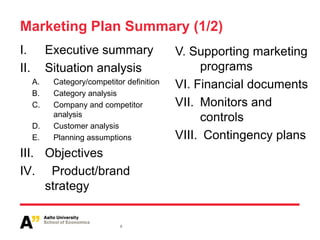
Marketing Plan Summary (1/2)
I.         Executive summary                 V. Supporting marketing
II.        Situation analysis                     programs
      A.    Category/competitor definition   VI. Financial documents
      B.    Category analysis
      C.    Company and competitor           VII. Monitors and
            analysis
                                                  controls
      D.    Customer analysis
      E.    Planning assumptions             VIII. Contingency plans
III. Objectives
IV. Product/brand
     strategy


                              9
Ch. 11

ADVERTISING DECISIONS


         10
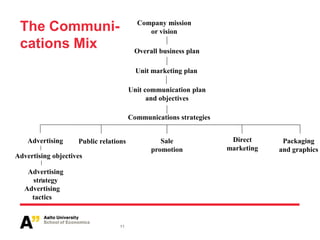
Company mission
 The Communi-                               or vision

 cations Mix                            Overall business plan

                                         Unit marketing plan

                                       Unit communication plan
                                             and objectives

                                       Communications strategies


    Advertising     Public relations             Sale               Direct      Packaging
                                              promotion            marketing   and graphics
Advertising objectives

    Advertising
     strategy
   Advertising
     tactics


                                  11
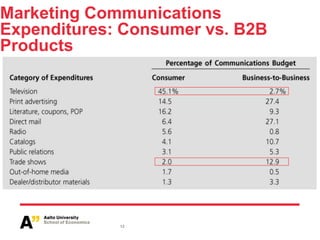
Marketing Communications
Expenditures: Consumer vs. B2B
Products


             12
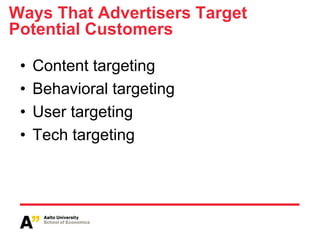
Ways That Advertisers Target
Potential Customers

 •   Content targeting
 •   Behavioral targeting
 •   User targeting
 •   Tech targeting
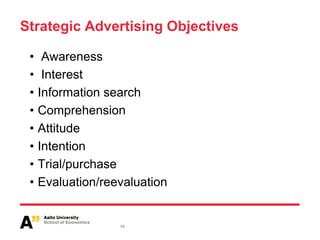
Strategic Advertising Objectives

 •    Awareness
 •    Interest
 •   Information search
 •   Comprehension
 •   Attitude
 •   Intention
 •   Trial/purchase
 •   Evaluation/reevaluation


                   14
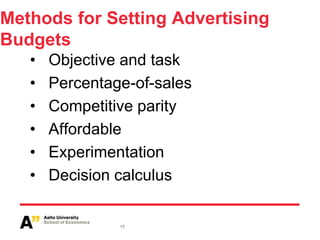
Methods for Setting Advertising
Budgets
   •   Objective and task
   •   Percentage-of-sales
   •   Competitive parity
   •   Affordable
   •   Experimentation
   •   Decision calculus

                15
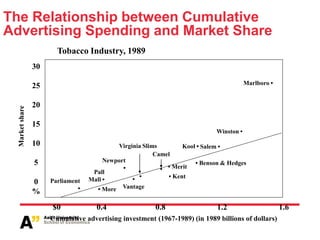
The Relationship between Cumulative
Advertising Spending and Market Share
          Tobacco Industry, 1989
   30

                                                                           Marlboro •
   25

   20

   15
                                                               Winston •
   10                         Virginia Slims        Kool • Salem •
                                           Camel
    5                     Newport                       • Benson & Hedges
                                •            • • Merit
                      Pall
   0    Parliament   Mall •        • •         • Kent

   %             •     • More Vantage

        $0             0.4                 0.8                 1.2                      1.6
        Cumulative advertising investment (1967-1989) (in 1989 billions of dollars)
Ch. 12

PROMOTIONS


         17
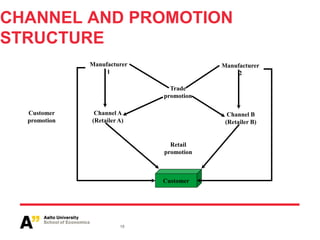
CHANNEL AND PROMOTION
STRUCTURE
              Manufacturer               Manufacturer
                   1                          2

                               Trade
                             promotion

  Customer     Channel A                   Channel B
  promotion   (Retailer A)                (Retailer B)


                               Retail
                             promotion


                             Customer


                        18
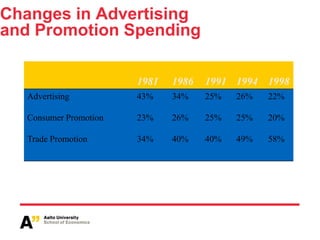
Changes in Advertising
and Promotion Spending

                       1981   1986   1991 1994 1998
  Advertising          43%    34%    25%   26%   22%

  Consumer Promotion   23%    26%    25%   25%   20%

  Trade Promotion      34%    40%    40%   49%   58%
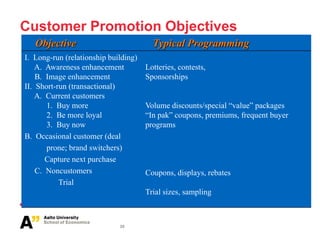
Customer Promotion Objectives
   Objective                            Typical Programming
I. Long-run (relationship building)
    A. Awareness enhancement          Lotteries, contests,
    B. Image enhancement              Sponsorships
II. Short-run (transactional)
    A. Current customers
       1. Buy more                    Volume discounts/special “value” packages
       2. Be more loyal               “In pak” coupons, premiums, frequent buyer
       3. Buy now                     programs
B. Occasional customer (deal
       prone; brand switchers)
       Capture next purchase
    C. Noncustomers                   Coupons, displays, rebates
           Trial
                                      Trial sizes, sampling


                             20
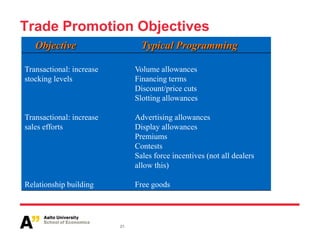
Trade Promotion Objectives
   Objective                     Typical Programming

Transactional: increase        Volume allowances
stocking levels                Financing terms
                               Discount/price cuts
                               Slotting allowances

Transactional: increase        Advertising allowances
sales efforts                  Display allowances
                               Premiums
                               Contests
                               Sales force incentives (not all dealers
                               allow this)

Relationship building          Free goods


                          21
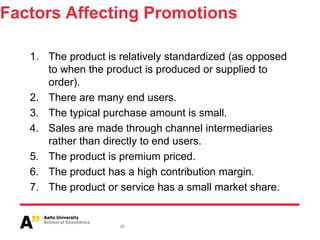
Factors Affecting Promotions

   1. The product is relatively standardized (as opposed
      to when the product is produced or supplied to
      order).
   2. There are many end users.
   3. The typical purchase amount is small.
   4. Sales are made through channel intermediaries
      rather than directly to end users.
   5. The product is premium priced.
   6. The product has a high contribution margin.
   7. The product or service has a small market share.


                     22
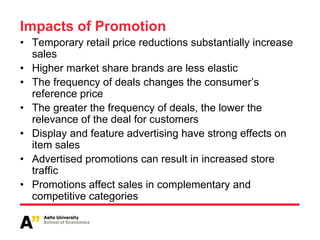
Impacts of Promotion
• Temporary retail price reductions substantially increase
  sales
• Higher market share brands are less elastic
• The frequency of deals changes the consumer’s
  reference price
• The greater the frequency of deals, the lower the
  relevance of the deal for customers
• Display and feature advertising have strong effects on
  item sales
• Advertised promotions can result in increased store
  traffic
• Promotions affect sales in complementary and
  competitive categories
Marketing planning, ads and promotions


Product and Brand Management (23C630)
Ch. 2, Ch. 11 & Ch. 12
September, 20th

Giuseppe Pedeliento, University of Bergamo (Italy)
Visiting Aalto University School of Economics,
Department of Marketing

Lecture Four

  • 1.
    Marketing planning, adsand promotions Product and Brand Management (23C630) Ch. 2, Ch. 11 & Ch. 12 September, 20th Giuseppe Pedeliento, University of Bergamo (Italy) Visiting Aalto University School of Economics, Department of Marketing
  • 2.
  • 3.
    Marketing Plan A marketing plan is a written document containing the guidelines for the business center’s marketing programs and allocations over the planning period.
  • 4.
    Time Horizons forMarketing Plans Time Consumer Industrial Services Period Products Products 1 year 62% 45% 65% 3 years 5% 5% 8% 5 years 15% 17% 3% Long term 4% 3% 6% Indefinite 0% 2% 2% Other 14% 28% 16%
  • 5.
    Hierarchy of Planning Corporate Strategic Planning Group or Sector Planning SBU Planning Annual Marketing (Business) Plan
  • 6.
    Objectives of aMarketing Plan 1. Define the current business situation. 2. Define problems and opportunities facing the business. 3. Establish objectives. 4. Define the strategies and programs necessary to achieve the objectives. 5. Pinpoint responsibility for achieving product objectives. 6. Encourage careful and disciplined thinking. 7. Establish a customer/competitor orientation.
  • 7.
    Frequent Mistakes inthe Planning Process • The speed of the process • The amount of data collected • Who does the planning • The structure • Length of the plan • Number of courses of action considered • Who sees the plan • Not using the plan as a sales document • Insufficient senior management leadership • Frequency of planning
  • 8.
    Marketing Planning Sequence Update historical data Collect current situation data Data analysis Develop objectives, strategies, programs Develop financial document Negotiate s final plan Measure progress toward objectives Audit 8
  • 9.
    Marketing Plan Summary(1/2) I. Executive summary V. Supporting marketing II. Situation analysis programs A. Category/competitor definition VI. Financial documents B. Category analysis C. Company and competitor VII. Monitors and analysis controls D. Customer analysis E. Planning assumptions VIII. Contingency plans III. Objectives IV. Product/brand strategy 9
  • 10.
  • 11.
    Company mission TheCommuni- or vision cations Mix Overall business plan Unit marketing plan Unit communication plan and objectives Communications strategies Advertising Public relations Sale Direct Packaging promotion marketing and graphics Advertising objectives Advertising strategy Advertising tactics 11
  • 12.
  • 13.
    Ways That AdvertisersTarget Potential Customers • Content targeting • Behavioral targeting • User targeting • Tech targeting
  • 14.
    Strategic Advertising Objectives • Awareness • Interest • Information search • Comprehension • Attitude • Intention • Trial/purchase • Evaluation/reevaluation 14
  • 15.
    Methods for SettingAdvertising Budgets • Objective and task • Percentage-of-sales • Competitive parity • Affordable • Experimentation • Decision calculus 15
  • 16.
    The Relationship betweenCumulative Advertising Spending and Market Share Tobacco Industry, 1989 30 Marlboro • 25 20 15 Winston • 10 Virginia Slims Kool • Salem • Camel 5 Newport • Benson & Hedges • • • Merit Pall 0 Parliament Mall • • • • Kent % • • More Vantage $0 0.4 0.8 1.2 1.6 Cumulative advertising investment (1967-1989) (in 1989 billions of dollars)
  • 17.
  • 18.
    CHANNEL AND PROMOTION STRUCTURE Manufacturer Manufacturer 1 2 Trade promotion Customer Channel A Channel B promotion (Retailer A) (Retailer B) Retail promotion Customer 18
  • 19.
    Changes in Advertising andPromotion Spending 1981 1986 1991 1994 1998 Advertising 43% 34% 25% 26% 22% Consumer Promotion 23% 26% 25% 25% 20% Trade Promotion 34% 40% 40% 49% 58%
  • 20.
    Customer Promotion Objectives Objective Typical Programming I. Long-run (relationship building) A. Awareness enhancement Lotteries, contests, B. Image enhancement Sponsorships II. Short-run (transactional) A. Current customers 1. Buy more Volume discounts/special “value” packages 2. Be more loyal “In pak” coupons, premiums, frequent buyer 3. Buy now programs B. Occasional customer (deal prone; brand switchers) Capture next purchase C. Noncustomers Coupons, displays, rebates Trial Trial sizes, sampling 20
  • 21.
    Trade Promotion Objectives Objective Typical Programming Transactional: increase Volume allowances stocking levels Financing terms Discount/price cuts Slotting allowances Transactional: increase Advertising allowances sales efforts Display allowances Premiums Contests Sales force incentives (not all dealers allow this) Relationship building Free goods 21
  • 22.
    Factors Affecting Promotions 1. The product is relatively standardized (as opposed to when the product is produced or supplied to order). 2. There are many end users. 3. The typical purchase amount is small. 4. Sales are made through channel intermediaries rather than directly to end users. 5. The product is premium priced. 6. The product has a high contribution margin. 7. The product or service has a small market share. 22
  • 23.
    Impacts of Promotion •Temporary retail price reductions substantially increase sales • Higher market share brands are less elastic • The frequency of deals changes the consumer’s reference price • The greater the frequency of deals, the lower the relevance of the deal for customers • Display and feature advertising have strong effects on item sales • Advertised promotions can result in increased store traffic • Promotions affect sales in complementary and competitive categories
  • 24.
    Marketing planning, adsand promotions Product and Brand Management (23C630) Ch. 2, Ch. 11 & Ch. 12 September, 20th Giuseppe Pedeliento, University of Bergamo (Italy) Visiting Aalto University School of Economics, Department of Marketing