Financial statements, taxes and
cash flow
Chapter 2
Key concepts and skills
• Know the difference between book value
and market value
• Know the difference between accounting
income and cash flow
• Know the difference between average and
marginal tax rates
• Know how to determine a firm’s cash flow
from its financial statements
2-2
Copyright © 2011 McGraw-Hill Australia Pty Ltd
PPTs t/a Essentials of Corporate Finance 2e by Ross et al.
Slides prepared by David E. Allen and Abhay K. Singh
Chapter outline
• The balance sheet
• The income statement
• Taxes
• Cash flow
2-3
Copyright ©2011 McGraw-Hill Australia Pty Ltd
PPTs t/a Essentials of Corporate Finance 2e by Ross et al.
Slides prepared by David E. Allen and Abhay K. Singh
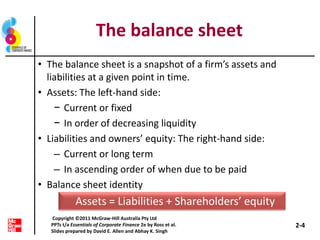
The balance sheet
• The balance sheet is a snapshot of a firm’s assets and
liabilities at a given point in time.
• Assets: The left-hand side:
− Current or fixed
− In order of decreasing liquidity
• Liabilities and owners’ equity: The right-hand side:
– Current or long term
– In ascending order of when due to be paid
• Balance sheet identity
Assets = Liabilities + Shareholders’ equity
2-4
Copyright ©2011 McGraw-Hill Australia Pty Ltd
PPTs t/a Essentials of Corporate Finance 2e by Ross et al.
Slides prepared by David E. Allen and Abhay K. Singh
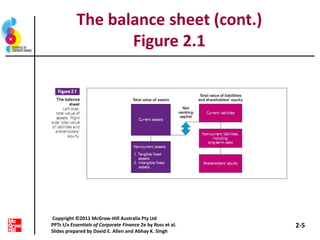
The balance sheet (cont.)
Figure 2.1
2-5
Copyright ©2011 McGraw-Hill Australia Pty Ltd
PPTs t/a Essentials of Corporate Finance 2e by Ross et al.
Slides prepared by David E. Allen and Abhay K. Singh
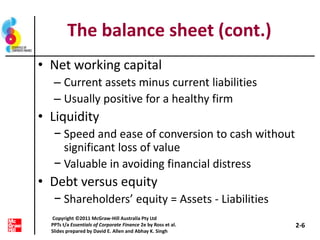
The balance sheet (cont.)
• Net working capital
– Current assets minus current liabilities
– Usually positive for a healthy firm
• Liquidity
− Speed and ease of conversion to cash without
significant loss of value
− Valuable in avoiding financial distress
• Debt versus equity
− Shareholders’ equity = Assets - Liabilities
2-6
Copyright ©2011 McGraw-Hill Australia Pty Ltd
PPTs t/a Essentials of Corporate Finance 2e by Ross et al.
Slides prepared by David E. Allen and Abhay K. Singh
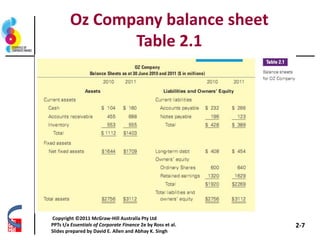
Oz Company balance sheet
Table 2.1
2-7
Copyright ©2011 McGraw-Hill Australia Pty Ltd
PPTs t/a Essentials of Corporate Finance 2e by Ross et al.
Slides prepared by David E. Allen and Abhay K. Singh
Market value vs book value
• Market value is the price at which assets,
liabilities or equity can actually be bought
or sold.
• The balance sheet provides the book value
of assets, liabilities and equity.
• Market value and book value are often very
different. Why?
• Which is more important to the decision-
making process?
2-8
Copyright © 2011 McGraw-Hill Australia Pty Ltd
PPTs t/a Essentials of Corporate Finance 2e by Ross et al.
Slides prepared by David E. Allen and Abhay K. Singh
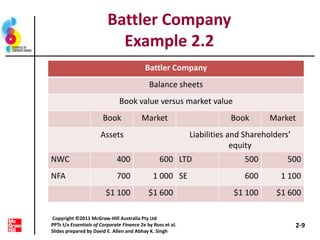
Battler Company
Example 2.2
Battler Company
Balance sheets
Book value versus market value
Book Market Book Market
Assets Liabilities and Shareholders’
equity
NWC 400 600 LTD 500 500
NFA 700 1 000 SE 600 1 100
$1 100 $1 600 $1 100 $1 600
2-9
Copyright ©2011 McGraw-Hill Australia Pty Ltd
PPTs t/a Essentials of Corporate Finance 2e by Ross et al.
Slides prepared by David E. Allen and Abhay K. Singh
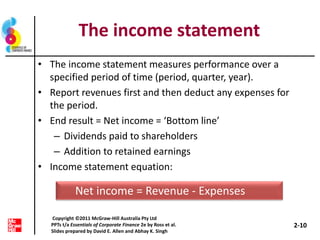
The income statement
• The income statement measures performance over a
specified period of time (period, quarter, year).
• Report revenues first and then deduct any expenses for
the period.
• End result = Net income = ‘Bottom line’
– Dividends paid to shareholders
– Addition to retained earnings
• Income statement equation:
Net income = Revenue - Expenses
2-10
Copyright ©2011 McGraw-Hill Australia Pty Ltd
PPTs t/a Essentials of Corporate Finance 2e by Ross et al.
Slides prepared by David E. Allen and Abhay K. Singh
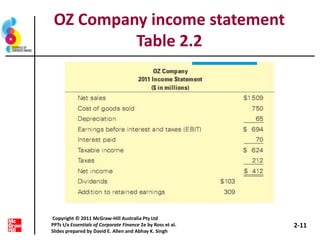
OZ Company income statement
Table 2.2
2-11
Copyright © 2011 McGraw-Hill Australia Pty Ltd
PPTs t/a Essentials of Corporate Finance 2e by Ross et al.
Slides prepared by David E. Allen and Abhay K. Singh
The income statement (cont.)
• AAS and the income statement
– The matching principle
• Recognise revenue when it is fully earned.
• Matching expenses required to generate
revenue to the period of recognition
• Non-cash items
– Expenses charged against revenue that do
not affect cash flow.
– Most important of these is depreciation.
2-12
Copyright © 2011 McGraw-Hill Australia Pty Ltd
PPTs t/a Essentials of Corporate Finance 2e by Ross et al.
Slides prepared by David E. Allen and Abhay K. Singh
The income statement (cont.)
• Time and costs
– Fixed or variable costs
– Not obvious on income statement
• Earnings management
–Smoothing earnings
–Wriggle room
2-13
Copyright © 2011 McGraw-Hill Australia Pty Ltd
PPTs t/a Essentials of Corporate Finance 2e by Ross et al.
Slides prepared by David E. Allen and Abhay K. Singh
Example: Work the Web
• Most Australian companies post their
annual reports on their websites. Look for
them in the investor or shareholder areas.
• Go to companies’ websites and see what
kinds of financial reports you can find.
• Example: Virgin Blue
2-14
Copyright ©2011 McGraw-Hill Australia Pty Ltd
PPTs t/a Essentials of Corporate Finance 2e by Ross et al.
Slides prepared by David E. Allen and Abhay K. Singh
Taxes
• The one thing we can rely on with taxes is that they
are always changing.
• Tax bill depends on tax code, which can be
amended by political will.
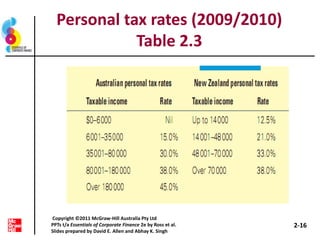
• Corporate tax in Australia and New Zealand
– Flat rate tax (currently 30%)
• Marginal vs average tax rates
– Marginal–the percentage paid on the next dollar
earned
– Average–the tax bill/taxable income
• Other taxes
2-15
Copyright ©2011 McGraw-Hill Australia Pty Ltd
PPTs t/a Essentials of Corporate Finance 2e by Ross et al.
Slides prepared by David E. Allen and Abhay K. Singh
Personal tax rates (2009/2010)
Table 2.3
2-16
Copyright ©2011 McGraw-Hill Australia Pty Ltd
PPTs t/a Essentials of Corporate Finance 2e by Ross et al.
Slides prepared by David E. Allen and Abhay K. Singh
Example: Marginal vs average tax
rates
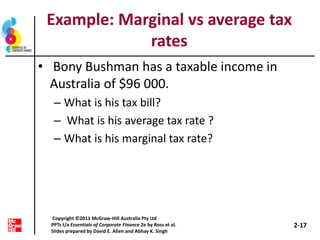
• Bony Bushman has a taxable income in
Australia of $96 000.
– What is his tax bill?
– What is his average tax rate ?
– What is his marginal tax rate?
2-17
Copyright ©2011 McGraw-Hill Australia Pty Ltd
PPTs t/a Essentials of Corporate Finance 2e by Ross et al.
Slides prepared by David E. Allen and Abhay K. Singh
Example: Marginal vs average tax
rates
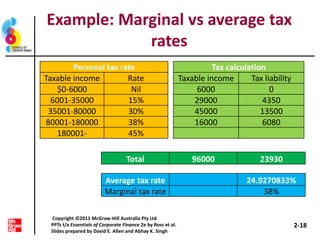
Total 96000 23930
Average tax rate 24.9270833%
Marginal tax rate 38%
Personal tax rate
Taxable income Rate
$0-6000 Nil
6001-35000 15%
35001-80000 30%
80001-180000 38%
180001- 45%
Tax calculation
Taxable income Tax liability
6000 0
29000 4350
45000 13500
16000 6080
2-18
Copyright ©2011 McGraw-Hill Australia Pty Ltd
PPTs t/a Essentials of Corporate Finance 2e by Ross et al.
Slides prepared by David E. Allen and Abhay K. Singh
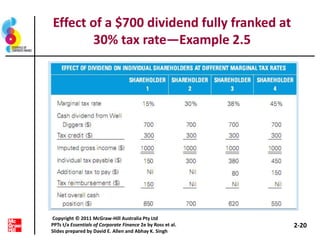
Taxation of dividends:
An imputation system
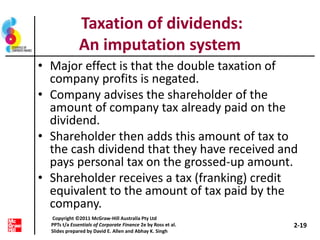
• Major effect is that the double taxation of
company profits is negated.
• Company advises the shareholder of the
amount of company tax already paid on the
dividend.
• Shareholder then adds this amount of tax to
the cash dividend that they have received and
pays personal tax on the grossed-up amount.
• Shareholder receives a tax (franking) credit
equivalent to the amount of tax paid by the
company.
2-19
Copyright ©2011 McGraw-Hill Australia Pty Ltd
PPTs t/a Essentials of Corporate Finance 2e by Ross et al.
Slides prepared by David E. Allen and Abhay K. Singh
Effect of a $700 dividend fully franked at
30% tax rate—Example 2.5
2-20
Copyright © 2011 McGraw-Hill Australia Pty Ltd
PPTs t/a Essentials of Corporate Finance 2e by Ross et al.
Slides prepared by David E. Allen and Abhay K. Singh
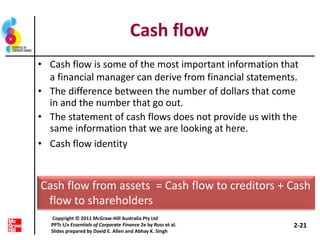
Cash flow
• Cash flow is some of the most important information that
a financial manager can derive from financial statements.
• The difference between the number of dollars that come
in and the number that go out.
• The statement of cash flows does not provide us with the
same information that we are looking at here.
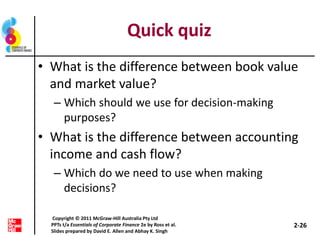
• Cash flow identity
Cash flow from assets = Cash flow to creditors + Cash
flow to shareholders
2-21
Copyright © 2011 McGraw-Hill Australia Pty Ltd
PPTs t/a Essentials of Corporate Finance 2e by Ross et al.
Slides prepared by David E. Allen and Abhay K. Singh
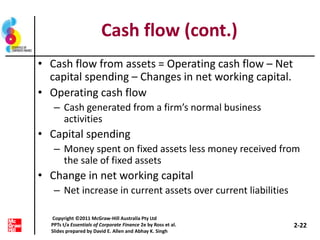
Cash flow (cont.)
• Cash flow from assets = Operating cash flow – Net
capital spending – Changes in net working capital.
• Operating cash flow
– Cash generated from a firm’s normal business
activities
• Capital spending
– Money spent on fixed assets less money received from
the sale of fixed assets
• Change in net working capital
– Net increase in current assets over current liabilities
2-22
Copyright ©2011 McGraw-Hill Australia Pty Ltd
PPTs t/a Essentials of Corporate Finance 2e by Ross et al.
Slides prepared by David E. Allen and Abhay K. Singh
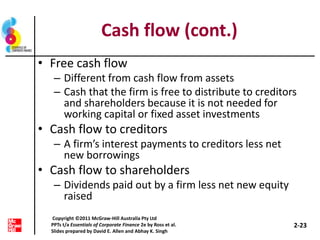
Cash flow (cont.)
• Free cash flow
– Different from cash flow from assets
– Cash that the firm is free to distribute to creditors
and shareholders because it is not needed for
working capital or fixed asset investments
• Cash flow to creditors
– A firm’s interest payments to creditors less net
new borrowings
• Cash flow to shareholders
– Dividends paid out by a firm less net new equity
raised
2-23
Copyright ©2011 McGraw-Hill Australia Pty Ltd
PPTs t/a Essentials of Corporate Finance 2e by Ross et al.
Slides prepared by David E. Allen and Abhay K. Singh
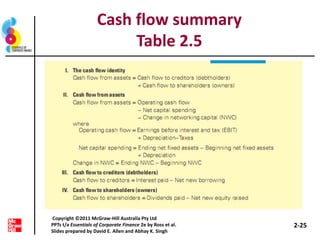
OZ Company example
• OCF (I/S) = EBIT + Depreciation – Taxes = $547
• NCS (B/S and I/S) = Ending net fixed assets –
Beginning net fixed assets + Depreciation = $130
• Changes in NWC (B/S) = Ending NWC – Beginning
NWC = $330
• CFFA = 547 – 130 – 330 = $87
• CF to creditors (B/S and I/S) = Interest paid – Net
new borrowings = $24
• CF to stockholders (B/S and I/S) = Dividends paid –
Net new equity raised = $63
• CFFA = 24 + 63 = $87
2-24
Copyright © 2011 McGraw-Hill Australia Pty Ltd
PPTs t/a Essentials of Corporate Finance 2e by Ross et al.
Slides prepared by David E. Allen and Abhay K. Singh
Cash flow summary
Table 2.5
2-25
Copyright ©2011 McGraw-Hill Australia Pty Ltd
PPTs t/a Essentials of Corporate Finance 2e by Ross et al.
Slides prepared by David E. Allen and Abhay K. Singh
Quick quiz
• What is the difference between book value
and market value?
– Which should we use for decision-making
purposes?
• What is the difference between accounting
income and cash flow?
– Which do we need to use when making
decisions?
2-26
Copyright © 2011 McGraw-Hill Australia Pty Ltd
PPTs t/a Essentials of Corporate Finance 2e by Ross et al.
Slides prepared by David E. Allen and Abhay K. Singh
Quick quiz (cont.)
• What is the difference between average
and marginal tax rates?
– Which should we use when making financial
decisions?
• How do we determine a firm’s cash flows?
– What are the equations and where do we find
the information?
2-27
Copyright ©2011 McGraw-Hill Australia Pty Ltd
PPTs t/a Essentials of Corporate Finance 2e by Ross et al.
Slides prepared by David E. Allen and Abhay K. Singh
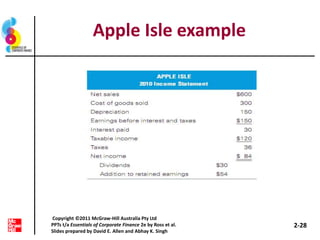
Apple Isle example
2-28
Copyright ©2011 McGraw-Hill Australia Pty Ltd
PPTs t/a Essentials of Corporate Finance 2e by Ross et al.
Slides prepared by David E. Allen and Abhay K. Singh
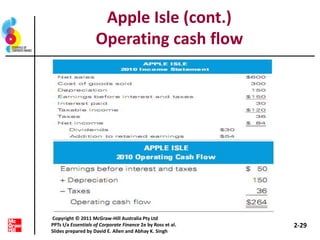
Apple Isle (cont.)
Operating cash flow
2-29
Copyright © 2011 McGraw-Hill Australia Pty Ltd
PPTs t/a Essentials of Corporate Finance 2e by Ross et al.
Slides prepared by David E. Allen and Abhay K. Singh
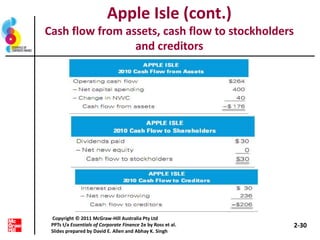
Apple Isle (cont.)
Cash flow from assets, cash flow to stockholders
and creditors
2-30
Copyright © 2011 McGraw-Hill Australia Pty Ltd
PPTs t/a Essentials of Corporate Finance 2e by Ross et al.
Slides prepared by David E. Allen and Abhay K. Singh
Chapter 2
END
2-31

CHAPTER 2 PPT.ppt

  • 1.
    Financial statements, taxesand cash flow Chapter 2
  • 2.
    Key concepts andskills • Know the difference between book value and market value • Know the difference between accounting income and cash flow • Know the difference between average and marginal tax rates • Know how to determine a firm’s cash flow from its financial statements 2-2 Copyright © 2011 McGraw-Hill Australia Pty Ltd PPTs t/a Essentials of Corporate Finance 2e by Ross et al. Slides prepared by David E. Allen and Abhay K. Singh
  • 3.
    Chapter outline • Thebalance sheet • The income statement • Taxes • Cash flow 2-3 Copyright ©2011 McGraw-Hill Australia Pty Ltd PPTs t/a Essentials of Corporate Finance 2e by Ross et al. Slides prepared by David E. Allen and Abhay K. Singh
  • 4.
    The balance sheet •The balance sheet is a snapshot of a firm’s assets and liabilities at a given point in time. • Assets: The left-hand side: − Current or fixed − In order of decreasing liquidity • Liabilities and owners’ equity: The right-hand side: – Current or long term – In ascending order of when due to be paid • Balance sheet identity Assets = Liabilities + Shareholders’ equity 2-4 Copyright ©2011 McGraw-Hill Australia Pty Ltd PPTs t/a Essentials of Corporate Finance 2e by Ross et al. Slides prepared by David E. Allen and Abhay K. Singh
  • 5.
    The balance sheet(cont.) Figure 2.1 2-5 Copyright ©2011 McGraw-Hill Australia Pty Ltd PPTs t/a Essentials of Corporate Finance 2e by Ross et al. Slides prepared by David E. Allen and Abhay K. Singh
  • 6.
    The balance sheet(cont.) • Net working capital – Current assets minus current liabilities – Usually positive for a healthy firm • Liquidity − Speed and ease of conversion to cash without significant loss of value − Valuable in avoiding financial distress • Debt versus equity − Shareholders’ equity = Assets - Liabilities 2-6 Copyright ©2011 McGraw-Hill Australia Pty Ltd PPTs t/a Essentials of Corporate Finance 2e by Ross et al. Slides prepared by David E. Allen and Abhay K. Singh
  • 7.
    Oz Company balancesheet Table 2.1 2-7 Copyright ©2011 McGraw-Hill Australia Pty Ltd PPTs t/a Essentials of Corporate Finance 2e by Ross et al. Slides prepared by David E. Allen and Abhay K. Singh
  • 8.
    Market value vsbook value • Market value is the price at which assets, liabilities or equity can actually be bought or sold. • The balance sheet provides the book value of assets, liabilities and equity. • Market value and book value are often very different. Why? • Which is more important to the decision- making process? 2-8 Copyright © 2011 McGraw-Hill Australia Pty Ltd PPTs t/a Essentials of Corporate Finance 2e by Ross et al. Slides prepared by David E. Allen and Abhay K. Singh
  • 9.
    Battler Company Example 2.2 BattlerCompany Balance sheets Book value versus market value Book Market Book Market Assets Liabilities and Shareholders’ equity NWC 400 600 LTD 500 500 NFA 700 1 000 SE 600 1 100 $1 100 $1 600 $1 100 $1 600 2-9 Copyright ©2011 McGraw-Hill Australia Pty Ltd PPTs t/a Essentials of Corporate Finance 2e by Ross et al. Slides prepared by David E. Allen and Abhay K. Singh
  • 10.
    The income statement •The income statement measures performance over a specified period of time (period, quarter, year). • Report revenues first and then deduct any expenses for the period. • End result = Net income = ‘Bottom line’ – Dividends paid to shareholders – Addition to retained earnings • Income statement equation: Net income = Revenue - Expenses 2-10 Copyright ©2011 McGraw-Hill Australia Pty Ltd PPTs t/a Essentials of Corporate Finance 2e by Ross et al. Slides prepared by David E. Allen and Abhay K. Singh
  • 11.
    OZ Company incomestatement Table 2.2 2-11 Copyright © 2011 McGraw-Hill Australia Pty Ltd PPTs t/a Essentials of Corporate Finance 2e by Ross et al. Slides prepared by David E. Allen and Abhay K. Singh
  • 12.
    The income statement(cont.) • AAS and the income statement – The matching principle • Recognise revenue when it is fully earned. • Matching expenses required to generate revenue to the period of recognition • Non-cash items – Expenses charged against revenue that do not affect cash flow. – Most important of these is depreciation. 2-12 Copyright © 2011 McGraw-Hill Australia Pty Ltd PPTs t/a Essentials of Corporate Finance 2e by Ross et al. Slides prepared by David E. Allen and Abhay K. Singh
  • 13.
    The income statement(cont.) • Time and costs – Fixed or variable costs – Not obvious on income statement • Earnings management –Smoothing earnings –Wriggle room 2-13 Copyright © 2011 McGraw-Hill Australia Pty Ltd PPTs t/a Essentials of Corporate Finance 2e by Ross et al. Slides prepared by David E. Allen and Abhay K. Singh
  • 14.
    Example: Work theWeb • Most Australian companies post their annual reports on their websites. Look for them in the investor or shareholder areas. • Go to companies’ websites and see what kinds of financial reports you can find. • Example: Virgin Blue 2-14 Copyright ©2011 McGraw-Hill Australia Pty Ltd PPTs t/a Essentials of Corporate Finance 2e by Ross et al. Slides prepared by David E. Allen and Abhay K. Singh
  • 15.
    Taxes • The onething we can rely on with taxes is that they are always changing. • Tax bill depends on tax code, which can be amended by political will. • Corporate tax in Australia and New Zealand – Flat rate tax (currently 30%) • Marginal vs average tax rates – Marginal–the percentage paid on the next dollar earned – Average–the tax bill/taxable income • Other taxes 2-15 Copyright ©2011 McGraw-Hill Australia Pty Ltd PPTs t/a Essentials of Corporate Finance 2e by Ross et al. Slides prepared by David E. Allen and Abhay K. Singh
  • 16.
    Personal tax rates(2009/2010) Table 2.3 2-16 Copyright ©2011 McGraw-Hill Australia Pty Ltd PPTs t/a Essentials of Corporate Finance 2e by Ross et al. Slides prepared by David E. Allen and Abhay K. Singh
  • 17.
    Example: Marginal vsaverage tax rates • Bony Bushman has a taxable income in Australia of $96 000. – What is his tax bill? – What is his average tax rate ? – What is his marginal tax rate? 2-17 Copyright ©2011 McGraw-Hill Australia Pty Ltd PPTs t/a Essentials of Corporate Finance 2e by Ross et al. Slides prepared by David E. Allen and Abhay K. Singh
  • 18.
    Example: Marginal vsaverage tax rates Total 96000 23930 Average tax rate 24.9270833% Marginal tax rate 38% Personal tax rate Taxable income Rate $0-6000 Nil 6001-35000 15% 35001-80000 30% 80001-180000 38% 180001- 45% Tax calculation Taxable income Tax liability 6000 0 29000 4350 45000 13500 16000 6080 2-18 Copyright ©2011 McGraw-Hill Australia Pty Ltd PPTs t/a Essentials of Corporate Finance 2e by Ross et al. Slides prepared by David E. Allen and Abhay K. Singh
  • 19.
    Taxation of dividends: Animputation system • Major effect is that the double taxation of company profits is negated. • Company advises the shareholder of the amount of company tax already paid on the dividend. • Shareholder then adds this amount of tax to the cash dividend that they have received and pays personal tax on the grossed-up amount. • Shareholder receives a tax (franking) credit equivalent to the amount of tax paid by the company. 2-19 Copyright ©2011 McGraw-Hill Australia Pty Ltd PPTs t/a Essentials of Corporate Finance 2e by Ross et al. Slides prepared by David E. Allen and Abhay K. Singh
  • 20.
    Effect of a$700 dividend fully franked at 30% tax rate—Example 2.5 2-20 Copyright © 2011 McGraw-Hill Australia Pty Ltd PPTs t/a Essentials of Corporate Finance 2e by Ross et al. Slides prepared by David E. Allen and Abhay K. Singh
  • 21.
    Cash flow • Cashflow is some of the most important information that a financial manager can derive from financial statements. • The difference between the number of dollars that come in and the number that go out. • The statement of cash flows does not provide us with the same information that we are looking at here. • Cash flow identity Cash flow from assets = Cash flow to creditors + Cash flow to shareholders 2-21 Copyright © 2011 McGraw-Hill Australia Pty Ltd PPTs t/a Essentials of Corporate Finance 2e by Ross et al. Slides prepared by David E. Allen and Abhay K. Singh
  • 22.
    Cash flow (cont.) •Cash flow from assets = Operating cash flow – Net capital spending – Changes in net working capital. • Operating cash flow – Cash generated from a firm’s normal business activities • Capital spending – Money spent on fixed assets less money received from the sale of fixed assets • Change in net working capital – Net increase in current assets over current liabilities 2-22 Copyright ©2011 McGraw-Hill Australia Pty Ltd PPTs t/a Essentials of Corporate Finance 2e by Ross et al. Slides prepared by David E. Allen and Abhay K. Singh
  • 23.
    Cash flow (cont.) •Free cash flow – Different from cash flow from assets – Cash that the firm is free to distribute to creditors and shareholders because it is not needed for working capital or fixed asset investments • Cash flow to creditors – A firm’s interest payments to creditors less net new borrowings • Cash flow to shareholders – Dividends paid out by a firm less net new equity raised 2-23 Copyright ©2011 McGraw-Hill Australia Pty Ltd PPTs t/a Essentials of Corporate Finance 2e by Ross et al. Slides prepared by David E. Allen and Abhay K. Singh
  • 24.
    OZ Company example •OCF (I/S) = EBIT + Depreciation – Taxes = $547 • NCS (B/S and I/S) = Ending net fixed assets – Beginning net fixed assets + Depreciation = $130 • Changes in NWC (B/S) = Ending NWC – Beginning NWC = $330 • CFFA = 547 – 130 – 330 = $87 • CF to creditors (B/S and I/S) = Interest paid – Net new borrowings = $24 • CF to stockholders (B/S and I/S) = Dividends paid – Net new equity raised = $63 • CFFA = 24 + 63 = $87 2-24 Copyright © 2011 McGraw-Hill Australia Pty Ltd PPTs t/a Essentials of Corporate Finance 2e by Ross et al. Slides prepared by David E. Allen and Abhay K. Singh
  • 25.
    Cash flow summary Table2.5 2-25 Copyright ©2011 McGraw-Hill Australia Pty Ltd PPTs t/a Essentials of Corporate Finance 2e by Ross et al. Slides prepared by David E. Allen and Abhay K. Singh
  • 26.
    Quick quiz • Whatis the difference between book value and market value? – Which should we use for decision-making purposes? • What is the difference between accounting income and cash flow? – Which do we need to use when making decisions? 2-26 Copyright © 2011 McGraw-Hill Australia Pty Ltd PPTs t/a Essentials of Corporate Finance 2e by Ross et al. Slides prepared by David E. Allen and Abhay K. Singh
  • 27.
    Quick quiz (cont.) •What is the difference between average and marginal tax rates? – Which should we use when making financial decisions? • How do we determine a firm’s cash flows? – What are the equations and where do we find the information? 2-27 Copyright ©2011 McGraw-Hill Australia Pty Ltd PPTs t/a Essentials of Corporate Finance 2e by Ross et al. Slides prepared by David E. Allen and Abhay K. Singh
  • 28.
    Apple Isle example 2-28 Copyright©2011 McGraw-Hill Australia Pty Ltd PPTs t/a Essentials of Corporate Finance 2e by Ross et al. Slides prepared by David E. Allen and Abhay K. Singh
  • 29.
    Apple Isle (cont.) Operatingcash flow 2-29 Copyright © 2011 McGraw-Hill Australia Pty Ltd PPTs t/a Essentials of Corporate Finance 2e by Ross et al. Slides prepared by David E. Allen and Abhay K. Singh
  • 30.
    Apple Isle (cont.) Cashflow from assets, cash flow to stockholders and creditors 2-30 Copyright © 2011 McGraw-Hill Australia Pty Ltd PPTs t/a Essentials of Corporate Finance 2e by Ross et al. Slides prepared by David E. Allen and Abhay K. Singh
  • 31.

Editor's Notes

  • #5  Balance sheet: Financial statement showing a firm’s accounting value on a particular date. Summarises the assets and liabilities of the company. Visit <au.finance.yahoo.com> for company financial information.
  • #6 The left-hand side lists the assets of the firm. Current assets are listed first because they are the most liquid. Fixed assets can include both tangible and intangible assets, and they are listed at the bottom because they generally are not very liquid. These are a direct result of management’s investment decisions. (Please emphasise that ‘investment decisions’ are not limited to investments in financial assets.) Note that the balance sheet does not list some very valuable assets, such as the people who work for the firm. The liabilities and equity (or ownership) components of the firm are listed on the right-hand side. This indicates how the assets are paid for. Since the balance sheet has to balance, total equity = total assets – total liabilities. The portion of equity that can most easily fluctuate to create this balance is retained earnings. The right-hand side of the balance sheet is a direct result of management’s financing decisions. Remember that shareholders’ equity consists of several components and that total equity includes all of these components not just the ‘common stock’ item. In particular, remind students that retained earnings belong to the shareholders.
  • #7 Liquidity is a very important concept. Students tend to remember the ‘convert to cash quickly’ component of liquidity, but often forget the part about ‘without loss of value’. Remind them that we can convert anything to cash quickly if we are willing to lower the price enough, but that doesn’t mean it is liquid. Also, point out that a firm can be TOO liquid. Excess cash holdings lead to overall lower returns. See the IM for a more complete discussion of this issue.
  • #8 Here is an example of a simplified balance sheet. Many students make it through business school without ever seeing an actual balance sheet, particularly those who are not majoring in finance or accounting. Later in the chapter, a hot link is provided to the 1999 annual report for McGraw-Hill. If you don’t have access to the Internet for your presentation, I encourage you to bring in some annual reports and let the students see the differences between the simplified statements they see in textbooks and the real thing. This is a good place to talk about some of the specific types of items that show up on a balance sheet and remind the students what accounts receivable, accounts payable, notes payable, etc., are.
  • #9 Mention Australian Accounting Standards (AAS): The common set of standards and procedures by which audited financial statements are prepared. The homepage for Australian Accounting Standards Board is at <www.aasb.com.au>. Current assets and liabilities generally have book values and market values that are very close. This is not necessarily the case with the other assets, liabilities and equity of the firm. Assets are listed at historical costs less accumulated depreciation—this may bear little resemblance to what they could actually be sold for today. The balance sheet also does not include the value of many important assets, such as human capital. Consequently, the ‘Total assets’ line on the balance sheet is generally not a very good estimate of what the assets of the firm are actually worth. Liabilities are listed at face value. When interest rates change or the risk of the firm changes, the value of those liabilities change in the market as well. This is especially true for longer term liabilities. Equity is the ownership interest in the firm. The market value of equity (stock price times number of shares) depends on the future growth prospects of the firm and on the market’s estimation of the current value of ALL of the assets of the firm. The best estimate of the market value of the firm’s assets is market value of liabilities + market value of equity. Market values are generally more important for the decision-making process because they are more reflective of the cash flows that would occur today.
  • #10 Shareholders are the ones that benefit from increases in the market value of a firm’s assets. They are also the ones that bear the losses of a decrease in market value. Consequently, managers need to consider the impact of their decisions on the market value of assets, not on their book value. Here is a good illustration: Suppose that the MV of assets declined to $700 and the market value of long-term debt remained unchanged. What would happen to the market value of equity? It would decrease to 700 – 500 = 200. The market-to-book ratio, which compares the market value of equity to the book value of equity, is often used by analysts as a measure of valuation for a stock. It is generally a bad sign if a company’s market-to-book ratio approaches 1.00 (meaning market value = book value) because of the GAAP employed in creating a balance sheet. It is definitely a bad sign if the ratio is less than 1.00. GAAP does provide for some assets to be marked-to-market, primarily those assets for which current market values are readily available owing to trading in liquid markets. However, it does not generally apply to long-term assets, where market values and book values are likely to differ the most.
  • #11 The income statement shows how the revenue received from sales before expenses are taken out, also known as the ‘top line’, is transformed into the net income; the result after all revenues and expenses have been accounted for, also known as the ‘bottom line’.
  • #12 The first example computing cash flows has a link to the information in this table. The arrow in the corner is used to return you to the example. Remember that these are simplified income statements for illustrative purposes. Earnings before interest and taxes is often called operating income. COGS would include both the fixed costs and the variable costs needed to generate the revenues. Analysts often look at EBITDA (earnings before interest, taxes, depreciation and amortisation) as a measure of the operating cash flow of the firm. It is not true in the strictest sense because taxes are operating cash flow as well, but it does provide a reasonable estimate for analysis purposes.
  • #13 Financial managers needs to keep three things in mind while looking at income statements: Australian Accounting Standards (AAS) Cash versus non-cash items Time and cost
  • #14 Fixed costs: Costs that are paid no matter what, such as office rent. Variable costs: Costs such as wages to staff and payments to suppliers. In practice, accountants report costs as product costs and period costs. Product costs, including raw material and direct labour expenses, are reported as costs of good sold on income statements and include both fixed and variable costs. Period costs are incurred during a particular time period and are generally reported as selling, general and administrative expenses; they too can be fixed or variable.
  • #15 Remember companies can adopt different accounting conventions when they draw up their accounts. The Australian Accounting Standards Board regulates accounting practice. See their website at <http://www.aasb.gov.au/Home.aspx>.
  • #16 Click on the information icon to go to the ATO website for more up-to-date information. Point out to students that taxes can be a very important component of the decision-making process, but that what they learn about tax specifics now could change tomorrow. Consequently, it is important to keep up with the changing tax laws and to utilise specialists in the tax area when making decisions where taxes are involved. It is important to point out that we are concerned with the taxes that we will pay if a decision is made. Consequently, the marginal tax rate is what we should use in our analysis. Point out that the tax rates discussed in the textbook are just federal taxes. Many states and cities have income taxes as well and those taxes should figure into any analysis that we do.
  • #19 The arrow on slide takes you to the tax rate table. Tax liability: .15(29 000) + .3(45 000) + .38(16 000) = $23 930 Average rate: 23930/ 96000 = 24.93% The marginal tax rate comes from Table 2.3; it is 38%.
  • #22  Cash flow is the movement of cash into or out of a business. It is usually measured during a specified, finite period of time. Measurement of cash flow can be used for a variety of purposes.
  • #23 The equation is the cash flow that the firm receives from its assets. This is an important equation to remember. We will come back to it and use it again when we do our capital budgeting analysis. We want to base our decisions on the timing and risk of the cash flows we expect to receive from a project.
  • #25 Use the information from the balance sheet and income statement presented previously to work through this example. There is a hyperlink on ‘I/S’ that will take you to that slide. Another one exists on ‘B/S’. The arrows on the income statement and balance sheet slides will bring you back here. OCF = 694 + 65 – 212 = 547 NCS = 1709 – 1644 + 65 = 130 Students often have a difficult time understanding why a cash outflow has a positive sign and a cash inflow has a negative sign. Emphasise that we are talking about SPENDING in the net capital spending formula and investment in NWC. The formula for CFFA takes care of reducing cash flow when NCS is positive and increasing CF when it is negative. Ending NWC = 1403 – 389 = 1014 Beginning NWC = 1112 – 428 = 684 Changes in NWC = 1014 – 684 = 330 Net new borrowing = Ending LT debt – Beginning LT debt = 454 – 408 = 46 CF to creditors = 70 – 46 = 24 Net new equity = 640 – 600 = 40 (Be sure to point out that we want equity raised in the capital markets, not retained earnings.) CF to stockholders = 103 – 40 =