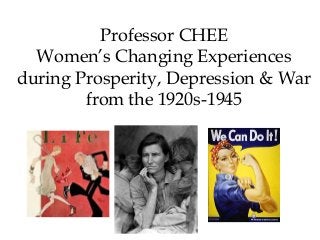
Professor CHEE
Women’s Changing Experiences
during Prosperity, Depression & War
from the 1920s-1945
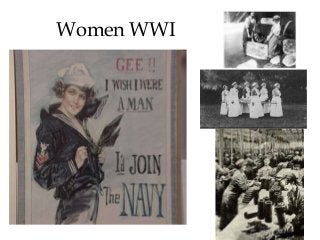
Women WWI
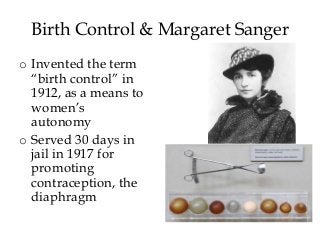
Birth Control & Margaret Sanger
o Invented the term
“birth control” in
1912, as a means to
women’s
autonomy
o Served 30 days in
jail in 1917 for
promoting
contraception, the
diaphragm
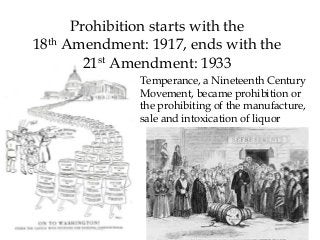
Prohibition starts with the
18th Amendment: 1917, ends with the
21st Amendment: 1933
Temperance, a Nineteenth Century
Movement, became prohibition or
the prohibiting of the manufacture,
sale and intoxication of liquor
Prohibition: A Nation of Drunkards.
Ken Burns & Lynn Novick. 2011
https://www.pbs.org/kenburns/prohibiti
on/watch-video/#id=2082675582
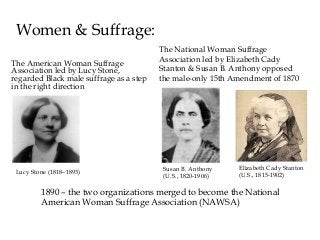
Women & Suffrage:
The American Woman Suffrage
Association led by Lucy Stone,
regarded Black male suffrage as a step
in the right direction
Elizabeth Cady Stanton
(U.S., 1815-1902)
Susan B. Anthony
(U.S., 1820-1906)
Lucy Stone (1818–1893)
1890 – the two organizations merged to become the National
American Woman Suffrage Association (NAWSA)
The National Woman Suffrage
Association led by Elizabeth Cady
Stanton & Susan B. Anthony opposed
the male-only 15th Amendment of 1870
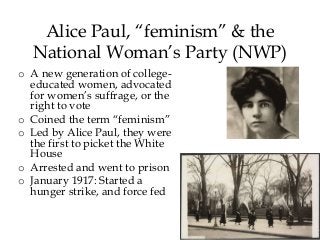
Alice Paul, “feminism” & the
National Woman’s Party (NWP)
o A new generation of college-
educated women, advocated
for women’s suffrage, or the
right to vote
o Coined the term “feminism”
o Led by Alice Paul, they were
the first to picket the White
House
o Arrested and went to prison
o January 1917: Started a
hunger strike, and force fed
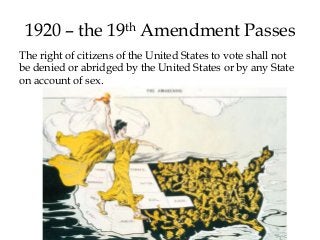
1920 – the 19th Amendment Passes
The right of citizens of the United States to vote shall not
be denied or abridged by the United States or by any State
on account of sex.
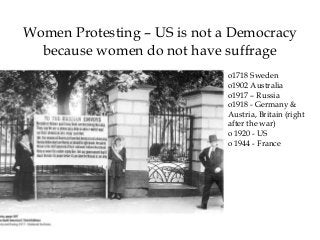
Women Protesting – US is not a Democracy
because women do not have suffrage
o1718 Sweden
o1902 Australia
o1917 – Russia
o1918 - Germany &
Austria, Britain (right
after the war)
o 1920 - US
o 1944 - France
League of Women Voters
Founded in 1920 during the convention of
the National American Woman Suffrage
Association, 6 months before the 19th
amendment passes
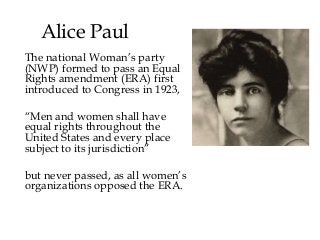
Alice Paul
The national Woman’s party
(NWP) formed to pass an Equal
Rights amendment (ERA) first
introduced to Congress in 1923,
“Men and women shall have
equal rights throughout the
United States and every place
subject to its jurisdiction”
but never passed, as all women’s
organizations opposed the ERA.
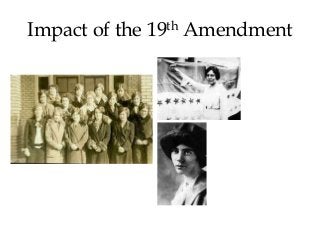
Impact of the 19th Amendment
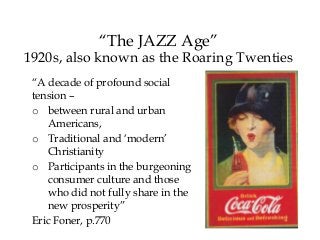
“The JAZZ Age”
1920s, also known as the Roaring Twenties
“A decade of profound social
tension –
o between rural and urban
Americans,
o Traditional and ‘modern’
Christianity
o Participants in the burgeoning
consumer culture and those
who did not fully share in the
new prosperity”
Eric Foner, p.770
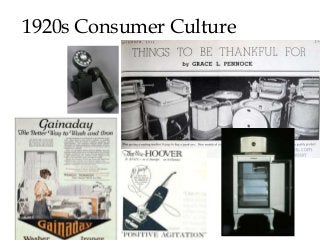
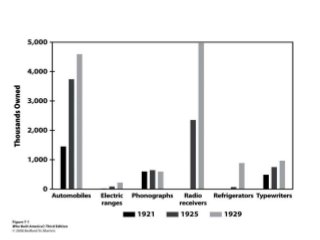
1920s Consumer Culture
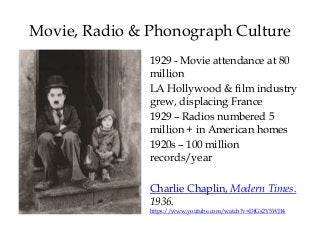
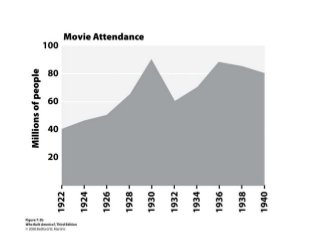
Movie, Radio & Phonograph Culture
1929 - Movie attendance at 80
million
LA Hollywood & film industry
grew, displacing France
1929 – Radios numbered 5
million + in American homes
1920s – 100 million
records/year
Charlie Chaplin, Modern Times.
1936.
https://www.youtube.com/watch?v=DfGs2Y5WJ14
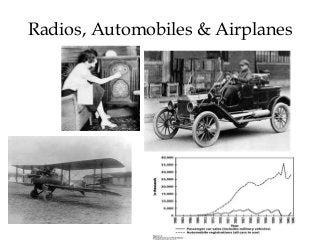
Radios, Automobiles & Airplanes
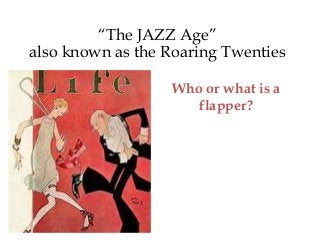
“The JAZZ Age”
also known as the Roaring Twenties
Who or what is a
flapper?
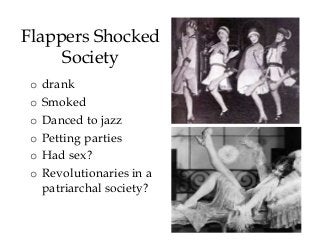
Flappers Shocked
Society
o drank
o Smoked
o Danced to jazz
o Petting parties
o Had sex?
o Revolutionaries in a
patriarchal society?
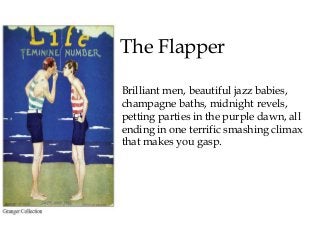
The Flapper
Brilliant men, beautiful jazz babies,
champagne baths, midnight revels,
petting parties in the purple dawn, all
ending in one terrific smashing climax
that makes you gasp.
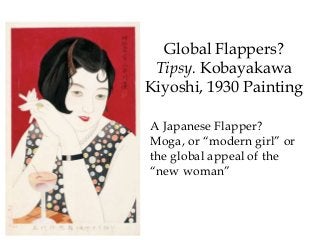
Global Flappers?
Tipsy. Kobayakawa
Kiyoshi, 1930 Painting
A Japanese Flapper?
Moga, or “modern girl” or
the global appeal of the
“new woman”
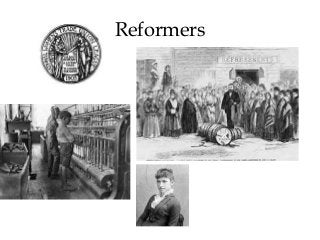
Reformers
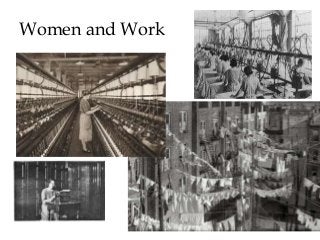
Women and Work
Women and Work
o 8 million employed, 437
different job classifications
o Female labor force grew 26%
by 1930, increase 2 million
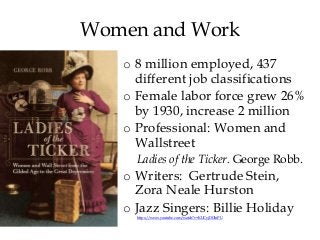
o Professional: Women and
Wallstreet
Ladies of the Ticker. George Robb.
o Writers: Gertrude Stein,
Zora Neale Hurston
o Jazz Singers: Billie Holiday
https://www.youtube.com/watch?v=KUCyjDOlnPU
Work and Women of Color
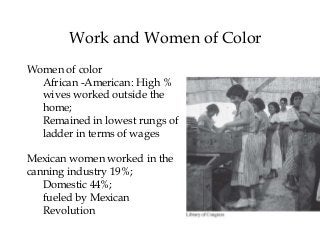
Women of color
African -American: High %
wives worked outside the
home;
Remained in lowest rungs of
ladder in terms of wages
Mexican women worked in the
canning industry 19%;
Domestic 44%;
fueled by Mexican
Revolution
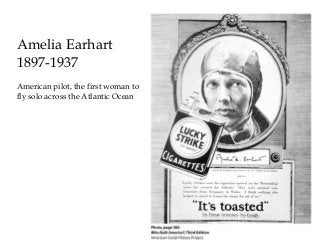
American pilot, the first woman to
fly solo across the Atlantic Ocean
Amelia Earhart
1897-1937
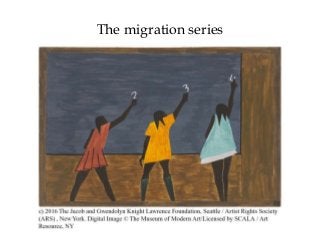
The migration series
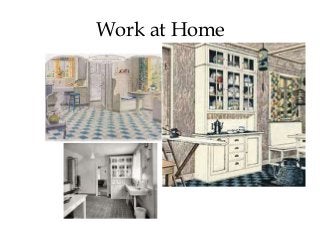
Work at Home
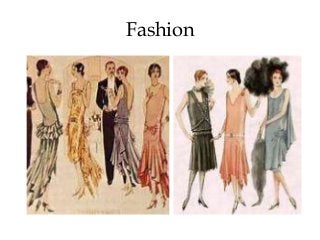
Fashion
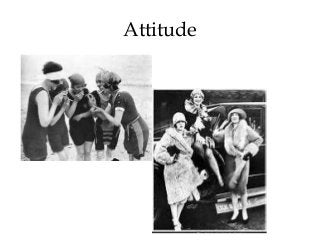
Attitude
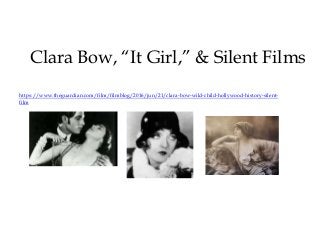
Clara Bow, “It Girl,” & Silent Films
https://www.theguardian.com/film/filmblog/2016/jun/21/clara-bow-wild-child-hollywood-history-silent-
film
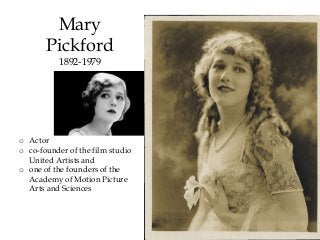
Mary
Pickford
1892-1979
o Actor
o co-founder of the film studio
United Artists and
o one of the founders of the
Academy of Motion Picture
Arts and Sciences
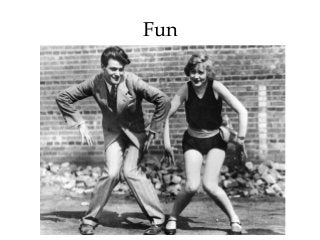
Fun
Conclusion
o In 1928, the New York Times declared,
“there were no more flappers.”
o The Times wasn’t wrong – for a better part
of a decade, the flapper – part reality, part
invention- had dominated the national
imagination. But Americans living
through depression, war, and the Red
scares could scarcely afford to indulge in
the frivolities of the 1920s.
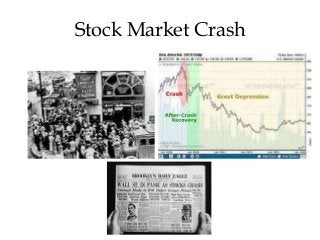
Stock Market Crash
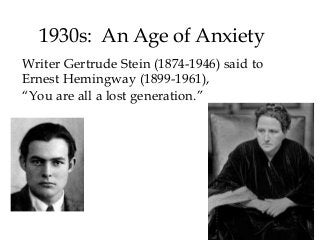
1930s: An Age of Anxiety
Writer Gertrude Stein (1874-1946) said to
Ernest Hemingway (1899-1961),
“You are all a lost generation.”
38
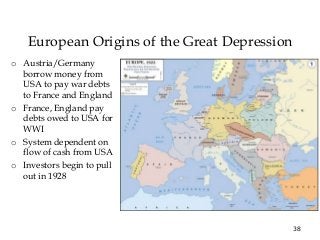
European Origins of the Great Depression
o Austria/Germany
borrow money from
USA to pay war debts
to France and England
o France, England pay
debts owed to USA for
WWI
o System dependent on
flow of cash from USA
o Investors begin to pull
out in 1928
39
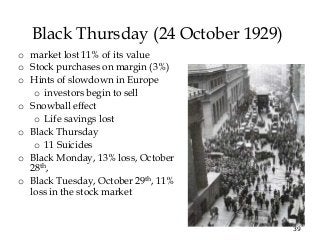
Black Thursday (24 October 1929)
o market lost 11% of its value
o Stock purchases on margin (3%)
o Hints of slowdown in Europe
o investors begin to sell
o Snowball effect
o Life savings lost
o Black Thursday
o 11 Suicides
o Black Monday, 13% loss, October
28th,
o Black Tuesday, October 29th, 11%
loss in the stock market
40
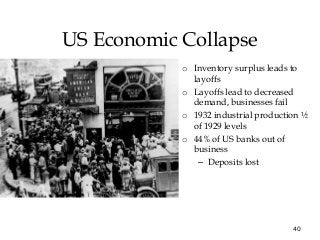
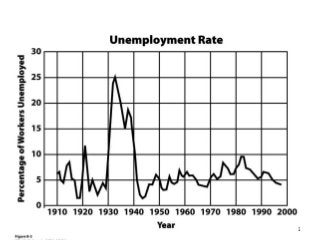
US Economic Collapse
o Inventory surplus leads to
layoffs
o Layoffs lead to decreased
demand, businesses fail
o 1932 industrial production ½
of 1929 levels
o 44% of US banks out of
business
– Deposits lost
41
42
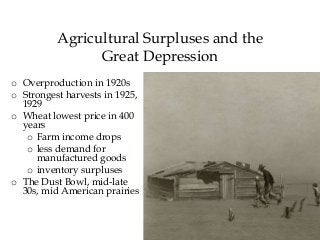
Agricultural Surpluses and the
Great Depression
o Overproduction in 1920s
o Strongest harvests in 1925,
1929
o Wheat lowest price in 400
years
o Farm income drops
o less demand for
manufactured goods
o inventory surpluses
o The Dust Bowl, mid-late
30s, mid American prairies
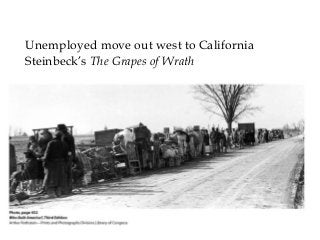
Unemployed move out west to California
Steinbeck’s The Grapes of Wrath
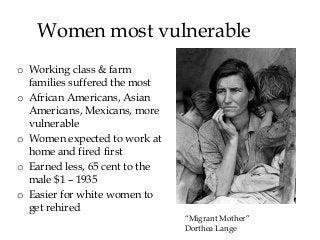
Women most vulnerable
o Working class & farm
families suffered the most
o African Americans, Asian
Americans, Mexicans, more
vulnerable
o Women expected to work at
home and fired first
o Earned less, 65 cent to the
male $1 – 1935
o Easier for white women to
get rehired
“Migrant Mother”
Dorthea Lange
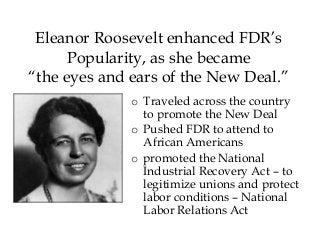
Eleanor Roosevelt enhanced FDR’s
Popularity, as she became
“the eyes and ears of the New Deal.”
o Traveled across the country
to promote the New Deal
o Pushed FDR to attend to
African Americans
o promoted the National
Industrial Recovery Act – to
legitimize unions and protect
labor conditions – National
Labor Relations Act
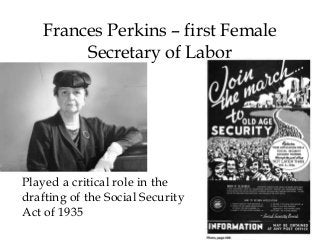
Frances Perkins – first Female
Secretary of Labor
Played a critical role in the
drafting of the Social Security
Act of 1935
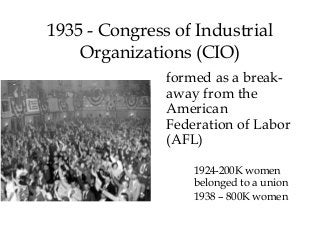
1935 - Congress of Industrial
Organizations (CIO)
formed as a break-
away from the
American
Federation of Labor
(AFL)
1924-200K women
belonged to a union
1938 – 800K women
Give Me Liberty!: An American History, 5th Brief Edition
Copyright © 2017 W. W. Norton & Company
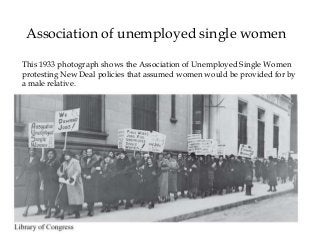
Association of unemployed single women
This 1933 photograph shows the Association of Unemployed Single Women
protesting New Deal policies that assumed women would be provided for by
a male relative.
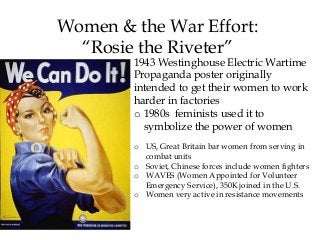
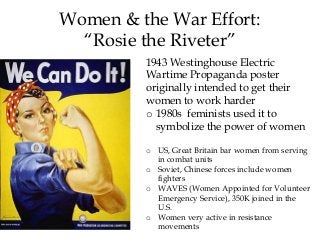
1943 Westinghouse Electric Wartime
Propaganda poster originally
intended to get their women to work
harder in factories
o 1980s feminists used it to
symbolize the power of women
o US, Great Britain bar women from serving in
combat units
o Soviet, Chinese forces include women fighters
o WAVES (Women Appointed for Volunteer
Emergency Service), 350K joined in the U.S.
o Women very active in resistance movements
Women & the War Effort:
“Rosie the Riveter”
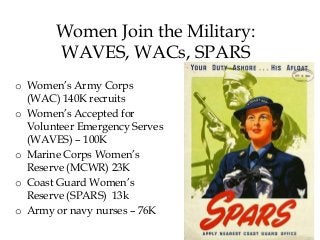
Women Join the Military:
WAVES, WACs, SPARS
o Women’s Army Corps
(WAC) 140K recruits
o Women’s Accepted for
Volunteer Emergency Serves
(WAVES) – 100K
o Marine Corps Women’s
Reserve (MCWR) 23K
o Coast Guard Women’s
Reserve (SPARS) 13k
o Army or navy nurses – 76K
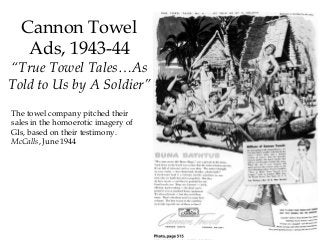
The towel company pitched their
sales in the homoerotic imagery of
GIs, based on their testimony.
McCalls, June 1944
Cannon Towel
Ads, 1943-44
“True Towel Tales…As
Told to Us by A Soldier”
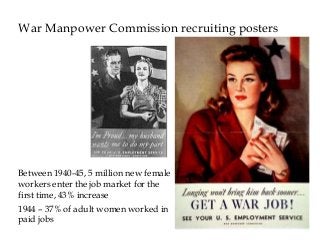
War Manpower Commission recruiting posters
Between 1940-45, 5 million new female
workers enter the job market for the
first time, 43% increase
1944 – 37% of adult women worked in
paid jobs
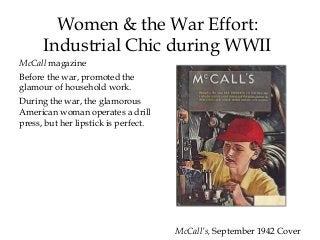
McCall magazine
Before the war, promoted the
glamour of household work.
During the war, the glamorous
American woman operates a drill
press, but her lipstick is perfect.
Women & the War Effort:
Industrial Chic during WWII
McCall’s, September 1942 Cover
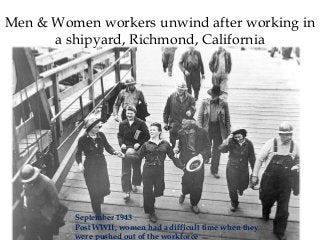
September 1943
Post WWII, women had a difficult time when they
were pushed out of the workforce
Men & Women workers unwind after working in
a shipyard, Richmond, California
1943 Westinghouse Electric
Wartime Propaganda poster
originally intended to get their
women to work harder
o 1980s feminists used it to
symbolize the power of women
o US, Great Britain bar women from serving
in combat units
o Soviet, Chinese forces include women
fighters
o WAVES (Women Appointed for Volunteer
Emergency Service), 350K joined in the
U.S.
o Women very active in resistance
movements
Women & the War Effort:
“Rosie the Riveter”

Lecture - Women's Changing Experiences - CHEE

  • 1.
    Professor CHEE Women’s ChangingExperiences during Prosperity, Depression & War from the 1920s-1945
  • 2.
  • 3.
    Birth Control &Margaret Sanger o Invented the term “birth control” in 1912, as a means to women’s autonomy o Served 30 days in jail in 1917 for promoting contraception, the diaphragm
  • 4.
    Prohibition starts withthe 18th Amendment: 1917, ends with the 21st Amendment: 1933 Temperance, a Nineteenth Century Movement, became prohibition or the prohibiting of the manufacture, sale and intoxication of liquor
  • 5.
    Prohibition: A Nationof Drunkards. Ken Burns & Lynn Novick. 2011 https://www.pbs.org/kenburns/prohibiti on/watch-video/#id=2082675582
  • 6.
    Women & Suffrage: TheAmerican Woman Suffrage Association led by Lucy Stone, regarded Black male suffrage as a step in the right direction Elizabeth Cady Stanton (U.S., 1815-1902) Susan B. Anthony (U.S., 1820-1906) Lucy Stone (1818–1893) 1890 – the two organizations merged to become the National American Woman Suffrage Association (NAWSA) The National Woman Suffrage Association led by Elizabeth Cady Stanton & Susan B. Anthony opposed the male-only 15th Amendment of 1870
  • 7.
    Alice Paul, “feminism”& the National Woman’s Party (NWP) o A new generation of college- educated women, advocated for women’s suffrage, or the right to vote o Coined the term “feminism” o Led by Alice Paul, they were the first to picket the White House o Arrested and went to prison o January 1917: Started a hunger strike, and force fed
  • 8.
    1920 – the19th Amendment Passes The right of citizens of the United States to vote shall not be denied or abridged by the United States or by any State on account of sex.
  • 9.
    Women Protesting –US is not a Democracy because women do not have suffrage o1718 Sweden o1902 Australia o1917 – Russia o1918 - Germany & Austria, Britain (right after the war) o 1920 - US o 1944 - France
  • 10.
    League of WomenVoters Founded in 1920 during the convention of the National American Woman Suffrage Association, 6 months before the 19th amendment passes
  • 11.
    Alice Paul The nationalWoman’s party (NWP) formed to pass an Equal Rights amendment (ERA) first introduced to Congress in 1923, “Men and women shall have equal rights throughout the United States and every place subject to its jurisdiction” but never passed, as all women’s organizations opposed the ERA.
  • 12.
    Impact of the19th Amendment
  • 13.
    “The JAZZ Age” 1920s,also known as the Roaring Twenties “A decade of profound social tension – o between rural and urban Americans, o Traditional and ‘modern’ Christianity o Participants in the burgeoning consumer culture and those who did not fully share in the new prosperity” Eric Foner, p.770
  • 14.
  • 16.
    Movie, Radio &Phonograph Culture 1929 - Movie attendance at 80 million LA Hollywood & film industry grew, displacing France 1929 – Radios numbered 5 million + in American homes 1920s – 100 million records/year Charlie Chaplin, Modern Times. 1936. https://www.youtube.com/watch?v=DfGs2Y5WJ14
  • 18.
  • 19.
    “The JAZZ Age” alsoknown as the Roaring Twenties Who or what is a flapper?
  • 20.
    Flappers Shocked Society o drank oSmoked o Danced to jazz o Petting parties o Had sex? o Revolutionaries in a patriarchal society?
  • 21.
    The Flapper Brilliant men,beautiful jazz babies, champagne baths, midnight revels, petting parties in the purple dawn, all ending in one terrific smashing climax that makes you gasp.
  • 22.
    Global Flappers? Tipsy. Kobayakawa Kiyoshi,1930 Painting A Japanese Flapper? Moga, or “modern girl” or the global appeal of the “new woman”
  • 23.
  • 24.
  • 25.
    Women and Work o8 million employed, 437 different job classifications o Female labor force grew 26% by 1930, increase 2 million o Professional: Women and Wallstreet Ladies of the Ticker. George Robb. o Writers: Gertrude Stein, Zora Neale Hurston o Jazz Singers: Billie Holiday https://www.youtube.com/watch?v=KUCyjDOlnPU
  • 26.
    Work and Womenof Color Women of color African -American: High % wives worked outside the home; Remained in lowest rungs of ladder in terms of wages Mexican women worked in the canning industry 19%; Domestic 44%; fueled by Mexican Revolution
  • 27.
    American pilot, thefirst woman to fly solo across the Atlantic Ocean Amelia Earhart 1897-1937
  • 28.
  • 29.
  • 30.
  • 31.
  • 32.
    Clara Bow, “ItGirl,” & Silent Films https://www.theguardian.com/film/filmblog/2016/jun/21/clara-bow-wild-child-hollywood-history-silent- film
  • 33.
    Mary Pickford 1892-1979 o Actor o co-founderof the film studio United Artists and o one of the founders of the Academy of Motion Picture Arts and Sciences
  • 34.
  • 35.
    Conclusion o In 1928,the New York Times declared, “there were no more flappers.” o The Times wasn’t wrong – for a better part of a decade, the flapper – part reality, part invention- had dominated the national imagination. But Americans living through depression, war, and the Red scares could scarcely afford to indulge in the frivolities of the 1920s.
  • 36.
  • 37.
    1930s: An Ageof Anxiety Writer Gertrude Stein (1874-1946) said to Ernest Hemingway (1899-1961), “You are all a lost generation.”
  • 38.
    38 European Origins ofthe Great Depression o Austria/Germany borrow money from USA to pay war debts to France and England o France, England pay debts owed to USA for WWI o System dependent on flow of cash from USA o Investors begin to pull out in 1928
  • 39.
    39 Black Thursday (24October 1929) o market lost 11% of its value o Stock purchases on margin (3%) o Hints of slowdown in Europe o investors begin to sell o Snowball effect o Life savings lost o Black Thursday o 11 Suicides o Black Monday, 13% loss, October 28th, o Black Tuesday, October 29th, 11% loss in the stock market
  • 40.
    40 US Economic Collapse oInventory surplus leads to layoffs o Layoffs lead to decreased demand, businesses fail o 1932 industrial production ½ of 1929 levels o 44% of US banks out of business – Deposits lost
  • 41.
  • 42.
    42 Agricultural Surpluses andthe Great Depression o Overproduction in 1920s o Strongest harvests in 1925, 1929 o Wheat lowest price in 400 years o Farm income drops o less demand for manufactured goods o inventory surpluses o The Dust Bowl, mid-late 30s, mid American prairies
  • 43.
    Unemployed move outwest to California Steinbeck’s The Grapes of Wrath
  • 44.
    Women most vulnerable oWorking class & farm families suffered the most o African Americans, Asian Americans, Mexicans, more vulnerable o Women expected to work at home and fired first o Earned less, 65 cent to the male $1 – 1935 o Easier for white women to get rehired “Migrant Mother” Dorthea Lange
  • 45.
    Eleanor Roosevelt enhancedFDR’s Popularity, as she became “the eyes and ears of the New Deal.” o Traveled across the country to promote the New Deal o Pushed FDR to attend to African Americans o promoted the National Industrial Recovery Act – to legitimize unions and protect labor conditions – National Labor Relations Act
  • 46.
    Frances Perkins –first Female Secretary of Labor Played a critical role in the drafting of the Social Security Act of 1935
  • 47.
    1935 - Congressof Industrial Organizations (CIO) formed as a break- away from the American Federation of Labor (AFL) 1924-200K women belonged to a union 1938 – 800K women
  • 48.
    Give Me Liberty!:An American History, 5th Brief Edition Copyright © 2017 W. W. Norton & Company Association of unemployed single women This 1933 photograph shows the Association of Unemployed Single Women protesting New Deal policies that assumed women would be provided for by a male relative.
  • 49.
    1943 Westinghouse ElectricWartime Propaganda poster originally intended to get their women to work harder in factories o 1980s feminists used it to symbolize the power of women o US, Great Britain bar women from serving in combat units o Soviet, Chinese forces include women fighters o WAVES (Women Appointed for Volunteer Emergency Service), 350K joined in the U.S. o Women very active in resistance movements Women & the War Effort: “Rosie the Riveter”
  • 50.
    Women Join theMilitary: WAVES, WACs, SPARS o Women’s Army Corps (WAC) 140K recruits o Women’s Accepted for Volunteer Emergency Serves (WAVES) – 100K o Marine Corps Women’s Reserve (MCWR) 23K o Coast Guard Women’s Reserve (SPARS) 13k o Army or navy nurses – 76K
  • 51.
    The towel companypitched their sales in the homoerotic imagery of GIs, based on their testimony. McCalls, June 1944 Cannon Towel Ads, 1943-44 “True Towel Tales…As Told to Us by A Soldier”
  • 52.
    War Manpower Commissionrecruiting posters Between 1940-45, 5 million new female workers enter the job market for the first time, 43% increase 1944 – 37% of adult women worked in paid jobs
  • 53.
    McCall magazine Before thewar, promoted the glamour of household work. During the war, the glamorous American woman operates a drill press, but her lipstick is perfect. Women & the War Effort: Industrial Chic during WWII McCall’s, September 1942 Cover
  • 54.
    September 1943 Post WWII,women had a difficult time when they were pushed out of the workforce Men & Women workers unwind after working in a shipyard, Richmond, California
  • 55.
    1943 Westinghouse Electric WartimePropaganda poster originally intended to get their women to work harder o 1980s feminists used it to symbolize the power of women o US, Great Britain bar women from serving in combat units o Soviet, Chinese forces include women fighters o WAVES (Women Appointed for Volunteer Emergency Service), 350K joined in the U.S. o Women very active in resistance movements Women & the War Effort: “Rosie the Riveter”