Dr. Hosny Ahmed Abbas
 01007478550
 hosny.abbas@fci.luxor.edu.eg
Information Technology Luxor Faculty of Computers and Information
Lecture 7: Bandwidth Utilization
Data Communications
(IT251(
Lecture 7: Bandwidth Utilization Luxor Faculty of Computers and Information
2
Topics to be covered
 Transportation Analogy
 Bandwidth Utilization
 Multiplexing
✔ Analog
 FDM
 WDM
✔ Digital
 TDM
 Spread Spectrum
✔ Analog
 FHSS
✔ Digital
 DSSS
Lecture 7: Bandwidth Utilization Luxor Faculty of Computers and Information
3
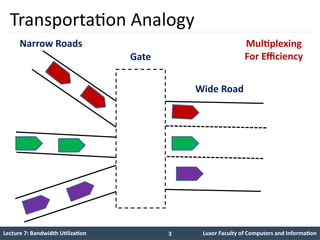
Transportation Analogy
Wide Road
Narrow Roads
Gate
Multiplexing
For Efficiency
Lecture 7: Bandwidth Utilization Luxor Faculty of Computers and Information
4
Transportation Analogy
Wide Road
Narrow Roads
Gate
Spreading
For Privacy and to
Avoid Risks
Lecture 7: Bandwidth Utilization Luxor Faculty of Computers and Information
5
Bandwidth Utilization
 In real life, we have links with limited bandwidths.
 Bandwidth utilization is the wise use of available
bandwidth to achieve specific goals.
 Efficiency can be achieved by multiplexing.
 Privacy and anti-jamming can be achieved by
spreading.
Lecture 7: Bandwidth Utilization Luxor Faculty of Computers and Information
6
Multiplexing
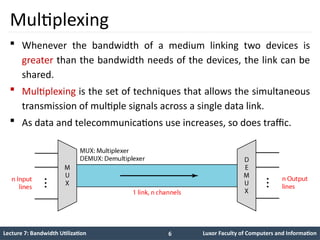
 Whenever the bandwidth of a medium linking two devices is
greater than the bandwidth needs of the devices, the link can be
shared.
 Multiplexing is the set of techniques that allows the simultaneous
transmission of multiple signals across a single data link.
 As data and telecommunications use increases, so does traffic.
Lecture 7: Bandwidth Utilization Luxor Faculty of Computers and Information
7
Multiplexing
Lecture 7: Bandwidth Utilization Luxor Faculty of Computers and Information
8
Multiplexing
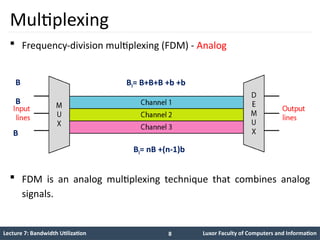
 Frequency-division multiplexing (FDM) - Analog
 FDM is an analog multiplexing technique that combines analog
signals.
Bl= B+B+B +b +b
B
B
B
Bl= nB +(n-1)b
Lecture 7: Bandwidth Utilization Luxor Faculty of Computers and Information
9
Multiplexing
 FDM process
Multiplexing
Lecture 7: Bandwidth Utilization Luxor Faculty of Computers and Information
10
Multiplexing
 FDM process
De-multiplexing
Lecture 7: Bandwidth Utilization Luxor Faculty of Computers and Information
11
Multiplexing
 FDM process
Frequency Division Multiplexing (FDM)
Lecture 7: Bandwidth Utilization Luxor Faculty of Computers and Information
12
Multiplexing
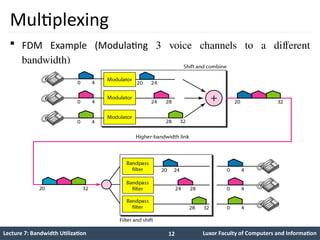
 FDM Example (Modulating 3 voice channels to a different
bandwidth)
Lecture 7: Bandwidth Utilization Luxor Faculty of Computers and Information
13
Multiplexing
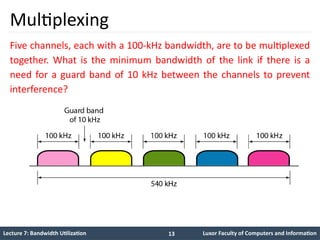
Five channels, each with a 100-kHz bandwidth, are to be multiplexed
together. What is the minimum bandwidth of the link if there is a
need for a guard band of 10 kHz between the channels to prevent
interference?
Lecture 7: Bandwidth Utilization Luxor Faculty of Computers and Information
14
Multiplexing
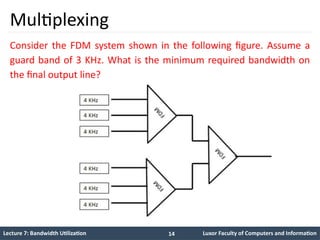
Consider the FDM system shown in the following figure. Assume a
guard band of 3 KHz. What is the minimum required bandwidth on
the final output line?
Lecture 7: Bandwidth Utilization Luxor Faculty of Computers and Information
15
Multiplexing
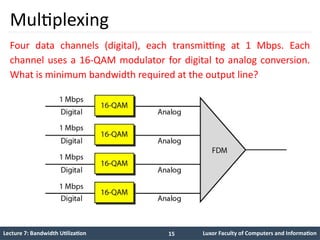
Four data channels (digital), each transmitting at 1 Mbps. Each
channel uses a 16-QAM modulator for digital to analog conversion.
What is minimum bandwidth required at the output line?
Lecture 7: Bandwidth Utilization Luxor Faculty of Computers and Information
16
Multiplexing
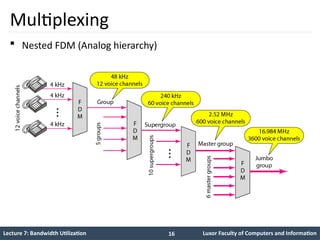
 Nested FDM (Analog hierarchy)
Lecture 7: Bandwidth Utilization Luxor Faculty of Computers and Information
17
Multiplexing
 Amplitude Modulation (AM)
AM band allocation: Federal Communication Commission (FCC)
Lecture 7: Bandwidth Utilization Luxor Faculty of Computers and Information
18
Multiplexing
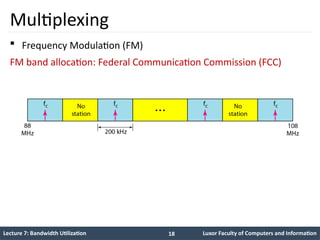
 Frequency Modulation (FM)
FM band allocation: Federal Communication Commission (FCC)
Lecture 7: Bandwidth Utilization Luxor Faculty of Computers and Information
19
Multiplexing
 Wavelength-Division Multiplexing (WDM) - Analog
 WDM is an analog multiplexing technique to combine optical
signals.
Prisms in wavelength-division multiplexing and de-multiplexing
Lecture 7: Bandwidth Utilization Luxor Faculty of Computers and Information
20
Multiplexing
 Wavelength-Division Multiplexing (WDM) - Analog
 Although WDM technology is very complex, the basic idea is very
simple.
 A prism bends a beam of light based on the angle of incidence and
frequency.
Lecture 7: Bandwidth Utilization Luxor Faculty of Computers and Information
21
Multiplexing
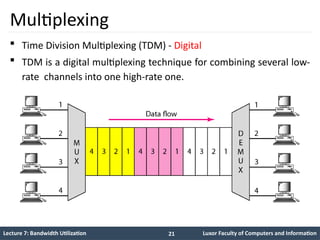
 Time Division Multiplexing (TDM) - Digital
 TDM is a digital multiplexing technique for combining several low-
rate channels into one high-rate one.
Lecture 7: Bandwidth Utilization Luxor Faculty of Computers and Information
22
Multiplexing
 Synchronous TDM
 In synchronous TDM, the data rate of the link is n times faster, and
the unit duration is n times shorter.
Lecture 7: Bandwidth Utilization Luxor Faculty of Computers and Information
23
 Synchronous TDM
What is the minimum bit rate of each line if we used
synchronous-TDM?
Multiplexing
10 lines
Each 56.6 Kbps
10 lines
Each 56.6 Kbps
Lecture 7: Bandwidth Utilization Luxor Faculty of Computers and Information
24
Multiplexing
 Synchronous TDM
Four 1-Kbps connections are multiplexed together. A unit is
1-bit, Find: (1) the duration of 1-bit before multiplexing, (2)
the transmission rate of the link, (3) the duration of a time
slot, and (4) the duration of a frame.
Lecture 7: Bandwidth Utilization Luxor Faculty of Computers and Information
25
SPREAD SPECTRUM
 Frequency Hopping Spread Spectrum (FHSS) - Analog
FDM
Lecture 7: Bandwidth Utilization Luxor Faculty of Computers and Information
26
SPREAD SPECTRUM
 Frequency Hopping Spread Spectrum (FHSS) - Analog
Bandwidth sharing
Lecture 7: Bandwidth Utilization Luxor Faculty of Computers and Information
27
SPREAD SPECTRUM
 In spread spectrum (SS), we combine signals from different
sources to fit into a larger bandwidth, but our goals are to prevent
eavesdropping and jamming.
 To achieve these goals, spread spectrum techniques add
redundancy.
Lecture 7: Bandwidth Utilization Luxor Faculty of Computers and Information
28
SPREAD SPECTRUM
 Frequency Hopping Spread Spectrum (FHSS) - Analog
Bs Bss
Processing Gain or Spreading Factor L= Bss/Bs
Lecture 7: Bandwidth Utilization Luxor Faculty of Computers and Information
29
SPREAD SPECTRUM
 Frequency Hopping Spread Spectrum (FHSS) - Analog
Frequency selection in FHSS
Processing Gain L= 8
Lecture 7: Bandwidth Utilization Luxor Faculty of Computers and Information
30
SPREAD SPECTRUM
 Frequency Hopping Spread Spectrum (FHSS) - Analog
FHSS cycles
Lecture 7: Bandwidth Utilization Luxor Faculty of Computers and Information
31
SPREAD SPECTRUM
 Frequency Hopping Spread Spectrum (FHSS) - Analog
A wireless communication system uses FHSS. If the number
of orthogonal carrier frequencies is 16 and the bandwidth
of the original signal is 10 KHz, what is bandwidth of the
spread signal?
Lecture 7: Bandwidth Utilization Luxor Faculty of Computers and Information
32
SPREAD SPECTRUM
 Direct Sequence Spread Spectrum (DSSS)-Digital
 In DS Spread Spectrum (DSSS) transmission, a PN sequence is (XOR
/AND) combined with a data stream before it is mixed with RF and
then transmitted.
DSSS with AND
Lecture 7: Bandwidth Utilization Luxor Faculty of Computers and Information
33
SPREAD SPECTRUM
 Direct Sequence Spread Spectrum (DSSS)-Digital
DSSS with XOR
Lecture 7: Bandwidth Utilization Luxor Faculty of Computers and Information
34
SPREAD SPECTRUM
 Direct Sequence Spread Spectrum (DSSS) - Digital
Bs Bss
L=Ts/Tss
Ts
Tss
L=Bss/Bs
1010001101
L=# chips (bits)
Lecture 7: Bandwidth Utilization Luxor Faculty of Computers and Information
35
SPREAD SPECTRUM
 Direct Sequence Spread Spectrum (DSSS)
In DSSS, given data=10, Spread Code=0011, find the
resultant generated Spread code and draw the original and
spread signals if polar NRZ-L is used for encoding. (hint:
XOR).
Lecture 7: Bandwidth Utilization Luxor Faculty of Computers and Information
36
SPREAD SPECTRUM
 Direct Sequence Spread Spectrum (DSSS) - Digital
A communication system uses DSSS. If the bit duration of
the original signal is 1ms and the bit duration of the spread
signal is 125 microseconds with spread spectrum
bandwidth of 200KHz:
• What is the Spreading Factor?
• What is the bandwidth of the original signal?
Lecture 7: Analog Transmission Luxor Faculty of Computers and Information
37
References
1. Data Communications and Networking, Behrouz Forouzan,
University of California, 4ed.Chapter 6
2. Internet
Thank You

Lecture 7 Bandwidth Utilization Techniques

  • 1.
    Dr. Hosny AhmedAbbas  01007478550  hosny.abbas@fci.luxor.edu.eg Information Technology Luxor Faculty of Computers and Information Lecture 7: Bandwidth Utilization Data Communications (IT251(
  • 2.
    Lecture 7: BandwidthUtilization Luxor Faculty of Computers and Information 2 Topics to be covered  Transportation Analogy  Bandwidth Utilization  Multiplexing ✔ Analog  FDM  WDM ✔ Digital  TDM  Spread Spectrum ✔ Analog  FHSS ✔ Digital  DSSS
  • 3.
    Lecture 7: BandwidthUtilization Luxor Faculty of Computers and Information 3 Transportation Analogy Wide Road Narrow Roads Gate Multiplexing For Efficiency
  • 4.
    Lecture 7: BandwidthUtilization Luxor Faculty of Computers and Information 4 Transportation Analogy Wide Road Narrow Roads Gate Spreading For Privacy and to Avoid Risks
  • 5.
    Lecture 7: BandwidthUtilization Luxor Faculty of Computers and Information 5 Bandwidth Utilization  In real life, we have links with limited bandwidths.  Bandwidth utilization is the wise use of available bandwidth to achieve specific goals.  Efficiency can be achieved by multiplexing.  Privacy and anti-jamming can be achieved by spreading.
  • 6.
    Lecture 7: BandwidthUtilization Luxor Faculty of Computers and Information 6 Multiplexing  Whenever the bandwidth of a medium linking two devices is greater than the bandwidth needs of the devices, the link can be shared.  Multiplexing is the set of techniques that allows the simultaneous transmission of multiple signals across a single data link.  As data and telecommunications use increases, so does traffic.
  • 7.
    Lecture 7: BandwidthUtilization Luxor Faculty of Computers and Information 7 Multiplexing
  • 8.
    Lecture 7: BandwidthUtilization Luxor Faculty of Computers and Information 8 Multiplexing  Frequency-division multiplexing (FDM) - Analog  FDM is an analog multiplexing technique that combines analog signals. Bl= B+B+B +b +b B B B Bl= nB +(n-1)b
  • 9.
    Lecture 7: BandwidthUtilization Luxor Faculty of Computers and Information 9 Multiplexing  FDM process Multiplexing
  • 10.
    Lecture 7: BandwidthUtilization Luxor Faculty of Computers and Information 10 Multiplexing  FDM process De-multiplexing
  • 11.
    Lecture 7: BandwidthUtilization Luxor Faculty of Computers and Information 11 Multiplexing  FDM process Frequency Division Multiplexing (FDM)
  • 12.
    Lecture 7: BandwidthUtilization Luxor Faculty of Computers and Information 12 Multiplexing  FDM Example (Modulating 3 voice channels to a different bandwidth)
  • 13.
    Lecture 7: BandwidthUtilization Luxor Faculty of Computers and Information 13 Multiplexing Five channels, each with a 100-kHz bandwidth, are to be multiplexed together. What is the minimum bandwidth of the link if there is a need for a guard band of 10 kHz between the channels to prevent interference?
  • 14.
    Lecture 7: BandwidthUtilization Luxor Faculty of Computers and Information 14 Multiplexing Consider the FDM system shown in the following figure. Assume a guard band of 3 KHz. What is the minimum required bandwidth on the final output line?
  • 15.
    Lecture 7: BandwidthUtilization Luxor Faculty of Computers and Information 15 Multiplexing Four data channels (digital), each transmitting at 1 Mbps. Each channel uses a 16-QAM modulator for digital to analog conversion. What is minimum bandwidth required at the output line?
  • 16.
    Lecture 7: BandwidthUtilization Luxor Faculty of Computers and Information 16 Multiplexing  Nested FDM (Analog hierarchy)
  • 17.
    Lecture 7: BandwidthUtilization Luxor Faculty of Computers and Information 17 Multiplexing  Amplitude Modulation (AM) AM band allocation: Federal Communication Commission (FCC)
  • 18.
    Lecture 7: BandwidthUtilization Luxor Faculty of Computers and Information 18 Multiplexing  Frequency Modulation (FM) FM band allocation: Federal Communication Commission (FCC)
  • 19.
    Lecture 7: BandwidthUtilization Luxor Faculty of Computers and Information 19 Multiplexing  Wavelength-Division Multiplexing (WDM) - Analog  WDM is an analog multiplexing technique to combine optical signals. Prisms in wavelength-division multiplexing and de-multiplexing
  • 20.
    Lecture 7: BandwidthUtilization Luxor Faculty of Computers and Information 20 Multiplexing  Wavelength-Division Multiplexing (WDM) - Analog  Although WDM technology is very complex, the basic idea is very simple.  A prism bends a beam of light based on the angle of incidence and frequency.
  • 21.
    Lecture 7: BandwidthUtilization Luxor Faculty of Computers and Information 21 Multiplexing  Time Division Multiplexing (TDM) - Digital  TDM is a digital multiplexing technique for combining several low- rate channels into one high-rate one.
  • 22.
    Lecture 7: BandwidthUtilization Luxor Faculty of Computers and Information 22 Multiplexing  Synchronous TDM  In synchronous TDM, the data rate of the link is n times faster, and the unit duration is n times shorter.
  • 23.
    Lecture 7: BandwidthUtilization Luxor Faculty of Computers and Information 23  Synchronous TDM What is the minimum bit rate of each line if we used synchronous-TDM? Multiplexing 10 lines Each 56.6 Kbps 10 lines Each 56.6 Kbps
  • 24.
    Lecture 7: BandwidthUtilization Luxor Faculty of Computers and Information 24 Multiplexing  Synchronous TDM Four 1-Kbps connections are multiplexed together. A unit is 1-bit, Find: (1) the duration of 1-bit before multiplexing, (2) the transmission rate of the link, (3) the duration of a time slot, and (4) the duration of a frame.
  • 25.
    Lecture 7: BandwidthUtilization Luxor Faculty of Computers and Information 25 SPREAD SPECTRUM  Frequency Hopping Spread Spectrum (FHSS) - Analog FDM
  • 26.
    Lecture 7: BandwidthUtilization Luxor Faculty of Computers and Information 26 SPREAD SPECTRUM  Frequency Hopping Spread Spectrum (FHSS) - Analog Bandwidth sharing
  • 27.
    Lecture 7: BandwidthUtilization Luxor Faculty of Computers and Information 27 SPREAD SPECTRUM  In spread spectrum (SS), we combine signals from different sources to fit into a larger bandwidth, but our goals are to prevent eavesdropping and jamming.  To achieve these goals, spread spectrum techniques add redundancy.
  • 28.
    Lecture 7: BandwidthUtilization Luxor Faculty of Computers and Information 28 SPREAD SPECTRUM  Frequency Hopping Spread Spectrum (FHSS) - Analog Bs Bss Processing Gain or Spreading Factor L= Bss/Bs
  • 29.
    Lecture 7: BandwidthUtilization Luxor Faculty of Computers and Information 29 SPREAD SPECTRUM  Frequency Hopping Spread Spectrum (FHSS) - Analog Frequency selection in FHSS Processing Gain L= 8
  • 30.
    Lecture 7: BandwidthUtilization Luxor Faculty of Computers and Information 30 SPREAD SPECTRUM  Frequency Hopping Spread Spectrum (FHSS) - Analog FHSS cycles
  • 31.
    Lecture 7: BandwidthUtilization Luxor Faculty of Computers and Information 31 SPREAD SPECTRUM  Frequency Hopping Spread Spectrum (FHSS) - Analog A wireless communication system uses FHSS. If the number of orthogonal carrier frequencies is 16 and the bandwidth of the original signal is 10 KHz, what is bandwidth of the spread signal?
  • 32.
    Lecture 7: BandwidthUtilization Luxor Faculty of Computers and Information 32 SPREAD SPECTRUM  Direct Sequence Spread Spectrum (DSSS)-Digital  In DS Spread Spectrum (DSSS) transmission, a PN sequence is (XOR /AND) combined with a data stream before it is mixed with RF and then transmitted. DSSS with AND
  • 33.
    Lecture 7: BandwidthUtilization Luxor Faculty of Computers and Information 33 SPREAD SPECTRUM  Direct Sequence Spread Spectrum (DSSS)-Digital DSSS with XOR
  • 34.
    Lecture 7: BandwidthUtilization Luxor Faculty of Computers and Information 34 SPREAD SPECTRUM  Direct Sequence Spread Spectrum (DSSS) - Digital Bs Bss L=Ts/Tss Ts Tss L=Bss/Bs 1010001101 L=# chips (bits)
  • 35.
    Lecture 7: BandwidthUtilization Luxor Faculty of Computers and Information 35 SPREAD SPECTRUM  Direct Sequence Spread Spectrum (DSSS) In DSSS, given data=10, Spread Code=0011, find the resultant generated Spread code and draw the original and spread signals if polar NRZ-L is used for encoding. (hint: XOR).
  • 36.
    Lecture 7: BandwidthUtilization Luxor Faculty of Computers and Information 36 SPREAD SPECTRUM  Direct Sequence Spread Spectrum (DSSS) - Digital A communication system uses DSSS. If the bit duration of the original signal is 1ms and the bit duration of the spread signal is 125 microseconds with spread spectrum bandwidth of 200KHz: • What is the Spreading Factor? • What is the bandwidth of the original signal?
  • 37.
    Lecture 7: AnalogTransmission Luxor Faculty of Computers and Information 37 References 1. Data Communications and Networking, Behrouz Forouzan, University of California, 4ed.Chapter 6 2. Internet
  • 38.