BUILDING MATERIALS
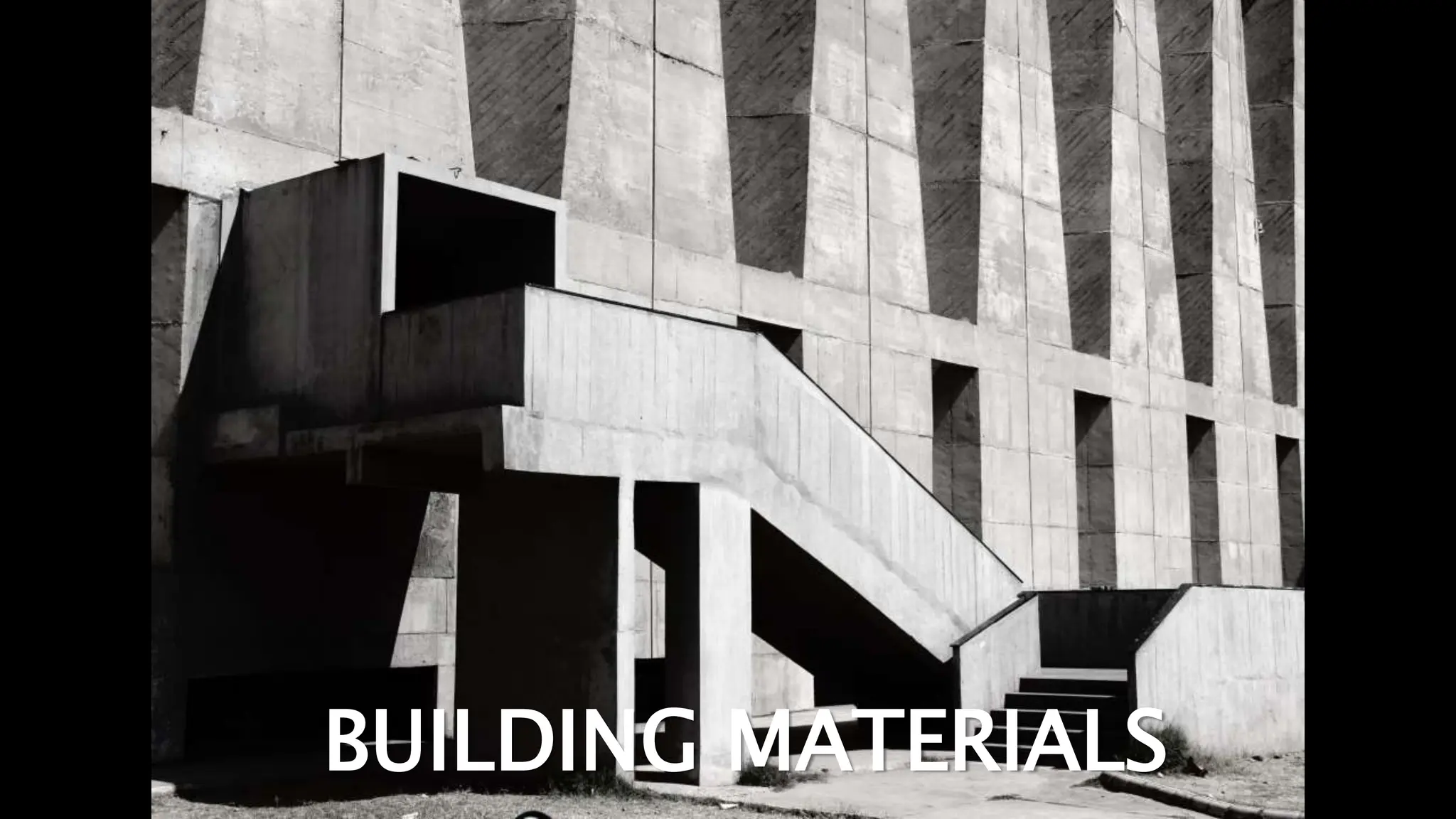
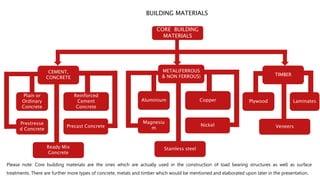
BUILDING MATERIALS
CEMENT,
CONCRETE
TIMBER
Plain or
Ordinary
Concrete
Reinforced
Cement
Concrete
Precast Concrete
Ready Mix
Concrete
Plywood Laminates
Veneers
Prestresse
d Concrete
Please note: Core building materials are the ones which are actually used in the construction of load bearing structures as well as surface
treatments. There are further more types of concrete, metals and timber which would be mentioned and elaborated upon later in the presentation.
METAL(FERROUS
& NON FERROUS)
Aluminium Copper
Nickel
Stainless steel
Magnesiu
m
CORE BUILDING
MATERIALS
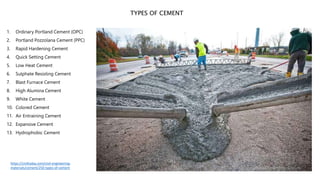
1. Ordinary Portland Cement (OPC)
2. Portland Pozzolana Cement (PPC)
3. Rapid Hardening Cement
4. Quick Setting Cement
5. Low Heat Cement
6. Sulphate Resisting Cement
7. Blast Furnace Cement
8. High Alumina Cement
9. White Cement
10. Colored Cement
11. Air Entraining Cement
12. Expansive Cement
13. Hydrophobic Cement
TYPES OF CEMENT
https://civiltoday.com/civil-engineering-
materials/cement/250-types-of-cement
CEMENT - CONCRETE
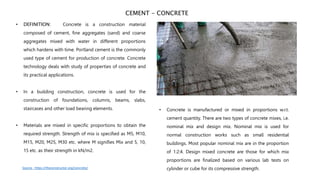
• DEFINITION: Concrete is a construction material
composed of cement, fine aggregates (sand) and coarse
aggregates mixed with water in different proportions
which hardens with time. Portland cement is the commonly
used type of cement for production of concrete. Concrete
technology deals with study of properties of concrete and
its practical applications.
• In a building construction, concrete is used for the
construction of foundations, columns, beams, slabs,
staircases and other load bearing elements.
• Materials are mixed in specific proportions to obtain the
required strength. Strength of mix is specified as M5, M10,
M15, M20, M25, M30 etc. where M signifies Mix and 5, 10,
15 etc. as their strength in kN/m2.
Source - https://theconstructor.org/concrete/
• Concrete is manufactured or mixed in proportions w.r.t.
cement quantity. There are two types of concrete mixes, i.e.
nominal mix and design mix. Nominal mix is used for
normal construction works such as small residential
buildings. Most popular nominal mix are in the proportion
of 1:2:4. Design mixed concrete are those for which mix
proportions are finalized based on various lab tests on
cylinder or cube for its compressive strength.
MIXING IN CONCRETE
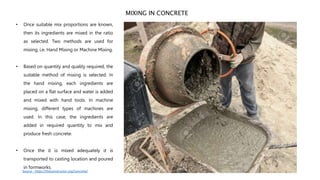
• Once suitable mix proportions are known,
then its ingredients are mixed in the ratio
as selected. Two methods are used for
mixing, i.e. Hand Mixing or Machine Mixing.
• Based on quantity and quality required, the
suitable method of mixing is selected. In
the hand mixing, each ingredients are
placed on a flat surface and water is added
and mixed with hand tools. In machine
mixing, different types of machines are
used. In this case, the ingredients are
added in required quantity to mix and
produce fresh concrete.
• Once the it is mixed adequately it is
transported to casting location and poured
in formworks.
Source - https://theconstructor.org/concrete/
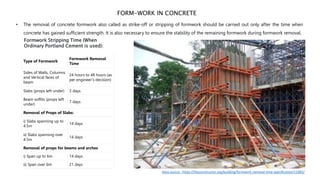
• The removal of concrete formwork also called as strike-off or stripping of formwork should be carried out only after the time when
concrete has gained sufficient strength. It is also necessary to ensure the stability of the remaining formwork during formwork removal.
FORM-WORK IN CONCRETE
Type of Formwork
Formwork Removal
Time
Sides of Walls, Columns
and Vertical faces of
beam
24 hours to 48 hours (as
per engineer’s decision)
Slabs (props left under) 3 days
Beam soffits (props left
under)
7 days
Removal of Props of Slabs:
i) Slabs spanning up to
4.5m
14 days
ii) Slabs spanning over
4.5m
14 days
Removal of props for beams and arches
i) Span up to 6m 14 days
ii) Span over 6m 21 days
Formwork Stripping Time (When
Ordinary Portland Cement is used):
Data source - https://theconstructor.org/building/formwork-removal-time-specification/11083/
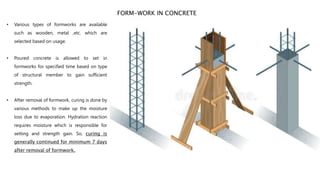
• Various types of formworks are available
such as wooden, metal ,etc. which are
selected based on usage.
• Poured concrete is allowed to set in
formworks for specified time based on type
of structural member to gain sufficient
strength.
• After removal of formwork, curing is done by
various methods to make up the moisture
loss due to evaporation. Hydration reaction
requires moisture which is responsible for
setting and strength gain. So, curing is
generally continued for minimum 7 days
after removal of formwork.
FORM-WORK IN CONCRETE
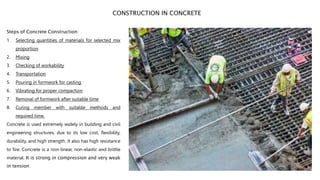
Steps of Concrete Construction:
1. Selecting quantities of materials for selected mix
proportion
2. Mixing
3. Checking of workability
4. Transportation
5. Pouring in formwork for casting
6. Vibrating for proper compaction
7. Removal of formwork after suitable time
8. Curing member with suitable methods and
required time.
Concrete is used extremely widely in building and civil
engineering structures, due to its low cost, flexibility,
durability, and high strength. It also has high resistance
to fire. Concrete is a non-linear, non-elastic and brittle
material. It is strong in compression and very weak
in tension
CONSTRUCTION IN CONCRETE
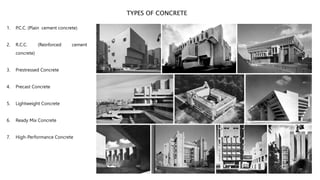
1. P.C.C. (Plain cement concrete)
2. R.C.C. (Reinforced cement
concrete)
3. Prestressed Concrete
4. Precast Concrete
5. Lightweight Concrete
6. Ready Mix Concrete
7. High-Performance Concrete
TYPES OF CONCRETE
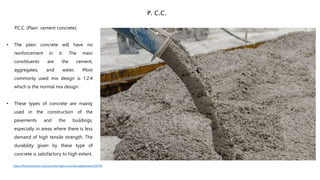
P.C.C. (Plain cement concrete):
• The plain concrete will have no
reinforcement in it. The main
constituents are the cement,
aggregates, and water. Most
commonly used mix design is 1:2:4
which is the normal mix design.
• These types of concrete are mainly
used in the construction of the
pavements and the buildings,
especially in areas where there is less
demand of high tensile strength. The
durability given by these type of
concrete is satisfactory to high extent.
P. C.C.
https://theconstructor.org/concrete/types-concrete-applications/19779/
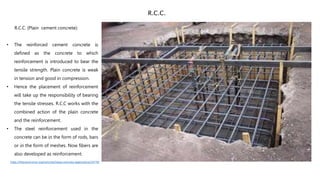
R.C.C. (Plain cement concrete):
• The reinforced cement concrete is
defined as the concrete to which
reinforcement is introduced to bear the
tensile strength. Plain concrete is weak
in tension and good in compression.
• Hence the placement of reinforcement
will take up the responsibility of bearing
the tensile stresses. R.C.C works with the
combined action of the plain concrete
and the reinforcement.
• The steel reinforcement used in the
concrete can be in the form of rods, bars
or in the form of meshes. Now fibers are
also developed as reinforcement.
R.C.C.
https://theconstructor.org/concrete/types-concrete-applications/19779/
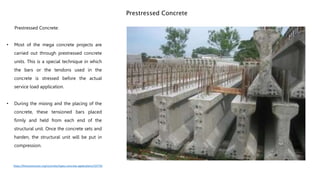
Prestressed Concrete:
• Most of the mega concrete projects are
carried out through prestressed concrete
units. This is a special technique in which
the bars or the tendons used in the
concrete is stressed before the actual
service load application.
• During the mixing and the placing of the
concrete, these tensioned bars placed
firmly and held from each end of the
structural unit. Once the concrete sets and
harden, the structural unit will be put in
compression.
Prestressed Concrete
https://theconstructor.org/concrete/types-concrete-applications/19779/
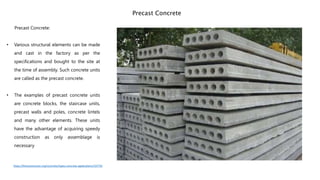
Precast Concrete:
• Various structural elements can be made
and cast in the factory as per the
specifications and bought to the site at
the time of assembly. Such concrete units
are called as the precast concrete.
• The examples of precast concrete units
are concrete blocks, the staircase units,
precast walls and poles, concrete lintels
and many other elements. These units
have the advantage of acquiring speedy
construction as only assemblage is
necessary
Precast Concrete
https://theconstructor.org/concrete/types-concrete-applications/19779/
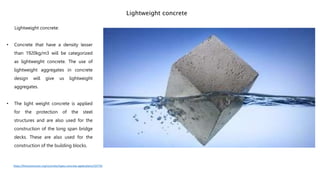
Lightweight concrete:
• Concrete that have a density lesser
than 1920kg/m3 will be categorized
as lightweight concrete. The use of
lightweight aggregates in concrete
design will give us lightweight
aggregates.
• The light weight concrete is applied
for the protection of the steel
structures and are also used for the
construction of the long span bridge
decks. These are also used for the
construction of the building blocks.
Lightweight concrete
https://theconstructor.org/concrete/types-concrete-applications/19779/
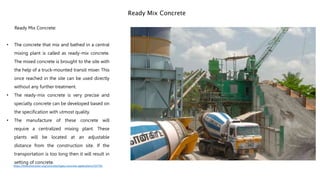
Ready Mix Concrete:
• The concrete that mix and bathed in a central
mixing plant is called as ready-mix concrete.
The mixed concrete is brought to the site with
the help of a truck-mounted transit mixer. This
once reached in the site can be used directly
without any further treatment.
• The ready-mix concrete is very precise and
specialty concrete can be developed based on
the specification with utmost quality.
• The manufacture of these concrete will
require a centralized mixing plant. These
plants will be located at an adjustable
distance from the construction site. If the
transportation is too long then it will result in
setting of concrete.
Ready Mix Concrete
https://theconstructor.org/concrete/types-concrete-applications/19779/
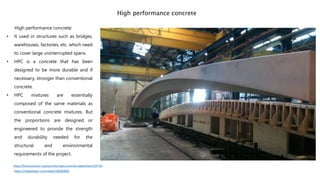
High performance concrete:
• It used in structures such as bridges,
warehouses, factories, etc. which need
to cover large uninterrupted spans.
• HPC is a concrete that has been
designed to be more durable and if
necessary, stronger than conventional
concrete.
• HPC mixtures are essentially
composed of the same materials as
conventional concrete mixtures. But
the proportions are designed or
engineered to provide the strength
and durability needed for the
structural and environmental
requirements of the project.
High performance concrete
https://theconstructor.org/concrete/types-concrete-applications/19779/
https://slideplayer.com/slide/10828300/
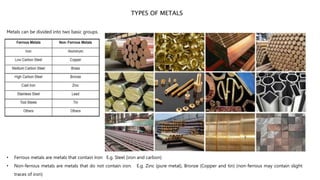
Metals can be divided into two basic groups.
TYPES OF METALS
• Ferrous metals are metals that contain Iron E.g. Steel (iron and carbon)
• Non-ferrous metals are metals that do not contain iron. E.g. Zinc (pure metal), Bronze (Copper and tin) (non-ferrous may contain slight
traces of iron)
f
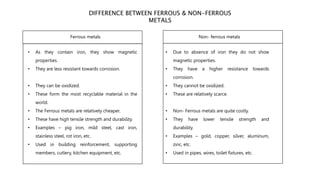
Ferrous metals
DIFFERENCE BETWEEN FERROUS & NON-FERROUS
METALS
• As they contain iron, they show magnetic
properties.
• They are less resistant towards corrosion.
• They can be oxidized.
• These form the most recyclable material in the
world.
• The Ferrous metals are relatively cheaper.
• These have high tensile strength and durability.
• Examples – pig iron, mild steel, cast iron,
stainless steel, rot iron, etc.
• Used in building reinforcement, supporting
members, cutlery, kitchen equipment, etc.
Non- ferrous metals
• Due to absence of iron they do not show
magnetic properties.
• They have a higher resistance towards
corrosion.
• They cannot be oxidized.
• These are relatively scarce.
• Non- Ferrous metals are quite costly.
• They have lower tensile strength and
durability.
• Examples – gold, copper, silver, aluminum,
zinc, etc.
• Used in pipes, wires, toilet fixtures, etc.
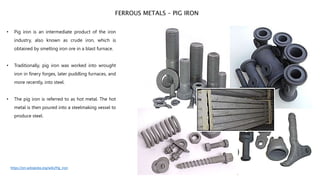
• Pig iron is an intermediate product of the iron
industry, also known as crude iron, which is
obtained by smelting iron ore in a blast furnace.
• Traditionally, pig iron was worked into wrought
iron in finery forges, later puddling furnaces, and
more recently, into steel.
• The pig iron is referred to as hot metal. The hot
metal is then poured into a steelmaking vessel to
produce steel.
FERROUS METALS – PIG IRON
https://en.wikipedia.org/wiki/Pig_iron
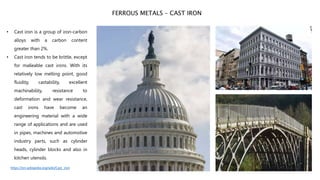
• Cast iron is a group of iron-carbon
alloys with a carbon content
greater than 2%.
• Cast iron tends to be brittle, except
for malleable cast irons. With its
relatively low melting point, good
fluidity, castability, excellent
machinability, resistance to
deformation and wear resistance,
cast irons have become an
engineering material with a wide
range of applications and are used
in pipes, machines and automotive
industry parts, such as cylinder
heads, cylinder blocks and also in
kitchen utensils.
FERROUS METALS – CAST IRON
https://en.wikipedia.org/wiki/Cast_iron
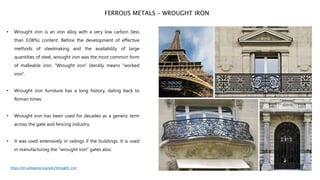
• Wrought iron is an iron alloy with a very low carbon (less
than 0.08%) content. Before the development of effective
methods of steelmaking and the availability of large
quantities of steel, wrought iron was the most common form
of malleable iron. “Wrought iron" literally means "worked
iron".
• Wrought iron furniture has a long history, dating back to
Roman times.
• Wrought iron has been used for decades as a generic term
across the gate and fencing industry.
• It was used extensively in railings if the buildings. It is used
in manufacturing the "wrought iron" gates also.
FERROUS METALS – WROUGHT IRON
https://en.wikipedia.org/wiki/Wrought_iron
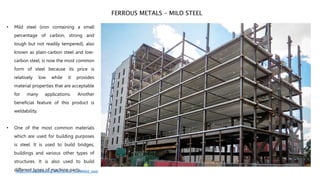
• Mild steel (iron containing a small
percentage of carbon, strong and
tough but not readily tempered), also
known as plain-carbon steel and low-
carbon steel, is now the most common
form of steel because its price is
relatively low while it provides
material properties that are acceptable
for many applications. Another
beneficial feature of this product is
weldability.
• One of the most common materials
which are used for building purposes
is steel. It is used to build bridges,
buildings and various other types of
structures. It is also used to build
different types of machine parts.
FERROUS METALS – MILD STEEL
https://en.wikipedia.org/wiki/Carbon_steel#Mild_steel
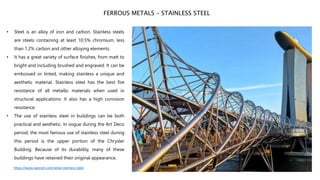
• Steel is an alloy of iron and carbon. Stainless steels
are steels containing at least 10.5% chromium, less
than 1.2% carbon and other alloying elements.
• It has a great variety of surface finishes, from matt to
bright and including brushed and engraved. It can be
embossed or tinted, making stainless a unique and
aesthetic material. Stainless steel has the best fire
resistance of all metallic materials when used in
structural applications. It also has a high corrosion
resistance.
• The use of stainless steel in buildings can be both
practical and aesthetic. In vogue during the Art Deco
period, the most famous use of stainless steel during
this period is the upper portion of the Chrysler
Building. Because of its durability, many of these
buildings have retained their original appearance.
FERROUS METALS – STAINLESS STEEL
https://www.aperam.com/what-stainless-steel
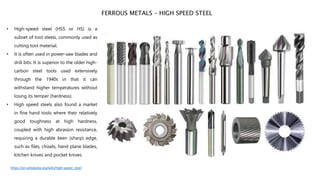
• High-speed steel (HSS or HS) is a
subset of tool steels, commonly used as
cutting tool material.
• It is often used in power-saw blades and
drill bits. It is superior to the older high-
carbon steel tools used extensively
through the 1940s in that it can
withstand higher temperatures without
losing its temper (hardness).
• High speed steels also found a market
in fine hand tools where their relatively
good toughness at high hardness,
coupled with high abrasion resistance,
requiring a durable keen (sharp) edge,
such as files, chisels, hand plane blades,
kitchen knives and pocket knives.
FERROUS METALS – HIGH SPEED STEEL
https://en.wikipedia.org/wiki/High-speed_steel
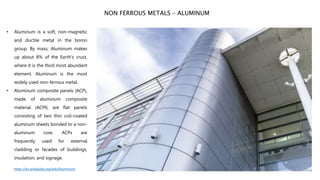
• Aluminum is a soft, non-magnetic
and ductile metal in the boron
group. By mass, Aluminum makes
up about 8% of the Earth's crust,
where it is the third most abundant
element. Aluminum is the most
widely used non-ferrous metal.
• Aluminum composite panels (ACP),
made of aluminum composite
material (ACM), are flat panels
consisting of two thin coil-coated
aluminum sheets bonded to a non-
aluminum core. ACPs are
frequently used for external
cladding or facades of buildings,
insulation, and signage.
NON FERROUS METALS – ALUMINUM
https://en.wikipedia.org/wiki/Aluminium
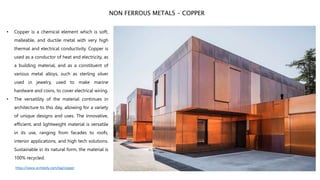
• Copper is a chemical element which is soft,
malleable, and ductile metal with very high
thermal and electrical conductivity. Copper is
used as a conductor of heat and electricity, as
a building material, and as a constituent of
various metal alloys, such as sterling silver
used in jewelry, used to make marine
hardware and coins, to cover electrical wiring.
• The versatility of the material continues in
architecture to this day, allowing for a variety
of unique designs and uses. The innovative,
efficient, and lightweight material is versatile
in its use, ranging from facades to roofs,
interior applications, and high tech solutions.
Sustainable in its natural form, the material is
100% recycled.
NON FERROUS METALS – COPPER
https://www.archdaily.com/tag/copper
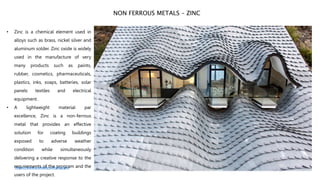
• Zinc is a chemical element used in
alloys such as brass, nickel silver and
aluminum solder. Zinc oxide is widely
used in the manufacture of very
many products such as paints,
rubber, cosmetics, pharmaceuticals,
plastics, inks, soaps, batteries, solar
panels textiles and electrical
equipment.
• A lightweight material par
excellence, Zinc is a non-ferrous
metal that provides an effective
solution for coating buildings
exposed to adverse weather
condition while simultaneously
delivering a creative response to the
requirements of the program and the
users of the project.
NON FERROUS METALS – ZINC
https://www.archdaily.com/tag/zinc
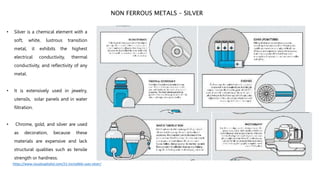
• Silver is a chemical element with a
soft, white, lustrous transition
metal, it exhibits the highest
electrical conductivity, thermal
conductivity, and reflectivity of any
metal.
• It is extensively used in jewelry,
utensils, solar panels and in water
filtration.
• Chrome, gold, and silver are used
as decoration, because these
materials are expensive and lack
structural qualities such as tensile
strength or hardness.
NON FERROUS METALS – SILVER
https://www.visualcapitalist.com/21-incredible-uses-silver/
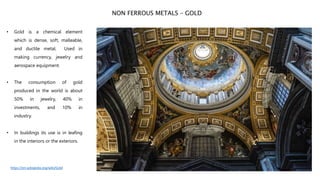
• Gold is a chemical element
which is dense, soft, malleable,
and ductile metal. Used in
making currency, jewelry and
aerospace equipment.
• The consumption of gold
produced in the world is about
50% in jewelry, 40% in
investments, and 10% in
industry.
• In buildings its use is in leafing
in the interiors or the exteriors.
NON FERROUS METALS – GOLD
https://en.wikipedia.org/wiki/Gold
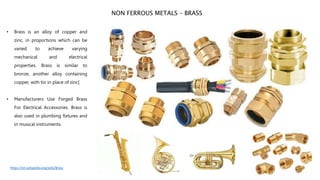
• Brass is an alloy of copper and
zinc, in proportions which can be
varied to achieve varying
mechanical and electrical
properties. Brass is similar to
bronze, another alloy containing
copper, with tin in place of zinc[
• Manufacturers Use Forged Brass
For Electrical Accessories. Brass is
also used in plumbing fixtures and
in musical instruments.
NON FERROUS METALS – BRASS
https://en.wikipedia.org/wiki/Brass
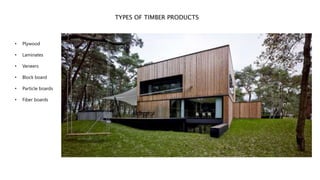
TYPES OF TIMBER PRODUCTS
• Plywood
• Laminates
• Veneers
• Block board
• Particle boards
• Fiber boards
TYPES OF TIMBER BOARDS
Timber Boards :
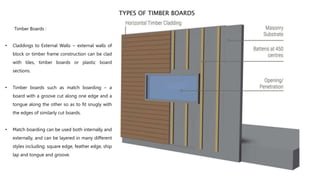
• Claddings to External Walls ~ external walls of
block or timber frame construction can be clad
with tiles, timber boards or plastic board
sections.
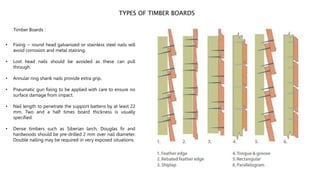
• Timber boards such as match boarding – a
board with a groove cut along one edge and a
tongue along the other so as to fit snugly with
the edges of similarly cut boards.
• Match boarding can be used both internally and
externally, and can be layered in many different
styles including: square edge, feather edge, ship
lap and tongue and groove.
TYPES OF TIMBER BOARDS
Timber Boards :
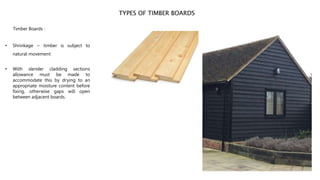
• Shrinkage ~ timber is subject to
natural movement
• With slender cladding sections
allowance must be made to
accommodate this by drying to an
appropriate moisture content before
fixing, otherwise gaps will open
between adjacent boards.
TYPES OF TIMBER BOARDS
Timber Boards :
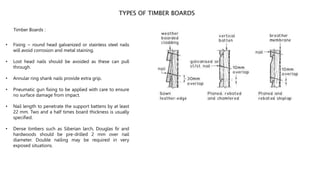
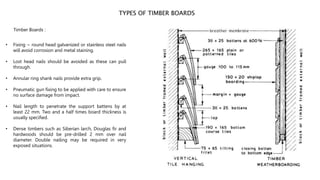
• Fixing ~ round head galvanized or stainless steel nails
will avoid corrosion and metal staining.
• Lost head nails should be avoided as these can pull
through.
• Annular ring shank nails provide extra grip.
• Pneumatic gun fixing to be applied with care to ensure
no surface damage from impact.
• Nail length to penetrate the support battens by at
least 22 mm. Two and a half times board thickness is
usually specified.
• Dense timbers such as Siberian larch, Douglas fir and
hardwoods should be pre-drilled 2 mm over nail
diameter. Double nailing may be required in very
exposed situations.
TYPES OF TIMBER BOARDS
Timber Boards :
• Fixing ~ round head galvanized or stainless steel nails will
avoid corrosion and metal staining.
• Lost head nails should be avoided as these can pull
through.
• Annular ring shank nails provide extra grip.
• Pneumatic gun fixing to be applied with care to ensure no
surface damage from impact.
• Nail length to penetrate the support battens by at least 22
mm. Two and a half times board thickness is usually
specified.
• Dense timbers such as Siberian larch, Douglas fir and
hardwoods should be pre-drilled 2 mm over nail diameter.
Double nailing may be required in very exposed situations.
TYPES OF TIMBER BOARDS
Timber Boards :
• Fixing ~ round head galvanized or stainless steel nails
will avoid corrosion and metal staining.
• Lost head nails should be avoided as these can pull
through.
• Annular ring shank nails provide extra grip.
• Pneumatic gun fixing to be applied with care to ensure
no surface damage from impact.
• Nail length to penetrate the support battens by at least
22 mm. Two and a half times board thickness is usually
specified.
• Dense timbers such as Siberian larch, Douglas fir and
hardwoods should be pre-drilled 2 mm over nail
diameter. Double nailing may be required in very
exposed situations.
TYPES OF TIMBER BOARDS
Timber Boards : Materials
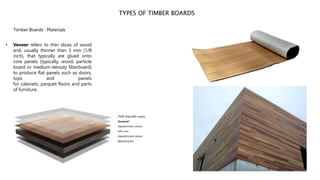
• Veneer refers to thin slices of wood
and, usually thinner than 3 mm (1/8
inch), that typically are glued onto
core panels (typically, wood, particle
board or medium-density fiberboard)
to produce flat panels such as doors,
tops and panels
for cabinets, parquet floors and parts
of furniture.
TYPES OF TIMBER BOARDS
Timber Boards : Materials
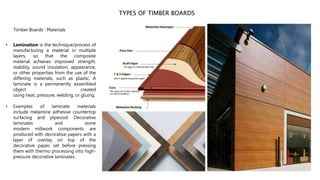
• Lamination is the technique/process of
manufacturing a material in multiple
layers, so that the composite
material achieves improved strength,
stability, sound insulation, appearance,
or other properties from the use of the
differing materials, such as plastic. A
laminate is a permanently assembled
object created
using heat, pressure, welding, or gluing.
• Examples of laminate materials
include melamine adhesive countertop
surfacing and plywood. Decorative
laminates and some
modern millwork components are
produced with decorative papers with a
layer of overlay on top of the
decorative paper, set before pressing
them with thermo processing into high-
pressure decorative laminates.
TYPES OF TIMBER BOARDS
Timber Boards : Materials
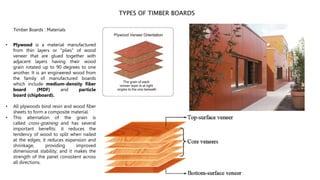
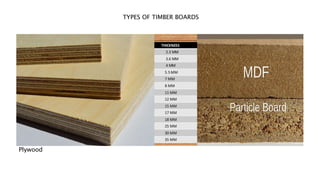
• Plywood is a material manufactured
from thin layers or "plies" of wood
veneer that are glued together with
adjacent layers having their wood
grain rotated up to 90 degrees to one
another. It is an engineered wood from
the family of manufactured boards
which include medium-density fiber
board (MDF) and particle
board (chipboard).
• All plywoods bind resin and wood fiber
sheets to form a composite material.
• This alternation of the grain is
called cross-graining and has several
important benefits: it reduces the
tendency of wood to split when nailed
at the edges; it reduces expansion and
shrinkage, providing improved
dimensional stability; and it makes the
strength of the panel consistent across
all directions.
Plywood
TYPES OF TIMBER BOARDS

Lecture 7 - Advanced BUILDING MATERIALS.pptx

  • 1.
  • 2.
    BUILDING MATERIALS CEMENT, CONCRETE TIMBER Plain or Ordinary Concrete Reinforced Cement Concrete PrecastConcrete Ready Mix Concrete Plywood Laminates Veneers Prestresse d Concrete Please note: Core building materials are the ones which are actually used in the construction of load bearing structures as well as surface treatments. There are further more types of concrete, metals and timber which would be mentioned and elaborated upon later in the presentation. METAL(FERROUS & NON FERROUS) Aluminium Copper Nickel Stainless steel Magnesiu m CORE BUILDING MATERIALS
  • 3.
    1. Ordinary PortlandCement (OPC) 2. Portland Pozzolana Cement (PPC) 3. Rapid Hardening Cement 4. Quick Setting Cement 5. Low Heat Cement 6. Sulphate Resisting Cement 7. Blast Furnace Cement 8. High Alumina Cement 9. White Cement 10. Colored Cement 11. Air Entraining Cement 12. Expansive Cement 13. Hydrophobic Cement TYPES OF CEMENT https://civiltoday.com/civil-engineering- materials/cement/250-types-of-cement
  • 4.
    CEMENT - CONCRETE •DEFINITION: Concrete is a construction material composed of cement, fine aggregates (sand) and coarse aggregates mixed with water in different proportions which hardens with time. Portland cement is the commonly used type of cement for production of concrete. Concrete technology deals with study of properties of concrete and its practical applications. • In a building construction, concrete is used for the construction of foundations, columns, beams, slabs, staircases and other load bearing elements. • Materials are mixed in specific proportions to obtain the required strength. Strength of mix is specified as M5, M10, M15, M20, M25, M30 etc. where M signifies Mix and 5, 10, 15 etc. as their strength in kN/m2. Source - https://theconstructor.org/concrete/ • Concrete is manufactured or mixed in proportions w.r.t. cement quantity. There are two types of concrete mixes, i.e. nominal mix and design mix. Nominal mix is used for normal construction works such as small residential buildings. Most popular nominal mix are in the proportion of 1:2:4. Design mixed concrete are those for which mix proportions are finalized based on various lab tests on cylinder or cube for its compressive strength.
  • 5.
    MIXING IN CONCRETE •Once suitable mix proportions are known, then its ingredients are mixed in the ratio as selected. Two methods are used for mixing, i.e. Hand Mixing or Machine Mixing. • Based on quantity and quality required, the suitable method of mixing is selected. In the hand mixing, each ingredients are placed on a flat surface and water is added and mixed with hand tools. In machine mixing, different types of machines are used. In this case, the ingredients are added in required quantity to mix and produce fresh concrete. • Once the it is mixed adequately it is transported to casting location and poured in formworks. Source - https://theconstructor.org/concrete/
  • 6.
    • The removalof concrete formwork also called as strike-off or stripping of formwork should be carried out only after the time when concrete has gained sufficient strength. It is also necessary to ensure the stability of the remaining formwork during formwork removal. FORM-WORK IN CONCRETE Type of Formwork Formwork Removal Time Sides of Walls, Columns and Vertical faces of beam 24 hours to 48 hours (as per engineer’s decision) Slabs (props left under) 3 days Beam soffits (props left under) 7 days Removal of Props of Slabs: i) Slabs spanning up to 4.5m 14 days ii) Slabs spanning over 4.5m 14 days Removal of props for beams and arches i) Span up to 6m 14 days ii) Span over 6m 21 days Formwork Stripping Time (When Ordinary Portland Cement is used): Data source - https://theconstructor.org/building/formwork-removal-time-specification/11083/
  • 7.
    • Various typesof formworks are available such as wooden, metal ,etc. which are selected based on usage. • Poured concrete is allowed to set in formworks for specified time based on type of structural member to gain sufficient strength. • After removal of formwork, curing is done by various methods to make up the moisture loss due to evaporation. Hydration reaction requires moisture which is responsible for setting and strength gain. So, curing is generally continued for minimum 7 days after removal of formwork. FORM-WORK IN CONCRETE
  • 8.
    Steps of ConcreteConstruction: 1. Selecting quantities of materials for selected mix proportion 2. Mixing 3. Checking of workability 4. Transportation 5. Pouring in formwork for casting 6. Vibrating for proper compaction 7. Removal of formwork after suitable time 8. Curing member with suitable methods and required time. Concrete is used extremely widely in building and civil engineering structures, due to its low cost, flexibility, durability, and high strength. It also has high resistance to fire. Concrete is a non-linear, non-elastic and brittle material. It is strong in compression and very weak in tension CONSTRUCTION IN CONCRETE
  • 9.
    1. P.C.C. (Plaincement concrete) 2. R.C.C. (Reinforced cement concrete) 3. Prestressed Concrete 4. Precast Concrete 5. Lightweight Concrete 6. Ready Mix Concrete 7. High-Performance Concrete TYPES OF CONCRETE
  • 10.
    P.C.C. (Plain cementconcrete): • The plain concrete will have no reinforcement in it. The main constituents are the cement, aggregates, and water. Most commonly used mix design is 1:2:4 which is the normal mix design. • These types of concrete are mainly used in the construction of the pavements and the buildings, especially in areas where there is less demand of high tensile strength. The durability given by these type of concrete is satisfactory to high extent. P. C.C. https://theconstructor.org/concrete/types-concrete-applications/19779/
  • 11.
    R.C.C. (Plain cementconcrete): • The reinforced cement concrete is defined as the concrete to which reinforcement is introduced to bear the tensile strength. Plain concrete is weak in tension and good in compression. • Hence the placement of reinforcement will take up the responsibility of bearing the tensile stresses. R.C.C works with the combined action of the plain concrete and the reinforcement. • The steel reinforcement used in the concrete can be in the form of rods, bars or in the form of meshes. Now fibers are also developed as reinforcement. R.C.C. https://theconstructor.org/concrete/types-concrete-applications/19779/
  • 12.
    Prestressed Concrete: • Mostof the mega concrete projects are carried out through prestressed concrete units. This is a special technique in which the bars or the tendons used in the concrete is stressed before the actual service load application. • During the mixing and the placing of the concrete, these tensioned bars placed firmly and held from each end of the structural unit. Once the concrete sets and harden, the structural unit will be put in compression. Prestressed Concrete https://theconstructor.org/concrete/types-concrete-applications/19779/
  • 13.
    Precast Concrete: • Variousstructural elements can be made and cast in the factory as per the specifications and bought to the site at the time of assembly. Such concrete units are called as the precast concrete. • The examples of precast concrete units are concrete blocks, the staircase units, precast walls and poles, concrete lintels and many other elements. These units have the advantage of acquiring speedy construction as only assemblage is necessary Precast Concrete https://theconstructor.org/concrete/types-concrete-applications/19779/
  • 14.
    Lightweight concrete: • Concretethat have a density lesser than 1920kg/m3 will be categorized as lightweight concrete. The use of lightweight aggregates in concrete design will give us lightweight aggregates. • The light weight concrete is applied for the protection of the steel structures and are also used for the construction of the long span bridge decks. These are also used for the construction of the building blocks. Lightweight concrete https://theconstructor.org/concrete/types-concrete-applications/19779/
  • 15.
    Ready Mix Concrete: •The concrete that mix and bathed in a central mixing plant is called as ready-mix concrete. The mixed concrete is brought to the site with the help of a truck-mounted transit mixer. This once reached in the site can be used directly without any further treatment. • The ready-mix concrete is very precise and specialty concrete can be developed based on the specification with utmost quality. • The manufacture of these concrete will require a centralized mixing plant. These plants will be located at an adjustable distance from the construction site. If the transportation is too long then it will result in setting of concrete. Ready Mix Concrete https://theconstructor.org/concrete/types-concrete-applications/19779/
  • 16.
    High performance concrete: •It used in structures such as bridges, warehouses, factories, etc. which need to cover large uninterrupted spans. • HPC is a concrete that has been designed to be more durable and if necessary, stronger than conventional concrete. • HPC mixtures are essentially composed of the same materials as conventional concrete mixtures. But the proportions are designed or engineered to provide the strength and durability needed for the structural and environmental requirements of the project. High performance concrete https://theconstructor.org/concrete/types-concrete-applications/19779/ https://slideplayer.com/slide/10828300/
  • 17.
    Metals can bedivided into two basic groups. TYPES OF METALS • Ferrous metals are metals that contain Iron E.g. Steel (iron and carbon) • Non-ferrous metals are metals that do not contain iron. E.g. Zinc (pure metal), Bronze (Copper and tin) (non-ferrous may contain slight traces of iron) f
  • 18.
    Ferrous metals DIFFERENCE BETWEENFERROUS & NON-FERROUS METALS • As they contain iron, they show magnetic properties. • They are less resistant towards corrosion. • They can be oxidized. • These form the most recyclable material in the world. • The Ferrous metals are relatively cheaper. • These have high tensile strength and durability. • Examples – pig iron, mild steel, cast iron, stainless steel, rot iron, etc. • Used in building reinforcement, supporting members, cutlery, kitchen equipment, etc. Non- ferrous metals • Due to absence of iron they do not show magnetic properties. • They have a higher resistance towards corrosion. • They cannot be oxidized. • These are relatively scarce. • Non- Ferrous metals are quite costly. • They have lower tensile strength and durability. • Examples – gold, copper, silver, aluminum, zinc, etc. • Used in pipes, wires, toilet fixtures, etc.
  • 19.
    • Pig ironis an intermediate product of the iron industry, also known as crude iron, which is obtained by smelting iron ore in a blast furnace. • Traditionally, pig iron was worked into wrought iron in finery forges, later puddling furnaces, and more recently, into steel. • The pig iron is referred to as hot metal. The hot metal is then poured into a steelmaking vessel to produce steel. FERROUS METALS – PIG IRON https://en.wikipedia.org/wiki/Pig_iron
  • 20.
    • Cast ironis a group of iron-carbon alloys with a carbon content greater than 2%. • Cast iron tends to be brittle, except for malleable cast irons. With its relatively low melting point, good fluidity, castability, excellent machinability, resistance to deformation and wear resistance, cast irons have become an engineering material with a wide range of applications and are used in pipes, machines and automotive industry parts, such as cylinder heads, cylinder blocks and also in kitchen utensils. FERROUS METALS – CAST IRON https://en.wikipedia.org/wiki/Cast_iron
  • 21.
    • Wrought ironis an iron alloy with a very low carbon (less than 0.08%) content. Before the development of effective methods of steelmaking and the availability of large quantities of steel, wrought iron was the most common form of malleable iron. “Wrought iron" literally means "worked iron". • Wrought iron furniture has a long history, dating back to Roman times. • Wrought iron has been used for decades as a generic term across the gate and fencing industry. • It was used extensively in railings if the buildings. It is used in manufacturing the "wrought iron" gates also. FERROUS METALS – WROUGHT IRON https://en.wikipedia.org/wiki/Wrought_iron
  • 22.
    • Mild steel(iron containing a small percentage of carbon, strong and tough but not readily tempered), also known as plain-carbon steel and low- carbon steel, is now the most common form of steel because its price is relatively low while it provides material properties that are acceptable for many applications. Another beneficial feature of this product is weldability. • One of the most common materials which are used for building purposes is steel. It is used to build bridges, buildings and various other types of structures. It is also used to build different types of machine parts. FERROUS METALS – MILD STEEL https://en.wikipedia.org/wiki/Carbon_steel#Mild_steel
  • 23.
    • Steel isan alloy of iron and carbon. Stainless steels are steels containing at least 10.5% chromium, less than 1.2% carbon and other alloying elements. • It has a great variety of surface finishes, from matt to bright and including brushed and engraved. It can be embossed or tinted, making stainless a unique and aesthetic material. Stainless steel has the best fire resistance of all metallic materials when used in structural applications. It also has a high corrosion resistance. • The use of stainless steel in buildings can be both practical and aesthetic. In vogue during the Art Deco period, the most famous use of stainless steel during this period is the upper portion of the Chrysler Building. Because of its durability, many of these buildings have retained their original appearance. FERROUS METALS – STAINLESS STEEL https://www.aperam.com/what-stainless-steel
  • 24.
    • High-speed steel(HSS or HS) is a subset of tool steels, commonly used as cutting tool material. • It is often used in power-saw blades and drill bits. It is superior to the older high- carbon steel tools used extensively through the 1940s in that it can withstand higher temperatures without losing its temper (hardness). • High speed steels also found a market in fine hand tools where their relatively good toughness at high hardness, coupled with high abrasion resistance, requiring a durable keen (sharp) edge, such as files, chisels, hand plane blades, kitchen knives and pocket knives. FERROUS METALS – HIGH SPEED STEEL https://en.wikipedia.org/wiki/High-speed_steel
  • 25.
    • Aluminum isa soft, non-magnetic and ductile metal in the boron group. By mass, Aluminum makes up about 8% of the Earth's crust, where it is the third most abundant element. Aluminum is the most widely used non-ferrous metal. • Aluminum composite panels (ACP), made of aluminum composite material (ACM), are flat panels consisting of two thin coil-coated aluminum sheets bonded to a non- aluminum core. ACPs are frequently used for external cladding or facades of buildings, insulation, and signage. NON FERROUS METALS – ALUMINUM https://en.wikipedia.org/wiki/Aluminium
  • 26.
    • Copper isa chemical element which is soft, malleable, and ductile metal with very high thermal and electrical conductivity. Copper is used as a conductor of heat and electricity, as a building material, and as a constituent of various metal alloys, such as sterling silver used in jewelry, used to make marine hardware and coins, to cover electrical wiring. • The versatility of the material continues in architecture to this day, allowing for a variety of unique designs and uses. The innovative, efficient, and lightweight material is versatile in its use, ranging from facades to roofs, interior applications, and high tech solutions. Sustainable in its natural form, the material is 100% recycled. NON FERROUS METALS – COPPER https://www.archdaily.com/tag/copper
  • 27.
    • Zinc isa chemical element used in alloys such as brass, nickel silver and aluminum solder. Zinc oxide is widely used in the manufacture of very many products such as paints, rubber, cosmetics, pharmaceuticals, plastics, inks, soaps, batteries, solar panels textiles and electrical equipment. • A lightweight material par excellence, Zinc is a non-ferrous metal that provides an effective solution for coating buildings exposed to adverse weather condition while simultaneously delivering a creative response to the requirements of the program and the users of the project. NON FERROUS METALS – ZINC https://www.archdaily.com/tag/zinc
  • 28.
    • Silver isa chemical element with a soft, white, lustrous transition metal, it exhibits the highest electrical conductivity, thermal conductivity, and reflectivity of any metal. • It is extensively used in jewelry, utensils, solar panels and in water filtration. • Chrome, gold, and silver are used as decoration, because these materials are expensive and lack structural qualities such as tensile strength or hardness. NON FERROUS METALS – SILVER https://www.visualcapitalist.com/21-incredible-uses-silver/
  • 29.
    • Gold isa chemical element which is dense, soft, malleable, and ductile metal. Used in making currency, jewelry and aerospace equipment. • The consumption of gold produced in the world is about 50% in jewelry, 40% in investments, and 10% in industry. • In buildings its use is in leafing in the interiors or the exteriors. NON FERROUS METALS – GOLD https://en.wikipedia.org/wiki/Gold
  • 30.
    • Brass isan alloy of copper and zinc, in proportions which can be varied to achieve varying mechanical and electrical properties. Brass is similar to bronze, another alloy containing copper, with tin in place of zinc[ • Manufacturers Use Forged Brass For Electrical Accessories. Brass is also used in plumbing fixtures and in musical instruments. NON FERROUS METALS – BRASS https://en.wikipedia.org/wiki/Brass
  • 31.
    TYPES OF TIMBERPRODUCTS • Plywood • Laminates • Veneers • Block board • Particle boards • Fiber boards
  • 32.
    TYPES OF TIMBERBOARDS Timber Boards : • Claddings to External Walls ~ external walls of block or timber frame construction can be clad with tiles, timber boards or plastic board sections. • Timber boards such as match boarding – a board with a groove cut along one edge and a tongue along the other so as to fit snugly with the edges of similarly cut boards. • Match boarding can be used both internally and externally, and can be layered in many different styles including: square edge, feather edge, ship lap and tongue and groove.
  • 33.
    TYPES OF TIMBERBOARDS Timber Boards : • Shrinkage ~ timber is subject to natural movement • With slender cladding sections allowance must be made to accommodate this by drying to an appropriate moisture content before fixing, otherwise gaps will open between adjacent boards.
  • 34.
    TYPES OF TIMBERBOARDS Timber Boards : • Fixing ~ round head galvanized or stainless steel nails will avoid corrosion and metal staining. • Lost head nails should be avoided as these can pull through. • Annular ring shank nails provide extra grip. • Pneumatic gun fixing to be applied with care to ensure no surface damage from impact. • Nail length to penetrate the support battens by at least 22 mm. Two and a half times board thickness is usually specified. • Dense timbers such as Siberian larch, Douglas fir and hardwoods should be pre-drilled 2 mm over nail diameter. Double nailing may be required in very exposed situations.
  • 35.
    TYPES OF TIMBERBOARDS Timber Boards : • Fixing ~ round head galvanized or stainless steel nails will avoid corrosion and metal staining. • Lost head nails should be avoided as these can pull through. • Annular ring shank nails provide extra grip. • Pneumatic gun fixing to be applied with care to ensure no surface damage from impact. • Nail length to penetrate the support battens by at least 22 mm. Two and a half times board thickness is usually specified. • Dense timbers such as Siberian larch, Douglas fir and hardwoods should be pre-drilled 2 mm over nail diameter. Double nailing may be required in very exposed situations.
  • 36.
    TYPES OF TIMBERBOARDS Timber Boards : • Fixing ~ round head galvanized or stainless steel nails will avoid corrosion and metal staining. • Lost head nails should be avoided as these can pull through. • Annular ring shank nails provide extra grip. • Pneumatic gun fixing to be applied with care to ensure no surface damage from impact. • Nail length to penetrate the support battens by at least 22 mm. Two and a half times board thickness is usually specified. • Dense timbers such as Siberian larch, Douglas fir and hardwoods should be pre-drilled 2 mm over nail diameter. Double nailing may be required in very exposed situations.
  • 37.
    TYPES OF TIMBERBOARDS Timber Boards : Materials • Veneer refers to thin slices of wood and, usually thinner than 3 mm (1/8 inch), that typically are glued onto core panels (typically, wood, particle board or medium-density fiberboard) to produce flat panels such as doors, tops and panels for cabinets, parquet floors and parts of furniture.
  • 38.
    TYPES OF TIMBERBOARDS Timber Boards : Materials • Lamination is the technique/process of manufacturing a material in multiple layers, so that the composite material achieves improved strength, stability, sound insulation, appearance, or other properties from the use of the differing materials, such as plastic. A laminate is a permanently assembled object created using heat, pressure, welding, or gluing. • Examples of laminate materials include melamine adhesive countertop surfacing and plywood. Decorative laminates and some modern millwork components are produced with decorative papers with a layer of overlay on top of the decorative paper, set before pressing them with thermo processing into high- pressure decorative laminates.
  • 39.
    TYPES OF TIMBERBOARDS Timber Boards : Materials • Plywood is a material manufactured from thin layers or "plies" of wood veneer that are glued together with adjacent layers having their wood grain rotated up to 90 degrees to one another. It is an engineered wood from the family of manufactured boards which include medium-density fiber board (MDF) and particle board (chipboard). • All plywoods bind resin and wood fiber sheets to form a composite material. • This alternation of the grain is called cross-graining and has several important benefits: it reduces the tendency of wood to split when nailed at the edges; it reduces expansion and shrinkage, providing improved dimensional stability; and it makes the strength of the panel consistent across all directions.
  • 40.