Biofluid Mechanics and Heat Transfer
Course Code: 04041115
Lecture 06: Basic Equations of Fluid Mechanics
Date: 31/07/2023
Course Teacher: Tohfatul Jinan
Lecturer
Department of Biomedical Engineering BUHS
BANGLADESH UNIVERSITY OF HEALTH SCIENCES
Department of Biomedical Engineering
1
2
Bernoulli Equation
3
4
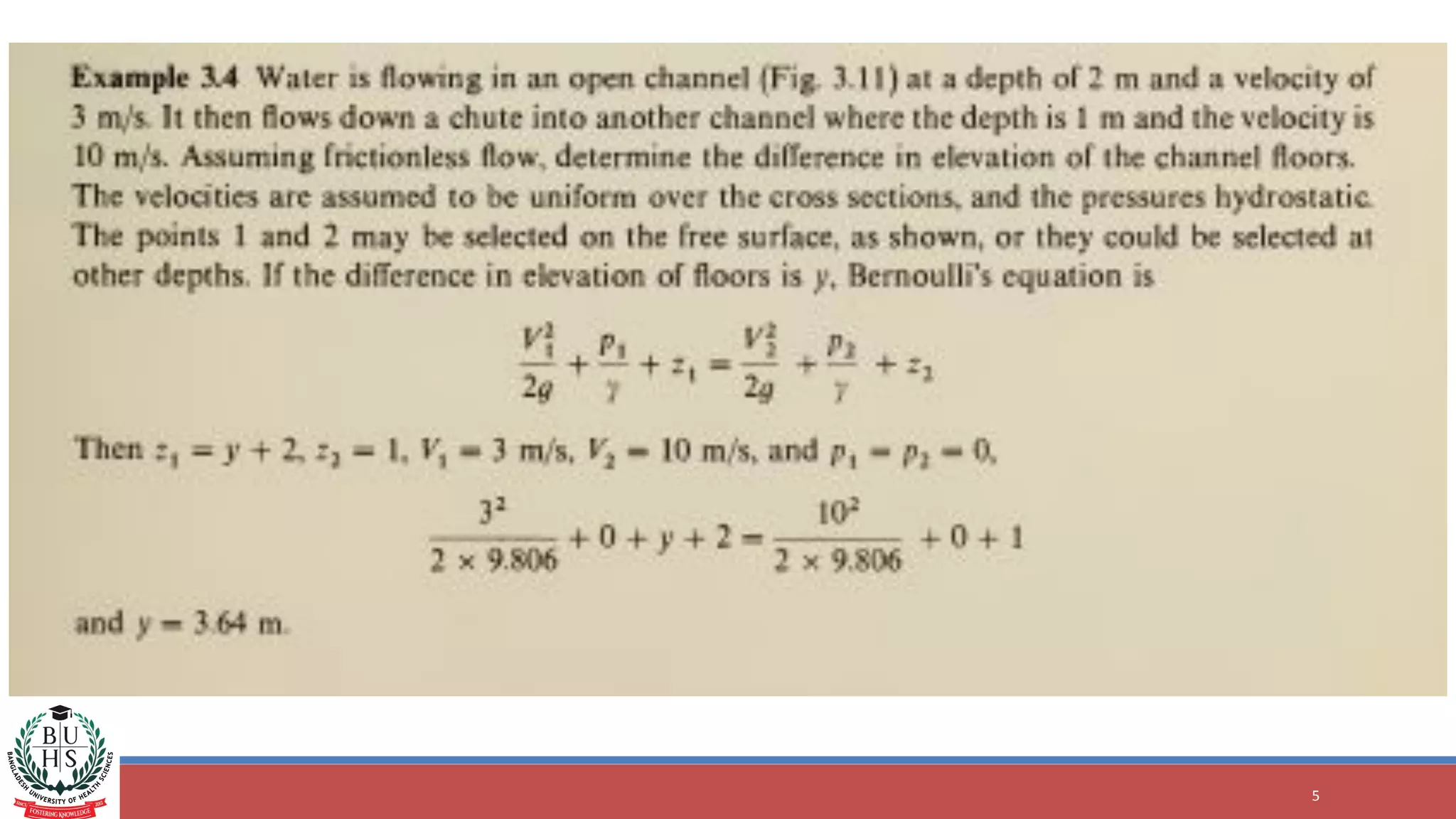
Problem 1
5
6
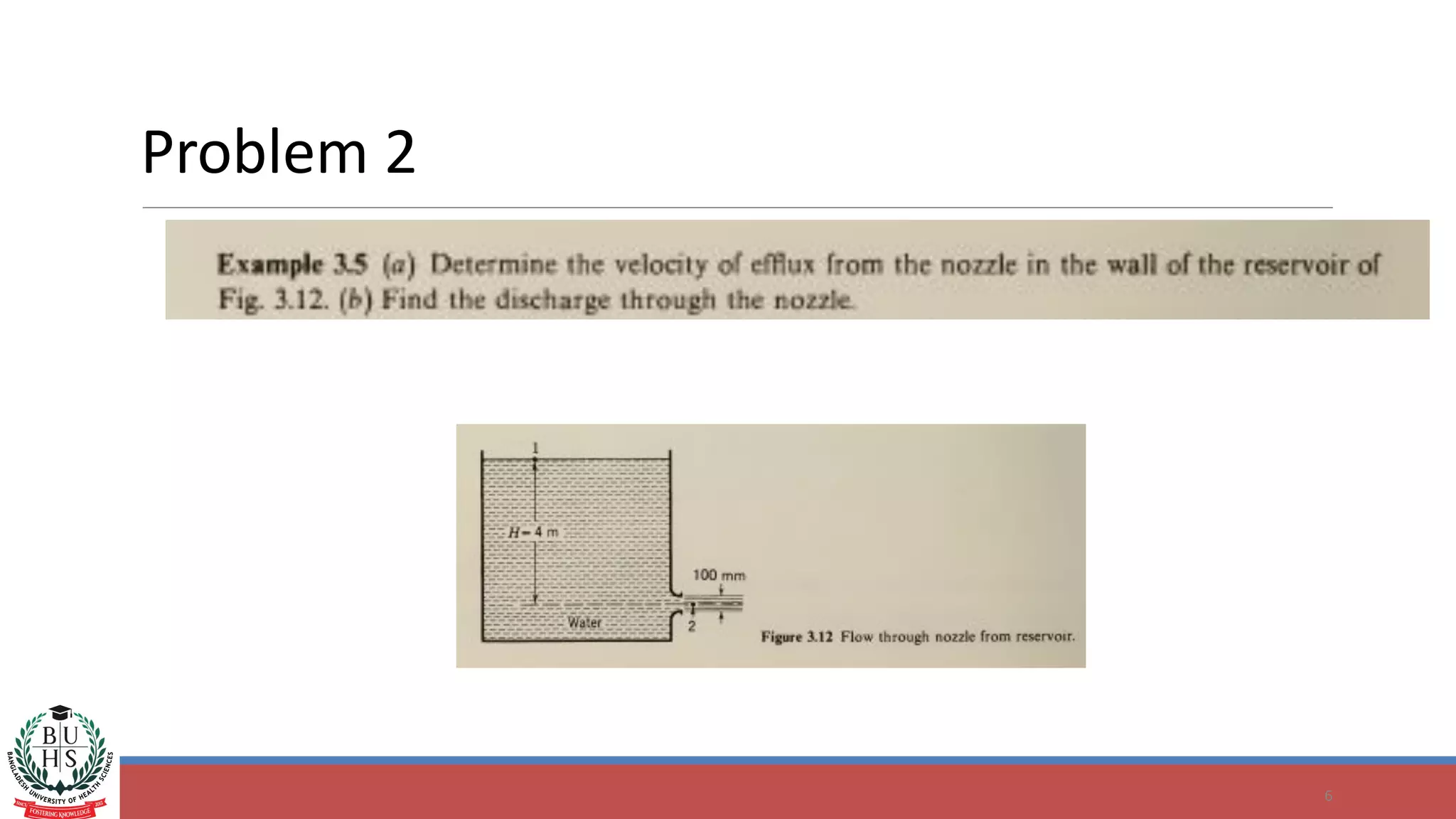
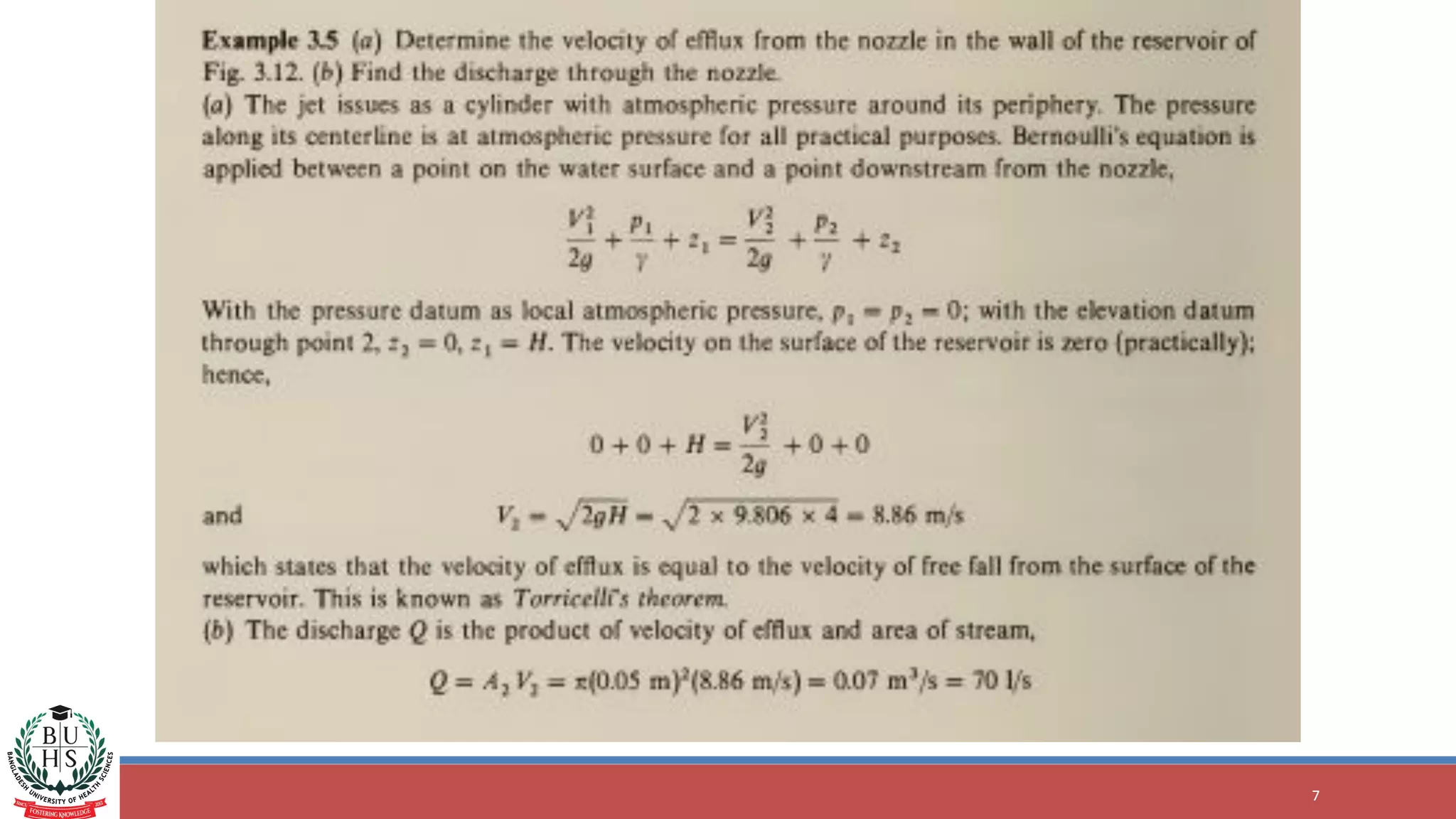
Problem 2
7
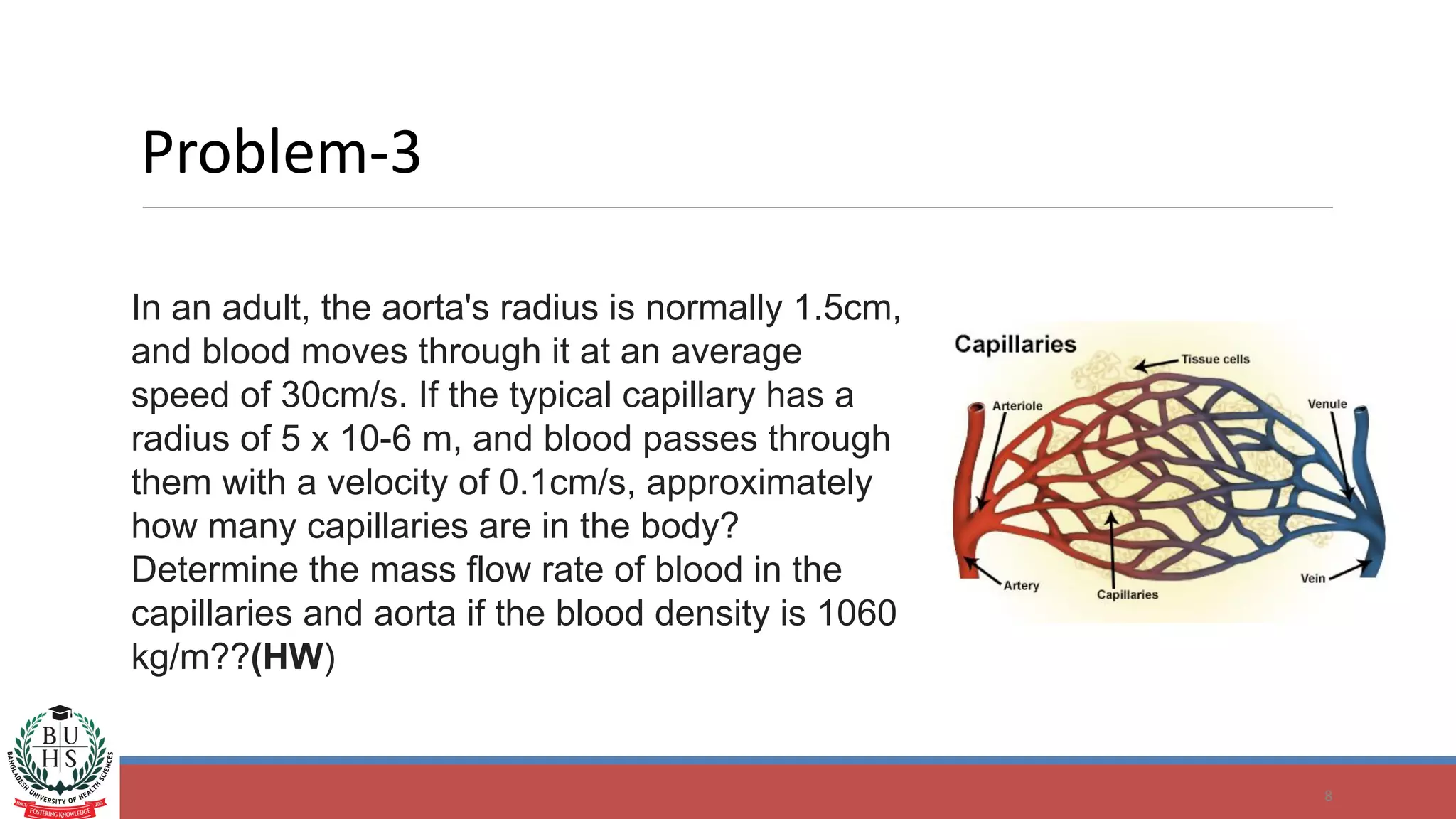
Problem-3
8
In an adult, the aorta's radius is normally 1.5cm,
and blood moves through it at an average
speed of 30cm/s. If the typical capillary has a
radius of 5 x 10⁻⁶ m, and blood passes through
them with a velocity of 0.1cm/s, approximately
how many capillaries are in the body?
Determine the mass flow rate of blood in the
capillaries and aorta if the blood density is 1060
kg/m??(HW)
9
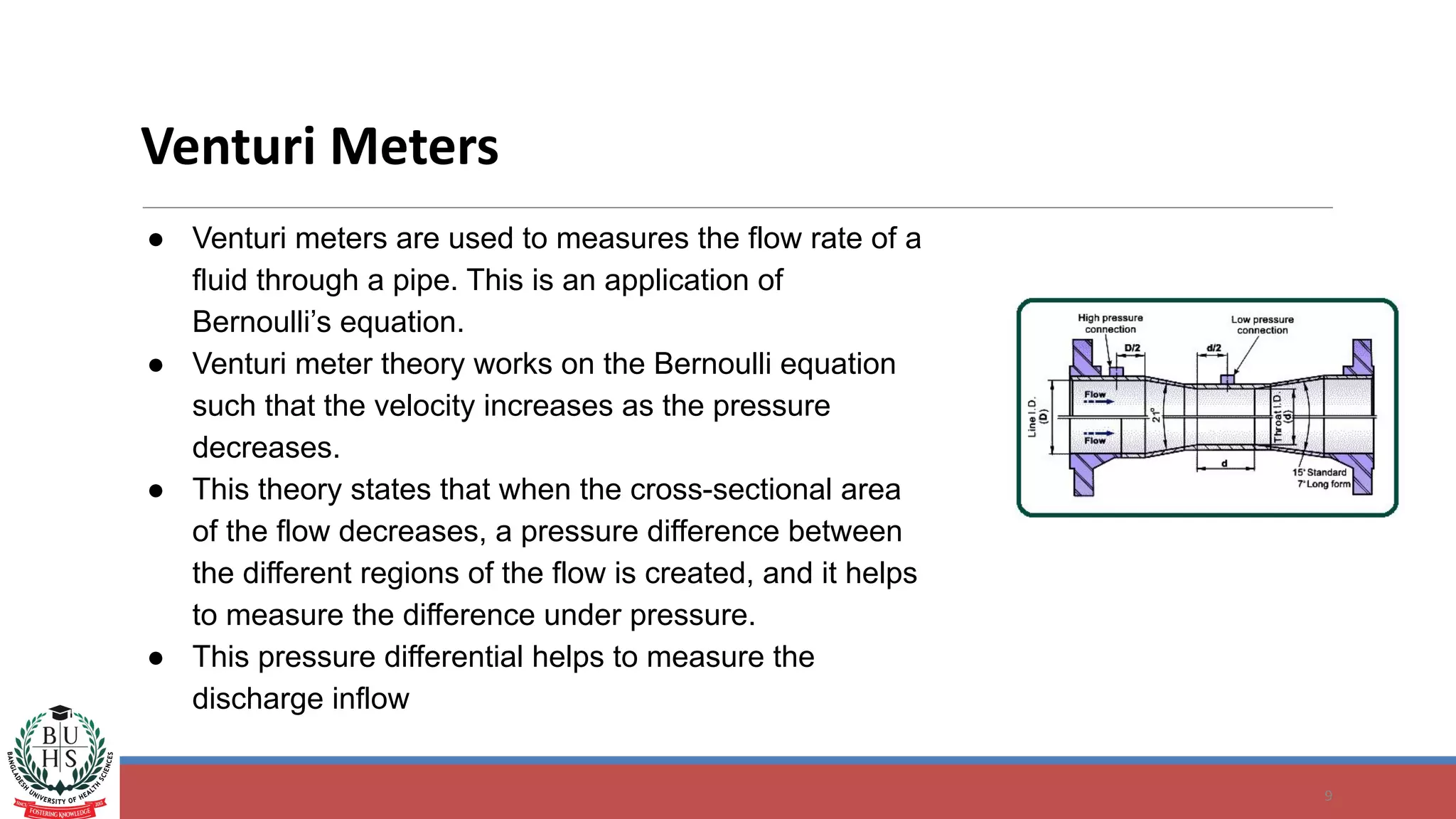
Venturi Meters
● Venturi meters are used to measures the flow rate of a
fluid through a pipe. This is an application of
Bernoulli’s equation.
● Venturi meter theory works on the Bernoulli equation
such that the velocity increases as the pressure
decreases.
● This theory states that when the cross-sectional area
of the flow decreases, a pressure difference between
the different regions of the flow is created, and it helps
to measure the difference under pressure.
● This pressure differential helps to measure the
discharge inflow
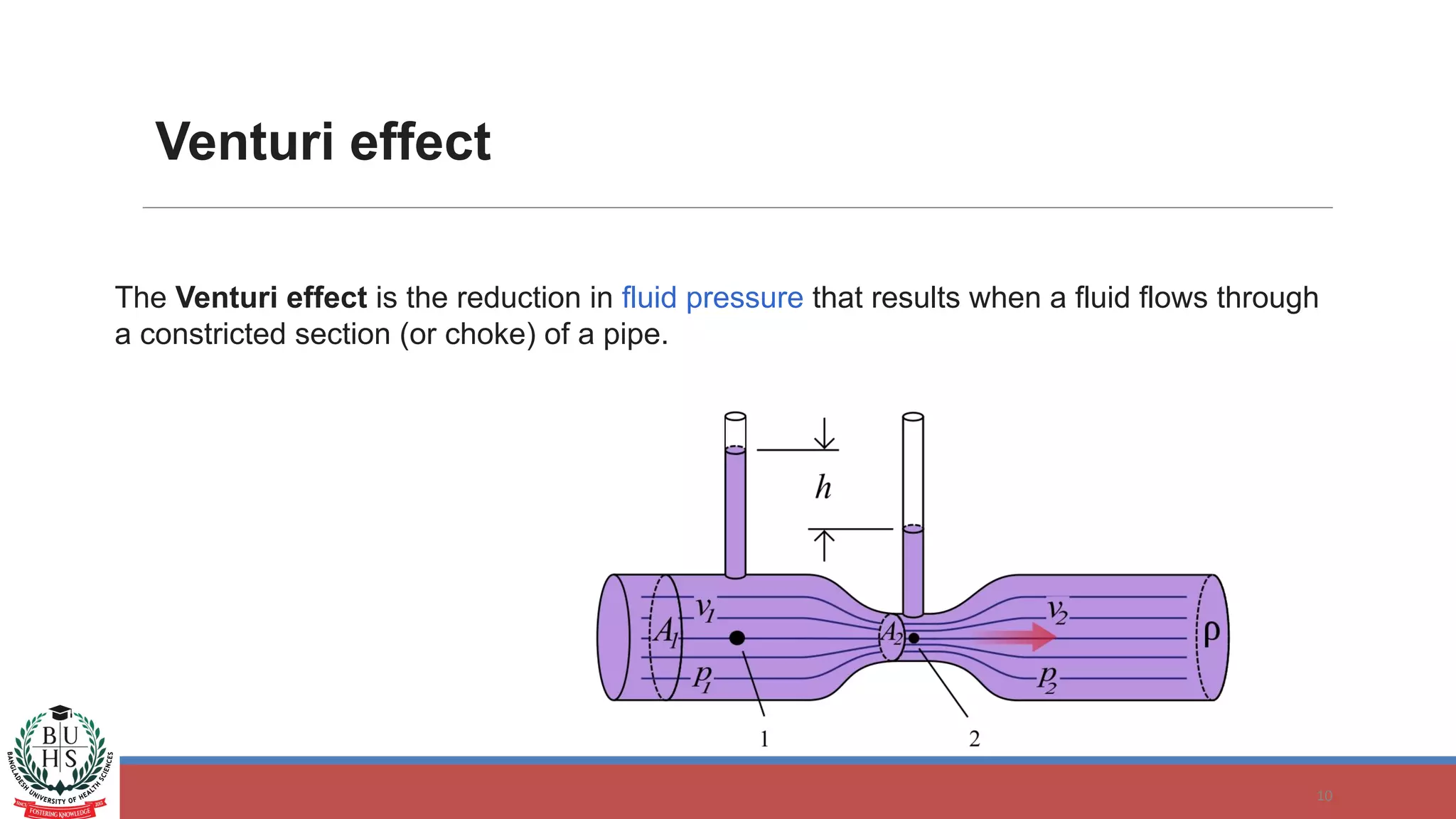
Venturi effect
10
The Venturi effect is the reduction in fluid pressure that results when a fluid flows through
a constricted section (or choke) of a pipe.
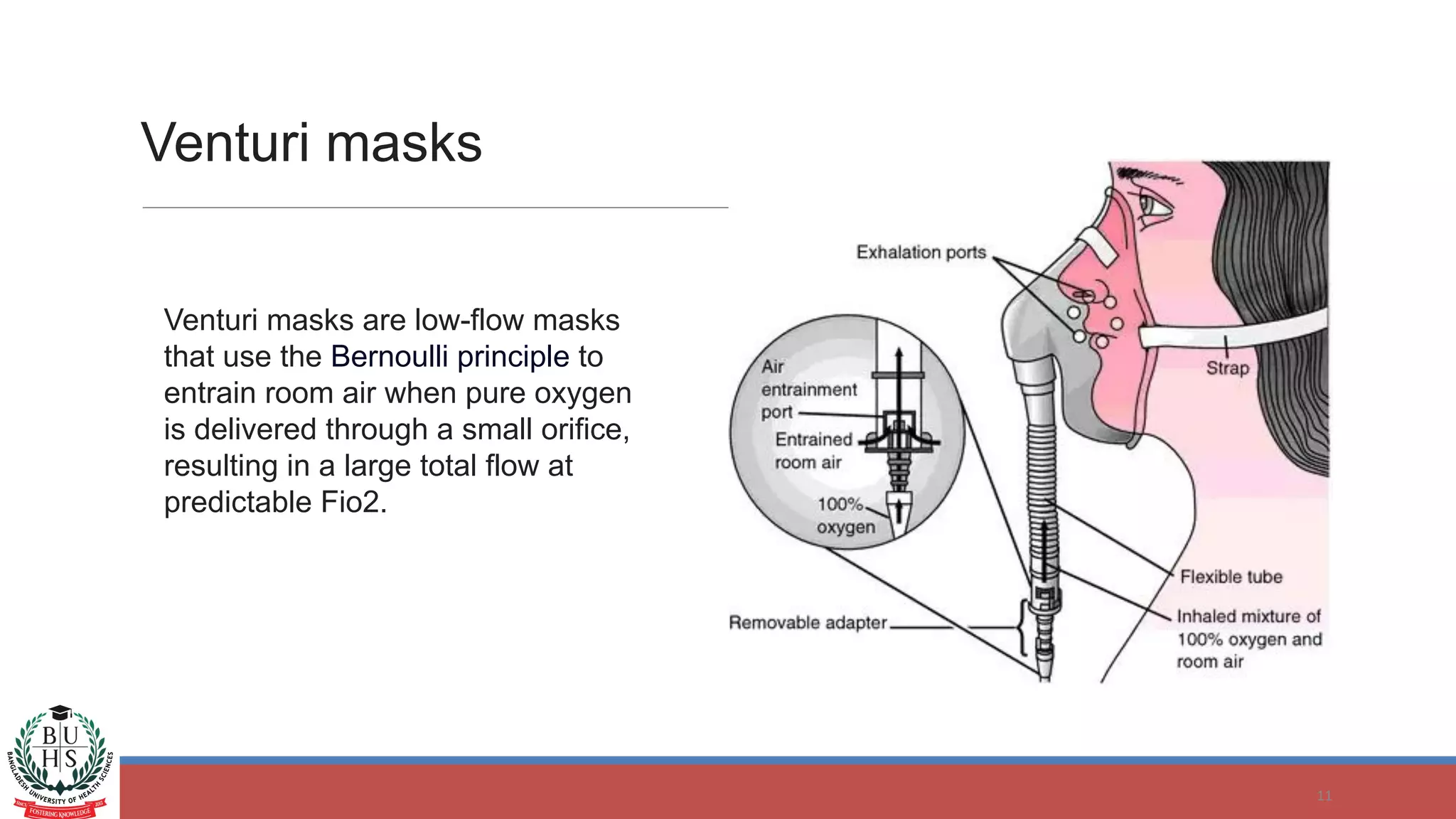
Venturi masks
11
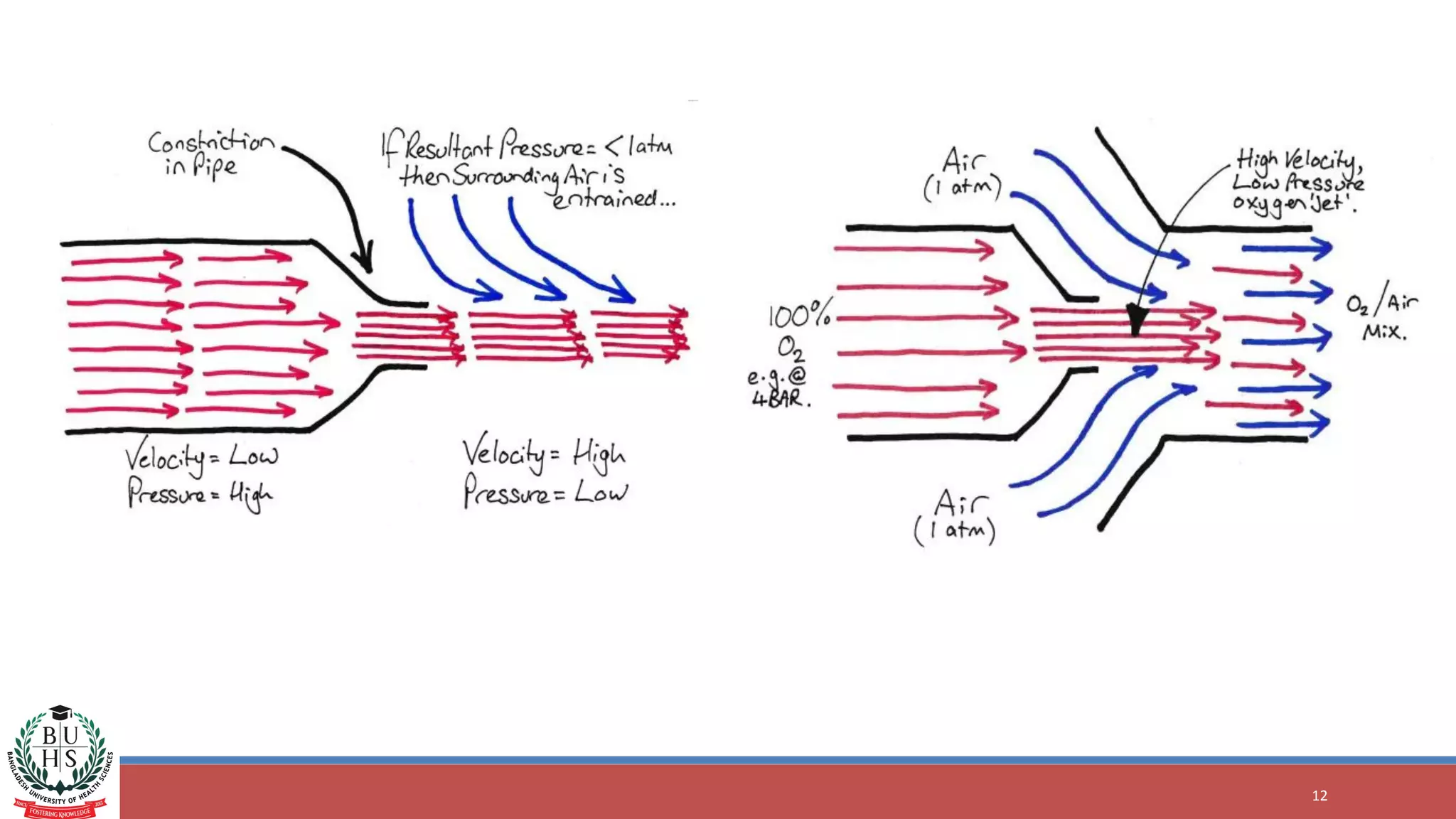
Venturi masks are low-flow masks
that use the Bernoulli principle to
entrain room air when pure oxygen
is delivered through a small orifice,
resulting in a large total flow at
predictable Fio2.
12
HW
13
1. Principle of venturi mask
2. Difference between venturi mask and oxygen mask
The Expression for the Rate of Flow-Through Venturimeter:
14
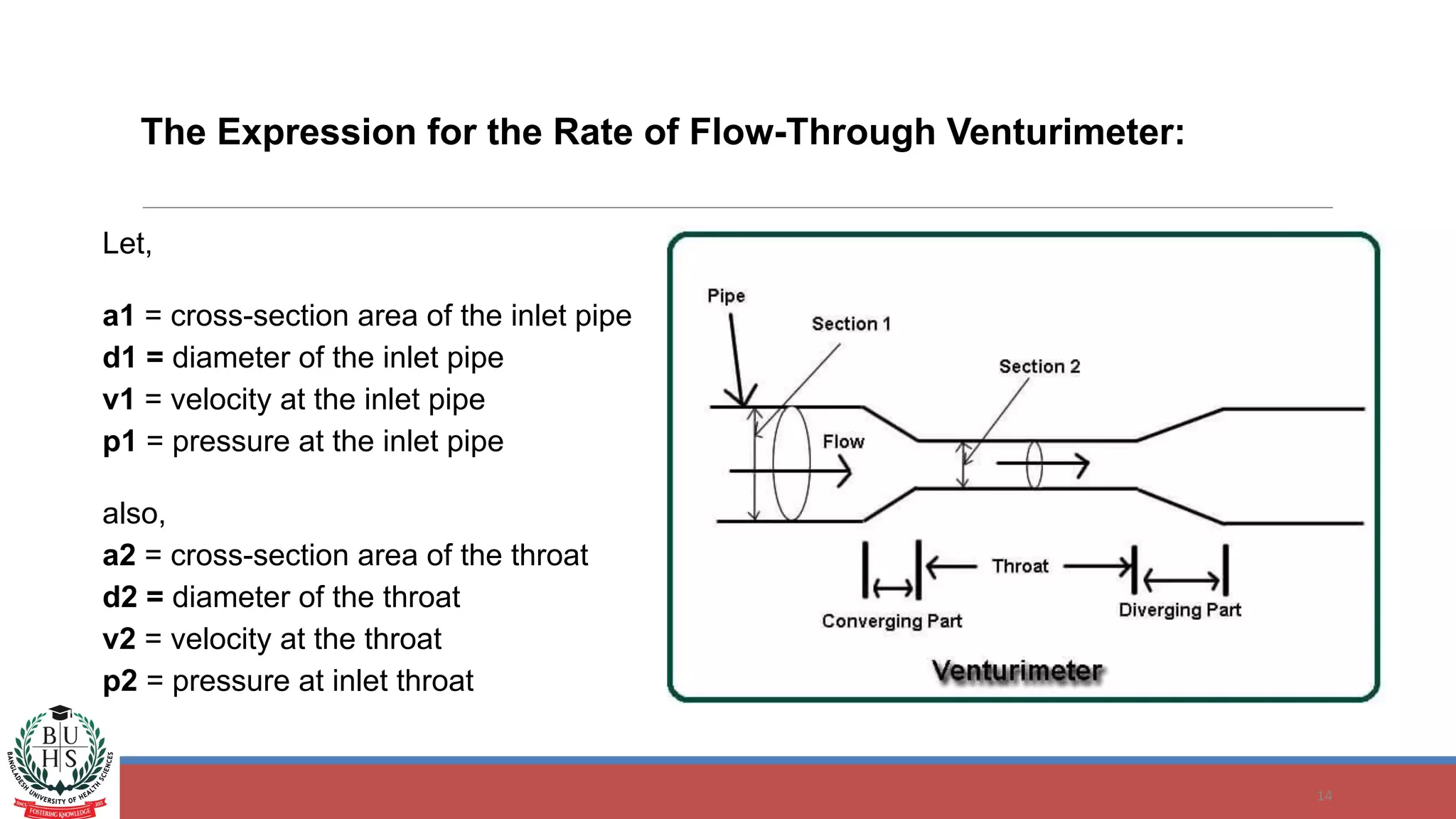
Let,
a1 = cross-section area of the inlet pipe
d1 = diameter of the inlet pipe
v1 = velocity at the inlet pipe
p1 = pressure at the inlet pipe
also,
a2 = cross-section area of the throat
d2 = diameter of the throat
v2 = velocity at the throat
p2 = pressure at inlet throat
15
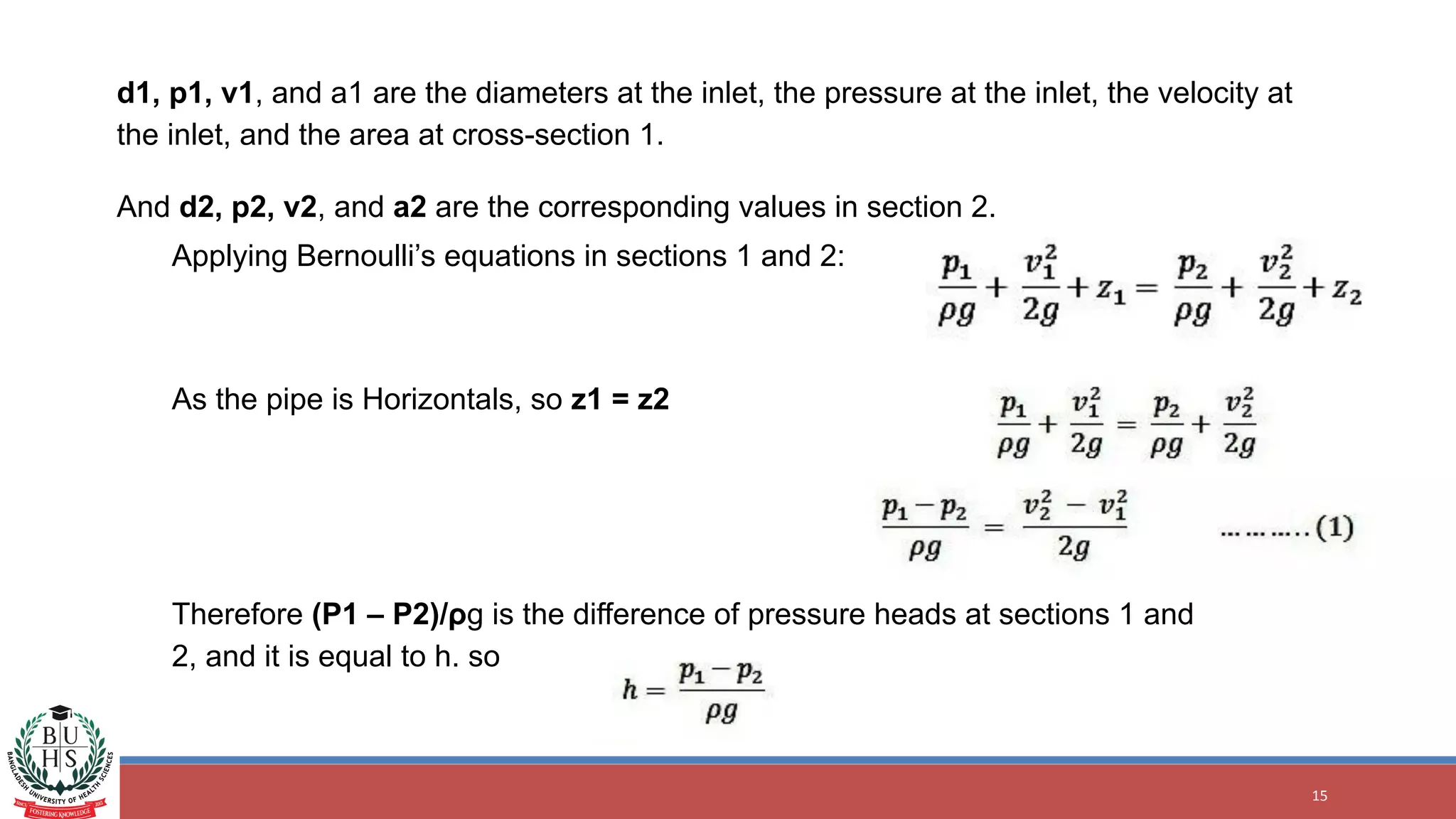
d1, p1, v1, and a1 are the diameters at the inlet, the pressure at the inlet, the velocity at
the inlet, and the area at cross-section 1.
And d2, p2, v2, and a2 are the corresponding values in section 2.
Applying Bernoulli’s equations in sections 1 and 2:
As the pipe is Horizontals, so z1 = z2
Therefore (P1 – P2)/ρg is the difference of pressure heads at sections 1 and
2, and it is equal to h. so
16
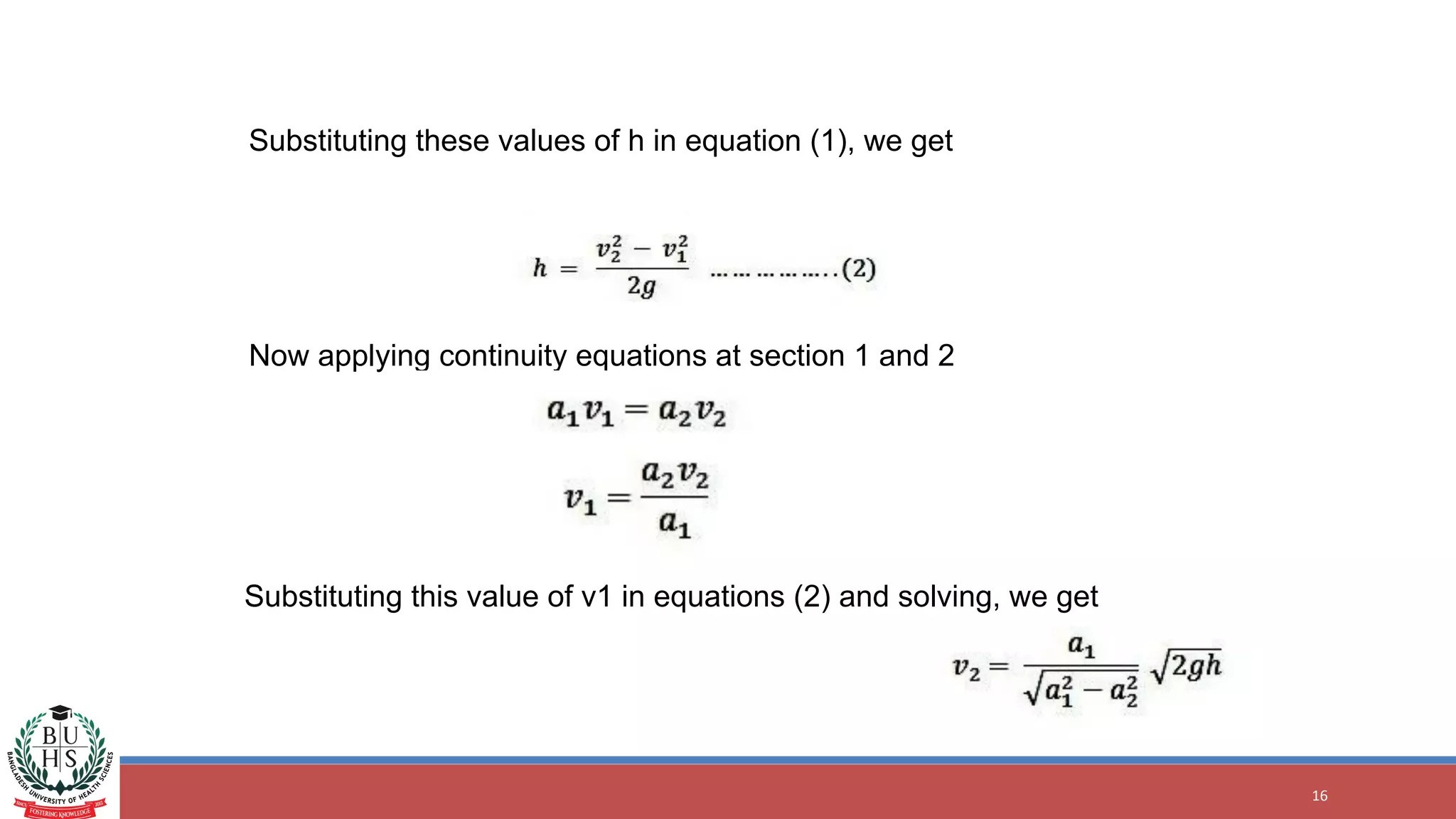
Substituting these values of h in equation (1), we get
Now applying continuity equations at section 1 and 2
Substituting this value of v1 in equations (2) and solving, we get
17
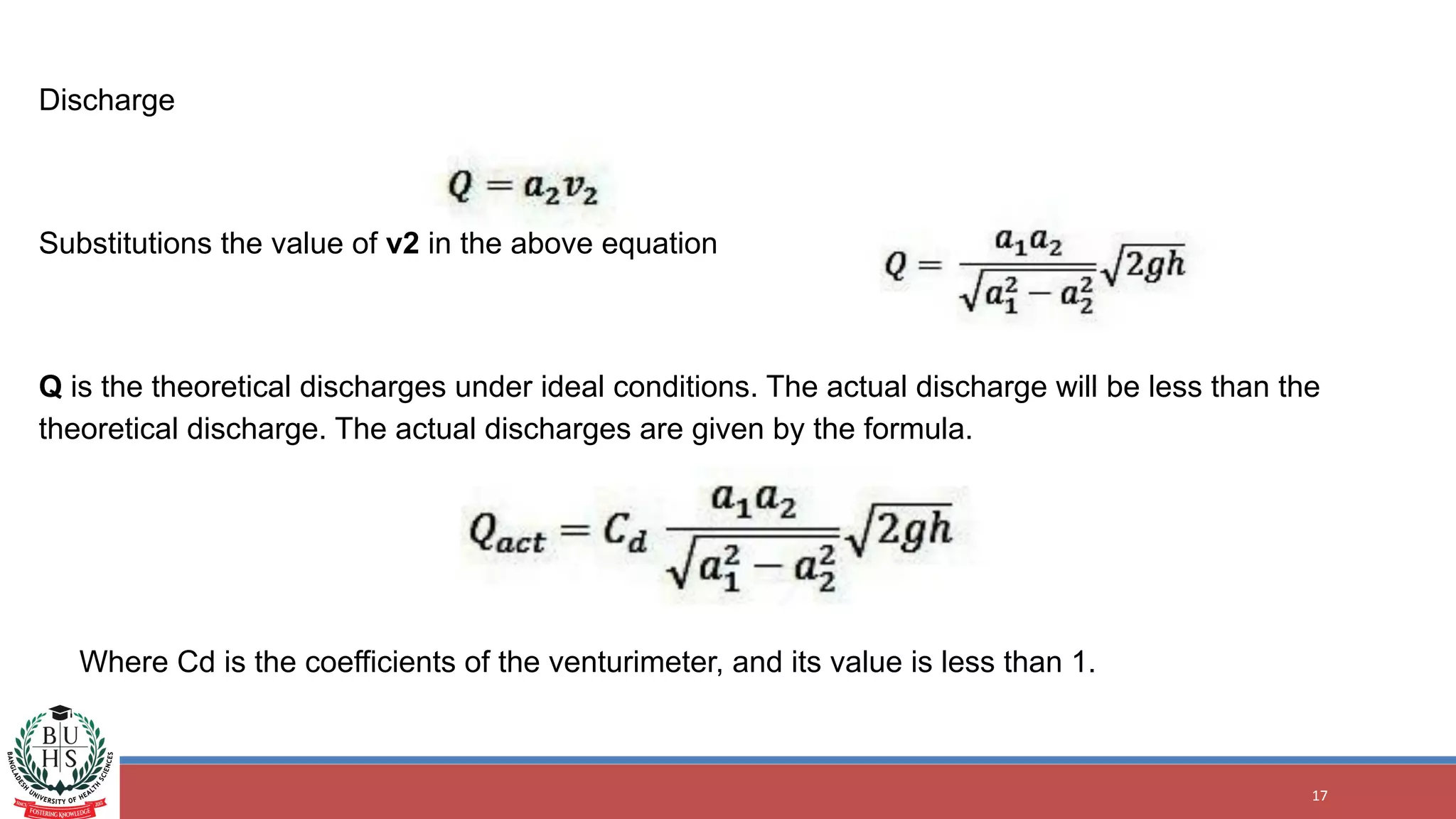
Discharge
Substitutions the value of v2 in the above equation
Q is the theoretical discharges under ideal conditions. The actual discharge will be less than the
theoretical discharge. The actual discharges are given by the formula.
Where Cd is the coefficients of the venturimeter, and its value is less than 1.
18
Home Study
Reference:
https://mechanicaljungle.com/working-of-venturimeter/
1. Advantages of Venturimeter
2. Disadvantages of Venturimeter
3. Applications of Venturimeter
19
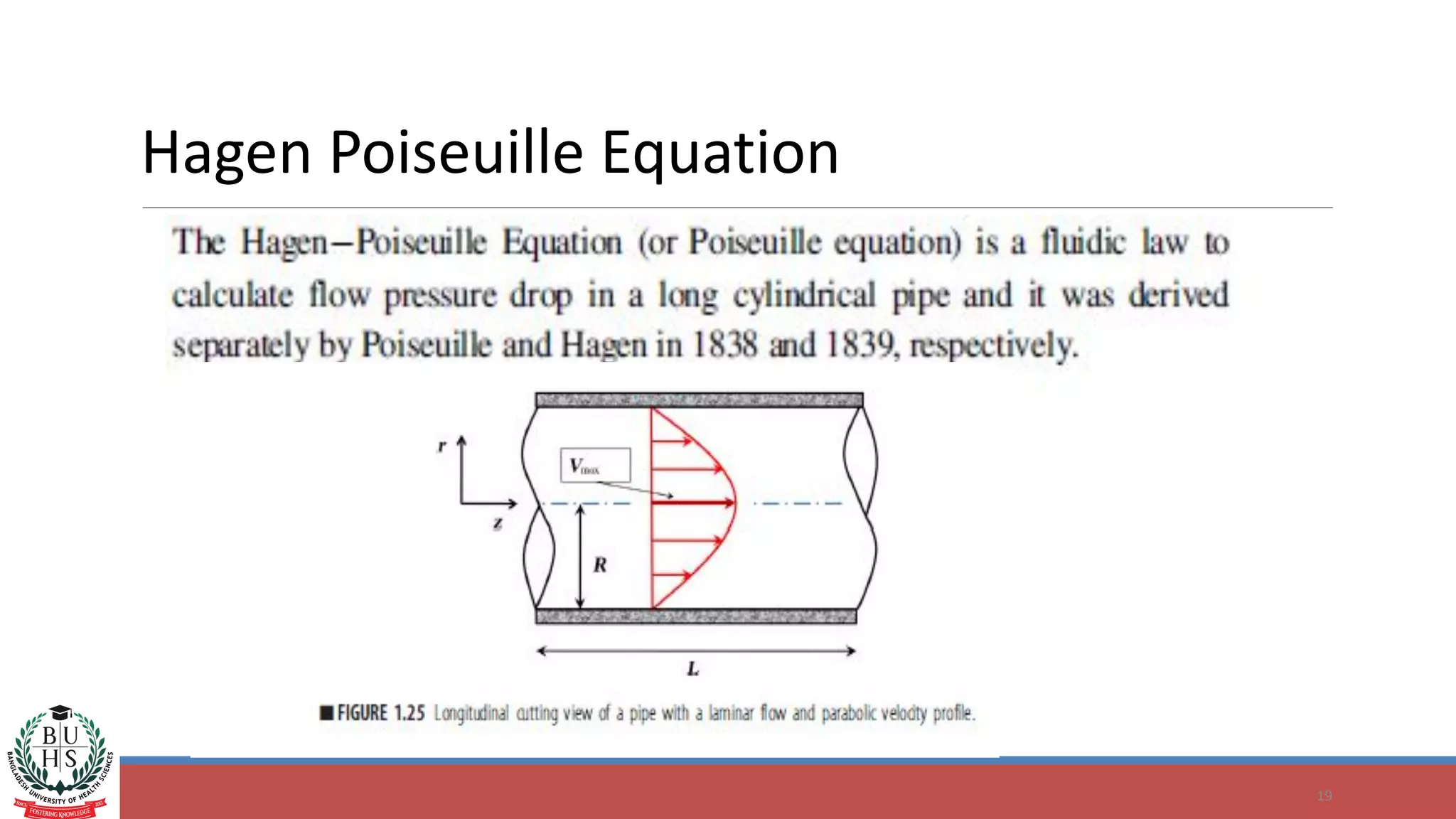
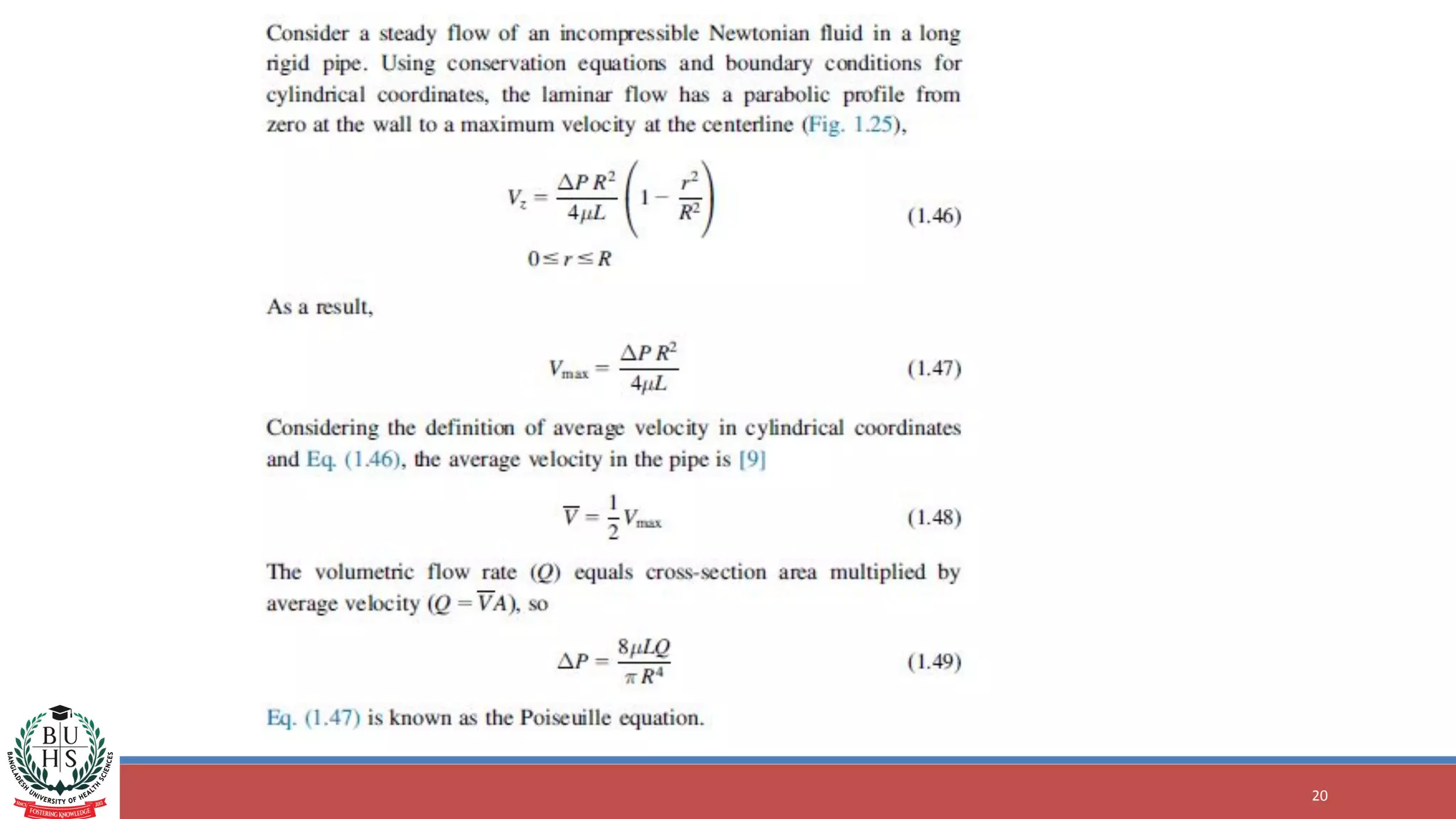
Hagen Poiseuille Equation
20
Biofluid Mechanics and Heat Transfer :
BANGLADESH UNIVERSITY OF HEALTH SCIENCE
BIOMEDICAL ENGINEERING
21
Thank you!

Lecture 6_Basic Equations of Fluid Mechanics.pptx.pdf

  • 1.
    Biofluid Mechanics andHeat Transfer Course Code: 04041115 Lecture 06: Basic Equations of Fluid Mechanics Date: 31/07/2023 Course Teacher: Tohfatul Jinan Lecturer Department of Biomedical Engineering BUHS BANGLADESH UNIVERSITY OF HEALTH SCIENCES Department of Biomedical Engineering 1
  • 2.
  • 3.
  • 4.
  • 5.
  • 6.
  • 7.
  • 8.
    Problem-3 8 In an adult,the aorta's radius is normally 1.5cm, and blood moves through it at an average speed of 30cm/s. If the typical capillary has a radius of 5 x 10⁻⁶ m, and blood passes through them with a velocity of 0.1cm/s, approximately how many capillaries are in the body? Determine the mass flow rate of blood in the capillaries and aorta if the blood density is 1060 kg/m??(HW)
  • 9.
    9 Venturi Meters ● Venturimeters are used to measures the flow rate of a fluid through a pipe. This is an application of Bernoulli’s equation. ● Venturi meter theory works on the Bernoulli equation such that the velocity increases as the pressure decreases. ● This theory states that when the cross-sectional area of the flow decreases, a pressure difference between the different regions of the flow is created, and it helps to measure the difference under pressure. ● This pressure differential helps to measure the discharge inflow
  • 10.
    Venturi effect 10 The Venturieffect is the reduction in fluid pressure that results when a fluid flows through a constricted section (or choke) of a pipe.
  • 11.
    Venturi masks 11 Venturi masksare low-flow masks that use the Bernoulli principle to entrain room air when pure oxygen is delivered through a small orifice, resulting in a large total flow at predictable Fio2.
  • 12.
  • 13.
    HW 13 1. Principle ofventuri mask 2. Difference between venturi mask and oxygen mask
  • 14.
    The Expression forthe Rate of Flow-Through Venturimeter: 14 Let, a1 = cross-section area of the inlet pipe d1 = diameter of the inlet pipe v1 = velocity at the inlet pipe p1 = pressure at the inlet pipe also, a2 = cross-section area of the throat d2 = diameter of the throat v2 = velocity at the throat p2 = pressure at inlet throat
  • 15.
    15 d1, p1, v1,and a1 are the diameters at the inlet, the pressure at the inlet, the velocity at the inlet, and the area at cross-section 1. And d2, p2, v2, and a2 are the corresponding values in section 2. Applying Bernoulli’s equations in sections 1 and 2: As the pipe is Horizontals, so z1 = z2 Therefore (P1 – P2)/ρg is the difference of pressure heads at sections 1 and 2, and it is equal to h. so
  • 16.
    16 Substituting these valuesof h in equation (1), we get Now applying continuity equations at section 1 and 2 Substituting this value of v1 in equations (2) and solving, we get
  • 17.
    17 Discharge Substitutions the valueof v2 in the above equation Q is the theoretical discharges under ideal conditions. The actual discharge will be less than the theoretical discharge. The actual discharges are given by the formula. Where Cd is the coefficients of the venturimeter, and its value is less than 1.
  • 18.
    18 Home Study Reference: https://mechanicaljungle.com/working-of-venturimeter/ 1. Advantagesof Venturimeter 2. Disadvantages of Venturimeter 3. Applications of Venturimeter
  • 19.
  • 20.
  • 21.
    Biofluid Mechanics andHeat Transfer : BANGLADESH UNIVERSITY OF HEALTH SCIENCE BIOMEDICAL ENGINEERING 21 Thank you!