TRANS PACIFIC PARTNERSHIP
By: Harveer Singh
harveersinh@gmail.com
HARVEERSIRforGSSCORE
1
TPP
2
HARVEERSIRforGSSCORE
 The pact aims to deepen economic ties between
these nations, slashing tariffs and fostering trade to
boost growth.
 Member countries are also hoping to foster a closer
relationship on economic policies and regulation.
 The agreement could create a new single market
something like that of the EU.
 some 18,000 tariffs would be affected.
3
HARVEERSIRforGSSCORE
Collective population of about 800
million - almost double that of the
European Union's single market.
The 12-nation would-be bloc is already
responsible for 40% of world trade.
If this has not happened before 4
February 2018, it will enter into force
after ratification by at least 6 states,
which hold together a GDP of more
than 85% if the GDP of all signatories.
4
HARVEERSIRforGSSCORE
Tariffs on US manufactured goods
and almost all US farm products
will go almost immediately once
the deal is ratified.
Countries would also to co-
operate on wider issues such as
employment practices, intellectual
property and competition policies. 5
HARVEERSIRforGSSCORE
ISSUES
Investor-state dispute
settlement (ISDS)
Food and Environment
Safety
Health/Medicines
Job Loss
No exit clause. 6
HARVEERSIRforGSSCORE
7
HARVEERSIRforGSSCORE
8
HARVEERSIRforGSSCORE
WHAT INDIA SHOULD DO?
Should go ahead with India-EU
FTA
Concluding RCEP
Blocking effort of these mega
blocks to bypass
 Traditional Knowledge
 WTO rules on Labor, environment,
public procurement etc 9
HARVEERSIRforGSSCORE
THANK YOU.
10
HARVEERSIRforGSSCORE
SS TARAPORE
By: Harveer Singh
harveersinh@gmail.com
HARVEERSIRforGSSCORE
11
SS Tarapore, served as deputy
governor at RBI. He worked
under C Rangarajan, the then RBI
Chairperson.
The mutual understanding and
respect led them to reform India’s
financial sector and put it on a
sound footing. 12
HARVEERSIRforGSSCORE
 After retiring, he chaired two committees on full
capital account convertibility and one on how to
streamline the RBI.
 Between 1997 and 2016, he wrote and lectured on
a scale that is hard to emulate.
 He remained steadfast in his belief that RBI knew
what it was doing and ought to be left alone
(Autonomy) to get on with its job, which was
maintaining the monetary stability of India.
13
HARVEERSIRforGSSCORE
CAPITAL ACCOUNT CONVERTIBILITY
HARVEERSIRforGSSCORE
14
 Freedom to convert local financial assets into foreign
ones at market-determined exchange rates.
 Leads to free exchange of currency at lower rates and an
unrestricted mobility of capital.
 India currently has full convertibility of the rupee in
current accounts such as for exports and imports.
15HARVEERSIR for GSSCORE
 The Capital can be of any entity/type: Some of
these are
 Foreign Direct Investment (FDI)
 ADRs and GDRs by Indian Companies
 ECBs
 G-SECs
 Joint Ventures/ Subsidiaries
 Disinvestment
 Foreign Venture Capital Investment (FVCI)
 FIIs
 Commodity Hedging
 Overseas Investment by Indian Mutual Fund
 Resident’s borrowings in Foreign Currency
16HARVEERSIR for GSSCORE
However, India’s capital
account convertibility is not
full.
There are ceilings on
government and corporate
debt, external commercial
borrowings and equity.
17HARVEERSIR for GSSCORE
DEBATE
 Inflow of foreign investment increases, and
transactions are much easier and occur at a faster
pace.
 It also initiates risk spreading through diversification
of portfolios.
 It could destabilise an economy due to massive
outflow of the country.
 It could cause currency appreciation/depreciation
and worsen balance of trade.
18HARVEERSIR for GSSCORE
 Real liberalization was initiated in 1991 aftermath
balance of payment crises.
 Rangarajan Committee report outlines the reforms
in the external sector.
 Recommendations
 dismantling of trade restrictions
 transition to market determined exchange rates
 gradual opening of capital account
19HARVEERSIR for GSSCORE
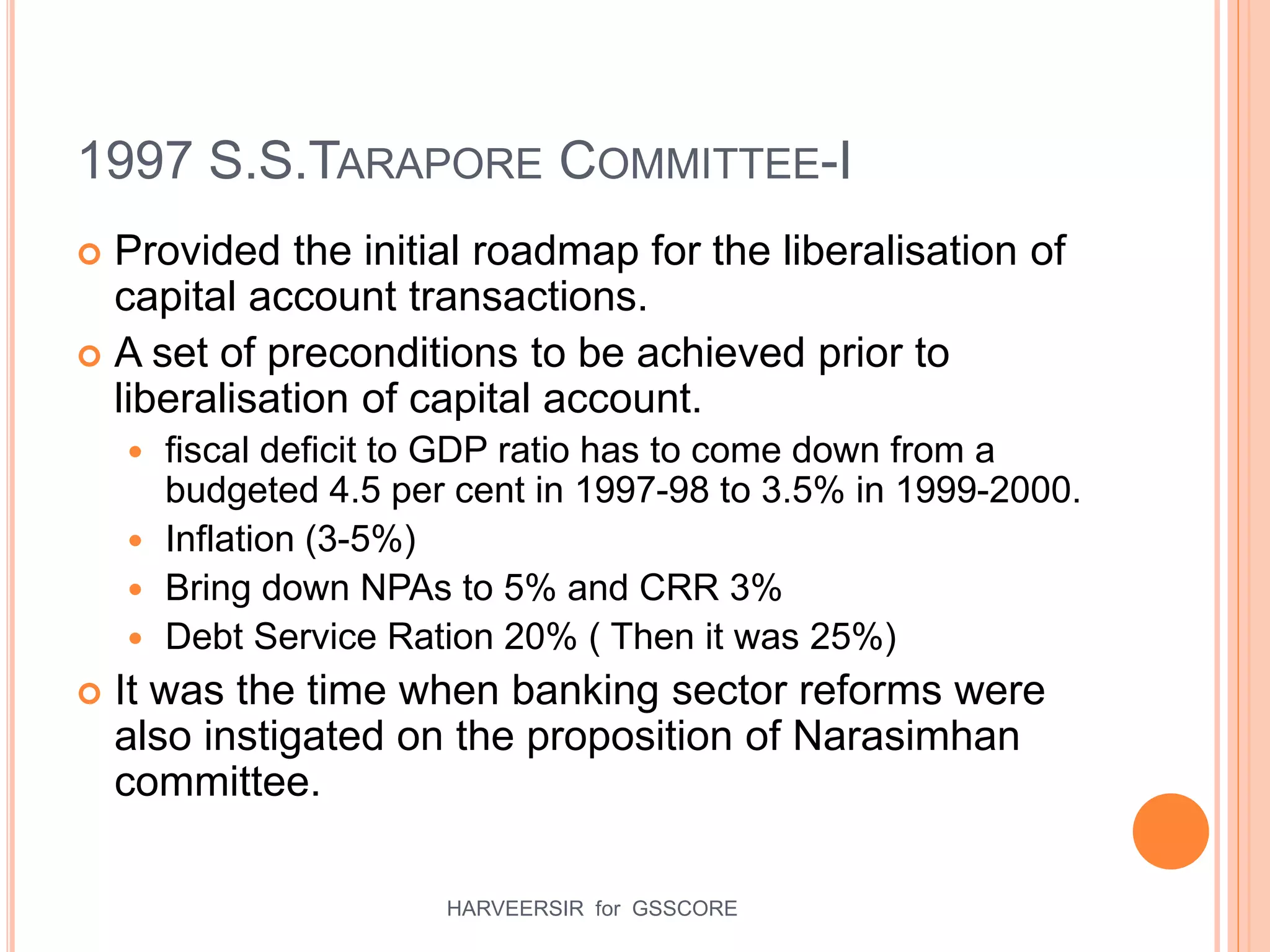
1997 S.S.TARAPORE COMMITTEE-I
 Provided the initial roadmap for the liberalisation of
capital account transactions.
 A set of preconditions to be achieved prior to
liberalisation of capital account.
 fiscal deficit to GDP ratio has to come down from a
budgeted 4.5 per cent in 1997-98 to 3.5% in 1999-2000.
 Inflation (3-5%)
 Bring down NPAs to 5% and CRR 3%
 Debt Service Ration 20% ( Then it was 25%)
 It was the time when banking sector reforms were
also instigated on the proposition of Narasimhan
committee.
20HARVEERSIR for GSSCORE
 2000: FEMA over FERA- All the current account
transactions are permitted under FEMA and no
prior permission of RBI is required for any such
transactions, while there remain restrictions on
capital account.
 Under FEMA some capital account transactions are
completely permitted, some are totally prohibited
while some are allowed within a fixed ceiling.
 Sectoral rules have also been shaped and enforced
with FEMA rules.
21HARVEERSIR for GSSCORE
2006: TARAPORE COMMITTEE II
 It also did not recommended unlimited openings of
Capital account but preferred a phased
liberalisation of controls on outflows and inflows.
22HARVEERSIR for GSSCORE
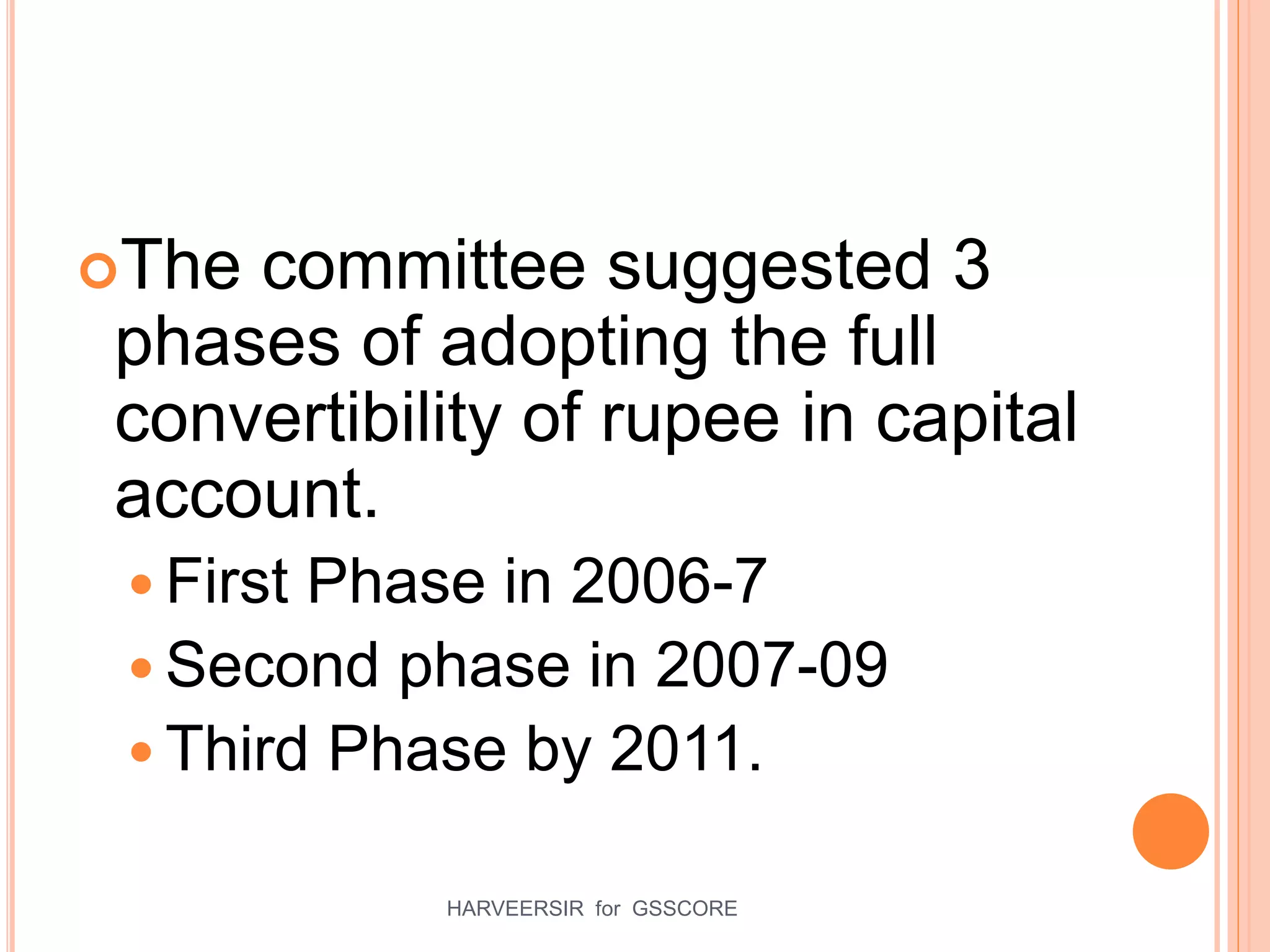
The committee suggested 3
phases of adopting the full
convertibility of rupee in capital
account.
 First Phase in 2006-7
 Second phase in 2007-09
 Third Phase by 2011.
23HARVEERSIR for GSSCORE
Allow NRIs to invest in Capital
Market
Give Tax benefit to NRI deposit
Prohibit FIIs from investing in P-
Notes
Raise ceiling on ECB for
automatic route.
24HARVEERSIR for GSSCORE
SHOULD INDIA GO FOR FULL CAPITAL
ACCOUNT CONVERTIBILITY ?
Looking at the fragile
economic structure and
underlying problems with
the free capital flow in world
economy, India must be
cautious.
25HARVEERSIR for GSSCORE
THANK YOU.
26
HARVEERSIRforGSSCORE
INTELLECTUAL PROPERTY
INDEX BY GLOBAL
INTELLECTUAL PROPERTY
CENTRE (GIPC)
HARVEERSIRforGSSCORE
27
 Released by U.S. Chamber of Commerce’s Global
Intellectual Property Center (GIPC)
 There are 6 Categories and 30 Criteria.
 Categories include patent, copyright and trademark
protections, enforcement, and engagement in
international treaties
 India remains at the bottom of the Index for the
fourth year in a row.
28
HARVEERSIRforGSSCORE
The 38 economies benchmarked
in the 2016 Index accounts for
nearly 85 per cent of the global
GDP.
In BRICS Russia ranked 20th,
China (22nd), South Africa (26th)
and Brazil (29th).
29
HARVEERSIRforGSSCORE
30
HARVEERSIRforGSSCORE
WHAT INDIA’S WEAKNESSES ARE?
 The use of compulsory licensing (CL) for
commercial and non-emergency situations, and the
expanded use of CL being considered by the Indian
government.
 Poor application and enforcement of civil remedies
and criminal penalties.
31
HARVEERSIRforGSSCORE
DO YOU AGREE THAT THE IP PROTECTION
SYSTEM IN INDIA IS LAX. ELABORATE.
Is it because India relatively
lacks culture of innovation.
Is it because of huge
affordability- aspiration gap.
32
HARVEERSIRforGSSCORE
SEPARATE ISSUE: WHY INDIA LAGS IN
INNOVATION?
33
HARVEERSIRforGSSCORE
THANK YOU 
34
HARVEERSIRforGSSCORE

Tpp intellectual capital ac convertibility

  • 1.
    TRANS PACIFIC PARTNERSHIP By:Harveer Singh harveersinh@gmail.com HARVEERSIRforGSSCORE 1
  • 2.
  • 3.
     The pactaims to deepen economic ties between these nations, slashing tariffs and fostering trade to boost growth.  Member countries are also hoping to foster a closer relationship on economic policies and regulation.  The agreement could create a new single market something like that of the EU.  some 18,000 tariffs would be affected. 3 HARVEERSIRforGSSCORE
  • 4.
    Collective population ofabout 800 million - almost double that of the European Union's single market. The 12-nation would-be bloc is already responsible for 40% of world trade. If this has not happened before 4 February 2018, it will enter into force after ratification by at least 6 states, which hold together a GDP of more than 85% if the GDP of all signatories. 4 HARVEERSIRforGSSCORE
  • 5.
    Tariffs on USmanufactured goods and almost all US farm products will go almost immediately once the deal is ratified. Countries would also to co- operate on wider issues such as employment practices, intellectual property and competition policies. 5 HARVEERSIRforGSSCORE
  • 6.
    ISSUES Investor-state dispute settlement (ISDS) Foodand Environment Safety Health/Medicines Job Loss No exit clause. 6 HARVEERSIRforGSSCORE
  • 7.
  • 8.
  • 9.
    WHAT INDIA SHOULDDO? Should go ahead with India-EU FTA Concluding RCEP Blocking effort of these mega blocks to bypass  Traditional Knowledge  WTO rules on Labor, environment, public procurement etc 9 HARVEERSIRforGSSCORE
  • 10.
  • 11.
    SS TARAPORE By: HarveerSingh harveersinh@gmail.com HARVEERSIRforGSSCORE 11
  • 12.
    SS Tarapore, servedas deputy governor at RBI. He worked under C Rangarajan, the then RBI Chairperson. The mutual understanding and respect led them to reform India’s financial sector and put it on a sound footing. 12 HARVEERSIRforGSSCORE
  • 13.
     After retiring,he chaired two committees on full capital account convertibility and one on how to streamline the RBI.  Between 1997 and 2016, he wrote and lectured on a scale that is hard to emulate.  He remained steadfast in his belief that RBI knew what it was doing and ought to be left alone (Autonomy) to get on with its job, which was maintaining the monetary stability of India. 13 HARVEERSIRforGSSCORE
  • 14.
  • 15.
     Freedom toconvert local financial assets into foreign ones at market-determined exchange rates.  Leads to free exchange of currency at lower rates and an unrestricted mobility of capital.  India currently has full convertibility of the rupee in current accounts such as for exports and imports. 15HARVEERSIR for GSSCORE
  • 16.
     The Capitalcan be of any entity/type: Some of these are  Foreign Direct Investment (FDI)  ADRs and GDRs by Indian Companies  ECBs  G-SECs  Joint Ventures/ Subsidiaries  Disinvestment  Foreign Venture Capital Investment (FVCI)  FIIs  Commodity Hedging  Overseas Investment by Indian Mutual Fund  Resident’s borrowings in Foreign Currency 16HARVEERSIR for GSSCORE
  • 17.
    However, India’s capital accountconvertibility is not full. There are ceilings on government and corporate debt, external commercial borrowings and equity. 17HARVEERSIR for GSSCORE
  • 18.
    DEBATE  Inflow offoreign investment increases, and transactions are much easier and occur at a faster pace.  It also initiates risk spreading through diversification of portfolios.  It could destabilise an economy due to massive outflow of the country.  It could cause currency appreciation/depreciation and worsen balance of trade. 18HARVEERSIR for GSSCORE
  • 19.
     Real liberalizationwas initiated in 1991 aftermath balance of payment crises.  Rangarajan Committee report outlines the reforms in the external sector.  Recommendations  dismantling of trade restrictions  transition to market determined exchange rates  gradual opening of capital account 19HARVEERSIR for GSSCORE
  • 20.
    1997 S.S.TARAPORE COMMITTEE-I Provided the initial roadmap for the liberalisation of capital account transactions.  A set of preconditions to be achieved prior to liberalisation of capital account.  fiscal deficit to GDP ratio has to come down from a budgeted 4.5 per cent in 1997-98 to 3.5% in 1999-2000.  Inflation (3-5%)  Bring down NPAs to 5% and CRR 3%  Debt Service Ration 20% ( Then it was 25%)  It was the time when banking sector reforms were also instigated on the proposition of Narasimhan committee. 20HARVEERSIR for GSSCORE
  • 21.
     2000: FEMAover FERA- All the current account transactions are permitted under FEMA and no prior permission of RBI is required for any such transactions, while there remain restrictions on capital account.  Under FEMA some capital account transactions are completely permitted, some are totally prohibited while some are allowed within a fixed ceiling.  Sectoral rules have also been shaped and enforced with FEMA rules. 21HARVEERSIR for GSSCORE
  • 22.
    2006: TARAPORE COMMITTEEII  It also did not recommended unlimited openings of Capital account but preferred a phased liberalisation of controls on outflows and inflows. 22HARVEERSIR for GSSCORE
  • 23.
    The committee suggested3 phases of adopting the full convertibility of rupee in capital account.  First Phase in 2006-7  Second phase in 2007-09  Third Phase by 2011. 23HARVEERSIR for GSSCORE
  • 24.
    Allow NRIs toinvest in Capital Market Give Tax benefit to NRI deposit Prohibit FIIs from investing in P- Notes Raise ceiling on ECB for automatic route. 24HARVEERSIR for GSSCORE
  • 25.
    SHOULD INDIA GOFOR FULL CAPITAL ACCOUNT CONVERTIBILITY ? Looking at the fragile economic structure and underlying problems with the free capital flow in world economy, India must be cautious. 25HARVEERSIR for GSSCORE
  • 26.
  • 27.
    INTELLECTUAL PROPERTY INDEX BYGLOBAL INTELLECTUAL PROPERTY CENTRE (GIPC) HARVEERSIRforGSSCORE 27
  • 28.
     Released byU.S. Chamber of Commerce’s Global Intellectual Property Center (GIPC)  There are 6 Categories and 30 Criteria.  Categories include patent, copyright and trademark protections, enforcement, and engagement in international treaties  India remains at the bottom of the Index for the fourth year in a row. 28 HARVEERSIRforGSSCORE
  • 29.
    The 38 economiesbenchmarked in the 2016 Index accounts for nearly 85 per cent of the global GDP. In BRICS Russia ranked 20th, China (22nd), South Africa (26th) and Brazil (29th). 29 HARVEERSIRforGSSCORE
  • 30.
  • 31.
    WHAT INDIA’S WEAKNESSESARE?  The use of compulsory licensing (CL) for commercial and non-emergency situations, and the expanded use of CL being considered by the Indian government.  Poor application and enforcement of civil remedies and criminal penalties. 31 HARVEERSIRforGSSCORE
  • 32.
    DO YOU AGREETHAT THE IP PROTECTION SYSTEM IN INDIA IS LAX. ELABORATE. Is it because India relatively lacks culture of innovation. Is it because of huge affordability- aspiration gap. 32 HARVEERSIRforGSSCORE
  • 33.
    SEPARATE ISSUE: WHYINDIA LAGS IN INNOVATION? 33 HARVEERSIRforGSSCORE
  • 34.