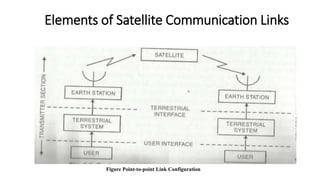
Elements of Satellite Communication Links
Figure Point-to-point Link Configuration
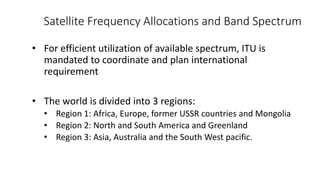
Satellite Frequency Allocations and Band Spectrum
• For efficient utilization of available spectrum, ITU is
mandated to coordinate and plan international
requirement
• The world is divided into 3 regions:
• Region 1: Africa, Europe, former USSR countries and Mongolia
• Region 2: North and South America and Greenland
• Region 3: Asia, Australia and the South West pacific.
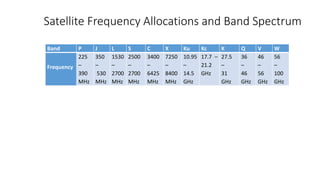
Satellite Frequency Allocations and Band Spectrum
Band P J L S C X Ku Kc K Q V W
Frequency
225
–
390
MHz
350
–
530
MHz
1530
–
2700
MHz
2500
–
2700
MHz
3400
–
6425
MHz
7250
–
8400
MHz
10.95
–
14.5
GHz
17.7 –
21.2
GHz
27.5
–
31
GHz
36
–
46
GHz
46
–
56
GHz
56
–
100
GHz
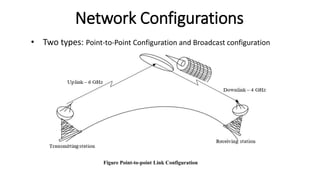
Network Configurations
• Two types: Point-to-Point Configuration and Broadcast configuration
Figure Point-to-point Link Configuration
Network Configurations
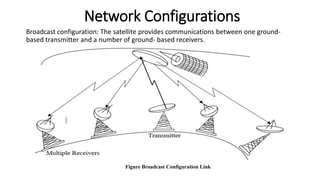
Broadcast configuration: The satellite provides communications between one ground-
based transmitter and a number of ground- based receivers.
Figure Broadcast Configuration Link
Satellite Subsystem
Transponder
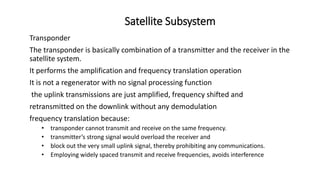
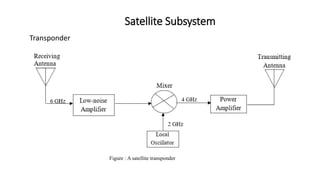
The transponder is basically combination of a transmitter and the receiver in the
satellite system.
It performs the amplification and frequency translation operation
It is not a regenerator with no signal processing function
the uplink transmissions are just amplified, frequency shifted and
retransmitted on the downlink without any demodulation
frequency translation because:
• transponder cannot transmit and receive on the same frequency.
• transmitter’s strong signal would overload the receiver and
• block out the very small uplink signal, thereby prohibiting any communications.
• Employing widely spaced transmit and receive frequencies, avoids interference
Satellite Subsystem
Transponder
Figure : A satellite transponder
Satellite Subsystem
Transponder
A typical communications satellite has 12, 24 or more transponders
Each transponder operates at different frequency
Current satellites have over 40 transponders each, with 36 MHz bandwidth
Each transponder represents an individual communications channel
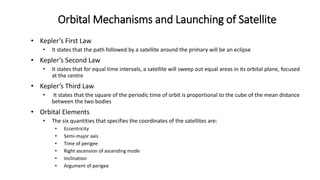
Orbital Mechanisms and Launching of Satellite
• Kepler’s First Law
• It states that the path followed by a satellite around the primary will be an eclipse
• Kepler’s Second Law
• It states that for equal time intervals, a satellite will sweep out equal areas in its orbital plane, focused
at the centre
• Kepler’s Third Law
• It states that the square of the periodic time of orbit is proportional to the cube of the mean distance
between the two bodies
• Orbital Elements
• The six quantities that specifies the coordinates of the satellites are:
• Eccentricity
• Semi-major axis
• Time of perigee
• Right ascension of ascending mode
• Inclination
• Argument of perigee
Orbital Mechanisms and Launching of Satellite
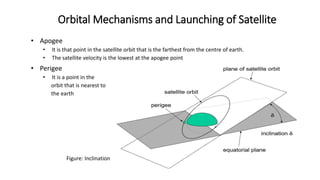
• Apogee
• It is that point in the satellite orbit that is the farthest from the centre of earth.
• The satellite velocity is the lowest at the apogee point
• Perigee
• It is a point in the
orbit that is nearest to
the earth
Figure: Inclination
Designing Satellite Communication System
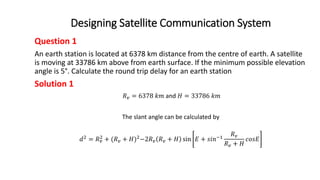
Question 1
An earth station is located at 6378 km distance from the centre of earth. A satellite
is moving at 33786 km above from earth surface. If the minimum possible elevation
angle is 5°. Calculate the round trip delay for an earth station
Solution 1
𝑅𝑣 = 6378 𝑘𝑚 and 𝐻 = 33786 𝑘𝑚
The slant angle can be calculated by
𝑑2
= 𝑅𝑣
2
+ (𝑅𝑣 + 𝐻)2
−2𝑅𝑣 𝑅𝑣 + 𝐻 sin 𝐸 + 𝑠𝑖𝑛−1
𝑅𝑣
𝑅𝑣 + 𝐻
𝑐𝑜𝑠𝐸
Designing Satellite Communication System
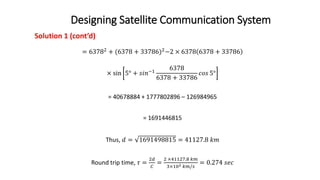
Solution 1 (cont’d)
= 63782 + (6378 + 33786)2−2 × 6378 6378 + 33786
× sin 5° + 𝑠𝑖𝑛−1
6378
6378 + 33786
𝑐𝑜𝑠 5°
= 40678884 + 1777802896 – 126984965
= 1691446815
Thus, 𝑑 = 1691498815 = 41127.8 𝑘𝑚
Round trip time, 𝜏 =
2𝑑
𝐶
=
2 ×41127.8 𝑘𝑚
3×10² 𝑘𝑚/𝑠
= 0.274 𝑠𝑒𝑐
Designing Satellite Communication System
Question 2
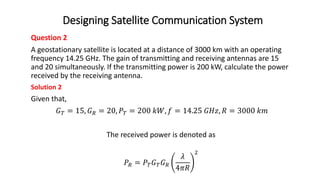
A geostationary satellite is located at a distance of 3000 km with an operating
frequency 14.25 GHz. The gain of transmitting and receiving antennas are 15
and 20 simultaneously. If the transmitting power is 200 kW, calculate the power
received by the receiving antenna.
Solution 2
Given that,
𝐺𝑇 = 15, 𝐺𝑅 = 20, 𝑃𝑇 = 200 𝑘𝑊, 𝑓 = 14.25 𝐺𝐻𝑧, 𝑅 = 3000 𝑘𝑚
The received power is denoted as
𝑃𝑅 = 𝑃𝑇𝐺𝑇𝐺𝑅
𝜆
4𝜋𝑅
2
Designing Satellite Communication System
Solution 2 (cont’d)
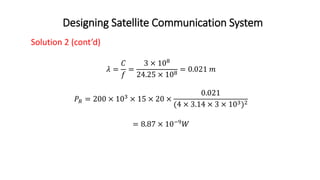
𝜆 =
𝐶
𝑓
=
3 × 10⁸
24.25 × 108
= 0.021 𝑚
𝑃𝑅 = 200 × 103
× 15 × 20 ×
0.021
(4 × 3.14 × 3 × 103)2
= 8.87 × 10⁻⁹
𝑊
Designing Satellite Communication System
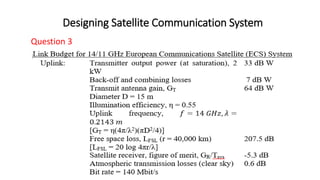
Question 3
Designing Satellite Communication System
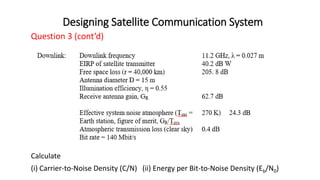
Question 3 (cont’d)
Calculate
(i) Carrier-to-Noise Density (C/N) (ii) Energy per Bit-to-Noise Density (Eb/N0)
Designing Satellite Communication System
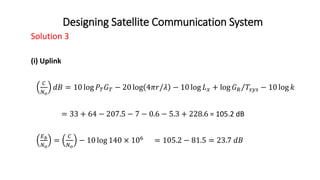
Solution 3
(i) Uplink
𝐶
𝑁𝑜
𝑑𝐵 = 10 log 𝑃𝑇𝐺𝑇 − 20 log 4𝜋𝑟/𝜆 − 10 log 𝐿𝑥 + log 𝐺𝑅 𝑇𝑠𝑦𝑠 − 10 log 𝑘
= 33 + 64 − 207.5 − 7 − 0.6 − 5.3 + 228.6 = 105.2 dB
𝐸𝑏
𝑁𝑜
=
𝐶
𝑁𝑜
− 10 log 140 × 106
= 105.2 − 81.5 = 23.7 𝑑𝐵
Designing Satellite Communication System
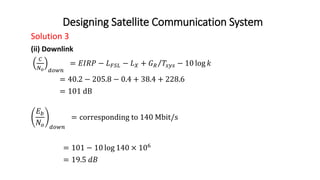
Solution 3
(ii) Downlink
𝐶
𝑁𝑜 𝑑𝑜𝑤𝑛
= 𝐸𝐼𝑅𝑃 − 𝐿𝐹𝑆𝐿 − 𝐿𝑋 + 𝐺𝑅 𝑇𝑠𝑦𝑠 − 10 log 𝑘
= 40.2 − 205.8 − 0.4 + 38.4 + 228.6
= 101 dB
𝐸𝑏
𝑁𝑜 𝑑𝑜𝑤𝑛
= corresponding to 140 Mbit/s
= 101 − 10 log 140 × 106
= 19.5 𝑑𝐵

Lecture 10_Satellite Communication System.pptx

  • 1.
    Elements of SatelliteCommunication Links Figure Point-to-point Link Configuration
  • 2.
    Satellite Frequency Allocationsand Band Spectrum • For efficient utilization of available spectrum, ITU is mandated to coordinate and plan international requirement • The world is divided into 3 regions: • Region 1: Africa, Europe, former USSR countries and Mongolia • Region 2: North and South America and Greenland • Region 3: Asia, Australia and the South West pacific.
  • 3.
    Satellite Frequency Allocationsand Band Spectrum Band P J L S C X Ku Kc K Q V W Frequency 225 – 390 MHz 350 – 530 MHz 1530 – 2700 MHz 2500 – 2700 MHz 3400 – 6425 MHz 7250 – 8400 MHz 10.95 – 14.5 GHz 17.7 – 21.2 GHz 27.5 – 31 GHz 36 – 46 GHz 46 – 56 GHz 56 – 100 GHz
  • 4.
    Network Configurations • Twotypes: Point-to-Point Configuration and Broadcast configuration Figure Point-to-point Link Configuration
  • 5.
    Network Configurations Broadcast configuration:The satellite provides communications between one ground- based transmitter and a number of ground- based receivers. Figure Broadcast Configuration Link
  • 6.
    Satellite Subsystem Transponder The transponderis basically combination of a transmitter and the receiver in the satellite system. It performs the amplification and frequency translation operation It is not a regenerator with no signal processing function the uplink transmissions are just amplified, frequency shifted and retransmitted on the downlink without any demodulation frequency translation because: • transponder cannot transmit and receive on the same frequency. • transmitter’s strong signal would overload the receiver and • block out the very small uplink signal, thereby prohibiting any communications. • Employing widely spaced transmit and receive frequencies, avoids interference
  • 7.
  • 8.
    Satellite Subsystem Transponder A typicalcommunications satellite has 12, 24 or more transponders Each transponder operates at different frequency Current satellites have over 40 transponders each, with 36 MHz bandwidth Each transponder represents an individual communications channel
  • 9.
    Orbital Mechanisms andLaunching of Satellite • Kepler’s First Law • It states that the path followed by a satellite around the primary will be an eclipse • Kepler’s Second Law • It states that for equal time intervals, a satellite will sweep out equal areas in its orbital plane, focused at the centre • Kepler’s Third Law • It states that the square of the periodic time of orbit is proportional to the cube of the mean distance between the two bodies • Orbital Elements • The six quantities that specifies the coordinates of the satellites are: • Eccentricity • Semi-major axis • Time of perigee • Right ascension of ascending mode • Inclination • Argument of perigee
  • 10.
    Orbital Mechanisms andLaunching of Satellite • Apogee • It is that point in the satellite orbit that is the farthest from the centre of earth. • The satellite velocity is the lowest at the apogee point • Perigee • It is a point in the orbit that is nearest to the earth Figure: Inclination
  • 11.
    Designing Satellite CommunicationSystem Question 1 An earth station is located at 6378 km distance from the centre of earth. A satellite is moving at 33786 km above from earth surface. If the minimum possible elevation angle is 5°. Calculate the round trip delay for an earth station Solution 1 𝑅𝑣 = 6378 𝑘𝑚 and 𝐻 = 33786 𝑘𝑚 The slant angle can be calculated by 𝑑2 = 𝑅𝑣 2 + (𝑅𝑣 + 𝐻)2 −2𝑅𝑣 𝑅𝑣 + 𝐻 sin 𝐸 + 𝑠𝑖𝑛−1 𝑅𝑣 𝑅𝑣 + 𝐻 𝑐𝑜𝑠𝐸
  • 12.
    Designing Satellite CommunicationSystem Solution 1 (cont’d) = 63782 + (6378 + 33786)2−2 × 6378 6378 + 33786 × sin 5° + 𝑠𝑖𝑛−1 6378 6378 + 33786 𝑐𝑜𝑠 5° = 40678884 + 1777802896 – 126984965 = 1691446815 Thus, 𝑑 = 1691498815 = 41127.8 𝑘𝑚 Round trip time, 𝜏 = 2𝑑 𝐶 = 2 ×41127.8 𝑘𝑚 3×10² 𝑘𝑚/𝑠 = 0.274 𝑠𝑒𝑐
  • 13.
    Designing Satellite CommunicationSystem Question 2 A geostationary satellite is located at a distance of 3000 km with an operating frequency 14.25 GHz. The gain of transmitting and receiving antennas are 15 and 20 simultaneously. If the transmitting power is 200 kW, calculate the power received by the receiving antenna. Solution 2 Given that, 𝐺𝑇 = 15, 𝐺𝑅 = 20, 𝑃𝑇 = 200 𝑘𝑊, 𝑓 = 14.25 𝐺𝐻𝑧, 𝑅 = 3000 𝑘𝑚 The received power is denoted as 𝑃𝑅 = 𝑃𝑇𝐺𝑇𝐺𝑅 𝜆 4𝜋𝑅 2
  • 14.
    Designing Satellite CommunicationSystem Solution 2 (cont’d) 𝜆 = 𝐶 𝑓 = 3 × 10⁸ 24.25 × 108 = 0.021 𝑚 𝑃𝑅 = 200 × 103 × 15 × 20 × 0.021 (4 × 3.14 × 3 × 103)2 = 8.87 × 10⁻⁹ 𝑊
  • 15.
  • 16.
    Designing Satellite CommunicationSystem Question 3 (cont’d) Calculate (i) Carrier-to-Noise Density (C/N) (ii) Energy per Bit-to-Noise Density (Eb/N0)
  • 17.
    Designing Satellite CommunicationSystem Solution 3 (i) Uplink 𝐶 𝑁𝑜 𝑑𝐵 = 10 log 𝑃𝑇𝐺𝑇 − 20 log 4𝜋𝑟/𝜆 − 10 log 𝐿𝑥 + log 𝐺𝑅 𝑇𝑠𝑦𝑠 − 10 log 𝑘 = 33 + 64 − 207.5 − 7 − 0.6 − 5.3 + 228.6 = 105.2 dB 𝐸𝑏 𝑁𝑜 = 𝐶 𝑁𝑜 − 10 log 140 × 106 = 105.2 − 81.5 = 23.7 𝑑𝐵
  • 18.
    Designing Satellite CommunicationSystem Solution 3 (ii) Downlink 𝐶 𝑁𝑜 𝑑𝑜𝑤𝑛 = 𝐸𝐼𝑅𝑃 − 𝐿𝐹𝑆𝐿 − 𝐿𝑋 + 𝐺𝑅 𝑇𝑠𝑦𝑠 − 10 log 𝑘 = 40.2 − 205.8 − 0.4 + 38.4 + 228.6 = 101 dB 𝐸𝑏 𝑁𝑜 𝑑𝑜𝑤𝑛 = corresponding to 140 Mbit/s = 101 − 10 log 140 × 106 = 19.5 𝑑𝐵