TE581: Computer Networks & Protocols
Software Defined Networking
Two Key Network-Layer Functions
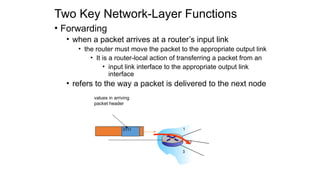
• Forwarding
• when a packet arrives at a router’s input link
• the router must move the packet to the appropriate output link
• It is a router-local action of transferring a packet from an
• input link interface to the appropriate output link
interface
• refers to the way a packet is delivered to the next node
1
2
3
0111
values in arriving
packet header
Two Key Network-Layer Functions
• Routing
• there are more than one route from the source to the
destination
• the network layer is responsible for determining the
‘best’ route or path
• taken by packets as they flow from a sender to a receiver
• It is a network-wide process that determines the end-to-
end paths that packets take from sender to receive
• routing algorithms
• refers to the way routing tables are created to help in
forwarding
1
2
3
0111
value in arriving
packet’s header
routing algorithm
local forwarding table
header value output link
0100
0101
0111
1001
3
2
2
1
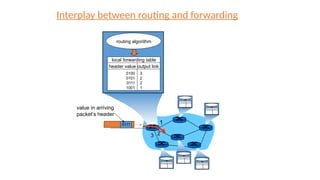
Interplay between routing and forwarding
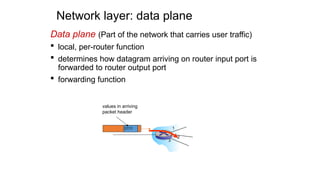
Network layer: data plane
Data plane (Part of the network that carries user traffic)
 local, per-router function
 determines how datagram arriving on router input port is
forwarded to router output port
 forwarding function
1
2
3
0111
values in arriving
packet header
Network layer: control plane
Control plane (make decisions about where traffic is sent)
 Part of the network that carries signaling traffic and is
responsible for routing (configuration, management and exchange
of routing table information)
 network-wide logic
 determines how datagram is routed among routers along
end-end path from source host to destination host
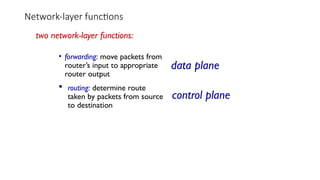
Network-layer functions
• forwarding: move packets from
router’s input to appropriate
router output
data plane
control plane
two network-layer functions:
 routing: determine route
taken by packets from source
to destination
Network Design Philosophy
• Networks and networking devices
• have been designed to overcome RARE but severe challenges
• The philosophy is survivability
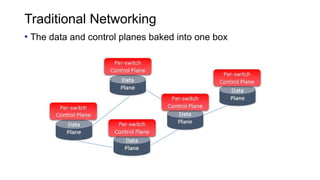
Traditional Networking
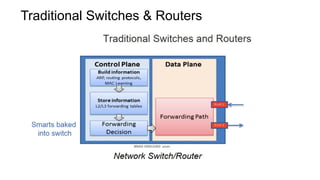
• The data and control planes baked into one box
Traditional Switches & Routers
Networks design not based on formal principles
• Networks used to be simple
- Basic Ethernet/IP straightforward, easy to manage
- For every issue a protocol is developed
• New control requirements have led to complexity
- ACLs, VLANs, TE, Middleboxes, DPI,…
• The infrastructure still works...
- Only because of our great ability to master complexity
- Focus is on mastering complexity
• Ability to master complexity both blessing and curse
11
Simplicity
• To make systems easy to use and understand
• The focus must be on extracting simplicity
• The ability to master complexity is
• not the same as the ability to extract simplicity
• Extracting simplicity builds intellectual foundations
• Necessary for creating a discipline….
• Abstraction is key to extracting simplicity
• What abstractions do we have in networking?
• Abstraction
• Is the act of representing essential
features without including the
background details or explanations
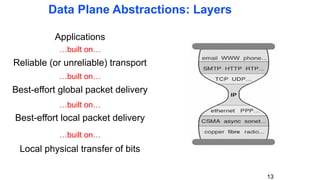
Data Plane Abstractions: Layers
Applications
…built on…
Reliable (or unreliable) transport
…built on…
Best-effort global packet delivery
…built on…
Best-effort local packet delivery
…built on…
Local physical transfer of bits
13
Control Plane Abstractions
14
Control Plane Abstractions
• How do we find these abstractions?
• Define our problem, and then decompose it
The Control Plane Problem
• What is the control plane problem?
The Control Plane Problem
• Control plane must compute forwarding state. To
accomplish its task, the control plane must:
1. Figure out what network looks like (topology)
2. Figure out how to accomplish goal on given topology
3. Tell the swtiches what to do (configure forwarding state)
• What components do we want to reuse?
1. Determining the topology information
3. Configuring forwarding state on routers/switches
Two Control Plane Abstractions
• Abstraction: global network view
- Provides information about current network
• Abstraction: forwarding model
- Provides standard way of defining forwarding state
SDN: Two Control Plane Abstractions
• Abstraction: global network view
- Provides information about current network
- Implementation: “Network Operating System”
- Runs on servers in network (replicated for reliability)
• Abstraction: forwarding model
- Provides standard way of defining forwarding state
- This is OpenFlow
- Specification of <match,action> flow entries
SDN Basic Concept
• Separate Control plane and Data plane entities
• Network intelligence and state are logically centralized.
• The underlying network infrastructure is abstracted from the
applications.
• Execute or run Control plane software on general purpose
hardware
• Decouple from specific networking hardware
• Use commodity servers and switches
• Have programmable data planes
• Maintain, control and program data plane state from a central entity
• An architecture to
• control not just a networking device but an entire network
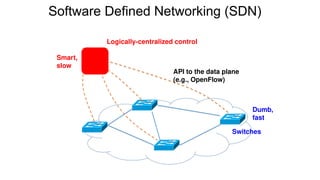
Software Defined Networking (SDN)
API to the data plane
(e.g., OpenFlow)
Logically-centralized control
Switches
Smart,
slow
Dumb,
fast
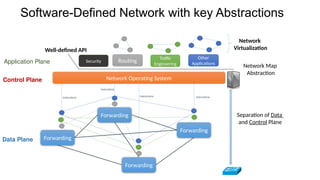
Software-Defined Network with key Abstractions
Network Operating System
Routing Traffic
Engineering
Other
Applications
Well-defined API
Network Map
Abstraction
Forwarding
Forwarding
Forwarding
Forwarding
Separation of Data
and Control Plane
Network
Virtualization
Security
Data Plane
Control Plane
Application Plane
Instructions Instructions
Instructions
Instructions
23
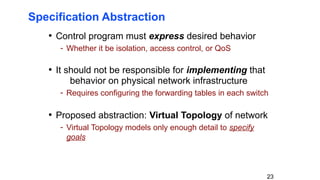
Specification Abstraction
• Control program must express desired behavior
- Whether it be isolation, access control, or QoS
• It should not be responsible for implementing that
behavior on physical network infrastructure
- Requires configuring the forwarding tables in each switch
• Proposed abstraction: Virtual Topology of network
- Virtual Topology models only enough detail to specify
goals
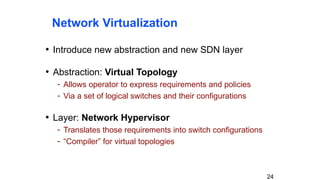
Network Virtualization
• Introduce new abstraction and new SDN layer
• Abstraction: Virtual Topology
- Allows operator to express requirements and policies
- Via a set of logical switches and their configurations
• Layer: Network Hypervisor
- Translates those requirements into switch configurations
- “Compiler” for virtual topologies
24
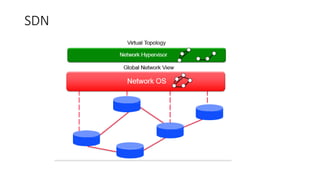
SDN
26
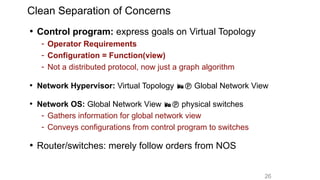
Clean Separation of Concerns
• Control program: express goals on Virtual Topology
- Operator Requirements
- Configuration = Function(view)
- Not a distributed protocol, now just a graph algorithm
• Network Hypervisor: Virtual Topology  Global Network View
• Network OS: Global Network View  physical switches
- Gathers information for global network view
- Conveys configurations from control program to switches
• Router/switches: merely follow orders from NOS
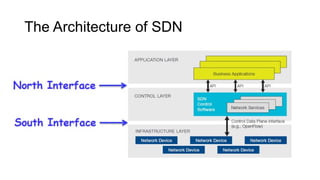
The Architecture of SDN
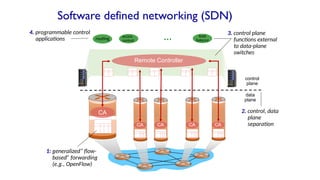
Software defined networking (SDN)
data
plane
control
plane
Remote Controller
CA
CA CA CA CA
1: generalized“ flow-
based” forwarding
(e.g., OpenFlow)
2. control, data
plane
separation
3. control plane
functions external
to data-plane
switches
…
4. programmable control
applications routing
access
control
load
balance
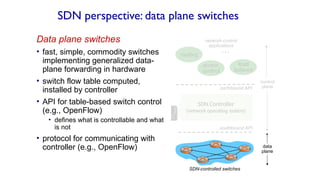
SDN perspective: data plane switches
Data plane switches
• fast, simple, commodity switches
implementing generalized data-
plane forwarding in hardware
• switch flow table computed,
installed by controller
• API for table-based switch control
(e.g., OpenFlow)
• defines what is controllable and what
is not
• protocol for communicating with
controller (e.g., OpenFlow) data
plane
control
plane
SDN Controller
(network operating system)
…
routing
access
control
load
balance
southbound API
northbound API
SDN-controlled switches
network-control
applications
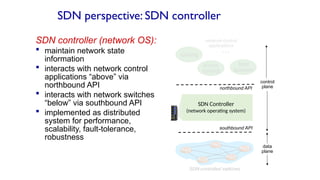
SDN perspective: SDN controller
SDN controller (network OS):
 maintain network state
information
 interacts with network control
applications “above” via
northbound API
 interacts with network switches
“below” via southbound API
 implemented as distributed
system for performance,
scalability, fault-tolerance,
robustness
data
plane
control
plane
SDN Controller
(network operating system)
…
routing
access
control
load
balance
southbound API
northbound API
SDN-controlled switches
network-control
applications
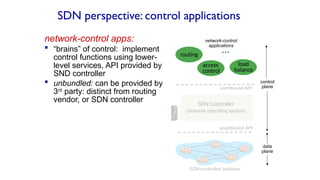
SDN perspective: control applications
network-control apps:
 “brains” of control: implement
control functions using lower-
level services, API provided by
SND controller
 unbundled: can be provided by
3rd
party: distinct from routing
vendor, or SDN controller
data
plane
control
plane
SDN Controller
(network operating system)
…
routing
access
control
load
balance
southbound API
northbound API
SDN-controlled switches
network-control
applications
Network-wide distributed, robust state management
Communication to/from controlled devices
Link-state info switch info
host info
statistics flow tables
…
…
OpenFlow SNMP
…
network
graph intent
RESTful
API
…
Interface, abstractions for network control apps
SDN
controller
routing access
control
load
balance
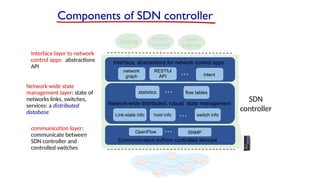
Components of SDN controller
communication layer:
communicate between
SDN controller and
controlled switches
Network-wide state
management layer: state of
networks links, switches,
services: a distributed
database
Interface layer to network
control apps: abstractions
API
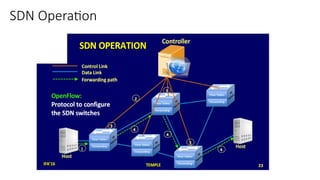
SDN Operation
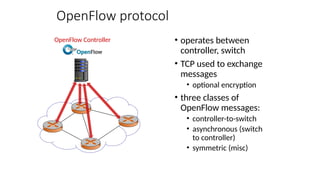
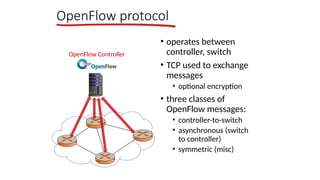
OpenFlow protocol
• operates between
controller, switch
• TCP used to exchange
messages
• optional encryption
• three classes of
OpenFlow messages:
• controller-to-switch
• asynchronous (switch
to controller)
• symmetric (misc)
OpenFlow Controller
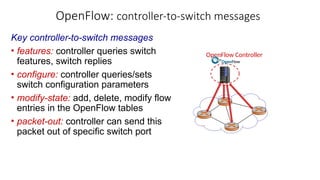
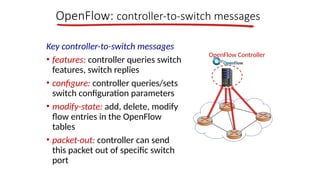
OpenFlow: controller-to-switch messages
Key controller-to-switch messages
• features: controller queries switch
features, switch replies
• configure: controller queries/sets
switch configuration parameters
• modify-state: add, delete, modify flow
entries in the OpenFlow tables
• packet-out: controller can send this
packet out of specific switch port
OpenFlow Controller
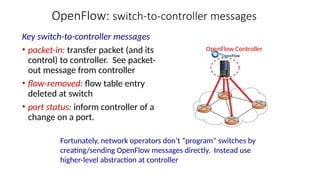
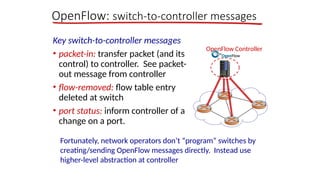
OpenFlow: switch-to-controller messages
Key switch-to-controller messages
• packet-in: transfer packet (and its
control) to controller. See packet-
out message from controller
• flow-removed: flow table entry
deleted at switch
• port status: inform controller of a
change on a port.
Fortunately, network operators don’t “program” switches by
creating/sending OpenFlow messages directly. Instead use
higher-level abstraction at controller
OpenFlow Controller
Link-state info switch info
host info
statistics flow tables
…
…
OpenFlow SNMP
…
network
graph intent
RESTful
API
…
1
2
3
4
6
5
Dijkstra’s link-state
Routing
s1
s2
s3
s4
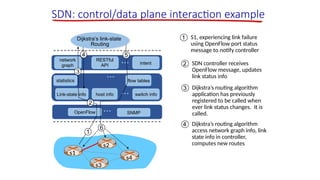
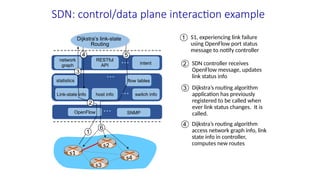
SDN: control/data plane interaction example
S1, experiencing link failure
using OpenFlow port status
message to notify controller
1
SDN controller receives
OpenFlow message, updates
link status info
2
Dijkstra’s routing algorithm
application has previously
registered to be called when
ever link status changes. It is
called.
3
Dijkstra’s routing algorithm
access network graph info, link
state info in controller,
computes new routes
4
Link-state info switch info
host info
statistics flow tables
…
…
OpenFlow SNMP
…
network
graph intent
RESTful
API
…
1
2
3
4
6
5
Dijkstra’s link-state
Routing
s1
s2
s3
s4
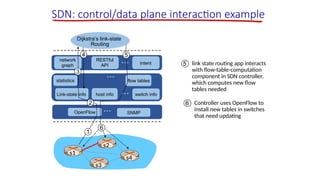
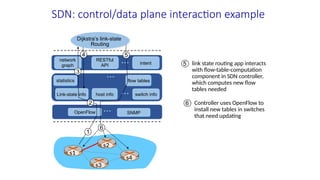
SDN: control/data plane interaction example
link state routing app interacts
with flow-table-computation
component in SDN controller,
which computes new flow
tables needed
5
Controller uses OpenFlow to
install new tables in switches
that need updating
6
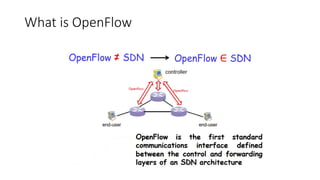
What is OpenFlow
OpenFlow protocol
• operates between
controller, switch
• TCP used to exchange
messages
• optional encryption
• three classes of
OpenFlow messages:
• controller-to-switch
• asynchronous (switch
to controller)
• symmetric (misc)
OpenFlow Controller
OpenFlow: controller-to-switch messages
Key controller-to-switch messages
• features: controller queries switch
features, switch replies
• configure: controller queries/sets
switch configuration parameters
• modify-state: add, delete, modify
flow entries in the OpenFlow
tables
• packet-out: controller can send
this packet out of specific switch
port
OpenFlow Controller
OpenFlow: switch-to-controller messages
Key switch-to-controller messages
• packet-in: transfer packet (and its
control) to controller. See packet-
out message from controller
• flow-removed: flow table entry
deleted at switch
• port status: inform controller of a
change on a port.
Fortunately, network operators don’t “program” switches by
creating/sending OpenFlow messages directly. Instead use
higher-level abstraction at controller
OpenFlow Controller
Link-state info switch info
host info
statistics flow tables
…
…
OpenFlow SNMP
…
network
graph intent
RESTful
API
…
1
2
3
4
6
5
Dijkstra’s link-state
Routing
s1
s2
s3
s4
SDN: control/data plane interaction example
S1, experiencing link failure
using OpenFlow port status
message to notify controller
1
SDN controller receives
OpenFlow message, updates
link status info
2
Dijkstra’s routing algorithm
application has previously
registered to be called when
ever link status changes. It is
called.
3
Dijkstra’s routing algorithm
access network graph info, link
state info in controller,
computes new routes
4
Link-state info switch info
host info
statistics flow tables
…
…
OpenFlow SNMP
…
network
graph intent
RESTful
API
…
1
2
3
4
6
5
Dijkstra’s link-state
Routing
s1
s2
s3
s4
SDN: control/data plane interaction example
link state routing app interacts
with flow-table-computation
component in SDN controller,
which computes new flow
tables needed
5
Controller uses OpenFlow to
install new tables in switches
that need updating
6
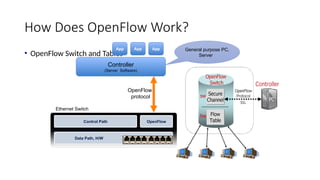
How Does OpenFlow Work?
• OpenFlow Switch and Tables
General purpose PC,
Server
OpenFlow
protocol
Data Path, H/W
Control Path OpenFlow
Controller
(Server Software)
App App App
Ethernet Switch
What is OpenFlow?
• Allow separation of control and data planes.
• Centralization of control.
• Flow based control.
• Takes advantage routing tables in Ethernet switches and routers.
• SDN is not OpenFlow.
• SDN is a concept of the physical separation of the network control plane from the
forwarding plane, and where a control plane controls several devices.
• OpenFlow is communication interface between the control and data plane of an SDN
architecture.
• Allows direct access to and manipulation of the forwarding plane of network devices such as switches and
routers, both physical and virtual.
• Think of as a protocol used in switching devices and controllers interface.
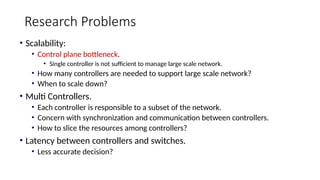
Research Problems
• Scalability:
• Control plane bottleneck.
• Single controller is not sufficient to manage large scale network.
• How many controllers are needed to support large scale network?
• When to scale down?
• Multi Controllers.
• Each controller is responsible to a subset of the network.
• Concern with synchronization and communication between controllers.
• How to slice the resources among controllers?
• Latency between controllers and switches.
• Less accurate decision?
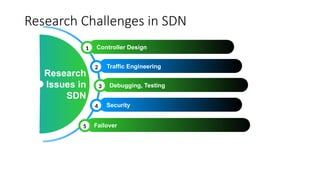
Research Challenges in SDN
Research
Issues in
SDN
1 Controller Design
Traffic Engineering
2
3 Debugging, Testing
Security
4
5 Failover
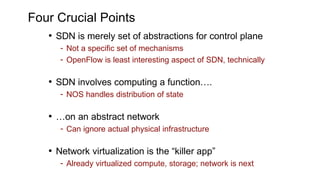
Four Crucial Points
• SDN is merely set of abstractions for control plane
- Not a specific set of mechanisms
- OpenFlow is least interesting aspect of SDN, technically
• SDN involves computing a function….
- NOS handles distribution of state
• …on an abstract network
- Can ignore actual physical infrastructure
• Network virtualization is the “killer app”
- Already virtualized compute, storage; network is next
Conclusion
• Key ideas of SDN:
• Dynamic programmability in forwarding packets.
• Decoupling control and data plane.
• Global view network by logical centralization in control plane.
• Applications can be implemented on top of the control plane.
• SDN is a concept to manage network that leverages OpenFlow protocols.

TE581-Software Defined Networking-2019aaaaaaaaaaaaaaaa.pptx

  • 1.
    TE581: Computer Networks& Protocols Software Defined Networking
  • 2.
    Two Key Network-LayerFunctions • Forwarding • when a packet arrives at a router’s input link • the router must move the packet to the appropriate output link • It is a router-local action of transferring a packet from an • input link interface to the appropriate output link interface • refers to the way a packet is delivered to the next node 1 2 3 0111 values in arriving packet header
  • 3.
    Two Key Network-LayerFunctions • Routing • there are more than one route from the source to the destination • the network layer is responsible for determining the ‘best’ route or path • taken by packets as they flow from a sender to a receiver • It is a network-wide process that determines the end-to- end paths that packets take from sender to receive • routing algorithms • refers to the way routing tables are created to help in forwarding
  • 4.
    1 2 3 0111 value in arriving packet’sheader routing algorithm local forwarding table header value output link 0100 0101 0111 1001 3 2 2 1 Interplay between routing and forwarding
  • 5.
    Network layer: dataplane Data plane (Part of the network that carries user traffic)  local, per-router function  determines how datagram arriving on router input port is forwarded to router output port  forwarding function 1 2 3 0111 values in arriving packet header
  • 6.
    Network layer: controlplane Control plane (make decisions about where traffic is sent)  Part of the network that carries signaling traffic and is responsible for routing (configuration, management and exchange of routing table information)  network-wide logic  determines how datagram is routed among routers along end-end path from source host to destination host
  • 7.
    Network-layer functions • forwarding:move packets from router’s input to appropriate router output data plane control plane two network-layer functions:  routing: determine route taken by packets from source to destination
  • 8.
    Network Design Philosophy •Networks and networking devices • have been designed to overcome RARE but severe challenges • The philosophy is survivability
  • 9.
    Traditional Networking • Thedata and control planes baked into one box
  • 10.
  • 11.
    Networks design notbased on formal principles • Networks used to be simple - Basic Ethernet/IP straightforward, easy to manage - For every issue a protocol is developed • New control requirements have led to complexity - ACLs, VLANs, TE, Middleboxes, DPI,… • The infrastructure still works... - Only because of our great ability to master complexity - Focus is on mastering complexity • Ability to master complexity both blessing and curse 11
  • 12.
    Simplicity • To makesystems easy to use and understand • The focus must be on extracting simplicity • The ability to master complexity is • not the same as the ability to extract simplicity • Extracting simplicity builds intellectual foundations • Necessary for creating a discipline…. • Abstraction is key to extracting simplicity • What abstractions do we have in networking? • Abstraction • Is the act of representing essential features without including the background details or explanations
  • 13.
    Data Plane Abstractions:Layers Applications …built on… Reliable (or unreliable) transport …built on… Best-effort global packet delivery …built on… Best-effort local packet delivery …built on… Local physical transfer of bits 13
  • 14.
  • 15.
    Control Plane Abstractions •How do we find these abstractions? • Define our problem, and then decompose it
  • 16.
    The Control PlaneProblem • What is the control plane problem?
  • 17.
    The Control PlaneProblem • Control plane must compute forwarding state. To accomplish its task, the control plane must: 1. Figure out what network looks like (topology) 2. Figure out how to accomplish goal on given topology 3. Tell the swtiches what to do (configure forwarding state) • What components do we want to reuse? 1. Determining the topology information 3. Configuring forwarding state on routers/switches
  • 18.
    Two Control PlaneAbstractions • Abstraction: global network view - Provides information about current network • Abstraction: forwarding model - Provides standard way of defining forwarding state
  • 19.
    SDN: Two ControlPlane Abstractions • Abstraction: global network view - Provides information about current network - Implementation: “Network Operating System” - Runs on servers in network (replicated for reliability) • Abstraction: forwarding model - Provides standard way of defining forwarding state - This is OpenFlow - Specification of <match,action> flow entries
  • 20.
    SDN Basic Concept •Separate Control plane and Data plane entities • Network intelligence and state are logically centralized. • The underlying network infrastructure is abstracted from the applications. • Execute or run Control plane software on general purpose hardware • Decouple from specific networking hardware • Use commodity servers and switches • Have programmable data planes • Maintain, control and program data plane state from a central entity • An architecture to • control not just a networking device but an entire network
  • 21.
    Software Defined Networking(SDN) API to the data plane (e.g., OpenFlow) Logically-centralized control Switches Smart, slow Dumb, fast
  • 22.
    Software-Defined Network withkey Abstractions Network Operating System Routing Traffic Engineering Other Applications Well-defined API Network Map Abstraction Forwarding Forwarding Forwarding Forwarding Separation of Data and Control Plane Network Virtualization Security Data Plane Control Plane Application Plane Instructions Instructions Instructions Instructions
  • 23.
    23 Specification Abstraction • Controlprogram must express desired behavior - Whether it be isolation, access control, or QoS • It should not be responsible for implementing that behavior on physical network infrastructure - Requires configuring the forwarding tables in each switch • Proposed abstraction: Virtual Topology of network - Virtual Topology models only enough detail to specify goals
  • 24.
    Network Virtualization • Introducenew abstraction and new SDN layer • Abstraction: Virtual Topology - Allows operator to express requirements and policies - Via a set of logical switches and their configurations • Layer: Network Hypervisor - Translates those requirements into switch configurations - “Compiler” for virtual topologies 24
  • 25.
  • 26.
    26 Clean Separation ofConcerns • Control program: express goals on Virtual Topology - Operator Requirements - Configuration = Function(view) - Not a distributed protocol, now just a graph algorithm • Network Hypervisor: Virtual Topology  Global Network View • Network OS: Global Network View  physical switches - Gathers information for global network view - Conveys configurations from control program to switches • Router/switches: merely follow orders from NOS
  • 27.
  • 28.
    Software defined networking(SDN) data plane control plane Remote Controller CA CA CA CA CA 1: generalized“ flow- based” forwarding (e.g., OpenFlow) 2. control, data plane separation 3. control plane functions external to data-plane switches … 4. programmable control applications routing access control load balance
  • 29.
    SDN perspective: dataplane switches Data plane switches • fast, simple, commodity switches implementing generalized data- plane forwarding in hardware • switch flow table computed, installed by controller • API for table-based switch control (e.g., OpenFlow) • defines what is controllable and what is not • protocol for communicating with controller (e.g., OpenFlow) data plane control plane SDN Controller (network operating system) … routing access control load balance southbound API northbound API SDN-controlled switches network-control applications
  • 30.
    SDN perspective: SDNcontroller SDN controller (network OS):  maintain network state information  interacts with network control applications “above” via northbound API  interacts with network switches “below” via southbound API  implemented as distributed system for performance, scalability, fault-tolerance, robustness data plane control plane SDN Controller (network operating system) … routing access control load balance southbound API northbound API SDN-controlled switches network-control applications
  • 31.
    SDN perspective: controlapplications network-control apps:  “brains” of control: implement control functions using lower- level services, API provided by SND controller  unbundled: can be provided by 3rd party: distinct from routing vendor, or SDN controller data plane control plane SDN Controller (network operating system) … routing access control load balance southbound API northbound API SDN-controlled switches network-control applications
  • 32.
    Network-wide distributed, robuststate management Communication to/from controlled devices Link-state info switch info host info statistics flow tables … … OpenFlow SNMP … network graph intent RESTful API … Interface, abstractions for network control apps SDN controller routing access control load balance Components of SDN controller communication layer: communicate between SDN controller and controlled switches Network-wide state management layer: state of networks links, switches, services: a distributed database Interface layer to network control apps: abstractions API
  • 33.
  • 34.
    OpenFlow protocol • operatesbetween controller, switch • TCP used to exchange messages • optional encryption • three classes of OpenFlow messages: • controller-to-switch • asynchronous (switch to controller) • symmetric (misc) OpenFlow Controller
  • 35.
    OpenFlow: controller-to-switch messages Keycontroller-to-switch messages • features: controller queries switch features, switch replies • configure: controller queries/sets switch configuration parameters • modify-state: add, delete, modify flow entries in the OpenFlow tables • packet-out: controller can send this packet out of specific switch port OpenFlow Controller
  • 36.
    OpenFlow: switch-to-controller messages Keyswitch-to-controller messages • packet-in: transfer packet (and its control) to controller. See packet- out message from controller • flow-removed: flow table entry deleted at switch • port status: inform controller of a change on a port. Fortunately, network operators don’t “program” switches by creating/sending OpenFlow messages directly. Instead use higher-level abstraction at controller OpenFlow Controller
  • 37.
    Link-state info switchinfo host info statistics flow tables … … OpenFlow SNMP … network graph intent RESTful API … 1 2 3 4 6 5 Dijkstra’s link-state Routing s1 s2 s3 s4 SDN: control/data plane interaction example S1, experiencing link failure using OpenFlow port status message to notify controller 1 SDN controller receives OpenFlow message, updates link status info 2 Dijkstra’s routing algorithm application has previously registered to be called when ever link status changes. It is called. 3 Dijkstra’s routing algorithm access network graph info, link state info in controller, computes new routes 4
  • 38.
    Link-state info switchinfo host info statistics flow tables … … OpenFlow SNMP … network graph intent RESTful API … 1 2 3 4 6 5 Dijkstra’s link-state Routing s1 s2 s3 s4 SDN: control/data plane interaction example link state routing app interacts with flow-table-computation component in SDN controller, which computes new flow tables needed 5 Controller uses OpenFlow to install new tables in switches that need updating 6
  • 39.
  • 40.
    OpenFlow protocol • operatesbetween controller, switch • TCP used to exchange messages • optional encryption • three classes of OpenFlow messages: • controller-to-switch • asynchronous (switch to controller) • symmetric (misc) OpenFlow Controller
  • 41.
    OpenFlow: controller-to-switch messages Keycontroller-to-switch messages • features: controller queries switch features, switch replies • configure: controller queries/sets switch configuration parameters • modify-state: add, delete, modify flow entries in the OpenFlow tables • packet-out: controller can send this packet out of specific switch port OpenFlow Controller
  • 42.
    OpenFlow: switch-to-controller messages Keyswitch-to-controller messages • packet-in: transfer packet (and its control) to controller. See packet- out message from controller • flow-removed: flow table entry deleted at switch • port status: inform controller of a change on a port. Fortunately, network operators don’t “program” switches by creating/sending OpenFlow messages directly. Instead use higher-level abstraction at controller OpenFlow Controller
  • 43.
    Link-state info switchinfo host info statistics flow tables … … OpenFlow SNMP … network graph intent RESTful API … 1 2 3 4 6 5 Dijkstra’s link-state Routing s1 s2 s3 s4 SDN: control/data plane interaction example S1, experiencing link failure using OpenFlow port status message to notify controller 1 SDN controller receives OpenFlow message, updates link status info 2 Dijkstra’s routing algorithm application has previously registered to be called when ever link status changes. It is called. 3 Dijkstra’s routing algorithm access network graph info, link state info in controller, computes new routes 4
  • 44.
    Link-state info switchinfo host info statistics flow tables … … OpenFlow SNMP … network graph intent RESTful API … 1 2 3 4 6 5 Dijkstra’s link-state Routing s1 s2 s3 s4 SDN: control/data plane interaction example link state routing app interacts with flow-table-computation component in SDN controller, which computes new flow tables needed 5 Controller uses OpenFlow to install new tables in switches that need updating 6
  • 45.
    How Does OpenFlowWork? • OpenFlow Switch and Tables General purpose PC, Server OpenFlow protocol Data Path, H/W Control Path OpenFlow Controller (Server Software) App App App Ethernet Switch
  • 46.
    What is OpenFlow? •Allow separation of control and data planes. • Centralization of control. • Flow based control. • Takes advantage routing tables in Ethernet switches and routers. • SDN is not OpenFlow. • SDN is a concept of the physical separation of the network control plane from the forwarding plane, and where a control plane controls several devices. • OpenFlow is communication interface between the control and data plane of an SDN architecture. • Allows direct access to and manipulation of the forwarding plane of network devices such as switches and routers, both physical and virtual. • Think of as a protocol used in switching devices and controllers interface.
  • 47.
    Research Problems • Scalability: •Control plane bottleneck. • Single controller is not sufficient to manage large scale network. • How many controllers are needed to support large scale network? • When to scale down? • Multi Controllers. • Each controller is responsible to a subset of the network. • Concern with synchronization and communication between controllers. • How to slice the resources among controllers? • Latency between controllers and switches. • Less accurate decision?
  • 48.
    Research Challenges inSDN Research Issues in SDN 1 Controller Design Traffic Engineering 2 3 Debugging, Testing Security 4 5 Failover
  • 49.
    Four Crucial Points •SDN is merely set of abstractions for control plane - Not a specific set of mechanisms - OpenFlow is least interesting aspect of SDN, technically • SDN involves computing a function…. - NOS handles distribution of state • …on an abstract network - Can ignore actual physical infrastructure • Network virtualization is the “killer app” - Already virtualized compute, storage; network is next
  • 50.
    Conclusion • Key ideasof SDN: • Dynamic programmability in forwarding packets. • Decoupling control and data plane. • Global view network by logical centralization in control plane. • Applications can be implemented on top of the control plane. • SDN is a concept to manage network that leverages OpenFlow protocols.

Editor's Notes

  • #46 OpenFlow is a communications protocol that gives access to the forwarding plane of a network switch or router over the network