Lecture 1.1.1 (Introduction to Microcontroller and Microprrocessor) (1).pptx
1.
1
University Institute ofComputing
Master of Computer Applications
Internet of Things (IoT)
Course Code: 23CAH-702
Designed By :
Dr. Kavita Jindal
Assistant Professor, ECE, UIC
2.
University Vision
To beglobally recognized as a Centre of Excellence for Research, Innovation, Entrepreneurship and disseminating
knowledge by providing inspirational learning to produce professional leaders for serving the society.
3.
University Mission
M1: Providingworld-class infrastructure, renowned academicians, and an ideal environment for Research,
Innovation, Consultancy, and Entrepreneurship relevant to society.
M2: Offering programs & courses in consonance with National policies for nation-building and meeting global
challenges.
M3: Designing Curriculum to match international standards, and needs of Industry, civil society, and for inculcation
of traits of Creative Thinking and Critical Analysis as well as Human and Ethical values.
M4: Ensuring students delight by meeting their aspirations through blended learning, corporate mentoring,
professional grooming, flexible curriculum, and a healthy atmosphere based on co-curricular and extra-curricular
activities.
M5: Creating a scientific, transparent, and objective examination/evaluation system to ensure an ideal certification.
M6: Establishing strategic relationships with leading National and International corporates and universities for
academic as well as research collaborations.
M7: Contributing for the creation of a healthy, vibrant, and sustainable society by involving in Institutional Social
Responsibility (ISR) activities like rural development, the welfare of senior citizens, women empowerment,
community service, health and hygiene awareness, and environmental protection
4.
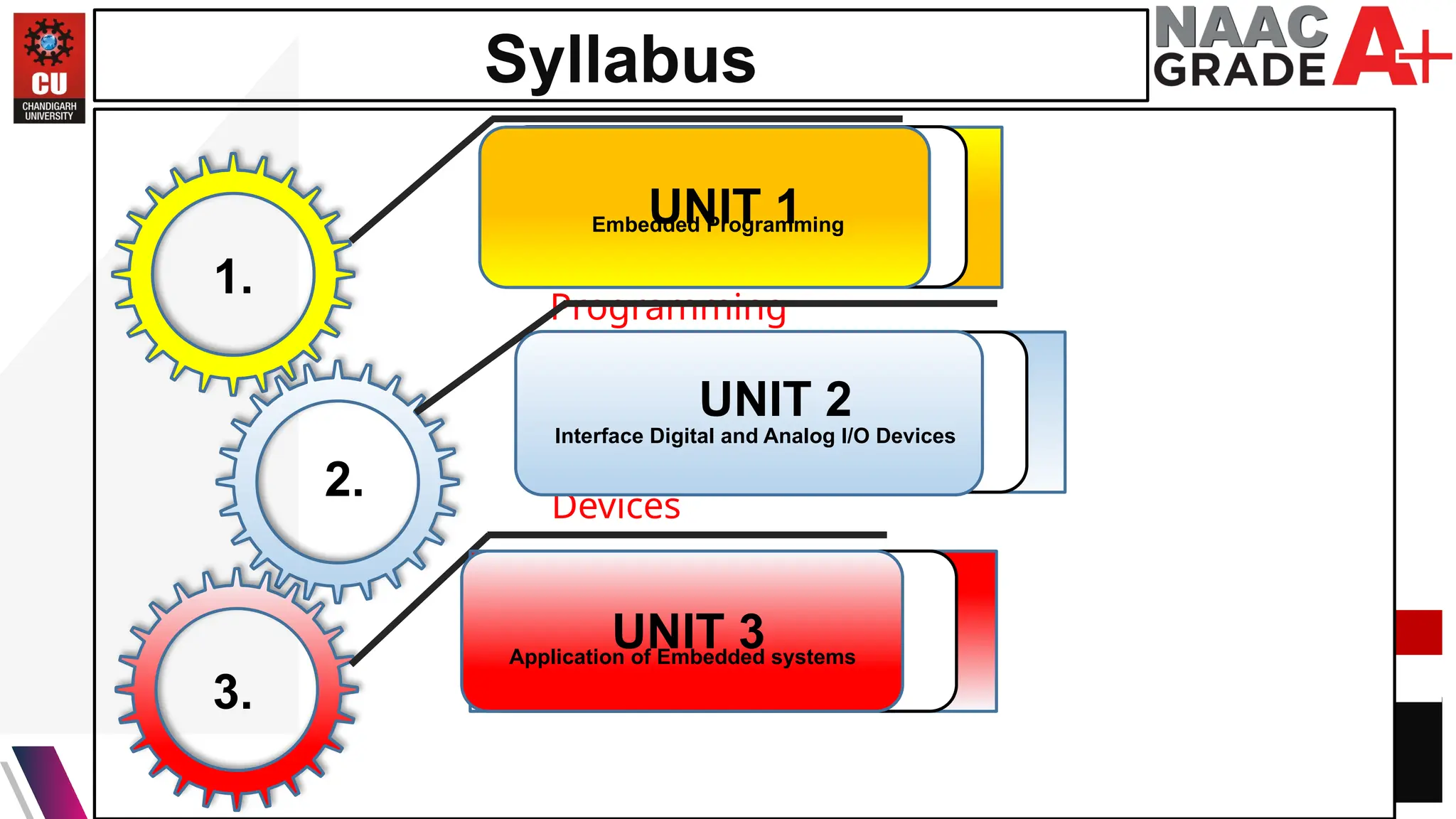
Syllabus
1. Embedded System
2.IOT & Raspberry Pi
3. Arduino
Programming
1. Embedded System
Application using
Arduino
1.
UNIT 1
2.
3.
1. Interfacing of Devices
2. Basic Laws and
Components
3. Various Sensor and
Devices
UNIT 3
UNIT 2
Embedded Programming
Interface Digital and Analog I/O Devices
Application of Embedded systems
5.
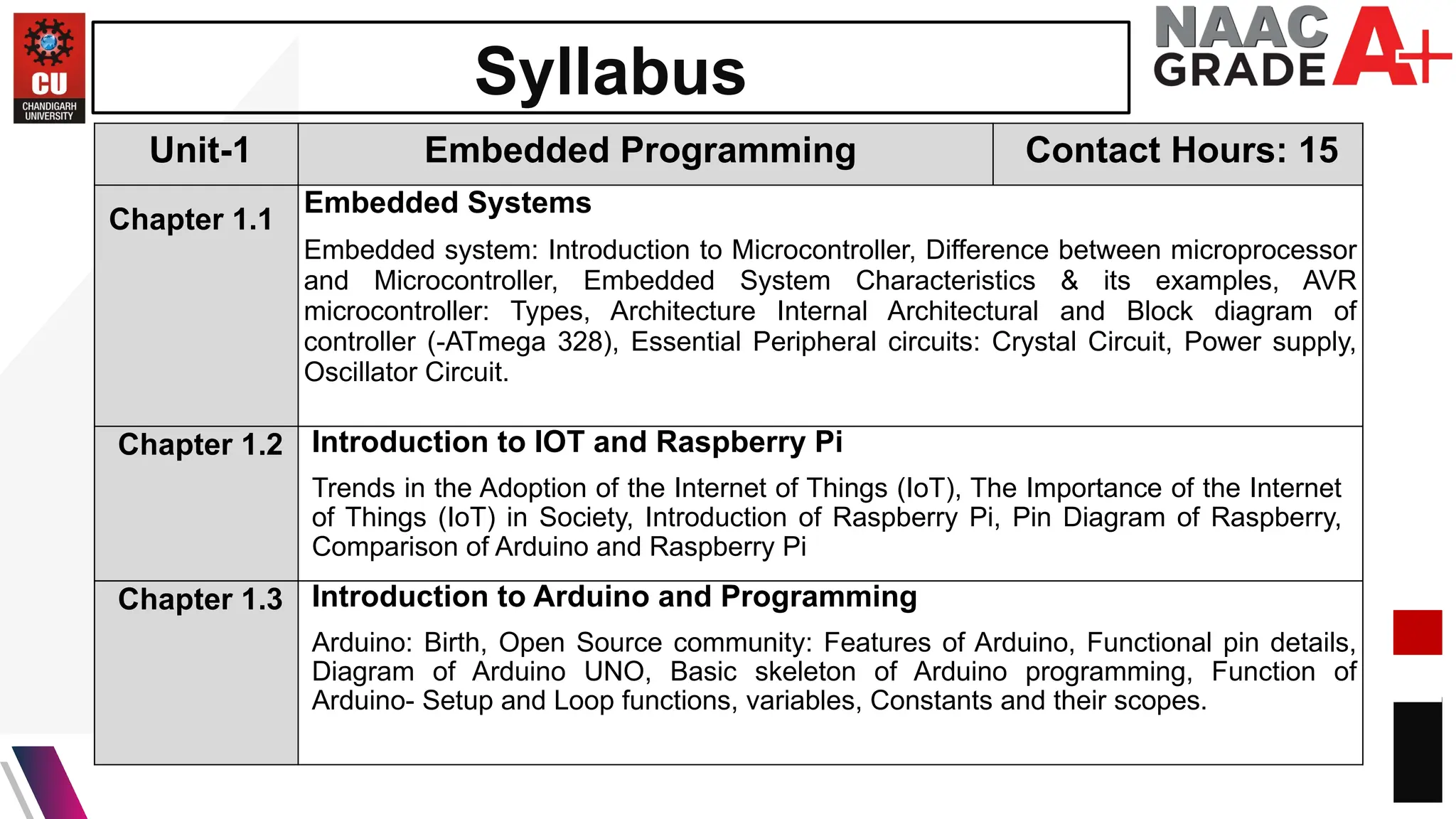
Syllabus
Unit-1 Embedded ProgrammingContact Hours: 15
Chapter 1.1
Embedded Systems
Embedded system: Introduction to Microcontroller, Difference between microprocessor
and Microcontroller, Embedded System Characteristics & its examples, AVR
microcontroller: Types, Architecture Internal Architectural and Block diagram of
controller (-ATmega 328), Essential Peripheral circuits: Crystal Circuit, Power supply,
Oscillator Circuit.
Chapter 1.2 Introduction to IOT and Raspberry Pi
Trends in the Adoption of the Internet of Things (IoT), The Importance of the Internet
of Things (IoT) in Society, Introduction of Raspberry Pi, Pin Diagram of Raspberry,
Comparison of Arduino and Raspberry Pi
Chapter 1.3 Introduction to Arduino and Programming
Arduino: Birth, Open Source community: Features of Arduino, Functional pin details,
Diagram of Arduino UNO, Basic skeleton of Arduino programming, Function of
Arduino- Setup and Loop functions, variables, Constants and their scopes.
6.
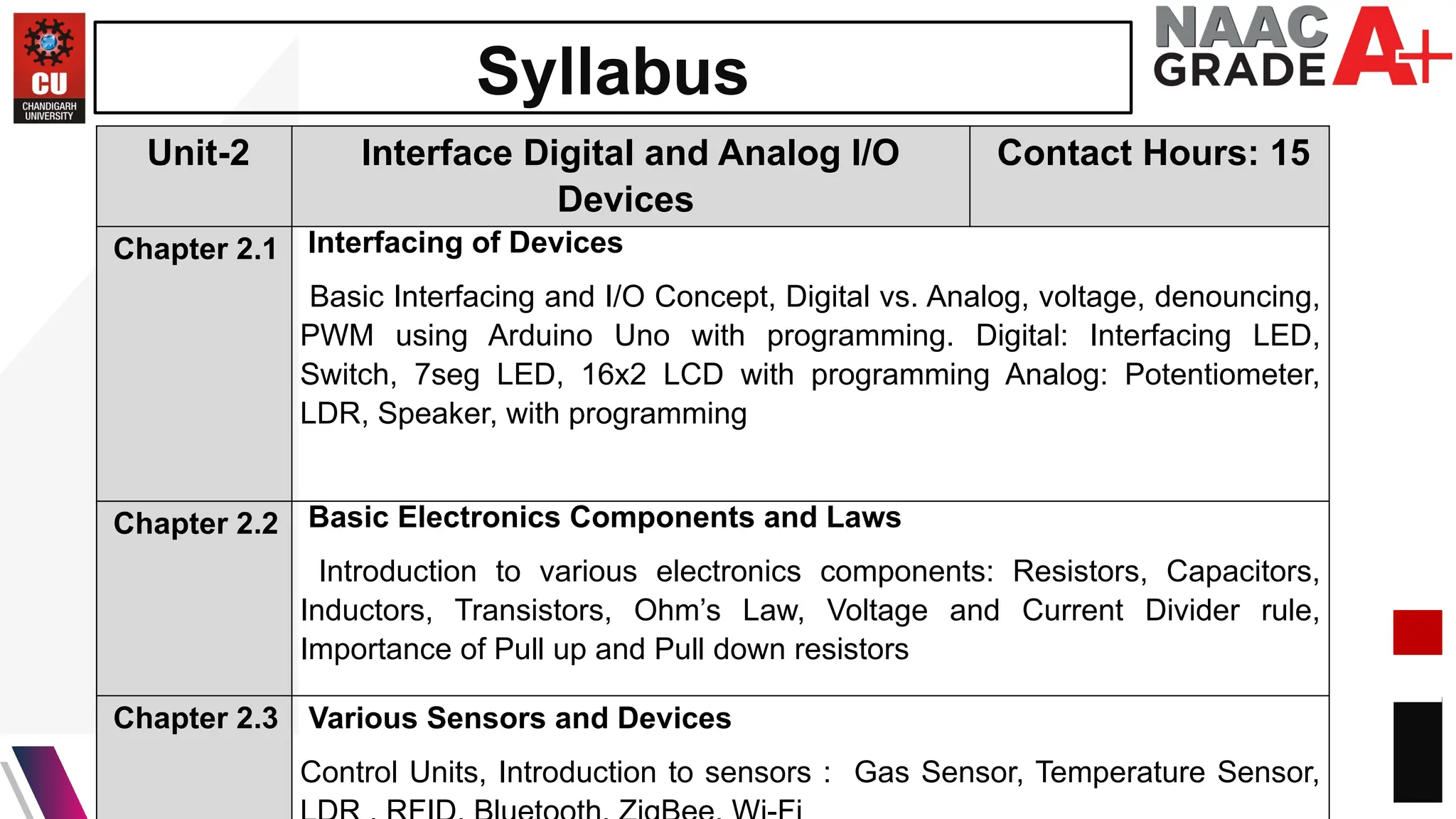
Syllabus
Unit-2 Interface Digitaland Analog I/O
Devices
Contact Hours: 15
Chapter 2.1 Interfacing of Devices
Basic Interfacing and I/O Concept, Digital vs. Analog, voltage, denouncing,
PWM using Arduino Uno with programming. Digital: Interfacing LED,
Switch, 7seg LED, 16x2 LCD with programming Analog: Potentiometer,
LDR, Speaker, with programming
Chapter 2.2 Basic Electronics Components and Laws
Introduction to various electronics components: Resistors, Capacitors,
Inductors, Transistors, Ohm’s Law, Voltage and Current Divider rule,
Importance of Pull up and Pull down resistors
Chapter 2.3 Various Sensors and Devices
Control Units, Introduction to sensors : Gas Sensor, Temperature Sensor,
7.
Syllabus
Unit-3 Application ofEmbedded systems Contact Hours: 15
Chapter 3.1 Embedded system Applications using Arduino
Timers/counters with programming, Emphasis on various real world
applications via Interfacing Bluetooth and controlling by android phone.
Interfacing RF transmitter/receiver (2.4Ghz). Interfacing Ultrasonic Sensor
to calculate distance. Interfacing Motors, Smart Home System
8.
8
1. Introduction toMicrocontroller
2. History of Microcontroller
3. Introduction to Microprocessor
4. History of Microprocessor
5. FAQs
Course Outlines
9.
9
Learning Outcomes
After thislecture :
• Student will able to understand about Embedded systems
• Student will learn the various industrial revolutions.
• Student will able to differentiate between Embedded systems and IoT.
10.
10
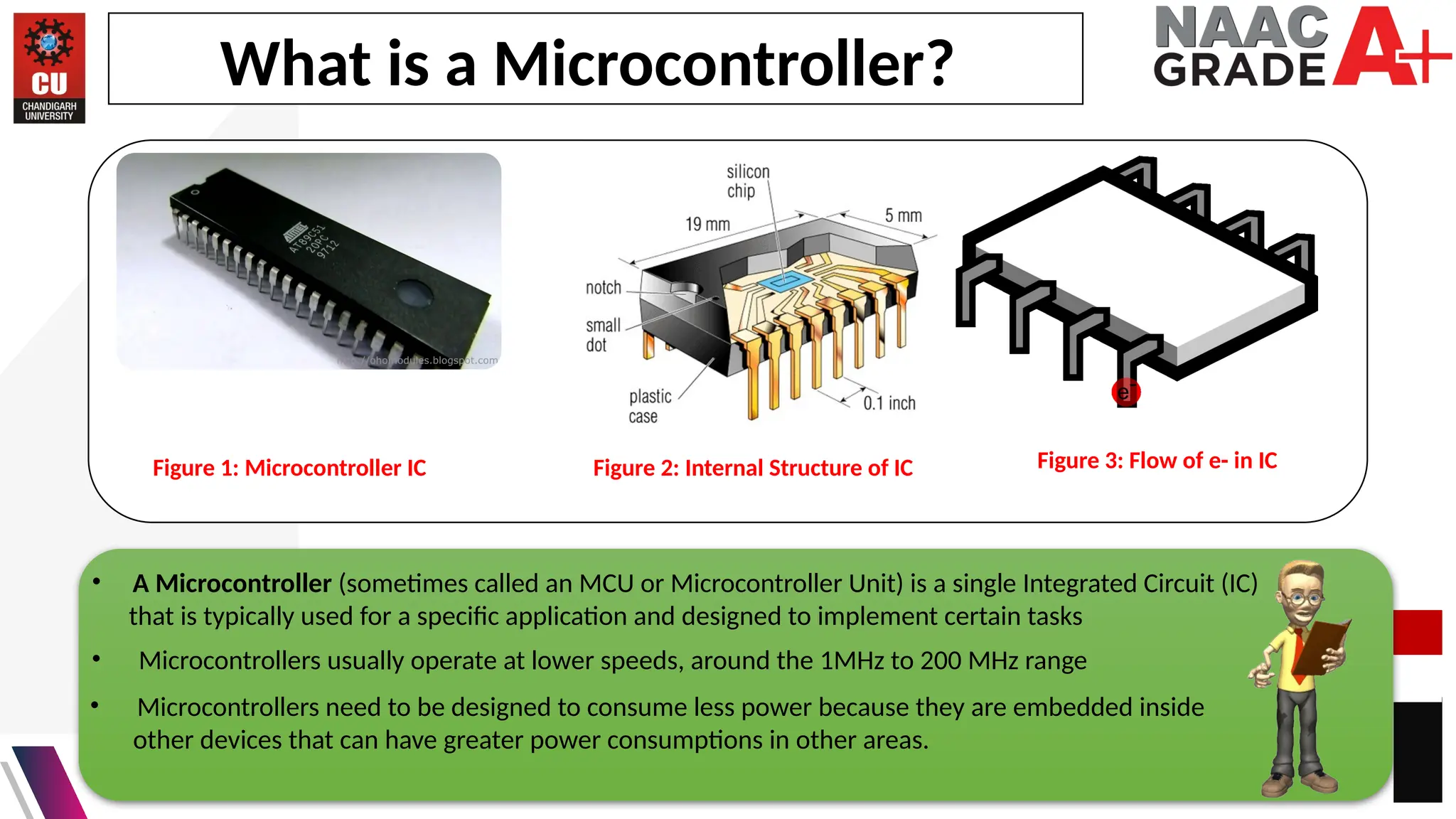
What is aMicrocontroller?
• A Microcontroller (sometimes called an MCU or Microcontroller Unit) is a single Integrated Circuit (IC)
that is typically used for a specific application and designed to implement certain tasks
• Microcontrollers usually operate at lower speeds, around the 1MHz to 200 MHz range
• Microcontrollers need to be designed to consume less power because they are embedded inside
other devices that can have greater power consumptions in other areas.
Figure 1: Microcontroller IC Figure 2: Internal Structure of IC Figure 3: Flow of e- in IC
11.
Introduction to Microcontroller
11
•Microcontrollers are widely used in embedded systems, such as home appliances, automotive
systems, medical devices, and industrial control systems
• A typical microcontroller includes a processor, memory and input/output (I/O) peripherals on a single
chip.
• Microcontrollers are often referred to as single chip devices or single chip computers.
• The main consequence of the microcontroller’s small size is that its resources are far more limited
than those of a desktop personal computer.
• Microcontroller (MCU) A microcontroller is a compact integrated circuit designed to govern a specific
operation in an embedded system.
12.
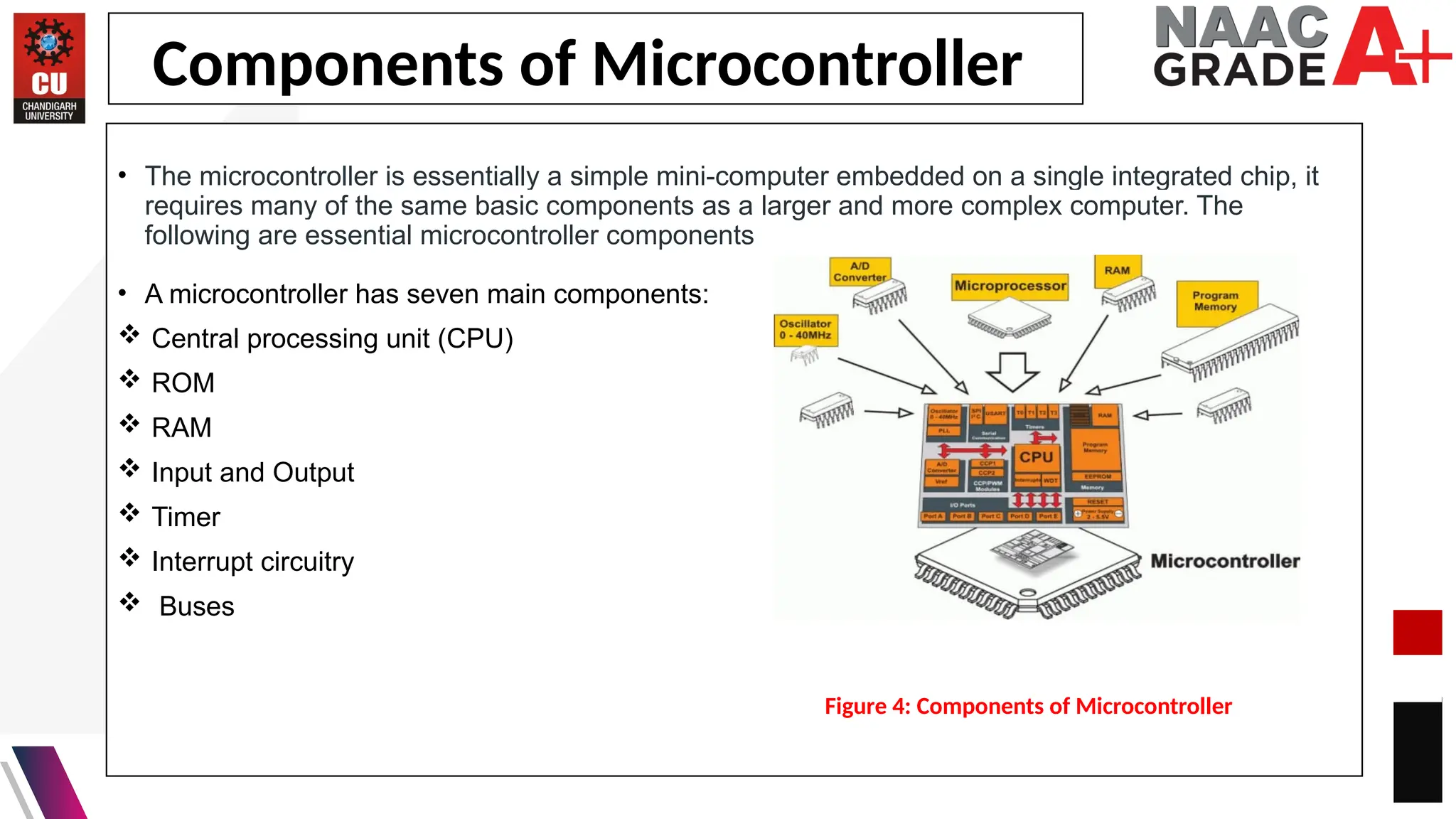
• The microcontrolleris essentially a simple mini-computer embedded on a single integrated chip, it
requires many of the same basic components as a larger and more complex computer. The
following are essential microcontroller components
• A microcontroller has seven main components:
Central processing unit (CPU)
ROM
RAM
Input and Output
Timer
Interrupt circuitry
Buses
Components of Microcontroller
Figure 4: Components of Microcontroller
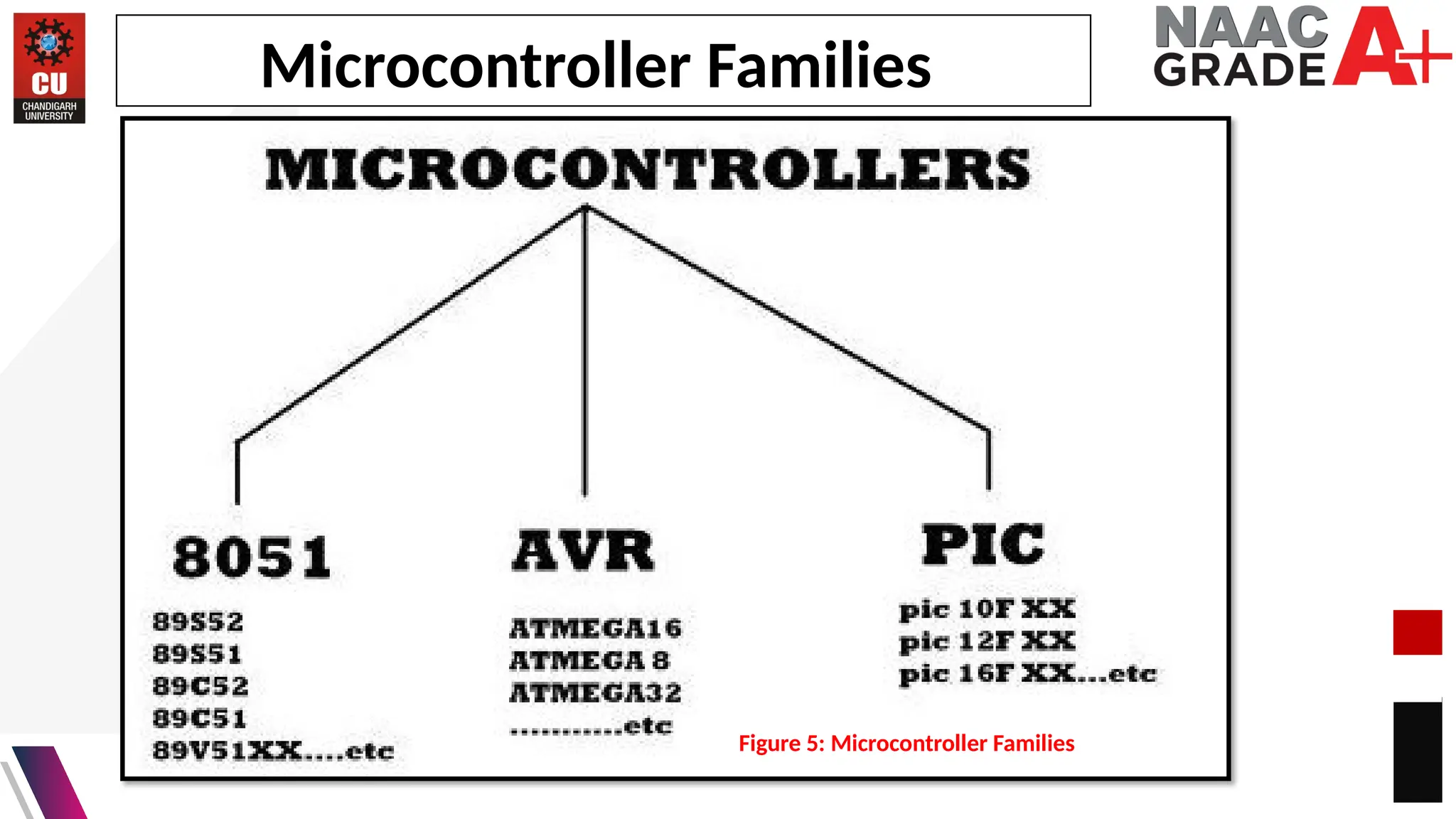
Microcontroller Families
15
• 8051-These microcontrollers are old but still trendy and most of the companies fabricate these
microcontrollers. The older types of 8051 have 12 clocks per instruction whereas the recent 8051
have 6 clocks per instruction. The 8051 microcontroller does not have an in built memory bus. In
1980, Intel fabricated the single chip microcontroller 8051 with Harvard architecture.
• AVR (Advanced Version RISC) - In 1996, Atmel fabricated this single chip microcontroller with a
modified Harvard Architecture. This chip is loaded with C- compiler, Free IDE and many more
features. This microcontroller is a bit difficult for the starters to handle. The AVR was one of the
first microcontroller families to use on-chip flash memory for program storage, as opposed
to one-time programmable ROM, EPROM, or EEPROM used by other microcontrollers at the time
16.
Microcontroller Families
16
• PIC-Programmable Interface Controller is usually referred as PIC. They are slightly older than
8051 microcontrollers but excel cause of their small low pin count devices. They perform well and
are affordable. The Microchip technology fabricated the single chip microcontroller PIC with
Harvard architecture. The programming part is very tedious and hence it is not recommended for
beginners
18.
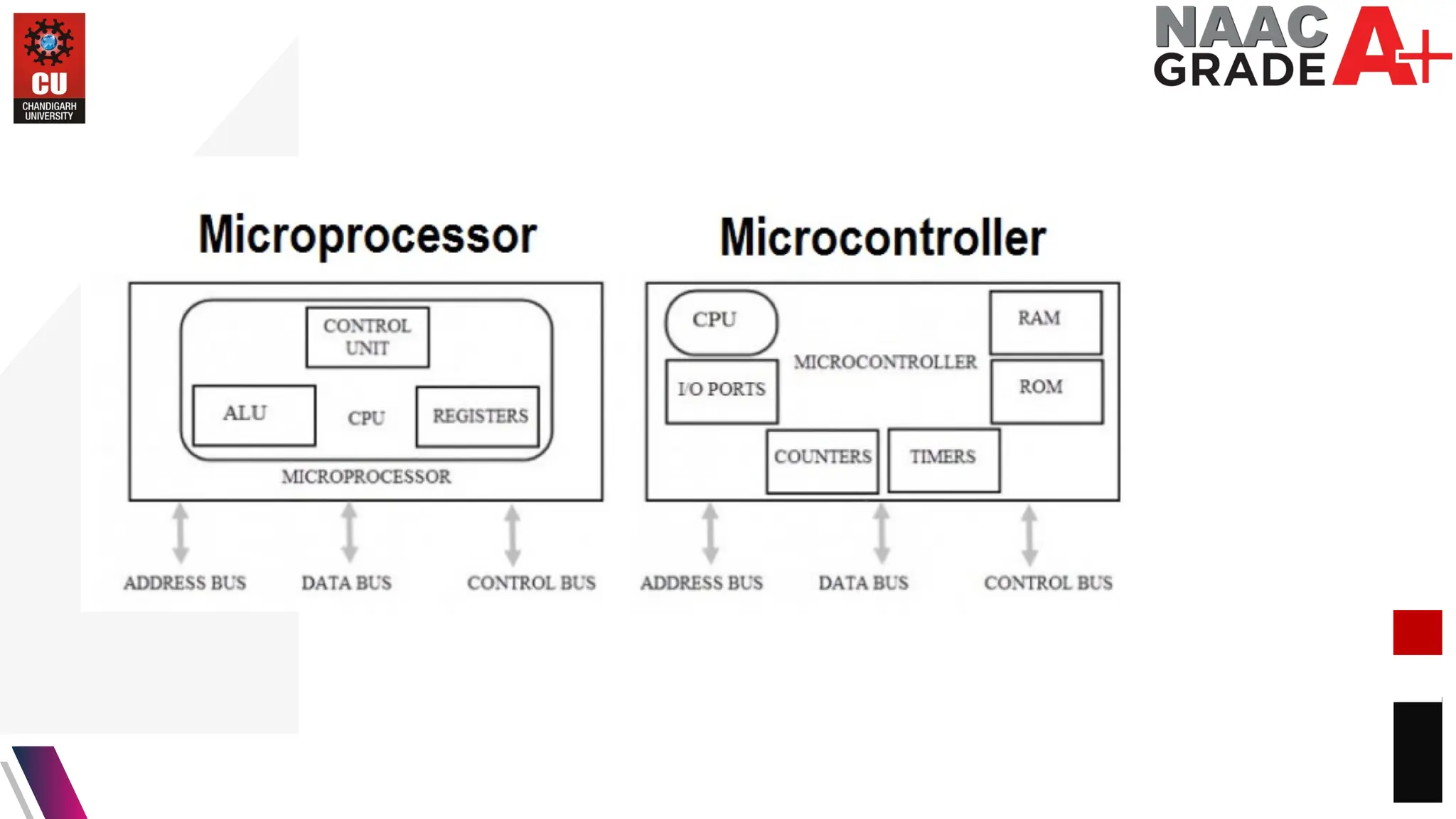
Difference between Microprocessorand Microcontroller
Microprocessor
• Since memory and I/O are connected
externally, the circuit becomes large in size.
• It is a central processing unit on a single
silicon-based integrated chip.
• Complex and expensive due to a large
number of instructions to process.
• Can run at a very high speed.
• RAM, ROM, I/O units, and other
peripherals are not embedded on a single
chip.
Microcontroller
• Since memory and I/O are present together,
the internal circuit is small in size.
• It is a byproduct of the development of
microprocessors with a CPU along with
other peripherals.
• Simple and inexpensive due to less number
of Instructions to process.
• Can run up to 200MHz or more.
• RAM, ROM, CPU and other peripherals are
embedded on a single chip.
18
Difference between RISCand CISC
RISC
• Instruction takes one or two cycles.
• Only load/store instructions are used to access
memory.
• Fixed format instruction
• Few addressing modes
• Few instructions
• Most of the have multiple register banks
CISC
• Instruction takes multiple cycles.
• In additions to load and store instructions,
memory access is possible with other
instructions also.
• Instructions executed by the micro process.
• Variable format instructions.
• Many addressing modes.
• Complex instruction set.
• Single register bank.
22





![Robotics & Embedded IoT System Design [Day-3]](https://cdn.slidesharecdn.com/ss_thumbnails/roboticsiot-3-170621121447-thumbnail.jpg?width=640&height=640&fit=bounds)


