Lecture 05
Irfan Malik
Dr. Sheraz Naseer
● Prompt Engineering
● Chat GPT PlayGround
Agenda
Generative AI
3
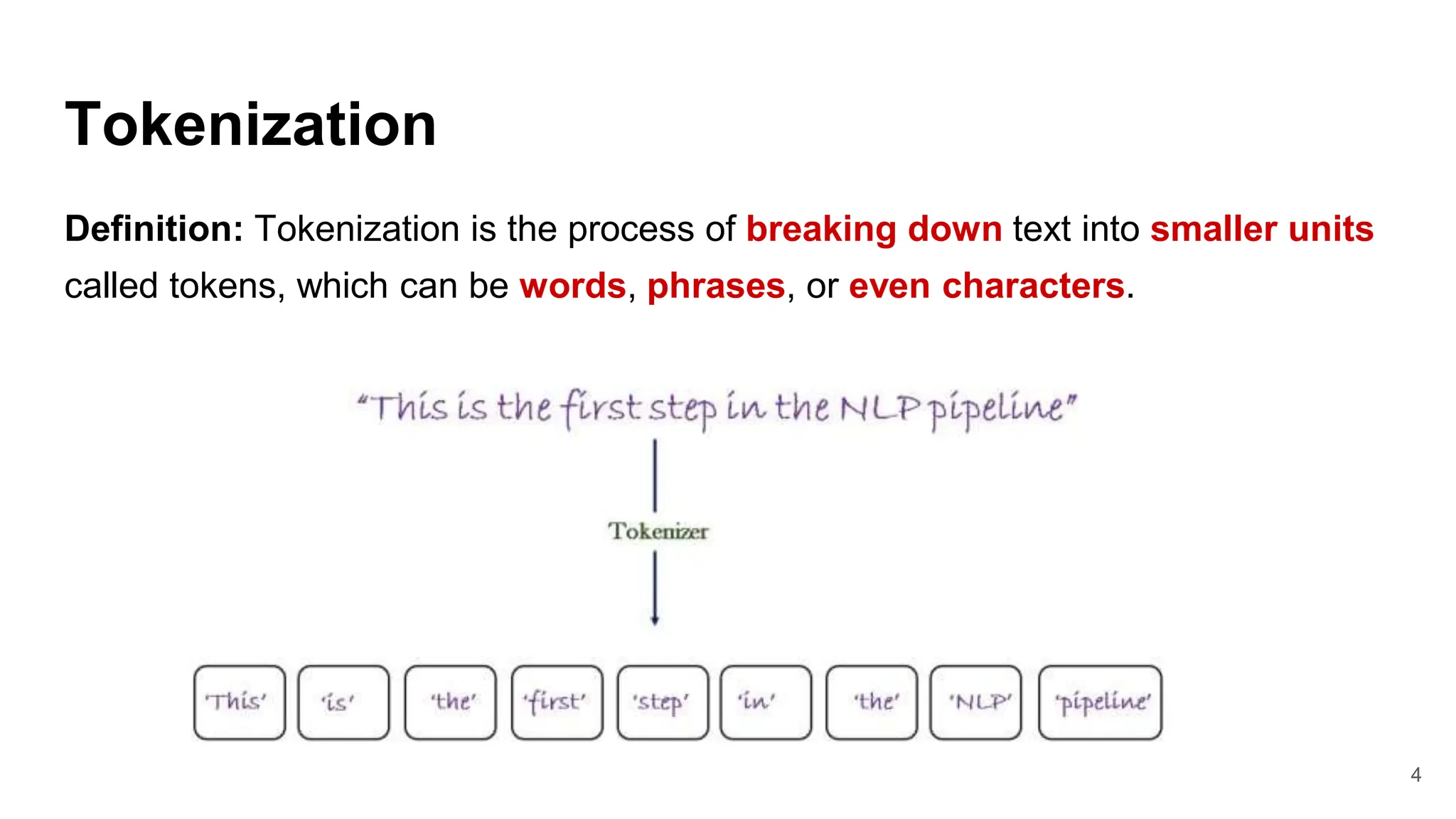
Tokenization
Definition: Tokenization is the process of breaking down text into smaller units
called tokens, which can be words, phrases, or even characters.
4
Tokens in Language Models
Definition: Tokens are the fundamental units of text used by language models.
They can be as short as a single character or as long as a word or phrase.
Importance: Language models process text at the token level, allowing them to
analyze and generate text based on the context and relationships between
individual tokens.
5
Prompt Limits in Language Models
Definition: Prompt limits refer to the constraints imposed on the input provided to
a language model.
Reasons for Prompt Limits:
● Memory limitations: Language models have a finite capacity to process
and store information.
● Computational constraints: Longer prompts require more processing time
and computational resources.
● Response coherence: Extremely long prompts may result in irrelevant
outputs.
6
Prompt Engineering
7
What is Prompt Engineering?
● Prompt engineering involves crafting tailored instructions or queries to
guide the language model towards desired outputs.
● It helps shape the behavior of the model and improves response quality.
8
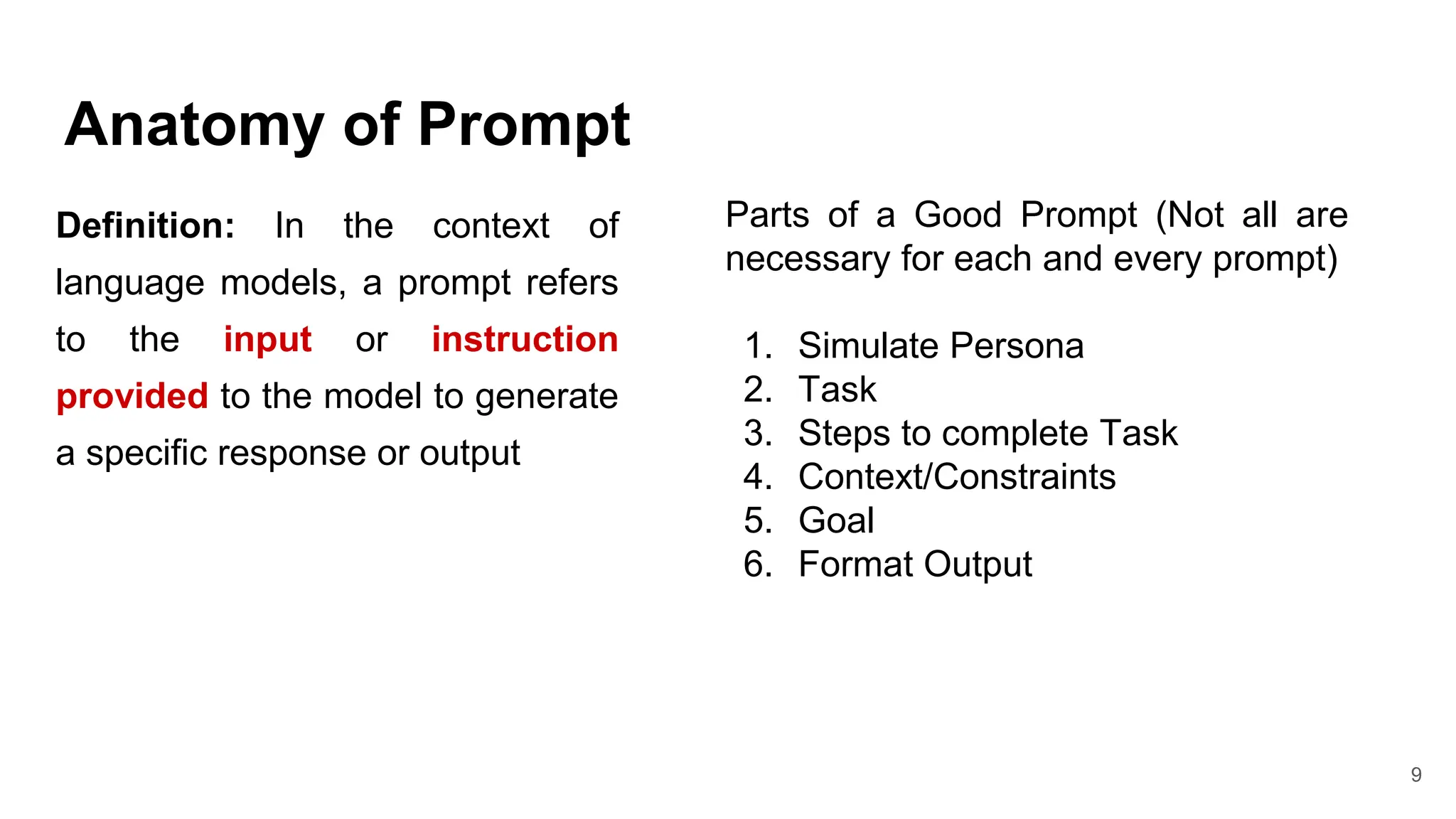
Anatomy of Prompt
Definition: In the context of
language models, a prompt refers
to the input or instruction
provided to the model to generate
a specific response or output
9
Parts of a Good Prompt (Not all are
necessary for each and every prompt)
1. Simulate Persona
2. Task
3. Steps to complete Task
4. Context/Constraints
5. Goal
6. Format Output
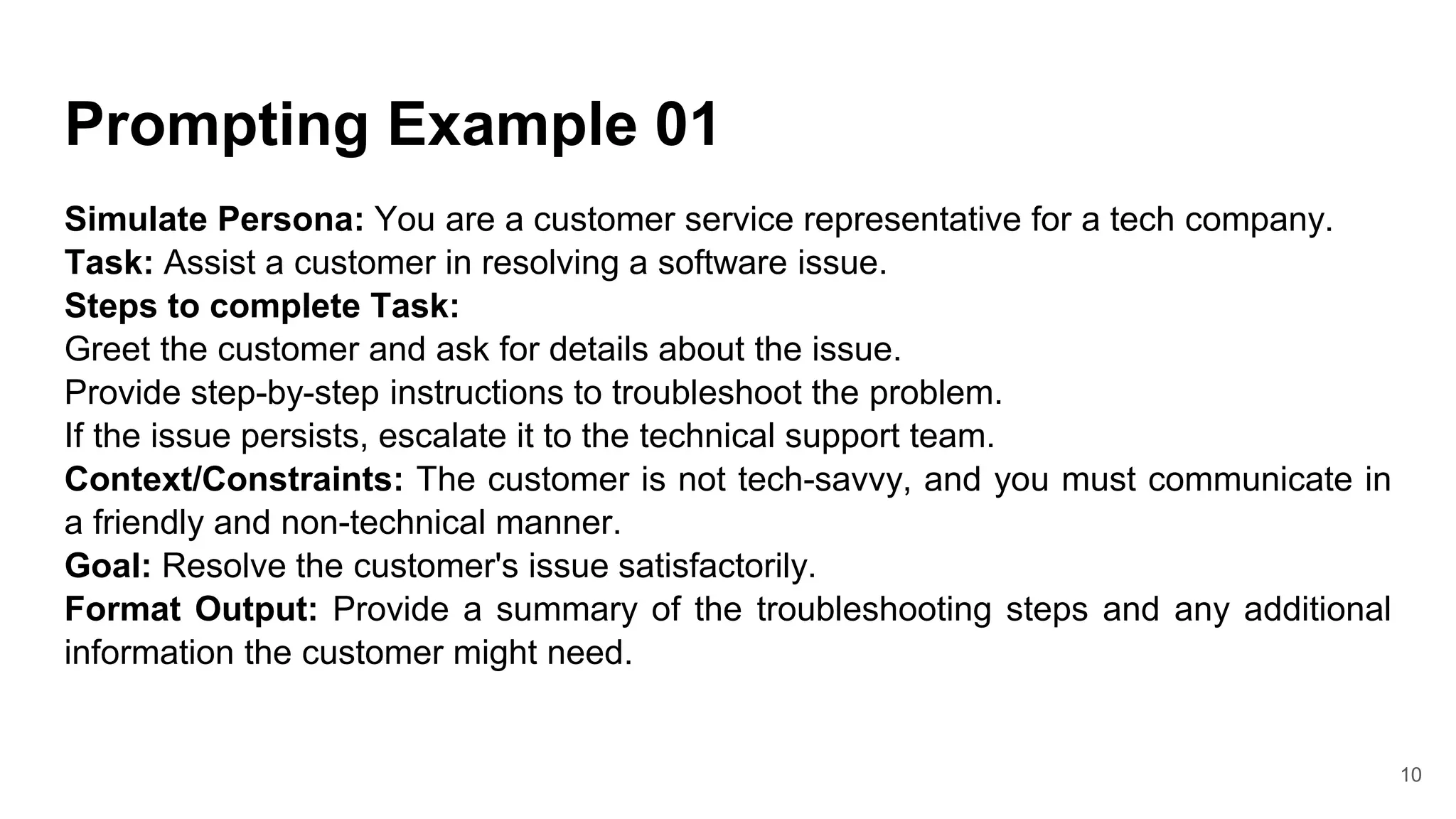
Prompting Example 01
Simulate Persona: You are a customer service representative for a tech company.
Task: Assist a customer in resolving a software issue.
Steps to complete Task:
Greet the customer and ask for details about the issue.
Provide step-by-step instructions to troubleshoot the problem.
If the issue persists, escalate it to the technical support team.
Context/Constraints: The customer is not tech-savvy, and you must communicate in
a friendly and non-technical manner.
Goal: Resolve the customer's issue satisfactorily.
Format Output: Provide a summary of the troubleshooting steps and any additional
information the customer might need.
10
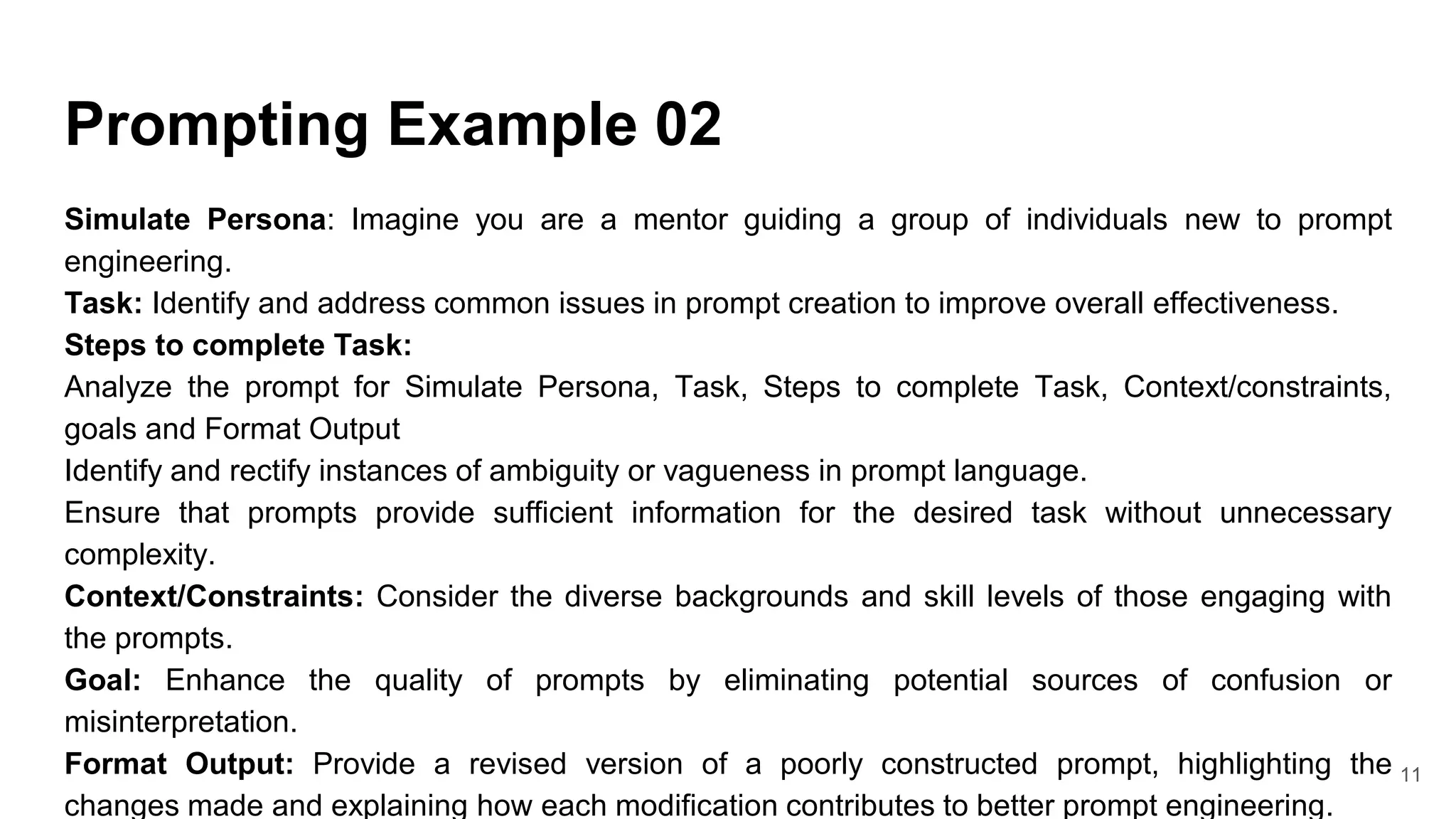
Prompting Example 02
Simulate Persona: Imagine you are a mentor guiding a group of individuals new to prompt
engineering.
Task: Identify and address common issues in prompt creation to improve overall effectiveness.
Steps to complete Task:
Analyze the prompt for Simulate Persona, Task, Steps to complete Task, Context/constraints,
goals and Format Output
Identify and rectify instances of ambiguity or vagueness in prompt language.
Ensure that prompts provide sufficient information for the desired task without unnecessary
complexity.
Context/Constraints: Consider the diverse backgrounds and skill levels of those engaging with
the prompts.
Goal: Enhance the quality of prompts by eliminating potential sources of confusion or
misinterpretation.
Format Output: Provide a revised version of a poorly constructed prompt, highlighting the
changes made and explaining how each modification contributes to better prompt engineering.
11
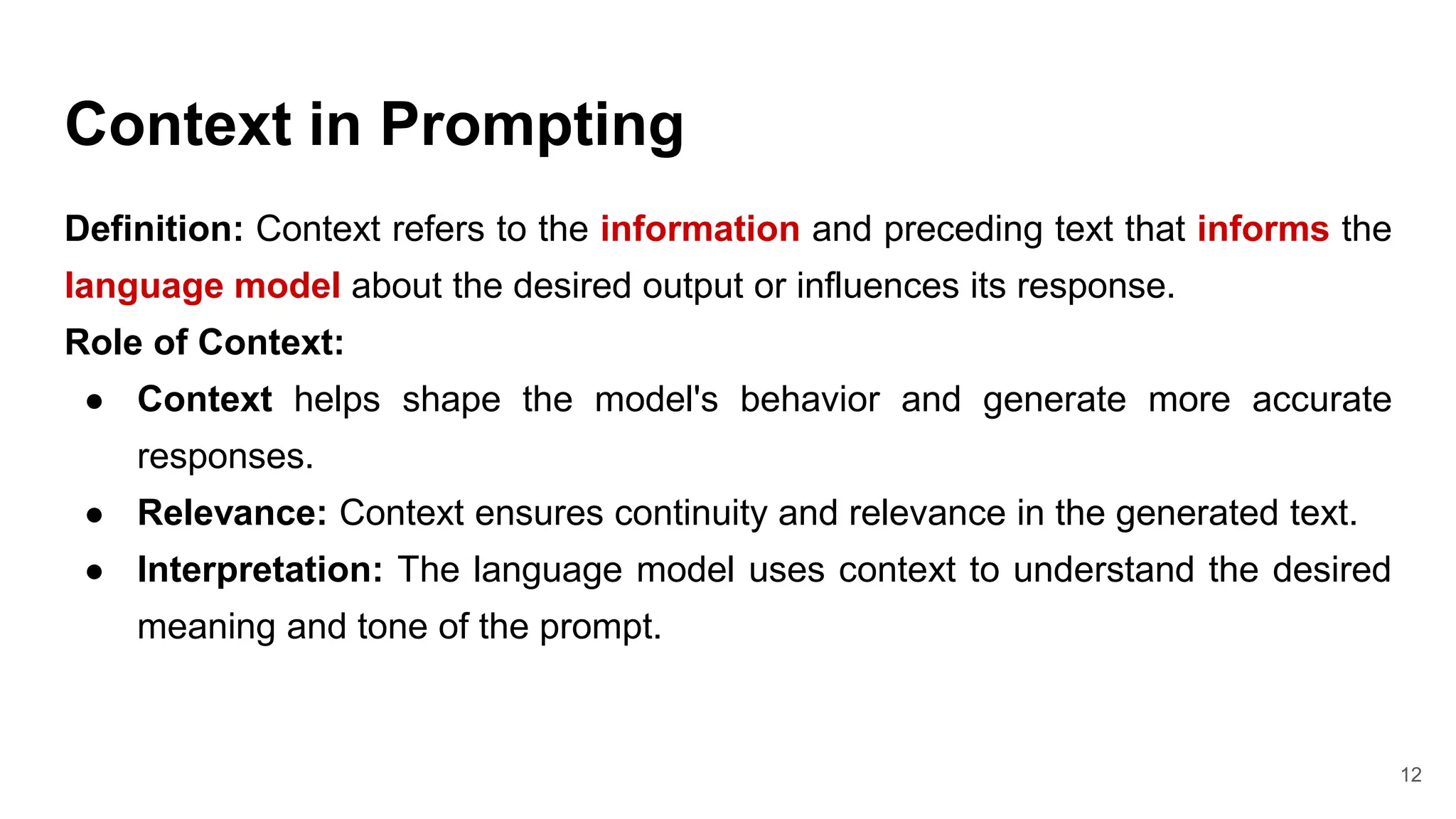
Context in Prompting
Definition: Context refers to the information and preceding text that informs the
language model about the desired output or influences its response.
Role of Context:
● Context helps shape the model's behavior and generate more accurate
responses.
● Relevance: Context ensures continuity and relevance in the generated text.
● Interpretation: The language model uses context to understand the desired
meaning and tone of the prompt.
12
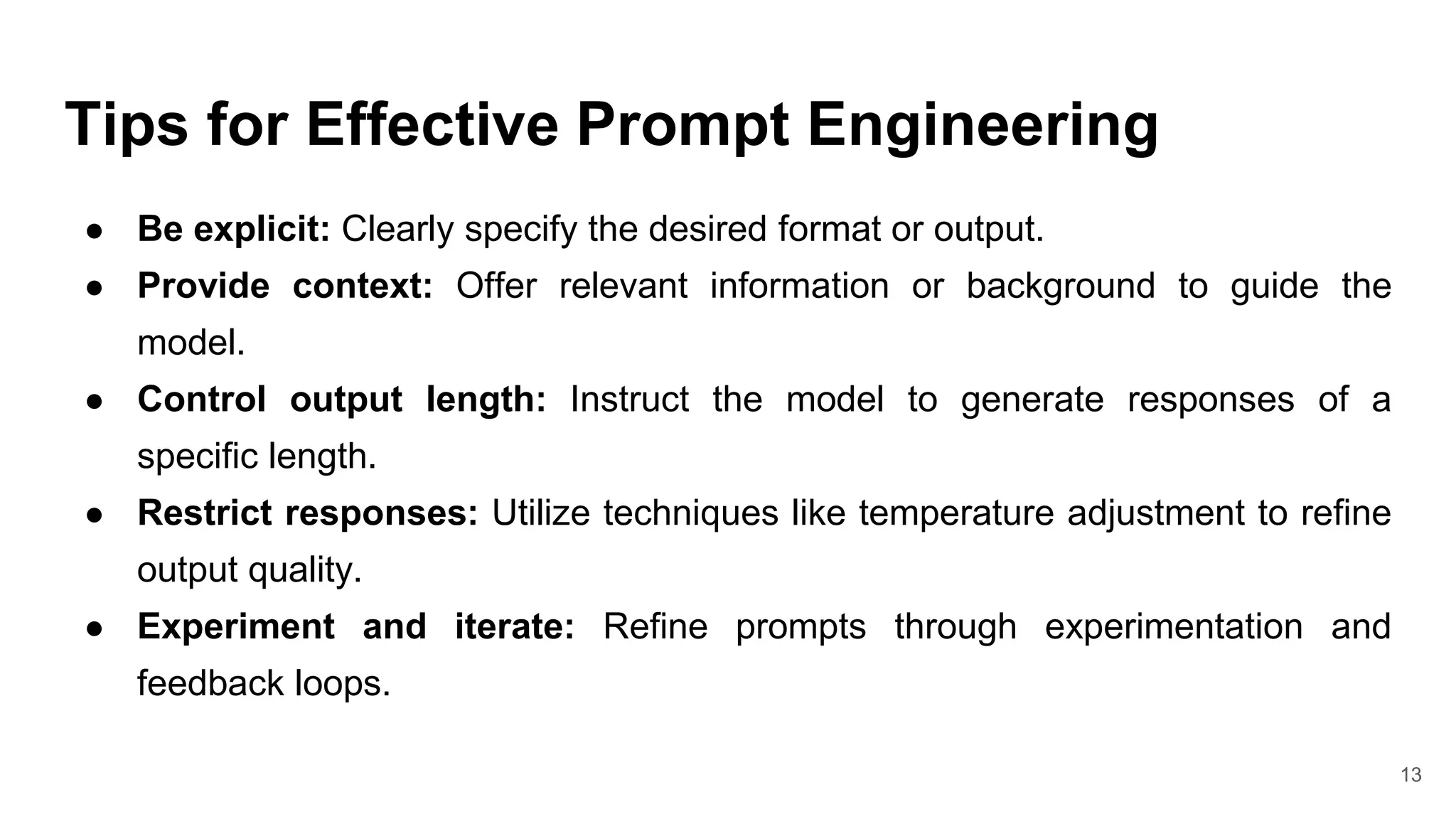
Tips for Effective Prompt Engineering
● Be explicit: Clearly specify the desired format or output.
● Provide context: Offer relevant information or background to guide the
model.
● Control output length: Instruct the model to generate responses of a
specific length.
● Restrict responses: Utilize techniques like temperature adjustment to refine
output quality.
● Experiment and iterate: Refine prompts through experimentation and
feedback loops.
13
Chat GPT PlayGround
14
Summary
1. Prompt Engineering
2. Best Practices
3. ChatGPT PlayGround
4. Sample prompt practise
15

Lecture 05 - Prompt Engineering.pptx

  • 1.
  • 2.
    ● Prompt Engineering ●Chat GPT PlayGround Agenda
  • 3.
  • 4.
    Tokenization Definition: Tokenization isthe process of breaking down text into smaller units called tokens, which can be words, phrases, or even characters. 4
  • 5.
    Tokens in LanguageModels Definition: Tokens are the fundamental units of text used by language models. They can be as short as a single character or as long as a word or phrase. Importance: Language models process text at the token level, allowing them to analyze and generate text based on the context and relationships between individual tokens. 5
  • 6.
    Prompt Limits inLanguage Models Definition: Prompt limits refer to the constraints imposed on the input provided to a language model. Reasons for Prompt Limits: ● Memory limitations: Language models have a finite capacity to process and store information. ● Computational constraints: Longer prompts require more processing time and computational resources. ● Response coherence: Extremely long prompts may result in irrelevant outputs. 6
  • 7.
  • 8.
    What is PromptEngineering? ● Prompt engineering involves crafting tailored instructions or queries to guide the language model towards desired outputs. ● It helps shape the behavior of the model and improves response quality. 8
  • 9.
    Anatomy of Prompt Definition:In the context of language models, a prompt refers to the input or instruction provided to the model to generate a specific response or output 9 Parts of a Good Prompt (Not all are necessary for each and every prompt) 1. Simulate Persona 2. Task 3. Steps to complete Task 4. Context/Constraints 5. Goal 6. Format Output
  • 10.
    Prompting Example 01 SimulatePersona: You are a customer service representative for a tech company. Task: Assist a customer in resolving a software issue. Steps to complete Task: Greet the customer and ask for details about the issue. Provide step-by-step instructions to troubleshoot the problem. If the issue persists, escalate it to the technical support team. Context/Constraints: The customer is not tech-savvy, and you must communicate in a friendly and non-technical manner. Goal: Resolve the customer's issue satisfactorily. Format Output: Provide a summary of the troubleshooting steps and any additional information the customer might need. 10
  • 11.
    Prompting Example 02 SimulatePersona: Imagine you are a mentor guiding a group of individuals new to prompt engineering. Task: Identify and address common issues in prompt creation to improve overall effectiveness. Steps to complete Task: Analyze the prompt for Simulate Persona, Task, Steps to complete Task, Context/constraints, goals and Format Output Identify and rectify instances of ambiguity or vagueness in prompt language. Ensure that prompts provide sufficient information for the desired task without unnecessary complexity. Context/Constraints: Consider the diverse backgrounds and skill levels of those engaging with the prompts. Goal: Enhance the quality of prompts by eliminating potential sources of confusion or misinterpretation. Format Output: Provide a revised version of a poorly constructed prompt, highlighting the changes made and explaining how each modification contributes to better prompt engineering. 11
  • 12.
    Context in Prompting Definition:Context refers to the information and preceding text that informs the language model about the desired output or influences its response. Role of Context: ● Context helps shape the model's behavior and generate more accurate responses. ● Relevance: Context ensures continuity and relevance in the generated text. ● Interpretation: The language model uses context to understand the desired meaning and tone of the prompt. 12
  • 13.
    Tips for EffectivePrompt Engineering ● Be explicit: Clearly specify the desired format or output. ● Provide context: Offer relevant information or background to guide the model. ● Control output length: Instruct the model to generate responses of a specific length. ● Restrict responses: Utilize techniques like temperature adjustment to refine output quality. ● Experiment and iterate: Refine prompts through experimentation and feedback loops. 13
  • 14.
  • 15.
    Summary 1. Prompt Engineering 2.Best Practices 3. ChatGPT PlayGround 4. Sample prompt practise 15