Gen AI meetup
Technology
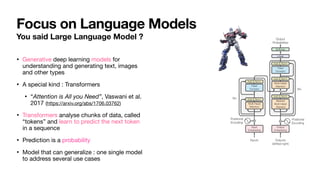
You said Large Language Model ?
• Generative deep learning models for
understanding and generating text, images
and other types
• A special kind : Transformers
• “Attention is All you Need”, Vaswani et al.
2017 (https://arxiv.org/abs/1706.03762)
• Transformers analyse chunks of data, called
“tokens” and learn to predict the next token
in a sequence
• Prediction is a probability
• Model that can generalize : one single model
to address several use cases
Focus on Language Models
Build the model - Training
What it’s like ?
• Foundational models
• Datasets
LLM are trained using techniques that requires huge text-based datasets, e.g.
“The Pile” : +880 Gb (Wikipedia, Youtube st, Github, …)
“RedPajama”: +5Tb (wikipedia, StackExchange, ArXiv, …)
Choosing and curating datasets for training is the secret sauce !
• Computing Power
Transformer-based model have limitations: quadratic-complexity of attention mechanism
Computationally intensive for long sequences
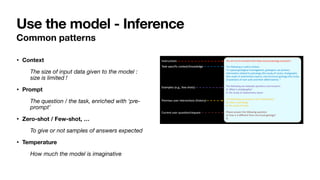
Common patterns
• Context
The size of input data given to the model :
size is limited !
• Prompt
The question / the task, enriched with ‘pre-
prompt’
• Zero-shot / Few-shot, …
To give or not samples of answers expected
• Temperature
How much the model is imaginative
Use the model - Inference
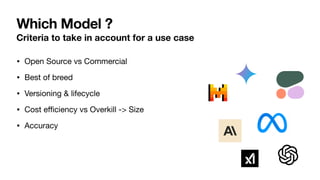
Which Model ?
Criteria to take in account for a use case
• Open Source vs Commercial
• Best of breed
• Versioning & lifecycle
• Cost e
ffi
ciency vs Overkill -> Size
• Accuracy
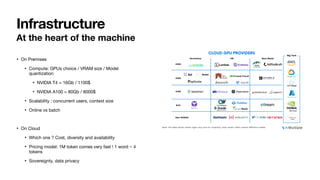
At the heart of the machine
• On Premises
• Compute: GPUs choice / VRAM size / Model
quantization
• NVIDIA T4 = 16Gb / 1100$
• NVIDIA A100 = 80Gb / 8000$
• Scalability : concurrent users, context size
• Online vs batch
• On Cloud
• Which one ? Cost, diversity and availability
• Pricing model: 1M token comes very fast ! 1 word ~ 4
tokens
• Sovereignty, data privacy
Infrastructure
Real-world usage
Aka your search engine 2.0
Very common use case =
“Retrival Augmented Generation”
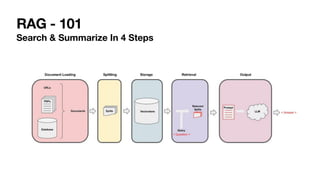
RAG - 101
Search & Summarize In 4 Steps
Step 1 - Document loading
• Documents are loaded from data
connectors
• They are split into chunks
RAG
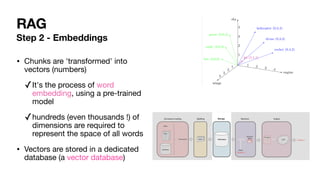
Step 2 - Embeddings
• Chunks are 'transformed' into
vectors (numbers)
✓It's the process of word
embedding, using a pre-trained
model
✓hundreds (even thousands !) of
dimensions are required to
represent the space of all words
• Vectors are stored in a dedicated
database (a vector database)
RAG
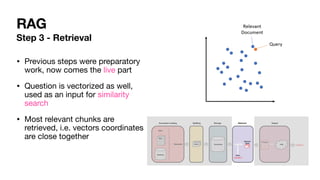
Step 3 - Retrieval
• Previous steps were preparatory
work, now comes the live part
• Question is vectorized as well,
used as an input for similarity
search
• Most relevant chunks are
retrieved, i.e. vectors coordinates
are close together
RAG
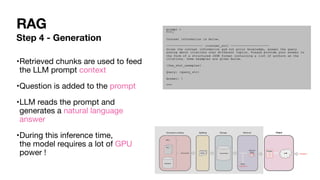
Step 4 - Generation
•Retrieved chunks are used to feed
the LLM prompt context
•Question is added to the prompt
•LLM reads the prompt and
generates a natural language
answer
•During this inference time,
the model requires a lot of GPU
power !
RAG
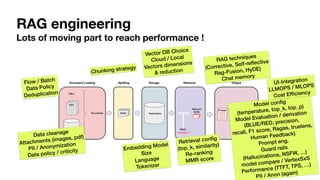
RAG engineering
Lots of moving part to reach performance !
Flow / Batch
Data Policy
Deduplication
Data cleanage
Attachments (images, pdf)
PII / Anonymization
Data policy / criticity
Chunking strategy
Embedding Model
Size
Language
Tokenizer
Vector DB Choice
Cloud / Local
Vectors dimensions
& reduction
Retrieval con
fi
g
(top_k, similarity)
Re-ranking
MMR score
RAG techniques
(Corrective, Self-re
fl
ective
Rag-Fusion, HyDE)
Chat memory
Model con
fi
g
(temperature, top_k, top_p)
Model Evaluation / derivation
(BLUE/RED, precision,
recall, F1 score, Ragas, truelens,
Human Feedback)
Prompt eng.
Guard rails
(Hallucinations, NSFW, …)
model compare / VertexSxS
Performance (TTFT, TPS, …)
PII / Anon (again)
UI-Integration
LLMOPS / MLOPS
Cost Ef
fi
ciency
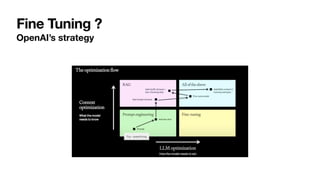
Fine Tuning ?
OpenAI’s strategy
Demo time !

AI presentation and introduction - Retrieval Augmented Generation RAG 101

  • 1.
  • 2.
  • 3.
    You said LargeLanguage Model ? • Generative deep learning models for understanding and generating text, images and other types • A special kind : Transformers • “Attention is All you Need”, Vaswani et al. 2017 (https://arxiv.org/abs/1706.03762) • Transformers analyse chunks of data, called “tokens” and learn to predict the next token in a sequence • Prediction is a probability • Model that can generalize : one single model to address several use cases Focus on Language Models
  • 5.
    Build the model- Training What it’s like ? • Foundational models • Datasets LLM are trained using techniques that requires huge text-based datasets, e.g. “The Pile” : +880 Gb (Wikipedia, Youtube st, Github, …) “RedPajama”: +5Tb (wikipedia, StackExchange, ArXiv, …) Choosing and curating datasets for training is the secret sauce ! • Computing Power Transformer-based model have limitations: quadratic-complexity of attention mechanism Computationally intensive for long sequences
  • 6.
    Common patterns • Context Thesize of input data given to the model : size is limited ! • Prompt The question / the task, enriched with ‘pre- prompt’ • Zero-shot / Few-shot, … To give or not samples of answers expected • Temperature How much the model is imaginative Use the model - Inference
  • 7.
    Which Model ? Criteriato take in account for a use case • Open Source vs Commercial • Best of breed • Versioning & lifecycle • Cost e ffi ciency vs Overkill -> Size • Accuracy
  • 8.
    At the heartof the machine • On Premises • Compute: GPUs choice / VRAM size / Model quantization • NVIDIA T4 = 16Gb / 1100$ • NVIDIA A100 = 80Gb / 8000$ • Scalability : concurrent users, context size • Online vs batch • On Cloud • Which one ? Cost, diversity and availability • Pricing model: 1M token comes very fast ! 1 word ~ 4 tokens • Sovereignty, data privacy Infrastructure
  • 9.
  • 10.
    Aka your searchengine 2.0 Very common use case = “Retrival Augmented Generation”
  • 11.
    RAG - 101 Search& Summarize In 4 Steps
  • 12.
    Step 1 -Document loading • Documents are loaded from data connectors • They are split into chunks RAG
  • 13.
    Step 2 -Embeddings • Chunks are 'transformed' into vectors (numbers) ✓It's the process of word embedding, using a pre-trained model ✓hundreds (even thousands !) of dimensions are required to represent the space of all words • Vectors are stored in a dedicated database (a vector database) RAG
  • 14.
    Step 3 -Retrieval • Previous steps were preparatory work, now comes the live part • Question is vectorized as well, used as an input for similarity search • Most relevant chunks are retrieved, i.e. vectors coordinates are close together RAG
  • 15.
    Step 4 -Generation •Retrieved chunks are used to feed the LLM prompt context •Question is added to the prompt •LLM reads the prompt and generates a natural language answer •During this inference time, the model requires a lot of GPU power ! RAG
  • 16.
    RAG engineering Lots ofmoving part to reach performance ! Flow / Batch Data Policy Deduplication Data cleanage Attachments (images, pdf) PII / Anonymization Data policy / criticity Chunking strategy Embedding Model Size Language Tokenizer Vector DB Choice Cloud / Local Vectors dimensions & reduction Retrieval con fi g (top_k, similarity) Re-ranking MMR score RAG techniques (Corrective, Self-re fl ective Rag-Fusion, HyDE) Chat memory Model con fi g (temperature, top_k, top_p) Model Evaluation / derivation (BLUE/RED, precision, recall, F1 score, Ragas, truelens, Human Feedback) Prompt eng. Guard rails (Hallucinations, NSFW, …) model compare / VertexSxS Performance (TTFT, TPS, …) PII / Anon (again) UI-Integration LLMOPS / MLOPS Cost Ef fi ciency
  • 17.
  • 18.