9.1 
99 
PPrrooggrraammmmii 
nngg 
LLFoaaundanntionsg gof Couumpuataer Scggienceee ã Cssengage 
Learning
OObbjjeeccttiivveess 
AAfftteerr ssttuuddyyiinngg tthhiiss cchhaapptteerr,, tthhee ssttuuddeenntt sshhoouulldd bbee aabbllee ttoo:: 
 Describe the evolution of programming languages from machine 
language to high-level languages. 
 Understand how a program in a high-level language is translated 
into machine language. 
 Distinguish between four computer language paradigms. 
 Understand the procedural paradigm and the interaction 
between a program unit and data items in the paradigm. 
 Understand the object-oriented paradigm and the interaction 
between a program unit and objects in this paradigm. 
 Define functional paradigm and understand its applications. 
 Define a declaration paradigm and understand its applications. 
 Define common concepts in procedural and object-oriented 
languages. 
9.2
9.3 
9-1 EVOLUTION 
TToo wwrriittee aa pprrooggrraamm ffoorr aa ccoommppuutteerr,, wwee mmuusstt uussee aa 
ccoommppuutteerr llaanngguuaaggee.. AA ccoommppuutteerr llaanngguuaaggee iiss aa sseett ooff 
pprreeddeeffiinneedd wwoorrddss tthhaatt aarree ccoommbbiinneedd iinnttoo aa pprrooggrraamm 
aaccccoorrddiinngg ttoo pprreeddeeffiinneedd rruulleess ((ssyynnttaaxx)).. OOvveerr tthhee yyeeaarrss,, 
ccoommppuutteerr llaanngguuaaggeess hhaavvee eevvoollvveedd ffrroomm mmaacchhiinnee 
llaanngguuaaggee ttoo hhiigghh--lleevveell llaanngguuaaggeess..
Machine languages 
In the earliest days of computers, the only programming 
languages available were machine languages. Each 
computer had its own machine language, which was made of 
streams of 0s and 1s. In Chapter 5 we showed that in a 
primitive hypothetical computer, we need to use eleven lines 
of code to read two integers, add them and print the result. 
These lines of code, when written in machine language, 
make eleven lines of binary code, each of 16 bits, as shown 
in Table 9.1. 
9.4 
The only language understood by a computer is 
machine language. 
i
9.5
Assembly languages 
The next evolution in programming came with the idea of 
replacing binary code for instruction and addresses with 
symbols or mnemonics. Because they used symbols, these 
languages were first known as symbolic languages. The set 
of these mnemonic languages were later referred to as 
assembly languages. The assembly language for our 
hypothetical computer to replace the machine language in 
Table 9.2 is shown in Program 9.1. 
9.6 
The only language understood by a computer is 
machine language. 
i
9.7
High-level languages 
Although assembly languages greatly improved 
programming efficiency, they still required programmers to 
concentrate on the hardware they were using. Working with 
symbolic languages was also very tedious, because each 
machine instruction had to be individually coded. The desire 
to improve programmer efficiency and to change the focus 
from the computer to the problem being solved led to the 
development of high-level languages. 
9.8 
Over the years, various languages, most notably 
BASIC, COBOL, Pascal, Ada, C, C++ and Java, were 
developed. Program 9.1 shows the code for adding two 
integers as it would appear in the C++ language.
9.9
9-2 TRANSLATION 
9.10 
PPrrooggrraammss ttooddaayy aarree nnoorrmmaallllyy wwrriitttteenn iinn oonnee ooff tthhee hhiigghh-lleevveell 
llaanngguuaaggeess.. TToo rruunn tthhee pprrooggrraamm oonn aa ccoommppuutteerr,, tthhee 
pprrooggrraamm nneeeeddss ttoo bbee ttrraannssllaatteedd iinnttoo tthhee mmaacchhiinnee 
llaanngguuaaggee ooff tthhee ccoommppuutteerr oonn wwhhiicchh iitt wwiillll rruunn.. TThhee 
pprrooggrraamm iinn aa hhiigghh-lleevveell llaanngguuaaggee iiss ccaalllleedd tthhee ssoouurrccee 
pprrooggrraamm.. TThhee ttrraannssllaatteedd pprrooggrraamm iinn mmaacchhiinnee llaanngguuaaggee iiss 
ccaalllleedd tthhee oobbjjeecctt pprrooggrraamm.. TTwwoo mmeetthhooddss aarree uusseedd ffoorr 
ttrraannssllaattiioonn:: ccoommppiillaattiioonn aanndd iinntteerrpprreettaattiioonn..
Compilation 
A compiler normally translates the whole source program 
into the object program. 
Interpretation 
Some computer languages use an interpreter to translate the 
source program into the object program. Interpretation refers 
to the process of translating each line of the source program 
into the corresponding line of the object program and 
executing the line. However, we need to be aware of two 
trends in interpretation: that used by some languages before 
Java and the interpretation used by Java. 
9.11
Translation process 
Compilation and interpretation differ in that the first 
translates the whole source code before executing it, while 
the second translates and executes the source code a line at a 
time. Both methods, however, follow the same translation 
process shown in Figure 9.1. 
9.12 
Figure 9.1 Source code translation process
9-3 PROGRAMMING PARADIGMS 
TTooddaayy,, ccoommppuutteerr llaanngguuaaggeess aarree ccaatteeggoorriizzeedd aaccccoorrddiinngg ttoo 
tthhee aapppprrooaacchh tthheeyy uussee ttoo ssoollvvee aa pprroobblleemm.. AA ppaarraaddiiggmm,, 
tthheerreeffoorree,, iiss aa wwaayy iinn wwhhiicchh aa ccoommppuutteerr llaanngguuaaggee llooookkss 
aatt tthhee pprroobblleemm ttoo bbee ssoollvveedd.. WWee ddiivviiddee ccoommppuutteerr 
llaanngguuaaggeess iinnttoo ffoouurr ppaarraaddiiggmmss:: pprroocceedduurraall,, oobbjjeecctt-- 
oorriieenntteedd,, ffuunnccttiioonnaall aanndd ddeeccllaarraattiivvee.. FFiigguurree 99..22 
ssuummmmaarriizzeess tthheessee.. 
9.13
9.14 
Figure 9.2 Categories of programming languages
The procedural paradigm 
In the procedural paradigm (or imperative paradigm) we can 
think of a program as an active agent that manipulates 
passive objects. We encounter many passive objects in our 
daily life: a stone, a book, a lamp, and so on. A passive 
object cannot initiate an action by itself, but it can receive 
actions from active agents. 
9.15 
A program in a procedural paradigm is an active agent 
that uses passive objects that we refer to as data or data 
items. To manipulate a piece of data, the active agent 
(program) issues an action, referred to as a procedure. For 
example, think of a program that prints the contents of a file. 
The file is a passive object. To print the file, the program 
uses a procedure, which we call print.
9.16 
Figure 9.3 The concept of the procedural paradigm
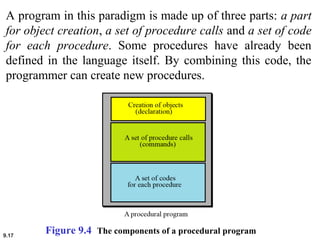
A program in this paradigm is made up of three parts: a part 
for object creation, a set of procedure calls and a set of code 
for each procedure. Some procedures have already been 
defined in the language itself. By combining this code, the 
programmer can create new procedures. 
9.17 
Figure 9.4 The components of a procedural program
9.18 
Some procedural languages 
 FORTRAN (FORmula TRANslation) 
 COBOL (COmmon Business-Oriented Language) 
 Pascal 
 C 
 Ada
The object-oriented paradigm 
The object-oriented paradigm deals with active objects 
instead of passive objects. We encounter many active objects 
in our daily life: a vehicle, an automatic door, a dishwasher 
and so on. The action to be performed on these objects are 
included in the object: the objects need only to receive the 
appropriate stimulus from outside to perform one of the 
actions. 
9.19 
A file in an object-oriented paradigm can be packed 
with all the procedures—called methods in the object-oriented 
paradigm—to be performed by the file: printing, 
copying, deleting and so on. The program in this paradigm 
just sends the corresponding request to the object.
9.20 
Figure 9.5 The concept of an object-oriented paradigm
Classes 
As Figure 9.5 shows, objects of the same type (files, for 
example) need a set of methods that show how an object of 
this type reacts to stimuli from outside the object’s 
“territories”. To create these methods, a unit called a class is 
used (see Appendix F). 
9.21 
Figure 9.6 The concept of an object-oriented paradigm
Methods 
In general, the format of methods are very similar to the 
functions used in some procedural languages. Each method 
has its header, its local variables and its statement. This 
means that most of the features we discussed for procedural 
languages are also applied to methods written for an object-oriented 
9.22 
program. In other words, we can claim that object-oriented 
languages are actually an extension of procedural 
languages with some new ideas and some new features. The 
C++ language, for example, is an object-oriented extension 
of the C language.
Inheritance 
In the object-oriented paradigm, as in nature, an object can 
inherit from another object. This concept is called 
inheritance. When a general class is defined, we can define a 
more specific class that inherits some of the characteristics of 
the general class, but also has some new characteristics. For 
example, when an object of the type GeometricalShapes is 
defined, we can define a class called Rectangles. Rectangles 
are geometrical shapes with additional characteristics. 
9.23
Polymorphism 
Polymorphism means “many forms”. Polymorphism in the 
object-oriented paradigm means that we can define several 
operations with the same name that can do different things in 
related classes. For example, assume that we define two 
classes, Rectangles and Circles, both inherited from the class 
GeometricalShapes. We define two operations both named 
area, one in Rectangles and one in Circles, that calculate the 
area of a rectangle or a circle. The two operations have the 
same name 
9.24
9.25 
Some object-oriented languages 
 C++ 
 Java
The functional paradigm 
In the functional paradigm a program is considered a 
mathematical function. In this context, a function is a black 
box that maps a list of inputs to a list of outputs. 
9.26 
Figure 9.7 A function in a functional language
For example, we can define a primitive function called first 
that extracts the first element of a list. It may also have a 
function called rest that extracts all the elements except the 
first. A program can define a function that extracts the third 
element of a list by combining these two functions as shown 
in Figure 9.8. 
9.27 
Figure 9.8 Extracting the third element of a list
9.28 
Some functional languages 
 LISP (LISt Programming) 
 Scheme
The declarative paradigm 
A declarative paradigm uses the principle of logical 
reasoning to answer queries. It is based on formal logic 
defined by Greek mathematicians and later developed into 
first-order predicate calculus. 
9.29 
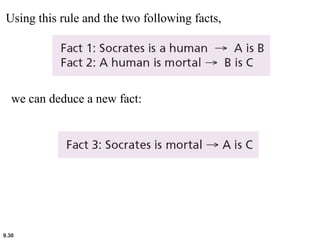
Logical reasoning is based on deduction. Some 
statements (facts) are given that are assumed to be true, and 
the logician uses solid rules of logical reasoning to deduce 
new statements (facts). For example, the famous rule of 
deduction in logic is:
Using this rule and the two following facts, 
we can deduce a new fact: 
9.30
Prolog 
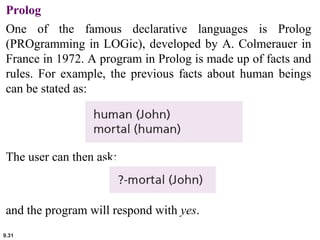
One of the famous declarative languages is Prolog 
(PROgramming in LOGic), developed by A. Colmerauer in 
France in 1972. A program in Prolog is made up of facts and 
rules. For example, the previous facts about human beings 
can be stated as: 
The user can then ask: 
and the program will respond with yes. 
9.31
9-4 COMMON CONCEPTS 
9.32 
IInn tthhiiss sseeccttiioonn wwee ccoonndduucctt aa qquuiicckk nnaavviiggaattiioonn tthhrroouugghh 
ssoommee pprroocceedduurraall llaanngguuaaggeess ttoo ffiinndd ccoommmmoonn ccoonncceeppttss.. 
SSoommee ooff tthheessee ccoonncceeppttss aarree aallssoo aavvaaiillaabbllee iinn mmoosstt 
oobbjjeecctt--oorriieenntteedd llaanngguuaaggeess bbeeccaauussee,, aass wwee eexxppllaaiinneedd,, aann 
oobbjjeecctt--oorriieenntteedd ppaarraaddiiggmm uusseess tthhee pprroocceedduurraall ppaarraaddiiggmm 
wwhheenn ccrreeaattiinngg mmeetthhooddss..
Identifiers 
One feature present in all procedural languages, as well as in 
other languages, is the identifier—that is, the name of 
objects. Identifiers allow us to name objects in the program. 
For example, each piece of data in a computer is stored at a 
unique address. If there were no identifiers to represent data 
locations symbolically, we would have to know and use data 
addresses to manipulate them. Instead, we simply give data 
names and let the compiler keep track of where they are 
physically located. 
9.33
Data types 
A data type defines a set of values and a set of operations 
that can be applied to those values. The set of values for each 
type is known as the domain for the type. Most languages 
define two categories of data types: simple types and 
composite types. 
9.34 
A simple type is a data type that cannot be broken into 
smaller data types. 
A composite type is a set of elements in which each 
element is a simple type or a composite type.
Variables 
Variables are names for memory locations. As discussed in 
Chapter 5, each memory location in a computer has an 
address. Although the addresses are used by the computer 
internally, it is very inconvenient for the programmer to use 
addresses. A programmer can use a variable, such as score, 
to store the integer value of a score received in a test. Since a 
variable holds a data item, it has a type. 
9.35
Literals 
A literal is a predetermined value used in a program. For 
example, if we need to calculate the area of circle when the 
value of the radius is stored in the variable r, we can use the 
expression 3.14 × r2, in which the approximate value of π 
(pi) is used as a literal. In most programming languages we 
can have integer, real, character and Boolean literals. In most 
languages, we can also have string literals. To distinguish the 
character and string literals from the names of variables and 
other objects, most languages require that the character 
literals be enclosed in single quotes, such as 'A', and strings 
to be enclosed in double quotes, such as "Anne". 
9.36
Constants 
The use of literals is not considered good programming 
practice unless we are sure that the value of the literal will 
not change with time (such as the value of π in geometry). 
However, most literals may change value with time. 
9.37 
For this reason, most programming languages define 
constants. A constant, like a variable, is a named location 
that can store a value, but the value cannot be changed after 
it has been defined at the beginning of the program. 
However, if we want to use the program later, we can change 
just one line at the beginning of the program, the value of the 
constant.
Inputs and Outputs 
Almost every program needs to read and/or write data. These 
operations can be quite complex, especially when we read 
and write large files. Most programming languages use a 
predefined function for input and output. 
9.38 
Data is input by either a statement or a predefined 
function such as scanf in the C language. 
Data is output by either a statement or a predefined 
function such as printf in the C language.
Expressions 
An expression is a sequence of operands and operators that 
reduces to a single value. For example, the following is an 
expression with a value of 13: 
9.39 
An operator is a language-specific token that requires 
an action to be taken. The most familiar operators are drawn 
from mathematics.
Table 9.3 shows some arithmetic operators used in C, C++, 
and Java. 
9.40
Relational operators compare data to see if a value is greater 
than, less than, or equal to another value. The result of 
applying relational operators is a Boolean value (true or 
false). C, C++ and Java use six relational operators, as shown 
in Table 9.4: 
9.41
Logical operators combine Boolean values (true or false) to 
get a new value. The C language uses three logical operators, 
as shown in Table 9.5: 
9.42
Statements 
A statement causes an action to be performed by the 
program. It translates directly into one or more executable 
computer instructions. For example, C, C++ and Java define 
many types of statements. 
An assignment statement assigns a value to a variable. In 
other words, it stores the value in the variable, which has 
already been created in the declaration section. 
A compound statement is a unit of code consisting of zero 
or more statements. It is also known as a block. A compound 
statement allows a group of statements to be treated as a 
single entity. 
9.43
Structured programming strongly recommends the use of the 
three types of control statements: sequence, selection and 
repetition, as we discussed in Chapter 8. 
9.44 
Figure 9.9 Two-way and multi-way decisions
9.45 
Figure 9.10 Three types of repetition
Subprograms 
The idea of subprograms is crucial in procedural languages 
and to a lesser extent in object-oriented languages. This is 
useful because the subprogram makes programming more 
structural: a subprogram to accomplish a specific task can be 
written once but called many times, just like predefined 
procedures in the programming language. 
9.46 
Figure 9.11 The concept of a subprogram
In a procedural language, a subprogram, like the main 
program, can call predefined procedures to operate on local 
objects. These local objects or local variables are created 
each time the subprogram is called and destroyed when 
control returns from the subprogram. The local objects 
belong to the subprograms. 
It is rare for a subprogram to act only upon local objects. 
Most of the time the main program requires a subprogram to 
act on an object or set of objects created by the main 
program. In this case, the program and subprogram use 
parameters. These are referred to as actual parameters in the 
main program and formal parameters in the subprogram. 
9.47
Pass by value 
In parameter pass by value, the main program and the 
subprogram create two different objects (variables). The 
object created in the program belongs to the program and the 
object created in the subprogram belongs to the subprogram. 
Since the territory is different, the corresponding objects can 
have the same or different names. Communication between 
the main program and the subprogram is one-way, from the 
main program to the subprogram. 
9.48
Example 9.1 
Assume that a subprogram is responsible ffoorr ccaarrrryyiinngg oouutt pprriinnttiinngg 
ffoorr tthhee mmaaiinn pprrooggrraamm.. EEaacchh ttiimmee tthhee mmaaiinn pprrooggrraamm wwaannttss ttoo pprriinntt 
aa vvaalluuee,, iitt sseennddss iitt ttoo tthhee ssuubbpprrooggrraamm ttoo bbee pprriinntteedd.. TThhee mmaaiinn 
pprrooggrraamm hhaass iittss oowwnn vvaarriiaabbllee XX,, tthhee ssuubbpprrooggrraamm hhaass iittss oowwnn 
vvaarriiaabbllee AA.. WWhhaatt iiss sseenntt ffrroomm tthhee mmaaiinn pprrooggrraamm ttoo tthhee 
ssuubbpprrooggrraamm iiss tthhee vvaalluuee ooff vvaarriiaabbllee XX.. 
9.49 
Figure 9.12 An example of pass by value
Example 9.2 
In Example 9.1, since the main program sseennddss oonnllyy aa vvaalluuee ttoo tthhee 
ssuubbpprrooggrraamm,, iitt ddooeess nnoott nneeeedd ttoo hhaavvee aa vvaarriiaabbllee ffoorr tthhiiss ppuurrppoossee:: 
tthhee mmaaiinn pprrooggrraamm ccaann jjuusstt sseenndd aa lliitteerraall vvaalluuee ttoo tthhee ssuubbpprrooggrraamm.. 
IInn ootthheerr wwoorrddss,, tthhee mmaaiinn pprrooggrraamm ccaann ccaallll tthhee ssuubbpprrooggrraamm aass 
pprriinntt ((XX)) oorr pprriinntt ((55)).. 
Example 9.3 
AAnn aannaallooggyy ooff ppaassss bbyy vvaalluuee iinn rreeaall lliiffee iiss wwhheenn aa ffrriieenndd wwaannttss ttoo 
bboorrrrooww aanndd rreeaadd aa vvaalluueedd bbooookk tthhaatt yyoouu wwrroottee.. SSiinnccee tthhee bbooookk iiss 
pprreecciioouuss,, ppoossssiibbllyy oouutt ooff pprriinntt,, yyoouu mmaakkee aa ccooppyy ooff tthhee bbooookk aanndd 
ppaassss iitt ttoo yyoouurr ffrriieenndd.. AAnnyy hhaarrmm ttoo tthhee ccooppyy tthheerreeffoorree ddooeess nnoott 
aaffffeecctt tthhee oorriiggiinnaall.. 
9.50
Example 9.4 
Assume that the main program has two variables XX aanndd YY tthhaatt 
nneeeedd ttoo sswwaapp tthheeiirr vvaalluueess.. TThhee mmaaiinn pprrooggrraamm ppaasssseess tthhee vvaalluuee ooff 
XX aanndd YY ttoo tthhee ssuubbpprrooggrraamm,, wwhhiicchh aarree ssttoorreedd iinn ttwwoo vvaarriiaabblleess AA 
aanndd BB.. TThhee sswwaapp ssuubbpprrooggrraamm uusseess aa llooccaall vvaarriiaabbllee TT ((tteemmppoorraarryy)) 
aanndd sswwaappss tthhee ttwwoo vvaalluueess iinn AA aanndd BB,, bbuutt tthhee oorriiggiinnaall vvaalluueess iinn XX 
aanndd YY rreemmaaiinn tthhee ssaammee:: tthheeyy aarree nnoott sswwaappppeedd.. 
9.51 
Figure 9.13 An example in which pass by value does not work
Pass by reference 
Pass by reference was devised to allow a subprogram to 
change the value of a variable in the main program. In pass 
by reference, the variable, which in reality is a location in 
memory, is shared by the main program and the subprogram. 
The same variable may have different names in the main 
program and the subprogram, but both names refer to the 
same variable. Metaphorically, we can think of pass by 
reference as a box with two doors: one opens in the main 
program, the other opens in the subprogram. The main 
program can leave a value in this box for the subprogram, 
the subprogram can change the original value and leave a 
new value for the program in it. 
9.52
Example 9.5 
If we use the same swap subprogram bbuutt lleett tthhee vvaarriiaabblleess bbee 
ppaasssseedd bbyy rreeffeerreennccee,, tthhee ttwwoo vvaalluueess iinn XX aanndd YY aarree aaccttuuaallllyy 
eexxcchhaannggeedd.. 
9.53 
Figure 9.14 An example of pass by reference
Returning values 
A subprogram can be designed to return a value or values. 
This is the way that predefined procedures are designed. 
When we use the expression C ← A + B, we actually call a 
procedure add (A, B) that returns a value to be stored in the 
variable C. 
9.54

Lect 1

  • 1.
    9.1 99 PPrrooggrraammmmii nngg LLFoaaundanntionsg gof Couumpuataer Scggienceee ã Cssengage Learning
  • 2.
    OObbjjeeccttiivveess AAfftteerr ssttuuddyyiinnggtthhiiss cchhaapptteerr,, tthhee ssttuuddeenntt sshhoouulldd bbee aabbllee ttoo::  Describe the evolution of programming languages from machine language to high-level languages.  Understand how a program in a high-level language is translated into machine language.  Distinguish between four computer language paradigms.  Understand the procedural paradigm and the interaction between a program unit and data items in the paradigm.  Understand the object-oriented paradigm and the interaction between a program unit and objects in this paradigm.  Define functional paradigm and understand its applications.  Define a declaration paradigm and understand its applications.  Define common concepts in procedural and object-oriented languages. 9.2
  • 3.
    9.3 9-1 EVOLUTION TToo wwrriittee aa pprrooggrraamm ffoorr aa ccoommppuutteerr,, wwee mmuusstt uussee aa ccoommppuutteerr llaanngguuaaggee.. AA ccoommppuutteerr llaanngguuaaggee iiss aa sseett ooff pprreeddeeffiinneedd wwoorrddss tthhaatt aarree ccoommbbiinneedd iinnttoo aa pprrooggrraamm aaccccoorrddiinngg ttoo pprreeddeeffiinneedd rruulleess ((ssyynnttaaxx)).. OOvveerr tthhee yyeeaarrss,, ccoommppuutteerr llaanngguuaaggeess hhaavvee eevvoollvveedd ffrroomm mmaacchhiinnee llaanngguuaaggee ttoo hhiigghh--lleevveell llaanngguuaaggeess..
  • 4.
    Machine languages Inthe earliest days of computers, the only programming languages available were machine languages. Each computer had its own machine language, which was made of streams of 0s and 1s. In Chapter 5 we showed that in a primitive hypothetical computer, we need to use eleven lines of code to read two integers, add them and print the result. These lines of code, when written in machine language, make eleven lines of binary code, each of 16 bits, as shown in Table 9.1. 9.4 The only language understood by a computer is machine language. i
  • 5.
  • 6.
    Assembly languages Thenext evolution in programming came with the idea of replacing binary code for instruction and addresses with symbols or mnemonics. Because they used symbols, these languages were first known as symbolic languages. The set of these mnemonic languages were later referred to as assembly languages. The assembly language for our hypothetical computer to replace the machine language in Table 9.2 is shown in Program 9.1. 9.6 The only language understood by a computer is machine language. i
  • 7.
  • 8.
    High-level languages Althoughassembly languages greatly improved programming efficiency, they still required programmers to concentrate on the hardware they were using. Working with symbolic languages was also very tedious, because each machine instruction had to be individually coded. The desire to improve programmer efficiency and to change the focus from the computer to the problem being solved led to the development of high-level languages. 9.8 Over the years, various languages, most notably BASIC, COBOL, Pascal, Ada, C, C++ and Java, were developed. Program 9.1 shows the code for adding two integers as it would appear in the C++ language.
  • 9.
  • 10.
    9-2 TRANSLATION 9.10 PPrrooggrraammss ttooddaayy aarree nnoorrmmaallllyy wwrriitttteenn iinn oonnee ooff tthhee hhiigghh-lleevveell llaanngguuaaggeess.. TToo rruunn tthhee pprrooggrraamm oonn aa ccoommppuutteerr,, tthhee pprrooggrraamm nneeeeddss ttoo bbee ttrraannssllaatteedd iinnttoo tthhee mmaacchhiinnee llaanngguuaaggee ooff tthhee ccoommppuutteerr oonn wwhhiicchh iitt wwiillll rruunn.. TThhee pprrooggrraamm iinn aa hhiigghh-lleevveell llaanngguuaaggee iiss ccaalllleedd tthhee ssoouurrccee pprrooggrraamm.. TThhee ttrraannssllaatteedd pprrooggrraamm iinn mmaacchhiinnee llaanngguuaaggee iiss ccaalllleedd tthhee oobbjjeecctt pprrooggrraamm.. TTwwoo mmeetthhooddss aarree uusseedd ffoorr ttrraannssllaattiioonn:: ccoommppiillaattiioonn aanndd iinntteerrpprreettaattiioonn..
  • 11.
    Compilation A compilernormally translates the whole source program into the object program. Interpretation Some computer languages use an interpreter to translate the source program into the object program. Interpretation refers to the process of translating each line of the source program into the corresponding line of the object program and executing the line. However, we need to be aware of two trends in interpretation: that used by some languages before Java and the interpretation used by Java. 9.11
  • 12.
    Translation process Compilationand interpretation differ in that the first translates the whole source code before executing it, while the second translates and executes the source code a line at a time. Both methods, however, follow the same translation process shown in Figure 9.1. 9.12 Figure 9.1 Source code translation process
  • 13.
    9-3 PROGRAMMING PARADIGMS TTooddaayy,, ccoommppuutteerr llaanngguuaaggeess aarree ccaatteeggoorriizzeedd aaccccoorrddiinngg ttoo tthhee aapppprrooaacchh tthheeyy uussee ttoo ssoollvvee aa pprroobblleemm.. AA ppaarraaddiiggmm,, tthheerreeffoorree,, iiss aa wwaayy iinn wwhhiicchh aa ccoommppuutteerr llaanngguuaaggee llooookkss aatt tthhee pprroobblleemm ttoo bbee ssoollvveedd.. WWee ddiivviiddee ccoommppuutteerr llaanngguuaaggeess iinnttoo ffoouurr ppaarraaddiiggmmss:: pprroocceedduurraall,, oobbjjeecctt-- oorriieenntteedd,, ffuunnccttiioonnaall aanndd ddeeccllaarraattiivvee.. FFiigguurree 99..22 ssuummmmaarriizzeess tthheessee.. 9.13
  • 14.
    9.14 Figure 9.2Categories of programming languages
  • 15.
    The procedural paradigm In the procedural paradigm (or imperative paradigm) we can think of a program as an active agent that manipulates passive objects. We encounter many passive objects in our daily life: a stone, a book, a lamp, and so on. A passive object cannot initiate an action by itself, but it can receive actions from active agents. 9.15 A program in a procedural paradigm is an active agent that uses passive objects that we refer to as data or data items. To manipulate a piece of data, the active agent (program) issues an action, referred to as a procedure. For example, think of a program that prints the contents of a file. The file is a passive object. To print the file, the program uses a procedure, which we call print.
  • 16.
    9.16 Figure 9.3The concept of the procedural paradigm
  • 17.
    A program inthis paradigm is made up of three parts: a part for object creation, a set of procedure calls and a set of code for each procedure. Some procedures have already been defined in the language itself. By combining this code, the programmer can create new procedures. 9.17 Figure 9.4 The components of a procedural program
  • 18.
    9.18 Some procedurallanguages  FORTRAN (FORmula TRANslation)  COBOL (COmmon Business-Oriented Language)  Pascal  C  Ada
  • 19.
    The object-oriented paradigm The object-oriented paradigm deals with active objects instead of passive objects. We encounter many active objects in our daily life: a vehicle, an automatic door, a dishwasher and so on. The action to be performed on these objects are included in the object: the objects need only to receive the appropriate stimulus from outside to perform one of the actions. 9.19 A file in an object-oriented paradigm can be packed with all the procedures—called methods in the object-oriented paradigm—to be performed by the file: printing, copying, deleting and so on. The program in this paradigm just sends the corresponding request to the object.
  • 20.
    9.20 Figure 9.5The concept of an object-oriented paradigm
  • 21.
    Classes As Figure9.5 shows, objects of the same type (files, for example) need a set of methods that show how an object of this type reacts to stimuli from outside the object’s “territories”. To create these methods, a unit called a class is used (see Appendix F). 9.21 Figure 9.6 The concept of an object-oriented paradigm
  • 22.
    Methods In general,the format of methods are very similar to the functions used in some procedural languages. Each method has its header, its local variables and its statement. This means that most of the features we discussed for procedural languages are also applied to methods written for an object-oriented 9.22 program. In other words, we can claim that object-oriented languages are actually an extension of procedural languages with some new ideas and some new features. The C++ language, for example, is an object-oriented extension of the C language.
  • 23.
    Inheritance In theobject-oriented paradigm, as in nature, an object can inherit from another object. This concept is called inheritance. When a general class is defined, we can define a more specific class that inherits some of the characteristics of the general class, but also has some new characteristics. For example, when an object of the type GeometricalShapes is defined, we can define a class called Rectangles. Rectangles are geometrical shapes with additional characteristics. 9.23
  • 24.
    Polymorphism Polymorphism means“many forms”. Polymorphism in the object-oriented paradigm means that we can define several operations with the same name that can do different things in related classes. For example, assume that we define two classes, Rectangles and Circles, both inherited from the class GeometricalShapes. We define two operations both named area, one in Rectangles and one in Circles, that calculate the area of a rectangle or a circle. The two operations have the same name 9.24
  • 25.
    9.25 Some object-orientedlanguages  C++  Java
  • 26.
    The functional paradigm In the functional paradigm a program is considered a mathematical function. In this context, a function is a black box that maps a list of inputs to a list of outputs. 9.26 Figure 9.7 A function in a functional language
  • 27.
    For example, wecan define a primitive function called first that extracts the first element of a list. It may also have a function called rest that extracts all the elements except the first. A program can define a function that extracts the third element of a list by combining these two functions as shown in Figure 9.8. 9.27 Figure 9.8 Extracting the third element of a list
  • 28.
    9.28 Some functionallanguages  LISP (LISt Programming)  Scheme
  • 29.
    The declarative paradigm A declarative paradigm uses the principle of logical reasoning to answer queries. It is based on formal logic defined by Greek mathematicians and later developed into first-order predicate calculus. 9.29 Logical reasoning is based on deduction. Some statements (facts) are given that are assumed to be true, and the logician uses solid rules of logical reasoning to deduce new statements (facts). For example, the famous rule of deduction in logic is:
  • 30.
    Using this ruleand the two following facts, we can deduce a new fact: 9.30
  • 31.
    Prolog One ofthe famous declarative languages is Prolog (PROgramming in LOGic), developed by A. Colmerauer in France in 1972. A program in Prolog is made up of facts and rules. For example, the previous facts about human beings can be stated as: The user can then ask: and the program will respond with yes. 9.31
  • 32.
    9-4 COMMON CONCEPTS 9.32 IInn tthhiiss sseeccttiioonn wwee ccoonndduucctt aa qquuiicckk nnaavviiggaattiioonn tthhrroouugghh ssoommee pprroocceedduurraall llaanngguuaaggeess ttoo ffiinndd ccoommmmoonn ccoonncceeppttss.. SSoommee ooff tthheessee ccoonncceeppttss aarree aallssoo aavvaaiillaabbllee iinn mmoosstt oobbjjeecctt--oorriieenntteedd llaanngguuaaggeess bbeeccaauussee,, aass wwee eexxppllaaiinneedd,, aann oobbjjeecctt--oorriieenntteedd ppaarraaddiiggmm uusseess tthhee pprroocceedduurraall ppaarraaddiiggmm wwhheenn ccrreeaattiinngg mmeetthhooddss..
  • 33.
    Identifiers One featurepresent in all procedural languages, as well as in other languages, is the identifier—that is, the name of objects. Identifiers allow us to name objects in the program. For example, each piece of data in a computer is stored at a unique address. If there were no identifiers to represent data locations symbolically, we would have to know and use data addresses to manipulate them. Instead, we simply give data names and let the compiler keep track of where they are physically located. 9.33
  • 34.
    Data types Adata type defines a set of values and a set of operations that can be applied to those values. The set of values for each type is known as the domain for the type. Most languages define two categories of data types: simple types and composite types. 9.34 A simple type is a data type that cannot be broken into smaller data types. A composite type is a set of elements in which each element is a simple type or a composite type.
  • 35.
    Variables Variables arenames for memory locations. As discussed in Chapter 5, each memory location in a computer has an address. Although the addresses are used by the computer internally, it is very inconvenient for the programmer to use addresses. A programmer can use a variable, such as score, to store the integer value of a score received in a test. Since a variable holds a data item, it has a type. 9.35
  • 36.
    Literals A literalis a predetermined value used in a program. For example, if we need to calculate the area of circle when the value of the radius is stored in the variable r, we can use the expression 3.14 × r2, in which the approximate value of π (pi) is used as a literal. In most programming languages we can have integer, real, character and Boolean literals. In most languages, we can also have string literals. To distinguish the character and string literals from the names of variables and other objects, most languages require that the character literals be enclosed in single quotes, such as 'A', and strings to be enclosed in double quotes, such as "Anne". 9.36
  • 37.
    Constants The useof literals is not considered good programming practice unless we are sure that the value of the literal will not change with time (such as the value of π in geometry). However, most literals may change value with time. 9.37 For this reason, most programming languages define constants. A constant, like a variable, is a named location that can store a value, but the value cannot be changed after it has been defined at the beginning of the program. However, if we want to use the program later, we can change just one line at the beginning of the program, the value of the constant.
  • 38.
    Inputs and Outputs Almost every program needs to read and/or write data. These operations can be quite complex, especially when we read and write large files. Most programming languages use a predefined function for input and output. 9.38 Data is input by either a statement or a predefined function such as scanf in the C language. Data is output by either a statement or a predefined function such as printf in the C language.
  • 39.
    Expressions An expressionis a sequence of operands and operators that reduces to a single value. For example, the following is an expression with a value of 13: 9.39 An operator is a language-specific token that requires an action to be taken. The most familiar operators are drawn from mathematics.
  • 40.
    Table 9.3 showssome arithmetic operators used in C, C++, and Java. 9.40
  • 41.
    Relational operators comparedata to see if a value is greater than, less than, or equal to another value. The result of applying relational operators is a Boolean value (true or false). C, C++ and Java use six relational operators, as shown in Table 9.4: 9.41
  • 42.
    Logical operators combineBoolean values (true or false) to get a new value. The C language uses three logical operators, as shown in Table 9.5: 9.42
  • 43.
    Statements A statementcauses an action to be performed by the program. It translates directly into one or more executable computer instructions. For example, C, C++ and Java define many types of statements. An assignment statement assigns a value to a variable. In other words, it stores the value in the variable, which has already been created in the declaration section. A compound statement is a unit of code consisting of zero or more statements. It is also known as a block. A compound statement allows a group of statements to be treated as a single entity. 9.43
  • 44.
    Structured programming stronglyrecommends the use of the three types of control statements: sequence, selection and repetition, as we discussed in Chapter 8. 9.44 Figure 9.9 Two-way and multi-way decisions
  • 45.
    9.45 Figure 9.10Three types of repetition
  • 46.
    Subprograms The ideaof subprograms is crucial in procedural languages and to a lesser extent in object-oriented languages. This is useful because the subprogram makes programming more structural: a subprogram to accomplish a specific task can be written once but called many times, just like predefined procedures in the programming language. 9.46 Figure 9.11 The concept of a subprogram
  • 47.
    In a procedurallanguage, a subprogram, like the main program, can call predefined procedures to operate on local objects. These local objects or local variables are created each time the subprogram is called and destroyed when control returns from the subprogram. The local objects belong to the subprograms. It is rare for a subprogram to act only upon local objects. Most of the time the main program requires a subprogram to act on an object or set of objects created by the main program. In this case, the program and subprogram use parameters. These are referred to as actual parameters in the main program and formal parameters in the subprogram. 9.47
  • 48.
    Pass by value In parameter pass by value, the main program and the subprogram create two different objects (variables). The object created in the program belongs to the program and the object created in the subprogram belongs to the subprogram. Since the territory is different, the corresponding objects can have the same or different names. Communication between the main program and the subprogram is one-way, from the main program to the subprogram. 9.48
  • 49.
    Example 9.1 Assumethat a subprogram is responsible ffoorr ccaarrrryyiinngg oouutt pprriinnttiinngg ffoorr tthhee mmaaiinn pprrooggrraamm.. EEaacchh ttiimmee tthhee mmaaiinn pprrooggrraamm wwaannttss ttoo pprriinntt aa vvaalluuee,, iitt sseennddss iitt ttoo tthhee ssuubbpprrooggrraamm ttoo bbee pprriinntteedd.. TThhee mmaaiinn pprrooggrraamm hhaass iittss oowwnn vvaarriiaabbllee XX,, tthhee ssuubbpprrooggrraamm hhaass iittss oowwnn vvaarriiaabbllee AA.. WWhhaatt iiss sseenntt ffrroomm tthhee mmaaiinn pprrooggrraamm ttoo tthhee ssuubbpprrooggrraamm iiss tthhee vvaalluuee ooff vvaarriiaabbllee XX.. 9.49 Figure 9.12 An example of pass by value
  • 50.
    Example 9.2 InExample 9.1, since the main program sseennddss oonnllyy aa vvaalluuee ttoo tthhee ssuubbpprrooggrraamm,, iitt ddooeess nnoott nneeeedd ttoo hhaavvee aa vvaarriiaabbllee ffoorr tthhiiss ppuurrppoossee:: tthhee mmaaiinn pprrooggrraamm ccaann jjuusstt sseenndd aa lliitteerraall vvaalluuee ttoo tthhee ssuubbpprrooggrraamm.. IInn ootthheerr wwoorrddss,, tthhee mmaaiinn pprrooggrraamm ccaann ccaallll tthhee ssuubbpprrooggrraamm aass pprriinntt ((XX)) oorr pprriinntt ((55)).. Example 9.3 AAnn aannaallooggyy ooff ppaassss bbyy vvaalluuee iinn rreeaall lliiffee iiss wwhheenn aa ffrriieenndd wwaannttss ttoo bboorrrrooww aanndd rreeaadd aa vvaalluueedd bbooookk tthhaatt yyoouu wwrroottee.. SSiinnccee tthhee bbooookk iiss pprreecciioouuss,, ppoossssiibbllyy oouutt ooff pprriinntt,, yyoouu mmaakkee aa ccooppyy ooff tthhee bbooookk aanndd ppaassss iitt ttoo yyoouurr ffrriieenndd.. AAnnyy hhaarrmm ttoo tthhee ccooppyy tthheerreeffoorree ddooeess nnoott aaffffeecctt tthhee oorriiggiinnaall.. 9.50
  • 51.
    Example 9.4 Assumethat the main program has two variables XX aanndd YY tthhaatt nneeeedd ttoo sswwaapp tthheeiirr vvaalluueess.. TThhee mmaaiinn pprrooggrraamm ppaasssseess tthhee vvaalluuee ooff XX aanndd YY ttoo tthhee ssuubbpprrooggrraamm,, wwhhiicchh aarree ssttoorreedd iinn ttwwoo vvaarriiaabblleess AA aanndd BB.. TThhee sswwaapp ssuubbpprrooggrraamm uusseess aa llooccaall vvaarriiaabbllee TT ((tteemmppoorraarryy)) aanndd sswwaappss tthhee ttwwoo vvaalluueess iinn AA aanndd BB,, bbuutt tthhee oorriiggiinnaall vvaalluueess iinn XX aanndd YY rreemmaaiinn tthhee ssaammee:: tthheeyy aarree nnoott sswwaappppeedd.. 9.51 Figure 9.13 An example in which pass by value does not work
  • 52.
    Pass by reference Pass by reference was devised to allow a subprogram to change the value of a variable in the main program. In pass by reference, the variable, which in reality is a location in memory, is shared by the main program and the subprogram. The same variable may have different names in the main program and the subprogram, but both names refer to the same variable. Metaphorically, we can think of pass by reference as a box with two doors: one opens in the main program, the other opens in the subprogram. The main program can leave a value in this box for the subprogram, the subprogram can change the original value and leave a new value for the program in it. 9.52
  • 53.
    Example 9.5 Ifwe use the same swap subprogram bbuutt lleett tthhee vvaarriiaabblleess bbee ppaasssseedd bbyy rreeffeerreennccee,, tthhee ttwwoo vvaalluueess iinn XX aanndd YY aarree aaccttuuaallllyy eexxcchhaannggeedd.. 9.53 Figure 9.14 An example of pass by reference
  • 54.
    Returning values Asubprogram can be designed to return a value or values. This is the way that predefined procedures are designed. When we use the expression C ← A + B, we actually call a procedure add (A, B) that returns a value to be stored in the variable C. 9.54