DNA Extraction
• Outline
• Purpose of DNA extraction
• Review the main steps in the DNA extraction
protocol and the chemistry involved in each step
Purpose of DNA Extraction
To obtain DNA in a relatively purified form
which can be used for further
investigations, i.e. PCR, sequencing, etc
Basic Protocol
• Most DNA extraction protocols consist of two parts
1. A technique to lyse the cells gently and solubilize the
DNA
2. Enzymatic or chemical methods to remove
contaminating proteins, RNA, or macromolecules
• In plants, the nucleus is protected within a nuclear membrane
which is surrounded by a cell membrane and a cell wall. Four
steps are used to remove and purify the DNA from the rest of the
cell.
1. Lysis
2. Precipitation
3. Wash
4. Resuspension
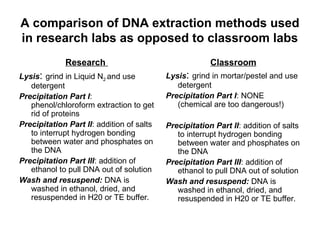
A comparison of DNA extraction methods used
in research labs as opposed to classroom labs
Research
Lysis: grind in Liquid N2 and use
detergent
Precipitation Part I:
phenol/chloroform extraction to get
rid of proteins
Precipitation Part II: addition of salts
to interrupt hydrogen bonding
between water and phosphates on
the DNA
Precipitation Part III: addition of
ethanol to pull DNA out of solution
Wash and resuspend: DNA is
washed in ethanol, dried, and
resuspended in H20 or TE buffer.
Classroom
Lysis: grind in mortar/pestel and use
detergent
Precipitation Part I: NONE
(chemical are too dangerous!)
Precipitation Part II: addition of salts
to interrupt hydrogen bonding
between water and phosphates on
the DNA
Precipitation Part III: addition of
ethanol to pull DNA out of solution
Wash and resuspend: DNA is
washed in ethanol, dried, and
resuspended in H20 or TE buffer.
LYSIS:
LYSIS:
In DNA extraction from plants,
this step commonly refers to the breaking
of the cell wall and cellular membranes (most importantly,
the plasma and nuclear membranes)
• The cell wall (made of cellulose) is disrupted by
mechanical force (for example, grinding the leaves)
• Then the addition of a detergent in the which breaks
down the cell membranes
• Detergents are able to disrupt membranes due to the amphipathic
(having both hydrophilic and hydrophobic regions) nature of both
cellular membranes and detergent molecules. The detergent
molecules are able to pull apart the membranes
• The end result of LYSIS is that the contents of the plant
cells are distributed in solution.
PRECIPITATION (In a research lab):
This a series of steps where DNA is separated from the
rest of the cellular components
• In a research lab, the first part of precipitation uses
phenol/chloroform to remove the proteins from the DNA
• Phenol denatures proteins and dissolves denatured proteins.
• Chloroform is also a protein denaturant
THIS STEP CANNOT BE PERFORMED IN CLASSROOM LABS!!
• The second part of research lab DNA precipitation is the addition of
salts
• The salts interrupt the hydrogen bonds between the water and DNA
molecules.
• The DNA is then precipitated from the protein in a subsequent step with
isopropanol or ethanol
• In the presence of cations, ethanol induces a structural change in DNA
molecules that causes them to aggregate and precipitate out of solution.
• The DNA is pelleted by spinning with a centrifuge and the supernatant
removed
PRECIPITATION (In a classroom lab):
This a series of steps where DNA is separated from the
rest of the cellular components
• In a classroom lab, DNA precipitation involves the
addition of salts
• The salts interrupt the hydrogen bonds between the water
and DNA molecules.
• The DNA is then precipitated from the protein in a
subsequent step with isopropanol or ethanol
• In the presence of cations, ethanol induces a structural
change in DNA molecules that causes them to aggregate
and precipitate out of solution.
• The DNA is pelleted by spinning with a centrifuge and
the supernatant removed
Note: because this protocol does not use
phenol/chloroform, the DNA extracted in a classroom lab
is not as “clean” as the DNA extracted in a research lab!
Washing:
The precipitated DNA is laden with acetate
salts. It is “washed” with a 70% ethanol
solution to remove salts and other water
soluble impurities but not resuspend the DNA.
Resuspension:
The clean DNA is now resuspended in a
buffer to ensure stability and long term
storage.
The most commonly used buffer for
resuspension is called 1xTE
Washing and Resuspension
Washing and Resuspension:
:
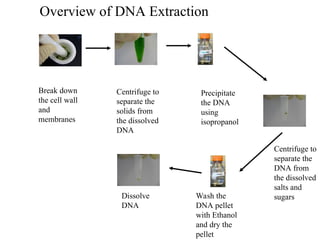
Break down
the cell wall
and
membranes
Centrifuge to
separate the
solids from
the dissolved
DNA
Precipitate
the DNA
using
isopropanol
Centrifuge to
separate the
DNA from
the dissolved
salts and
sugars
Wash the
DNA pellet
with Ethanol
and dry the
pellet
Dissolve
DNA
Overview of DNA Extraction
Checking the Quality of your DNA
• The product of your DNA extraction will be used
in subsequent experiments
• Poor quality DNA will not perform well in PCR
• You will want to assess the quality of your DNA
extraction using the following simple protocol:
• Mix 10 µL of DNA with 10 µL of loading buffer
• Load this mixture into a 1% agarose gel
• Analyze results (the following slides provide
guidance)
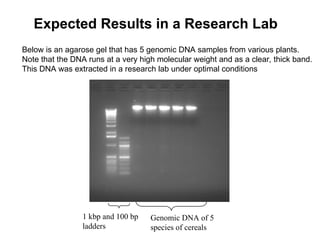
1 kbp and 100 bp
ladders
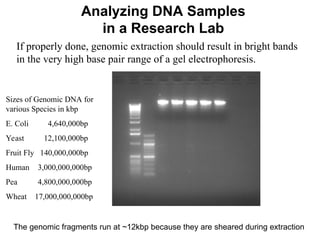
Genomic DNA of 5
species of cereals
Expected Results in a Research Lab
Below is an agarose gel that has 5 genomic DNA samples from various plants.
Note that the DNA runs at a very high molecular weight and as a clear, thick band.
This DNA was extracted in a research lab under optimal conditions
If properly done, genomic extraction should result in bright bands
in the very high base pair range of a gel electrophoresis.
Sizes of Genomic DNA for
various Species in kbp
E. Coli 4,640,000bp
Yeast 12,100,000bp
Fruit Fly 140,000,000bp
Human 3,000,000,000bp
Pea 4,800,000,000bp
Wheat 17,000,000,000bp
The genomic fragments run at ~12kbp because they are sheared during extraction
Analyzing DNA Samples
in a Research Lab
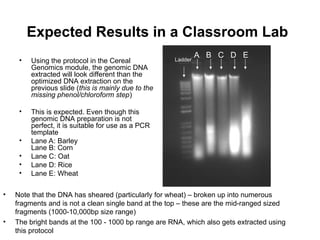
Expected Results in a Classroom Lab
• Using the protocol in the Cereal
Genomics module, the genomic DNA
extracted will look different than the
optimized DNA extraction on the
previous slide (this is mainly due to the
missing phenol/chloroform step)
• This is expected. Even though this
genomic DNA preparation is not
perfect, it is suitable for use as a PCR
template
• Lane A: Barley
Lane B: Corn
• Lane C: Oat
• Lane D: Rice
• Lane E: Wheat
A B C D E
Ladder
• Note that the DNA has sheared (particularly for wheat) – broken up into numerous
fragments and is not a clean single band at the top – these are the mid-ranged sized
fragments (1000-10,000bp size range)
• The bright bands at the 100 - 1000 bp range are RNA, which also gets extracted using
this protocol
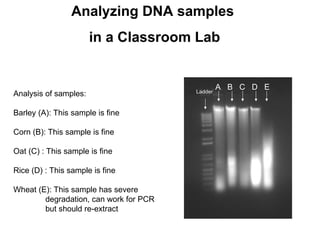
Analyzing DNA samples
in a Classroom Lab
A B C D E
Ladder
Analysis of samples:
Barley (A): This sample is fine
Corn (B): This sample is fine
Oat (C) : This sample is fine
Rice (D) : This sample is fine
Wheat (E): This sample has severe
degradation, can work for PCR
but should re-extract

DNA_Extraction_Method_Protocolindetail.ppt

  • 1.
    DNA Extraction • Outline •Purpose of DNA extraction • Review the main steps in the DNA extraction protocol and the chemistry involved in each step
  • 2.
    Purpose of DNAExtraction To obtain DNA in a relatively purified form which can be used for further investigations, i.e. PCR, sequencing, etc
  • 3.
    Basic Protocol • MostDNA extraction protocols consist of two parts 1. A technique to lyse the cells gently and solubilize the DNA 2. Enzymatic or chemical methods to remove contaminating proteins, RNA, or macromolecules • In plants, the nucleus is protected within a nuclear membrane which is surrounded by a cell membrane and a cell wall. Four steps are used to remove and purify the DNA from the rest of the cell. 1. Lysis 2. Precipitation 3. Wash 4. Resuspension
  • 4.
    A comparison ofDNA extraction methods used in research labs as opposed to classroom labs Research Lysis: grind in Liquid N2 and use detergent Precipitation Part I: phenol/chloroform extraction to get rid of proteins Precipitation Part II: addition of salts to interrupt hydrogen bonding between water and phosphates on the DNA Precipitation Part III: addition of ethanol to pull DNA out of solution Wash and resuspend: DNA is washed in ethanol, dried, and resuspended in H20 or TE buffer. Classroom Lysis: grind in mortar/pestel and use detergent Precipitation Part I: NONE (chemical are too dangerous!) Precipitation Part II: addition of salts to interrupt hydrogen bonding between water and phosphates on the DNA Precipitation Part III: addition of ethanol to pull DNA out of solution Wash and resuspend: DNA is washed in ethanol, dried, and resuspended in H20 or TE buffer.
  • 5.
    LYSIS: LYSIS: In DNA extractionfrom plants, this step commonly refers to the breaking of the cell wall and cellular membranes (most importantly, the plasma and nuclear membranes) • The cell wall (made of cellulose) is disrupted by mechanical force (for example, grinding the leaves) • Then the addition of a detergent in the which breaks down the cell membranes • Detergents are able to disrupt membranes due to the amphipathic (having both hydrophilic and hydrophobic regions) nature of both cellular membranes and detergent molecules. The detergent molecules are able to pull apart the membranes • The end result of LYSIS is that the contents of the plant cells are distributed in solution.
  • 6.
    PRECIPITATION (In aresearch lab): This a series of steps where DNA is separated from the rest of the cellular components • In a research lab, the first part of precipitation uses phenol/chloroform to remove the proteins from the DNA • Phenol denatures proteins and dissolves denatured proteins. • Chloroform is also a protein denaturant THIS STEP CANNOT BE PERFORMED IN CLASSROOM LABS!! • The second part of research lab DNA precipitation is the addition of salts • The salts interrupt the hydrogen bonds between the water and DNA molecules. • The DNA is then precipitated from the protein in a subsequent step with isopropanol or ethanol • In the presence of cations, ethanol induces a structural change in DNA molecules that causes them to aggregate and precipitate out of solution. • The DNA is pelleted by spinning with a centrifuge and the supernatant removed
  • 7.
    PRECIPITATION (In aclassroom lab): This a series of steps where DNA is separated from the rest of the cellular components • In a classroom lab, DNA precipitation involves the addition of salts • The salts interrupt the hydrogen bonds between the water and DNA molecules. • The DNA is then precipitated from the protein in a subsequent step with isopropanol or ethanol • In the presence of cations, ethanol induces a structural change in DNA molecules that causes them to aggregate and precipitate out of solution. • The DNA is pelleted by spinning with a centrifuge and the supernatant removed Note: because this protocol does not use phenol/chloroform, the DNA extracted in a classroom lab is not as “clean” as the DNA extracted in a research lab!
  • 8.
    Washing: The precipitated DNAis laden with acetate salts. It is “washed” with a 70% ethanol solution to remove salts and other water soluble impurities but not resuspend the DNA. Resuspension: The clean DNA is now resuspended in a buffer to ensure stability and long term storage. The most commonly used buffer for resuspension is called 1xTE Washing and Resuspension Washing and Resuspension: :
  • 9.
    Break down the cellwall and membranes Centrifuge to separate the solids from the dissolved DNA Precipitate the DNA using isopropanol Centrifuge to separate the DNA from the dissolved salts and sugars Wash the DNA pellet with Ethanol and dry the pellet Dissolve DNA Overview of DNA Extraction
  • 10.
    Checking the Qualityof your DNA • The product of your DNA extraction will be used in subsequent experiments • Poor quality DNA will not perform well in PCR • You will want to assess the quality of your DNA extraction using the following simple protocol: • Mix 10 µL of DNA with 10 µL of loading buffer • Load this mixture into a 1% agarose gel • Analyze results (the following slides provide guidance)
  • 11.
    1 kbp and100 bp ladders Genomic DNA of 5 species of cereals Expected Results in a Research Lab Below is an agarose gel that has 5 genomic DNA samples from various plants. Note that the DNA runs at a very high molecular weight and as a clear, thick band. This DNA was extracted in a research lab under optimal conditions
  • 12.
    If properly done,genomic extraction should result in bright bands in the very high base pair range of a gel electrophoresis. Sizes of Genomic DNA for various Species in kbp E. Coli 4,640,000bp Yeast 12,100,000bp Fruit Fly 140,000,000bp Human 3,000,000,000bp Pea 4,800,000,000bp Wheat 17,000,000,000bp The genomic fragments run at ~12kbp because they are sheared during extraction Analyzing DNA Samples in a Research Lab
  • 13.
    Expected Results ina Classroom Lab • Using the protocol in the Cereal Genomics module, the genomic DNA extracted will look different than the optimized DNA extraction on the previous slide (this is mainly due to the missing phenol/chloroform step) • This is expected. Even though this genomic DNA preparation is not perfect, it is suitable for use as a PCR template • Lane A: Barley Lane B: Corn • Lane C: Oat • Lane D: Rice • Lane E: Wheat A B C D E Ladder • Note that the DNA has sheared (particularly for wheat) – broken up into numerous fragments and is not a clean single band at the top – these are the mid-ranged sized fragments (1000-10,000bp size range) • The bright bands at the 100 - 1000 bp range are RNA, which also gets extracted using this protocol
  • 14.
    Analyzing DNA samples ina Classroom Lab A B C D E Ladder Analysis of samples: Barley (A): This sample is fine Corn (B): This sample is fine Oat (C) : This sample is fine Rice (D) : This sample is fine Wheat (E): This sample has severe degradation, can work for PCR but should re-extract

Editor's Notes

  • #1 Image of DNA
  • #9 Flowchart of the various steps
  • #11 Image of Matt's perfect extraction
  • #13 Put on the picture