Leaves
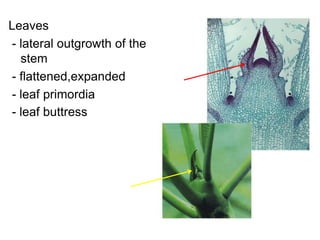
- lateral outgrowth of the
  stem
- flattened,expanded
- leaf primordia
- leaf buttress
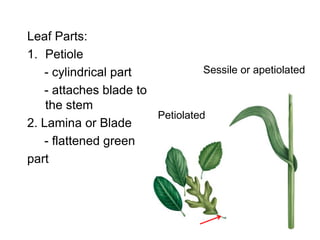
Leaf Parts:
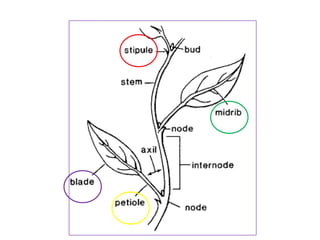
1. Petiole
   - cylindrical part            Sessile or apetiolated
   - attaches blade to
    the stem
                       Petiolated
2. Lamina or Blade
   - flattened green
part
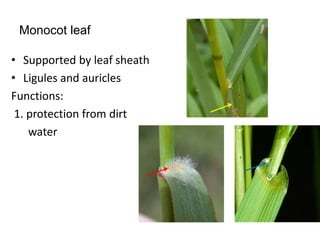
Monocot leaf

• Supported by leaf sheath
• Ligules and auricles
Functions:
 1. protection from dirt
    water
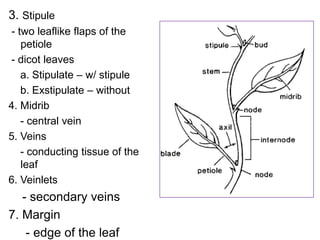
3. Stipule
- two leaflike flaps of the
   petiole
- dicot leaves
   a. Stipulate – w/ stipule
   b. Exstipulate – without
4. Midrib
   - central vein
5. Veins
   - conducting tissue of the
   leaf
6. Veinlets
   - secondary veins
7. Margin
    - edge of the leaf
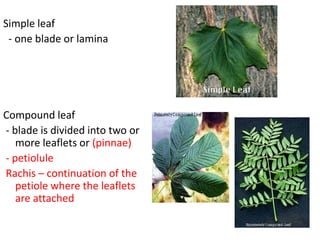
Simple leaf
 - one blade or lamina


Compound leaf
- blade is divided into two or
   more leaflets or (pinnae)
- petiolule
Rachis – continuation of the
   petiole where the leaflets
   are attached
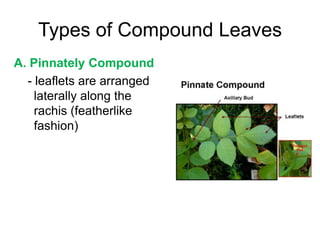
Types of Compound Leaves
A. Pinnately Compound
  - leaflets are arranged
    laterally along the
    rachis (featherlike
    fashion)
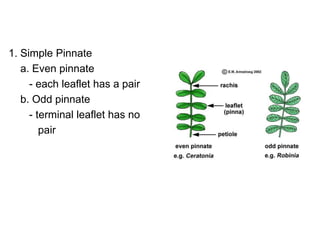
1. Simple Pinnate
   a. Even pinnate
     - each leaflet has a pair
   b. Odd pinnate
     - terminal leaflet has no
        pair
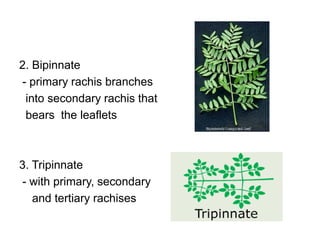
2. Bipinnate
- primary rachis branches
 into secondary rachis that
 bears the leaflets


3. Tripinnate
- with primary, secondary
   and tertiary rachises
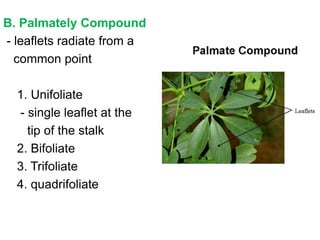
B. Palmately Compound
- leaflets radiate from a
  common point

  1. Unifoliate
  - single leaflet at the
    tip of the stalk
  2. Bifoliate
  3. Trifoliate
  4. quadrifoliate
PHYLLOTAXY
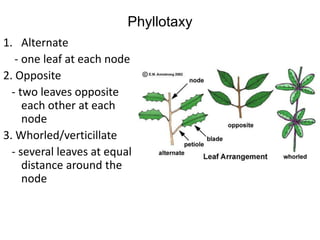
Phyllotaxy
1. Alternate
   - one leaf at each node
2. Opposite
  - two leaves opposite
     each other at each
     node
3. Whorled/verticillate
  - several leaves at equal
     distance around the
     node
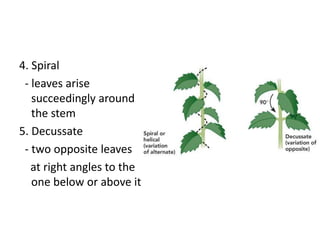
4. Spiral
 - leaves arise
   succeedingly around
   the stem
5. Decussate
 - two opposite leaves
   at right angles to the
   one below or above it
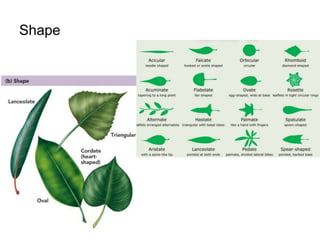
Shape
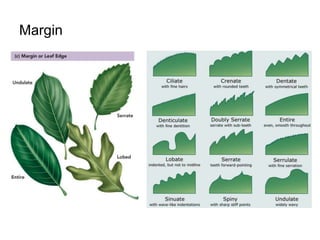
Margin
Leaf Venation
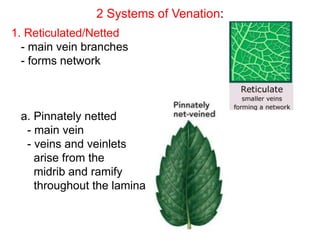
2 Systems of Venation:
1. Reticulated/Netted
  - main vein branches
  - forms network


 a. Pinnately netted
  - main vein
  - veins and veinlets
    arise from the
    midrib and ramify
    throughout the lamina
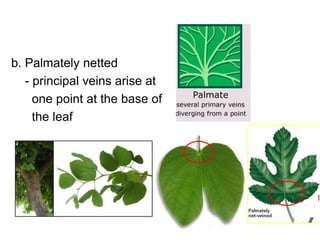
b. Palmately netted
   - principal veins arise at
     one point at the base of
     the leaf
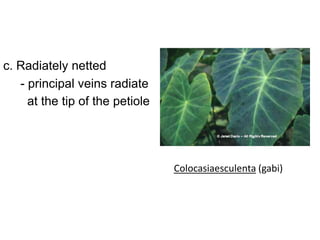
c. Radiately netted
   - principal veins radiate
     at the tip of the petiole


                                 Colocasiaesculenta (gabi)
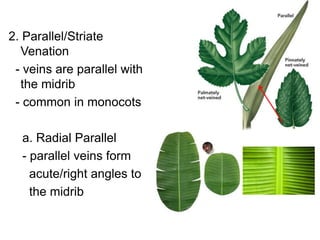
2. Parallel/Striate
  Venation
 - veins are parallel with
  the midrib
 - common in monocots

  a. Radial Parallel
  - parallel veins form
    acute/right angles to
    the midrib
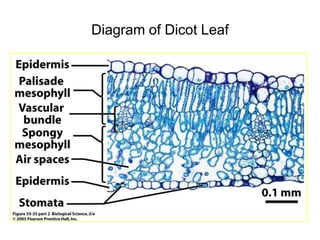
Diagram of Dicot Leaf
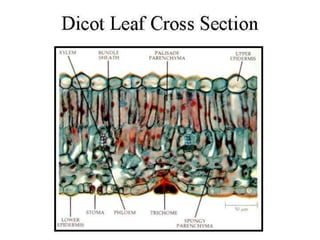
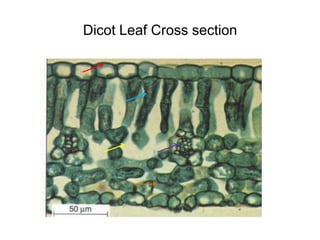
Dicot Leaf Cross section
1. Epidermis
  - upper and lower
  - single layer of cells
  - derived from protoderm
  Functions:
   a. Protects leaf from dessication –(cuticle)
   b. Abrasion
   c. Prevents entry of fungi and bacteria
    d. Regulates exchange of gases (Oxygen
    and carbon dioxide
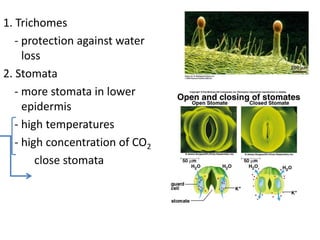
1. Trichomes
   - protection against water
     loss
2. Stomata
   - more stomata in lower
     epidermis
   - high temperatures
   - high concentration of CO2
        close stomata
2. Mesophyll
   - located between the upper and lower
     epidermis
   - dicots (2 distinct layers)
       a. Palisade mesophyll
           - arranged in compact columnar fashion
           - most photosynthetic activity takes
              place
        b. Spongy mesophyll
            - irregularly shaped
            - prominent intercellular air spaces
            - diffussion of carbon dioxide to other
              parts of leaf
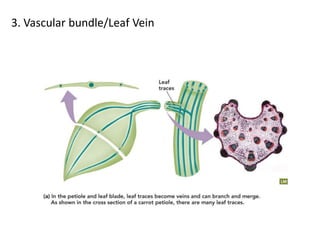
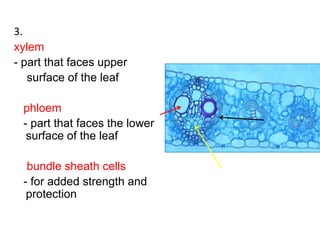
3. Vascular bundle/Leaf Vein
3.
xylem
- part that faces upper
   surface of the leaf

 phloem
 - part that faces the lower
  surface of the leaf

  bundle sheath cells
 - for added strength and
  protection
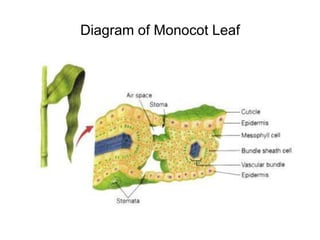
Diagram of Monocot Leaf
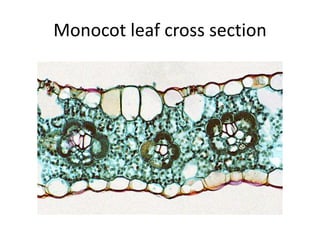
Monocot leaf cross section
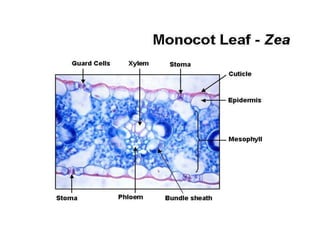
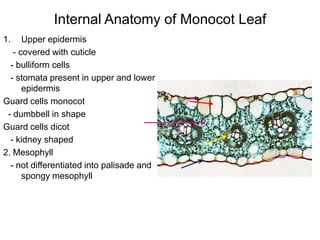
Internal Anatomy of Monocot Leaf
1.    Upper epidermis
   - covered with cuticle
  - bulliform cells
  - stomata present in upper and lower
      epidermis
Guard cells monocot
 - dumbbell in shape
Guard cells dicot
  - kidney shaped
2. Mesophyll
  - not differentiated into palisade and
      spongy mesophyll
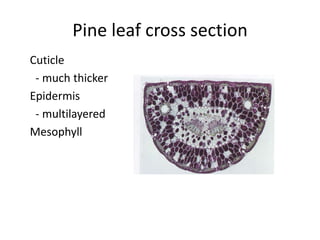
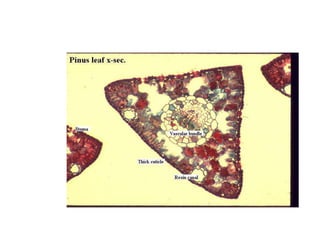
Pine leaf cross section
Cuticle
 - much thicker
Epidermis
 - multilayered
Mesophyll
Modified Leaves
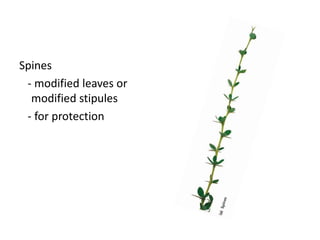
Spines
 - modified leaves or
  modified stipules
 - for protection
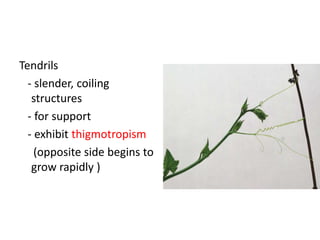
Tendrils
  - slender, coiling
   structures
  - for support
  - exhibit thigmotropism
    (opposite side begins to
   grow rapidly )
b
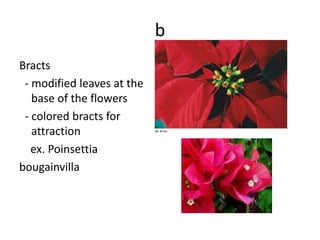
Bracts
 - modified leaves at the
   base of the flowers
 - colored bracts for
   attraction
   ex. Poinsettia
bougainvilla
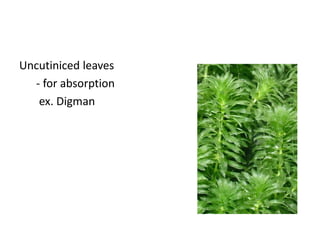
Uncutiniced leaves
  - for absorption
   ex. Digman
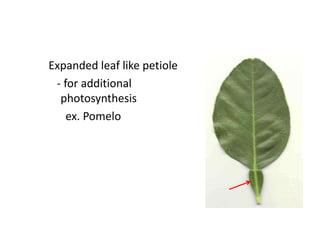
Expanded leaf like petiole
 - for additional
  photosynthesis
    ex. Pomelo
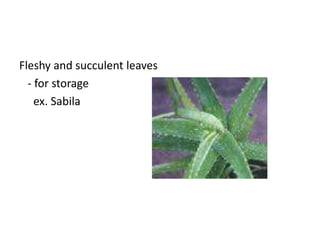
Fleshy and succulent leaves
  - for storage
    ex. Sabila
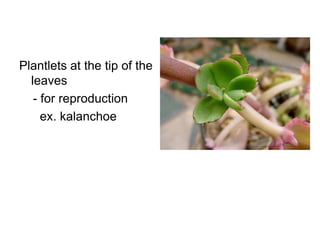
Plantlets at the tip of the
  leaves
   - for reproduction
     ex. kalanchoe
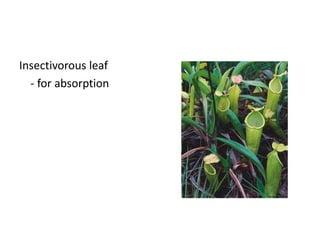
Insectivorous leaf
  - for absorption

Leaves

  • 3.
    Leaves - lateral outgrowthof the stem - flattened,expanded - leaf primordia - leaf buttress
  • 4.
    Leaf Parts: 1. Petiole - cylindrical part Sessile or apetiolated - attaches blade to the stem Petiolated 2. Lamina or Blade - flattened green part
  • 5.
    Monocot leaf • Supportedby leaf sheath • Ligules and auricles Functions: 1. protection from dirt water
  • 6.
    3. Stipule - twoleaflike flaps of the petiole - dicot leaves a. Stipulate – w/ stipule b. Exstipulate – without 4. Midrib - central vein 5. Veins - conducting tissue of the leaf 6. Veinlets - secondary veins 7. Margin - edge of the leaf
  • 7.
    Simple leaf -one blade or lamina Compound leaf - blade is divided into two or more leaflets or (pinnae) - petiolule Rachis – continuation of the petiole where the leaflets are attached
  • 8.
    Types of CompoundLeaves A. Pinnately Compound - leaflets are arranged laterally along the rachis (featherlike fashion)
  • 9.
    1. Simple Pinnate a. Even pinnate - each leaflet has a pair b. Odd pinnate - terminal leaflet has no pair
  • 10.
    2. Bipinnate - primaryrachis branches into secondary rachis that bears the leaflets 3. Tripinnate - with primary, secondary and tertiary rachises
  • 11.
    B. Palmately Compound -leaflets radiate from a common point 1. Unifoliate - single leaflet at the tip of the stalk 2. Bifoliate 3. Trifoliate 4. quadrifoliate
  • 12.
  • 13.
    Phyllotaxy 1. Alternate - one leaf at each node 2. Opposite - two leaves opposite each other at each node 3. Whorled/verticillate - several leaves at equal distance around the node
  • 14.
    4. Spiral -leaves arise succeedingly around the stem 5. Decussate - two opposite leaves at right angles to the one below or above it
  • 15.
  • 16.
  • 17.
  • 18.
    2 Systems ofVenation: 1. Reticulated/Netted - main vein branches - forms network a. Pinnately netted - main vein - veins and veinlets arise from the midrib and ramify throughout the lamina
  • 19.
    b. Palmately netted - principal veins arise at one point at the base of the leaf
  • 20.
    c. Radiately netted - principal veins radiate at the tip of the petiole Colocasiaesculenta (gabi)
  • 21.
    2. Parallel/Striate Venation - veins are parallel with the midrib - common in monocots a. Radial Parallel - parallel veins form acute/right angles to the midrib
  • 22.
  • 24.
  • 25.
    1. Epidermis - upper and lower - single layer of cells - derived from protoderm Functions: a. Protects leaf from dessication –(cuticle) b. Abrasion c. Prevents entry of fungi and bacteria d. Regulates exchange of gases (Oxygen and carbon dioxide
  • 26.
    1. Trichomes - protection against water loss 2. Stomata - more stomata in lower epidermis - high temperatures - high concentration of CO2 close stomata
  • 27.
    2. Mesophyll - located between the upper and lower epidermis - dicots (2 distinct layers) a. Palisade mesophyll - arranged in compact columnar fashion - most photosynthetic activity takes place b. Spongy mesophyll - irregularly shaped - prominent intercellular air spaces - diffussion of carbon dioxide to other parts of leaf
  • 28.
  • 29.
    3. xylem - part thatfaces upper surface of the leaf phloem - part that faces the lower surface of the leaf bundle sheath cells - for added strength and protection
  • 30.
  • 31.
  • 33.
    Internal Anatomy ofMonocot Leaf 1. Upper epidermis - covered with cuticle - bulliform cells - stomata present in upper and lower epidermis Guard cells monocot - dumbbell in shape Guard cells dicot - kidney shaped 2. Mesophyll - not differentiated into palisade and spongy mesophyll
  • 34.
    Pine leaf crosssection Cuticle - much thicker Epidermis - multilayered Mesophyll
  • 36.
  • 37.
    Spines - modifiedleaves or modified stipules - for protection
  • 38.
    Tendrils -slender, coiling structures - for support - exhibit thigmotropism (opposite side begins to grow rapidly )
  • 39.
    b Bracts - modifiedleaves at the base of the flowers - colored bracts for attraction ex. Poinsettia bougainvilla
  • 40.
    Uncutiniced leaves - for absorption ex. Digman
  • 41.
    Expanded leaf likepetiole - for additional photosynthesis ex. Pomelo
  • 42.
    Fleshy and succulentleaves - for storage ex. Sabila
  • 43.
    Plantlets at thetip of the leaves - for reproduction ex. kalanchoe
  • 44.
    Insectivorous leaf - for absorption