Learning
Transferable Visual
Models from Natural
Language
Supervision: CLIP
Authors: Alec Radford, Jong Wook Kim, Chris
Hallacy, et al.
Presented By:
Zohaib Hassan
Objective
Problem:
• Current limitations of traditional
SOTA computer vision models,
which rely on labeled datasets
with fixed categories.
• limits generality and flexibility
Proposed Solution:
• A method that enables flexible,
scalable learning from natural
language.
• Learning directly from raw text
(natural descriptions) paired with
images is a promising alternative
Background and
Motivating Work
• Inspired by NLP breakthroughs
(e.g., GPT-3)
• NLP and Vision Integration
• Pre-training methods which learn
directly from raw, unstructured
text
• Previous Works: VirTex and
ConVIRT combined vision and NLP
but did not reach the scale and
flexibility of CLIP.
CLIP: Contrastive Language-
Image Pre-Training
• CLIP - A Promising Solution to Traditional
Model Limitations
• Developed to overcome these limitations of
traditional computer vision systems
• Uses natural language descriptions as a
form of supervision
• Learns from a large dataset of image-text
pairs
• Does not rely on labeled datasets with
predefined classes
• Offers Generalization, Scalability, and
Zero-Shot Transfer Capabilities
Key Concept -
Natural
Language
Supervision
CLIP leverages text descriptions paired
with images to learn visual
representations. Instead of labeled
datasets with fixed classes, it uses freely
available text as supervision.
This enables CLIP to learn a vast range of
visual concepts without requiring
traditional, manually labeled data
Approach
Overview
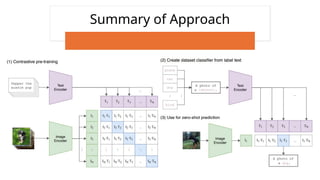
The CLIP Framework: CLIP's unique
framework involves pre-training on (image,
text) pairs using a contrastive objective.
Steps Involved:
1) Image Encoder: Uses ResNet or ViT
2) Text Encoder: Transformer-based text
embeddings.
3) Contrastive Objective: Learns by
maximizing similarity between correct
image-text pairs and minimizing it for
incorrect ones.
Given a batch of N pairs, CLIP aims to identify
the correct pairs among the × possible
𝑁 𝑁
pairs.
Summary of Approach
Data and
Dataset Creation
Dataset Size: Built a new dataset of 400
million (image, text) pairs from the
internet...
Balance and Scale: Limited to 20,000
pairs per query
Unique Dataset: Diverse and internet-
scale data, facilitating broad
generalization.
Scalability: Unlike MS-COCO and
ImageNet, CLIP’s dataset isn’t manually
labeled, increasing scalability.
Training Strategy
Contrastive Learning: Predict correct
image-text pairs...
CLIP learns a multi-modal
embedding space by jointly training
an image encoder and text encoder
to maximize the cosine similarity
Objective: Maximize similarity for
correct pairs, minimize for incorrect.
Contrastive Objective: Key to
improving learning efficiency.
Image/Text Embedding: These
enable the “zero-shot” applications
Zero-Shot Learning
and Transferability
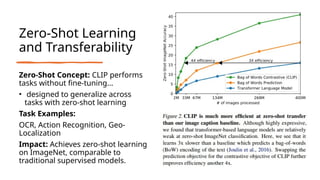
Zero-Shot Concept: CLIP performs
tasks without fine-tuning...
• designed to generalize across
tasks with zero-shot learning
Task Examples:
OCR, Action Recognition, Geo-
Localization
Impact: Achieves zero-shot learning
on ImageNet, comparable to
traditional supervised models.
Experimental
Setup and
Results
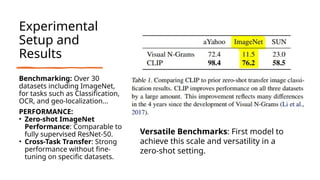
Benchmarking: Over 30
datasets including ImageNet,
for tasks such as Classification,
OCR, and geo-localization...
PERFORMANCE:
• Zero-shot ImageNet
Performance: Comparable to
fully supervised ResNet-50.
• Cross-Task Transfer: Strong
performance without fine-
tuning on specific datasets.
Versatile Benchmarks: First model to
achieve this scale and versatility in a
zero-shot setting.
Efficiency and
Scalability
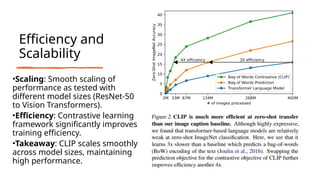
•Scaling: Smooth scaling of
performance as tested with
different model sizes (ResNet-50
to Vision Transformers).
•Efficiency: Contrastive learning
framework significantly improves
training efficiency.
•Takeaway: CLIP scales smoothly
across model sizes, maintaining
high performance.
Robustness
and Analysis
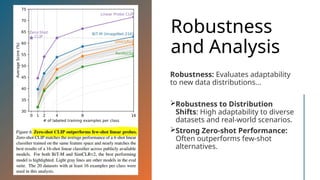
Robustness: Evaluates adaptability
to new data distributions...
Robustness to Distribution
Shifts: High adaptability to diverse
datasets and real-world scenarios.
Strong Zero-shot Performance:
Often outperforms few-shot
alternatives.
Prompt Engineering
and Ensembling
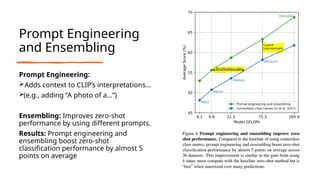
Prompt Engineering:
Adds context to CLIP’s interpretations...
(e.g., adding “A photo of a…”)
Ensembling: Improves zero-shot
performance by using different prompts.
Results: Prompt engineering and
ensembling boost zero-shot
classification performance by almost 5
points on average
Limitation
s and
Challenge
s
CLIP’s limitations include potential
data bias and challenges with
complex tasks
• Data Bias: Internet-sourced data
can introduce biases...
• Complex Tasks:
Underperformance in specialized
domains (e.g., medical images)
Conclusion
s
CLIP represents a shift towards
scalable, flexible vision models
Future Directions:
•Improving Robustness: More robust
models across domains.
•Specialization: Enhanced handling of
complex tasks.
Q&A Questions and
feedback?

Learning Transferable Visual Models from Natural Language Supervision: CLIP

  • 1.
    Learning Transferable Visual Models fromNatural Language Supervision: CLIP Authors: Alec Radford, Jong Wook Kim, Chris Hallacy, et al. Presented By: Zohaib Hassan
  • 2.
    Objective Problem: • Current limitationsof traditional SOTA computer vision models, which rely on labeled datasets with fixed categories. • limits generality and flexibility Proposed Solution: • A method that enables flexible, scalable learning from natural language. • Learning directly from raw text (natural descriptions) paired with images is a promising alternative
  • 3.
    Background and Motivating Work •Inspired by NLP breakthroughs (e.g., GPT-3) • NLP and Vision Integration • Pre-training methods which learn directly from raw, unstructured text • Previous Works: VirTex and ConVIRT combined vision and NLP but did not reach the scale and flexibility of CLIP.
  • 4.
    CLIP: Contrastive Language- ImagePre-Training • CLIP - A Promising Solution to Traditional Model Limitations • Developed to overcome these limitations of traditional computer vision systems • Uses natural language descriptions as a form of supervision • Learns from a large dataset of image-text pairs • Does not rely on labeled datasets with predefined classes • Offers Generalization, Scalability, and Zero-Shot Transfer Capabilities
  • 5.
    Key Concept - Natural Language Supervision CLIPleverages text descriptions paired with images to learn visual representations. Instead of labeled datasets with fixed classes, it uses freely available text as supervision. This enables CLIP to learn a vast range of visual concepts without requiring traditional, manually labeled data
  • 6.
    Approach Overview The CLIP Framework:CLIP's unique framework involves pre-training on (image, text) pairs using a contrastive objective. Steps Involved: 1) Image Encoder: Uses ResNet or ViT 2) Text Encoder: Transformer-based text embeddings. 3) Contrastive Objective: Learns by maximizing similarity between correct image-text pairs and minimizing it for incorrect ones. Given a batch of N pairs, CLIP aims to identify the correct pairs among the × possible 𝑁 𝑁 pairs.
  • 7.
  • 8.
    Data and Dataset Creation DatasetSize: Built a new dataset of 400 million (image, text) pairs from the internet... Balance and Scale: Limited to 20,000 pairs per query Unique Dataset: Diverse and internet- scale data, facilitating broad generalization. Scalability: Unlike MS-COCO and ImageNet, CLIP’s dataset isn’t manually labeled, increasing scalability.
  • 9.
    Training Strategy Contrastive Learning:Predict correct image-text pairs... CLIP learns a multi-modal embedding space by jointly training an image encoder and text encoder to maximize the cosine similarity Objective: Maximize similarity for correct pairs, minimize for incorrect. Contrastive Objective: Key to improving learning efficiency. Image/Text Embedding: These enable the “zero-shot” applications
  • 10.
    Zero-Shot Learning and Transferability Zero-ShotConcept: CLIP performs tasks without fine-tuning... • designed to generalize across tasks with zero-shot learning Task Examples: OCR, Action Recognition, Geo- Localization Impact: Achieves zero-shot learning on ImageNet, comparable to traditional supervised models.
  • 11.
    Experimental Setup and Results Benchmarking: Over30 datasets including ImageNet, for tasks such as Classification, OCR, and geo-localization... PERFORMANCE: • Zero-shot ImageNet Performance: Comparable to fully supervised ResNet-50. • Cross-Task Transfer: Strong performance without fine- tuning on specific datasets. Versatile Benchmarks: First model to achieve this scale and versatility in a zero-shot setting.
  • 12.
    Efficiency and Scalability •Scaling: Smoothscaling of performance as tested with different model sizes (ResNet-50 to Vision Transformers). •Efficiency: Contrastive learning framework significantly improves training efficiency. •Takeaway: CLIP scales smoothly across model sizes, maintaining high performance.
  • 13.
    Robustness and Analysis Robustness: Evaluatesadaptability to new data distributions... Robustness to Distribution Shifts: High adaptability to diverse datasets and real-world scenarios. Strong Zero-shot Performance: Often outperforms few-shot alternatives.
  • 14.
    Prompt Engineering and Ensembling PromptEngineering: Adds context to CLIP’s interpretations... (e.g., adding “A photo of a…”) Ensembling: Improves zero-shot performance by using different prompts. Results: Prompt engineering and ensembling boost zero-shot classification performance by almost 5 points on average
  • 15.
    Limitation s and Challenge s CLIP’s limitationsinclude potential data bias and challenges with complex tasks • Data Bias: Internet-sourced data can introduce biases... • Complex Tasks: Underperformance in specialized domains (e.g., medical images)
  • 16.
    Conclusion s CLIP represents ashift towards scalable, flexible vision models Future Directions: •Improving Robustness: More robust models across domains. •Specialization: Enhanced handling of complex tasks.
  • 17.

Editor's Notes

  • #1 - Today, I’ll be presenting a paper titled Learning Transferable Visual Models from Natural Language Supervision, commonly known as CLIP. This research was prepared by researchers at the Open AI.
  • #2 Traditional computer vision models rely on labeled datasets with fixed categories, which limits their generalizability. The reliance on labeled data constrains flexibility, making it difficult for models to adapt to new visual concepts or tasks. CLIP aims to solve this by learning directly from natural language descriptions paired with images
  • #3 Recent breakthroughs in NLP, like GPT-3, show that models trained on vast text data without task-specific labels can handle diverse tasks. learning from raw, unstructured text and CLIP tries to use text descriptions of images for broader understanding models like VirTex and ConVIRT, laid the groundwork for combining vision and language but did not reach the scale or flexibility of CLIP
  • #4 CLIP is designed to overcome these limitations by using natural language as a form of supervision. Instead of relying on fixed-label datasets, CLIP can learn from any image with a paired text description. 3 main benefits: Generalization (it can handle various tasks), Scalability (it scales with internet data), and Zero-Shot Learning (it can perform tasks without additional training)
  • #5 Natural language supervision means that CLIP learns directly from text descriptions associated with images, bypassing the need for specific labels. this enables it to learn a wide range of visual concepts beyond fixed categories Show previous image, illustrate how the text itself acts as the “label.”
  • #6 CLIP’s framework involves pre-training on image-text pairs using a method called contrastive learning, where it tries to match the right image with the right caption in a batch. CLIP has an Image Encoder and a Text Encoder (transformer-based) which both map images and text into a shared embedding space It learns by maximizing similarity between correct pairs and Vice Versa
  • #7 While standard image models jointly train an image feature extractor and a linear classifier to predict some label, CLIP jointly trains an image encoder and a text encoder to predict the correct pairings of a batch of (image, text). At test time the learned text encoder synthesizes a zero-shot linear classifier by embedding the names or descriptions of the target dataset’s classes.
  • #8 The authors built a large dataset of 400 million (image, text) pairs from the internet to ensure diversity the importance of coverage and balance is to avoid over-representation of specific concepts (limited to 20,000 pairs per query) this scale helps CLIP learn more flexibly and generalize well across tasks.
  • #9 In CLIP’s training, contrastive learning allows it to identify the correct image-text pairs within each batch… this process creates a shared multi-modal embedding space, where related images and text are close to each other. the cosine similarity measure is used to align correct pairs and separate incorrect pairs
  • #10 One of CLIP’s major strengths is its zero-shot transferability, which means it can handle tasks it wasn’t specifically trained for, such as OCR or action recognition The impact of this is significant, as it achieved a zero-shot comparable performance to the traditional SOTA supervised models
  • #11 CLIP was benchmarked across 30+ datasets and tasks, where it often matched or exceeded the performance of traditional models. The ImageNet zero-shot performance was a key result, where CLIP performed comparably to a fully supervised ResNet-50
  • #12 As the model size increases from ResNet-50 to Vision Transformers, CLIP’s performance scales smoothly, maintaining high accuracy across tasks. Figure for efficiency.
  • #13 Robosutness basically means the Adaptability Across Tasks CLIP’s robustness was tested by evaluating its adaptability to diverse datasets and handling real-world variations strength in domain shifts it often outperforms few-shot learning models
  • #14 It basically means Improving performance with prompts… Prompt engineering, such as adding contextual phrases like ‘A photo of...’ significantly boosts CLIP’s accuracy in specific tasks. Ensembling is basically trying different prompts and seeing which works best
  • #15 CLIP, while powerful, has some limitations, such as data bias from internet-sourced images and struggles with very specialized domains, like medical imagery. ethical concerns due to biases in internet-sourced data
  • #16 - CLIP represents a major step forward for vision models, demonstrating scalability and flexibility with natural language supervision.