Aditi Khandekar E 03
Akshit Patniak E 04
Nishant Bhatt
Saasha Jethwani E
17
Shreya BoseFormation of Eurozone
OVERVIEW
Timeline
1929 – German politician Gustav Stresemann proposes a single European currency in an address to the League
of Nations
1969 – At a summit in The Hague, European leaders define a new objective: Economic and Monetary Union
(EMU)
1992 – The eurozone is established in Maastricht by the European Union. The UK negotiates an opt-out clause.
1999 – The euro currency is officially introduced in the original 11 countries of the eurozone (coins and
banknotes follow in 2002)
April 2009 – The EU orders France, Spain, the Republic of Ireland and Greece to reduce their budget deficits
May 2010 – Eurozone countries and the IMF agree a €110bn bailout package for Greece. Bailouts for the
HISTORY
For centuries, Europe was home to feuding empires and states. After World War II, it became the home of devastated
peoples whose security was the responsibility of the United States. Through the Bretton Woods agreement, the United
States crafted an economic grouping that regenerated Western Europe’s economic fortunes under a security rubric that
Washington firmly controlled. Freed of security competition, the Europeans not only were free to pursue economic growth,
they also enjoyed nearly unlimited access to the American market to fuel that growth. Economic integration within Europe to
maximize these opportunities made perfect sense. The United States encouraged the economic and political integration
because it gave a political underpinning to a security alliance it imposed on Europe, i.e., NATO. Thus, the European
Economic Community – the predecessor to today’s European Union – was born.
When the United States abandoned the gold standard in 1971 (for reasons largely unconnected to things European),
Washington essentially abolished the Bretton Woods currency pegs that went with it. One result was a European panic.
Floating currencies raised the inevitability of currency competition among the European states, the exact sort of competition
that contributed to the Great Depression 40 years earlier. Almost immediately, the need to limit that competition sharpened,
first with currency coordination efforts still concentrating on the U.S. dollar and then from 1979 on with efforts focused on
FORMATION
January 1, 1999 - The euro is introduced.
The European Union's Maastricht Treaty "convergence criteria," or requirements for a
member country to use the euro as currency:
- Annual budget deficits must not exceed 3% of gross domestic product.
- Public debt must be under 60% of gross domestic product.
- The country must have exchange rate stability.
- Inflation rates must be within 1.5% of the three EU countries with the lowest rate.
- Long-term interest rates must be within 2% of the three lowest interest rates in the EU.
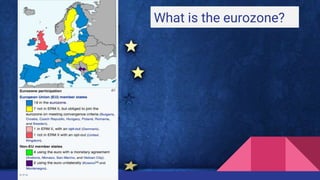
What is the eurozone?
❖ The euro (€) as their common currency and sole legal tender
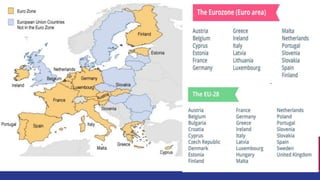
❖ Austria, Belgium, Cyprus, Estonia, Finland, France, Germany, Greece, Ireland, Italy, Latvia, Lithuania,
Luxembourg, Malta, the Netherlands, Portugal, Slovakia, Slovenia, and Spain
❖ Other EU states (except for Denmark and the United Kingdom) are obliged to join once they meet the
criteria to do so
❖ No state has left, and there are no provisions to do so or to be expelled.
❖ Andorra, Monaco, San Marino, and Vatican City have formal agreements with the EU to use the euro
as their official currency and issue their own coins (Microstates)
❖ Other states, like Kosovo and Montenegro, have adopted the euro unilaterally but these countries do
not officially form part of the eurozone and do not have representation in the ECB or the Eurogroup
What is the eurozone?
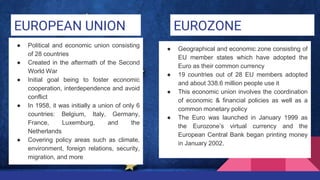
EUROPEAN UNION
● Political and economic union consisting
of 28 countries
● Created in the aftermath of the Second
World War
● Initial goal being to foster economic
cooperation, interdependence and avoid
conflict
● In 1958, it was initially a union of only 6
countries: Belgium, Italy, Germany,
France, Luxemburg, and the
Netherlands
● Covering policy areas such as climate,
environment, foreign relations, security,
migration, and more
● Geographical and economic zone consisting of
EU member states which have adopted the
Euro as their common currency
● 19 countries out of 28 EU members adopted
and about 338.6 million people use it
● This economic union involves the coordination
of economic & financial policies as well as a
common monetary policy
● The Euro was launched in January 1999 as
the Eurozone’s virtual currency and the
European Central Bank began printing money
in January 2002.
EUROZONE
GROWTH
A TIMELINE OF THE EUROZONE'S EXPANSION
1 January 1999: euro launched in Austria, Belgium, Finland, France, Germany, Ireland, Italy, Luxembourg, the Netherlands,
Portugal, and Spain.
1 January 2001 in Greece.
1 January 2007 in Slovenia.
1 January 2008 in Cyprus and Malta.
1 January 2009 in Slovakia.
1 January 2011 in Estonia.
1 January 2014 in Latvia.
1 January 2015 in Lithuania.
Structure
1. several governing bodies that oversee different aspects of the union's operation
2. union takes turn acting as chairman, with the position changing hands every six months
CURRENT SCENARIO
● Eurozone economy slows sharply in Q3; moderate momentum likely persists in Q4
○ latest reading confirms that the economy has shifted from a recovery boom last year to a
slower cruising speed
○ political stability in the Eurozone’s largest economy is not yet guaranteed and a poor result for
either of the parties in the “grand coalition” in 2019’s local or European elections could spark
calls for her resignation
○ On the flip side, the political and economic situation in France deteriorated starkly in
December
○ Some political turbulence was also seen in Belgium this month, after the government lost its
majority on 8 December
CURRENT SCENARIO
● Growth set to moderate again next year
○ growth is set to come in at 1.9% this year amid a less favorable external
environment
○ While a tightening labor market, looser fiscal policy and still-accommodative
monetary policy are seen powering growth next year
○ lower-than-anticipated energy prices, slower ‘normalization’ of monetary policy or
dissipating fears over a global trade war
○ Seven of the Eurozone’s economies saw no change in their 2019 forecasts this
month
EFFECT ON WORLD ECONOMY
● GERMANY | Soft data for Q4 comes in; Merkel ally wins CDU party chief
○ In the third quarter, the economy shrunk for the first time in over two years on the
back of weakening domestic demand and a contraction in exports
○ The composite PMI averaged significantly lower in October-November than in the
third quarter, while consumer confidence is expected to ease further in December
to its lowest level since June 2017
○ Private consumption will likely benefit from the minimum wage increase from 1
January and a tight labor market
○ However, uncertainty surrounding Brexit and trade tensions between the EU and
the United States cloud the outlook
EFFECT ON WORLD ECONOMY
● FRANCE | Macron unveils stimulus to appease protesters
○ Analysts applauded the centrist politician’s resolve to keep alive his reform agenda by
introducing sweeteners rather than backtracking entirely on badly-needed labor-market
changes, although most acknowledged the president’s weaker footing from here on out
○ Household spending should benefit from income-tax cuts and an improving labor market, while
fixed investment—despite the spook in recent weeks—should hold up amid Macron’s reform
push, elevated capacity utilization and upbeat economic sentiment
● ITALY | Government and European Commission strike truce on 2019 budget
○ The industrial sector remained weak in October
○ The negative effects of higher interest rates on the capitalization of the banking system are
also constricting credit
○ Growth is expected to be anemic next year
EFFECT ON WORLD ECONOMY
● SPAIN | Government loses support in regional election
○ A strong rebound in retail sales and a notable acceleration in tourist arrivals in October,
coupled with solid readings for the services PMI in October−November, indicate healthy
private consumption
○ the ruling Socialist Party’s setback in Andalusian regional elections in early December,
together with growing political tensions with Catalan pro-independence parties, pose growing
challenges to the party’s political mandate
● MONETARY SECTOR | Inflation recedes in November; ECB ends QE
○ Complete data revealed harmonized inflation fell to 1.9% in November, from October’s 2.2%.
October’s reading had marked one of the highest readings in the last two years due to higher
energy prices
○ The quantitative easing program has seen the ECB accumulate a portfolio of EUR 2.6 trillion
in assets over nearly four years to stimulate the Eurozone’s economic recovery

Formation of Eurozone

  • 1.
    Aditi Khandekar E03 Akshit Patniak E 04 Nishant Bhatt Saasha Jethwani E 17 Shreya BoseFormation of Eurozone
  • 2.
    OVERVIEW Timeline 1929 – Germanpolitician Gustav Stresemann proposes a single European currency in an address to the League of Nations 1969 – At a summit in The Hague, European leaders define a new objective: Economic and Monetary Union (EMU) 1992 – The eurozone is established in Maastricht by the European Union. The UK negotiates an opt-out clause. 1999 – The euro currency is officially introduced in the original 11 countries of the eurozone (coins and banknotes follow in 2002) April 2009 – The EU orders France, Spain, the Republic of Ireland and Greece to reduce their budget deficits May 2010 – Eurozone countries and the IMF agree a €110bn bailout package for Greece. Bailouts for the
  • 3.
    HISTORY For centuries, Europewas home to feuding empires and states. After World War II, it became the home of devastated peoples whose security was the responsibility of the United States. Through the Bretton Woods agreement, the United States crafted an economic grouping that regenerated Western Europe’s economic fortunes under a security rubric that Washington firmly controlled. Freed of security competition, the Europeans not only were free to pursue economic growth, they also enjoyed nearly unlimited access to the American market to fuel that growth. Economic integration within Europe to maximize these opportunities made perfect sense. The United States encouraged the economic and political integration because it gave a political underpinning to a security alliance it imposed on Europe, i.e., NATO. Thus, the European Economic Community – the predecessor to today’s European Union – was born. When the United States abandoned the gold standard in 1971 (for reasons largely unconnected to things European), Washington essentially abolished the Bretton Woods currency pegs that went with it. One result was a European panic. Floating currencies raised the inevitability of currency competition among the European states, the exact sort of competition that contributed to the Great Depression 40 years earlier. Almost immediately, the need to limit that competition sharpened, first with currency coordination efforts still concentrating on the U.S. dollar and then from 1979 on with efforts focused on
  • 4.
    FORMATION January 1, 1999- The euro is introduced. The European Union's Maastricht Treaty "convergence criteria," or requirements for a member country to use the euro as currency: - Annual budget deficits must not exceed 3% of gross domestic product. - Public debt must be under 60% of gross domestic product. - The country must have exchange rate stability. - Inflation rates must be within 1.5% of the three EU countries with the lowest rate. - Long-term interest rates must be within 2% of the three lowest interest rates in the EU.
  • 5.
    What is theeurozone? ❖ The euro (€) as their common currency and sole legal tender ❖ Austria, Belgium, Cyprus, Estonia, Finland, France, Germany, Greece, Ireland, Italy, Latvia, Lithuania, Luxembourg, Malta, the Netherlands, Portugal, Slovakia, Slovenia, and Spain ❖ Other EU states (except for Denmark and the United Kingdom) are obliged to join once they meet the criteria to do so ❖ No state has left, and there are no provisions to do so or to be expelled. ❖ Andorra, Monaco, San Marino, and Vatican City have formal agreements with the EU to use the euro as their official currency and issue their own coins (Microstates) ❖ Other states, like Kosovo and Montenegro, have adopted the euro unilaterally but these countries do not officially form part of the eurozone and do not have representation in the ECB or the Eurogroup
  • 6.
    What is theeurozone?
  • 7.
    EUROPEAN UNION ● Politicaland economic union consisting of 28 countries ● Created in the aftermath of the Second World War ● Initial goal being to foster economic cooperation, interdependence and avoid conflict ● In 1958, it was initially a union of only 6 countries: Belgium, Italy, Germany, France, Luxemburg, and the Netherlands ● Covering policy areas such as climate, environment, foreign relations, security, migration, and more ● Geographical and economic zone consisting of EU member states which have adopted the Euro as their common currency ● 19 countries out of 28 EU members adopted and about 338.6 million people use it ● This economic union involves the coordination of economic & financial policies as well as a common monetary policy ● The Euro was launched in January 1999 as the Eurozone’s virtual currency and the European Central Bank began printing money in January 2002. EUROZONE
  • 9.
    GROWTH A TIMELINE OFTHE EUROZONE'S EXPANSION 1 January 1999: euro launched in Austria, Belgium, Finland, France, Germany, Ireland, Italy, Luxembourg, the Netherlands, Portugal, and Spain. 1 January 2001 in Greece. 1 January 2007 in Slovenia. 1 January 2008 in Cyprus and Malta. 1 January 2009 in Slovakia. 1 January 2011 in Estonia. 1 January 2014 in Latvia. 1 January 2015 in Lithuania.
  • 10.
    Structure 1. several governingbodies that oversee different aspects of the union's operation 2. union takes turn acting as chairman, with the position changing hands every six months
  • 11.
    CURRENT SCENARIO ● Eurozoneeconomy slows sharply in Q3; moderate momentum likely persists in Q4 ○ latest reading confirms that the economy has shifted from a recovery boom last year to a slower cruising speed ○ political stability in the Eurozone’s largest economy is not yet guaranteed and a poor result for either of the parties in the “grand coalition” in 2019’s local or European elections could spark calls for her resignation ○ On the flip side, the political and economic situation in France deteriorated starkly in December ○ Some political turbulence was also seen in Belgium this month, after the government lost its majority on 8 December
  • 12.
    CURRENT SCENARIO ● Growthset to moderate again next year ○ growth is set to come in at 1.9% this year amid a less favorable external environment ○ While a tightening labor market, looser fiscal policy and still-accommodative monetary policy are seen powering growth next year ○ lower-than-anticipated energy prices, slower ‘normalization’ of monetary policy or dissipating fears over a global trade war ○ Seven of the Eurozone’s economies saw no change in their 2019 forecasts this month
  • 13.
    EFFECT ON WORLDECONOMY ● GERMANY | Soft data for Q4 comes in; Merkel ally wins CDU party chief ○ In the third quarter, the economy shrunk for the first time in over two years on the back of weakening domestic demand and a contraction in exports ○ The composite PMI averaged significantly lower in October-November than in the third quarter, while consumer confidence is expected to ease further in December to its lowest level since June 2017 ○ Private consumption will likely benefit from the minimum wage increase from 1 January and a tight labor market ○ However, uncertainty surrounding Brexit and trade tensions between the EU and the United States cloud the outlook
  • 14.
    EFFECT ON WORLDECONOMY ● FRANCE | Macron unveils stimulus to appease protesters ○ Analysts applauded the centrist politician’s resolve to keep alive his reform agenda by introducing sweeteners rather than backtracking entirely on badly-needed labor-market changes, although most acknowledged the president’s weaker footing from here on out ○ Household spending should benefit from income-tax cuts and an improving labor market, while fixed investment—despite the spook in recent weeks—should hold up amid Macron’s reform push, elevated capacity utilization and upbeat economic sentiment ● ITALY | Government and European Commission strike truce on 2019 budget ○ The industrial sector remained weak in October ○ The negative effects of higher interest rates on the capitalization of the banking system are also constricting credit ○ Growth is expected to be anemic next year
  • 15.
    EFFECT ON WORLDECONOMY ● SPAIN | Government loses support in regional election ○ A strong rebound in retail sales and a notable acceleration in tourist arrivals in October, coupled with solid readings for the services PMI in October−November, indicate healthy private consumption ○ the ruling Socialist Party’s setback in Andalusian regional elections in early December, together with growing political tensions with Catalan pro-independence parties, pose growing challenges to the party’s political mandate ● MONETARY SECTOR | Inflation recedes in November; ECB ends QE ○ Complete data revealed harmonized inflation fell to 1.9% in November, from October’s 2.2%. October’s reading had marked one of the highest readings in the last two years due to higher energy prices ○ The quantitative easing program has seen the ECB accumulate a portfolio of EUR 2.6 trillion in assets over nearly four years to stimulate the Eurozone’s economic recovery

Editor's Notes

  • #5 The U.S. budget deficit by year is how much more the federal government spends than it receives in revenue annually. The big difference is the absence of costs of converting from German marks into French francs into Italian lira as you transact, as you trade, as you do finance across Europe itself. In theory, if a company or an individual had transacted across the whole of Europe, he would've had to make 17 different currency conversions over the course of his business and that would've doubled the cost of the business or more. Now, you do it with no cost, same currency, avoid all of those transaction costs, add deeply to the integrated economy of Europe. The euro was launched on 1 January 1999 as "an invisible currency, only used for accounting purposes, e.g. in electronic payments" for more than 300 million people in 11 nations in Europe.4 On 1 January 2002, euro cash replaced the banknotes and coins of 12 European nations (Austria, Belgium, Finland, France, Germany, Greece, Ireland, Italy, Luxembourg, the Netherlands, Portugal and Spain).1 Inflation rates: No more than 1.5 percentage points higher than the average of the three best performing member states of the EU. Government finance: Annual government deficit: The ratio of the annual government deficit to gross domestic product (GDP) must not exceed 3% at the end of the preceding fiscal year. If not it is at least required to reach a level close to 3%. Only exceptional and temporary excesses would be granted for exceptional cases. Government debt: The ratio of gross government debt to GDP must not exceed 60% at the end of the preceding fiscal year. Even if the target cannot be achieved due to the specific conditions, the ratio must have sufficiently diminished and must be approaching the reference value at a satisfactory pace. Exchange rate: Applicant countries should have joined ERM II for two consecutive years and should not have devalued its currency during the period. Long-term interest rates: The nominal long-term interest rate must not be more than 2 percentage points higher than in the three lowest inflation member states. The criteria are meant to maintain the price stability within the Eurozone even with the inclusion of new member states.8 The European Monetary Institute (EMI) was created 1 January 1994 to prepare the creation of the euro (so named in 1995); as aforementioned, the EMI was dissolved with the creation of the European Central Bank on 1 June 1998. The ECB, headquartered in Frankfurt, Germany, oversees the activities of the national central banks (NCBs) and initiates further harmonizing of cash services within the Eurozone. The NCBs are responsible for the functioning of their national cash-distribution systems.4
  • #6 European Union (EU) countries that have fully incorporated the euro as their national currency. -As of 2018, the eurozone consisted of 19 countries in the EU The eurozone is one of the largest economic regions in the world and its currency, the euro, is considered one of the most liquid when compared to others. This region's currency continues to develop over time and is taking a more prominent position in the reserves of many central banks. In 1992, the countries making up the European Community (EC) signed the Maastricht Treaty, thereby creating the EU. The creation of the EU had a few areas of major impact—it promoted greater coordination and cooperation in policy, broadly speaking, but it had specific effects on citizenship, security and defense policy, and economic policy. Regarding economic policy, the Maastricht Treaty aimed to create a common economic and monetary union, with a central banking system (the European Central Bank (ECB)) and a common currency (the euro). In order to do this, the treaty called for the free movement of capital between the member states, which then graduated into increased cooperation between national central banks and the increased alignment of economic policy among member states. The final step was the introduction of the euro itself, along with the implementation of a singular monetary policy, coming from the ECB. It also introduced convergence criteria, or requirements that countries must meet in order to use the euro as currency. According to CNN, these include 1) limitations for budget deficits and public debt, 2) exchange rate stability, 3) inflation rates within 1.5% of 3 EU countries with the lowest rate, and 4) long term interest rates within 2% of the three lowest rates in the EU.
  • #7 European Union (EU) countries that have fully incorporated the euro as their national currency. -As of 2018, the eurozone consisted of 19 countries in the EU The eurozone is one of the largest economic regions in the world and its currency, the euro, is considered one of the most liquid when compared to others. This region's currency continues to develop over time and is taking a more prominent position in the reserves of many central banks. In 1992, the countries making up the European Community (EC) signed the Maastricht Treaty, thereby creating the EU. The creation of the EU had a few areas of major impact—it promoted greater coordination and cooperation in policy, broadly speaking, but it had specific effects on citizenship, security and defense policy, and economic policy. Regarding economic policy, the Maastricht Treaty aimed to create a common economic and monetary union, with a central banking system (the European Central Bank (ECB)) and a common currency (the euro). In order to do this, the treaty called for the free movement of capital between the member states, which then graduated into increased cooperation between national central banks and the increased alignment of economic policy among member states. The final step was the introduction of the euro itself, along with the implementation of a singular monetary policy, coming from the ECB. It also introduced convergence criteria, or requirements that countries must meet in order to use the euro as currency. According to CNN, these include 1) limitations for budget deficits and public debt, 2) exchange rate stability, 3) inflation rates within 1.5% of 3 EU countries with the lowest rate, and 4) long term interest rates within 2% of the three lowest rates in the EU.
  • #8 European Union The EU is a political and economic union consisting of 28 countries that together cover much of the continent. The EU was created in the aftermath of the Second World War, with the initial goal being to foster economic cooperation. The idea was that countries that trade with one another become economically interdependent and are thus less likely to engage in conflict. At its inception in 1958, it was initially a union of only 6 countries: Belgium, Italy, Germany, France, Luxemburg, and the Netherlands. Since then, a huge single market has been created and continues to develop until now. What began as a purely economic union has evolved into an organization covering policy areas such as climate, environment, foreign relations, security, migration, and more. This union has also been governed with the principle of representative democracy, where citizens are directly represented at union level in the European Parliament and member states are represented in the European Council. Member States: Austria, Belgium, Bulgaria, Croatia, Cyprus, Czech Republic, Denmark, Estonia, Finland, France, Germany, Greece, Hungary, Ireland, Italy, Latvia, Lithuania, Luxembourg, Malta, Netherlands, Portugal, Poland, Spain, Sweden, United Kingdom (currently leaving the EU). Eurozone The Eurozone is a geographical and economic zone consisting of EU member states which have adopted the Euro as their common currency. The Eurozone is the concrete evidence of European integration, and 19 countries out of 28 EU members adopted the Euro as their common currency and about 338.6 million people use it. This economic union involves the coordination of economic & financial policies as well as a common monetary policy. The Euro was launched in January 1999 as the Eurozone’s virtual currency and the European Central Bank began printing money in January 2002. Eurozone states: Austria, Belgium, Cyprus, Estonia, Finland, France, Germany, Greece, Ireland, Italy, Latvia, Luxembourg, Malta, Netherlands, Portugal, Slovakia, Slovenia, Spain States outside the Eurozone: Bulgaria, Croatia, Czech, Hungary, Poland, Romania, Sweden.
  • #9 There are currently 28 nations in the European Union and of these, nine countries are not in the eurozone—the unified monetary system using the euro. Two of these countries, the United Kingdom and Denmark, are legally exempt from ever adopting the euro (the UK has voted to leave the EU, see Brexit). All other EU countries must enter the eurozone after meeting certain criteria. Countries, however, do have the right to put off meeting the eurozone criteria and thereby postpone their adoption of the euro. EU nations are diverse in culture, climate, population, and economy. Nations have different financial needs and challenges to address. The common currency imposes a system of central monetary policy applied uniformly. The problem, however, is what’s good for the economy of one eurozone nation may be terrible for another. Most EU nations that have avoided the eurozone do so to maintain economic independence. Here are a few reasons why many EU nations don’t use the euro. Independence in Drafting Monetary Policies: Since the European Central Bank (ECB) sets the economic and monetary policies for all eurozone nations, there is no independence for an individual state to craft policies tailored for its own conditions. The UK, a non-euro county, may have managed to recover from the 2007-2008 financial crisis by quickly cutting domestic interest rates in October of 2008 and initiating a quantitative easing program in March of 2009. In contrast, the European Central Bank waited until 2015 to start its quantitative easing program (creating money to buy government bonds in order to spur the economy). Independence in Handling Country-Specific Challenges: Every economy has its own challenges. Greece, for example, has high sensitivity to interest rate changes, as most of its mortgages are on variable interest raterather than fixed. However, being bound by European Central Bank regulations, Greece does not have independence to manage interest rates to most benefit its people and economy. Meanwhile, the UK economy is also very sensitive to interest rate changes. But as a non-eurozone country, it was able to keep interest rates low through its central bank, the Bank of England. Independent Lender of Last Resort: A country’s economy is highly sensitive to the Treasury bond yields. Again, non-euro countries have the advantage here. They have their own independent central banks which are able to act as the lender of last resort for the country’s debt. In case of rising bond yields, these central banks start buying the bonds and in that way increase liquidity in the markets. Eurozone countries have the ECB as their central bank, but the ECB does not buy member-nation specific bonds in such situations. The result is that countries like Italy have faced major challenges due to increased bond yields. Independence in Inflation-Controlling Measures: When inflation rises in an economy, an effective response is to increase interest rates. Non-euro countries can do this through the monetary policy of their independent regulators. Eurozone countries don’t always have that option. For example, following the economic crisis, the European Central Bank raised interest rates fearing high inflation in Germany. The move helped Germany, but other eurozone nations like Italy and Portugal suffered under the high interest rates. (See related: Financial Regulators: Who They Are And What They Do) Independence for Currency Devaluation: Nations can face economic challenges due to periodic cycles of high inflation, high wages, reduced exports, or reduced industrial production. Such situations can be efficiently handled by devaluing the nation’s currency, which makes exports cheaper and more competitive and encourages foreign investments. Non-euro countries can devalue their respective currencies as needed. However, eurozone cannot independently change euro valuation—it affects 19 other countries and is controlled by the European Central Bank. The Bottom Line Eurozone nations first thrived under the euro. The common currency brought with it the elimination of exchange rate volatility (and associated costs), easy access to a large and monetarily unified European market, and price transparency. However, the financial crisis of 2007-2008 revealed some pitfalls of the euro. Some eurozone economies suffered more than others (examples are Greece, Spain, Italy and Portugal). Due to the lack of economic independence, these countries could not set monetary policy to best foster their own recoveries. The future of the euro will depend on how EU policies evolve to address the monetary challenges of individual nations under a single monetary policy.
  • #10 https://www.politico.eu/article/a-timeline-of-the-eurozones-growth/ https://www.independent.co.uk/news/factfiles/fact-file-the-eurozone-7778562.html
  • #12 https://www.focus-economics.com/regions/euro-area