CONSCIENCE
WHAT IS CONSCIENCE?
Etymology: con (with) + scientia (knowledge) [From scire (to know)].  The word “conscience” derives from the Latin cum (together) and scientia, scire (to know).
Conscience is our lived knowledge of good and evil, our judgment about how we should act, and our commitment to do so.A moral faculty or feeling prompting us to see that certain actions are morally right or wrong.
Conscience is the person’s moral faculty, the inner core and sanctuary where one knows oneself in confrontation with God and with fellowmen. (Bernard Haring, CSsR)“An inward moral impression of one’s actions and principles… as the inward faculty of moral judgment… as the inward moral and spiritual frame”   (Analytical Greek Lexicon)
Images of Conscience“our most secret core and sanctuary” where we encounter God; our heart(Catechism#1776).
Images of Consciencea law inscribed in our hearts by God and recognized as our own; its voice calls us “to love and do what is good and avoid evil” (Catechism #1776; Romans 2:14-15).
Images of Conscienceour moral compass that directs us to good or evil.
Images of Conscienceour moral sensory faculty: capacity to see, feel, hear, smell, and touch the good; moral appetiteus as we judge moral questions (whole person includes intellect, feeling, imagination, and will).
Conscience is a practical moral judgment: the “dictate of conscience”    A.  Conscienceis a practical moral judgment on the morality of a particular action.
commanding to do what is good and to avoid what is evil.      B.  This description of conscience pertains to all persons.
Example:  It was the night before their final examination.  Cherise prepared a  “kodigo”.  She earnestly desired to get a high grade in the exam and to impress her classmates as well.  However, on the day of the exam, she  felt a growing uneasiness deep within herself and gave up her plan.
The feeling of uneasiness - result of  conscience which made her realize her moral obligation to be honest, which led her to  give up her plan to cheat.Therefore if conscience tells us that this act is cheating and therefore is bad, it is a moral judgment which expresses that we are morally bound not to do the act. If we go ahead and do not follow my conscience, we sin.
As a practical moral judgment: the “dictate of conscience”Two basic elements of conscience:Moral judgment that discerns what is right or wrongMoral obligation or command to do the good and avoid the evil.
As a moral faculty     -   The faculty which makes known to man his moral obligations and urges him to fulfill them.      -    It is a faculty distinct from reason, will and feeling, situated at the very depth and center of the human person which gives to man an understanding of his meaning and destiny, an awareness of the divine purpose behind the world,          a perception of his personal calling within God’s plan and an experience of  the imperative character of this calling (Peschke).
“In the depths of his or her conscience, the human person detects a law which she or he does not impose upon themselves, but which holds them to obedience. Always summoning them to love good and avoid evil, the voice of conscience when necessary speaks to their heart: do this, shun that.Gaudium et Spes, Pastoral Constitution on the Church in the Modern World, #16
“Deep within our conscience we discover a law which we have not laid on ourselves, but which we must obey.  We are not the source of our own conscience.
We cannot manipulate or silence our conscience.
It will never leave us peace unless it is obeyed.Its voice, ever calling us to love and to do what is good and to avoid evil, tell us inwardly at the right time: do this, shun that.a law within us that always commands us to do good and avoid evilFor man has in his heart a law written by God; to obey it is the very dignity of man; according to it he will be judged.(9) Conscience is the most secret core and sanctuary of a man. There he is alone with God, Whose voice echoes in his depths.(10) Gaudium et Spes, Pastoral Constitution on the Church in the Modern World, #16
For persons have in their hearts a law written by God.  To obey it is their very dignity; according to it they will be judged.  The source of our conscience is GOD.
To obey it is our very dignity as true images of God.Conscience is the most secret core and sanctuary of all persons.  There they are alone with God, whose voice echoes in their depths. ”the core or sanctuary where God speaks to us/ meets the person as a free and intelligent being who has the capacity to make choices.CONSCIENCE IN THE SCRIPTURES
OLD TESTAMENTLimited interest in conscience; inner moral authorityStress is direct relations wit God; listening to the Word of God is primary“Syneidesis” – a Greek word for conscience appeared only in the Book of Wisdom
OLD TESTAMENTSome expressions related to conscience:“ Mind”    “Loins”   “Heart”Examine me, O LORD, and try me; Test my mind and my heart. (Psalm 26:2)But, O LORD Almighty, you who judge righteously and test the heart and mind, let me see your vengeance upon them, for to you I have committed my cause.   (Jer 11:20)
OLD TESTAMENTSome expressions related to conscience:“ Mind”    “Loins”   “Heart”Conscience condemns man after sin is known.  (Gen 3:7-10 – Adam and Eve, Gen 4:9-14 – Cain and Abel)Conscience praises man for justice. (Job 27:6, Ps 17:3, 26, ff, 139:23 – ff)Judgement of conscience in the OT  - ultimately voice of God.
NEW TESTAMENTSt. Paul  used the word “syneidesis”A Greek concept; a negative judge of completed or at least initiated action.
NEW TESTAMENT    Conscience is:A God-given capacity for human being to exercise self-evaluation (Acts 23:1, 24:16, 1 Cor 4:4)Paul refers to his conscience as “good”  “clear”, “blameless, his values and standards in conformity with God’s standards; conscience a faculty to evaluate good and evil.
NEW TESTAMENT    Conscience is:A witnessRomans 2:14 –15 = God’s law written in hearts of Gentiles
Romans 9:1 = His conscience as witness he is telling the truth
2 Cor 1:12 = he conducts self with holiness and sincerityNEW TESTAMENT    Conscience is:3. A Servant to the individual’s value systemRomans 14, 1 Cor 8 – the issue of the Church of Corinth eating food sacrificed for idols; Paul instructing not to eat from the disputed food in the presence of the weaker brothers so as not to seduce them from acting against their conscience and sin.
NEW TESTAMENT    Conscience is:3. A Servant to the individual’s value systemA weak value system produces weak sense of right and wrong while  a strong value system produces a strong sense of right and wrong.Conscience can be erroneous and cannot be directly equated to the voice of God; it examines and not creates norms; it uses criteria to judge what people do or fail to do.
NEW TESTAMENT    Conscience is:4. A universal endowment of all human beingsRomans 2:14-ff : Gentiles have the possibility to fulfill the moral law even without the knowledge of the written law; their conscience bears witness and shows what the law requires; everybody has conscience, endowed  with a faculty for moral judgements
SUMMARYConscience receives a growing attention in the BibleIn the Old Testament, the emphasis is more on man listening to the Word of God rather than an inner moral authority – conscience.In the New Testament, conscience is described as an endowment embedded in the context of faith and oriented by it.
SUMMARYIn the New Testament, conscience is also seen as a reality with limitations owing to man’s limitations a a creature; a reality in need of cleansing and purificationFor the Bible, the key words in ethics is not the concept of conscience experienced as something subjective and individual. The distinctive words are: obedience and love or service, always give expression of a transcendental relationship.
CONSCIENCE IN CHRISTIAN THEOLOGY
Scholastic TheologyConscience is a particular instance of the operation of reason.A process in which the general norms of the moral law are applied to a concrete action which a person is about to perform or has performedTells the person that his moral obligation is here and now or judging is past acts.
2 Essential parts  of  Conscience: Synderesis and ConscientiaSynderesis’  discovers very basic moral principles; the use of right reason by which we learn basic moral principles and understand that we have to do good and avoid evil.‘Conscientia’ (conscience) = practical reason which tells us what to do in particular situations
Joseph ButlerBishop of Durham 1750.wrote that the most crucial thing which distinguished women and men from the animal world was the possession of the faculty of reflection or conscience.
So being human involves being moral.
Conscience is a person’s God-given guide to right conduct and its demands must therefore always be followed.Joseph ButlerBishop of Durham 1750.the consequence of an action is not what makes it right or wrong as that has already happened
the purpose of conscience is to guide a person into a way of life that will make them happy
conscience will harmonise self-love and benevolence – this may take some sorting out and so in moral dilemmas we may be uncertain what to do
conscience controls human natureAugustine and Franciscan SchoolConscience is the place of the innermost encounter between God and man; the voice of God;A divine center of the person where he is addressed by God and in it he is aware of God and the soul.
Bonaventure and great mysticsConscience as the scintilla animae, the spark of the soulPeak of the soul; the center of the soul where man encounters God and is at least accessible to the contamination of sin.
Conscience is not mere reason; not mere executive agent of pre-existing moral laws  tasked to apply them on concrete situations.It informs a person about a personal calling in the context of God’s plan o creation.Reason is not purely intellectual  operations from merely rational premises considering strong elements of an emotional nature with consequent conscience
Conscience has both perceptive and volative functions; perceives the moral obligation and urges the person to accept the good and realize it.Conscience is not identical with the power of the will; man may still willand do what is against his conscienceA ground of the soul deeper than and distinct from both reason and will.
Conscience is a faculty in its own right distinct from reason, will and feeling; situated at the very depth and center of the person and helps him/her understand meaning and destiny:An awareness of the divine purpose; a perception of one’s personal calling; an experience of the imperative nature of the call;Conscience has a religious dimension
Conscience can evidently err. Even then it still manifests the will of God not in the sense that God wills the error. It is the voice of God in the sense that God wills the good faith and the love of the good of which it remains an expression.
KINDS OF CONSCIENCE AND ITS BINDING FORCE
A.   Conscience in the Process of Time:  Antecedent, Concomitant, ConsequentAntecedent:  Judgment on morality of action and obligation to perform or omit is passed before action is translated to reality.It helps us to sort out the data and examine the morality 	of an act before we perform it.It commands, exhorts, permits or forbids.
A.   Conscience in the Process of Time:  Antecedent, Concomitant, ConsequentConcomitant:  During the action; refers to one’s actual awareness of being morally responsible for the goodness and the badness of the particular act while one is doing it.eg.   Scolding or disapproving (as in the case of habitual sins: kupit, saying bad words, answering back, etc.) or approving (as in the case of good habits).
A.   Conscience in the Process of Time:  Antecedent, Concomitant, ConsequentConsequent: if it evaluates an act already done or omitted.   It is the process of looking back to review and evaluate the morality of what we have done.It approves, excuses, reproves or accuses.
B. Conscience seen according to the Objective Norm: Right,  Erroneous, perplexed, lax, scrupulous, compensatory
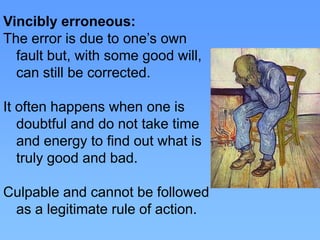
Vincibly erroneous:The error is due to one’s own fault but, with some good will, can still be corrected.It often happens when one is doubtful and do not take time and energy to find out what is truly good and bad.Culpable and cannot be followed as a legitimate rule of action.
Invincibly erroneous:It is the type that is not due to one’s own fault;Person has no awareness of the possibility of error;Must be followed just the same as a certain conscience which is right.
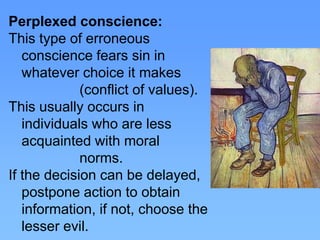
Perplexed conscience:This type of erroneous conscience fears sin in whatever choice it makes                    (conflict of values).  This usually occurs in individuals who are less acquainted with moral                  norms.If the decision can be delayed, postpone action to obtain information, if not, choose the lesser evil.
Lax conscience:With insufficient grounds, conscience is inclined to judge a thing to be truthful when in fact sinful; allowable when objectively it is notConsiders something to be a light sin when actually it is a grave one.Need to reform state of mind; considered erroneous
Scrupulous conscience:It is in constant dread of sin where there is none, or of grave sin when there is only venial sin.
Conscience in Relation to Certitude: Certain, Doubtful
Certain ConscienceIt passes judgment without fear of error.  It is purity of intention.  One’s moral actions are not for show but arise from a sincere intention 	to do what is right;  is acting according to one’s convictions.This must always be obeyed when it commands or forbids
Doubtful ConscienceIt is uncertain concerning the morality of an action;therefore it suspends its judgments; or it passes judgments but with reasonable fear of erring;One may never act in a practical doubt on the lawfulness of an action; act can be postponed there is certainty.
DEVELOPMENTOFCONSCIENCE
FreudThe human personality consists of three areas:the superego – the set of moral controls given to us by outside influences. It is our moral code or conscience and is often in conflict with the Id.
the ego – the conscious self, the part seem by the outside world.
id – the unconscious self, the part of the mind containing basic drives and repressed memories. It is amoral, has no concerns about right and wrong and is only concerned with itself.FreudConscience is most clearly connected with the sense of guilt that we feel when we go against our conscience.Conscience then is simply a construct of the mind.In religious people this would be in response to perceptions of God.
FreudIn non-religious people it would be their responses to externally imposed authority.The content of our consciences are shaped by our experiencesThe superego internalises the disapproval of others and creates the guilty conscience
PiagetA child’s moral sense develops and the ability to reason morally depends on cognitive development.Heteronomous morality (between the ages of 5 and 10 years) when the conscience is still immature, rules are not to be broken and punishment is expected if a rule is broken. The consequences of an action will show if it is right or wrong.Autonomous morality (10+) when children develop their own rules and understand how rules operate in and help society. The move towards autonomous morality occurs when the child is less dependant on others for moral authority.
KohlbergPeople move from:behaving in socially acceptable ways because they are told to do so by authority figures and want to gain approval,
to keeping the law
to caring for others
and finally respect for universal principles and the demands of an individual conscience.
Kohlberg felt that most adults never got beyond keeping the law.
I will not steal because if I get caught I will be punished.I will steal the drugs for my wife for if she dies, nobody will take care of me anymore.
I will steal the drug because if my wife remains untreated and dies, our friends will say I did not take care of her.I will not steal the drug because for stealing is against the law.
The drug should be made available to anyone who needs it, not possessed by one person for his own interest.The human being is more important than any law  or convention. I have to save her not because she is my wife but because she is a human being who needs  help.
FrommAuthoritarian Conscienceall humans are influenced by external authorities which apply rules and punishments for breaking them
these are internalised by the individual
a guilty conscience is a result of displeasing the authority
disobedience produces guilt which makes us more submissive to the authorityFrommHumanistic Conscience He saw the humanistic conscience as being much healthier as it assesses and evaluates our behaviour.
We use it to judge how successful we are as people.
We use our own discoveries in life and the teachings and example of others to give us personal integrity and moral honesty.
This is the opposite to the slavish obedience and conformity of the authoritarian conscience.External EnvironmentPeople, family, homeAuthority, societyLaws, rules, expectationsHuman PersonDynamic processInteriorityDevelopment of the sense of what is good and bad
LEVELS OF CONSCIENCEFEAR CONSCIENCEoperates on the instinctive levelfocuseson the command,
on the material breaking of the command,
on escaping punishment, and
on being restored to the good graces of the authority figure.     MORAL-ETHICAL CONSCIENCElooks beneath the command of the authority to the inner moral good or evil of the actThe inner good or evil is judged in terms of the value of the human  person in community.
CHRISTIAN ( Religious) CONSCIENCEoperates on the religious levelNot some separated area but the whole of our daily lives,Using ethical reasonBut now strengthened and illumined by Christ’s revelation and graceMETANOIA
Formation of a Christian Conscience
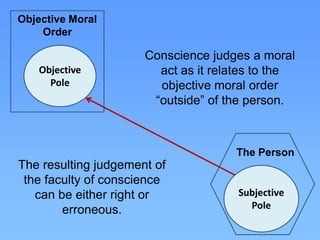
Objective Moral OrderObjective PoleConscience judges a moral act as it relates to the objective moral order  “outside” of the person.The PersonThe resulting judgement of the faculty of conscience can be either right or erroneous.Subjective Pole
Objective Moral OrderThe adult conscience “interiorizes” the external voice of the objective norms directing or constraining the person.Objective PoleThe PersonInteriorization arises from the conviction of the inner value of the moral obligation which enables human person to answer God’s call.Subjective Pole
Everyone is obliged to use serious diligence to possess on all occasions a true conscience.Overcome ignorance and error by applying ourselves to the study of our moral, civil and Church’s laws and regulations.Overcome doubts in moral matters by forming good habits of reasoning or by consulting prudent and virtuous persons.
FormInformReformConscience in ActionFormation Strengths/ObstaclesDiscernInformation Resources/ObstaclesReconsiderDiscernment Insights/BlindspotsDecision and Action Strengths/WeaknessesReflection to Reform Strengths/ObstaclesDecideReflectAct
Formation of a Christian ConsciencePersonal & ecclesial PRAYER LIFE.
Studying the WORD of GOD & the Teachings of the Church (Seek the moral guidance of the Church)
Responsiveness to the indwelling of the Holy Spirit.
Examination of one’s conscience. Critical Reflection on our concrete moral choices & experiences in daily life.In the formation of their consciences, the Christian faithful ought carefully to attend to the sacred and certain doctrine of the Church.(35) For the Church is, by the will of Christ, the teacher of the truth. It is her duty to give utterance to, and authoritatively to teach, that truth which is Christ Himself, and also to declare and confirm by her authority those principles of the moral order which have their origins in human nature itself. Dignitates Humanae #14
THE COMPULSORY NATURE OF CONSCIENCE
In so far as conscience operates within the realm of truth and sound reason, following it is compulsory. It is infallible, it should be followed.
It is truly the voice of God when it impels us to act according to our rational insights
When error creeps in, one has the responsibility to trace the roots of error and eradicate it.
FREEDOM OF CONSCIENCE
Human beings have the right to freedom of conscience; human dignity demands that the human being acts to a knowing and free choice.
Vatican II  declares that man is not to be forced to act in a manner contrary to his conscience nor is he to be restrained from acting in accordance with his conscience.
Man ought to be fully free in his moral decisions, gearing towards authentic self-realization and self-donation in love...a response of love to a call of love.
If  the dictates of his conscience is in conflict with rights of others or the common welfare, he must re-examine his conscience and suspect that it can be erroneous and needs revision.
Some Current Issues Related to Conscience
Conflict between the Church's teaching  (Magisterium) with one's conscience (conscience of the faithful).The faithful asserting to follow one’s conscience (primacy /compulsory nature of conscienceThe Magisterium performing its role and duty to teach with authority the princples of the moral order in line with the Christian faith.
THE RH BILLa high 69% of respondents agree and support the RH Bill. (Pulse Asia Survey  Oct 2010)
IN A survey conducted by the Ateneo Statistics Circle for The GUIDON last June, several Ateneans expressed support for the controversial Reproductive Health bill.142 out of 172 respondents from the sophomore, junior, and senior batches are in favor of the bill, citing its provisions for greater access to reproductive health information and services.
The Catholic Church says no to RH Bill
Conscience?The Magisterium.Primacy of Conscience?
Primacy of conscience does not mean that it is the final arbiter of what is morally right.Conscience is our judgement using ethical reason based on the law of God.
Conflict between the Church's teaching  (Magisterium) with one's conscience (conscience of the faithful).Conscience?The Magisterium.Conscience is one's best judgment, in a given situation, on what here and now is to be done as good, or to be avoided as evil.Presumption: conscience is formed and informed.
Conflict between the Church's teaching  (Magisterium) with one's conscience (conscience of the faithful).Conscience?The Magisterium.Dissent  comes not because one does not agree with the teaching or does not like what the Church wants to be done.Decision comes with one’s careful study of the teachings and an honest discernment.

CONSCIENCE

  • 1.
  • 2.
  • 3.
    Etymology: con (with)+ scientia (knowledge) [From scire (to know)]. The word “conscience” derives from the Latin cum (together) and scientia, scire (to know).
  • 4.
    Conscience is ourlived knowledge of good and evil, our judgment about how we should act, and our commitment to do so.A moral faculty or feeling prompting us to see that certain actions are morally right or wrong.
  • 5.
    Conscience is theperson’s moral faculty, the inner core and sanctuary where one knows oneself in confrontation with God and with fellowmen. (Bernard Haring, CSsR)“An inward moral impression of one’s actions and principles… as the inward faculty of moral judgment… as the inward moral and spiritual frame” (Analytical Greek Lexicon)
  • 6.
    Images of Conscience“ourmost secret core and sanctuary” where we encounter God; our heart(Catechism#1776).
  • 7.
    Images of Consciencealaw inscribed in our hearts by God and recognized as our own; its voice calls us “to love and do what is good and avoid evil” (Catechism #1776; Romans 2:14-15).
  • 8.
    Images of Conscienceourmoral compass that directs us to good or evil.
  • 9.
    Images of Conscienceourmoral sensory faculty: capacity to see, feel, hear, smell, and touch the good; moral appetiteus as we judge moral questions (whole person includes intellect, feeling, imagination, and will).
  • 10.
    Conscience is apractical moral judgment: the “dictate of conscience” A. Conscienceis a practical moral judgment on the morality of a particular action.
  • 11.
    commanding to dowhat is good and to avoid what is evil. B. This description of conscience pertains to all persons.
  • 12.
    Example: Itwas the night before their final examination. Cherise prepared a “kodigo”. She earnestly desired to get a high grade in the exam and to impress her classmates as well. However, on the day of the exam, she felt a growing uneasiness deep within herself and gave up her plan.
  • 13.
    The feeling ofuneasiness - result of conscience which made her realize her moral obligation to be honest, which led her to give up her plan to cheat.Therefore if conscience tells us that this act is cheating and therefore is bad, it is a moral judgment which expresses that we are morally bound not to do the act. If we go ahead and do not follow my conscience, we sin.
  • 14.
    As a practicalmoral judgment: the “dictate of conscience”Two basic elements of conscience:Moral judgment that discerns what is right or wrongMoral obligation or command to do the good and avoid the evil.
  • 15.
    As a moralfaculty - The faculty which makes known to man his moral obligations and urges him to fulfill them. - It is a faculty distinct from reason, will and feeling, situated at the very depth and center of the human person which gives to man an understanding of his meaning and destiny, an awareness of the divine purpose behind the world, a perception of his personal calling within God’s plan and an experience of the imperative character of this calling (Peschke).
  • 16.
    “In the depthsof his or her conscience, the human person detects a law which she or he does not impose upon themselves, but which holds them to obedience. Always summoning them to love good and avoid evil, the voice of conscience when necessary speaks to their heart: do this, shun that.Gaudium et Spes, Pastoral Constitution on the Church in the Modern World, #16
  • 17.
    “Deep within ourconscience we discover a law which we have not laid on ourselves, but which we must obey. We are not the source of our own conscience.
  • 18.
    We cannot manipulateor silence our conscience.
  • 19.
    It will neverleave us peace unless it is obeyed.Its voice, ever calling us to love and to do what is good and to avoid evil, tell us inwardly at the right time: do this, shun that.a law within us that always commands us to do good and avoid evilFor man has in his heart a law written by God; to obey it is the very dignity of man; according to it he will be judged.(9) Conscience is the most secret core and sanctuary of a man. There he is alone with God, Whose voice echoes in his depths.(10) Gaudium et Spes, Pastoral Constitution on the Church in the Modern World, #16
  • 20.
    For persons havein their hearts a law written by God. To obey it is their very dignity; according to it they will be judged. The source of our conscience is GOD.
  • 21.
    To obey itis our very dignity as true images of God.Conscience is the most secret core and sanctuary of all persons. There they are alone with God, whose voice echoes in their depths. ”the core or sanctuary where God speaks to us/ meets the person as a free and intelligent being who has the capacity to make choices.CONSCIENCE IN THE SCRIPTURES
  • 22.
    OLD TESTAMENTLimited interestin conscience; inner moral authorityStress is direct relations wit God; listening to the Word of God is primary“Syneidesis” – a Greek word for conscience appeared only in the Book of Wisdom
  • 23.
    OLD TESTAMENTSome expressionsrelated to conscience:“ Mind” “Loins” “Heart”Examine me, O LORD, and try me; Test my mind and my heart. (Psalm 26:2)But, O LORD Almighty, you who judge righteously and test the heart and mind, let me see your vengeance upon them, for to you I have committed my cause. (Jer 11:20)
  • 24.
    OLD TESTAMENTSome expressionsrelated to conscience:“ Mind” “Loins” “Heart”Conscience condemns man after sin is known. (Gen 3:7-10 – Adam and Eve, Gen 4:9-14 – Cain and Abel)Conscience praises man for justice. (Job 27:6, Ps 17:3, 26, ff, 139:23 – ff)Judgement of conscience in the OT - ultimately voice of God.
  • 25.
    NEW TESTAMENTSt. Paul used the word “syneidesis”A Greek concept; a negative judge of completed or at least initiated action.
  • 26.
    NEW TESTAMENT Conscience is:A God-given capacity for human being to exercise self-evaluation (Acts 23:1, 24:16, 1 Cor 4:4)Paul refers to his conscience as “good” “clear”, “blameless, his values and standards in conformity with God’s standards; conscience a faculty to evaluate good and evil.
  • 27.
    NEW TESTAMENT Conscience is:A witnessRomans 2:14 –15 = God’s law written in hearts of Gentiles
  • 28.
    Romans 9:1 =His conscience as witness he is telling the truth
  • 29.
    2 Cor 1:12= he conducts self with holiness and sincerityNEW TESTAMENT Conscience is:3. A Servant to the individual’s value systemRomans 14, 1 Cor 8 – the issue of the Church of Corinth eating food sacrificed for idols; Paul instructing not to eat from the disputed food in the presence of the weaker brothers so as not to seduce them from acting against their conscience and sin.
  • 30.
    NEW TESTAMENT Conscience is:3. A Servant to the individual’s value systemA weak value system produces weak sense of right and wrong while a strong value system produces a strong sense of right and wrong.Conscience can be erroneous and cannot be directly equated to the voice of God; it examines and not creates norms; it uses criteria to judge what people do or fail to do.
  • 31.
    NEW TESTAMENT Conscience is:4. A universal endowment of all human beingsRomans 2:14-ff : Gentiles have the possibility to fulfill the moral law even without the knowledge of the written law; their conscience bears witness and shows what the law requires; everybody has conscience, endowed with a faculty for moral judgements
  • 32.
    SUMMARYConscience receives agrowing attention in the BibleIn the Old Testament, the emphasis is more on man listening to the Word of God rather than an inner moral authority – conscience.In the New Testament, conscience is described as an endowment embedded in the context of faith and oriented by it.
  • 33.
    SUMMARYIn the NewTestament, conscience is also seen as a reality with limitations owing to man’s limitations a a creature; a reality in need of cleansing and purificationFor the Bible, the key words in ethics is not the concept of conscience experienced as something subjective and individual. The distinctive words are: obedience and love or service, always give expression of a transcendental relationship.
  • 34.
  • 35.
    Scholastic TheologyConscience isa particular instance of the operation of reason.A process in which the general norms of the moral law are applied to a concrete action which a person is about to perform or has performedTells the person that his moral obligation is here and now or judging is past acts.
  • 37.
    2 Essential parts of Conscience: Synderesis and ConscientiaSynderesis’ discovers very basic moral principles; the use of right reason by which we learn basic moral principles and understand that we have to do good and avoid evil.‘Conscientia’ (conscience) = practical reason which tells us what to do in particular situations
  • 38.
    Joseph ButlerBishop ofDurham 1750.wrote that the most crucial thing which distinguished women and men from the animal world was the possession of the faculty of reflection or conscience.
  • 39.
    So being humaninvolves being moral.
  • 40.
    Conscience is aperson’s God-given guide to right conduct and its demands must therefore always be followed.Joseph ButlerBishop of Durham 1750.the consequence of an action is not what makes it right or wrong as that has already happened
  • 41.
    the purpose ofconscience is to guide a person into a way of life that will make them happy
  • 42.
    conscience will harmoniseself-love and benevolence – this may take some sorting out and so in moral dilemmas we may be uncertain what to do
  • 43.
    conscience controls humannatureAugustine and Franciscan SchoolConscience is the place of the innermost encounter between God and man; the voice of God;A divine center of the person where he is addressed by God and in it he is aware of God and the soul.
  • 44.
    Bonaventure and greatmysticsConscience as the scintilla animae, the spark of the soulPeak of the soul; the center of the soul where man encounters God and is at least accessible to the contamination of sin.
  • 45.
    Conscience is notmere reason; not mere executive agent of pre-existing moral laws tasked to apply them on concrete situations.It informs a person about a personal calling in the context of God’s plan o creation.Reason is not purely intellectual operations from merely rational premises considering strong elements of an emotional nature with consequent conscience
  • 46.
    Conscience has bothperceptive and volative functions; perceives the moral obligation and urges the person to accept the good and realize it.Conscience is not identical with the power of the will; man may still willand do what is against his conscienceA ground of the soul deeper than and distinct from both reason and will.
  • 47.
    Conscience is afaculty in its own right distinct from reason, will and feeling; situated at the very depth and center of the person and helps him/her understand meaning and destiny:An awareness of the divine purpose; a perception of one’s personal calling; an experience of the imperative nature of the call;Conscience has a religious dimension
  • 48.
    Conscience can evidentlyerr. Even then it still manifests the will of God not in the sense that God wills the error. It is the voice of God in the sense that God wills the good faith and the love of the good of which it remains an expression.
  • 49.
    KINDS OF CONSCIENCEAND ITS BINDING FORCE
  • 50.
    A. Conscience in the Process of Time: Antecedent, Concomitant, ConsequentAntecedent: Judgment on morality of action and obligation to perform or omit is passed before action is translated to reality.It helps us to sort out the data and examine the morality of an act before we perform it.It commands, exhorts, permits or forbids.
  • 51.
    A. Conscience in the Process of Time: Antecedent, Concomitant, ConsequentConcomitant: During the action; refers to one’s actual awareness of being morally responsible for the goodness and the badness of the particular act while one is doing it.eg. Scolding or disapproving (as in the case of habitual sins: kupit, saying bad words, answering back, etc.) or approving (as in the case of good habits).
  • 52.
    A. Conscience in the Process of Time: Antecedent, Concomitant, ConsequentConsequent: if it evaluates an act already done or omitted. It is the process of looking back to review and evaluate the morality of what we have done.It approves, excuses, reproves or accuses.
  • 53.
    B. Conscience seenaccording to the Objective Norm: Right, Erroneous, perplexed, lax, scrupulous, compensatory
  • 54.
    Vincibly erroneous:The erroris due to one’s own fault but, with some good will, can still be corrected.It often happens when one is doubtful and do not take time and energy to find out what is truly good and bad.Culpable and cannot be followed as a legitimate rule of action.
  • 55.
    Invincibly erroneous:It isthe type that is not due to one’s own fault;Person has no awareness of the possibility of error;Must be followed just the same as a certain conscience which is right.
  • 56.
    Perplexed conscience:This typeof erroneous conscience fears sin in whatever choice it makes (conflict of values). This usually occurs in individuals who are less acquainted with moral norms.If the decision can be delayed, postpone action to obtain information, if not, choose the lesser evil.
  • 57.
    Lax conscience:With insufficientgrounds, conscience is inclined to judge a thing to be truthful when in fact sinful; allowable when objectively it is notConsiders something to be a light sin when actually it is a grave one.Need to reform state of mind; considered erroneous
  • 58.
    Scrupulous conscience:It isin constant dread of sin where there is none, or of grave sin when there is only venial sin.
  • 59.
    Conscience in Relationto Certitude: Certain, Doubtful
  • 60.
    Certain ConscienceIt passesjudgment without fear of error. It is purity of intention. One’s moral actions are not for show but arise from a sincere intention to do what is right; is acting according to one’s convictions.This must always be obeyed when it commands or forbids
  • 61.
    Doubtful ConscienceIt isuncertain concerning the morality of an action;therefore it suspends its judgments; or it passes judgments but with reasonable fear of erring;One may never act in a practical doubt on the lawfulness of an action; act can be postponed there is certainty.
  • 62.
  • 63.
    FreudThe human personalityconsists of three areas:the superego – the set of moral controls given to us by outside influences. It is our moral code or conscience and is often in conflict with the Id.
  • 64.
    the ego –the conscious self, the part seem by the outside world.
  • 65.
    id – theunconscious self, the part of the mind containing basic drives and repressed memories. It is amoral, has no concerns about right and wrong and is only concerned with itself.FreudConscience is most clearly connected with the sense of guilt that we feel when we go against our conscience.Conscience then is simply a construct of the mind.In religious people this would be in response to perceptions of God.
  • 66.
    FreudIn non-religious peopleit would be their responses to externally imposed authority.The content of our consciences are shaped by our experiencesThe superego internalises the disapproval of others and creates the guilty conscience
  • 67.
    PiagetA child’s moralsense develops and the ability to reason morally depends on cognitive development.Heteronomous morality (between the ages of 5 and 10 years) when the conscience is still immature, rules are not to be broken and punishment is expected if a rule is broken. The consequences of an action will show if it is right or wrong.Autonomous morality (10+) when children develop their own rules and understand how rules operate in and help society. The move towards autonomous morality occurs when the child is less dependant on others for moral authority.
  • 68.
    KohlbergPeople move from:behavingin socially acceptable ways because they are told to do so by authority figures and want to gain approval,
  • 69.
  • 70.
  • 71.
    and finally respectfor universal principles and the demands of an individual conscience.
  • 72.
    Kohlberg felt thatmost adults never got beyond keeping the law.
  • 73.
    I will notsteal because if I get caught I will be punished.I will steal the drugs for my wife for if she dies, nobody will take care of me anymore.
  • 74.
    I will stealthe drug because if my wife remains untreated and dies, our friends will say I did not take care of her.I will not steal the drug because for stealing is against the law.
  • 75.
    The drug shouldbe made available to anyone who needs it, not possessed by one person for his own interest.The human being is more important than any law or convention. I have to save her not because she is my wife but because she is a human being who needs help.
  • 76.
    FrommAuthoritarian Conscienceall humansare influenced by external authorities which apply rules and punishments for breaking them
  • 77.
    these are internalisedby the individual
  • 78.
    a guilty conscienceis a result of displeasing the authority
  • 79.
    disobedience produces guiltwhich makes us more submissive to the authorityFrommHumanistic Conscience He saw the humanistic conscience as being much healthier as it assesses and evaluates our behaviour.
  • 80.
    We use itto judge how successful we are as people.
  • 81.
    We use ourown discoveries in life and the teachings and example of others to give us personal integrity and moral honesty.
  • 82.
    This is theopposite to the slavish obedience and conformity of the authoritarian conscience.External EnvironmentPeople, family, homeAuthority, societyLaws, rules, expectationsHuman PersonDynamic processInteriorityDevelopment of the sense of what is good and bad
  • 83.
    LEVELS OF CONSCIENCEFEARCONSCIENCEoperates on the instinctive levelfocuseson the command,
  • 84.
    on the materialbreaking of the command,
  • 85.
  • 86.
    on being restoredto the good graces of the authority figure. MORAL-ETHICAL CONSCIENCElooks beneath the command of the authority to the inner moral good or evil of the actThe inner good or evil is judged in terms of the value of the human person in community.
  • 87.
    CHRISTIAN ( Religious)CONSCIENCEoperates on the religious levelNot some separated area but the whole of our daily lives,Using ethical reasonBut now strengthened and illumined by Christ’s revelation and graceMETANOIA
  • 88.
    Formation of aChristian Conscience
  • 89.
    Objective Moral OrderObjectivePoleConscience judges a moral act as it relates to the objective moral order “outside” of the person.The PersonThe resulting judgement of the faculty of conscience can be either right or erroneous.Subjective Pole
  • 90.
    Objective Moral OrderTheadult conscience “interiorizes” the external voice of the objective norms directing or constraining the person.Objective PoleThe PersonInteriorization arises from the conviction of the inner value of the moral obligation which enables human person to answer God’s call.Subjective Pole
  • 91.
    Everyone is obligedto use serious diligence to possess on all occasions a true conscience.Overcome ignorance and error by applying ourselves to the study of our moral, civil and Church’s laws and regulations.Overcome doubts in moral matters by forming good habits of reasoning or by consulting prudent and virtuous persons.
  • 92.
    FormInformReformConscience in ActionFormationStrengths/ObstaclesDiscernInformation Resources/ObstaclesReconsiderDiscernment Insights/BlindspotsDecision and Action Strengths/WeaknessesReflection to Reform Strengths/ObstaclesDecideReflectAct
  • 93.
    Formation of aChristian ConsciencePersonal & ecclesial PRAYER LIFE.
  • 94.
    Studying the WORDof GOD & the Teachings of the Church (Seek the moral guidance of the Church)
  • 95.
    Responsiveness to theindwelling of the Holy Spirit.
  • 96.
    Examination of one’sconscience. Critical Reflection on our concrete moral choices & experiences in daily life.In the formation of their consciences, the Christian faithful ought carefully to attend to the sacred and certain doctrine of the Church.(35) For the Church is, by the will of Christ, the teacher of the truth. It is her duty to give utterance to, and authoritatively to teach, that truth which is Christ Himself, and also to declare and confirm by her authority those principles of the moral order which have their origins in human nature itself. Dignitates Humanae #14
  • 98.
  • 99.
    In so faras conscience operates within the realm of truth and sound reason, following it is compulsory. It is infallible, it should be followed.
  • 100.
    It is trulythe voice of God when it impels us to act according to our rational insights
  • 101.
    When error creepsin, one has the responsibility to trace the roots of error and eradicate it.
  • 103.
  • 104.
    Human beings havethe right to freedom of conscience; human dignity demands that the human being acts to a knowing and free choice.
  • 105.
    Vatican II declares that man is not to be forced to act in a manner contrary to his conscience nor is he to be restrained from acting in accordance with his conscience.
  • 106.
    Man ought tobe fully free in his moral decisions, gearing towards authentic self-realization and self-donation in love...a response of love to a call of love.
  • 107.
    If thedictates of his conscience is in conflict with rights of others or the common welfare, he must re-examine his conscience and suspect that it can be erroneous and needs revision.
  • 108.
    Some Current IssuesRelated to Conscience
  • 109.
    Conflict between theChurch's teaching (Magisterium) with one's conscience (conscience of the faithful).The faithful asserting to follow one’s conscience (primacy /compulsory nature of conscienceThe Magisterium performing its role and duty to teach with authority the princples of the moral order in line with the Christian faith.
  • 110.
    THE RH BILLahigh 69% of respondents agree and support the RH Bill. (Pulse Asia Survey Oct 2010)
  • 111.
    IN A surveyconducted by the Ateneo Statistics Circle for The GUIDON last June, several Ateneans expressed support for the controversial Reproductive Health bill.142 out of 172 respondents from the sophomore, junior, and senior batches are in favor of the bill, citing its provisions for greater access to reproductive health information and services.
  • 112.
    The Catholic Churchsays no to RH Bill
  • 113.
  • 114.
    Primacy of consciencedoes not mean that it is the final arbiter of what is morally right.Conscience is our judgement using ethical reason based on the law of God.
  • 115.
    Conflict between theChurch's teaching (Magisterium) with one's conscience (conscience of the faithful).Conscience?The Magisterium.Conscience is one's best judgment, in a given situation, on what here and now is to be done as good, or to be avoided as evil.Presumption: conscience is formed and informed.
  • 116.
    Conflict between theChurch's teaching (Magisterium) with one's conscience (conscience of the faithful).Conscience?The Magisterium.Dissent comes not because one does not agree with the teaching or does not like what the Church wants to be done.Decision comes with one’s careful study of the teachings and an honest discernment.