Learning scenarios in initial
teacher education at
FTELab
ftelab.ie.ulisboa.pt
Learning scenarios
• Hypotethical situation of teaching and learning
• The learning scenarios, as a way to plan learning
activities, are being developed in many subjects of
Initial Teacher Education Master’s.
• The scenarios are developed in the Pedagogical Subjects
(disciplines) and validated by pairs and by the
supervisor´s during the process and before scenario’s
implementation
ftelab.ie.ulisboa.pt
How it works?
For an example:
• In Informatic initial teacher training, students (future informatic teachers) used the learning scenarios to plan their
supervised Teacher practice in Primary and Secondary Schools (k12 education)  They design a learning scenario to
be implemented in five or more lessons of a informatic subject, in many areas (e.g. programming languages,
hardware, computer networks, ICT, robotics, data base management systems).
• In the planning phase future teachers analyze the subject curriculum that they will teach, define the objectives and
the projects to be developed with the students.
• In second phase (produce or design) the future teachers organize the scenario plan using a specific template, where
they identify the narrative (stories), the learning objectives, the methodologies and strategies to be mobilized, the
work proposals, the resources, the actors and roles and the forms of regulation and self-regulation
• In the third phase the scenario is implemented with a group of students (k12).
• Finally the scenario implementation is evaluated by Teacher, students and supervisors with different assessment
tools (rubrics, surveys, interviews, checklists, observation grids).
At the end they will write the final reflexive report of their supervised Teacher practice where the process is describe
and finally they present the report to a jury in public session.
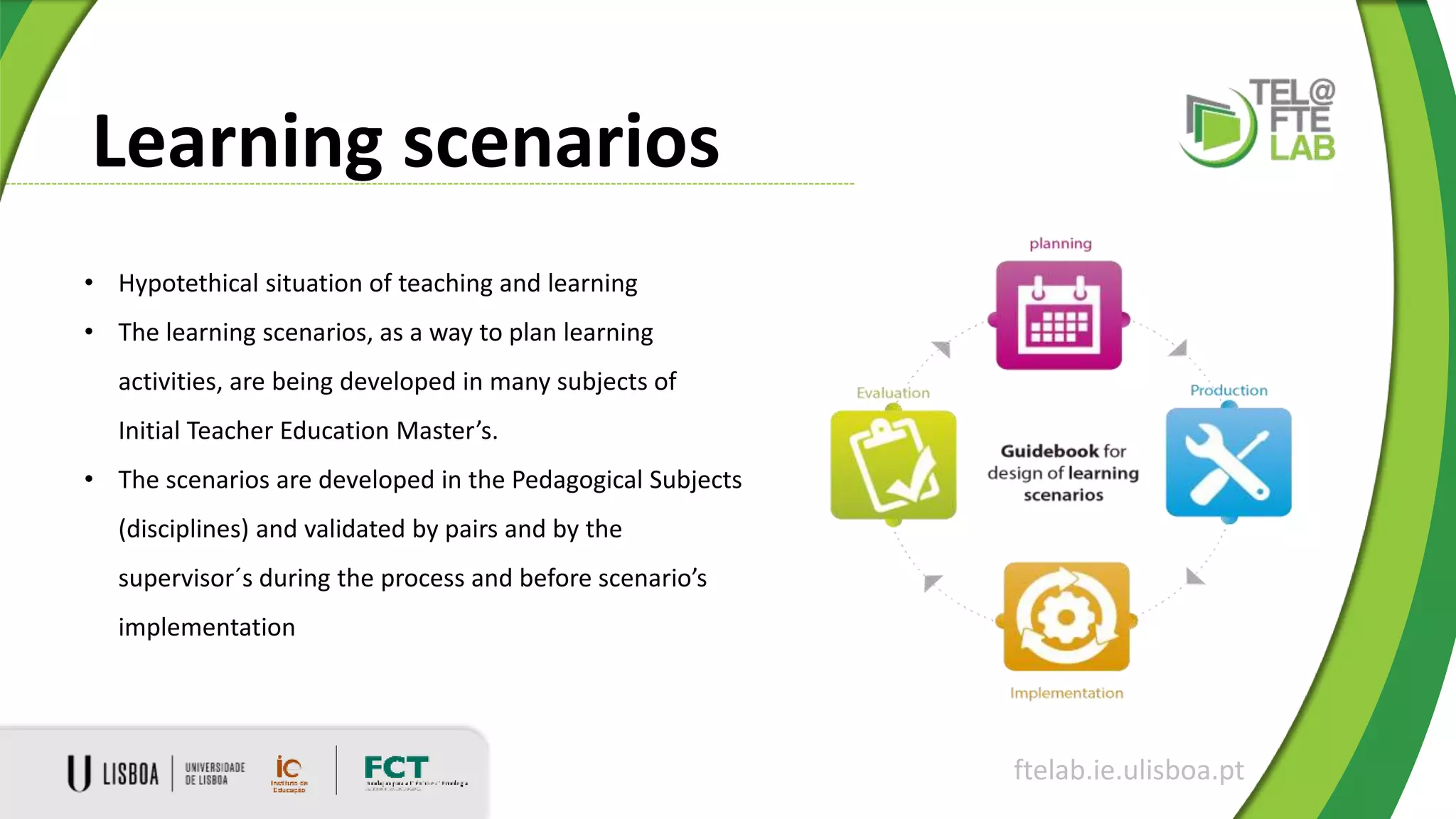
Guidebook for Learning scenarios
A resource for Learning Scenarios design
Organized in four areas:
• Planification
• Design/Production
• Implementation
• Evaluation
http://ftelab.ie.ulisboa.pt/tel/gbook/
tel-fte@ie.ulisboa.pt
ftelab.ie.ulisboa.pt
João PIEDADE
jmpiedade@ie.ulisboa.pt
Ana PEDRO
aipedro@ie.ulisboa.pt

Learning Scenarios in Initial Teacher Education at FTELab

  • 1.
    Learning scenarios ininitial teacher education at FTELab ftelab.ie.ulisboa.pt
  • 2.
    Learning scenarios • Hypotethicalsituation of teaching and learning • The learning scenarios, as a way to plan learning activities, are being developed in many subjects of Initial Teacher Education Master’s. • The scenarios are developed in the Pedagogical Subjects (disciplines) and validated by pairs and by the supervisor´s during the process and before scenario’s implementation ftelab.ie.ulisboa.pt
  • 3.
    How it works? Foran example: • In Informatic initial teacher training, students (future informatic teachers) used the learning scenarios to plan their supervised Teacher practice in Primary and Secondary Schools (k12 education)  They design a learning scenario to be implemented in five or more lessons of a informatic subject, in many areas (e.g. programming languages, hardware, computer networks, ICT, robotics, data base management systems). • In the planning phase future teachers analyze the subject curriculum that they will teach, define the objectives and the projects to be developed with the students. • In second phase (produce or design) the future teachers organize the scenario plan using a specific template, where they identify the narrative (stories), the learning objectives, the methodologies and strategies to be mobilized, the work proposals, the resources, the actors and roles and the forms of regulation and self-regulation • In the third phase the scenario is implemented with a group of students (k12). • Finally the scenario implementation is evaluated by Teacher, students and supervisors with different assessment tools (rubrics, surveys, interviews, checklists, observation grids). At the end they will write the final reflexive report of their supervised Teacher practice where the process is describe and finally they present the report to a jury in public session.
  • 4.
    Guidebook for Learningscenarios A resource for Learning Scenarios design Organized in four areas: • Planification • Design/Production • Implementation • Evaluation http://ftelab.ie.ulisboa.pt/tel/gbook/
  • 5.