Beurs van Berlage, Amsterdam (NL)
12-14 May 2013
Learning from Mistakes:
A Different Strategy for
Cultural Heritage Crisis Management
in Post-Disaster Areas
(Italy 2009 – 2012)
Alessandro Califano
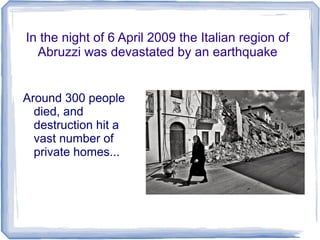
In the night of 6 April 2009 the Italian region of
Abruzzi was devastated by an earthquake
Around 300 people
died, and
destruction hit a
vast number of
private homes...
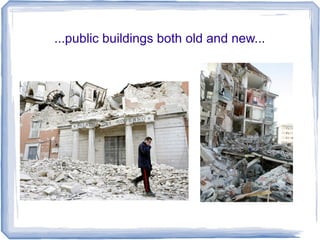
...public buildings both old and new...
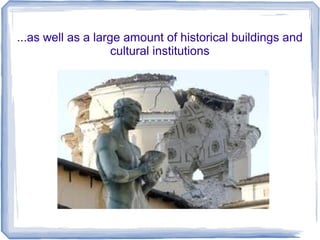
...as well as a large amount of historical buildings and
cultural institutions
ICOM Italy

Immediately wrote out a call to its members

Set up the Cultural Heritage High Risks
Commission in a matter of days

Set up an emergency restoration centre at the
Museum of Celano after a few weeks

Effectively cooperated with Fire brigades, a
large national association of volunteers, and
local boards for over a year
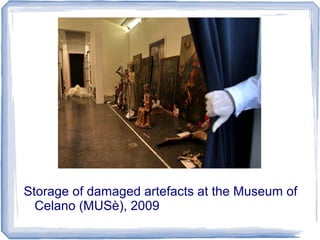
Storage of damaged artefacts at the Museum of
Celano (MUSè), 2009
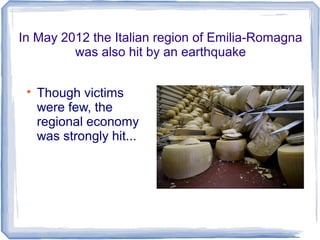
In May 2012 the Italian region of Emilia-Romagna
was also hit by an earthquake

Though victims
were few, the
regional economy
was strongly hit...
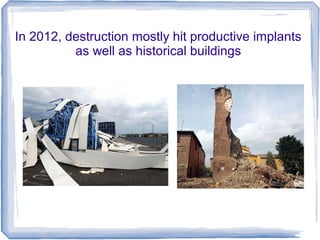
In 2012, destruction mostly hit productive implants
as well as historical buildings
A quantitative analysis
Considering only the historical buildings in the
four affected provinces of Bologna, Ferrara,
Modena, and Reggio Emilia we have these
figures:

Bologna: 203

Ferrara: 94

Modena: 126

Reggio Emilia: 106
In this case, however...

ICOM Italy's Cultural Heritage High Risks
Commission didn't even send out a Call for
Action to its members

Rescue attempts of historical buildings and
museum artefacts were mostly undertaken by
the fire and emergency brigades

Even trying to obtain a list of what existed, and
what had been damaged was – for weeks! –
almost impossible
Reasons for failure in 2012:

Though State driven actions were much more
coordinated and effective than in 2009, too
much reliance on local administrations by the
High Risks Commission proved to be a week
point, slowing down the whole rescue process

Regional geographic databases proved to be
not homogeneous enough, making combined
rescue efforts based on common knowledge
almost impossible to achieve
Moreover:

The trend to regionalize the model of action of
ICOM Italy – though it is the Italian Chapter of
an international professional organization –
has significantly weakened its potential
effectiveness

This same trend has made the ties the High
Risks Commission had with other international
bodies and programmes – like ICOMOS or
Blue Shield – less effective
Into the Future – Crowdsourcing
In the Editor's note of the 15 June 2012 edition
of “The Museum Studies Weekly” I wrote:

The Commission's failure in the present
occasion calls for a redefinition of its role...

It should … re-programme its mission as a
facilitator of grass roots action, and focus
on the documentation of damages.

A crowd sourcing based approach would
allow both laymen and new stakeholders to
step in...
Into the Future – Broadcast & FOSS
From this point of view, an excellent work has
been done in post-disaster areas by – even
very small – local audio broadcasting stations.
A crucial stakeholder, in the aftermath of the
2012 earthquake, has been an open group of
ICT people, Hackathon Terremoto, who shortly
after the earthquake started delivering detailed
information about FOSS based tools to keep
track of events and give feedback from post-
disaster areas.
Mobile Apps and G-FOSS
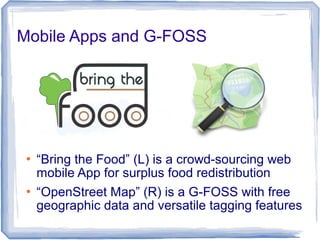
 “Bring the Food” (L) is a crowd-sourcing web
mobile App for surplus food redistribution
 “OpenStreet Map” (R) is a G-FOSS with free
geographic data and versatile tagging features
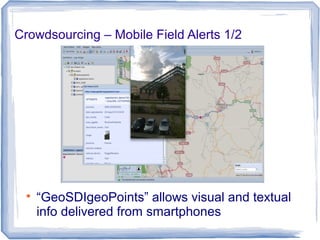
Crowdsourcing – Mobile Field Alerts 1/2

“GeoSDIgeoPoints” allows visual and textual
info delivered from smartphones
Crowdsourcing – Mobile Field Alerts 2/2

Georeferenced pictures of an event can be
sent from any smartphone to a geographic
database through a downloadable App.

A short description of the event can be chosen
from a list, with further data added by the user,
or by the system (date, time, etc.).

The geographic database is then updated on
the run, and the info – visible to all users as a
geographic repository – becomes immediately
usable by rescue teams and any other public
stakeholder.
Conclusions
Neither FOSS nor risk awareness can of course
altogether avoid disasters of all kinds, and their
tragic consequences.
Nevertheless, learning from our mistakes, and
developing better tools and more effective
strategies, will let us look with confidence
towards the challenges that tomorrow might
bring us.
Thank you!

Learning from mistakes - Cultural Heritage Crisis Management in Post-Disaster Areas

  • 1.
    Beurs van Berlage,Amsterdam (NL) 12-14 May 2013 Learning from Mistakes: A Different Strategy for Cultural Heritage Crisis Management in Post-Disaster Areas (Italy 2009 – 2012) Alessandro Califano
  • 2.
    In the nightof 6 April 2009 the Italian region of Abruzzi was devastated by an earthquake Around 300 people died, and destruction hit a vast number of private homes...
  • 3.
  • 4.
    ...as well asa large amount of historical buildings and cultural institutions
  • 5.
    ICOM Italy  Immediately wroteout a call to its members  Set up the Cultural Heritage High Risks Commission in a matter of days  Set up an emergency restoration centre at the Museum of Celano after a few weeks  Effectively cooperated with Fire brigades, a large national association of volunteers, and local boards for over a year
  • 6.
    Storage of damagedartefacts at the Museum of Celano (MUSè), 2009
  • 7.
    In May 2012the Italian region of Emilia-Romagna was also hit by an earthquake  Though victims were few, the regional economy was strongly hit...
  • 8.
    In 2012, destructionmostly hit productive implants as well as historical buildings
  • 9.
    A quantitative analysis Consideringonly the historical buildings in the four affected provinces of Bologna, Ferrara, Modena, and Reggio Emilia we have these figures:  Bologna: 203  Ferrara: 94  Modena: 126  Reggio Emilia: 106
  • 10.
    In this case,however...  ICOM Italy's Cultural Heritage High Risks Commission didn't even send out a Call for Action to its members  Rescue attempts of historical buildings and museum artefacts were mostly undertaken by the fire and emergency brigades  Even trying to obtain a list of what existed, and what had been damaged was – for weeks! – almost impossible
  • 11.
    Reasons for failurein 2012:  Though State driven actions were much more coordinated and effective than in 2009, too much reliance on local administrations by the High Risks Commission proved to be a week point, slowing down the whole rescue process  Regional geographic databases proved to be not homogeneous enough, making combined rescue efforts based on common knowledge almost impossible to achieve
  • 12.
    Moreover:  The trend toregionalize the model of action of ICOM Italy – though it is the Italian Chapter of an international professional organization – has significantly weakened its potential effectiveness  This same trend has made the ties the High Risks Commission had with other international bodies and programmes – like ICOMOS or Blue Shield – less effective
  • 13.
    Into the Future– Crowdsourcing In the Editor's note of the 15 June 2012 edition of “The Museum Studies Weekly” I wrote:  The Commission's failure in the present occasion calls for a redefinition of its role...  It should … re-programme its mission as a facilitator of grass roots action, and focus on the documentation of damages.  A crowd sourcing based approach would allow both laymen and new stakeholders to step in...
  • 14.
    Into the Future– Broadcast & FOSS From this point of view, an excellent work has been done in post-disaster areas by – even very small – local audio broadcasting stations. A crucial stakeholder, in the aftermath of the 2012 earthquake, has been an open group of ICT people, Hackathon Terremoto, who shortly after the earthquake started delivering detailed information about FOSS based tools to keep track of events and give feedback from post- disaster areas.
  • 15.
    Mobile Apps andG-FOSS  “Bring the Food” (L) is a crowd-sourcing web mobile App for surplus food redistribution  “OpenStreet Map” (R) is a G-FOSS with free geographic data and versatile tagging features
  • 16.
    Crowdsourcing – MobileField Alerts 1/2  “GeoSDIgeoPoints” allows visual and textual info delivered from smartphones
  • 17.
    Crowdsourcing – MobileField Alerts 2/2  Georeferenced pictures of an event can be sent from any smartphone to a geographic database through a downloadable App.  A short description of the event can be chosen from a list, with further data added by the user, or by the system (date, time, etc.).  The geographic database is then updated on the run, and the info – visible to all users as a geographic repository – becomes immediately usable by rescue teams and any other public stakeholder.
  • 18.
    Conclusions Neither FOSS norrisk awareness can of course altogether avoid disasters of all kinds, and their tragic consequences. Nevertheless, learning from our mistakes, and developing better tools and more effective strategies, will let us look with confidence towards the challenges that tomorrow might bring us. Thank you!