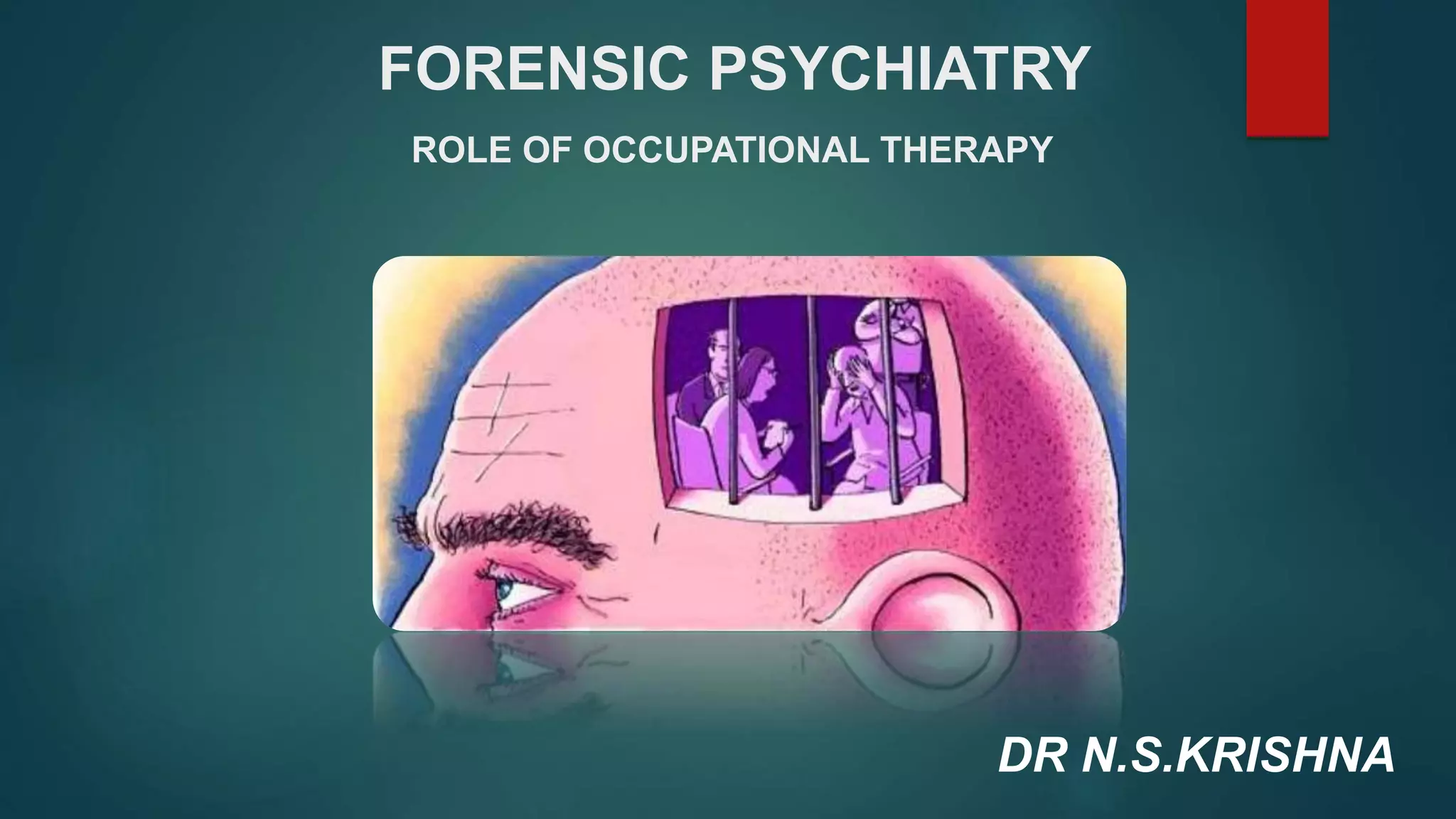
FORENSIC PSYCHIATRY
ROLE OF OCCUPATIONAL THERAPY
DR N.S.KRISHNA
FORENSIC PSYCHIATRY
 Forensic - ‘Pertaining to, or connected with, or used in court of
law’
 Forensic psychiatry :
It is a sub-speciality of psychiatry and is related to criminology.
It encompasses the interface between law and psychiatry
 It is defined as " a subspecialty of psychiatry in which
scientific and clinical expertise is applied in legal contexts
involving civil, criminal, correctional, regulatory or legislative
matters.
FORENSIC OCCUPATIONAL THERAPY
 Forensic occupational therapy:
 “Forensic occupational therapy engages people and facilitates their
participation in meaningful life activities whilst assisting in the
development of their increasing personal capacity and pro-social
values, identity and skills.” - Duncan (2004)
 It provides treatment for psychiatric patients who need to receive
care in conditions of maximum security because of the potential
dangerousness due to criminal cases.
SPECIAL SETTING
 It focused primarily on improving the level and quality of patient
care and engaging the individual into the community.
 As a place of maximum security, special hospitals aim to prevent
patients from absconding.
 Thus physical security - includes wall/fence, surveillance cameras,
routines of locking doors and checking of patients movements
N
S
K
The hospital are staffed by
 Psychiatrists,
 Nurses,
 Psychologist,
 Social workers & NGO’s
 more recently added occupational therapist and creative therapist/recreational
therapist
 FOT’s primarily work with those who have mental health
problems, cognitive and/or social difficulties
 FOT’s aim to re-establish, maintain and develop the service
users occupational functioning through encouraging
independence, self-efficacy, and positive identity whilst
addressing their offending behaviours
FOT’s- 3 Groups of people
 generally deals with 3 group of people
 Those who have severe psychosis/addiction that do not respond to
current therapies sufficiently to consider release
 Those who need rehabilitation to the status of mental competence.
 Those who can be rehabilitated for release back into community-
FOT’s Focuses on
 Assessment -Areas
 Self care activities
 Productivity – including history, skills, aptitudes, and interest
 Leisure activities – including skills and interests
 Academic learning skills
 Time management
 Problem solving skills
 Coping skills, adaptive strategies
 Interaction skills – including peer and authority relationship
 OT’s need to address
*Anger management
*Impulse control
*Immediate coping strategies, skills & habits
*Training in daily living skills
*Home management skills
*Budgeting & money management
*Special education
*Interpersonal skills
*awareness to self & others
OT-TOOLS
 Instruments and Assesments.
 Bay area functional performance evaluation (BaFPE)- To assess
components of functioning that are needed for daily living.
 Interest checklist
 Role checklist
 Occupational case analysis and rating scale
 Allen cognitive level screening test( Total level : 6)
 Client satisfaction survey
 Self assessment of occupational functioning.
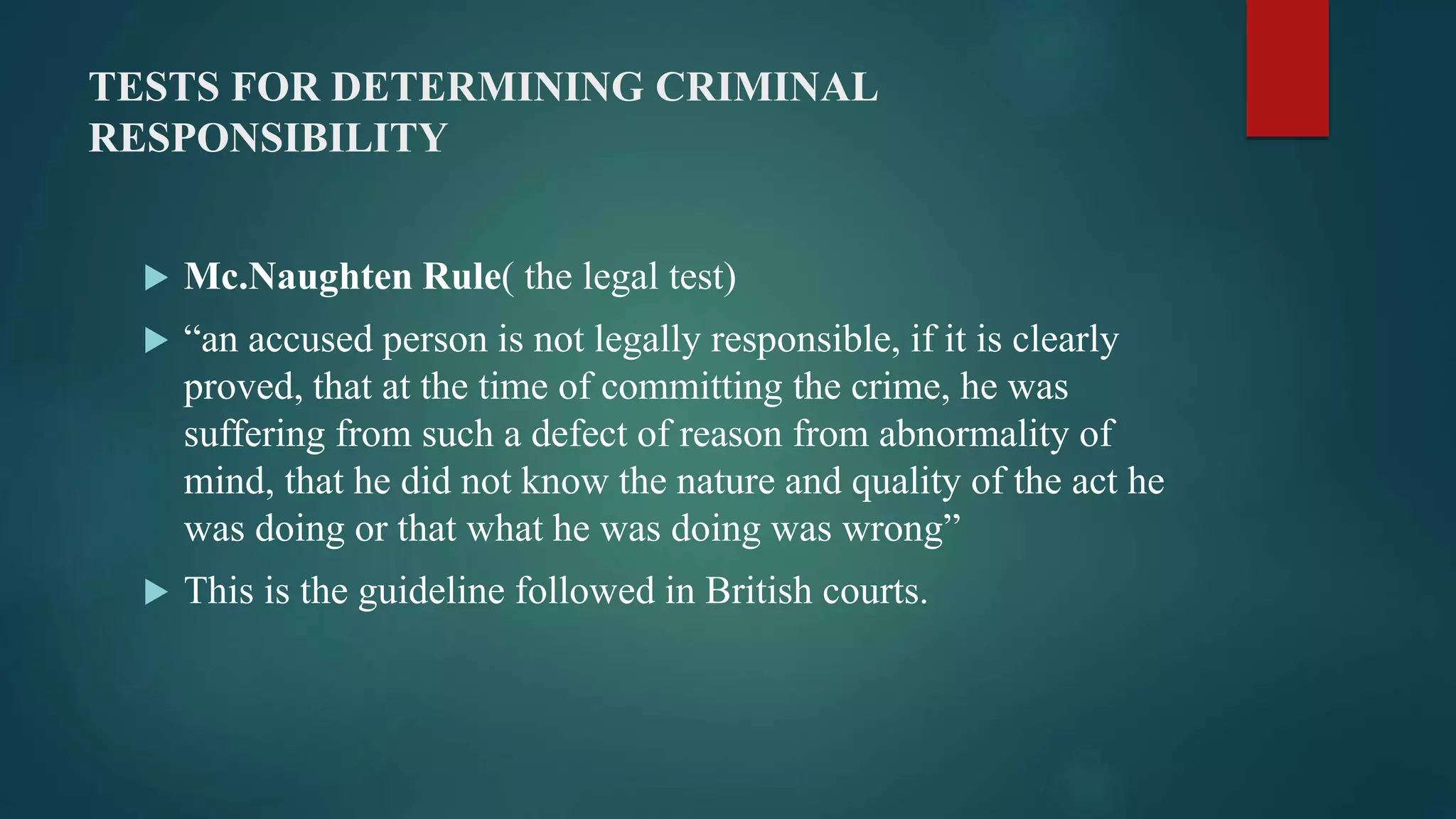
TESTS FOR DETERMINING CRIMINAL
RESPONSIBILITY
 Mc.Naughten Rule( the legal test)
 “an accused person is not legally responsible, if it is clearly
proved, that at the time of committing the crime, he was
suffering from such a defect of reason from abnormality of
mind, that he did not know the nature and quality of the act he
was doing or that what he was doing was wrong”
 This is the guideline followed in British courts.
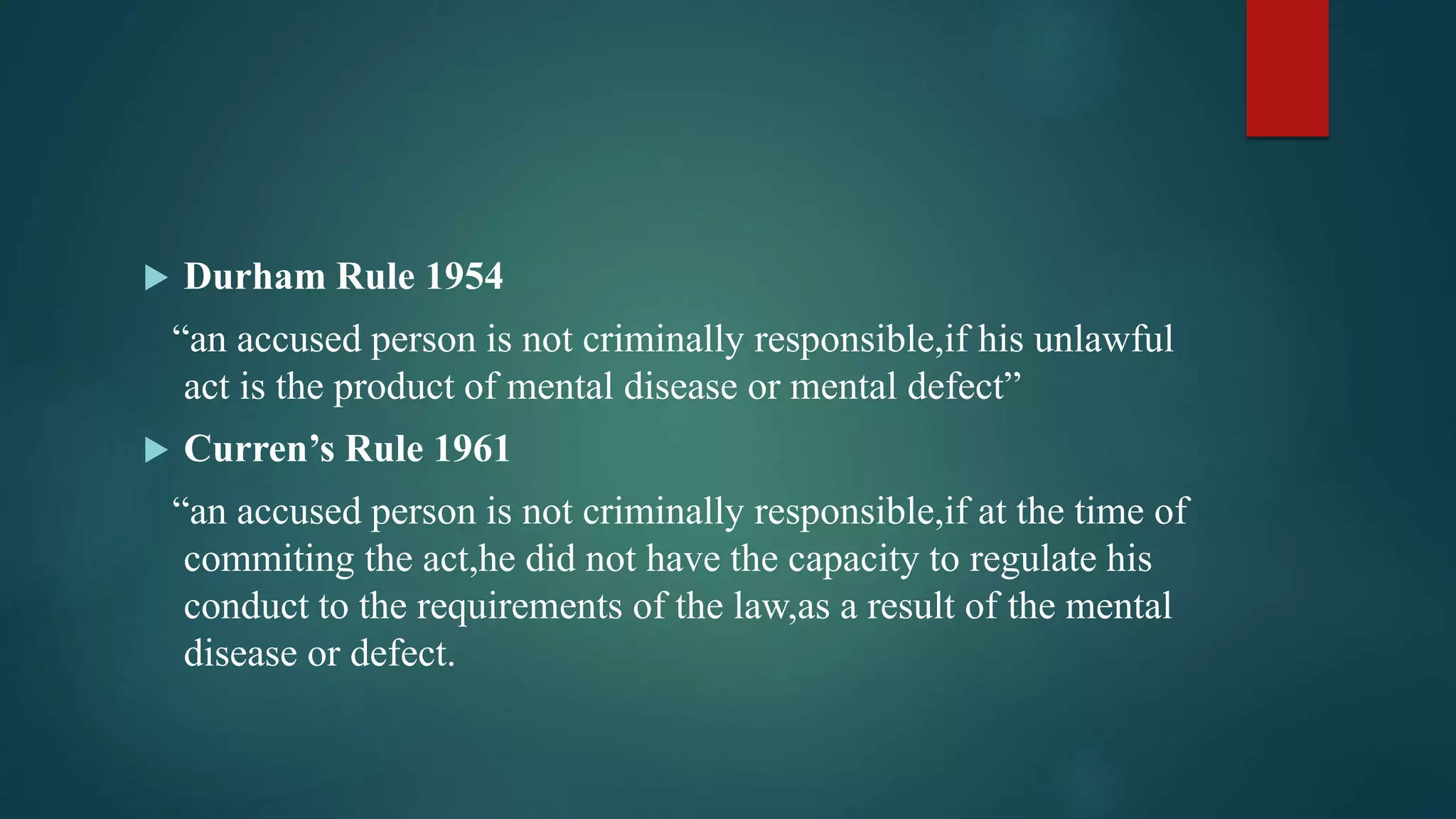
 Durham Rule 1954
“an accused person is not criminally responsible,if his unlawful
act is the product of mental disease or mental defect”
 Curren’s Rule 1961
“an accused person is not criminally responsible,if at the time of
commiting the act,he did not have the capacity to regulate his
conduct to the requirements of the law,as a result of the mental
disease or defect.
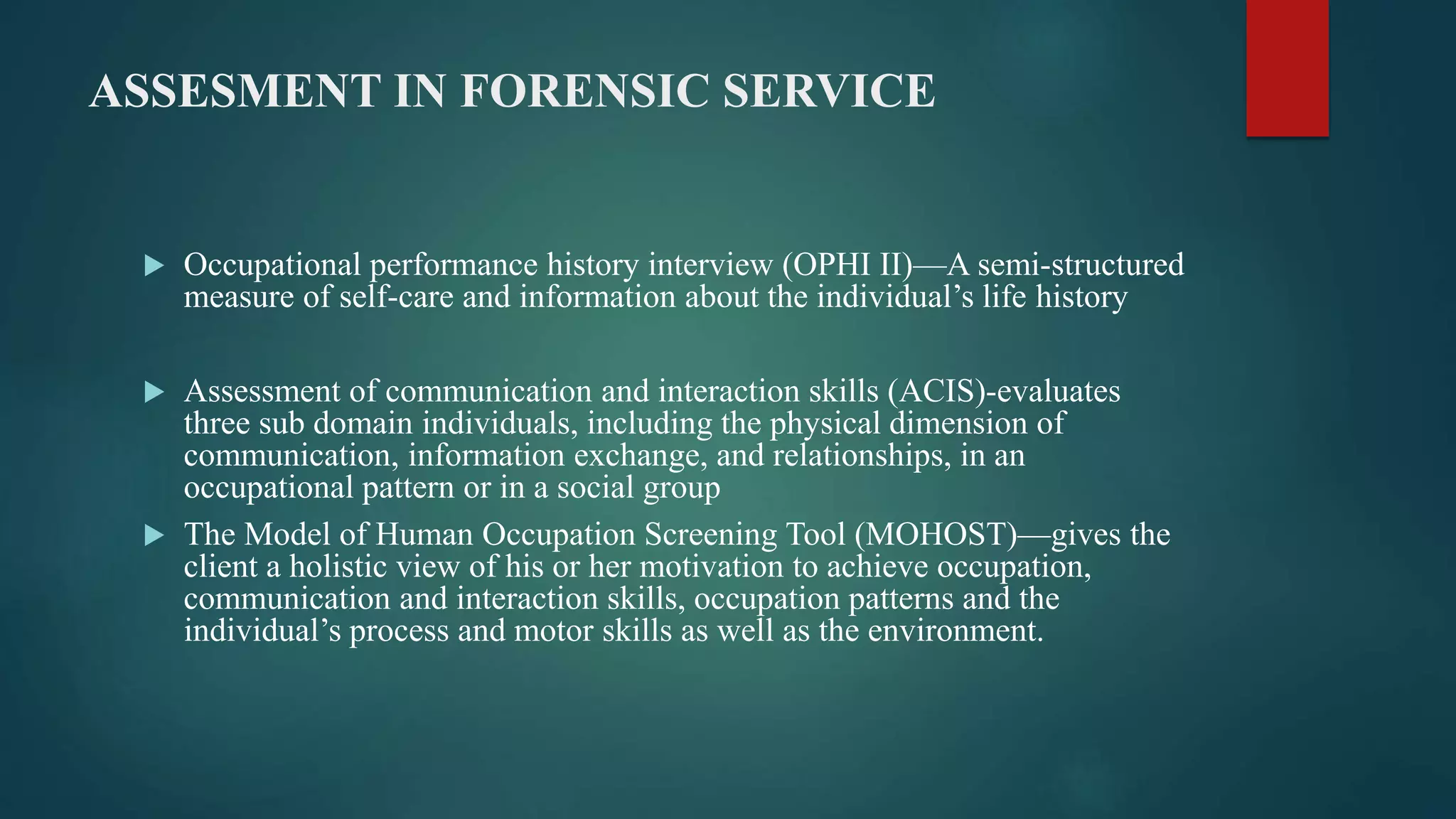
ASSESMENT IN FORENSIC SERVICE
 Occupational performance history interview (OPHI II)—A semi-structured
measure of self-care and information about the individual’s life history
 Assessment of communication and interaction skills (ACIS)-evaluates
three sub domain individuals, including the physical dimension of
communication, information exchange, and relationships, in an
occupational pattern or in a social group
 The Model of Human Occupation Screening Tool (MOHOST)—gives the
client a holistic view of his or her motivation to achieve occupation,
communication and interaction skills, occupation patterns and the
individual’s process and motor skills as well as the environment.
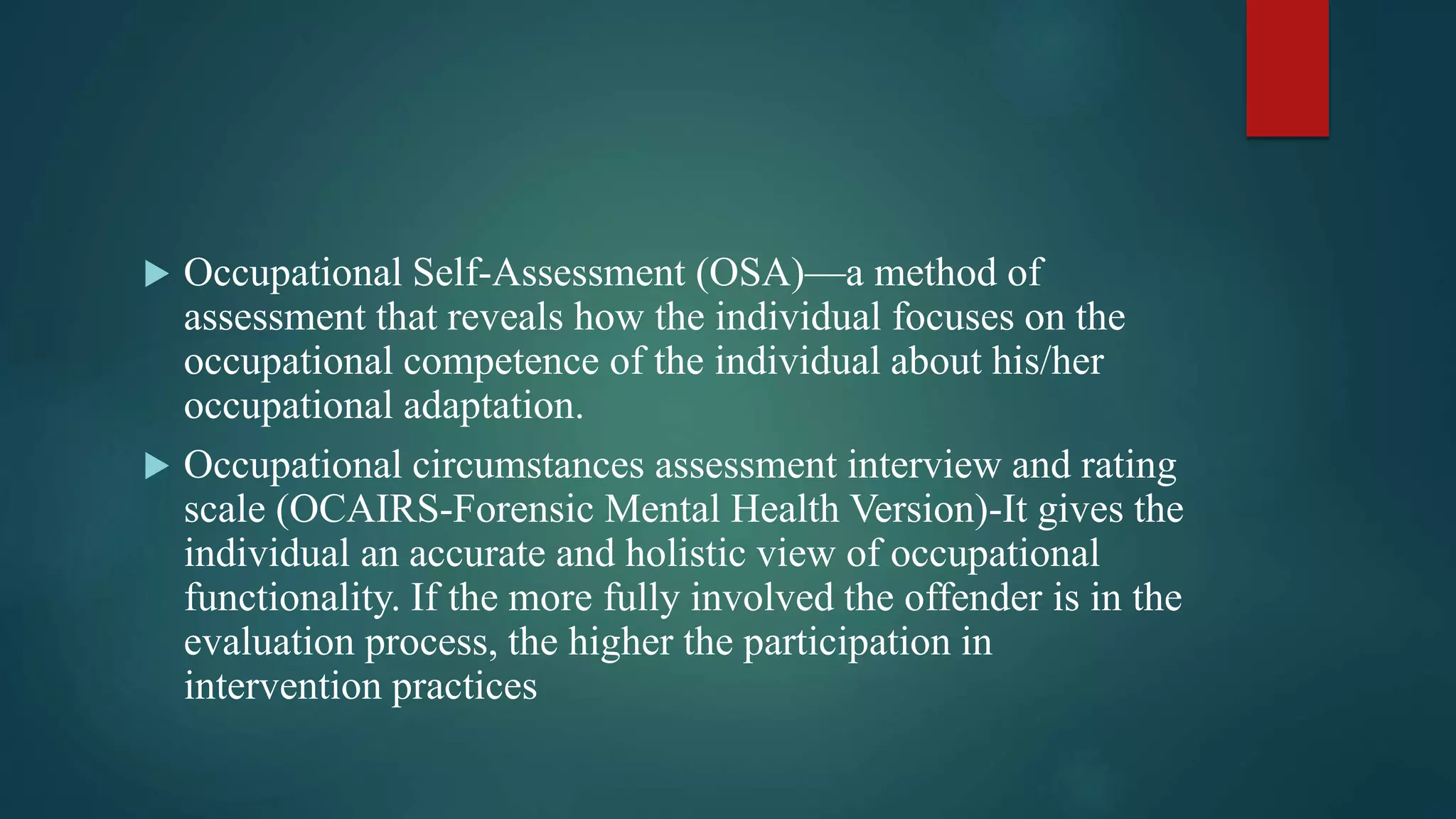
 Occupational Self-Assessment (OSA)—a method of
assessment that reveals how the individual focuses on the
occupational competence of the individual about his/her
occupational adaptation.
 Occupational circumstances assessment interview and rating
scale (OCAIRS-Forensic Mental Health Version)-It gives the
individual an accurate and holistic view of occupational
functionality. If the more fully involved the offender is in the
evaluation process, the higher the participation in
intervention practices
Role of OT in special hospital
 OT focuses on assessment, individual goal setting, functional and
daily living, quality of life, preparation for possible return to the
community
 They also highlights temporal adaptation and health giving
balance of activities of self care, productivity & leisure
 Leisure plays a major role – development of skills to use leisure
time constructively is imperative to increase quality of life and
prevent relapse.
 Some special hospital do have few facilities like escorted
shopping trips – but they have lesser opportunity to handle money
 There is a whole variety of tasks, activities which the patient must perform such as
shopping, budgeting, making decision, how to relate to friends, family, opposite sex
& other people in community.
 Risk assessment are undertaken by the rehabilitation professionals to make these
decisions & frequent rehabilitation trips are undertaken into the community
Regional secure units..
 The change in mental hospitals from closed secure institution
to open conditions occurred in 1950’s onwards which is called
as Regional secure units.
 The idea of RSU was reintroduced in 1974
 RSU’s are separate, specially designed units with exclusive
purpose of caring for potentially difficult or dangerous patients.
 RSU Patients – unit intended to admit most type of patients:
offenders/non-offenders, male/female, in-patient/out-patient, patients
being assessed for the court, adults and adolescent.
 RSU - Aims to keep patients for a short period as possible, run
treatment programmes which includes leave outside the unit as the
patient progress
i.e. initially with no leave – progress to ground leave (escorted by 2
members) – one member escort – escorted leave in community –
unescorted leave in community
Role of OT in RSU…
 OT process involves assessment, collaborative goal setting,
group and individual intervention & evaluation
 Special awareness and consideration required regarding
issues of security in relation to therapy and specific
intervention e.g. dealing with sex offenders
 Risk assessment is an important issue & important area in
mental health generally
 It aims –
 to provide a good range of therapeutic facilities within their
boundaries
 Highly staffed to provide greater therapeutic efficiency &
greater security to reflect complex needs of the patient group
 Patients referred from open psychiatric hospital or prison
 Individuals admitted from community in which their behavior
has caused concern
 OT – starts with assessment; to build good rapport; gather data
through observation and encourage engagement in a
therapeutic programmes
 Therapeutic programmes aimed at improving the patients
concentration and providing a routine and structure to the day,
to meet patients needs and match their abilities
 Emphasis on social skills, assertiveness and self awareness
becomes more appropriate in later stage of treatment
PRISONS….
 Types of prison:
 High Security prison
 Medium security prison
 Low Security prison
 2 types of facilities – those for prisons on remand (awaiting trials)
and those for convicted offenders
 System is currently segregated into male & female prison
 Prisons for adults over 21 years & younger offenders’ for individual
aged between 17-21 years
 Occupation involves any activity that people perform or participate
in, such as giving care to themselves or others, working, learning,
playing games, and interacting with others.
 From this perspective, the role of occupational therapists in forensic
settings is to determine the abilities of these individuals to
congregate their deprived freedoms and use them to train them for
an independent and autonomous life; to provide a professional
orientation, career counseling, and self-esteem; to gain some habits
for physical, spiritual and moral life and to reinforce.
 Prisoners who become mentally ill will be transferred to either
prison health care center or RSU depending on degree of
disturbance
 It provides comprehensive multidisciplinary team assessment
& intervention and review of medication of an individual who
has become depressed, psychotic, suicidal etc.
Role of OT in prison …
 Involving in purposeful activities
 Counselling and Guidance
 Activity scheduling
 Communicating the role of OT’S to others
 High tolerance of frustration necessary
 Managing risk: The following guidelines are given with
regard to management of risk patients/situation
 Realistic goals – taking into account instant gratification,
age appropriateness, purposefulness..
 Use disturbance alarm
 Careful during one to one situation
 Awareness to the area/room
 Awareness to the depth of the conversation
 Use of calm tone of voice and body language
 Removing dangerous equipments in the room
 While conducting groups -- have 2 or more staffs, be aware of
the conflicts, keep patients that the therapist knows well.
REFERENCE….
 Occupational Therapy and Mental Health, 4th Edition: Jennifer Creek,
Lesley Lougher.
 Paul Stewart1 and Christine Craik2. “Occupation, Mental Illness and
Medium Security: Exploring Time-Use in Forensic Regional Secure
Units”: British Journal of Occupational Therapy October 2007 -
70(10):416-425
 Kathlyn L. Reed, “Quick reference to occupational therapy” 2nd ed
 Esma Ozkan, Sümeyye Belhan, Mahmut Yaran and Meral Zarif
(November 5th 2018). Occupational Therapy in Forensic Settings,
Occupational Therapy - Therapeutic and Creative Use of Activity,
Meral Huri, IntechOpen,
Forensic Psychiatry in Occupational Therapy

Forensic Psychiatry in Occupational Therapy

  • 1.
    FORENSIC PSYCHIATRY ROLE OFOCCUPATIONAL THERAPY DR N.S.KRISHNA
  • 2.
    FORENSIC PSYCHIATRY  Forensic- ‘Pertaining to, or connected with, or used in court of law’  Forensic psychiatry : It is a sub-speciality of psychiatry and is related to criminology. It encompasses the interface between law and psychiatry  It is defined as " a subspecialty of psychiatry in which scientific and clinical expertise is applied in legal contexts involving civil, criminal, correctional, regulatory or legislative matters.
  • 3.
    FORENSIC OCCUPATIONAL THERAPY Forensic occupational therapy:  “Forensic occupational therapy engages people and facilitates their participation in meaningful life activities whilst assisting in the development of their increasing personal capacity and pro-social values, identity and skills.” - Duncan (2004)  It provides treatment for psychiatric patients who need to receive care in conditions of maximum security because of the potential dangerousness due to criminal cases.
  • 4.
    SPECIAL SETTING  Itfocused primarily on improving the level and quality of patient care and engaging the individual into the community.  As a place of maximum security, special hospitals aim to prevent patients from absconding.  Thus physical security - includes wall/fence, surveillance cameras, routines of locking doors and checking of patients movements N S K
  • 5.
    The hospital arestaffed by  Psychiatrists,  Nurses,  Psychologist,  Social workers & NGO’s  more recently added occupational therapist and creative therapist/recreational therapist
  • 6.
     FOT’s primarilywork with those who have mental health problems, cognitive and/or social difficulties  FOT’s aim to re-establish, maintain and develop the service users occupational functioning through encouraging independence, self-efficacy, and positive identity whilst addressing their offending behaviours
  • 7.
    FOT’s- 3 Groupsof people  generally deals with 3 group of people  Those who have severe psychosis/addiction that do not respond to current therapies sufficiently to consider release  Those who need rehabilitation to the status of mental competence.  Those who can be rehabilitated for release back into community-
  • 8.
    FOT’s Focuses on Assessment -Areas  Self care activities  Productivity – including history, skills, aptitudes, and interest  Leisure activities – including skills and interests  Academic learning skills  Time management  Problem solving skills  Coping skills, adaptive strategies  Interaction skills – including peer and authority relationship
  • 9.
     OT’s needto address *Anger management *Impulse control *Immediate coping strategies, skills & habits *Training in daily living skills *Home management skills *Budgeting & money management *Special education *Interpersonal skills *awareness to self & others
  • 10.
    OT-TOOLS  Instruments andAssesments.  Bay area functional performance evaluation (BaFPE)- To assess components of functioning that are needed for daily living.  Interest checklist  Role checklist  Occupational case analysis and rating scale  Allen cognitive level screening test( Total level : 6)  Client satisfaction survey  Self assessment of occupational functioning.
  • 11.
    TESTS FOR DETERMININGCRIMINAL RESPONSIBILITY  Mc.Naughten Rule( the legal test)  “an accused person is not legally responsible, if it is clearly proved, that at the time of committing the crime, he was suffering from such a defect of reason from abnormality of mind, that he did not know the nature and quality of the act he was doing or that what he was doing was wrong”  This is the guideline followed in British courts.
  • 12.
     Durham Rule1954 “an accused person is not criminally responsible,if his unlawful act is the product of mental disease or mental defect”  Curren’s Rule 1961 “an accused person is not criminally responsible,if at the time of commiting the act,he did not have the capacity to regulate his conduct to the requirements of the law,as a result of the mental disease or defect.
  • 13.
    ASSESMENT IN FORENSICSERVICE  Occupational performance history interview (OPHI II)—A semi-structured measure of self-care and information about the individual’s life history  Assessment of communication and interaction skills (ACIS)-evaluates three sub domain individuals, including the physical dimension of communication, information exchange, and relationships, in an occupational pattern or in a social group  The Model of Human Occupation Screening Tool (MOHOST)—gives the client a holistic view of his or her motivation to achieve occupation, communication and interaction skills, occupation patterns and the individual’s process and motor skills as well as the environment.
  • 14.
     Occupational Self-Assessment(OSA)—a method of assessment that reveals how the individual focuses on the occupational competence of the individual about his/her occupational adaptation.  Occupational circumstances assessment interview and rating scale (OCAIRS-Forensic Mental Health Version)-It gives the individual an accurate and holistic view of occupational functionality. If the more fully involved the offender is in the evaluation process, the higher the participation in intervention practices
  • 15.
    Role of OTin special hospital  OT focuses on assessment, individual goal setting, functional and daily living, quality of life, preparation for possible return to the community  They also highlights temporal adaptation and health giving balance of activities of self care, productivity & leisure  Leisure plays a major role – development of skills to use leisure time constructively is imperative to increase quality of life and prevent relapse.  Some special hospital do have few facilities like escorted shopping trips – but they have lesser opportunity to handle money
  • 16.
     There isa whole variety of tasks, activities which the patient must perform such as shopping, budgeting, making decision, how to relate to friends, family, opposite sex & other people in community.  Risk assessment are undertaken by the rehabilitation professionals to make these decisions & frequent rehabilitation trips are undertaken into the community
  • 17.
    Regional secure units.. The change in mental hospitals from closed secure institution to open conditions occurred in 1950’s onwards which is called as Regional secure units.  The idea of RSU was reintroduced in 1974  RSU’s are separate, specially designed units with exclusive purpose of caring for potentially difficult or dangerous patients.
  • 18.
     RSU Patients– unit intended to admit most type of patients: offenders/non-offenders, male/female, in-patient/out-patient, patients being assessed for the court, adults and adolescent.  RSU - Aims to keep patients for a short period as possible, run treatment programmes which includes leave outside the unit as the patient progress i.e. initially with no leave – progress to ground leave (escorted by 2 members) – one member escort – escorted leave in community – unescorted leave in community
  • 19.
    Role of OTin RSU…  OT process involves assessment, collaborative goal setting, group and individual intervention & evaluation  Special awareness and consideration required regarding issues of security in relation to therapy and specific intervention e.g. dealing with sex offenders  Risk assessment is an important issue & important area in mental health generally
  • 20.
     It aims–  to provide a good range of therapeutic facilities within their boundaries  Highly staffed to provide greater therapeutic efficiency & greater security to reflect complex needs of the patient group  Patients referred from open psychiatric hospital or prison  Individuals admitted from community in which their behavior has caused concern
  • 21.
     OT –starts with assessment; to build good rapport; gather data through observation and encourage engagement in a therapeutic programmes  Therapeutic programmes aimed at improving the patients concentration and providing a routine and structure to the day, to meet patients needs and match their abilities  Emphasis on social skills, assertiveness and self awareness becomes more appropriate in later stage of treatment
  • 22.
    PRISONS….  Types ofprison:  High Security prison  Medium security prison  Low Security prison  2 types of facilities – those for prisons on remand (awaiting trials) and those for convicted offenders  System is currently segregated into male & female prison  Prisons for adults over 21 years & younger offenders’ for individual aged between 17-21 years
  • 23.
     Occupation involvesany activity that people perform or participate in, such as giving care to themselves or others, working, learning, playing games, and interacting with others.  From this perspective, the role of occupational therapists in forensic settings is to determine the abilities of these individuals to congregate their deprived freedoms and use them to train them for an independent and autonomous life; to provide a professional orientation, career counseling, and self-esteem; to gain some habits for physical, spiritual and moral life and to reinforce.
  • 24.
     Prisoners whobecome mentally ill will be transferred to either prison health care center or RSU depending on degree of disturbance  It provides comprehensive multidisciplinary team assessment & intervention and review of medication of an individual who has become depressed, psychotic, suicidal etc.
  • 25.
    Role of OTin prison …  Involving in purposeful activities  Counselling and Guidance  Activity scheduling  Communicating the role of OT’S to others  High tolerance of frustration necessary  Managing risk: The following guidelines are given with regard to management of risk patients/situation  Realistic goals – taking into account instant gratification, age appropriateness, purposefulness..
  • 26.
     Use disturbancealarm  Careful during one to one situation  Awareness to the area/room  Awareness to the depth of the conversation  Use of calm tone of voice and body language  Removing dangerous equipments in the room  While conducting groups -- have 2 or more staffs, be aware of the conflicts, keep patients that the therapist knows well.
  • 27.
    REFERENCE….  Occupational Therapyand Mental Health, 4th Edition: Jennifer Creek, Lesley Lougher.  Paul Stewart1 and Christine Craik2. “Occupation, Mental Illness and Medium Security: Exploring Time-Use in Forensic Regional Secure Units”: British Journal of Occupational Therapy October 2007 - 70(10):416-425  Kathlyn L. Reed, “Quick reference to occupational therapy” 2nd ed  Esma Ozkan, Sümeyye Belhan, Mahmut Yaran and Meral Zarif (November 5th 2018). Occupational Therapy in Forensic Settings, Occupational Therapy - Therapeutic and Creative Use of Activity, Meral Huri, IntechOpen,