Improving Underrepresented High School Chemistry
Students’ Submicrorepresentations through a
Technology-Supported Desalinator Design Project
Dr. Dermot F. Donnelly
ddonnelly@csufresno.edu; Twitter: @dfdonn
AERA 2017, San Antonio, TX
Project Context – Drought
ddonnelly@csufresno.edu; Twitter: @dfdonn 2
Project Concepts – Heat Transfer,
Desalination, and Concentration
3ddonnelly@csufresno.edu; Twitter: @dfdonn
PHeT Simulation Within WISE
Navigation
Map
Students
Collect
Evidence
wise.berkeley.edu
https://phet.colorado.edu/
4ddonnelly@csufresno.edu; Twitter: @dfdonn
Background Literature
Student difficulties with submicrorepresentations
(SMRs) – limited empirical studies
(Adadan & Savasci, 2012; Devetak, Vogrinc, & Glažar, 2009; McDonagh, 2014)
Visualizations are helpful, but require scaffolding
(Linn & Eylon, 2011; McElhaney et al., 2015)
Students generally like projects
(Kanter, 2010; Krajcik and Blumenfeld, 2006)
Students have mixed attitudes about technology
(Ng, 2012; O’Connell & Dyment, 2016)
5ddonnelly@csufresno.edu; Twitter: @dfdonn
Research Questions
RQ1. What is the impact of technology-supported
projects on students’ SMRs of desalination and
concentration?
RQ2. How does a desalination design project
enhance students’ explanations related to heat
energy transfer and desalination?
RQ3. What are students’ attitudes towards projects
in Chemistry and the use of technology to support
Chemistry projects?
6ddonnelly@csufresno.edu; Twitter: @dfdonn
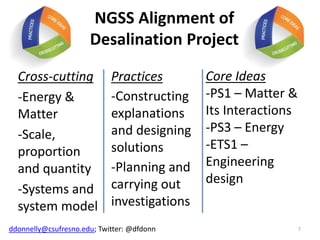
NGSS Alignment of
Desalination Project
Cross-cutting
-Energy &
Matter
-Scale,
proportion
and quantity
-Systems and
system model
Practices
-Constructing
explanations
and designing
solutions
-Planning and
carrying out
investigations
Core Ideas
-PS1 – Matter &
Its Interactions
-PS3 – Energy
-ETS1 –
Engineering
design
7ddonnelly@csufresno.edu; Twitter: @dfdonn
Method
• Social Constructivism/Situationalist Perspective
(Onwuegbuzie & Leech, 2005)
• Mixed Method Study
-10 Pre/Post items (RQ1 and RQ2)
-Short attitudinal questionnaire (RQ3)
-Classroom observations (RQ1-RQ3)
• 4 10th Grade Chemistry classes of 1 female
teacher. Teacher was first time WISE user.
2 week project.
8ddonnelly@csufresno.edu; Twitter: @dfdonn
Student Background
• n = 85 students (out of 138 students) - 15.7 years old
• Free/Reduced Lunch – 100%
• First time using the WISE platform
9ddonnelly@csufresno.edu; Twitter: @dfdonn
68
17
Gender
Female (80%) Male (20%)
44
122
14
13
Background
Hispanic (53%) Causasian (12%)
African-American (2%) Asian (17%)
Two or More (16%)
Knowledge Integration Framework
(Linn & Eylon, 2011)
Predict Interact
CompareExplain
KNOWLEDGE INTEGRATION
1. ELICIT IDEAS 2. ADD IDEAS
3. DISTINGUISH
IDEAS
4. REFLECT ON
IDEAS
YES
NO
MAYBE
I think X because...
Moreover...
However...
10ddonnelly@csufresno.edu; Twitter: @dfdonn
Pre-Post Items (SMRs)
(Adadan & Savasci, 2012; Devetak, Vogrinc, & Glažar, 2009; McDonagh, 2014).
• Heating Saltwater, and Salt (s) and Salt (aq)
(KI Rubric)
• Concentration 1 and Concentration 2 (Binary)
11ddonnelly@csufresno.edu; Twitter: @dfdonn
Example Representation Rubric
Score Response Type Nature of Representation
0 No
Response/Irrelev
ant
-Idk/Does an unrelated drawing
1 Incorrect
Representation
-Shows the loss of salt particles in the
‘after heating’ diagram
-Shows separation of salt and water in
the ‘before heating’ diagram
-Shows the same amount of water
particles in both diagrams
2 1 Representation -At least 1 of the representations noted
3 2
Representations
-At least 2 of the representations noted
4 3 -All three representations noted
12ddonnelly@csufresno.edu; Twitter: @dfdonn
Overall Findings – Student Learning
23.8
28.4
0
5
10
15
20
25
30
35
Overall Score
Combined
Score
(10 items – out
of a score of 40)
Pre
Post
n = 85, M = 4.6, SD = 3.68, p = 0.001, t = 11.5, d = 1.00
13ddonnelly@csufresno.edu; Twitter: @dfdonn
Findings for SMRs (RQ1)
4.6
5.7
0
1
2
3
4
5
6
7
8
Desalination SMRs
SMR Score
(2 items for a
total score of 8)
Pre
Post
n = 85, M = 1.1, SD = 1.22, p = 0.001, t = 8.1, d = 0.83
14ddonnelly@csufresno.edu; Twitter: @dfdonn
0.69
0.96
-0.5
0
0.5
1
1.5
2
2.5
Concentration SMRs
SMR Score
(2 items for a
total score of 2)
Pre
Post
Findings for SMRs (RQ1)
n = 85, M = .27, SD = .84, p = 0.004, t = 2.98, d = 0.25
15ddonnelly@csufresno.edu; Twitter: @dfdonn
Findings for Science Explanations (RQ2)
5.87
6.8
0
1
2
3
4
5
6
7
8
9
Heat Energy Transfer
KI Score
(2 items for a
total of 10)
Pre
Post
n = 85, M = .93, SD = 1.18, p = 0.001, t = 7.24, d = 0.85
16ddonnelly@csufresno.edu; Twitter: @dfdonn
12.64
14.95
0
2
4
6
8
10
12
14
16
18
20
Desalination Explanations
KI Score
(4 items for a
total score of
20)
Pre
Post
Findings for Science Explanations (RQ2)
n = 85, M = 2.31, SD = 2.44, p = 0.001, t = 8.77, d =
0.88 17ddonnelly@csufresno.edu; Twitter: @dfdonn
Findings – Project Learning Attitudes (RQ3)
“I like being able to have a hands-on experience of what we
are learning in class. I feel I learn and remember the
information better this way.” [251591, F]
“Projects makes things easier to learn since we're testing
things ourselves and it makes chemistry more interesting.”
[251670, F]
“I don't really like doing projects because it's very stressing
so I rather take a test.” [251687, M]
Project Learning Attitudes (n = 80) Percentage
Like (n = 50) 63%
Neither like or dislike (n=29) 36%
Dislike (n = 1) 1%
18ddonnelly@csufresno.edu; Twitter: @dfdonn
Findings – Technology Attitudes (RQ3)
“I like the online simulations that we do and videos we
watch because they help us understand what we're learning
a lot more and in more detail at our own pace.” [251670, F]
“I find technology can be unreliable with very important
things although I recognize it's value.” [251694, F]
“I feel like it could make things easier at times, but also
make things a bit more complicated at other times.”
[251583, F]
Technology Attitudes (n = 80) Percentage
Like (n = 34) 42.5%
Neither like or dislike (n=34) 42.5%
Dislike (n = 12) 15%
19ddonnelly@csufresno.edu; Twitter: @dfdonn
Conclusions
• Value of technology-supported projects to
support student learning
• The majority of students enjoy projects in
Chemistry, but indicate nuances in the use of
technology to support projects
• Simulations need careful scaffolding to
support understanding of concentration
20ddonnelly@csufresno.edu; Twitter: @dfdonn
Implications for Science Education
• Greater need for relevant and engaging
projects in high school chemistry
• Importance of scaffolding in projects such as
-the use of timelines,
-collaborative sharing by students, and
-technology embedded assessment tools
involving simulations
21ddonnelly@csufresno.edu; Twitter: @dfdonn
Acknowledgements
• Students and teachers who participated
• College of Science and Mathematics (CSM),
Fresno State
• Technology Enhanced Learning of Science
(TELS), UC Berkeley (Prof. Marcia Linn)
• PHeT, University of Colorado Boulder
22ddonnelly@csufresno.edu; Twitter: @dfdonn
Go raibh maith agaibh!
Questions?
Slides including references available:
http://www.slideshare.net/mynameis
dermot
23ddonnelly@csufresno.edu; Twitter: @dfdonn
References
• Adadan, E., & Savasci, F. (2012). An analysis of 16–17-year-old
students’ understanding of solution chemistry concepts using a
two-tier diagnostic instrument. International Journal of Science
Education, 34(4), 513–544.
http://doi.org/10.1080/09500693.2011.636084
• Devetak, I., Vogrinc, J., & Glažar, S. A. (2009). Assessing 16-year-old
students’ understanding of aqueous solution at submicroscopic
level. Research in Science Education, 39(2), 157–179.
http://doi.org/10.1007/s11165-007-9077-2
• Kanter, D. E. (2010). Doing the project and learning the content:
Designing project-based science curricula for meaningful
understanding. Science Education, 94(3), 525–551.
doi:10.1002/sce.20381
• Krajcik, J., & Blumenfeld, P. (2006). Project-based learning. In R. K.
Sawyer (Ed.), The Cambridge handbook of the learning sciences.
New York: Cambridge University Press.
24ddonnelly@csufresno.edu; Twitter: @dfdonn
References
• Linn, M., & Eylon, B.-S. (2011). Science learning and instruction:
Taking advantage of technology to promote knowledge integration.
New York: Routledge.
• Liu, O. L., Lee, H.-S., Hofstetter, C., & Linn, M. C. (2008). Assessing
Knowledge Integration in Science: Construct, Measures, and
Evidence. Educational Assessment, 13(1), 33–55.
http://doi.org/10.1080/10627190801968224
• McBride, E.A., Vitale, J.M, Applebaum, L, Linn, M.C. (2016) Use of
Interactive Computer Models to Promote Integration of Science
Concepts Through the Engineering Design Process. In Proceedings
of the 12th International Conference of the Learning Sciences.
• McDonagh, M. (2014). An Evaluation of Formative Assessment
Probes in a Solution Chemistry Teaching Sequence. Unpublished
Thesis, University of York.
25ddonnelly@csufresno.edu; Twitter: @dfdonn
References
• McElhaney, K. W., Chang, H.-Y., Chiu, J. L., & Linn, M. C. (2015).
Evidence for effective uses of dynamic visualisations in science
curriculum materials. Studies in Science Education, 51(1), 49–85.
http://doi.org/10.1080/03057267.2014.984506
• Ng, W. (2012). Can we teach digital natives digital literacy?
Computers & Education, 59(3), 1065–1078.
• O’Connell, T. S., & Dyment, J. E. (2016). “I”m just not that
comfortable with technology’: student perceptions of and
preferences for Web 2.0 technologies in reflective journals. Journal
of Further and Higher Education, 40(3), 392–411.
http://doi.org/10.1080/0309877X.2014.984594
• Onwuegbuzie, A. J., & Leech, N. L. (2005). On Becoming a Pragmatic
Researcher: The Importance of Combining Quantitative and
Qualitative Research Methodologies. International Journal of Social
Research Methodology, 8(5), 375–387.
http://doi.org/10.1080/13645570500402447
26ddonnelly@csufresno.edu; Twitter: @dfdonn
Image Credits
• California Drought GIF. Retrieved April 18th from:
https://www.washingtonpost.com/news/capital-weather-
gang/wp/2017/01/12/the-drought-is-over-in-northern-
california-after-up-to-20-inches-of-rain-and-12-feet-of-
snow/?utm_term=.0786396b10fa
• Lake Drought GIF. Retrieved April 18th from:
https://www.gizmodo.com.au/2017/04/look-at-the-
profound-difference-between-californias-drought-and-
california-today/
• Serious Drought Help Save Water Image. Retrieved and
Modified April 18th from:
http://www.epictimes.com/04/08/2015/california-
replaces-amber-alerts-with-water-alerts/
27ddonnelly@csufresno.edu; Twitter: @dfdonn

AERA 2017 Desalination Design Project

  • 1.
    Improving Underrepresented HighSchool Chemistry Students’ Submicrorepresentations through a Technology-Supported Desalinator Design Project Dr. Dermot F. Donnelly ddonnelly@csufresno.edu; Twitter: @dfdonn AERA 2017, San Antonio, TX
  • 2.
    Project Context –Drought ddonnelly@csufresno.edu; Twitter: @dfdonn 2
  • 3.
    Project Concepts –Heat Transfer, Desalination, and Concentration 3ddonnelly@csufresno.edu; Twitter: @dfdonn
  • 4.
    PHeT Simulation WithinWISE Navigation Map Students Collect Evidence wise.berkeley.edu https://phet.colorado.edu/ 4ddonnelly@csufresno.edu; Twitter: @dfdonn
  • 5.
    Background Literature Student difficultieswith submicrorepresentations (SMRs) – limited empirical studies (Adadan & Savasci, 2012; Devetak, Vogrinc, & Glažar, 2009; McDonagh, 2014) Visualizations are helpful, but require scaffolding (Linn & Eylon, 2011; McElhaney et al., 2015) Students generally like projects (Kanter, 2010; Krajcik and Blumenfeld, 2006) Students have mixed attitudes about technology (Ng, 2012; O’Connell & Dyment, 2016) 5ddonnelly@csufresno.edu; Twitter: @dfdonn
  • 6.
    Research Questions RQ1. Whatis the impact of technology-supported projects on students’ SMRs of desalination and concentration? RQ2. How does a desalination design project enhance students’ explanations related to heat energy transfer and desalination? RQ3. What are students’ attitudes towards projects in Chemistry and the use of technology to support Chemistry projects? 6ddonnelly@csufresno.edu; Twitter: @dfdonn
  • 7.
    NGSS Alignment of DesalinationProject Cross-cutting -Energy & Matter -Scale, proportion and quantity -Systems and system model Practices -Constructing explanations and designing solutions -Planning and carrying out investigations Core Ideas -PS1 – Matter & Its Interactions -PS3 – Energy -ETS1 – Engineering design 7ddonnelly@csufresno.edu; Twitter: @dfdonn
  • 8.
    Method • Social Constructivism/SituationalistPerspective (Onwuegbuzie & Leech, 2005) • Mixed Method Study -10 Pre/Post items (RQ1 and RQ2) -Short attitudinal questionnaire (RQ3) -Classroom observations (RQ1-RQ3) • 4 10th Grade Chemistry classes of 1 female teacher. Teacher was first time WISE user. 2 week project. 8ddonnelly@csufresno.edu; Twitter: @dfdonn
  • 9.
    Student Background • n= 85 students (out of 138 students) - 15.7 years old • Free/Reduced Lunch – 100% • First time using the WISE platform 9ddonnelly@csufresno.edu; Twitter: @dfdonn 68 17 Gender Female (80%) Male (20%) 44 122 14 13 Background Hispanic (53%) Causasian (12%) African-American (2%) Asian (17%) Two or More (16%)
  • 10.
    Knowledge Integration Framework (Linn& Eylon, 2011) Predict Interact CompareExplain KNOWLEDGE INTEGRATION 1. ELICIT IDEAS 2. ADD IDEAS 3. DISTINGUISH IDEAS 4. REFLECT ON IDEAS YES NO MAYBE I think X because... Moreover... However... 10ddonnelly@csufresno.edu; Twitter: @dfdonn
  • 11.
    Pre-Post Items (SMRs) (Adadan& Savasci, 2012; Devetak, Vogrinc, & Glažar, 2009; McDonagh, 2014). • Heating Saltwater, and Salt (s) and Salt (aq) (KI Rubric) • Concentration 1 and Concentration 2 (Binary) 11ddonnelly@csufresno.edu; Twitter: @dfdonn
  • 12.
    Example Representation Rubric ScoreResponse Type Nature of Representation 0 No Response/Irrelev ant -Idk/Does an unrelated drawing 1 Incorrect Representation -Shows the loss of salt particles in the ‘after heating’ diagram -Shows separation of salt and water in the ‘before heating’ diagram -Shows the same amount of water particles in both diagrams 2 1 Representation -At least 1 of the representations noted 3 2 Representations -At least 2 of the representations noted 4 3 -All three representations noted 12ddonnelly@csufresno.edu; Twitter: @dfdonn
  • 13.
    Overall Findings –Student Learning 23.8 28.4 0 5 10 15 20 25 30 35 Overall Score Combined Score (10 items – out of a score of 40) Pre Post n = 85, M = 4.6, SD = 3.68, p = 0.001, t = 11.5, d = 1.00 13ddonnelly@csufresno.edu; Twitter: @dfdonn
  • 14.
    Findings for SMRs(RQ1) 4.6 5.7 0 1 2 3 4 5 6 7 8 Desalination SMRs SMR Score (2 items for a total score of 8) Pre Post n = 85, M = 1.1, SD = 1.22, p = 0.001, t = 8.1, d = 0.83 14ddonnelly@csufresno.edu; Twitter: @dfdonn
  • 15.
    0.69 0.96 -0.5 0 0.5 1 1.5 2 2.5 Concentration SMRs SMR Score (2items for a total score of 2) Pre Post Findings for SMRs (RQ1) n = 85, M = .27, SD = .84, p = 0.004, t = 2.98, d = 0.25 15ddonnelly@csufresno.edu; Twitter: @dfdonn
  • 16.
    Findings for ScienceExplanations (RQ2) 5.87 6.8 0 1 2 3 4 5 6 7 8 9 Heat Energy Transfer KI Score (2 items for a total of 10) Pre Post n = 85, M = .93, SD = 1.18, p = 0.001, t = 7.24, d = 0.85 16ddonnelly@csufresno.edu; Twitter: @dfdonn
  • 17.
    12.64 14.95 0 2 4 6 8 10 12 14 16 18 20 Desalination Explanations KI Score (4items for a total score of 20) Pre Post Findings for Science Explanations (RQ2) n = 85, M = 2.31, SD = 2.44, p = 0.001, t = 8.77, d = 0.88 17ddonnelly@csufresno.edu; Twitter: @dfdonn
  • 18.
    Findings – ProjectLearning Attitudes (RQ3) “I like being able to have a hands-on experience of what we are learning in class. I feel I learn and remember the information better this way.” [251591, F] “Projects makes things easier to learn since we're testing things ourselves and it makes chemistry more interesting.” [251670, F] “I don't really like doing projects because it's very stressing so I rather take a test.” [251687, M] Project Learning Attitudes (n = 80) Percentage Like (n = 50) 63% Neither like or dislike (n=29) 36% Dislike (n = 1) 1% 18ddonnelly@csufresno.edu; Twitter: @dfdonn
  • 19.
    Findings – TechnologyAttitudes (RQ3) “I like the online simulations that we do and videos we watch because they help us understand what we're learning a lot more and in more detail at our own pace.” [251670, F] “I find technology can be unreliable with very important things although I recognize it's value.” [251694, F] “I feel like it could make things easier at times, but also make things a bit more complicated at other times.” [251583, F] Technology Attitudes (n = 80) Percentage Like (n = 34) 42.5% Neither like or dislike (n=34) 42.5% Dislike (n = 12) 15% 19ddonnelly@csufresno.edu; Twitter: @dfdonn
  • 20.
    Conclusions • Value oftechnology-supported projects to support student learning • The majority of students enjoy projects in Chemistry, but indicate nuances in the use of technology to support projects • Simulations need careful scaffolding to support understanding of concentration 20ddonnelly@csufresno.edu; Twitter: @dfdonn
  • 21.
    Implications for ScienceEducation • Greater need for relevant and engaging projects in high school chemistry • Importance of scaffolding in projects such as -the use of timelines, -collaborative sharing by students, and -technology embedded assessment tools involving simulations 21ddonnelly@csufresno.edu; Twitter: @dfdonn
  • 22.
    Acknowledgements • Students andteachers who participated • College of Science and Mathematics (CSM), Fresno State • Technology Enhanced Learning of Science (TELS), UC Berkeley (Prof. Marcia Linn) • PHeT, University of Colorado Boulder 22ddonnelly@csufresno.edu; Twitter: @dfdonn
  • 23.
    Go raibh maithagaibh! Questions? Slides including references available: http://www.slideshare.net/mynameis dermot 23ddonnelly@csufresno.edu; Twitter: @dfdonn
  • 24.
    References • Adadan, E.,& Savasci, F. (2012). An analysis of 16–17-year-old students’ understanding of solution chemistry concepts using a two-tier diagnostic instrument. International Journal of Science Education, 34(4), 513–544. http://doi.org/10.1080/09500693.2011.636084 • Devetak, I., Vogrinc, J., & Glažar, S. A. (2009). Assessing 16-year-old students’ understanding of aqueous solution at submicroscopic level. Research in Science Education, 39(2), 157–179. http://doi.org/10.1007/s11165-007-9077-2 • Kanter, D. E. (2010). Doing the project and learning the content: Designing project-based science curricula for meaningful understanding. Science Education, 94(3), 525–551. doi:10.1002/sce.20381 • Krajcik, J., & Blumenfeld, P. (2006). Project-based learning. In R. K. Sawyer (Ed.), The Cambridge handbook of the learning sciences. New York: Cambridge University Press. 24ddonnelly@csufresno.edu; Twitter: @dfdonn
  • 25.
    References • Linn, M.,& Eylon, B.-S. (2011). Science learning and instruction: Taking advantage of technology to promote knowledge integration. New York: Routledge. • Liu, O. L., Lee, H.-S., Hofstetter, C., & Linn, M. C. (2008). Assessing Knowledge Integration in Science: Construct, Measures, and Evidence. Educational Assessment, 13(1), 33–55. http://doi.org/10.1080/10627190801968224 • McBride, E.A., Vitale, J.M, Applebaum, L, Linn, M.C. (2016) Use of Interactive Computer Models to Promote Integration of Science Concepts Through the Engineering Design Process. In Proceedings of the 12th International Conference of the Learning Sciences. • McDonagh, M. (2014). An Evaluation of Formative Assessment Probes in a Solution Chemistry Teaching Sequence. Unpublished Thesis, University of York. 25ddonnelly@csufresno.edu; Twitter: @dfdonn
  • 26.
    References • McElhaney, K.W., Chang, H.-Y., Chiu, J. L., & Linn, M. C. (2015). Evidence for effective uses of dynamic visualisations in science curriculum materials. Studies in Science Education, 51(1), 49–85. http://doi.org/10.1080/03057267.2014.984506 • Ng, W. (2012). Can we teach digital natives digital literacy? Computers & Education, 59(3), 1065–1078. • O’Connell, T. S., & Dyment, J. E. (2016). “I”m just not that comfortable with technology’: student perceptions of and preferences for Web 2.0 technologies in reflective journals. Journal of Further and Higher Education, 40(3), 392–411. http://doi.org/10.1080/0309877X.2014.984594 • Onwuegbuzie, A. J., & Leech, N. L. (2005). On Becoming a Pragmatic Researcher: The Importance of Combining Quantitative and Qualitative Research Methodologies. International Journal of Social Research Methodology, 8(5), 375–387. http://doi.org/10.1080/13645570500402447 26ddonnelly@csufresno.edu; Twitter: @dfdonn
  • 27.
    Image Credits • CaliforniaDrought GIF. Retrieved April 18th from: https://www.washingtonpost.com/news/capital-weather- gang/wp/2017/01/12/the-drought-is-over-in-northern- california-after-up-to-20-inches-of-rain-and-12-feet-of- snow/?utm_term=.0786396b10fa • Lake Drought GIF. Retrieved April 18th from: https://www.gizmodo.com.au/2017/04/look-at-the- profound-difference-between-californias-drought-and- california-today/ • Serious Drought Help Save Water Image. Retrieved and Modified April 18th from: http://www.epictimes.com/04/08/2015/california- replaces-amber-alerts-with-water-alerts/ 27ddonnelly@csufresno.edu; Twitter: @dfdonn

Editor's Notes

  • #11 Pedagogy: The framework behind this research is the Knowledge Integration perspective Which suggests that guiding inquiry should help elicit students’ existing ideas, help them explore additional, more normative ideas, And support them in distinguishing and organizing those ideas into a coherent integrated understanding. Guides design Across contexts a focus on Knowledge Integration instruction helps students reflect upon and refine their understanding.