TRAINING ON
INCLUSIVE EDUCATION
TEACHING LEARNERS WITH
DIFFICULTY IN
REMEMBERING OR
CONCENTRATING
Objectives
After this session, participants will be able to:
1.Describe the characteristics of learners with
difficulty in remembering or concentrating based
from a screening device
2. Plan appropriate accommodations and
instructional strategies that will support the
learners with difficulty in remembering or
concentrating
3. Explain how the proper use of instructional
multi-sensory materials support the learning
of learners with difficulty in remembering or
concentrating
4. Appreciate learners with difficulty in
remembering or concentrating through
sharing of insights
Objectives
How are we going to
identify learners with
difficulty in remembering
or concentrating and how
are we going to intervene
once they are identified?
Activity 1 - Say
what?
TELL ME
THE COLOR
ORANGE
BLACK
GREEN
BLUE
PURPLE
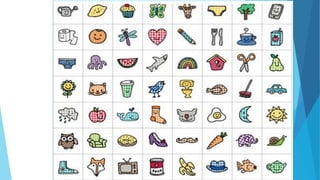
Activity #2. Remember Me
You have 1 minute to list
down all that you can
remember.
1. How many items do you
remember?
2. Have 1 representative for each
group to stand and name them.
3. How do you find this activity?
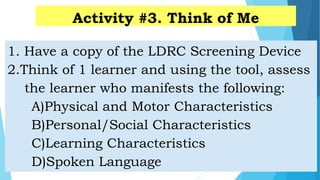
Activity #3. Think of Me
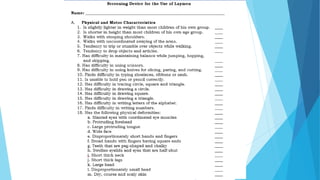
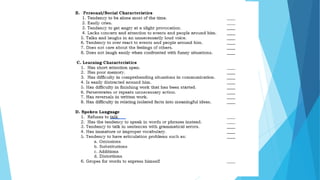
1. Have a copy of the LDRC Screening Device
2.Think of 1 learner and using the tool, assess
the learner who manifests the following:
A)Physical and Motor Characteristics
B)Personal/Social Characteristics
C)Learning Characteristics
D)Spoken Language
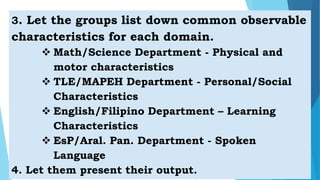
3. Let the groups list down common observable
characteristics for each domain.
 Math/Science Department - Physical and
motor characteristics
 TLE/MAPEH Department - Personal/Social
Characteristics
 English/Filipino Department – Learning
Characteristics
 EsP/Aral. Pan. Department - Spoken
Language
4. Let them present their output.
Time to Think!
1. How do you feel having these
kinds of learners in your
classroom? Why do you feel that
way?
2. What have you noticed with the
responses of the different
groups? Are there similarities
and differences?
Time to Intensify!
Characteristics of
Learners
with Difficulty in
Remembering
or Concentrating
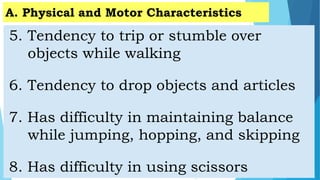
5. Tendency to trip or stumble over
objects while walking
6. Tendency to drop objects and articles
7. Has difficulty in maintaining balance
while jumping, hopping, and skipping
8. Has difficulty in using scissors
A. Physical and Motor Characteristics
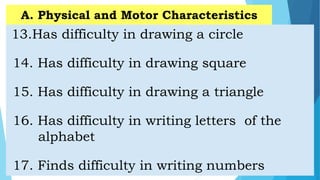
13.Has difficulty in drawing a circle
14. Has difficulty in drawing square
15. Has difficulty in drawing a triangle
16. Has difficulty in writing letters of the
alphabet
17. Finds difficulty in writing numbers
A. Physical and Motor Characteristics
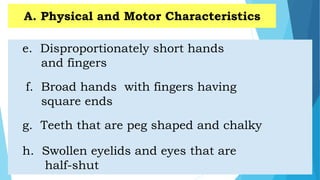
e. Disproportionately short hands
and fingers
f. Broad hands with fingers having
square ends
g. Teeth that are peg shaped and chalky
h. Swollen eyelids and eyes that are
half-shut
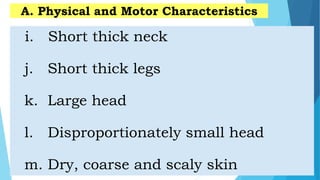
A. Physical and Motor Characteristics
i. Short thick neck
j. Short thick legs
k. Large head
l. Disproportionately small head
m. Dry, coarse and scaly skin
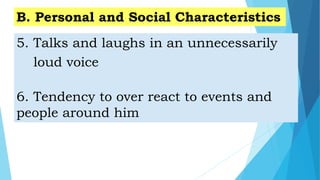
A. Physical and Motor Characteristics
5. Talks and laughs in an unnecessarily
loud voice
6. Tendency to over react to events and
people around him
B. Personal and Social Characteristics
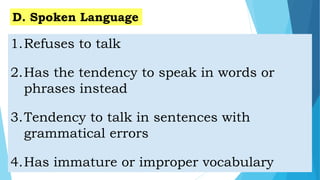
1.Refuses to talk
2.Has the tendency to speak in words or
phrases instead
3.Tendency to talk in sentences with
grammatical errors
4.Has immature or improper vocabulary
D. Spoken Language
e. Develop a procedure for the learner
to ask for help (e.g. cue card, raising
hand).
f. Arrange the classroom environment
so learners have many opportunities to
practice personal care and self-help
skills.
Environmental Accommodation
d. In constructing the test questions,
follow these simple reminders:
 Use short and simple sentences
to ensure understanding.
Test Taking Accommodation
Are the strategies and
materials that you are using
in the regular class the same
with the strategies presented?
In what way?
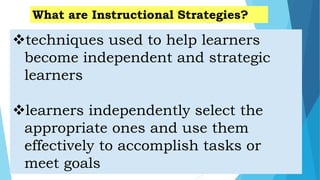
techniques used to help learners
become independent and strategic
learners
learners independently select the
appropriate ones and use them
effectively to accomplish tasks or
meet goals
What are Instructional Strategies?
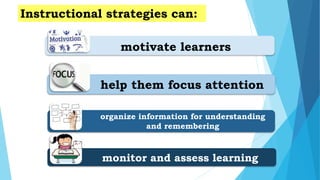
motivate learners
help them focus attention
organize information for understanding
and remembering
monitor and assess learning
Instructional strategies can:
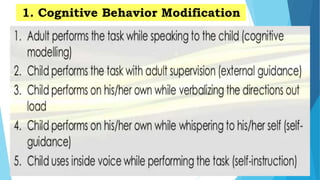
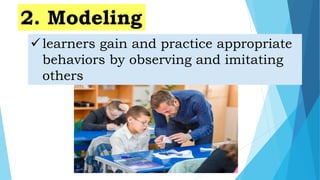
1. Cognitive Behavior Modification
learners gain and practice appropriate
behaviors by observing and imitating
others
2. Modeling
based on the premise that some
learners learn best when content is
presented in several modalities.
also known as VAKT
(visual-auditory-kinesthetic-
tactile)
3. Multisensory Method
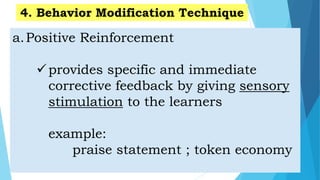
a.Positive Reinforcement
provides specific and immediate
corrective feedback by giving sensory
stimulation to the learners
example:
praise statement ; token economy
4. Behavior Modification Technique
b. Fading
gradually remove
prompts/ reinforcers to
promote independence
4. Behavior Modification Technique
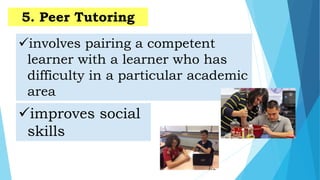
involves pairing a competent
learner with a learner who has
difficulty in a particular academic
area
5. Peer Tutoring
improves social
skills
may be used by the teacher to encourage
students to project or express their feelings and
emotions
Creative activities
 role playing
 puppetry
6. Projective Techniques
behavior difficulties become lesser
learners motivate each other
giving them tasks to
accomplish boost their
concept of responsibility
7. Group Learning
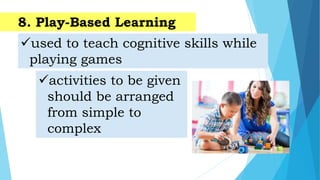
used to teach cognitive skills while
playing games
8. Play-Based Learning
activities to be given
should be arranged
from simple to
complex
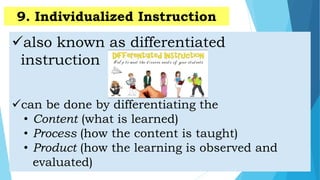
also known as differentiated
instruction
can be done by differentiating the
• Content (what is learned)
• Process (how the content is taught)
• Product (how the learning is observed and
evaluated)
9. Individualized Instruction
utilizes available appropriate low-
cost and craft materials for the
development of different teaching-
learning experiences and activities
11. Arts and Crafts Approach
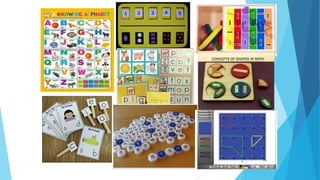
Multi-sensory
Materials that
Support the
Learning of LDRC
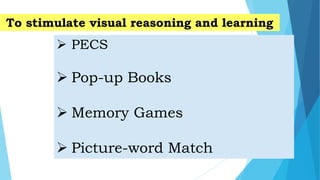
 PECS
 Pop-up Books
 Memory Games
 Picture-word Match
To stimulate visual reasoning and learning
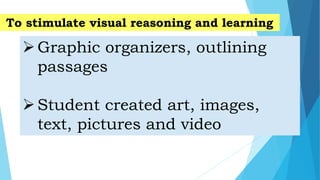
Graphic organizers, outlining
passages
Student created art, images,
text, pictures and video
To stimulate visual reasoning and learning
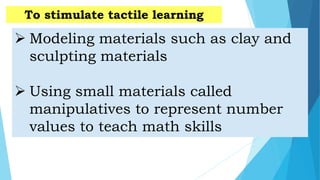
To stimulate tactile learning
 Modeling materials such as clay and
sculpting materials
 Using small materials called
manipulatives to represent number
values to teach math skills
Do you think there is such thing
as “best strategy” for teaching
learners with difficulty in
remembering and concentrating?
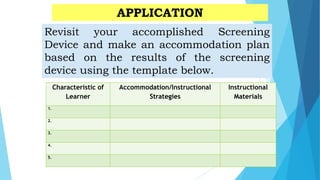
Characteristic of
Learner
Accommodation/Instructional
Strategies
Instructional
Materials
1.
2.
3.
4.
5.
Revisit your accomplished Screening
Device and make an accommodation plan
based on the results of the screening
device using the template below.
APPLICATION
Representative for each group will
share their accomplished
accommodation plan.
Each presenter shall be given 2
minutes to discuss their plan.
Thoughts to Ponder!
It shouldn’t matter how
slowly a child learns as
long as we are encouraging
them not to stop.
~Robert John Meehan~
55

LEARNERS WITH DIFFICULTY IN REMEMBERING AND CONCENTRATING.pptx

  • 1.
  • 2.
    TEACHING LEARNERS WITH DIFFICULTYIN REMEMBERING OR CONCENTRATING
  • 3.
    Objectives After this session,participants will be able to: 1.Describe the characteristics of learners with difficulty in remembering or concentrating based from a screening device 2. Plan appropriate accommodations and instructional strategies that will support the learners with difficulty in remembering or concentrating
  • 4.
    3. Explain howthe proper use of instructional multi-sensory materials support the learning of learners with difficulty in remembering or concentrating 4. Appreciate learners with difficulty in remembering or concentrating through sharing of insights Objectives
  • 5.
    How are wegoing to identify learners with difficulty in remembering or concentrating and how are we going to intervene once they are identified?
  • 6.
    Activity 1 -Say what? TELL ME THE COLOR
  • 8.
  • 9.
  • 11.
  • 12.
  • 13.
  • 15.
    Activity #2. RememberMe You have 1 minute to list down all that you can remember.
  • 16.
    1. How manyitems do you remember? 2. Have 1 representative for each group to stand and name them. 3. How do you find this activity?
  • 17.
    Activity #3. Thinkof Me 1. Have a copy of the LDRC Screening Device 2.Think of 1 learner and using the tool, assess the learner who manifests the following: A)Physical and Motor Characteristics B)Personal/Social Characteristics C)Learning Characteristics D)Spoken Language
  • 20.
    3. Let thegroups list down common observable characteristics for each domain.  Math/Science Department - Physical and motor characteristics  TLE/MAPEH Department - Personal/Social Characteristics  English/Filipino Department – Learning Characteristics  EsP/Aral. Pan. Department - Spoken Language 4. Let them present their output.
  • 21.
    Time to Think! 1.How do you feel having these kinds of learners in your classroom? Why do you feel that way? 2. What have you noticed with the responses of the different groups? Are there similarities and differences?
  • 22.
  • 23.
    Characteristics of Learners with Difficultyin Remembering or Concentrating
  • 24.
    5. Tendency totrip or stumble over objects while walking 6. Tendency to drop objects and articles 7. Has difficulty in maintaining balance while jumping, hopping, and skipping 8. Has difficulty in using scissors A. Physical and Motor Characteristics
  • 25.
    13.Has difficulty indrawing a circle 14. Has difficulty in drawing square 15. Has difficulty in drawing a triangle 16. Has difficulty in writing letters of the alphabet 17. Finds difficulty in writing numbers A. Physical and Motor Characteristics
  • 26.
    e. Disproportionately shorthands and fingers f. Broad hands with fingers having square ends g. Teeth that are peg shaped and chalky h. Swollen eyelids and eyes that are half-shut A. Physical and Motor Characteristics
  • 27.
    i. Short thickneck j. Short thick legs k. Large head l. Disproportionately small head m. Dry, coarse and scaly skin A. Physical and Motor Characteristics
  • 28.
    5. Talks andlaughs in an unnecessarily loud voice 6. Tendency to over react to events and people around him B. Personal and Social Characteristics
  • 29.
    1.Refuses to talk 2.Hasthe tendency to speak in words or phrases instead 3.Tendency to talk in sentences with grammatical errors 4.Has immature or improper vocabulary D. Spoken Language
  • 30.
    e. Develop aprocedure for the learner to ask for help (e.g. cue card, raising hand). f. Arrange the classroom environment so learners have many opportunities to practice personal care and self-help skills. Environmental Accommodation
  • 31.
    d. In constructingthe test questions, follow these simple reminders:  Use short and simple sentences to ensure understanding. Test Taking Accommodation
  • 32.
    Are the strategiesand materials that you are using in the regular class the same with the strategies presented? In what way?
  • 34.
    techniques used tohelp learners become independent and strategic learners learners independently select the appropriate ones and use them effectively to accomplish tasks or meet goals What are Instructional Strategies?
  • 35.
    motivate learners help themfocus attention organize information for understanding and remembering monitor and assess learning Instructional strategies can:
  • 36.
  • 37.
    learners gain andpractice appropriate behaviors by observing and imitating others 2. Modeling
  • 38.
    based on thepremise that some learners learn best when content is presented in several modalities. also known as VAKT (visual-auditory-kinesthetic- tactile) 3. Multisensory Method
  • 39.
    a.Positive Reinforcement provides specificand immediate corrective feedback by giving sensory stimulation to the learners example: praise statement ; token economy 4. Behavior Modification Technique
  • 40.
    b. Fading gradually remove prompts/reinforcers to promote independence 4. Behavior Modification Technique
  • 41.
    involves pairing acompetent learner with a learner who has difficulty in a particular academic area 5. Peer Tutoring improves social skills
  • 42.
    may be usedby the teacher to encourage students to project or express their feelings and emotions Creative activities  role playing  puppetry 6. Projective Techniques
  • 43.
    behavior difficulties becomelesser learners motivate each other giving them tasks to accomplish boost their concept of responsibility 7. Group Learning
  • 44.
    used to teachcognitive skills while playing games 8. Play-Based Learning activities to be given should be arranged from simple to complex
  • 45.
    also known asdifferentiated instruction can be done by differentiating the • Content (what is learned) • Process (how the content is taught) • Product (how the learning is observed and evaluated) 9. Individualized Instruction
  • 46.
    utilizes available appropriatelow- cost and craft materials for the development of different teaching- learning experiences and activities 11. Arts and Crafts Approach
  • 47.
  • 48.
     PECS  Pop-upBooks  Memory Games  Picture-word Match To stimulate visual reasoning and learning
  • 49.
    Graphic organizers, outlining passages Studentcreated art, images, text, pictures and video To stimulate visual reasoning and learning
  • 50.
    To stimulate tactilelearning  Modeling materials such as clay and sculpting materials  Using small materials called manipulatives to represent number values to teach math skills
  • 51.
    Do you thinkthere is such thing as “best strategy” for teaching learners with difficulty in remembering and concentrating?
  • 52.
    Characteristic of Learner Accommodation/Instructional Strategies Instructional Materials 1. 2. 3. 4. 5. Revisit youraccomplished Screening Device and make an accommodation plan based on the results of the screening device using the template below. APPLICATION
  • 53.
    Representative for eachgroup will share their accomplished accommodation plan. Each presenter shall be given 2 minutes to discuss their plan.
  • 54.
    Thoughts to Ponder! Itshouldn’t matter how slowly a child learns as long as we are encouraging them not to stop. ~Robert John Meehan~
  • 55.