Learning is therelatively permanent change in
a person’s knowledge or behavior due to
experience. This definition has three
components:
What is
learning? 1) the duration of the change is long-term
rather than short-term;
3) the cause of the change is the learner’s
experience in the environment rather than
fatigue, motivation, drugs, physical
condition or physiologic intervention.”
(Encyclopedia of Educational Research,
Richard E. Mayer)
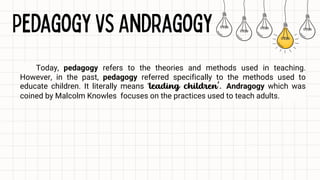
2) the locus of the change is the content
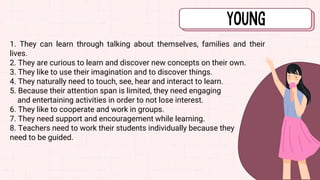
and structure of knowledge in memory or
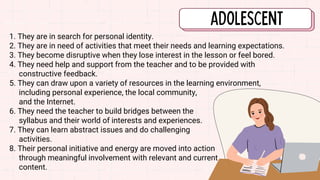
the behavior of the learner;
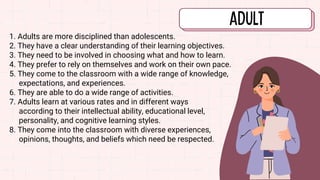
3.
A change inhuman disposition or capability
that persists over a period of time and is not
simply ascribable to processes of growth.
(Robert Gagne)
What is
learning? Learning is a process that is an active
process of engaging and manipulating
objects, experiences, and conversations in
order to build mental models of the world
(Dewey, 1938; Piaget, 1964; Vygotsky, 1986).
Learning is a process that builds on prior
knowledge - and involves enriching, building
on, and changing existing understanding,
where “one’s knowledge base is a scaffold that
supports the construction of all future
learning” (Alexander, 1996, p. 89).
4.
Learning is aprocess that occurs in a
complex social environment - and thus should
not be limited to being examined or perceived
as something that happens on an individual
level.
What is
learning? Learning is a process that is situated in an
authentic context - provides learners with the
opportunity to engage with specific ideas and
concepts on a need-to-know or want-to-know
basis (Greeno, 2006; Kolodner, 2006).
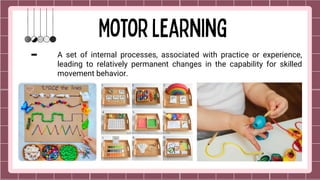
6.
A set ofinternal processes, associated with practice or experience,
leading to relatively permanent changes in the capability for skilled
movement behavior.
7.
Verbal learning wasfirst studied by Hermann Ebbinghaus, who used
lists of nonsense syllables to test recall. This is typically associated
with the memorization and retention of lists of words, in order to
describe basic elements of associative learning.
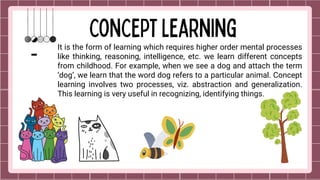
8.
It is theform of learning which requires higher order mental processes
like thinking, reasoning, intelligence, etc. we learn different concepts
from childhood. For example, when we see a dog and attach the term
‘dog’, we learn that the word dog refers to a particular animal. Concept
learning involves two processes, viz. abstraction and generalization.
This learning is very useful in recognizing, identifying things.
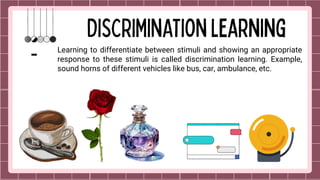
9.
Learning to differentiatebetween stimuli and showing an appropriate
response to these stimuli is called discrimination learning. Example,
sound horns of different vehicles like bus, car, ambulance, etc.
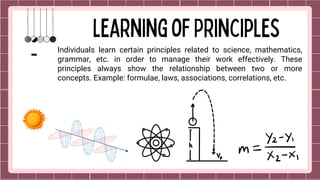
10.
Individuals learn certainprinciples related to science, mathematics,
grammar, etc. in order to manage their work effectively. These
principles always show the relationship between two or more
concepts. Example: formulae, laws, associations, correlations, etc.
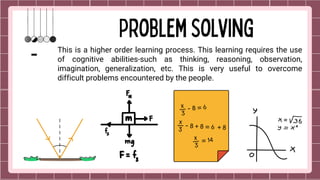
11.
This is ahigher order learning process. This learning requires the use
of cognitive abilities-such as thinking, reasoning, observation,
imagination, generalization, etc. This is very useful to overcome
difficult problems encountered by the people.
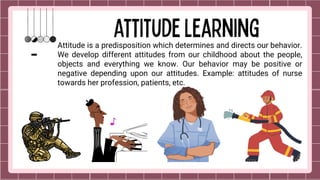
12.
Attitude is apredisposition which determines and directs our behavior.
We develop different attitudes from our childhood about the people,
objects and everything we know. Our behavior may be positive or
negative depending upon our attitudes. Example: attitudes of nurse
towards her profession, patients, etc.
13.
Today, pedagogy refersto the theories and methods used in teaching.
However, in the past, pedagogy referred specifically to the methods used to
educate children. It literally means ‘leading children’. Andragogy which was
coined by Malcolm Knowles focuses on the practices used to teach adults.
14.
1. They canlearn through talking about themselves, families and their
lives.
2. They are curious to learn and discover new concepts on their own.
3. They like to use their imagination and to discover things.
4. They naturally need to touch, see, hear and interact to learn.
5. Because their attention span is limited, they need engaging
and entertaining activities in order to not lose interest.
6. They like to cooperate and work in groups.
7. They need support and encouragement while learning.
8. Teachers need to work their students individually because they
need to be guided.
15.
1. They arein search for personal identity.
2. They are in need of activities that meet their needs and learning expectations.
3. They become disruptive when they lose interest in the lesson or feel bored.
4. They need help and support from the teacher and to be provided with
constructive feedback.
5. They can draw upon a variety of resources in the learning environment,
including personal experience, the local community,
and the Internet.
6. They need the teacher to build bridges between the
syllabus and their world of interests and experiences.
7. They can learn abstract issues and do challenging
activities.
8. Their personal initiative and energy are moved into action
through meaningful involvement with relevant and current
content.
16.
1. Adults aremore disciplined than adolescents.
2. They have a clear understanding of their learning objectives.
3. They need to be involved in choosing what and how to learn.
4. They prefer to rely on themselves and work on their own pace.
5. They come to the classroom with a wide range of knowledge,
expectations, and experiences.
6. They are able to do a wide range of activities.
7. Adults learn at various rates and in different ways
according to their intellectual ability, educational level,
personality, and cognitive learning styles.
8. They come into the classroom with diverse experiences,
opinions, thoughts, and beliefs which need be respected.




![EDUCATIONAL PSYCHOLOGY [Autosaved].pptx that that that](https://cdn.slidesharecdn.com/ss_thumbnails/educationalpsychologyautosaved-250206143043-e64687cd-thumbnail.jpg?width=640&height=640&fit=bounds)


