Chris Hall and Josh McArthur
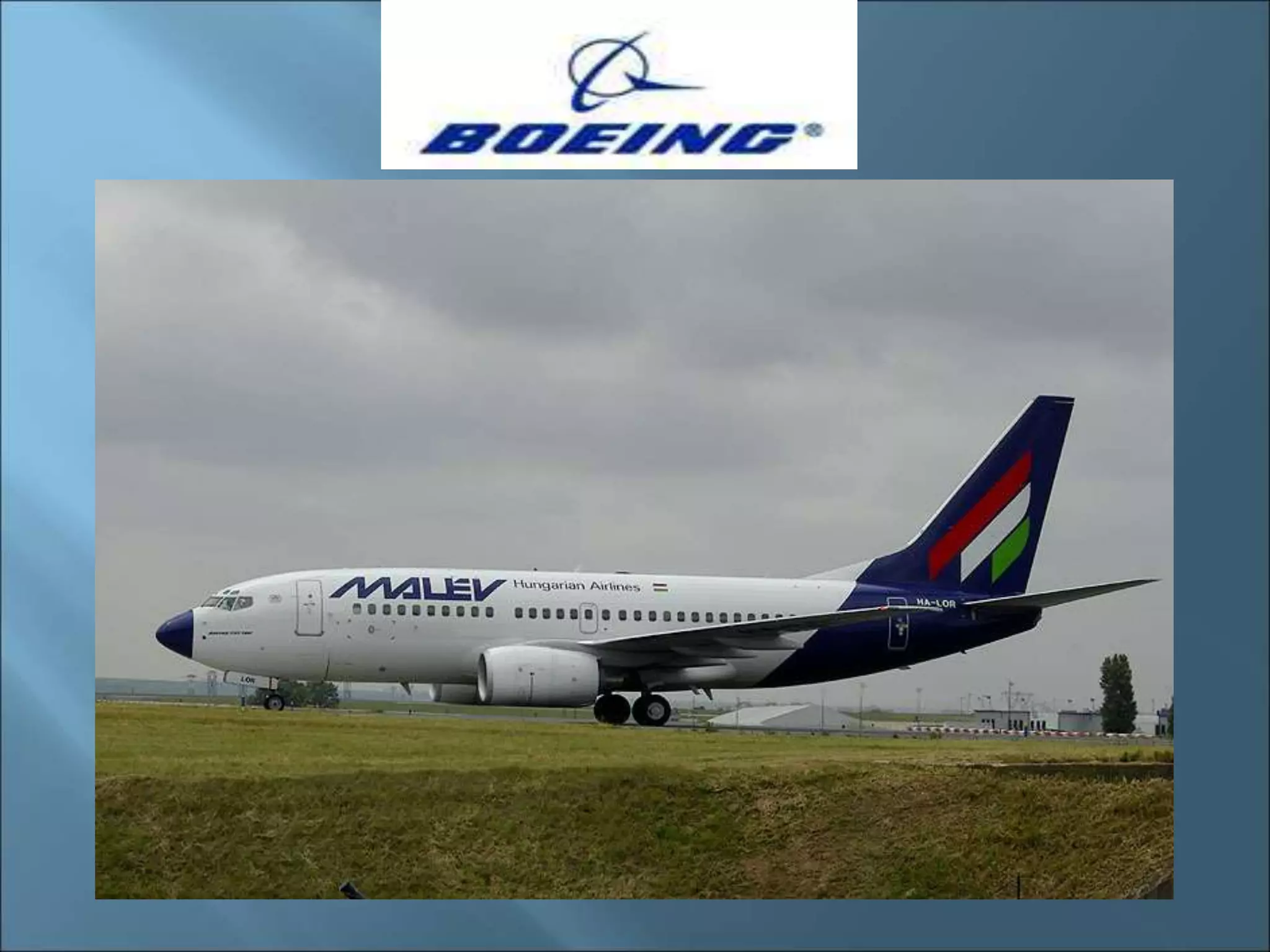
 Boeing was founded on July 15, 1916 by William E. Boeing
as Pacific Aero Products
 Became Boeing Airplane Company in 1917
 First “modern” plane, the 247 built in 1933
 Government regulations force a split into Boeing Airplane
Co. and United Airlines in 1934
 Built B-17 bombers in WW2, peak production was 350
planes a month
 First commercial jet, the 707, introduced in 1958
 1967 the 737 is introduced, the top selling plane of all time.
It is still being manufactured with modern updates
 Top contractor for the International Space Station
 Lost its market leadership position to Airbus in 2003
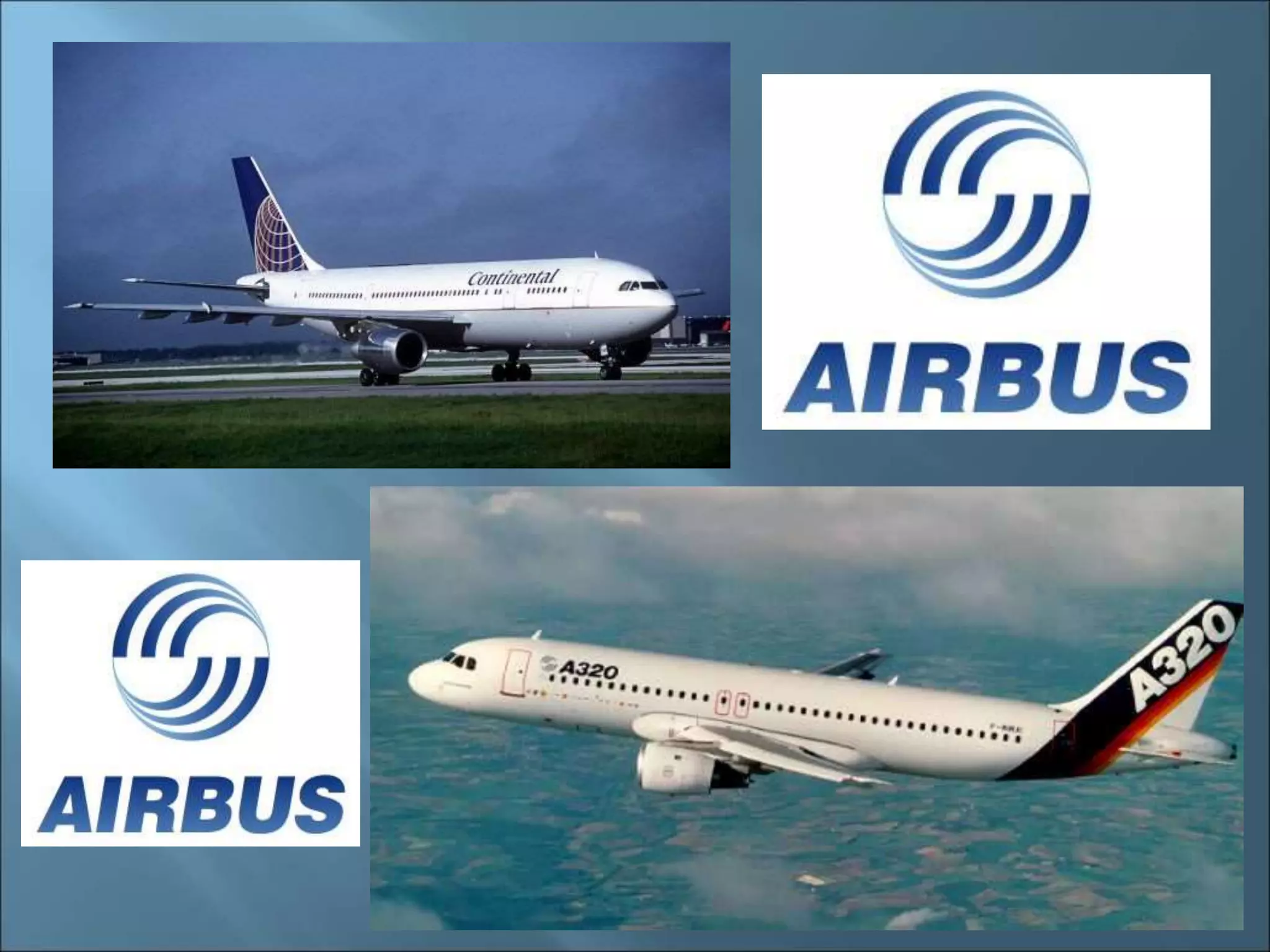
•Airbus was formally established in December 1970 in France.
•Company was founded by grouping of leading German aircraft
manufacturing firms.
•Together the companies had decided to build the A300, the first
twin-engine wide body airliner, to fill a gap in the market and to
challenge American supremacy in the aviation industry.
•In 1972 the Airbus A300 made its maiden flight.
•By 1979 their were only 81 A300’s in service.
•The launch of the Airbus A320 in 1981 established Airbus as a major
player in the aircraft market.
•The A320 was move advanced, fuel efficient, and smaller.
•Through out the 1980’s and up until today Airbus has
continued to grow their company through both civilian
and military contracts.
•Airbus is a EADS company (European Aeronautic Defense
and Space)
•Currently employee over 57,000 people
•President and CEO is Thomas Enders
• Airbus and Boeing are in direct competition with each other year after year.
•There are around 5000 airbus aircrafts in service.
•There are alone over 5000 Boeing 737’s in service.
2008 2007 2006 2005 2004 2003
Airbus 435 1341 824 1111 370 284
Boeing 453 1413 1044 1002 272 239
ORDERS
 A set of tools to reduce waste and create process
flow
 Developed by Toyota
 Includes value stream mapping, 5S, kanban, and
error-proofing ( poka-yoke ), and production
leveling
 Reduction of 3 types of waste:
 Non-value-added work ( muda )
 Overburdened systems ( muri )
 Unevenness ( mura )
 Incorporates JIT and “smart automation”
 Inventory turns are a common lean measure
 In the early 90’s Boeing realized it needed to
improve its process flow
 Executives were sent to Japan to study JIT,
error free production, and process flow
 Consultants were hired from Shingijutsu Co., a
group of former Toyota executives
 “To make planes is to make and develop
people” – Chihiro Nakao it’s all about training
 Boeing took over
manufacture of the
Apache in 1997
 Cycle time was
increasing and quality
slipping
 22 aircraft in
inventory for a 2 per
month delivery
 Huge inventory costs
 Manpower reduced and more direct work on the
helicopters was achieved
 Factory floor redesigned by building wood and
styrofoam models
 Tools and parts arranged for minimal movement
 Support cells moved alongside the aircraft
 Process targeted for 75% reduction, 72% was
achieved in the first year
 Takt time is 2.75 days, calculated from customer
demand, creating a “pulse line”
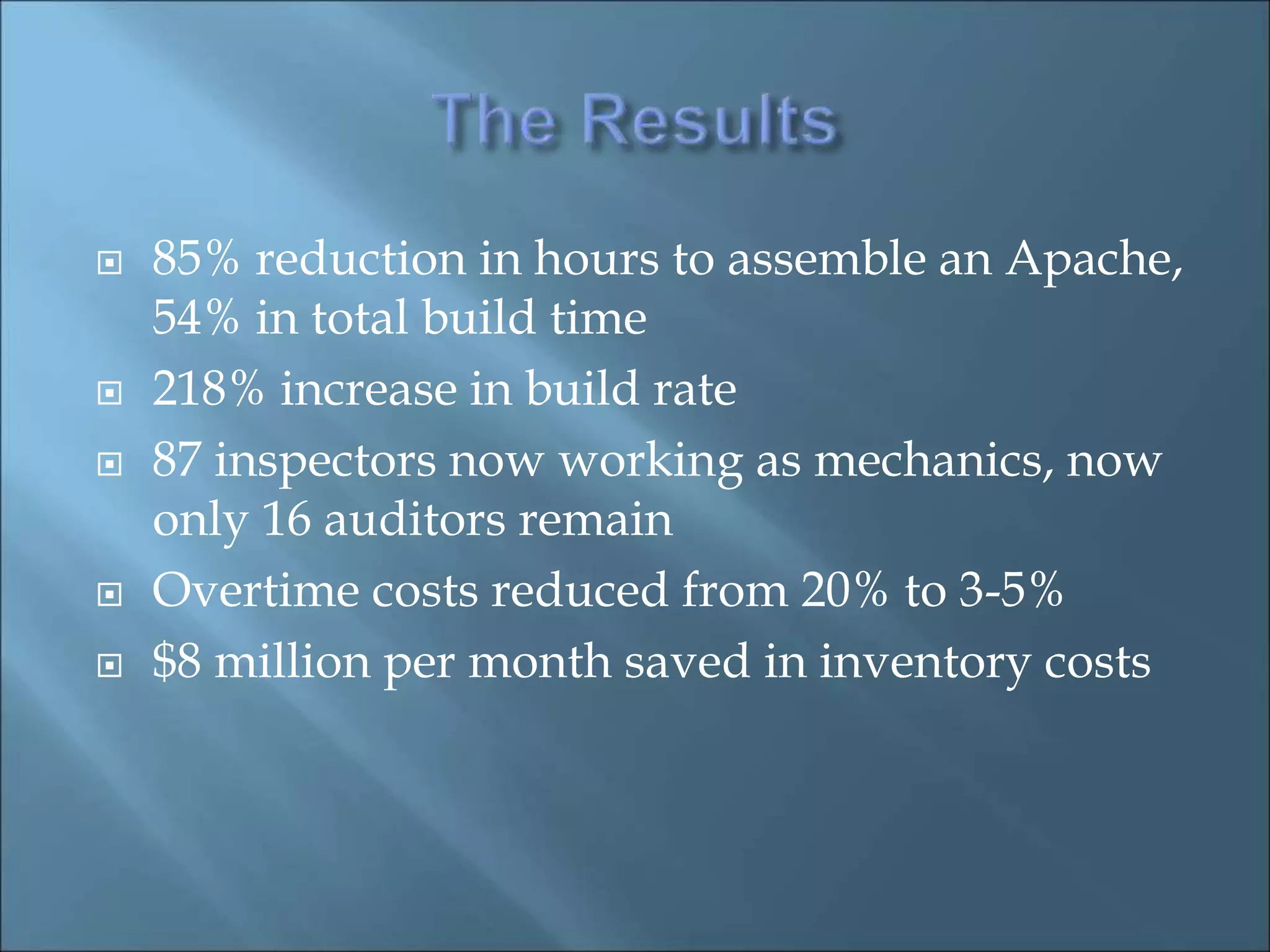
 85% reduction in hours to assemble an Apache,
54% in total build time
 218% increase in build rate
 87 inspectors now working as mechanics, now
only 16 auditors remain
 Overtime costs reduced from 20% to 3-5%
 $8 million per month saved in inventory costs
 1500 executives trained in Japan over a 3 year
period
 50 master six-sigma black belts, over 100 green
belts
 3-400 trained in kaizen
 Toyota consultants hired for 350 billed
weeks/year, now down to about 100/year
 Boeing worked
backward from the
plant exit to reorient the
line, from a 2 line slant
build to a single nose to
tail
 This change helped
implement a moving
line system
 60% of the time was
spent away from the
plane, so point of use
kitting was
incorporated
 Boeing is working
with suppliers to use
a JIT system on the
737 line
 The goal is first
contact by a Boeing
employee is attaching
the part to the aircraft
 Flow time reduced
from 28 days to 22, 15,
and now 11 days
 Moving line is set at 2 inches per minute,
calibrated to team task times with point of use
kits
 Crane moves reduced by 39%
 Flow times improved by 30%
 Inventory levels dropped by 42%
 Floor space reduced by 216,000 square feet
 Woven Electronics improved inventory turns
from 7 in 2000 to 26 in 2006, and will soon
achieve one-piece flow
 Interior manufacturers reduced flow time for
overhead storage bays from 140 days to 4
 Wing production facilities have created a
savings of $58,000 per set of wings, and have a
goal of $100,000
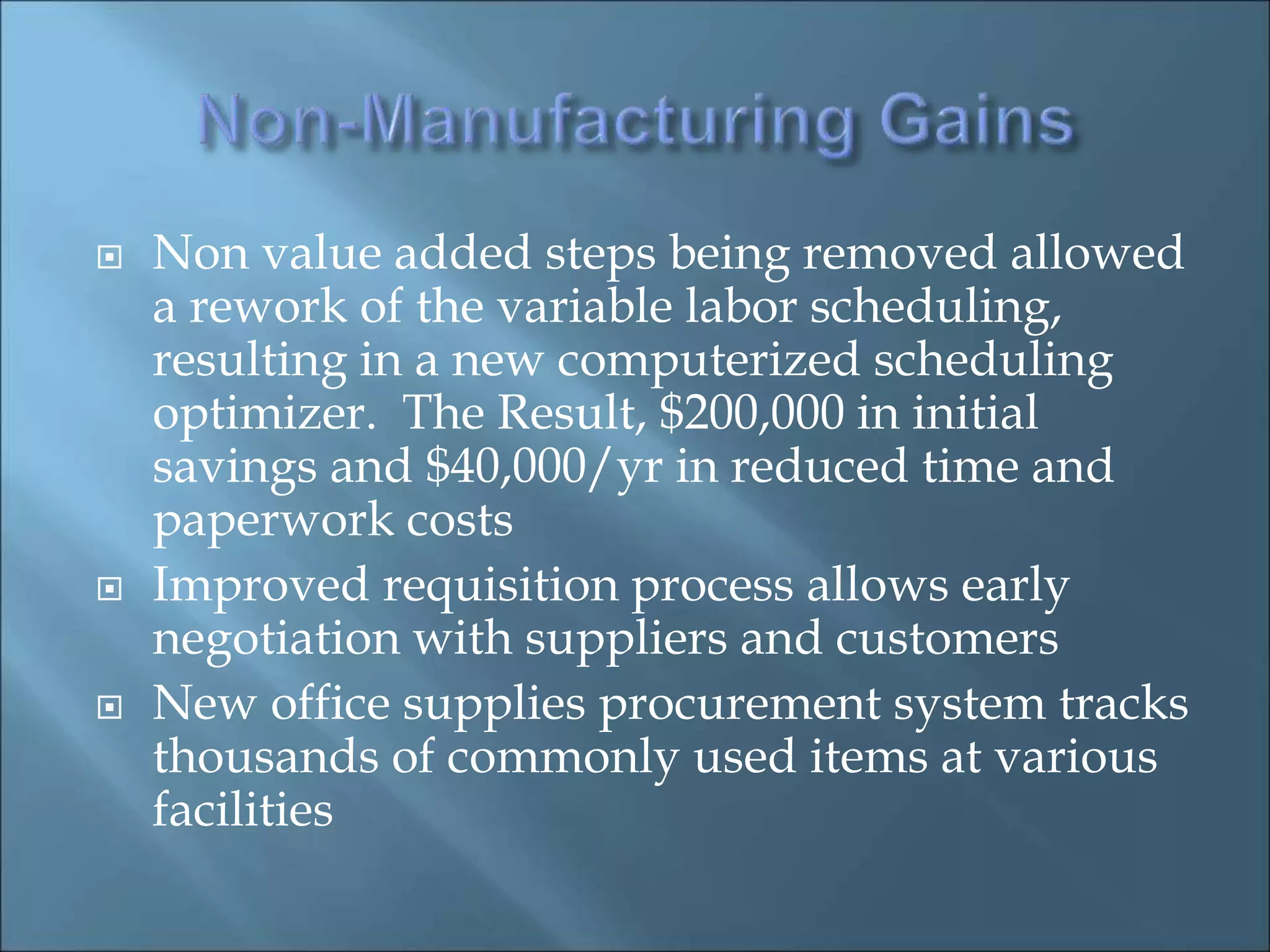
 Non value added steps being removed allowed
a rework of the variable labor scheduling,
resulting in a new computerized scheduling
optimizer. The Result, $200,000 in initial
savings and $40,000/yr in reduced time and
paperwork costs
 Improved requisition process allows early
negotiation with suppliers and customers
 New office supplies procurement system tracks
thousands of commonly used items at various
facilities
 Renton lake facility reorganized after a 2001
earthquake destroyed
 Consolidation reduced square footage by 40%,
forcing more efficient organization.
 Managers and engineers offices overlook the
factory floor, with glass and plastic barriers to
allow them observation points. Factory sounds
filter into the office environment
 This setup keeps everyone focused on the final
result, a better, more efficient plane
•The concept that turned Toyota into a powerhouse is now
transforming aerospace companies.
•Lean cut assembly time for the Boeing 737 by more than half,
transformed an Airbus factory, and probably saved Pratt & Whitney
from going belly-up.
•At its most basic, lean means eliminating waste, defined as
anything that uses resources without creating value for the
customer.
•In four years, the Airbus factory in North Wales, which produces
wings for all the company’s airliners, has reduced quality defects by
62%
•In the 1990’s delivery of its wings to Airbus’s final
assembly plant in France, took place on schedule only 18%
of the time.
•They began leading a formal implementation of lean
initiatives that by 2001 had boosted on-time delivery to
100%, where it has stayed ever since.
•To achieve these results Airbus appointed Unipart
Logistics as a supply chain partner and Lean Logistics
Service Partner for the Broughton operation.
•Unipart had been able to demonstrate a rich heritage in
lean operations and a track record of developing and
implementing lean logistics solutions for clients in a
diverse range of industries.
•Working as an integrated part of the Airbus
organization, Unipart assumed overall responsibility for
a wide range of supply chain operations
Productivity improved through: •Implementation of Lean Principles and
developing Unipart’s culture of continuous
improvement
•Progressive synchronization of extended
supply chain activities.
•Supplier capability assessments and
improvement programmers.
•Airbus manufacturing project planning and
support
• Improving operational control through
introduction of standard operating
procedures.
•Reduction in operational headcount
activity allowing for reallocation of
staff
•Inbound processing time reduced
by 70%
•80% reduction in lead time and
kitting inventory for A320 Family
production
•16,000 man hour savings identified
throughout the internal Supply
Chain and Manufacturing areas
•30% recorded improvement in
stock integrity levels
•51% improvement in internal
customer satisfaction score
•Consolidation of kitting operations
allowing for integration of processes
creating cost and space reductions
•Improved layout and material flow
releasing required floor space
Lean_Manufacturing_at_Boeing_and_Airbus.ppt

Lean_Manufacturing_at_Boeing_and_Airbus.ppt

  • 1.
    Chris Hall andJosh McArthur
  • 2.
     Boeing wasfounded on July 15, 1916 by William E. Boeing as Pacific Aero Products  Became Boeing Airplane Company in 1917  First “modern” plane, the 247 built in 1933  Government regulations force a split into Boeing Airplane Co. and United Airlines in 1934  Built B-17 bombers in WW2, peak production was 350 planes a month  First commercial jet, the 707, introduced in 1958  1967 the 737 is introduced, the top selling plane of all time. It is still being manufactured with modern updates  Top contractor for the International Space Station  Lost its market leadership position to Airbus in 2003
  • 4.
    •Airbus was formallyestablished in December 1970 in France. •Company was founded by grouping of leading German aircraft manufacturing firms. •Together the companies had decided to build the A300, the first twin-engine wide body airliner, to fill a gap in the market and to challenge American supremacy in the aviation industry. •In 1972 the Airbus A300 made its maiden flight. •By 1979 their were only 81 A300’s in service. •The launch of the Airbus A320 in 1981 established Airbus as a major player in the aircraft market. •The A320 was move advanced, fuel efficient, and smaller.
  • 5.
    •Through out the1980’s and up until today Airbus has continued to grow their company through both civilian and military contracts. •Airbus is a EADS company (European Aeronautic Defense and Space) •Currently employee over 57,000 people •President and CEO is Thomas Enders
  • 8.
    • Airbus andBoeing are in direct competition with each other year after year. •There are around 5000 airbus aircrafts in service. •There are alone over 5000 Boeing 737’s in service. 2008 2007 2006 2005 2004 2003 Airbus 435 1341 824 1111 370 284 Boeing 453 1413 1044 1002 272 239 ORDERS
  • 9.
     A setof tools to reduce waste and create process flow  Developed by Toyota  Includes value stream mapping, 5S, kanban, and error-proofing ( poka-yoke ), and production leveling  Reduction of 3 types of waste:  Non-value-added work ( muda )  Overburdened systems ( muri )  Unevenness ( mura )  Incorporates JIT and “smart automation”  Inventory turns are a common lean measure
  • 10.
     In theearly 90’s Boeing realized it needed to improve its process flow  Executives were sent to Japan to study JIT, error free production, and process flow  Consultants were hired from Shingijutsu Co., a group of former Toyota executives  “To make planes is to make and develop people” – Chihiro Nakao it’s all about training
  • 11.
     Boeing tookover manufacture of the Apache in 1997  Cycle time was increasing and quality slipping  22 aircraft in inventory for a 2 per month delivery  Huge inventory costs
  • 12.
     Manpower reducedand more direct work on the helicopters was achieved  Factory floor redesigned by building wood and styrofoam models  Tools and parts arranged for minimal movement  Support cells moved alongside the aircraft  Process targeted for 75% reduction, 72% was achieved in the first year  Takt time is 2.75 days, calculated from customer demand, creating a “pulse line”
  • 13.
     85% reductionin hours to assemble an Apache, 54% in total build time  218% increase in build rate  87 inspectors now working as mechanics, now only 16 auditors remain  Overtime costs reduced from 20% to 3-5%  $8 million per month saved in inventory costs
  • 14.
     1500 executivestrained in Japan over a 3 year period  50 master six-sigma black belts, over 100 green belts  3-400 trained in kaizen  Toyota consultants hired for 350 billed weeks/year, now down to about 100/year
  • 15.
     Boeing worked backwardfrom the plant exit to reorient the line, from a 2 line slant build to a single nose to tail  This change helped implement a moving line system  60% of the time was spent away from the plane, so point of use kitting was incorporated
  • 16.
     Boeing isworking with suppliers to use a JIT system on the 737 line  The goal is first contact by a Boeing employee is attaching the part to the aircraft  Flow time reduced from 28 days to 22, 15, and now 11 days
  • 17.
     Moving lineis set at 2 inches per minute, calibrated to team task times with point of use kits  Crane moves reduced by 39%  Flow times improved by 30%  Inventory levels dropped by 42%  Floor space reduced by 216,000 square feet
  • 18.
     Woven Electronicsimproved inventory turns from 7 in 2000 to 26 in 2006, and will soon achieve one-piece flow  Interior manufacturers reduced flow time for overhead storage bays from 140 days to 4  Wing production facilities have created a savings of $58,000 per set of wings, and have a goal of $100,000
  • 19.
     Non valueadded steps being removed allowed a rework of the variable labor scheduling, resulting in a new computerized scheduling optimizer. The Result, $200,000 in initial savings and $40,000/yr in reduced time and paperwork costs  Improved requisition process allows early negotiation with suppliers and customers  New office supplies procurement system tracks thousands of commonly used items at various facilities
  • 20.
     Renton lakefacility reorganized after a 2001 earthquake destroyed  Consolidation reduced square footage by 40%, forcing more efficient organization.  Managers and engineers offices overlook the factory floor, with glass and plastic barriers to allow them observation points. Factory sounds filter into the office environment  This setup keeps everyone focused on the final result, a better, more efficient plane
  • 22.
    •The concept thatturned Toyota into a powerhouse is now transforming aerospace companies. •Lean cut assembly time for the Boeing 737 by more than half, transformed an Airbus factory, and probably saved Pratt & Whitney from going belly-up. •At its most basic, lean means eliminating waste, defined as anything that uses resources without creating value for the customer. •In four years, the Airbus factory in North Wales, which produces wings for all the company’s airliners, has reduced quality defects by 62%
  • 23.
    •In the 1990’sdelivery of its wings to Airbus’s final assembly plant in France, took place on schedule only 18% of the time. •They began leading a formal implementation of lean initiatives that by 2001 had boosted on-time delivery to 100%, where it has stayed ever since. •To achieve these results Airbus appointed Unipart Logistics as a supply chain partner and Lean Logistics Service Partner for the Broughton operation.
  • 24.
    •Unipart had beenable to demonstrate a rich heritage in lean operations and a track record of developing and implementing lean logistics solutions for clients in a diverse range of industries. •Working as an integrated part of the Airbus organization, Unipart assumed overall responsibility for a wide range of supply chain operations
  • 25.
    Productivity improved through:•Implementation of Lean Principles and developing Unipart’s culture of continuous improvement •Progressive synchronization of extended supply chain activities. •Supplier capability assessments and improvement programmers. •Airbus manufacturing project planning and support • Improving operational control through introduction of standard operating procedures.
  • 26.
    •Reduction in operationalheadcount activity allowing for reallocation of staff •Inbound processing time reduced by 70% •80% reduction in lead time and kitting inventory for A320 Family production •16,000 man hour savings identified throughout the internal Supply Chain and Manufacturing areas •30% recorded improvement in stock integrity levels •51% improvement in internal customer satisfaction score •Consolidation of kitting operations allowing for integration of processes creating cost and space reductions •Improved layout and material flow releasing required floor space