The Lean Startup 
#leanstartup 
Eric Ries (@ericries) 
http://startuplessonslearned.blogspot.com
Thank You! 
• Scholarship Donors 
– KISSmetrics 
– Bill Braasch 
(@billmelater) 
– Bob Aniello 
(@CornOnTheBob) 
• Customer Advisory 
Board 
– Hiten Shah 
– Jared Goralnick 
– Siqi Chen 
– Andrew Meyer 
– Simon Newstead 
– Jeffrey Barman 
– Sean Heywood
Most Startups Fail 
• But it doesn’t have to be that way. We can do 
better. This talk is about how.
The Lean Startup and You 
• Thinking of starting a new company, but 
haven’t taken the first step 
• In a startup now and want to iterate faster 
• Want to create the conditions for lean 
innovation inside a big company
A Tale of Two Startups
Startup #1
A good plan? 
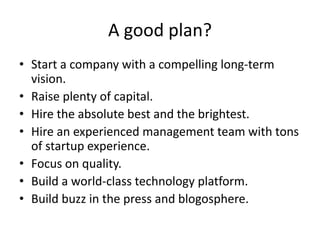
• Start a company with a compelling long-term 
vision. 
• Raise plenty of capital. 
• Hire the absolute best and the brightest. 
• Hire an experienced management team with tons 
of startup experience. 
• Focus on quality. 
• Build a world-class technology platform. 
• Build buzz in the press and blogosphere.
Achieving Failure 
• Company failed utterly, $40MM and five years 
of pain. 
• Crippled by “shadow beliefs” that destroyed 
the effort of all those smart people.
Shadow Belief #1 
• We know what customers want.
Shadow Belief #2 
• We can accurately predict the future.
Shadow Belief #3 
• Advancing the plan is progress.
A good plan? 
• Start a company with a compelling long-term 
vision. 
• Raise plenty of capital. 
• Hire the absolute best and the brightest. 
• Hire an experienced management team with tons 
of startup experience. 
• Focus on quality. 
• Build a world-class technology platform. 
• Build buzz in the press and blogosphere.
Startup #2
IMVU
New plan 
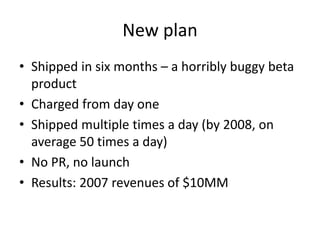
• Shipped in six months – a horribly buggy beta 
product 
• Charged from day one 
• Shipped multiple times a day (by 2008, on 
average 50 times a day) 
• No PR, no launch 
• Results: 2007 revenues of $10MM
Lean Startups Go Faster 
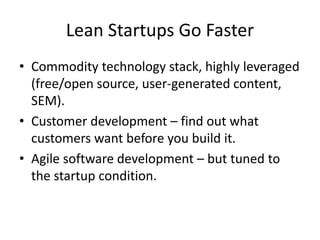
• Commodity technology stack, highly leveraged 
(free/open source, user-generated content, 
SEM). 
• Customer development – find out what 
customers want before you build it. 
• Agile software development – but tuned to 
the startup condition.
Commodity technology stack 
• Leverage = for each ounce of effort you invest 
in your product, you take advantage of the 
efforts of thousands or millions of others. 
• It’s easy to see how high-leverage technology 
is driving costs down. 
• More important is its impact on speed. 
• Time to bring a new product to market is 
falling rapidly.
Customer Development 
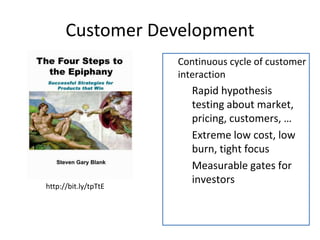
 Continuous cycle of customer 
interaction 
 Rapid hypothesis 
testing about market, 
pricing, customers, … 
 Extreme low cost, low 
burn, tight focus 
 Measurable gates for 
investors 
http://bit.ly/tpTtE
A tale of two startups, revisited 
• Mirrors the changes in development 
methodologies over the past few years. 
• Let’s look at those changes schematically. 
• These examples are drawn from software 
startups, but increasingly: 
– All products require software 
– All companies are operating in a startup-like 
environment
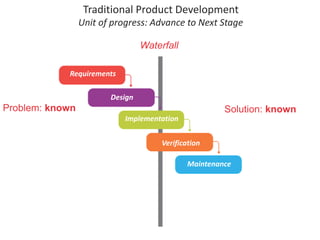
Traditional Product Development 
Unit of progress: Advance to Next Stage 
Waterfall 
Requirements 
Design 
Problem: known Solution: known 
Implementation 
Verification 
Maintenance
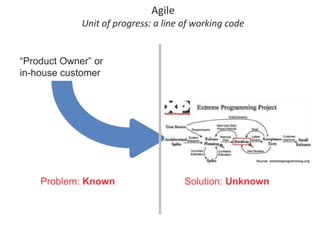
Unit of progress: a line of working code 
“Product Owner” or 
in-house customer 
Agile 
Problem: Known Solution: Unknown
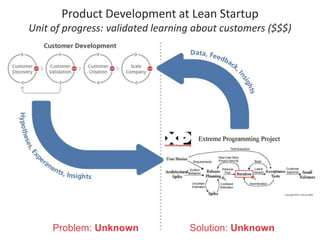
Product Development at Lean Startup 
Unit of progress: validated learning about customers ($$$) 
Problem: Unknown Solution: Unknown
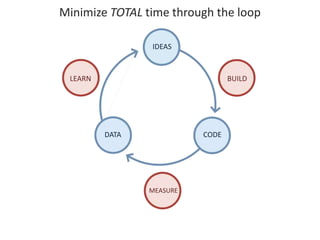
Minimize TOTAL time through the loop 
IDEAS 
LEARN BUILD 
DATA CODE 
MEASURE
How to build a Lean Startup 
• Let’s talk about some specifics. These are not 
everything you need, but they will get you 
started 
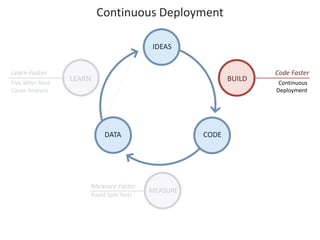
• Continuous deployment 
• Split-test (A/B) experimentation 
• Five why’s
Continuous Deployment 
IDEAS 
LEARN BUILD 
DATA CODE 
MEASURE 
Code Faster 
Continuous 
Deployment 
Measure Faster 
Rapid Split Tests 
Learn Faster 
Five Whys Root 
Cause Analysis
Continuous Deployment 
• Deploy new software quickly 
• At IMVU time from check-in to production = 20 minutes 
• Tell a good change from a bad change (quickly) 
• Revert a bad change quickly 
• Work in small batches 
• At IMVU, a large batch = 3 days worth of work 
• Break large projects down into small batches
Cluster Immune System 
What it looks like to ship one piece of code to production: 
• Run tests locally (SimpleTest, Selenium) 
o Everyone has a complete sandbox 
• Continuous Integration Server (BuildBot) 
o All tests must pass or “shut down the line” 
o Automatic feedback if the team is going too fast 
• Incremental deploy 
o Monitor cluster and business metrics in real-time 
o Reject changes that move metrics out-of-bounds 
• Alerting & Predictive monitoring (Nagios) 
o Monitor all metrics that stakeholders care about 
o If any metric goes out-of-bounds, wake somebody up 
o Use historical trends to predict acceptable bounds 
When customers see a failure: 
o Fix the problem for customers 
o Improve your defenses at each level
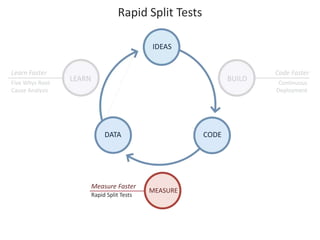
Rapid Split Tests 
IDEAS 
LEARN BUILD 
DATA CODE 
MEASURE 
Code Faster 
Continuous 
Deployment 
Measure Faster 
Rapid Split Tests 
Learn Faster 
Five Whys Root 
Cause Analysis
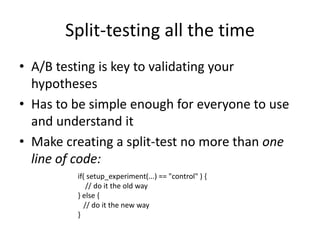
Split-testing all the time 
• A/B testing is key to validating your 
hypotheses 
• Has to be simple enough for everyone to use 
and understand it 
• Make creating a split-test no more than one 
line of code: 
if( setup_experiment(...) == "control" ) { 
// do it the old way 
} else { 
// do it the new way 
}
The AAA’s of Metrics 
• Actionable 
• Accessible 
• Auditable
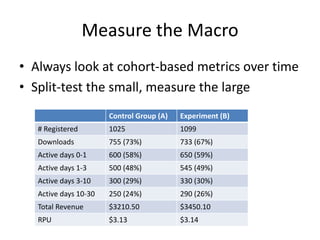
Measure the Macro 
• Always look at cohort-based metrics over time 
• Split-test the small, measure the large 
Control Group (A) Experiment (B) 
# Registered 1025 1099 
Downloads 755 (73%) 733 (67%) 
Active days 0-1 600 (58%) 650 (59%) 
Active days 1-3 500 (48%) 545 (49%) 
Active days 3-10 300 (29%) 330 (30%) 
Active days 10-30 250 (24%) 290 (26%) 
Total Revenue $3210.50 $3450.10 
RPU $3.13 $3.14
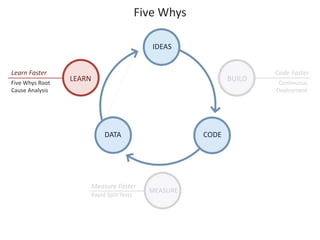
Five Whys 
IDEAS 
LEARN BUILD 
DATA CODE 
MEASURE 
Code Faster 
Continuous 
Deployment 
Measure Faster 
Rapid Split Tests 
Learn Faster 
Five Whys Root 
Cause Analysis
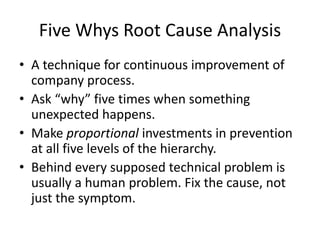
Five Whys Root Cause Analysis 
• A technique for continuous improvement of 
company process. 
• Ask “why” five times when something 
unexpected happens. 
• Make proportional investments in prevention 
at all five levels of the hierarchy. 
• Behind every supposed technical problem is 
usually a human problem. Fix the cause, not 
just the symptom.
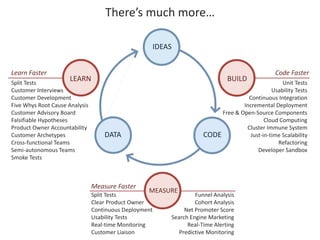
There’s much more… 
IDEAS 
LEARN BUILD 
DATA CODE 
MEASURE 
Code Faster 
Unit Tests 
Usability Tests 
Continuous Integration 
Incremental Deployment 
Free & Open-Source Components 
Cloud Computing 
Cluster Immune System 
Just-in-time Scalability 
Refactoring 
Developer Sandbox 
Measure Faster 
Split Tests 
Clear Product Owner 
Continuous Deployment 
Usability Tests 
Real-time Monitoring 
Customer Liaison 
Learn Faster 
Split Tests 
Customer Interviews 
Customer Development 
Five Whys Root Cause Analysis 
Customer Advisory Board 
Falsifiable Hypotheses 
Product Owner Accountability 
Customer Archetypes 
Cross-functional Teams 
Semi-autonomous Teams 
Smoke Tests 
Funnel Analysis 
Cohort Analysis 
Net Promoter Score 
Search Engine Marketing 
Real-Time Alerting 
Predictive Monitoring
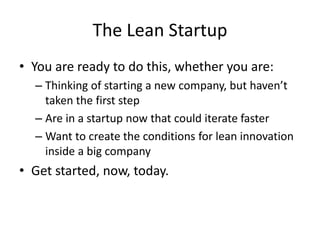
The Lean Startup 
• You are ready to do this, whether you are: 
– Thinking of starting a new company, but haven’t 
taken the first step 
– Are in a startup now that could iterate faster 
– Want to create the conditions for lean innovation 
inside a big company 
• Get started, now, today.
Thanks! 
• Startup Lessons Learned Blog 
– http://startuplessonslearned.blogspot.com/ 
• Webcast: “How to Build a Lean Startup, step-by-step” 
– May 1, 2009 at 10am PST 
– http://www.oreillynet.com/pub/e/1294 
• The Lean Startup Workshop 
– An all-day event for a select audience 
– May 29, 2009 in San Francisco 
– Sign up at: http://bit.ly/a5uw8

Ericriesleanstartuppresentationforweb2

  • 1.
    The Lean Startup #leanstartup Eric Ries (@ericries) http://startuplessonslearned.blogspot.com
  • 2.
    Thank You! •Scholarship Donors – KISSmetrics – Bill Braasch (@billmelater) – Bob Aniello (@CornOnTheBob) • Customer Advisory Board – Hiten Shah – Jared Goralnick – Siqi Chen – Andrew Meyer – Simon Newstead – Jeffrey Barman – Sean Heywood
  • 3.
    Most Startups Fail • But it doesn’t have to be that way. We can do better. This talk is about how.
  • 4.
    The Lean Startupand You • Thinking of starting a new company, but haven’t taken the first step • In a startup now and want to iterate faster • Want to create the conditions for lean innovation inside a big company
  • 5.
    A Tale ofTwo Startups
  • 6.
  • 7.
    A good plan? • Start a company with a compelling long-term vision. • Raise plenty of capital. • Hire the absolute best and the brightest. • Hire an experienced management team with tons of startup experience. • Focus on quality. • Build a world-class technology platform. • Build buzz in the press and blogosphere.
  • 8.
    Achieving Failure •Company failed utterly, $40MM and five years of pain. • Crippled by “shadow beliefs” that destroyed the effort of all those smart people.
  • 9.
    Shadow Belief #1 • We know what customers want.
  • 10.
    Shadow Belief #2 • We can accurately predict the future.
  • 11.
    Shadow Belief #3 • Advancing the plan is progress.
  • 12.
    A good plan? • Start a company with a compelling long-term vision. • Raise plenty of capital. • Hire the absolute best and the brightest. • Hire an experienced management team with tons of startup experience. • Focus on quality. • Build a world-class technology platform. • Build buzz in the press and blogosphere.
  • 13.
  • 14.
  • 15.
    New plan •Shipped in six months – a horribly buggy beta product • Charged from day one • Shipped multiple times a day (by 2008, on average 50 times a day) • No PR, no launch • Results: 2007 revenues of $10MM
  • 16.
    Lean Startups GoFaster • Commodity technology stack, highly leveraged (free/open source, user-generated content, SEM). • Customer development – find out what customers want before you build it. • Agile software development – but tuned to the startup condition.
  • 17.
    Commodity technology stack • Leverage = for each ounce of effort you invest in your product, you take advantage of the efforts of thousands or millions of others. • It’s easy to see how high-leverage technology is driving costs down. • More important is its impact on speed. • Time to bring a new product to market is falling rapidly.
  • 18.
    Customer Development Continuous cycle of customer interaction  Rapid hypothesis testing about market, pricing, customers, …  Extreme low cost, low burn, tight focus  Measurable gates for investors http://bit.ly/tpTtE
  • 19.
    A tale oftwo startups, revisited • Mirrors the changes in development methodologies over the past few years. • Let’s look at those changes schematically. • These examples are drawn from software startups, but increasingly: – All products require software – All companies are operating in a startup-like environment
  • 20.
    Traditional Product Development Unit of progress: Advance to Next Stage Waterfall Requirements Design Problem: known Solution: known Implementation Verification Maintenance
  • 21.
    Unit of progress:a line of working code “Product Owner” or in-house customer Agile Problem: Known Solution: Unknown
  • 22.
    Product Development atLean Startup Unit of progress: validated learning about customers ($$$) Problem: Unknown Solution: Unknown
  • 23.
    Minimize TOTAL timethrough the loop IDEAS LEARN BUILD DATA CODE MEASURE
  • 24.
    How to builda Lean Startup • Let’s talk about some specifics. These are not everything you need, but they will get you started • Continuous deployment • Split-test (A/B) experimentation • Five why’s
  • 25.
    Continuous Deployment IDEAS LEARN BUILD DATA CODE MEASURE Code Faster Continuous Deployment Measure Faster Rapid Split Tests Learn Faster Five Whys Root Cause Analysis
  • 26.
    Continuous Deployment •Deploy new software quickly • At IMVU time from check-in to production = 20 minutes • Tell a good change from a bad change (quickly) • Revert a bad change quickly • Work in small batches • At IMVU, a large batch = 3 days worth of work • Break large projects down into small batches
  • 27.
    Cluster Immune System What it looks like to ship one piece of code to production: • Run tests locally (SimpleTest, Selenium) o Everyone has a complete sandbox • Continuous Integration Server (BuildBot) o All tests must pass or “shut down the line” o Automatic feedback if the team is going too fast • Incremental deploy o Monitor cluster and business metrics in real-time o Reject changes that move metrics out-of-bounds • Alerting & Predictive monitoring (Nagios) o Monitor all metrics that stakeholders care about o If any metric goes out-of-bounds, wake somebody up o Use historical trends to predict acceptable bounds When customers see a failure: o Fix the problem for customers o Improve your defenses at each level
  • 28.
    Rapid Split Tests IDEAS LEARN BUILD DATA CODE MEASURE Code Faster Continuous Deployment Measure Faster Rapid Split Tests Learn Faster Five Whys Root Cause Analysis
  • 29.
    Split-testing all thetime • A/B testing is key to validating your hypotheses • Has to be simple enough for everyone to use and understand it • Make creating a split-test no more than one line of code: if( setup_experiment(...) == "control" ) { // do it the old way } else { // do it the new way }
  • 30.
    The AAA’s ofMetrics • Actionable • Accessible • Auditable
  • 31.
    Measure the Macro • Always look at cohort-based metrics over time • Split-test the small, measure the large Control Group (A) Experiment (B) # Registered 1025 1099 Downloads 755 (73%) 733 (67%) Active days 0-1 600 (58%) 650 (59%) Active days 1-3 500 (48%) 545 (49%) Active days 3-10 300 (29%) 330 (30%) Active days 10-30 250 (24%) 290 (26%) Total Revenue $3210.50 $3450.10 RPU $3.13 $3.14
  • 32.
    Five Whys IDEAS LEARN BUILD DATA CODE MEASURE Code Faster Continuous Deployment Measure Faster Rapid Split Tests Learn Faster Five Whys Root Cause Analysis
  • 33.
    Five Whys RootCause Analysis • A technique for continuous improvement of company process. • Ask “why” five times when something unexpected happens. • Make proportional investments in prevention at all five levels of the hierarchy. • Behind every supposed technical problem is usually a human problem. Fix the cause, not just the symptom.
  • 34.
    There’s much more… IDEAS LEARN BUILD DATA CODE MEASURE Code Faster Unit Tests Usability Tests Continuous Integration Incremental Deployment Free & Open-Source Components Cloud Computing Cluster Immune System Just-in-time Scalability Refactoring Developer Sandbox Measure Faster Split Tests Clear Product Owner Continuous Deployment Usability Tests Real-time Monitoring Customer Liaison Learn Faster Split Tests Customer Interviews Customer Development Five Whys Root Cause Analysis Customer Advisory Board Falsifiable Hypotheses Product Owner Accountability Customer Archetypes Cross-functional Teams Semi-autonomous Teams Smoke Tests Funnel Analysis Cohort Analysis Net Promoter Score Search Engine Marketing Real-Time Alerting Predictive Monitoring
  • 35.
    The Lean Startup • You are ready to do this, whether you are: – Thinking of starting a new company, but haven’t taken the first step – Are in a startup now that could iterate faster – Want to create the conditions for lean innovation inside a big company • Get started, now, today.
  • 36.
    Thanks! • StartupLessons Learned Blog – http://startuplessonslearned.blogspot.com/ • Webcast: “How to Build a Lean Startup, step-by-step” – May 1, 2009 at 10am PST – http://www.oreillynet.com/pub/e/1294 • The Lean Startup Workshop – An all-day event for a select audience – May 29, 2009 in San Francisco – Sign up at: http://bit.ly/a5uw8

Editor's Notes

  • #4 Hi, I’m Eric Ries. I wan to talk to you today about one simple fact: that the vast majority of high-tech startups fail. It does not have to be that way. Read the stories of successful startups and, if the founders are willing to be honest, you will see this pattern over and over again. They started out as digital cash for PDAs, but evolved into online payments for eBay. They started building BASIC interpreters, but evolved into the world's largest operating systems monopoly. They were shocked to discover their online games company was actually a photo-sharing site. Each of these companies were fortunate to have enough time, resources, and patience to endure the multiple iterations it took to find a successful product and market. The premise of the lean startup is simple: if we can reduce the time between these major iterations, we can increase the odds of success.
  • #5 … remember that a startup is not a shrunken-down big company.
  • #8 Start a company with a compelling long-term vision. Don't get distracted by trying to flip it. Instead, try and build a company that will matter on the scale of the next century. Aim to become the "next AOL or Microsoft" not a niche player. Raise sufficient capital to have an extended runway from experienced smart money investors with deep pockets who are prepared to make follow-on investments. Hire the absolute best and the brightest, true experts in their fields, who in turn can hire the smartest people possible to staff their departments. Insist on the incredibly high-IQ employees and hold them to incredibly high standards. Bring in an expert CEO with outstanding business credentials and startup experience to focus on relentless execution. Build a truly mainstream product. Focus on quality. Ship it when it's done, not a moment before. Insist on high levels of usability, UI design, and polish. Conduct constant focus groups and usability tests. Build a world-class technology platform, with patent-pending algorithms and the ability to scale to millions of simultaneous users. Launch with a PR blitz, including mentions in major mainstream publications. Build the product in stealth mode to build buzz for the eventual launch.
  • #10 By hiring experts, conducting lots of focus groups, and executing to a detailed plan, the company became deluded that it knew what customers wanted. I remember vividly a scene at a board meeting, where the company was celebrating a major milestone. The whole company and board play-tested the product to see its new features first hand. Everyone had fun; the product worked. But that was two full years before any customers were allowed to use it. Nobody even asked the question: why not ship this now? It was considered naive that the "next AOL" would ship a product that wasn't ready for prime time. Stealth is a customer-free zone. All of the efforts to create buzz, keep competitors in the dark, and launch with a bang had the direct effect of starving the company for much-needed feedback.
  • #11 Even though some aspects of the product were eventually vindicated as good ones, the underlying architecture suffered from hard-to-change assumptions. After years of engineering effort, changing these assumptions was incredibly hard. Without conscious process design, product development teams turn lines of code written into momentum in a certain direction. Even a great architecture becomes inflexible. This is why agility is such a prized quality in product development.
  • #12 This is the most devastating thing about achieving a failure: while in the midst of it, you think you're making progress. This company had disciplined schedules, milestones, employee evaluations, and a culture of execution. When schedules were missed, people were held accountable. Unfortunately, there was no corresponding discipline of evaluating the quality of the plan itself. As the company built infrastructure and added features, the team celebrated these accomplishments. Departments were built and were even metrics-driven. But there was no feedback loop to help the company find the right metrics to focus on.
  • #13 Do our actions live up to our ideals?
  • #15 After our crushing failure, the founders of my next company decided to question every single assumption for how a startup should be built. Failure gave us the courage to try some radical things.
  • #17 Based on that experience, and the experience of the other startups I have worked for, I now strongly believe there is a better way to create startups. I’ve called this vision the Lean Startup. It combines three key trends.
  • #20 Ladder of inference
  • #21 20
  • #22 21
  • #24  This is the core feedback loop that powers startups. Their goal is not to optimize the time it takes to do any one of these steps. There are many specific practices that can power lean startups, and we’ll cover a few in this presentation. But more important than any specific practice is this core idea: startups should be built to learn.
  • #28 Run tests locally: -- Sandbox includes as much of production as humanly possible (db, memcached, Solr, Apache). -- Write tests in every language. We use 8 different test frameworks for different environs. Otherwise you get fear and brittle. -- Example kind of problem is that AJAX updater for site header. Seemingly innocuous change would break shopping experience. CIT/BuildBot: -- Simply don’t push with red tests. Even if the site is in trouble. Example Christmas site outage with memcache sampling. -- Give an idea of the scale. 20 machine cluster, runs 10000 tests and 100,000’s of thousand of assertions on every change. Incremental deploy: -- Catch performance bugs and gaps in test coverage Slow query in free tags. This started to drive database load higher on one MySQL instance due to contention and data size. Detected and rolled back before it affected users and before the database was hosed due to high load. Changed transaction commit logic in foundation of the system. This passed all tests but caused registrations to fail in production due to subtle difference between sandbox and production. System detected drop in business metric in 1 minute and reverted the change Alerting and Predictive Monitoring Example: Second tier ISP to block our outbound email Example: Rooms list performance time bomb Example: Registration quality, second tier payment methods, invite mail success rates by service Story: Anything that can go wrong will, so just catch it then fast.
  • #34 When something goes wrong, we tend to see it as a crisis and seek to blame. A better way is to see it as a learning opportunity. Not in the existential sense of general self-improvement. Instead, we can use the technique of asking why five times to get to the root cause of the problem. Here's how it works. Let's say you notice that your website is down. Obviously, your first priority is to get it back up. But as soon as the crisis is past, you have the discipline to have a post-mortem in which you start asking why: 1. why was the website down? The CPU utilization on all our front-end servers went to 100% 2. why did the CPU usage spike? A new bit of code contained an infinite loop! 3. why did that code get written? So-and-so made a mistake 4. why did his mistake get checked in? He didn't write a unit test for the feature 5. why didn't he write a unit test? He's a new employee, and he was not properly trained in TDD So far, this isn't much different from the kind of analysis any competent operations team would conduct for a site outage. The next step is this: you have to commit to make a proportional investment in corrective action at every level of the analysis. So, in the example above, we'd have to take five corrective actions: 1. bring the site back up 2. remove the bad code 3. help so-and-so understand why his code doesn't work as written 4. train so-and-so in the principles of TDD 5. change the new engineer orientation to include TDD
  • #35 Webcast: May 1 Workshop: May 29 Fliers up front Discussion in web2open
  • #36 Take a moment to close your eyes…
  • #37 This is the core feedback loop that powers startups. Their goal is not to optimize the time it takes to do any one of these steps. There are many specific practices that can power lean startups, and we’ll cover a few in this presentation. But more important than any specific practice is this core idea: startups should be built to learn.