1
LEAN SOFTWARE DEVELOPMENT
Author: Christopher GrantPublished 5/2013
2
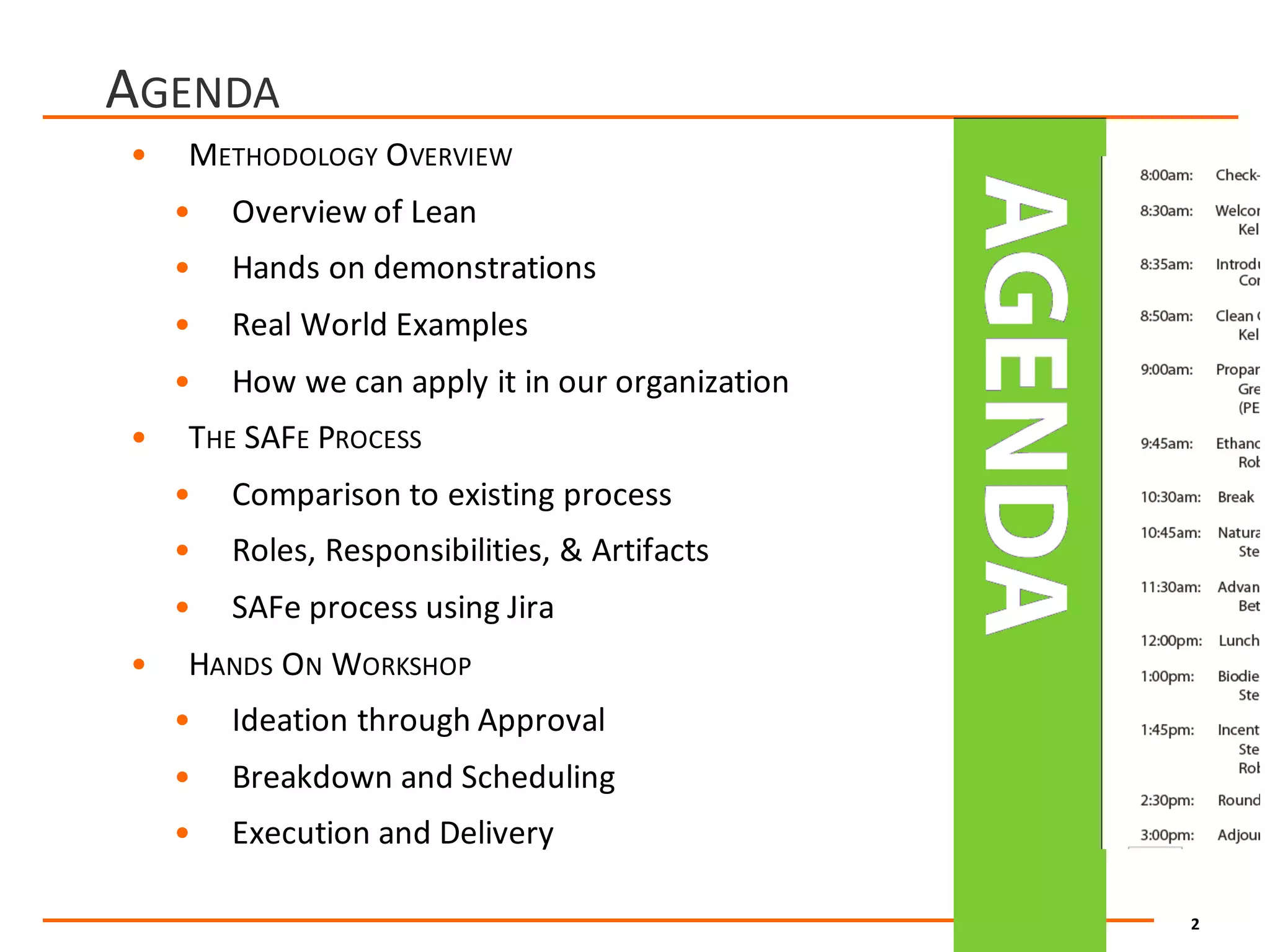
AGENDA
• METHODOLOGY OVERVIEW
• Overview	of	Lean
• Hands	on	demonstrations
• Real	World	Examples
• How	we	can	apply	it	in	our	organization
• THE SAFE PROCESS
• Comparison	to	existing	process
• Roles,	Responsibilities,	&	Artifacts
• SAFe process	using	Jira
• HANDS ON WORKSHOP
• Ideation	through	Approval
• Breakdown	and	Scheduling
• Execution	and	Delivery
3
ABOUT ME
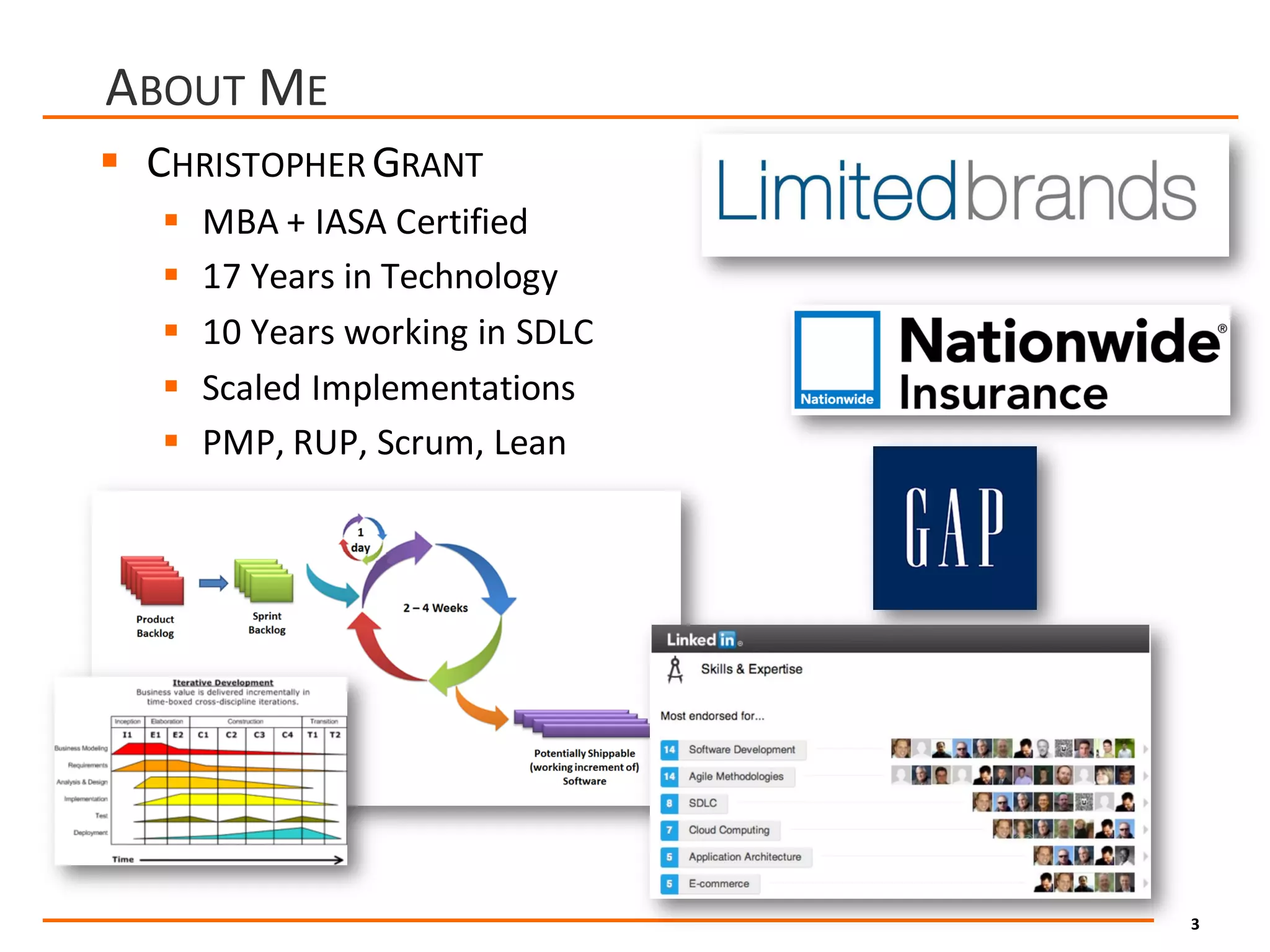
§ CHRISTOPHER GRANT
§ MBA	+	IASA	Certified
§ 17	Years	in	Technology
§ 10	Years	working	in	SDLC
§ Scaled	Implementations
§ PMP,	RUP,	Scrum,	Lean
4
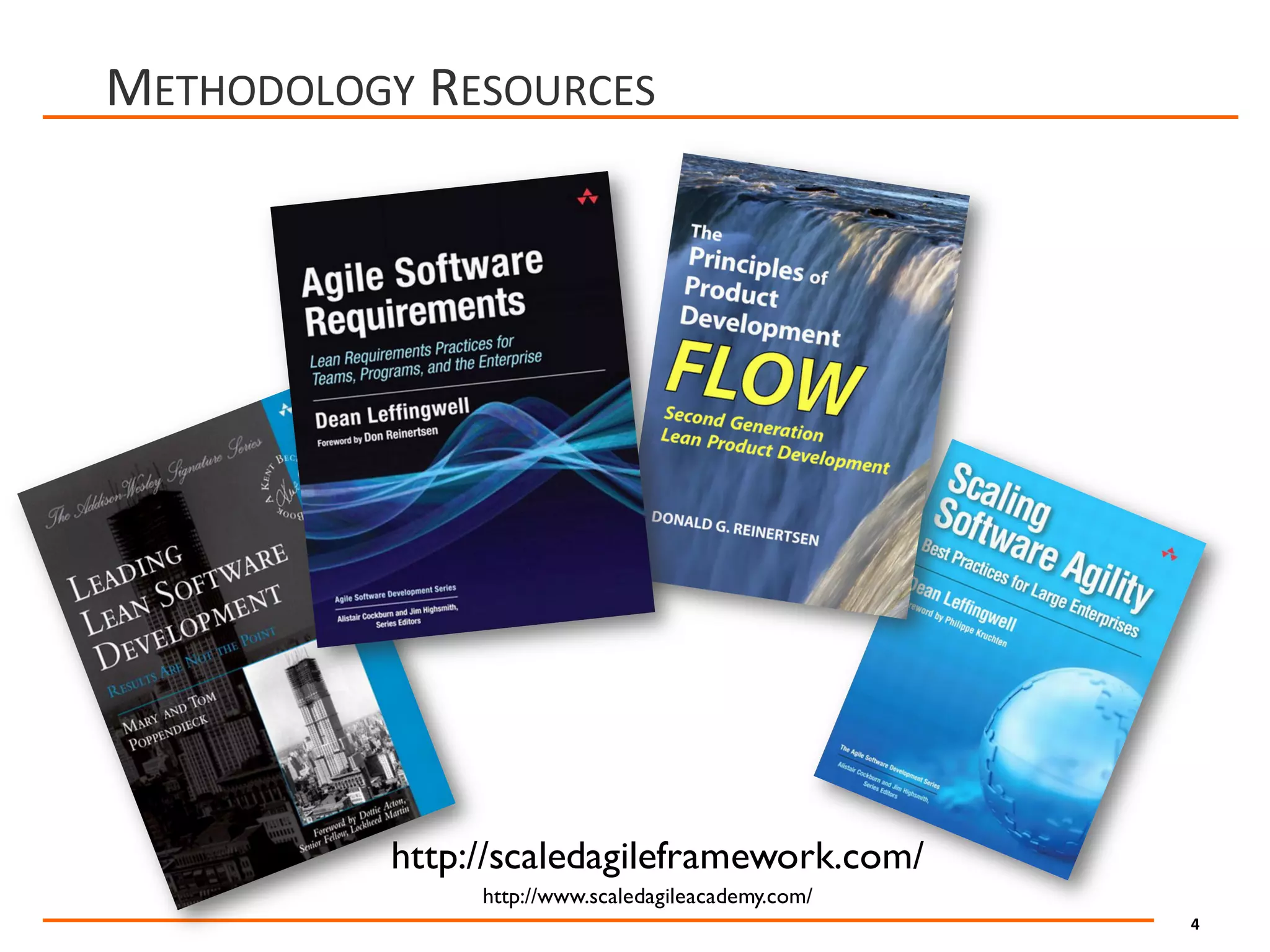
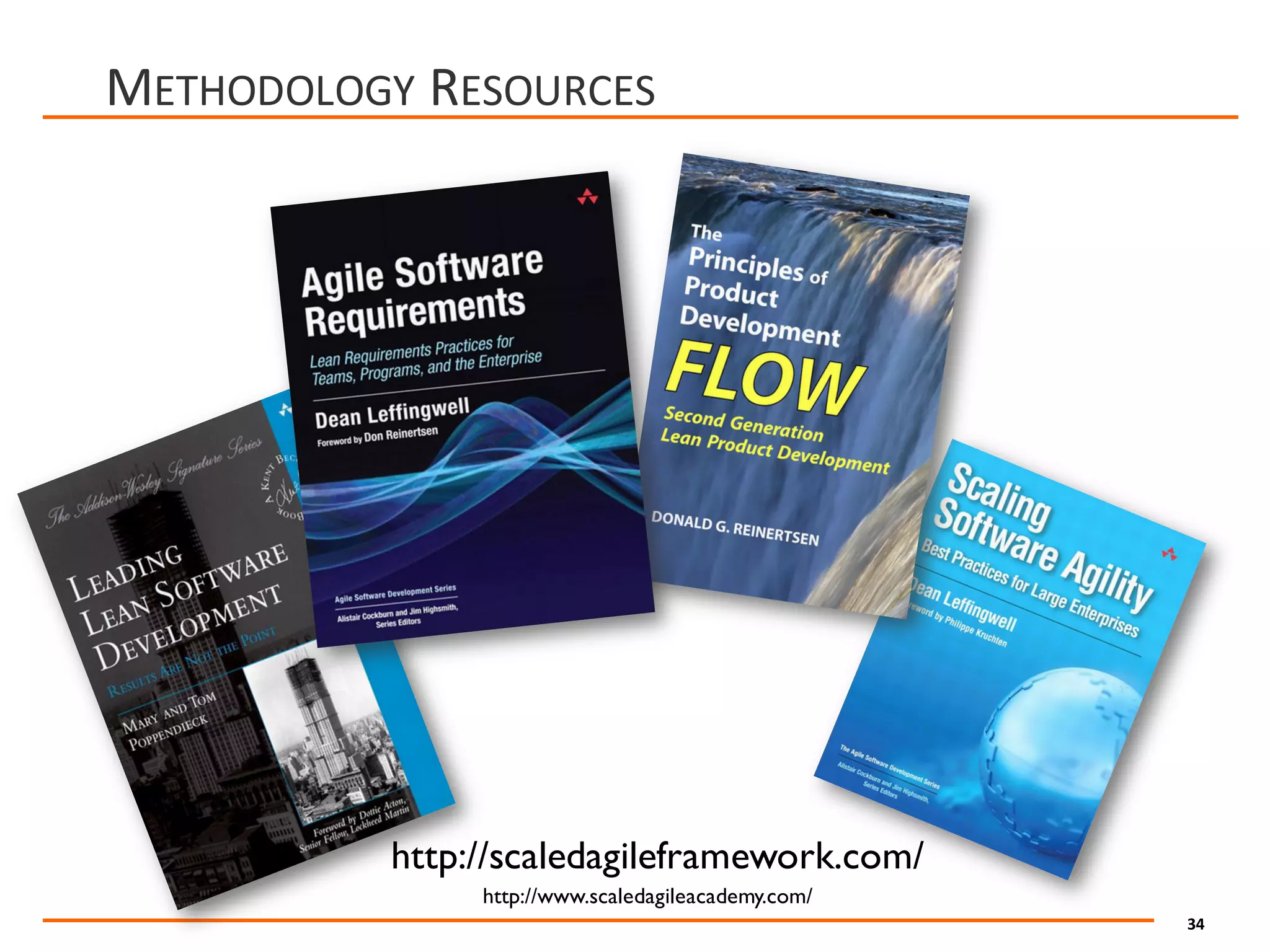
METHODOLOGY RESOURCES
http://scaledagileframework.com/
http://www.scaledagileacademy.com/
5
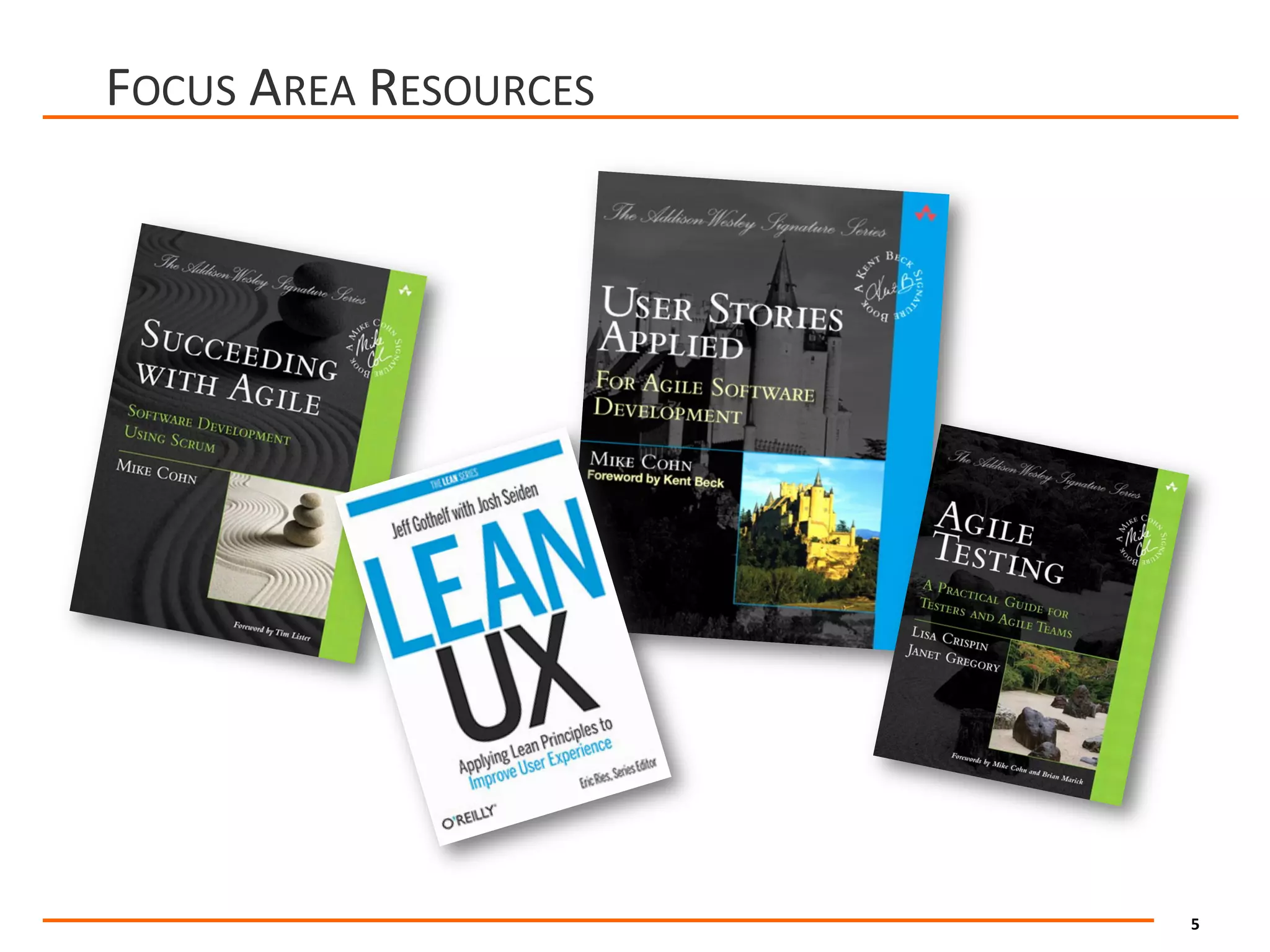
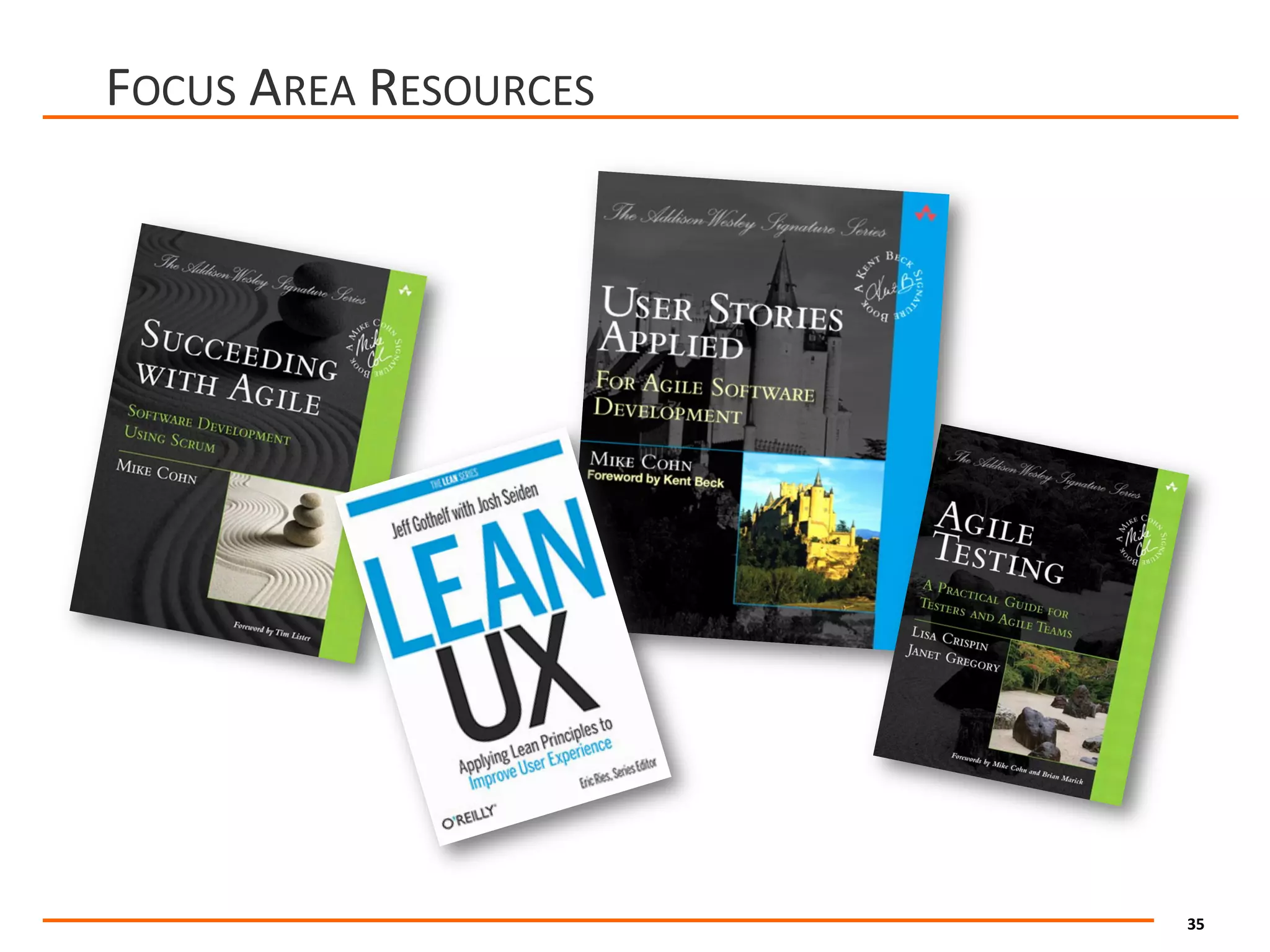
FOCUS AREA RESOURCES
6
METHODOLOGY OVERVIEW
7
LEAN OVERVIEW
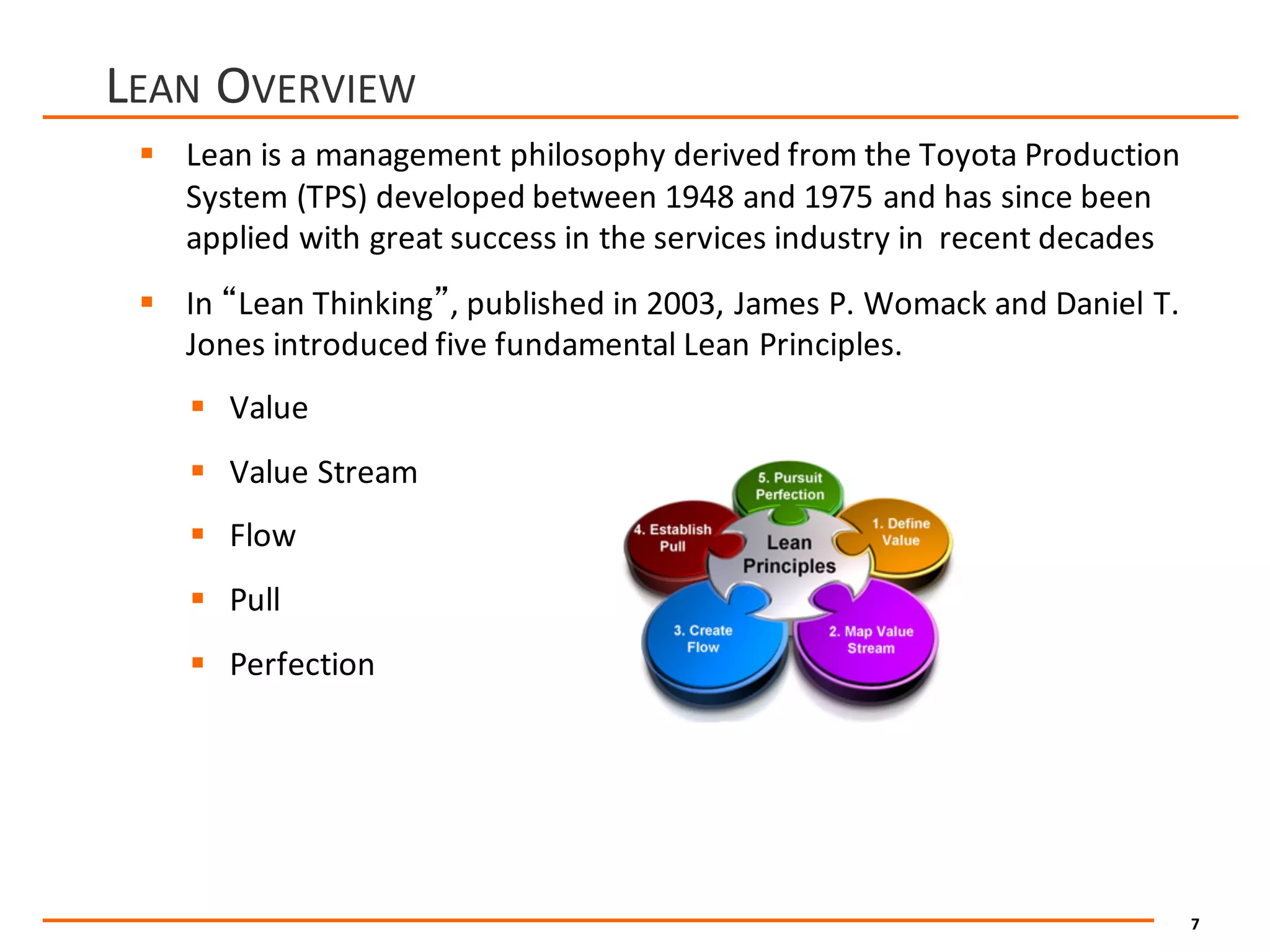
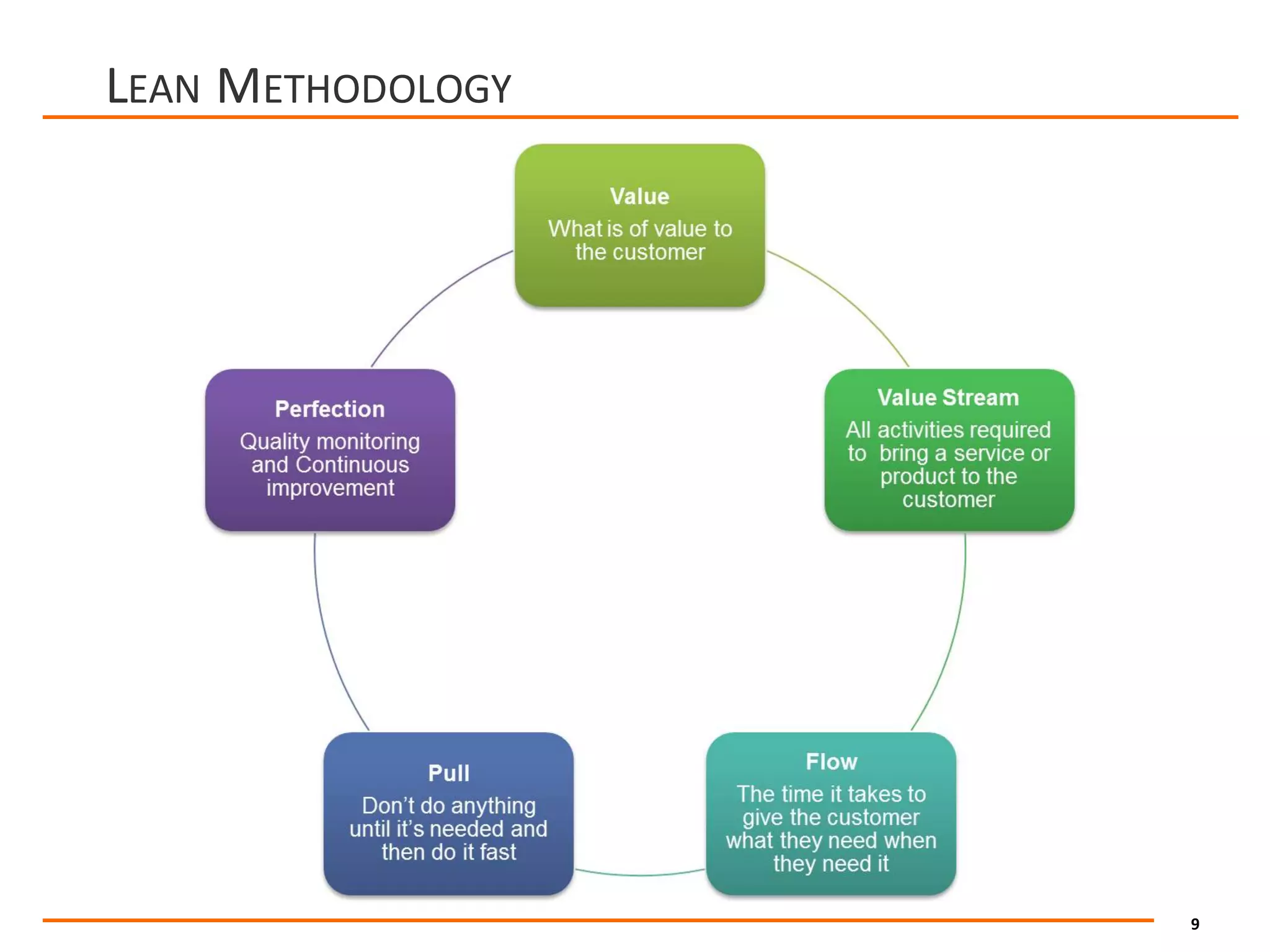
§ Lean	is	a	management	philosophy	derived	from	the	Toyota	Production	
System	(TPS)	developed	between	1948	and	1975	and	has	since	been	
applied	with	great	success	in	the	services	industry	in		recent	decades
§ In	“Lean	Thinking”,	published	in	2003,	James	P.	Womack	and	Daniel	T.	
Jones	introduced	five	fundamental	Lean	Principles.
§ Value	
§ Value	Stream
§ Flow
§ Pull	
§ Perfection
8
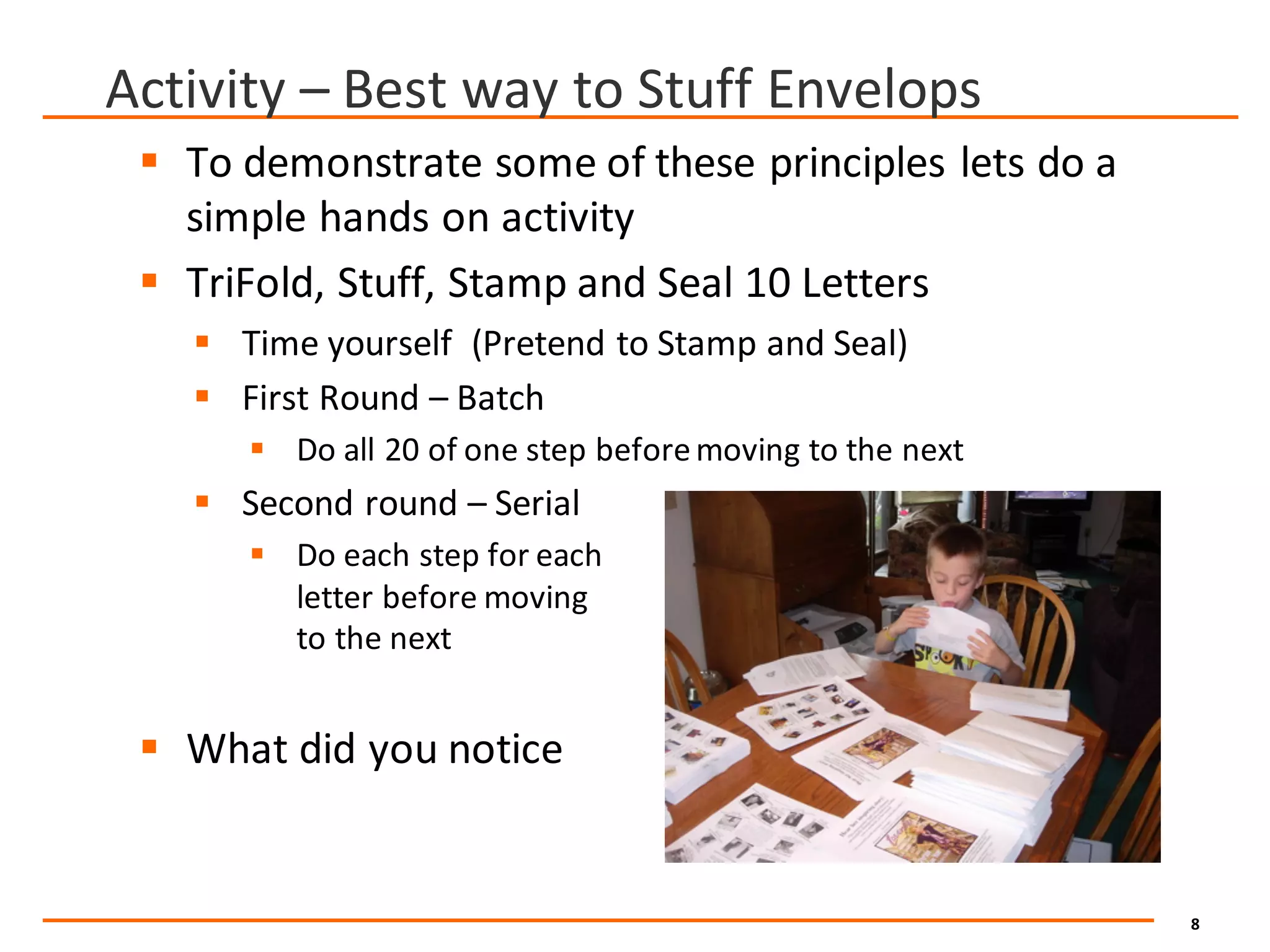
Activity	– Best	way	to	Stuff	Envelops
§ To	demonstrate	some	of	these	principles	lets	do	a	
simple	hands	on	activity
§ TriFold,	Stuff,	Stamp	and	Seal	10	Letters	
§ Time	yourself		(Pretend	to	Stamp	and	Seal)
§ First	Round	– Batch
§ Do	all	20	of	one	step	before	moving	to	the	next
§ Second	round	– Serial
§ Do	each	step	for	each	
letter	before	moving	
to	the	next
§ What	did	you	notice
9
LEAN METHODOLOGY
10
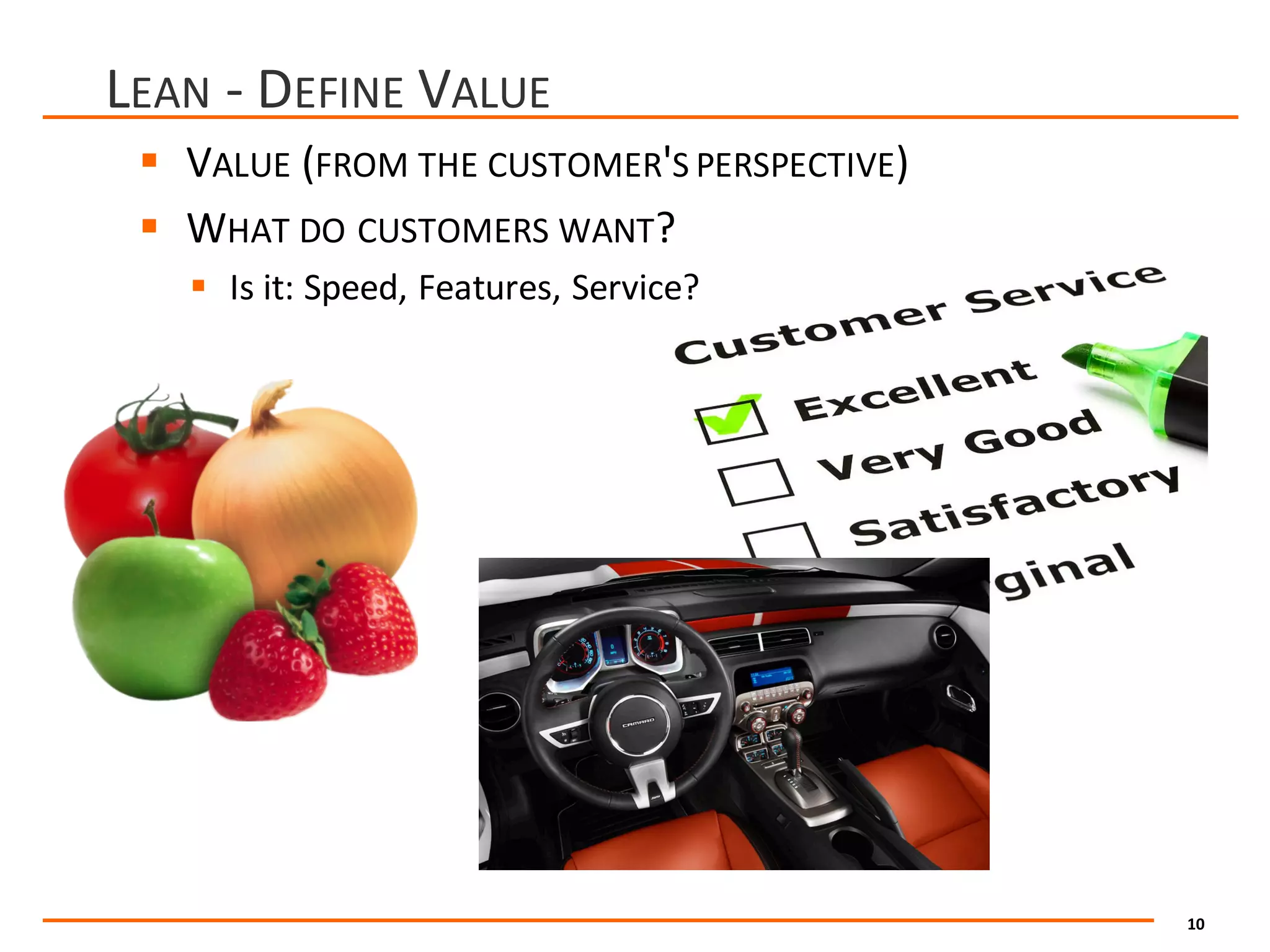
LEAN - DEFINE VALUE
§ VALUE (FROM THE CUSTOMER'S PERSPECTIVE)	
§ WHAT DO CUSTOMERS WANT?
§ Is	it:	Speed,	Features,	Service?
11
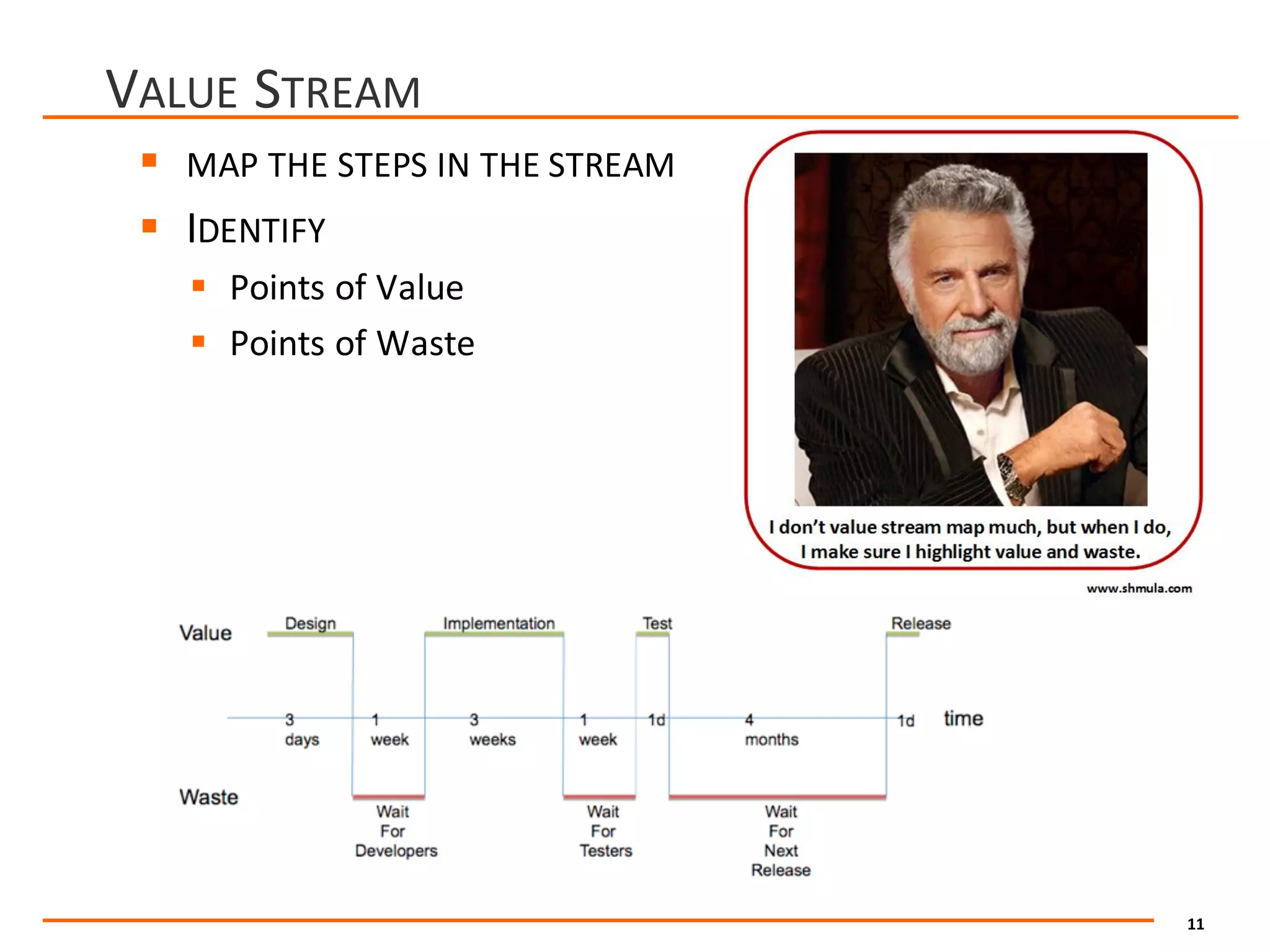
VALUE STREAM
§ MAP THE STEPS IN THE STREAM
§ IDENTIFY
§ Points	of	Value
§ Points	of	Waste
12
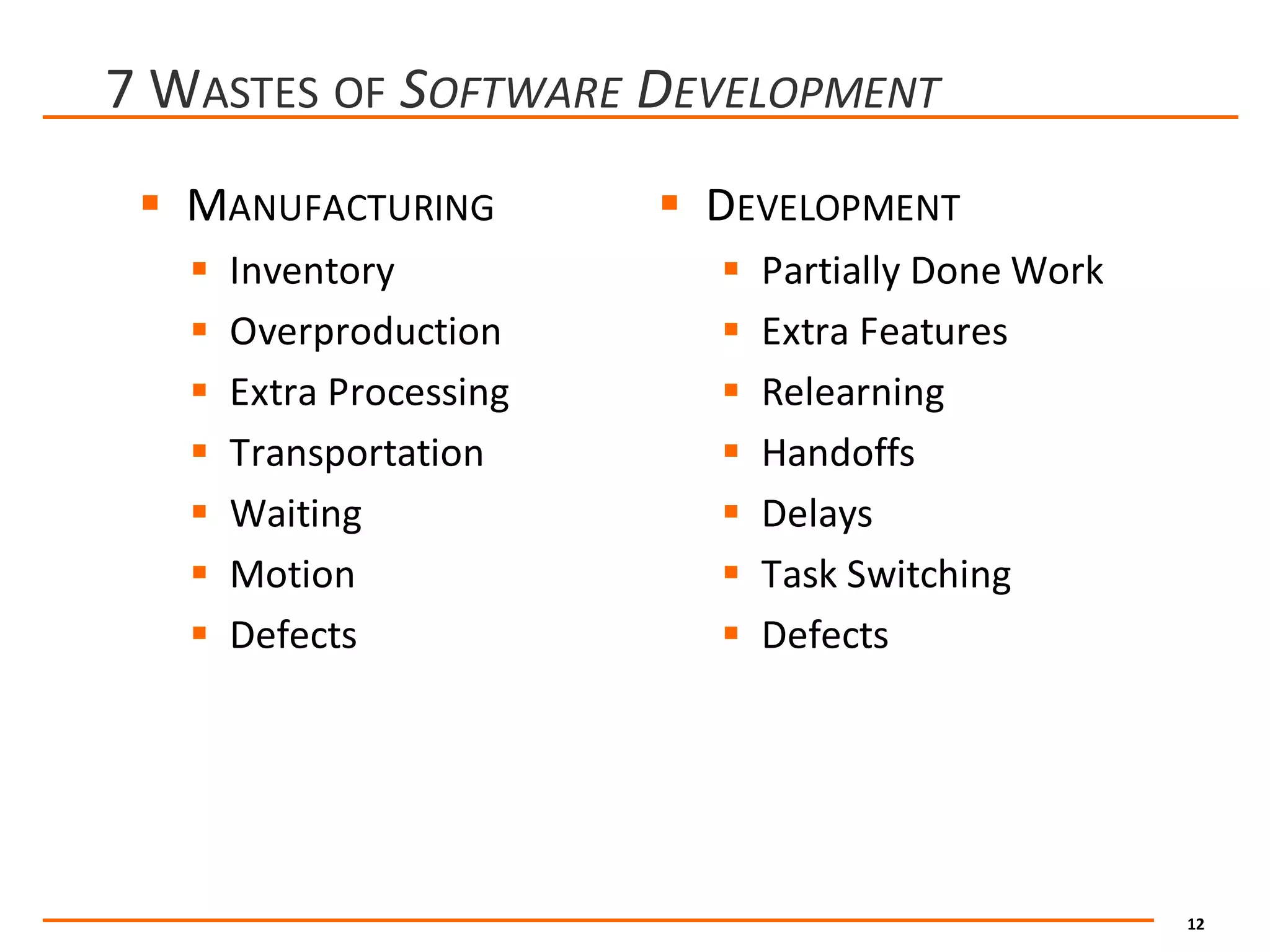
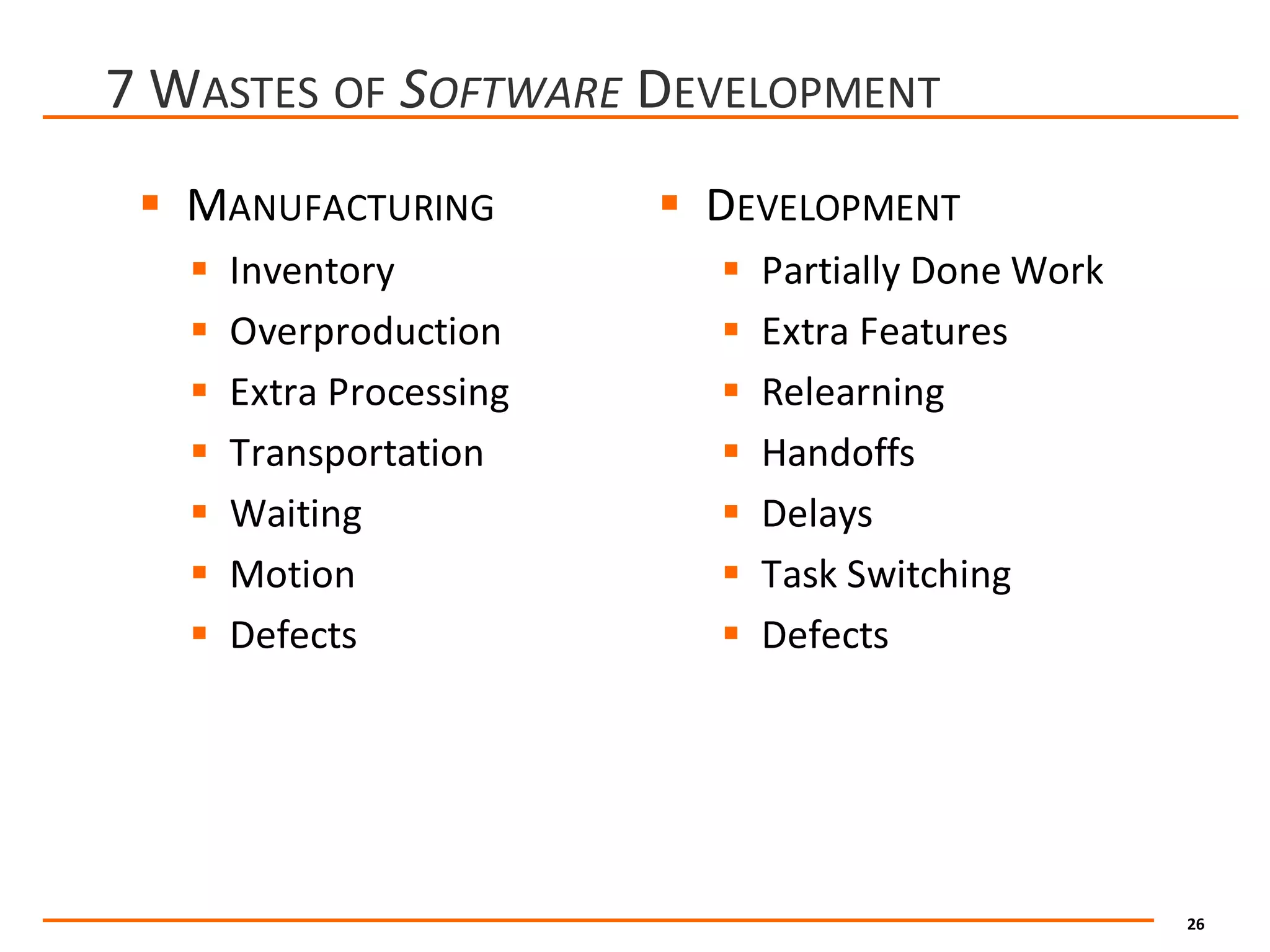
7	WASTES OF SOFTWARE DEVELOPMENT
§ MANUFACTURING
§ Inventory
§ Overproduction
§ Extra	Processing
§ Transportation
§ Waiting
§ Motion
§ Defects
§ DEVELOPMENT
§ Partially	Done	Work
§ Extra	Features
§ Relearning
§ Handoffs
§ Delays
§ Task	Switching
§ Defects
13
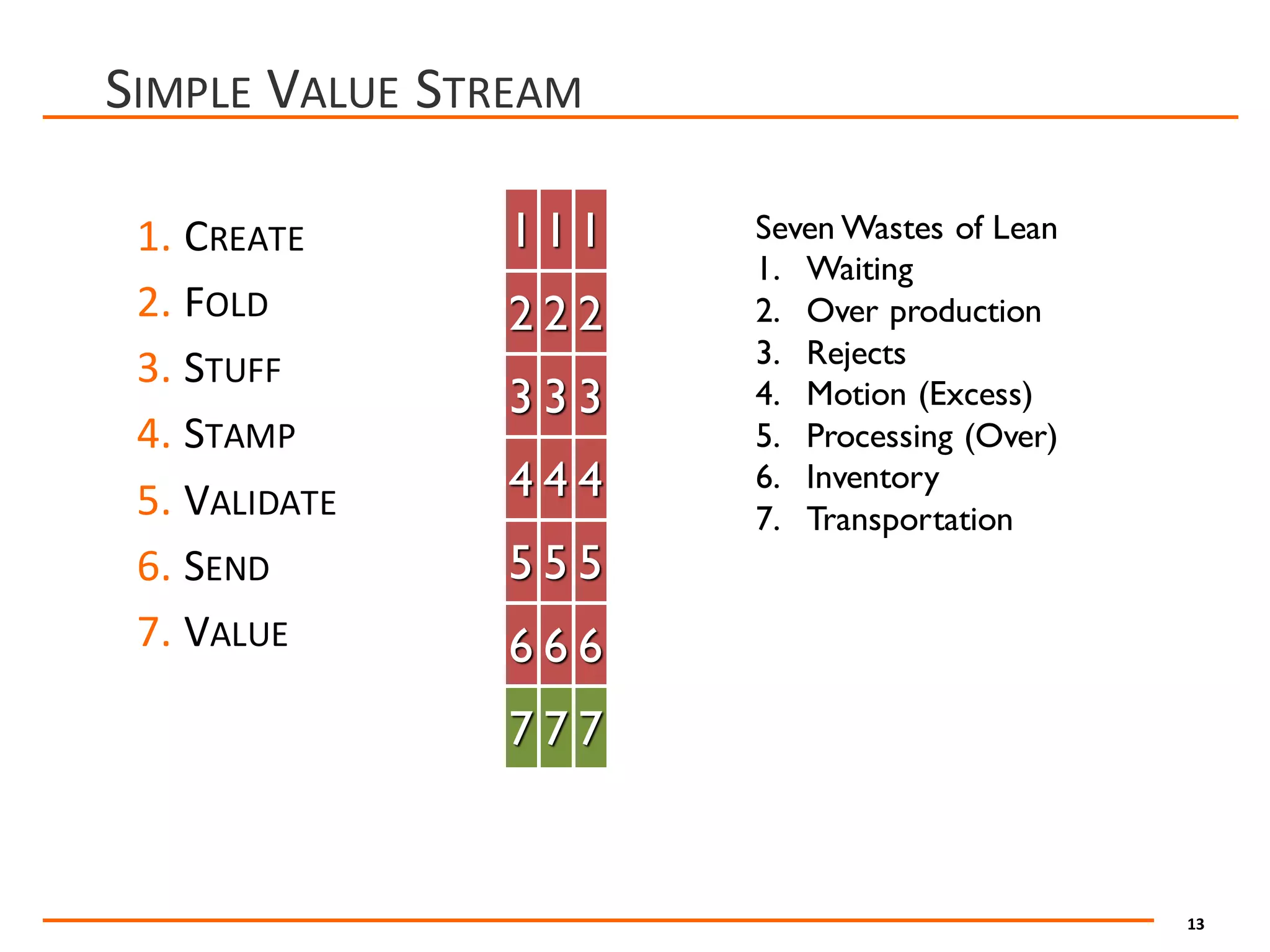
SIMPLE VALUE STREAM
1. CREATE
2. FOLD
3. STUFF
4. STAMP
5. VALIDATE
6. SEND
7. VALUE
7
666
7 7
555
444
333
222
111 Seven Wastes of Lean
1. Waiting
2. Over production
3. Rejects
4. Motion (Excess)
5. Processing (Over)
6. Inventory
7. Transportation
14
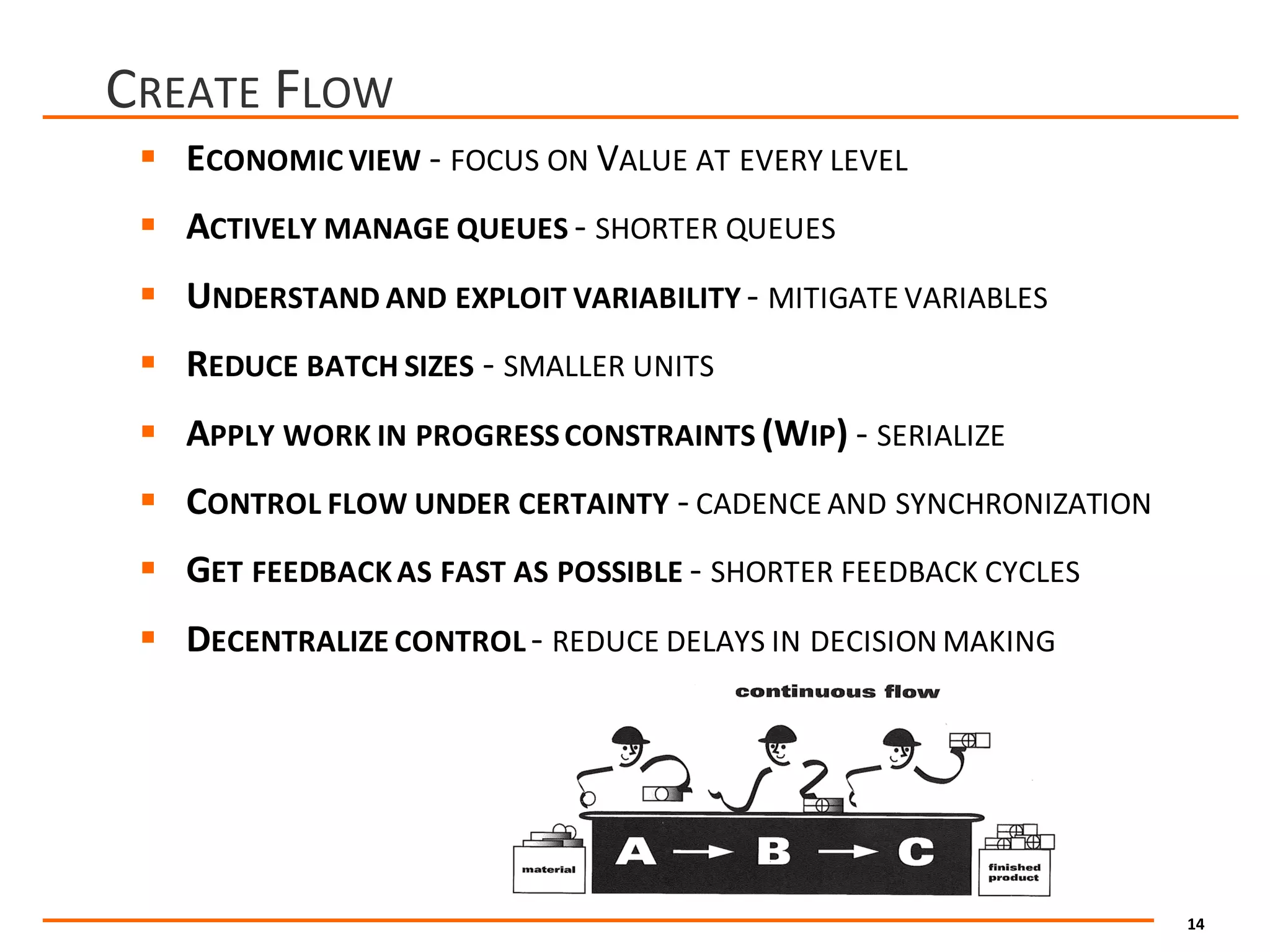
CREATE FLOW
§ ECONOMIC VIEW - FOCUS ON VALUE AT EVERY LEVEL
§ ACTIVELY MANAGE QUEUES - SHORTER QUEUES
§ UNDERSTAND AND EXPLOIT VARIABILITY - MITIGATE VARIABLES
§ REDUCE BATCH SIZES - SMALLER UNITS
§ APPLY WORK IN PROGRESSCONSTRAINTS (WIP)	- SERIALIZE
§ CONTROL FLOW UNDER CERTAINTY - CADENCE AND SYNCHRONIZATION
§ GET FEEDBACKAS FAST AS POSSIBLE - SHORTER FEEDBACK CYCLES
§ DECENTRALIZE CONTROL - REDUCE DELAYS IN DECISION MAKING
15
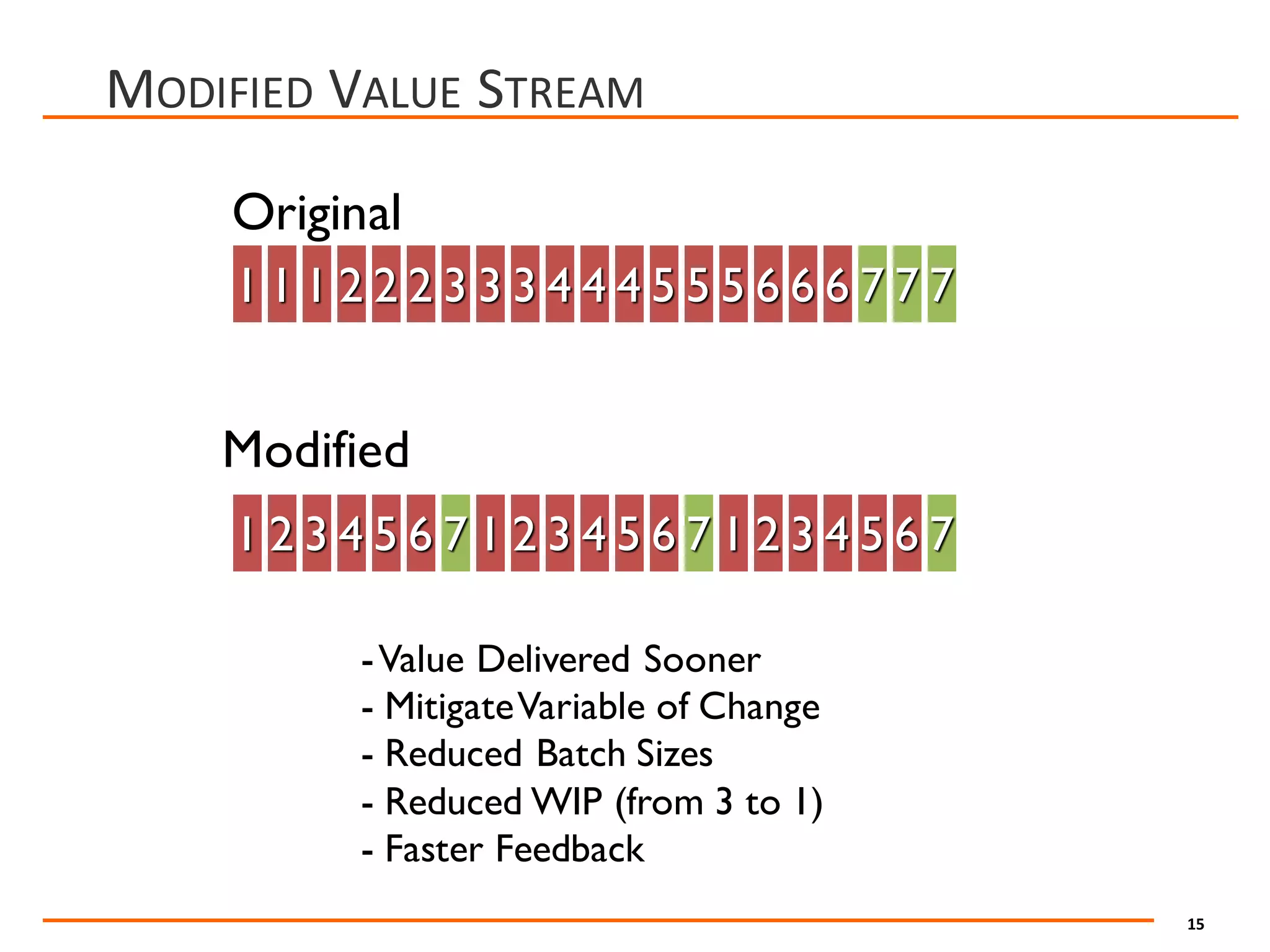
MODIFIED VALUE STREAM
1 2 3 4 5 6 7 1 2 3 4 5 6 7 1 2 3 4 5 6 7
1 2 3 4 5 6 71 2 3 4 5 6 71 2 3 4 5 6 7
Original
Modified
-Value Delivered Sooner
- MitigateVariable of Change
- Reduced Batch Sizes
- Reduced WIP (from 3 to 1)
- Faster Feedback
16
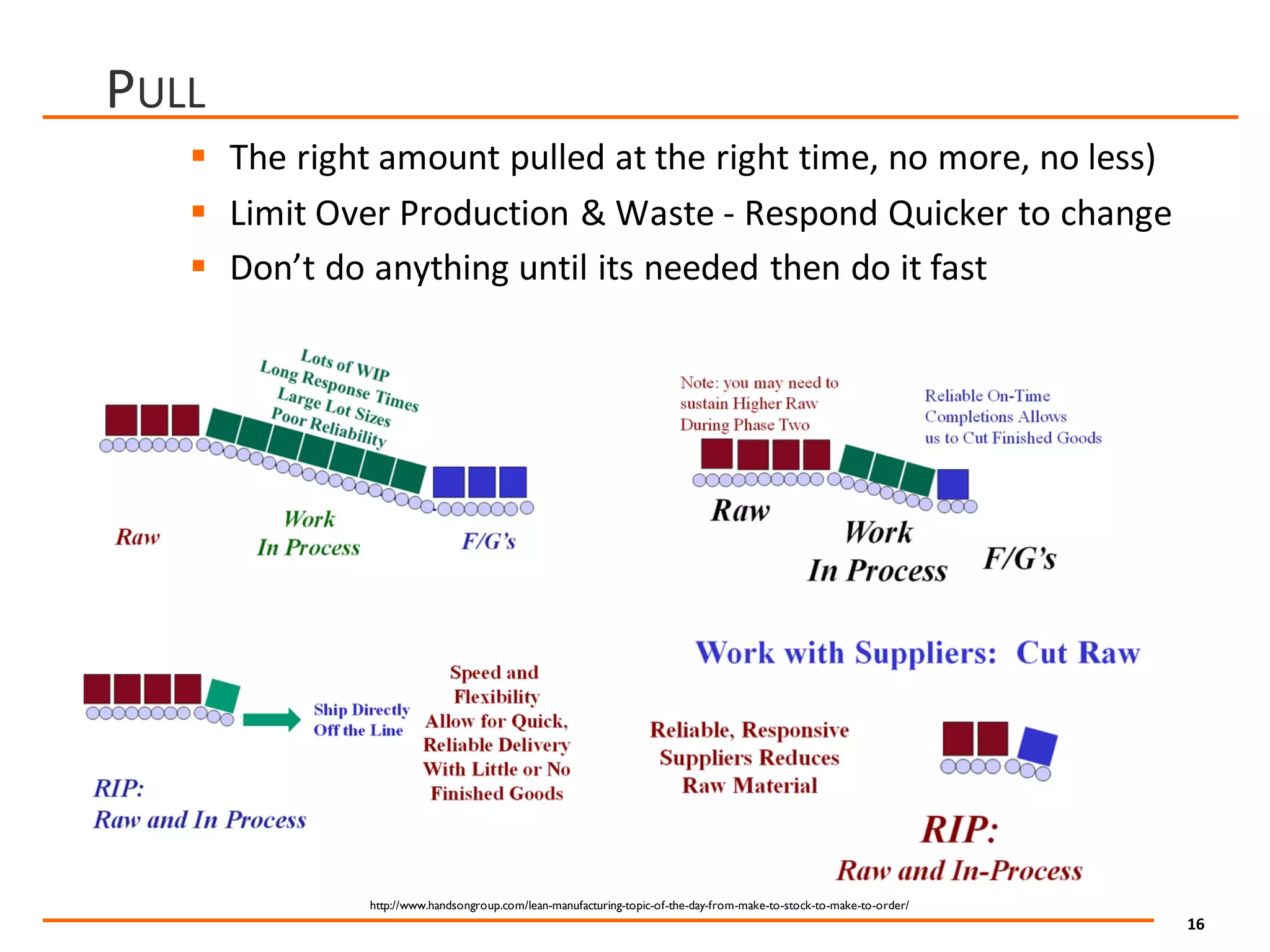
PULL
§ The	right	amount	pulled	at	the	right	time,	no	more,	no	less)
§ Limit	Over	Production	&	Waste	- Respond	Quicker	to	change
§ Don’t	do	anything	until	its	needed	then	do	it	fast
http://www.handsongroup.com/lean-manufacturing-topic-of-the-day-from-make-to-stock-to-make-to-order/
17
PERFECTION
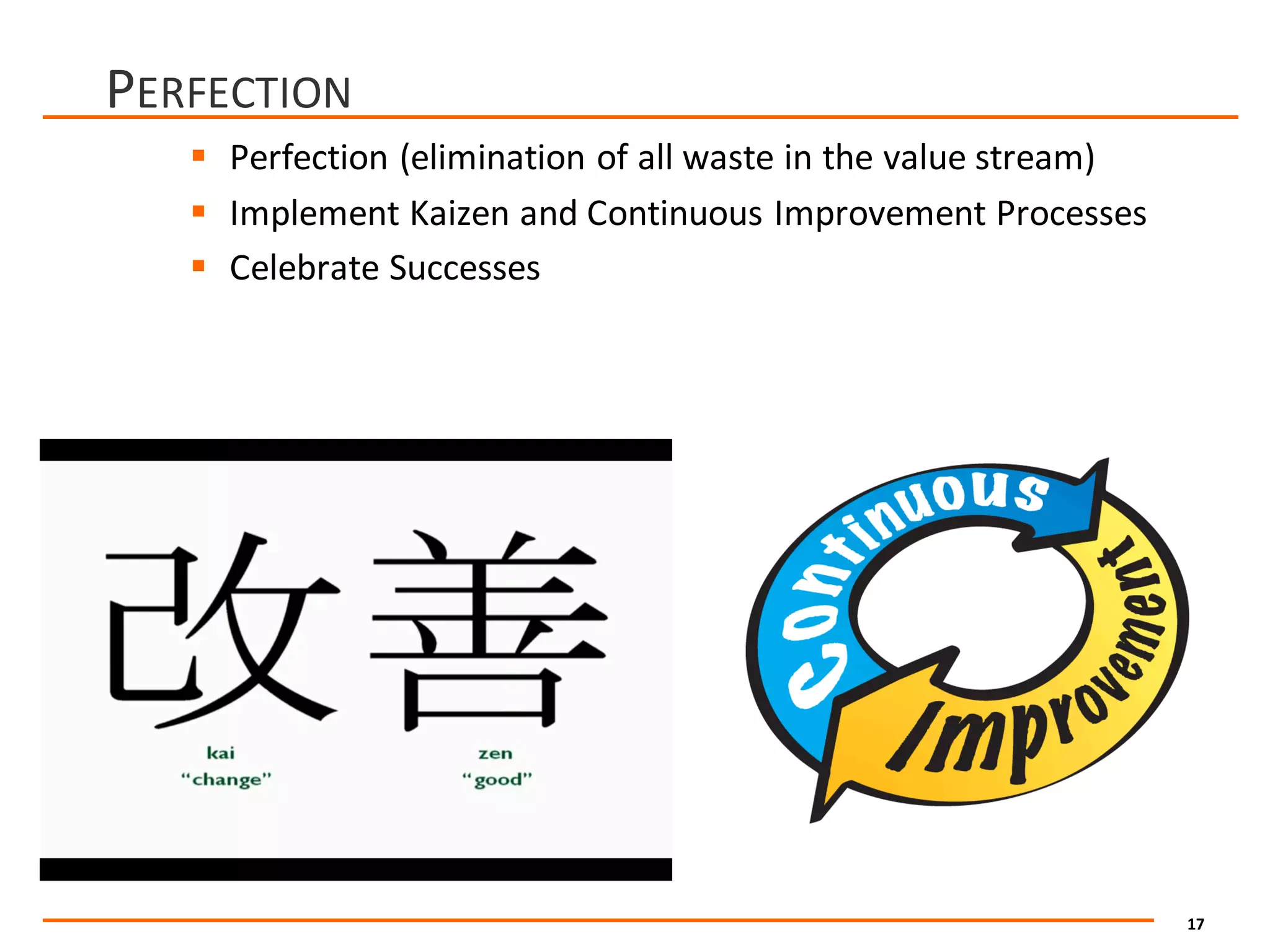
§ Perfection	(elimination	of	all	waste	in	the	value	stream)
§ Implement	Kaizen	and	Continuous	Improvement	Processes
§ Celebrate	Successes
18
REAL LIFE EXAMPLES
19
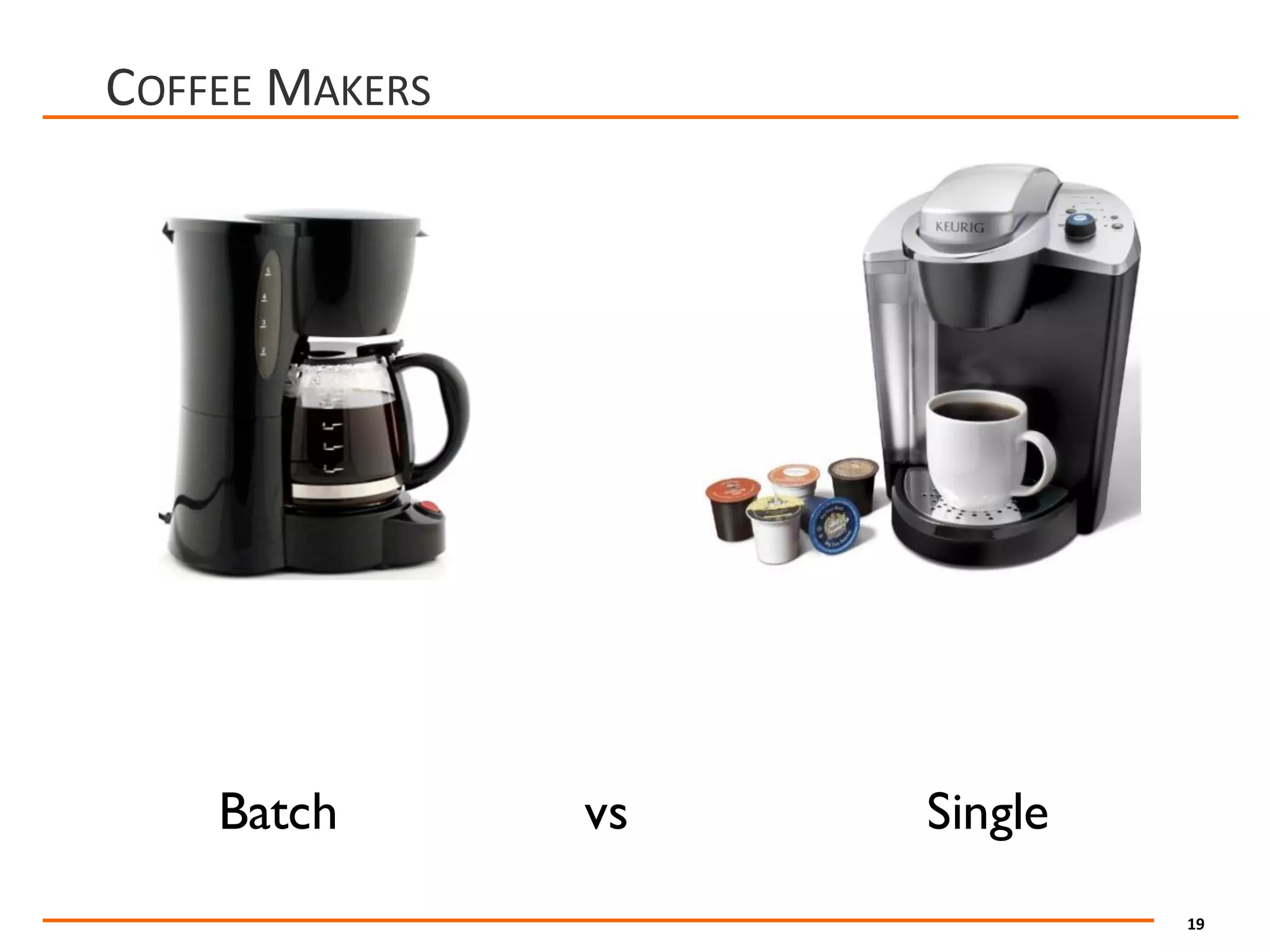
COFFEE MAKERS
Batch Singlevs
20
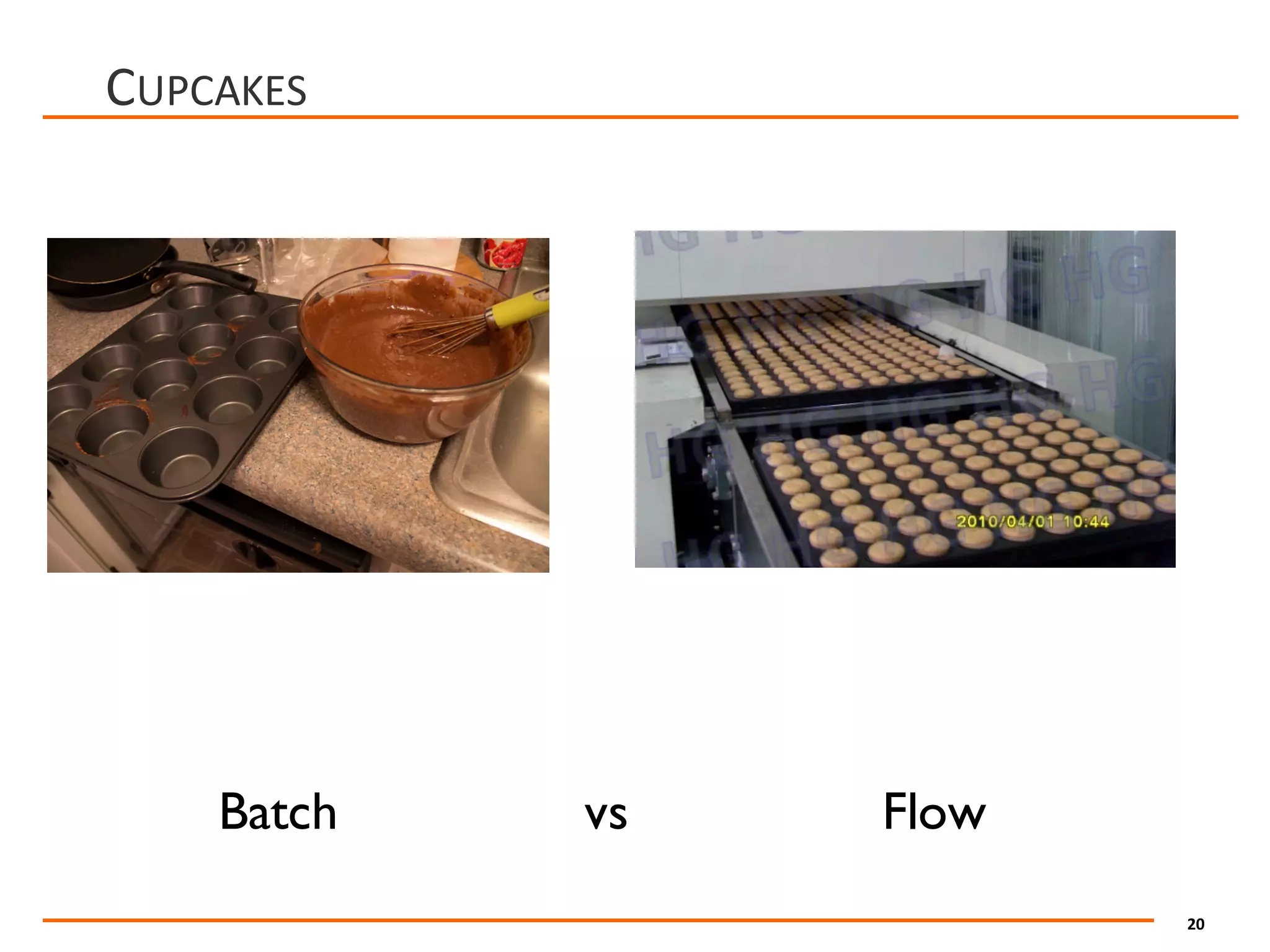
CUPCAKES
Batch Flowvs
21
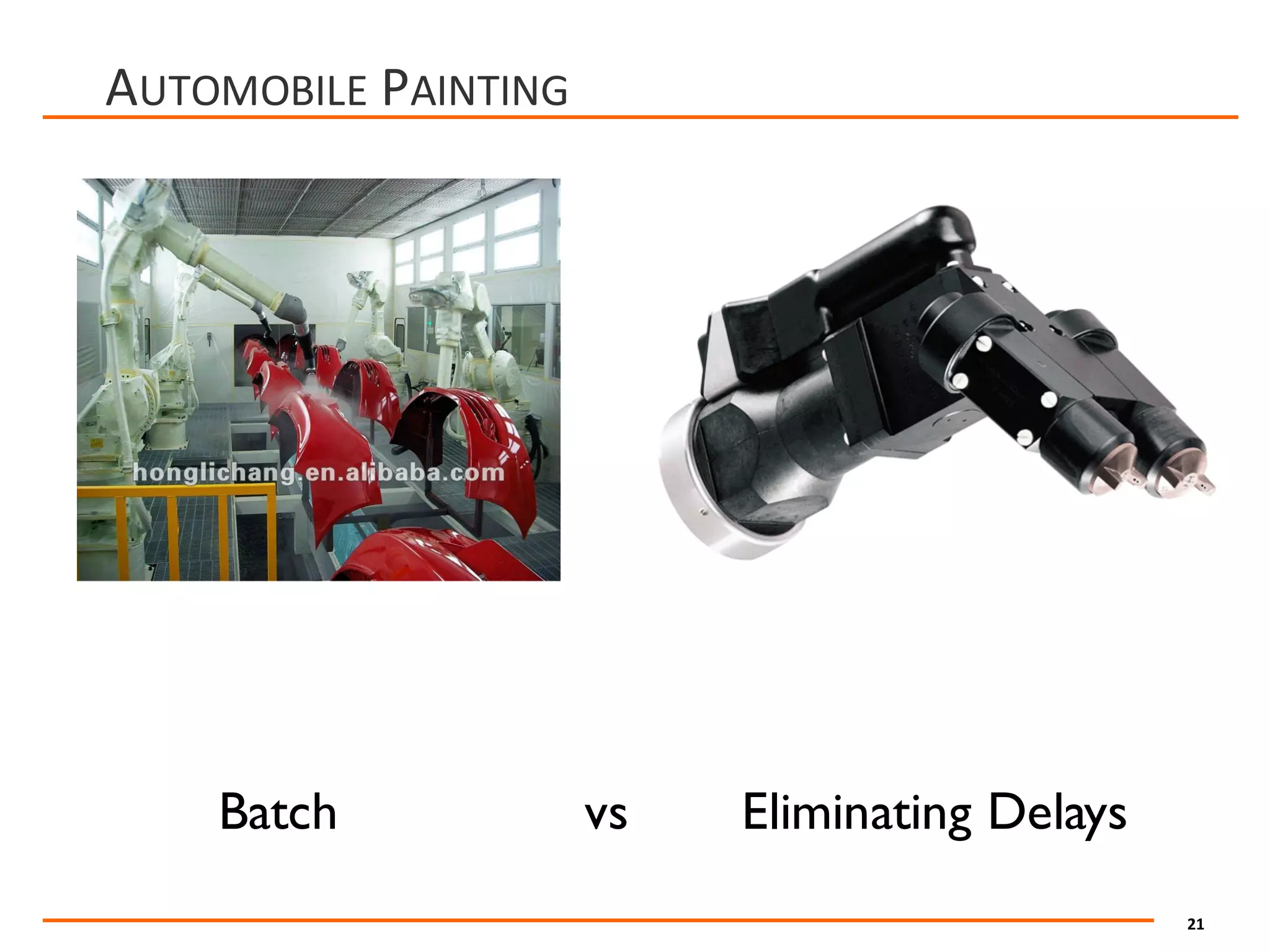
AUTOMOBILE PAINTING
Batch vs Eliminating Delays
22
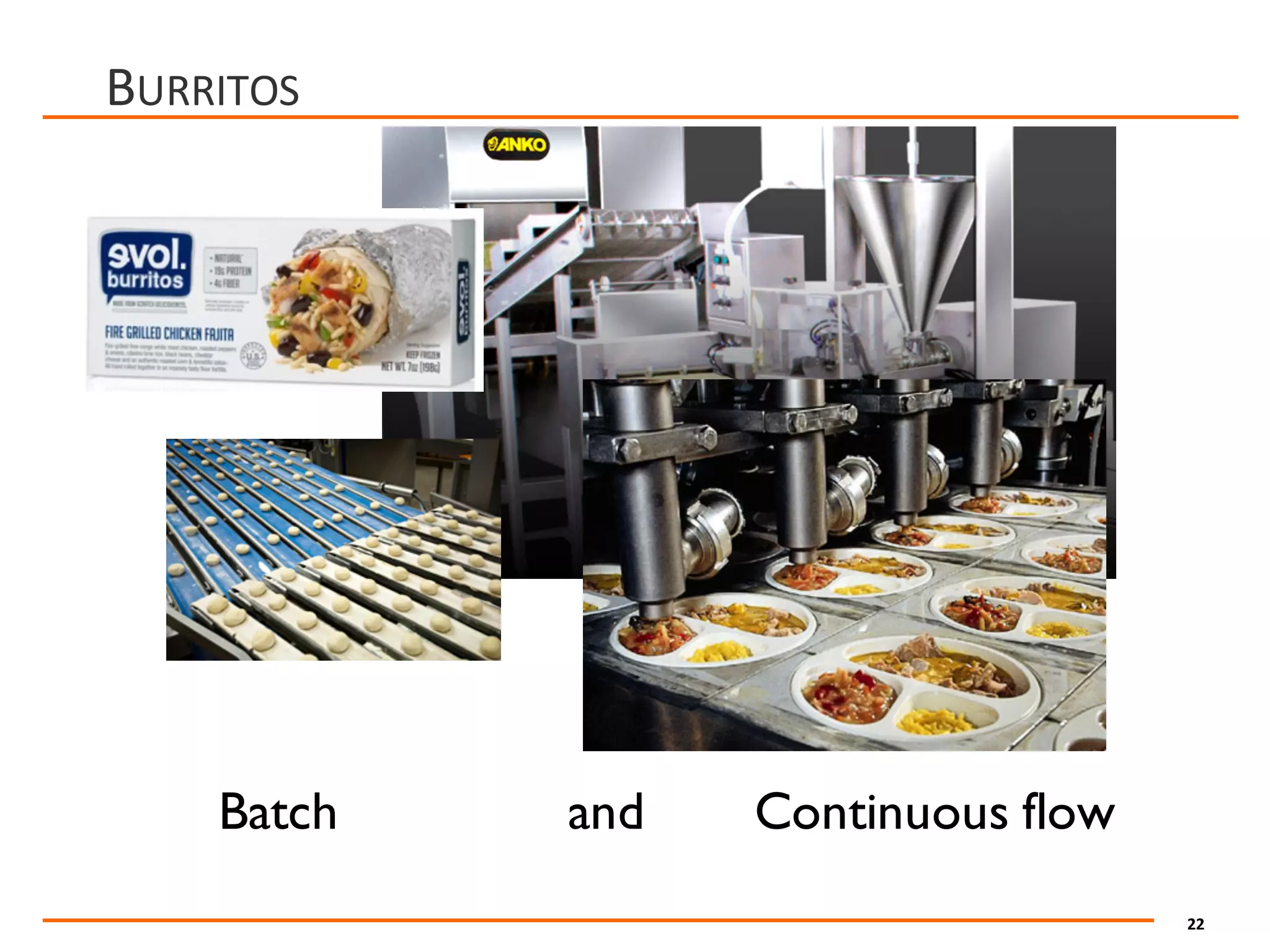
BURRITOS
Batch and Continuous flow
23
APPLYING IN LEAN IN PRACTICE
24
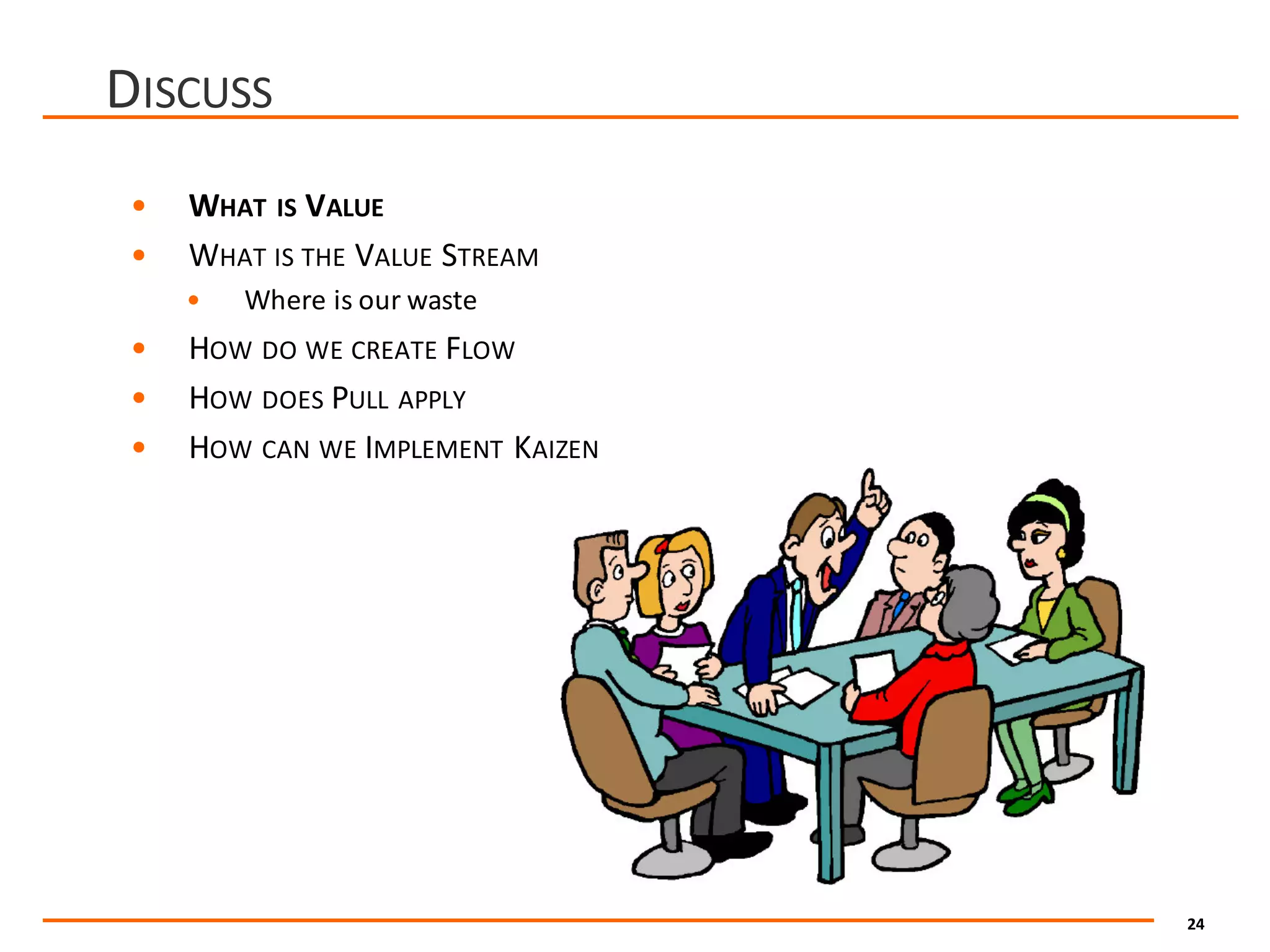
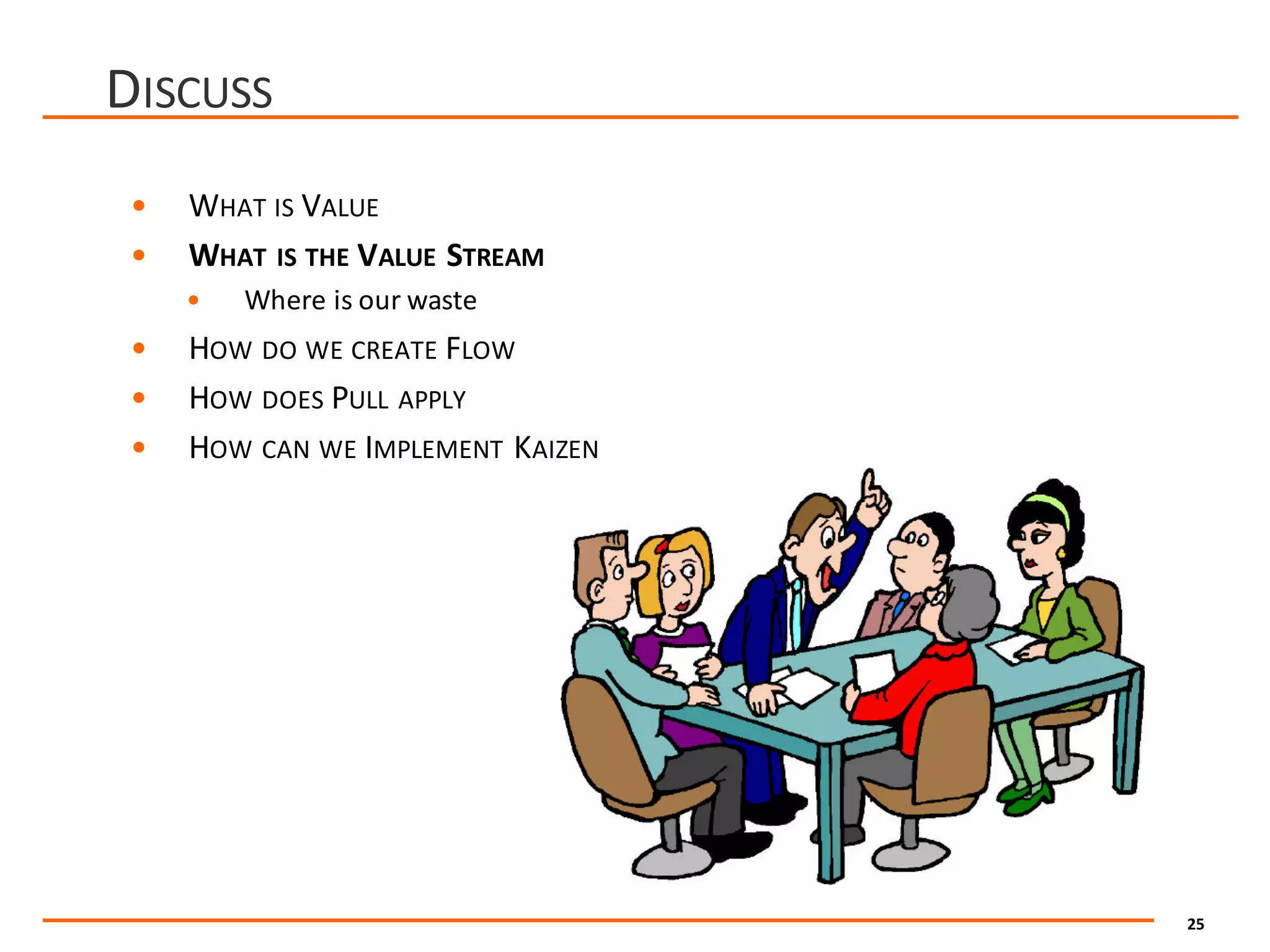
DISCUSS
• WHAT IS VALUE
• WHAT IS THE VALUE STREAM
• Where	is	our	waste
• HOW DO WE CREATE FLOW
• HOW DOES PULL APPLY
• HOW CAN WE IMPLEMENT KAIZEN
25
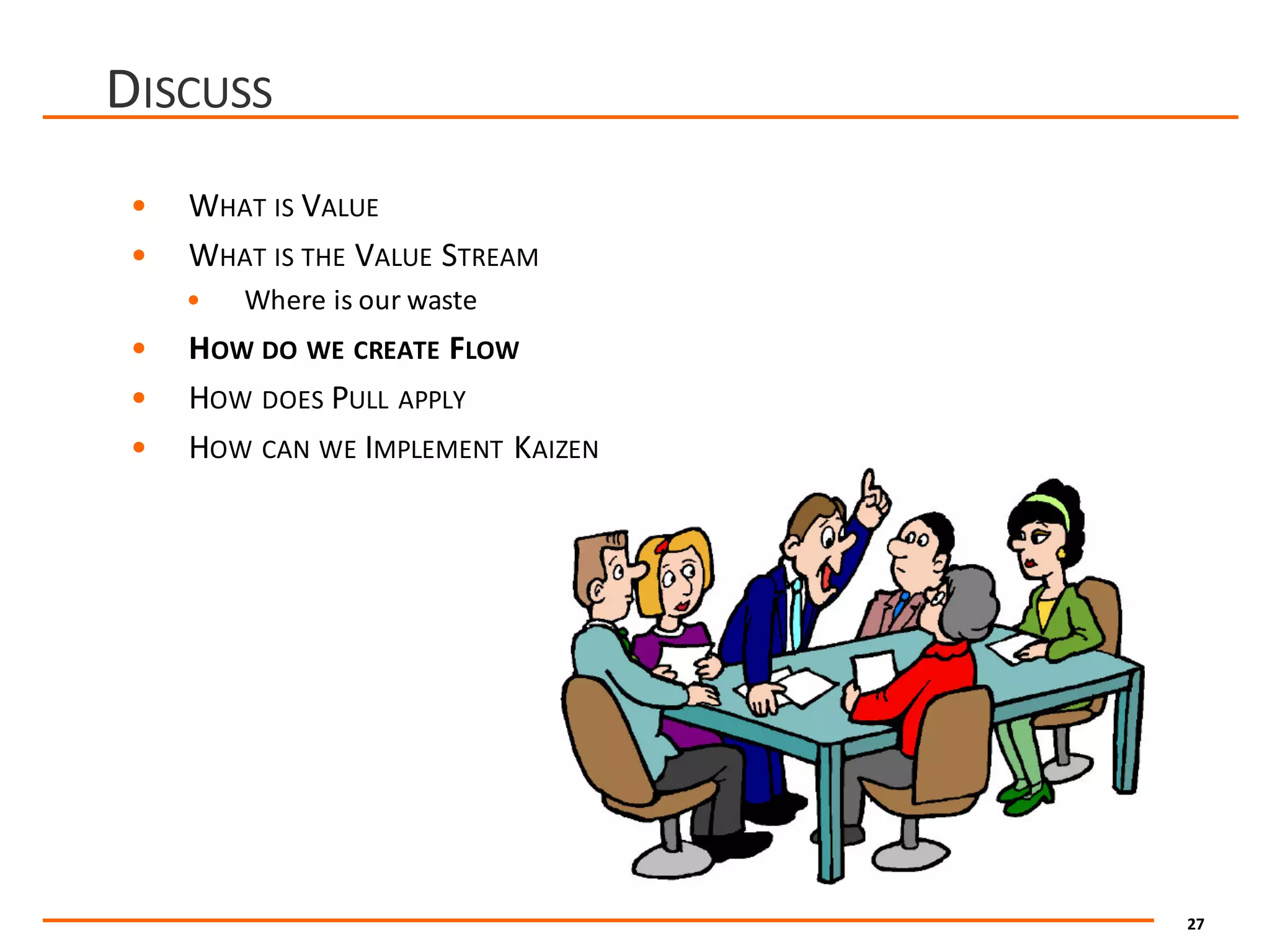
DISCUSS
• WHAT IS VALUE
• WHAT IS THE VALUE STREAM
• Where	is	our	waste
• HOW DO WE CREATE FLOW
• HOW DOES PULL APPLY
• HOW CAN WE IMPLEMENT KAIZEN
26
7	WASTES OF SOFTWARE DEVELOPMENT
§ MANUFACTURING
§ Inventory
§ Overproduction
§ Extra	Processing
§ Transportation
§ Waiting
§ Motion
§ Defects
§ DEVELOPMENT
§ Partially	Done	Work
§ Extra	Features
§ Relearning
§ Handoffs
§ Delays
§ Task	Switching
§ Defects
27
DISCUSS
• WHAT IS VALUE
• WHAT IS THE VALUE STREAM
• Where	is	our	waste
• HOW DO WE CREATE FLOW
• HOW DOES PULL APPLY
• HOW CAN WE IMPLEMENT KAIZEN
28
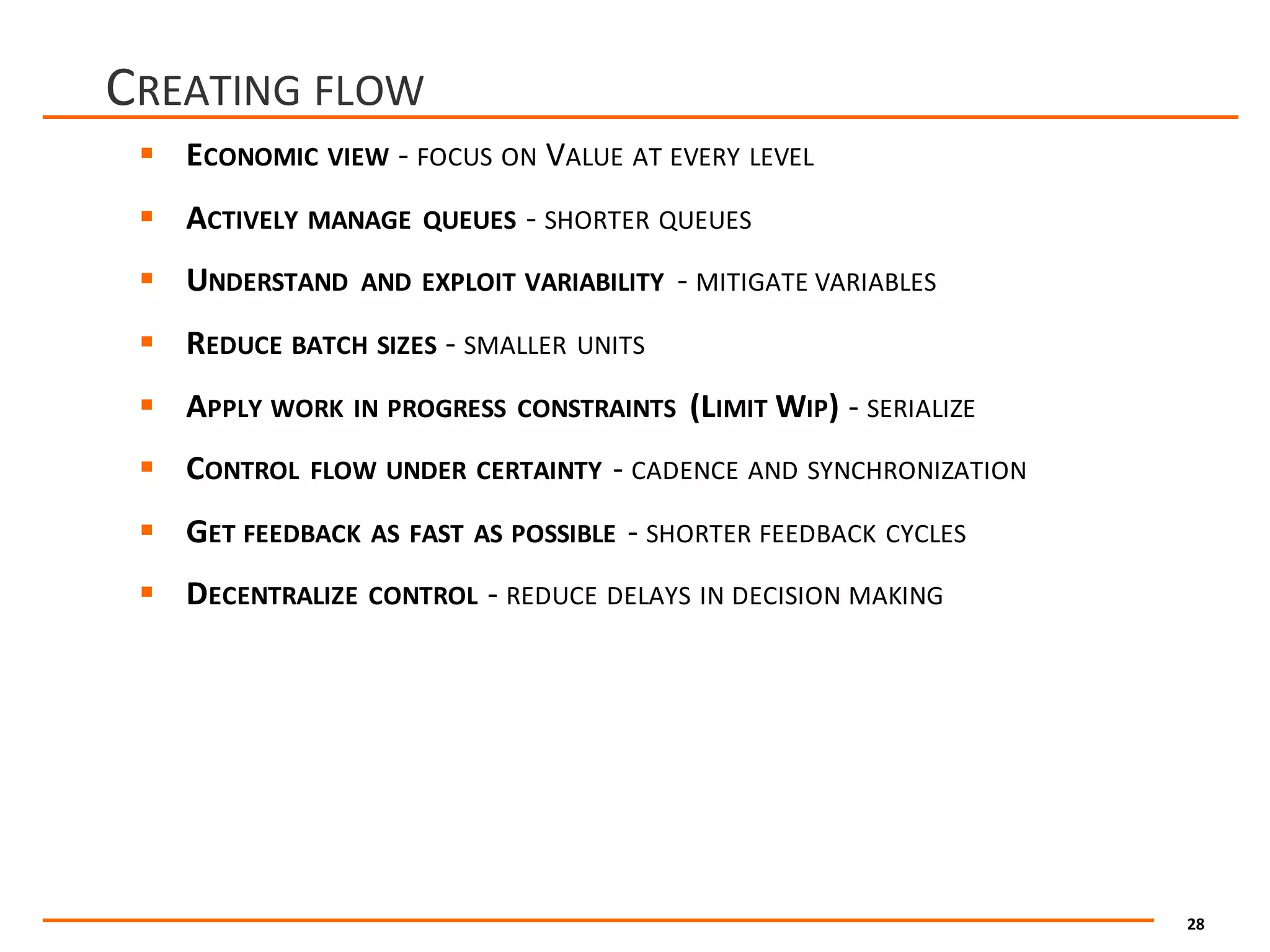
CREATING FLOW
§ ECONOMIC VIEW - FOCUS ON VALUE AT EVERY LEVEL
§ ACTIVELY MANAGE QUEUES - SHORTER QUEUES
§ UNDERSTAND AND EXPLOIT VARIABILITY - MITIGATE VARIABLES
§ REDUCE BATCH SIZES - SMALLER UNITS
§ APPLY WORK IN PROGRESS CONSTRAINTS (LIMIT WIP)	- SERIALIZE
§ CONTROL FLOW UNDER CERTAINTY - CADENCE AND SYNCHRONIZATION
§ GET FEEDBACK AS FAST AS POSSIBLE - SHORTER FEEDBACK CYCLES
§ DECENTRALIZE CONTROL - REDUCE DELAYS IN DECISION MAKING
29
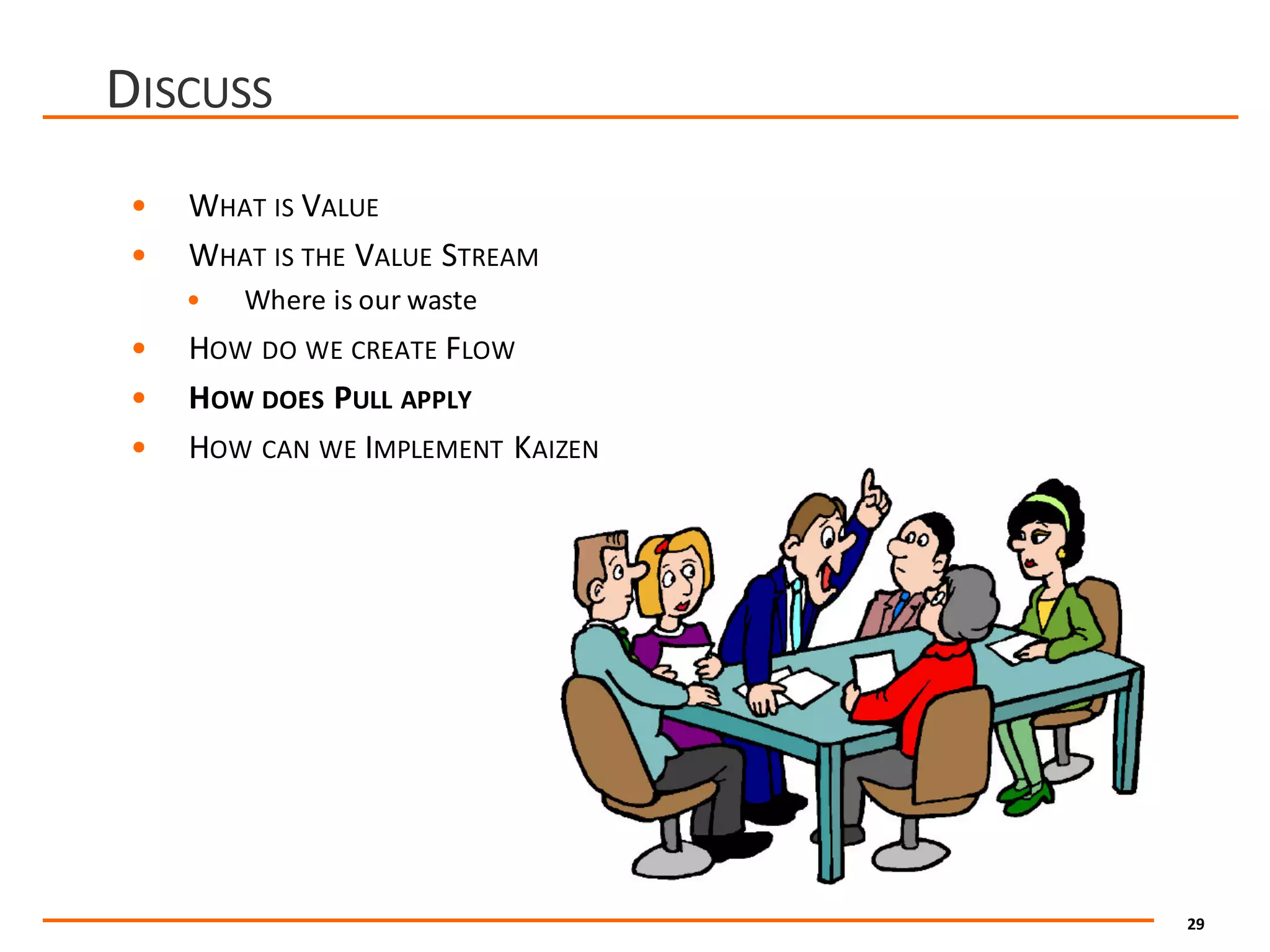
DISCUSS
• WHAT IS VALUE
• WHAT IS THE VALUE STREAM
• Where	is	our	waste
• HOW DO WE CREATE FLOW
• HOW DOES PULL APPLY
• HOW CAN WE IMPLEMENT KAIZEN
30
CREATING FLOW
§ The	right	amount	pulled	at	the	right	time,	no	more,	no	less)
§ Limit	Over	Production	&	Waste
§ Respond	Quicker	to	change
§ Don’t	do	anything	until	its	needed	then	do	it	fast
31
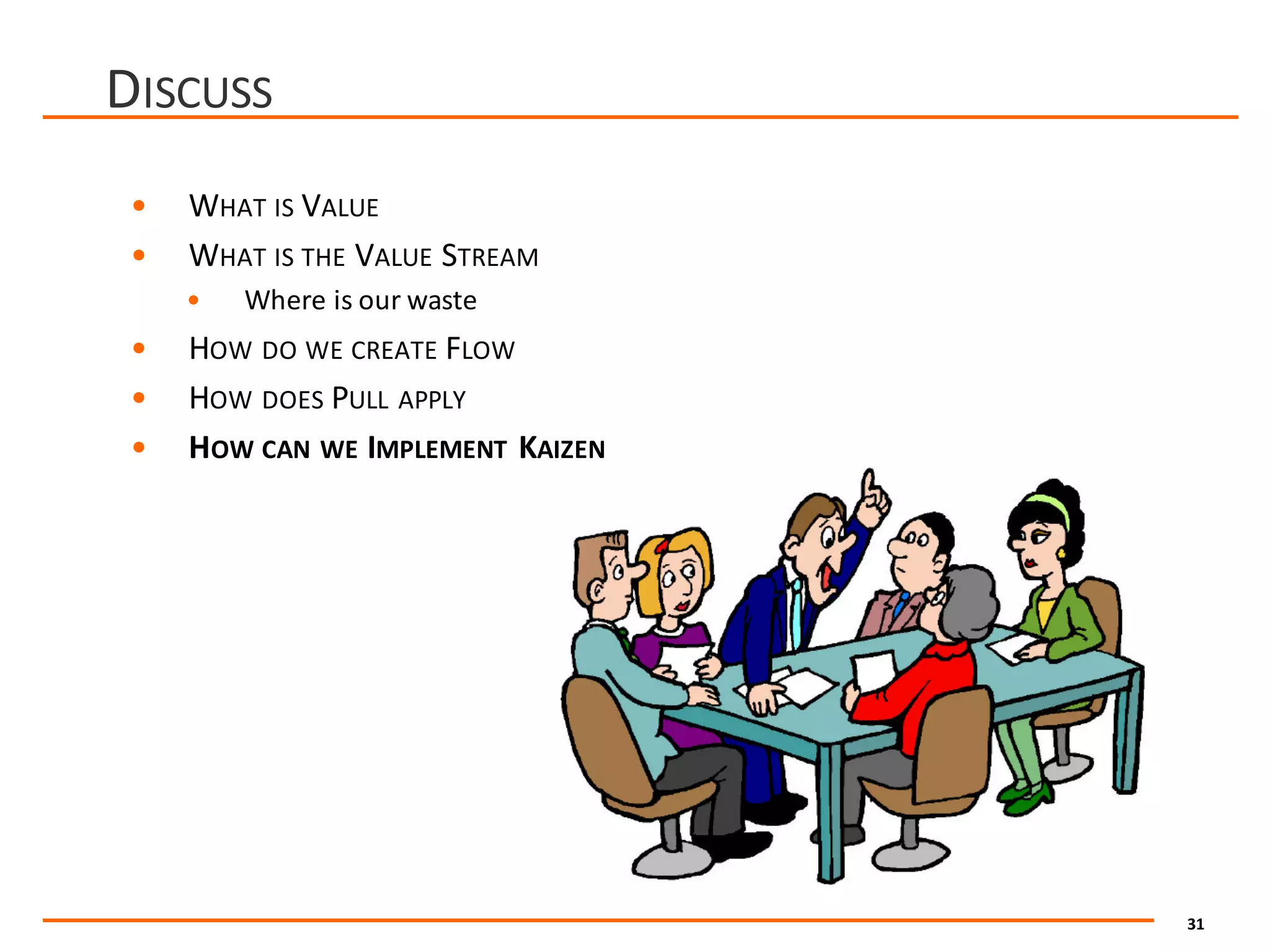
DISCUSS
• WHAT IS VALUE
• WHAT IS THE VALUE STREAM
• Where	is	our	waste
• HOW DO WE CREATE FLOW
• HOW DOES PULL APPLY
• HOW CAN WE IMPLEMENT KAIZEN
32
BREAK
33
APPENDIX
34
METHODOLOGY RESOURCES
http://scaledagileframework.com/
http://www.scaledagileacademy.com/
35
FOCUS AREA RESOURCES
36
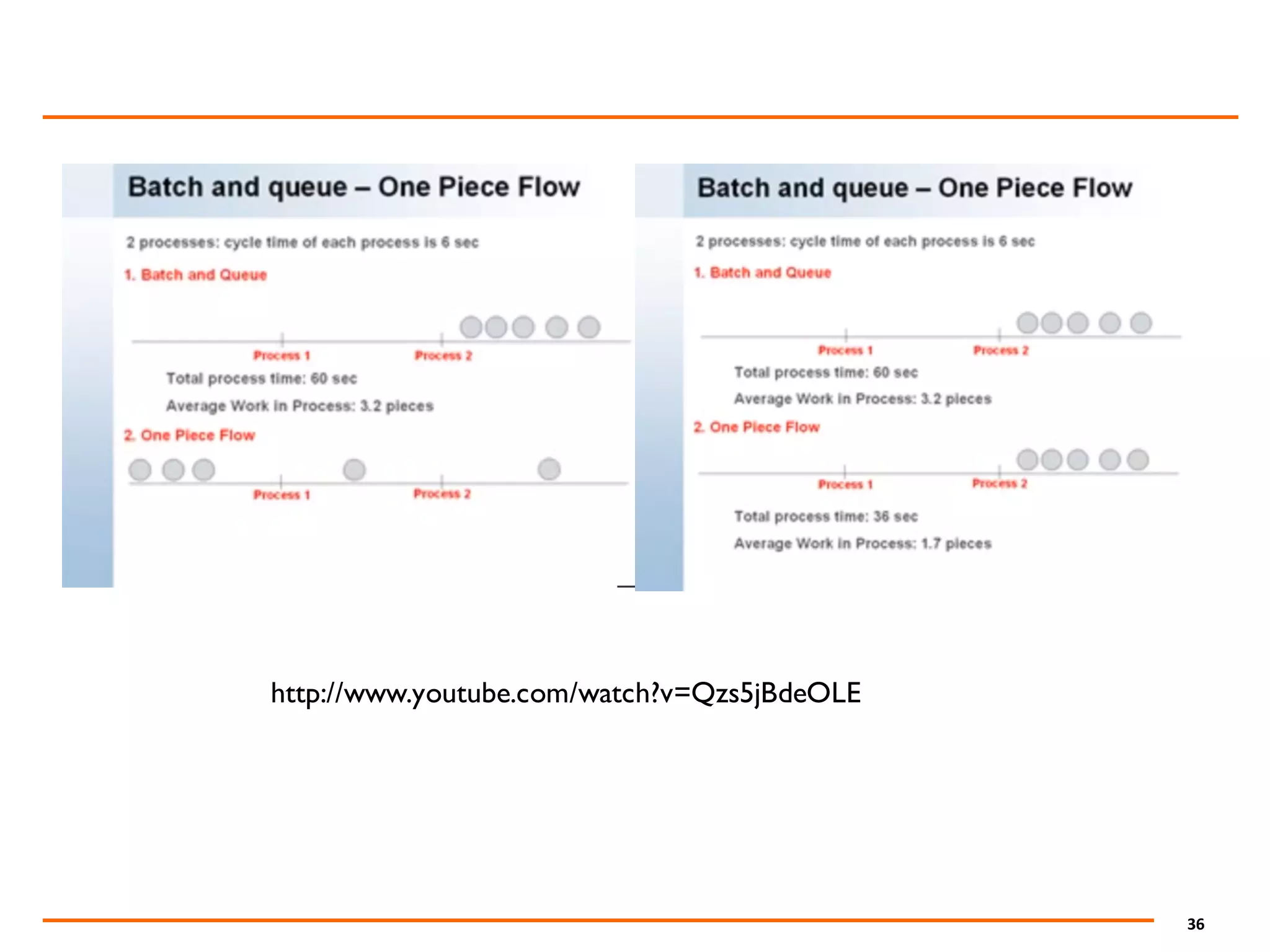
http://www.youtube.com/watch?v=Qzs5jBdeOLE
37
RESOURCES
§ HTTP://WWW.AMAZON.COM/LEAN-UX-PRINCIPLES-
EXPERIENCE-EBOOK/DP/B0074KA0A4

Lean Software Development