LEAN ON
HUMAN RESOURCES
MANAGEMENT
Human Resources and Lean; It Really Is About People
AGENDA
• Assessment 4P
• Lean Mindset
• Lean On HRM
For Self Assessment ?
4P
4P Assessment
PURPOSE
1. Vision, Mission and Values 2. Lean Linkage to the business 3. Hoshin Planning
3
Ditetapkan dengan masukan dari
semua Organisasi: semua
organisasi Mempengaruhi
keputusan sehari-hari untuk
dimintai pertanggung jawaban
3
Lean adalah cara kita berbisnis
dan terkait langsung dengan
kebutuhan bisnis
3
Ada keterlibatan dan keselarasan di
seluruh organisasi dalam
merumuskan perbaikan yang
terkait dengan kebutuhan bisnis
2
Ditetapkan dan dikomunikasikan
tetapi tidak mempengaruhi
pekerjaan sehari-hari dan
keputusan
2
Lean dikaitkan dengan tujuan
"Operasional" seperti
pengurangan biaya
2
Ada kantong-kantong perencanaan
“perbaikan proses” yang sedang
berlangsung tetapi tidak ada
keselarasan atau koordinasi
1
Ditetapkan tetapi tanpa masukan
dari seluruh organisasi 1
Lean didelegasikan dan
merupakan sistem paralel
dengan "bisnis"
1
"Manajemen by Objectives" dan
penurunan tujuan "berbasis hasil"
numerik ke organisasi
0 Tidak ditetapkan atau telah usang 0
Lean tidak ditetapkan sebagai
metodologi peningkatan bisnis
0
Tujuan organisasi bersifat sporadis
atau hap-hazard
4P Assessment
PROCESS
4. Operation System - Flow
5. Operation System: Tools 5S, Standardisation &
Visualisation
3
Flow proses saat ini, diukur dan digunakan
untuk mengidentifikasi masalah
3
Alat adalah bagian dari budaya dan dipahami
serta digunakan untuk mengidentifikasi dan
memecahkan masalah
2
Flow proses dipertimbangkan dari perspektif
pelanggan tetapi inventaris masih digunakan
untuk "menangani atau menutupi masalah"
2
Alat sudah ada tetapi tidak digunakan untuk
mengidentifikasi dan memecahkan masalah
1
Flow proses hanya dipertimbangkan di
beberapa aktivitas organisasi
1
Kantong alat diterapkan tetapi tidak
dipertahankan
0
Tidak ada pertimbangan flow proses dari
"order to cash"
0 Tidak ada alat yang digunakan
4P Assessment
6. Role of Problem Solving
3
Peran dan sistem yang ada untuk setiap lapisan dalam organisasi untuk
mengidentifikasikan dan memecahkan masalah.
2
Pemecahan masalah dilakukan oleh supervisor dan anggota tim tetapi
sebagian besar adalah “fire figthing"
1
Pemecahan masalah terutama dilakukan oleh para pemimpin, manajer,
dan “engineer"
0
Tidak ada pemecahan masalah yang terjadi,, hanya fire fighting and
containment
4P Assessment
PEOPLE
7. Leadership Development 8. Role of HR and System
3
Proses nilai organisasi atas hasil dan sistem tersedia
bagi para pemimpin untuk dimintai
pertanggungjawaban sebagai pelatih, guru, dan
mengembangkan orang-orang mereka
3
HR adalah “Keeper of the Value". Mereka
memiliki proses seperti perekrutan,
pemberhentian dan promosi untuk menjadi
"check and balance" dari organisasi
2
Kantong pemimpin yang menghargai dan
mempraktikkan "pengajaran dan pembinaan"
2
HR adalah mitra operasi dengan beberapa proses
untuk mendukung lean
1
Pemimpin berfokus pada hasil dan "mengelola
orang"
1
HR aktif dalam operasi tetapi tidak terlibat
langsung dalam strategi lean
0 Pengembangan manusia bukanlah prioritas 0
HR adalah “Compliance Organization" yang
berfokus pada admin seperti penggajian,
tunjangan, dll.
4P Assessment
Element 1 Score
Element 2 Score
Element 3 Score
Average
Element 4 Score
Element 5 Score
Average
Element 6 Score
Average
Element 7 Score
Element 8 Score
Average
Lean Mindset dan Lean Operation HRM
untuk Keunggulan Daya Saing
Kenapa HRD Membutuhkan “LEAN” ?
MASS VS LEAN COMPANY
# Jumlah Karyawan
Hanya sedikit karyawan memiliki
keterampilan dan keterampilan mereka
rendah
Karyawan yang memiliki potensial tidak
diberdayakan dengan baik
MASS COMPANY
# Jumlah Karyawan
Karyawan banyak memiliki keterampilan.
Mereka dapat mengontrol dirinya sendiri,
berpikir sendiri dan dapat memotivasi dirinya
sendiri.
LEAN COMPANY
Permasalahan terhebat dalam Organisasi, dan itu membutuhkan untuk diperbaiki segera :
People :
a. Pengetahuan tentang tingkah
laku membuat "Orang yang
Bergantung" bukan "Sistem
yang Tergantung“→ Silo's know-
how”
b. Silo’s / sesuai pola pikir /
kurangnya kompetensi
c. Perbedaan dalam pola pikir
antara Karyawan yang ada
(lama) and Karyawan baru
d. Tidak ada keterampilan
Manajemen dan Kepemimpinan
yang tepat
e. 3 level konflik :
- Konflik Individu
- Karyawan – Karyawan
- Karyawan – Pemilik
Workplace :
a. Perbaikan sporadis dan sektoral,
tidak ada pendekatan struktur
dalam pemecahan masalah
b. Tidak ada master operasional
per departemen yang jelas
c. Terjadi kembali terjadinya
masalah akibat pemadaman
kebakaran dan tindakan
penahanan saja, bukan eliminasi
akar penyebab
d. Tidak ada integrasi inisiatif
perbaikan utama untuk
Keunggulan Operasional:
- TPM : Meningkatkan keandalan
mesin
- Six sigma : Meningkatkan variasi
kualitas
- Lean : Perbaikan terus menerus
Business
1. Fokus hanya pada KPI/Action Plan
Deptnya sendiri, berdampak
negatif terhadap Departemen dan
Bisnis lain (primer vs konsekuensial
metrik)
2. Tidak ada penyelarasan Prioritas
Departemen
3. Tidak ada KPI/ Action Plan
keselarasan (Tujuan SILO)
4. Tidak ada kolaborasi yang sejajar /
lemah antara:
- Commercial & Industrial team
dalam Perusahaan
- Jabatan dalam Fungsional
5. Tidak ada kolaborasi yang sejajar /
lemah :
- Departments dalam Perusahaan
- Fungsional dalam Department
Berpikir LEAN
I Increase VA
C Cust. Satisfaction
R Reduce Waste
C Cont.Improvement
Berpikir LEAN
• Enabler: Segala aktifitas yang tidak
menambah nilai, tapi perlu dilakukan agar
proses tetap berjalan.
 Tidak bernilai Tambah (Non Value Added):
Segala aktifitas yang tidak menambah nilai
terhadap produk tetapi menambah biaya
(PEMBOROSAN) .
 Nilai Tambah (Value Added): Segala aktifitas
yang merubah bentuk, kegunaan atau fungsi
material untuk memenuhi permintaan
pelanggan atau aktivitas yang bersedia
dibayar pelanggan.
PERILAKU POKOK
LEAN IMPLEMENTATION
10
1. Pertanyakan segala cara dalam berproduksi
2. Lebih baik memikirkan cara untuk dapat
melaksanakannya dari pada mencari alasan
mengapa tidak bisa dilaksanakan
3. Jangan banyak ber-argumentasi, mulailah dengan
mempertanyakan kondisi saat ini.
4. Jangan menunggu solusi sempurna, 50% juga OK,
tapi segera lakukan
5. Bila terjadi kesalahan, segera perbaiki
6. Hindari penggunaan uang tetapi gunakan
kreativitas untuk improvement.
7. Kalau tidak ada kesulitan, “Ide Perbaikan” tidak
akan muncul
8. Cari penyebab sesungguhnya dengan menanyakan
5 kali “Mengapa”
9. Dibanding “pengetahuan” 1 orang masih lebih
baik “ide” 10 Orang
10.Improvement itu tidak terbatas
Management
Commitment
• Leadership
Commitment
• Managing Change
Vision &
Mission
• Create Vision
• Create Mission
• Managing
Roadblocks
Planning
• Develop
Organizational
Policies
• Employee
Involvement
• Develop Training
Plan
• Develop
Objectives
• Develop Metrics
• Align Strategy
with Organization
• Develop
Communication
Plan
Initiative Plan
• Select Pilot Area
• Select Project
Leader
• Stabilize Process
• Standardize
process
• Simplify Process
Rollout Plan
• Identify Value
Streams
• Prioritize Value
Streams
• Create Timeline
• Implement
• Audit / Adjust
Sustaining
Continuous
Improvement
• Lean
Management
System
LEAN Transformation Successful
LEAN ON
HUMAN RESOURCES
MANAGEMENT
PROBLEM
SOLVING
(Continuous
Improvement
& Learning)
PEOPLE & PARTNER
(Respect, Challenge, & Grow
Them
PROCESS
(Eliminate Waste)
PHILOSOPHY
(Long-term thinking)
• Continuous organizational learning through kaizen
• Go see for your self to thoroughly understand the
situation
• Make decision slowly, by consensus, thoroughly consider
all options, implement rapidly
• Grow leaders who live the philosophy
• Respect, Develop and Challenge your people & team
• Respect, Develop & help your suppliers
• Create Flow to surface problem
• Use pull system to avoid overproduction
• Level out the workload
• Stop when there is a quality problem
• Standardize task for continuous improvement
• Use Visual Control so no problem are hidden
• Use only reliable, thoroughly tested technology
• Base Management decisions on a long-term philosophy,
even at the expend of short term financial goal
TOYOTA : Very structured approach..
From the living philosophy to business principles
and daily operation practices.
Provide the Consumer with the
“VALUE they really want”, by the
time the want no more, no less
The 4P of TOYOTA WAY The 14 TOYOTA BUSINESS PRINCIPLES
LEAN ON HRM
(Respect, Challenge, & Grow Them)
The Most Importance
LEAN IMPLEMENTATION is
“LEAN CULTURE MINDSET”
ABNORMALITY MANAGEMENT
LEAN ON HRM
LEAN ON HRM
22
LEAN HRM
World Class
TPM
Pillar
FI
Pillar
People
Pillar
5S & Visual Management System
Compliance & Sustainability
People Involvement
Never Leave Anyone Behind
Technology
Pillar
People
Transformation
Cycle
•
People
Mapping
•
Leadership
Development
Program
•
Lean
Leadership
focus
on
People
Transformation
Create Capability
Building Team
Membangun rasa urgensi
Membentuk koalisi yang
kuat
Create Communication
Excellence
Membuat Visi
Mengkomunikasikan Visi
Create Empowerment
Excellence
Memberdayakan Orang
Lain
Merencanakan dan
menciptakan kemenangan
jangka pendek
Create Company
Excellence
Konsolidasi perbaikan
Melembagakan
perubahan
LEAN ON HRM
Moving from Denial ➔ Resistance ➔ Explore ➔ Buy in / Commitment
LEAN ON HRM
25
Lean Mindset/ Culture Change :
• Communication program
• People profiling
• Content
• Language
• Media
• Learning program
• People profiling
• Maturity journey
• Activities (training, workshop, benchmark,
seminar)
• Coaching program
• People profiling
• Maturity journey
LEADERSHIP PHASE
Lean on HRM
LEAN ON HRM
MINDSET
CHANGE Kotter Steps
(Our Iceberg is Melting)
Setting the Stage
Pre-requisites 1. Create Sense of Urgency 2. Pull together the Guiding Team
Change Mindset Program
"Kotter 8 steps"
- Availability of validated:
a) Emotional Profiling;
b) Readiness Level assessment;
c) Personality Profiling use DISC Style
(Dominance-Influence-Steadiness-
Conscientiousness);
d) Constructive Style use LSI (Life Style
Inventory) or BDQ (Behavior
Development Questionnaire) (adopted
from Life Style Inventory);
d) Engagement Level (Gallup Q12
Survey).
- Brainstorming about GI (attitude,
condition, resources) by: assessing or
profiling along Value Stream, getting
agreement with major problem.
- Communicate the problem clearly.
- Change Risk Assessment (resistance
source, impact, preventive).
- Select Guiding Team/Change Agent
from every department along Value
Stream:
(a) Select Executive Committee;
(b) Select of E&T (Education &Training),
FI (Focus Improvement) &Lean,
Compliance Leaders and the members.
- Profiling the guiding team / Change
Agent (identify emotional state,
readiness level, personality profiling,
Constructive Style, Engagement).
- Guiding Change Agent with Education,
Training and Coaching Session to
support their roles (define roles clearly
and encourage to similar "atmosphere").
Possible Readiness Level of Emotional State
- Define category of emotional state level.
- Define behaviors and indicator from each
category.
Denial:
- Anxiety
- Shock
- Confusion
- Vulnerable
Evaluation
Preparation tools for evaluation:
- Emotional Profiling
- Readiness Level
- Personality Profiling
- Constructive Style
- Engagement
Execute (along Value Stream - 1):
- Emotional Profiling,
- Readiness Level identification,
- Personality profiling,
- Constructive style measurement,
- Engagement survey
Objective: To see readiness for executing
communication activity and learning
agenda.
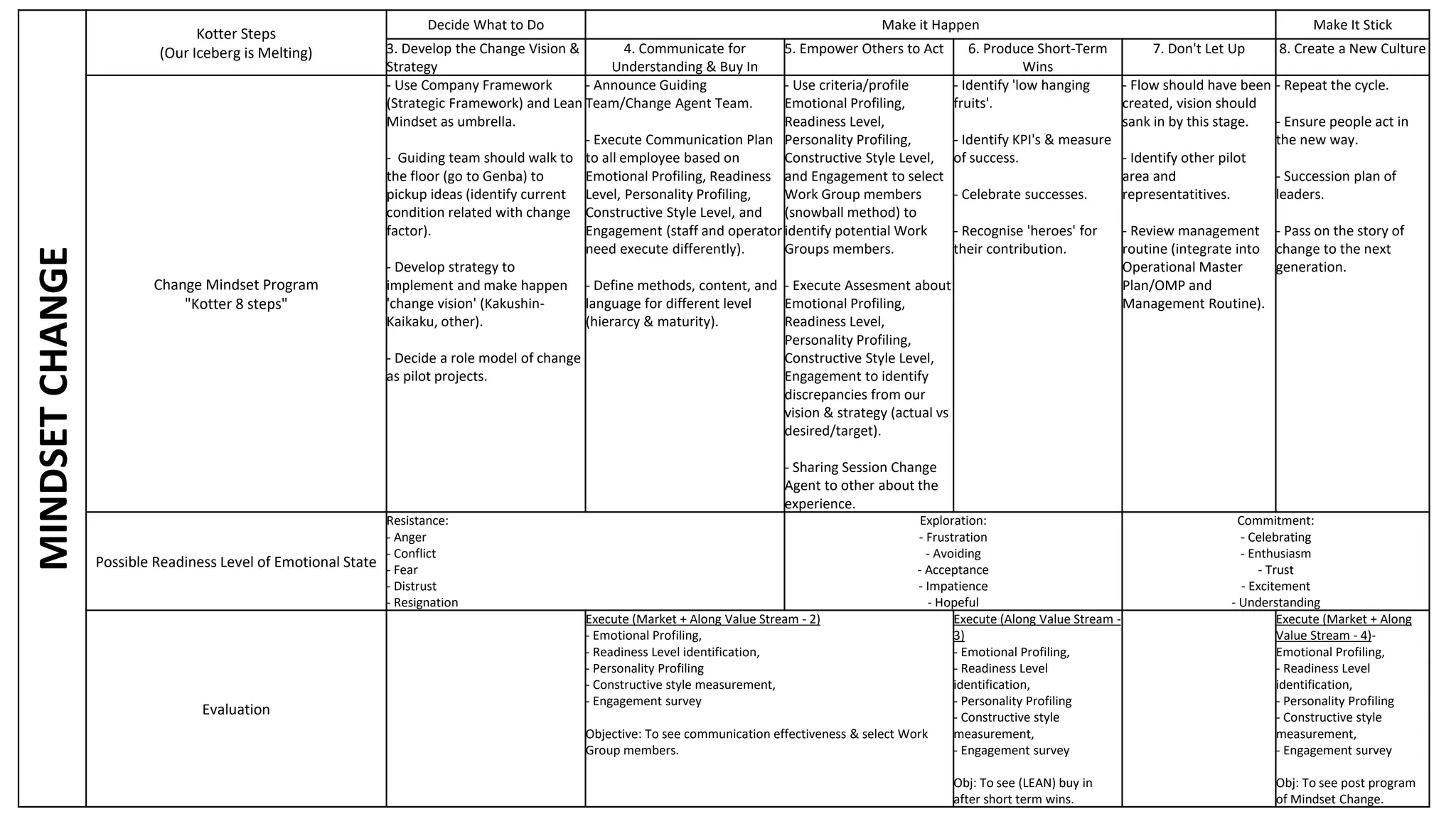
MINDSET CHANGE PROGRAM FRAMEWORK (8 STEPS)
MINDSET
CHANGE
Kotter Steps
(Our Iceberg is Melting)
Decide What to Do Make it Happen Make It Stick
3. Develop the Change Vision &
Strategy
4. Communicate for
Understanding & Buy In
5. Empower Others to Act 6. Produce Short-Term
Wins
7. Don't Let Up 8. Create a New Culture
Change Mindset Program
"Kotter 8 steps"
- Use Company Framework
(Strategic Framework) and Lean
Mindset as umbrella.
- Guiding team should walk to
the floor (go to Genba) to
pickup ideas (identify current
condition related with change
factor).
- Develop strategy to
implement and make happen
'change vision' (Kakushin-
Kaikaku, other).
- Decide a role model of change
as pilot projects.
- Announce Guiding
Team/Change Agent Team.
- Execute Communication Plan
to all employee based on
Emotional Profiling, Readiness
Level, Personality Profiling,
Constructive Style Level, and
Engagement (staff and operator
need execute differently).
- Define methods, content, and
language for different level
(hierarcy & maturity).
- Use criteria/profile
Emotional Profiling,
Readiness Level,
Personality Profiling,
Constructive Style Level,
and Engagement to select
Work Group members
(snowball method) to
identify potential Work
Groups members.
- Execute Assesment about
Emotional Profiling,
Readiness Level,
Personality Profiling,
Constructive Style Level,
Engagement to identify
discrepancies from our
vision & strategy (actual vs
desired/target).
- Sharing Session Change
Agent to other about the
experience.
- Identify 'low hanging
fruits'.
- Identify KPI's & measure
of success.
- Celebrate successes.
- Recognise 'heroes' for
their contribution.
- Flow should have been
created, vision should
sank in by this stage.
- Identify other pilot
area and
representatitives.
- Review management
routine (integrate into
Operational Master
Plan/OMP and
Management Routine).
- Repeat the cycle.
- Ensure people act in
the new way.
- Succession plan of
leaders.
- Pass on the story of
change to the next
generation.
Possible Readiness Level of Emotional State
Resistance:
- Anger
- Conflict
- Fear
- Distrust
- Resignation
Exploration:
- Frustration
- Avoiding
- Acceptance
- Impatience
- Hopeful
Commitment:
- Celebrating
- Enthusiasm
- Trust
- Excitement
- Understanding
Evaluation
Execute (Market + Along Value Stream - 2)
- Emotional Profiling,
- Readiness Level identification,
- Personality Profiling
- Constructive style measurement,
- Engagement survey
Objective: To see communication effectiveness & select Work
Group members.
Execute (Along Value Stream -
3)
- Emotional Profiling,
- Readiness Level
identification,
- Personality Profiling
- Constructive style
measurement,
- Engagement survey
Obj: To see (LEAN) buy in
after short term wins.
Execute (Market + Along
Value Stream - 4)-
Emotional Profiling,
- Readiness Level
identification,
- Personality Profiling
- Constructive style
measurement,
- Engagement survey
Obj: To see post program
of Mindset Change.
COMMUNICATION
Kotter Steps
(Our Iceberg is Melting)
Setting the Stage Decide What to Do Make it Happen
Pre-requisites 1. Create Sense of Urgency
2. Pull together the Guiding
Team
3. Develop the Change Vision &
Strategy
4. Communicate for
Understanding & Buy In
Communication
"Kotter"
Kick off & Socialization Series
Communication plan & strategy
in place, e.g. editorial calendar
established
Communication Focus Explain Needs Clarify Vision
Communication Content
Kick off
(urgency /needs for
internalization, benefits).
LEAN awareness.
Vision, Mission, Values, Culture,
Strategy, Guiding Team/Change
Agent.
Formal declaration.
Communication Activities
Define:
- Employees target (massal vs
targeted; cognitif vs affective),
- Media Communication
(printed, face to face, tech.
based),
- Budget
(1) Two Way Communication:
- Technology Based: Email Blast, legal social owned by
company/groups dept. (WA, BBM, etc).
- Face to Face Format (Group) : Project Briefing/Meeting,
Presentation, Training, Workshop.
- Face to Face Format (Individual) : one-on-one session
(2) One Way Communication:
- Written Matterial/Print/Publications : The Key
- Technology Based: multimedia
(1) Two Way Communication:
-Technology Based: Email Blast, legal social owned by
company/groups dept. (WA, etc.), Email Newsletter
- Face to Face Format (Group): Workshops, Training, Presentations,
Meetings
- Face to Face Format (Individual): one-on-one session
(2) One Way Communication:
- Written Materials/ Print/Publications: The Key, Notices for
Bulletin Boards, Posters/Banner, Progress Reports.
- Technology based: multimedia
Evaluation
Communication Survey -1
Obj : To know how far employee
know about Change Program
(executed by Change Agent) and
how their feel (give them
advantageous/benefits or not).
MINDSET CHANGE PROGRAM FRAMEWORK (8 STEPS)
COMMUNICATION
Kotter Steps
(Our Iceberg is Melting)
Make it Happen Make It Stick
4. Communicate for
Understanding & Buy In
5. Empower Others to Act
6. Produce Short-Term
Wins
7. Don't Let Up 8. Create a New Culture
Communication
"Kotter"
- Announce & introduce
extended change team
through various events &
media
- Announce activities
- Communicate the 'low
hanging fruits' through
various media
- Celebrate wins through
special events
- Announce the 'heroes'
& provide special
recognition
Communication Focus Inspire Action Sustain Momentum
Communication Content Updates on LEAN progress Updates on LEAN progress
Updates on LEAN
progress
Updates on LEAN
progress
Communication Activities
(1) Two Way Communication:
-Technology Based: Email blast, BRA email newsletter, legal social owned by
company/groups dept. (WA, BBM, etc).
- Face to Face Format (Group): Workshops, Presentations, Meetings, Project
Team meetings, Market is meetings (Cascade)
- Face to Face Format (Individual) : one-on-one session
(2) One Way Communication:
- Written Materials/ Print/Publications: Newsletters, Notices for Bulletin Boards,
Posters/Banner.
- Technology based: Multimedia
(1) One Way Communication:
- Written Materials/ Print/Publications:
Newsletters, Notices for Bulletin Boards,
Posters/Banner.
- Technology based: Multimedia
(2) Two Way Communication:
-Technology Based: Email blast, BRA email
newsletter
- Change Event Project.
Evaluation
Communication Survey - 2:
Objc : To know how far
employee know about
Change Program (executed
by 2nd Change Agent) and
how their feel (give them
advantageous/benefits or
not).
LEARNING
PROGRAM
Kotter Steps
(Our Iceberg is Melting)
Setting the Stage Decide What to Do
Pre-requisites 1. Create Sense of
Urgency
2. Pull together the
Guiding Team
3. Develop the Change Vision & Strategy
Education & Training
Pillar Steps
Step 1 Step 2
Coaching
- Develop Integration
Coaching Framework,
Tools, and Technique
(READINESS LEVEL-
DISC-LSI-GROW-SBI-
QUESTIONS)
- Create Coaching
Guideline in two
language (Eng. and
Bahasa)
- Identify Targeted Internal Coach
- Define Process and criteria for Level of Participants-Trainer-Facilitator-Coach
Learning Programs
- Competency Matrix (current map)
- Training Needs Analysis for Change Agent Team (actual vs target)
- Training Needs Analysis along Value Stream (Level Supervisor up)
- Development of Learning Matrix
Learning Support
Facilities
- Endorsement from
Market Leaders on
Learning Support
facilities set up
Facilities set up
MINDSET CHANGE PROGRAM FRAMEWORK (8 STEPS)
LEARNING
PROGRAM
Kotter Steps
(Our Iceberg is Melting)
Make it Happen Make It Stick
4. Communicate for
Understanding & Buy In
5. Empower Others
to Act
6. Produce Short-
Term Wins
7. Don't Let Up 8. Create a New
Culture
Education & Training Pillar Steps Step 3 (Pillars) Step 3 (Work Group)
Step 2
Step 3 (Operational)
Step 4
Step 5 Step 6
Coaching Everyday Coaching Program
Learning Programs
- Other trainings (based on the needs analysis and competency matrix)
Learning Support Facilities Roll out of training (refer to Training Programs)
EMOTIONAL PROFILING
FOCUS
DENIAL RESISTANCE EXPLORE BUY IN DENIAL RESISTANCE EXPLORE BUY IN
COMMUNICATION
FOCUS
EXPLAIN
NEEDS
CLARIFY
VISION
INSPIRE
ACTION
SUSTAIN
MOMENTUM
EXPLAIN
NEEDS
CLARIFY
VISION
INSPIRE
ACTION
SUSTAIN
MOMENTUM
COACHING
CONTENT
Goal / Objective
Understanding GI
Group Vision,
Culture, Values,
Business condition
and urgency, Why
Lean (workplace
and people
transformation)
Important
Understanding
Change Vision,
Implementation
Strategy,
Capability Building
Strategy, Problem
solving mindset
Understanding
Change Vision,
Implementation
Strategy,
Capability Building
Strategy, Problem
Solving execution
Understanding
Change Vision,
Implementation
Strategy,
Capability Building
Strategy, Problem
solving execution
Understanding GI
Vision, Culture,
Values, Business
condition and
urgency, Why Lean
(workplace and
people
transformation)
Important
Understanding
Change Vision,
Implementation
Strategy,
Capability Building
Strategy, Problem
solving mindset
Understanding
Change Vision,
Implementation
Strategy,
Capability Building
Strategy, Problem
solving execution
Understanding
Change Vision,
Implementation
Strategy,
Capability Building
Strategy, Problem
solving execution
Behavior
(Competencies)
Leadership &
Communication
skill to Lead the
change
Train the trainer
Leadership &
Communication
skill to Lead the
change, Train the
trainer, Facilitator
Leadership &
Communication
skill to Lead the
change, Train the
trainer, Facilitator,
Coach
Leadership &
Communication
skill to Lead the
change
Train the trainer
Leadership &
Communication
skill to Lead the
change, Train the
trainer, Facilitator
Leadership &
Communication
skill to Lead the
change, Train the
trainer, Facilitator,
Coach
Impact
COACHING PROGRAM
COMMUNICATION PROGRAM
EMOTIONAL
PROFILING
DENIAL RESISTANCE EXPLORE BUY IN DENIAL RESISTANCE EXPLORE BUY IN
COMMUNI-
CATION FOCUS
EXPLAIN
NEEDS
CLARIFY
VISION
INSPIRE
ACTION
SUSTAIN
MOMENTUM
EXPLAIN
NEEDS
CLARIFY
VISION
INSPIRE
ACTION
SUSTAIN
MOMENTUM
COMMUNICATION
CONTENT
LEAN
awareness
Vision,
Mission,
Strategy,
Guiding
Team, Lean
Awareness
Formal
declaration
Updates on
LEAN
progress
Updates on
LEAN
progress
LEAN
awareness
Vision,
Mission,
Strategy,
Guiding
Team, Lean
Awareness
Formal
declaration
Updates on
LEAN
progress
Updates on
LEAN
progress
1. Kick off & Socialization Series
Building Education & Training Team Ad Hoc (Identify, approved, communicate about roles&responsibility)
Preparation for Kick Off
Kick Off Communication
Define communication media (sites, target audience)
Design & produce communication material for Sense of Urgency
Contents :
1. Communicate who the communication ad hoc team members
2. Urgency /needs for change, for better internalization, benefits
3. Information must be the same (cross-information vertical & horizontal), but use of language, style & tone differs according to level
Publish communication
2. Pull together the Guiding Team
Define communication media (sites, target audience)
Design & produce communication material for Explain Needs
Contents :
1. LEAN awareness
2. Communicate to Guiding Team about their roles & responsibilities
3. Information must be the same (cross-information vertical & horizontal), but use of language, style & tone differs according to level
Publish communication
COMMUNICATION ACTIVITIES KICK OFF
3. Develop Change Vision & Strategy
Define communication media (sites, target audience)
Design & produce communication material for Clarify Vission
Contents :
1. Guiding Team
2. Vision, Mission, Strategy
3. Establish awareness program
4. Information must be the same (cross-information vertical & horizontal), but use of language, style & tone differs
according to level
Publish communication
4. Communicate for Understanding & Buy In
Define communication media (sites, target audience)
Design & produce communication material for Clarify Vission
Contents :
1. Establish communication plan & strategy - Editorial Calendar
2. Formal declaration
3. Remind organization of BRA Values
4. Information must be the same (cross-information vertical & horizontal), but use of language, style & tone differs
according to level
Publish communication
5. Empower Others to Act
Define communication media (sites, Target audience)
Design & produce communication material for Inspire Action
Contents :
1. Communicate to Extended Team (WG) about their roles & responsibilities
2. Announce & introduce extended change team
3. Gather inputs/ideas (subject of communication) from the different site
4. Information must be the same (cross-information vertical & horizontal), but use of language, style & tone differs according to level
3. Announce activities
4. Updates on LEAN progress
Publish communication
6. Produce Short-Term Wins
Define communication media (sites, Target audience)
Design & produce communication material for Inspire Action
Contents :
1. Gather inputs/ideas (subject of communication) from the different site
2. Communicate the 'low hanging fruits'
3. Announce activities
4. Updates on LEAN progress
5. Information must be the same (cross-information vertical & horizontal), but use of language, style & tone differs according to level
Publish communication
7. Don't Let Up
Define communication media (sites, Target audience)
Design & produce communication material for Sustain the Momentum
Contents :
1. Announce the 'heroes' & provide special recognition
2. Gather inputs/ideas (subject of communication) from the different site
3. Announce activities
4. Updates on LEAN progress
5. Information must be the same (cross-information vertical & horizontal), but use of language, style & tone differs
according to level
Publish communication
8. Create a New Culture
Define communication media (sites, Target audience)
Design & produce communication material for Sustain the Momentum
Contents :
1. Gather inputs/ideas (subject of communication) from the different site
2. Announce activities
3. Updates on LEAN progress
4. Information must be the same (cross-information vertical & horizontal), but use of language, style & tone differs
according to level
Publish communication
HR-Technology Pillar
Lean on Human Resources Management

Lean on Human Resources Management

  • 1.
    LEAN ON HUMAN RESOURCES MANAGEMENT HumanResources and Lean; It Really Is About People
  • 2.
    AGENDA • Assessment 4P •Lean Mindset • Lean On HRM
  • 3.
  • 4.
  • 5.
    4P Assessment PURPOSE 1. Vision,Mission and Values 2. Lean Linkage to the business 3. Hoshin Planning 3 Ditetapkan dengan masukan dari semua Organisasi: semua organisasi Mempengaruhi keputusan sehari-hari untuk dimintai pertanggung jawaban 3 Lean adalah cara kita berbisnis dan terkait langsung dengan kebutuhan bisnis 3 Ada keterlibatan dan keselarasan di seluruh organisasi dalam merumuskan perbaikan yang terkait dengan kebutuhan bisnis 2 Ditetapkan dan dikomunikasikan tetapi tidak mempengaruhi pekerjaan sehari-hari dan keputusan 2 Lean dikaitkan dengan tujuan "Operasional" seperti pengurangan biaya 2 Ada kantong-kantong perencanaan “perbaikan proses” yang sedang berlangsung tetapi tidak ada keselarasan atau koordinasi 1 Ditetapkan tetapi tanpa masukan dari seluruh organisasi 1 Lean didelegasikan dan merupakan sistem paralel dengan "bisnis" 1 "Manajemen by Objectives" dan penurunan tujuan "berbasis hasil" numerik ke organisasi 0 Tidak ditetapkan atau telah usang 0 Lean tidak ditetapkan sebagai metodologi peningkatan bisnis 0 Tujuan organisasi bersifat sporadis atau hap-hazard
  • 6.
    4P Assessment PROCESS 4. OperationSystem - Flow 5. Operation System: Tools 5S, Standardisation & Visualisation 3 Flow proses saat ini, diukur dan digunakan untuk mengidentifikasi masalah 3 Alat adalah bagian dari budaya dan dipahami serta digunakan untuk mengidentifikasi dan memecahkan masalah 2 Flow proses dipertimbangkan dari perspektif pelanggan tetapi inventaris masih digunakan untuk "menangani atau menutupi masalah" 2 Alat sudah ada tetapi tidak digunakan untuk mengidentifikasi dan memecahkan masalah 1 Flow proses hanya dipertimbangkan di beberapa aktivitas organisasi 1 Kantong alat diterapkan tetapi tidak dipertahankan 0 Tidak ada pertimbangan flow proses dari "order to cash" 0 Tidak ada alat yang digunakan
  • 7.
    4P Assessment 6. Roleof Problem Solving 3 Peran dan sistem yang ada untuk setiap lapisan dalam organisasi untuk mengidentifikasikan dan memecahkan masalah. 2 Pemecahan masalah dilakukan oleh supervisor dan anggota tim tetapi sebagian besar adalah “fire figthing" 1 Pemecahan masalah terutama dilakukan oleh para pemimpin, manajer, dan “engineer" 0 Tidak ada pemecahan masalah yang terjadi,, hanya fire fighting and containment
  • 8.
    4P Assessment PEOPLE 7. LeadershipDevelopment 8. Role of HR and System 3 Proses nilai organisasi atas hasil dan sistem tersedia bagi para pemimpin untuk dimintai pertanggungjawaban sebagai pelatih, guru, dan mengembangkan orang-orang mereka 3 HR adalah “Keeper of the Value". Mereka memiliki proses seperti perekrutan, pemberhentian dan promosi untuk menjadi "check and balance" dari organisasi 2 Kantong pemimpin yang menghargai dan mempraktikkan "pengajaran dan pembinaan" 2 HR adalah mitra operasi dengan beberapa proses untuk mendukung lean 1 Pemimpin berfokus pada hasil dan "mengelola orang" 1 HR aktif dalam operasi tetapi tidak terlibat langsung dalam strategi lean 0 Pengembangan manusia bukanlah prioritas 0 HR adalah “Compliance Organization" yang berfokus pada admin seperti penggajian, tunjangan, dll.
  • 9.
    4P Assessment Element 1Score Element 2 Score Element 3 Score Average Element 4 Score Element 5 Score Average Element 6 Score Average Element 7 Score Element 8 Score Average
  • 10.
    Lean Mindset danLean Operation HRM untuk Keunggulan Daya Saing
  • 11.
  • 12.
    MASS VS LEANCOMPANY # Jumlah Karyawan Hanya sedikit karyawan memiliki keterampilan dan keterampilan mereka rendah Karyawan yang memiliki potensial tidak diberdayakan dengan baik MASS COMPANY # Jumlah Karyawan Karyawan banyak memiliki keterampilan. Mereka dapat mengontrol dirinya sendiri, berpikir sendiri dan dapat memotivasi dirinya sendiri. LEAN COMPANY
  • 13.
    Permasalahan terhebat dalamOrganisasi, dan itu membutuhkan untuk diperbaiki segera : People : a. Pengetahuan tentang tingkah laku membuat "Orang yang Bergantung" bukan "Sistem yang Tergantung“→ Silo's know- how” b. Silo’s / sesuai pola pikir / kurangnya kompetensi c. Perbedaan dalam pola pikir antara Karyawan yang ada (lama) and Karyawan baru d. Tidak ada keterampilan Manajemen dan Kepemimpinan yang tepat e. 3 level konflik : - Konflik Individu - Karyawan – Karyawan - Karyawan – Pemilik Workplace : a. Perbaikan sporadis dan sektoral, tidak ada pendekatan struktur dalam pemecahan masalah b. Tidak ada master operasional per departemen yang jelas c. Terjadi kembali terjadinya masalah akibat pemadaman kebakaran dan tindakan penahanan saja, bukan eliminasi akar penyebab d. Tidak ada integrasi inisiatif perbaikan utama untuk Keunggulan Operasional: - TPM : Meningkatkan keandalan mesin - Six sigma : Meningkatkan variasi kualitas - Lean : Perbaikan terus menerus Business 1. Fokus hanya pada KPI/Action Plan Deptnya sendiri, berdampak negatif terhadap Departemen dan Bisnis lain (primer vs konsekuensial metrik) 2. Tidak ada penyelarasan Prioritas Departemen 3. Tidak ada KPI/ Action Plan keselarasan (Tujuan SILO) 4. Tidak ada kolaborasi yang sejajar / lemah antara: - Commercial & Industrial team dalam Perusahaan - Jabatan dalam Fungsional 5. Tidak ada kolaborasi yang sejajar / lemah : - Departments dalam Perusahaan - Fungsional dalam Department
  • 14.
    Berpikir LEAN I IncreaseVA C Cust. Satisfaction R Reduce Waste C Cont.Improvement
  • 15.
    Berpikir LEAN • Enabler:Segala aktifitas yang tidak menambah nilai, tapi perlu dilakukan agar proses tetap berjalan.  Tidak bernilai Tambah (Non Value Added): Segala aktifitas yang tidak menambah nilai terhadap produk tetapi menambah biaya (PEMBOROSAN) .  Nilai Tambah (Value Added): Segala aktifitas yang merubah bentuk, kegunaan atau fungsi material untuk memenuhi permintaan pelanggan atau aktivitas yang bersedia dibayar pelanggan.
  • 16.
    PERILAKU POKOK LEAN IMPLEMENTATION 10 1.Pertanyakan segala cara dalam berproduksi 2. Lebih baik memikirkan cara untuk dapat melaksanakannya dari pada mencari alasan mengapa tidak bisa dilaksanakan 3. Jangan banyak ber-argumentasi, mulailah dengan mempertanyakan kondisi saat ini. 4. Jangan menunggu solusi sempurna, 50% juga OK, tapi segera lakukan 5. Bila terjadi kesalahan, segera perbaiki 6. Hindari penggunaan uang tetapi gunakan kreativitas untuk improvement. 7. Kalau tidak ada kesulitan, “Ide Perbaikan” tidak akan muncul 8. Cari penyebab sesungguhnya dengan menanyakan 5 kali “Mengapa” 9. Dibanding “pengetahuan” 1 orang masih lebih baik “ide” 10 Orang 10.Improvement itu tidak terbatas
  • 17.
    Management Commitment • Leadership Commitment • ManagingChange Vision & Mission • Create Vision • Create Mission • Managing Roadblocks Planning • Develop Organizational Policies • Employee Involvement • Develop Training Plan • Develop Objectives • Develop Metrics • Align Strategy with Organization • Develop Communication Plan Initiative Plan • Select Pilot Area • Select Project Leader • Stabilize Process • Standardize process • Simplify Process Rollout Plan • Identify Value Streams • Prioritize Value Streams • Create Timeline • Implement • Audit / Adjust Sustaining Continuous Improvement • Lean Management System LEAN Transformation Successful
  • 18.
  • 19.
    PROBLEM SOLVING (Continuous Improvement & Learning) PEOPLE &PARTNER (Respect, Challenge, & Grow Them PROCESS (Eliminate Waste) PHILOSOPHY (Long-term thinking) • Continuous organizational learning through kaizen • Go see for your self to thoroughly understand the situation • Make decision slowly, by consensus, thoroughly consider all options, implement rapidly • Grow leaders who live the philosophy • Respect, Develop and Challenge your people & team • Respect, Develop & help your suppliers • Create Flow to surface problem • Use pull system to avoid overproduction • Level out the workload • Stop when there is a quality problem • Standardize task for continuous improvement • Use Visual Control so no problem are hidden • Use only reliable, thoroughly tested technology • Base Management decisions on a long-term philosophy, even at the expend of short term financial goal TOYOTA : Very structured approach.. From the living philosophy to business principles and daily operation practices. Provide the Consumer with the “VALUE they really want”, by the time the want no more, no less The 4P of TOYOTA WAY The 14 TOYOTA BUSINESS PRINCIPLES
  • 20.
    LEAN ON HRM (Respect,Challenge, & Grow Them)
  • 21.
    The Most Importance LEANIMPLEMENTATION is “LEAN CULTURE MINDSET” ABNORMALITY MANAGEMENT LEAN ON HRM
  • 22.
  • 23.
    LEAN HRM World Class TPM Pillar FI Pillar People Pillar 5S& Visual Management System Compliance & Sustainability People Involvement Never Leave Anyone Behind Technology Pillar People Transformation Cycle • People Mapping • Leadership Development Program • Lean Leadership focus on People Transformation Create Capability Building Team Membangun rasa urgensi Membentuk koalisi yang kuat Create Communication Excellence Membuat Visi Mengkomunikasikan Visi Create Empowerment Excellence Memberdayakan Orang Lain Merencanakan dan menciptakan kemenangan jangka pendek Create Company Excellence Konsolidasi perbaikan Melembagakan perubahan LEAN ON HRM
  • 24.
    Moving from Denial➔ Resistance ➔ Explore ➔ Buy in / Commitment LEAN ON HRM
  • 25.
    25 Lean Mindset/ CultureChange : • Communication program • People profiling • Content • Language • Media • Learning program • People profiling • Maturity journey • Activities (training, workshop, benchmark, seminar) • Coaching program • People profiling • Maturity journey LEADERSHIP PHASE Lean on HRM LEAN ON HRM
  • 26.
    MINDSET CHANGE Kotter Steps (OurIceberg is Melting) Setting the Stage Pre-requisites 1. Create Sense of Urgency 2. Pull together the Guiding Team Change Mindset Program "Kotter 8 steps" - Availability of validated: a) Emotional Profiling; b) Readiness Level assessment; c) Personality Profiling use DISC Style (Dominance-Influence-Steadiness- Conscientiousness); d) Constructive Style use LSI (Life Style Inventory) or BDQ (Behavior Development Questionnaire) (adopted from Life Style Inventory); d) Engagement Level (Gallup Q12 Survey). - Brainstorming about GI (attitude, condition, resources) by: assessing or profiling along Value Stream, getting agreement with major problem. - Communicate the problem clearly. - Change Risk Assessment (resistance source, impact, preventive). - Select Guiding Team/Change Agent from every department along Value Stream: (a) Select Executive Committee; (b) Select of E&T (Education &Training), FI (Focus Improvement) &Lean, Compliance Leaders and the members. - Profiling the guiding team / Change Agent (identify emotional state, readiness level, personality profiling, Constructive Style, Engagement). - Guiding Change Agent with Education, Training and Coaching Session to support their roles (define roles clearly and encourage to similar "atmosphere"). Possible Readiness Level of Emotional State - Define category of emotional state level. - Define behaviors and indicator from each category. Denial: - Anxiety - Shock - Confusion - Vulnerable Evaluation Preparation tools for evaluation: - Emotional Profiling - Readiness Level - Personality Profiling - Constructive Style - Engagement Execute (along Value Stream - 1): - Emotional Profiling, - Readiness Level identification, - Personality profiling, - Constructive style measurement, - Engagement survey Objective: To see readiness for executing communication activity and learning agenda. MINDSET CHANGE PROGRAM FRAMEWORK (8 STEPS)
  • 27.
    MINDSET CHANGE Kotter Steps (Our Icebergis Melting) Decide What to Do Make it Happen Make It Stick 3. Develop the Change Vision & Strategy 4. Communicate for Understanding & Buy In 5. Empower Others to Act 6. Produce Short-Term Wins 7. Don't Let Up 8. Create a New Culture Change Mindset Program "Kotter 8 steps" - Use Company Framework (Strategic Framework) and Lean Mindset as umbrella. - Guiding team should walk to the floor (go to Genba) to pickup ideas (identify current condition related with change factor). - Develop strategy to implement and make happen 'change vision' (Kakushin- Kaikaku, other). - Decide a role model of change as pilot projects. - Announce Guiding Team/Change Agent Team. - Execute Communication Plan to all employee based on Emotional Profiling, Readiness Level, Personality Profiling, Constructive Style Level, and Engagement (staff and operator need execute differently). - Define methods, content, and language for different level (hierarcy & maturity). - Use criteria/profile Emotional Profiling, Readiness Level, Personality Profiling, Constructive Style Level, and Engagement to select Work Group members (snowball method) to identify potential Work Groups members. - Execute Assesment about Emotional Profiling, Readiness Level, Personality Profiling, Constructive Style Level, Engagement to identify discrepancies from our vision & strategy (actual vs desired/target). - Sharing Session Change Agent to other about the experience. - Identify 'low hanging fruits'. - Identify KPI's & measure of success. - Celebrate successes. - Recognise 'heroes' for their contribution. - Flow should have been created, vision should sank in by this stage. - Identify other pilot area and representatitives. - Review management routine (integrate into Operational Master Plan/OMP and Management Routine). - Repeat the cycle. - Ensure people act in the new way. - Succession plan of leaders. - Pass on the story of change to the next generation. Possible Readiness Level of Emotional State Resistance: - Anger - Conflict - Fear - Distrust - Resignation Exploration: - Frustration - Avoiding - Acceptance - Impatience - Hopeful Commitment: - Celebrating - Enthusiasm - Trust - Excitement - Understanding Evaluation Execute (Market + Along Value Stream - 2) - Emotional Profiling, - Readiness Level identification, - Personality Profiling - Constructive style measurement, - Engagement survey Objective: To see communication effectiveness & select Work Group members. Execute (Along Value Stream - 3) - Emotional Profiling, - Readiness Level identification, - Personality Profiling - Constructive style measurement, - Engagement survey Obj: To see (LEAN) buy in after short term wins. Execute (Market + Along Value Stream - 4)- Emotional Profiling, - Readiness Level identification, - Personality Profiling - Constructive style measurement, - Engagement survey Obj: To see post program of Mindset Change.
  • 28.
    COMMUNICATION Kotter Steps (Our Icebergis Melting) Setting the Stage Decide What to Do Make it Happen Pre-requisites 1. Create Sense of Urgency 2. Pull together the Guiding Team 3. Develop the Change Vision & Strategy 4. Communicate for Understanding & Buy In Communication "Kotter" Kick off & Socialization Series Communication plan & strategy in place, e.g. editorial calendar established Communication Focus Explain Needs Clarify Vision Communication Content Kick off (urgency /needs for internalization, benefits). LEAN awareness. Vision, Mission, Values, Culture, Strategy, Guiding Team/Change Agent. Formal declaration. Communication Activities Define: - Employees target (massal vs targeted; cognitif vs affective), - Media Communication (printed, face to face, tech. based), - Budget (1) Two Way Communication: - Technology Based: Email Blast, legal social owned by company/groups dept. (WA, BBM, etc). - Face to Face Format (Group) : Project Briefing/Meeting, Presentation, Training, Workshop. - Face to Face Format (Individual) : one-on-one session (2) One Way Communication: - Written Matterial/Print/Publications : The Key - Technology Based: multimedia (1) Two Way Communication: -Technology Based: Email Blast, legal social owned by company/groups dept. (WA, etc.), Email Newsletter - Face to Face Format (Group): Workshops, Training, Presentations, Meetings - Face to Face Format (Individual): one-on-one session (2) One Way Communication: - Written Materials/ Print/Publications: The Key, Notices for Bulletin Boards, Posters/Banner, Progress Reports. - Technology based: multimedia Evaluation Communication Survey -1 Obj : To know how far employee know about Change Program (executed by Change Agent) and how their feel (give them advantageous/benefits or not). MINDSET CHANGE PROGRAM FRAMEWORK (8 STEPS)
  • 29.
    COMMUNICATION Kotter Steps (Our Icebergis Melting) Make it Happen Make It Stick 4. Communicate for Understanding & Buy In 5. Empower Others to Act 6. Produce Short-Term Wins 7. Don't Let Up 8. Create a New Culture Communication "Kotter" - Announce & introduce extended change team through various events & media - Announce activities - Communicate the 'low hanging fruits' through various media - Celebrate wins through special events - Announce the 'heroes' & provide special recognition Communication Focus Inspire Action Sustain Momentum Communication Content Updates on LEAN progress Updates on LEAN progress Updates on LEAN progress Updates on LEAN progress Communication Activities (1) Two Way Communication: -Technology Based: Email blast, BRA email newsletter, legal social owned by company/groups dept. (WA, BBM, etc). - Face to Face Format (Group): Workshops, Presentations, Meetings, Project Team meetings, Market is meetings (Cascade) - Face to Face Format (Individual) : one-on-one session (2) One Way Communication: - Written Materials/ Print/Publications: Newsletters, Notices for Bulletin Boards, Posters/Banner. - Technology based: Multimedia (1) One Way Communication: - Written Materials/ Print/Publications: Newsletters, Notices for Bulletin Boards, Posters/Banner. - Technology based: Multimedia (2) Two Way Communication: -Technology Based: Email blast, BRA email newsletter - Change Event Project. Evaluation Communication Survey - 2: Objc : To know how far employee know about Change Program (executed by 2nd Change Agent) and how their feel (give them advantageous/benefits or not).
  • 30.
    LEARNING PROGRAM Kotter Steps (Our Icebergis Melting) Setting the Stage Decide What to Do Pre-requisites 1. Create Sense of Urgency 2. Pull together the Guiding Team 3. Develop the Change Vision & Strategy Education & Training Pillar Steps Step 1 Step 2 Coaching - Develop Integration Coaching Framework, Tools, and Technique (READINESS LEVEL- DISC-LSI-GROW-SBI- QUESTIONS) - Create Coaching Guideline in two language (Eng. and Bahasa) - Identify Targeted Internal Coach - Define Process and criteria for Level of Participants-Trainer-Facilitator-Coach Learning Programs - Competency Matrix (current map) - Training Needs Analysis for Change Agent Team (actual vs target) - Training Needs Analysis along Value Stream (Level Supervisor up) - Development of Learning Matrix Learning Support Facilities - Endorsement from Market Leaders on Learning Support facilities set up Facilities set up MINDSET CHANGE PROGRAM FRAMEWORK (8 STEPS)
  • 31.
    LEARNING PROGRAM Kotter Steps (Our Icebergis Melting) Make it Happen Make It Stick 4. Communicate for Understanding & Buy In 5. Empower Others to Act 6. Produce Short- Term Wins 7. Don't Let Up 8. Create a New Culture Education & Training Pillar Steps Step 3 (Pillars) Step 3 (Work Group) Step 2 Step 3 (Operational) Step 4 Step 5 Step 6 Coaching Everyday Coaching Program Learning Programs - Other trainings (based on the needs analysis and competency matrix) Learning Support Facilities Roll out of training (refer to Training Programs)
  • 32.
    EMOTIONAL PROFILING FOCUS DENIAL RESISTANCEEXPLORE BUY IN DENIAL RESISTANCE EXPLORE BUY IN COMMUNICATION FOCUS EXPLAIN NEEDS CLARIFY VISION INSPIRE ACTION SUSTAIN MOMENTUM EXPLAIN NEEDS CLARIFY VISION INSPIRE ACTION SUSTAIN MOMENTUM COACHING CONTENT Goal / Objective Understanding GI Group Vision, Culture, Values, Business condition and urgency, Why Lean (workplace and people transformation) Important Understanding Change Vision, Implementation Strategy, Capability Building Strategy, Problem solving mindset Understanding Change Vision, Implementation Strategy, Capability Building Strategy, Problem Solving execution Understanding Change Vision, Implementation Strategy, Capability Building Strategy, Problem solving execution Understanding GI Vision, Culture, Values, Business condition and urgency, Why Lean (workplace and people transformation) Important Understanding Change Vision, Implementation Strategy, Capability Building Strategy, Problem solving mindset Understanding Change Vision, Implementation Strategy, Capability Building Strategy, Problem solving execution Understanding Change Vision, Implementation Strategy, Capability Building Strategy, Problem solving execution Behavior (Competencies) Leadership & Communication skill to Lead the change Train the trainer Leadership & Communication skill to Lead the change, Train the trainer, Facilitator Leadership & Communication skill to Lead the change, Train the trainer, Facilitator, Coach Leadership & Communication skill to Lead the change Train the trainer Leadership & Communication skill to Lead the change, Train the trainer, Facilitator Leadership & Communication skill to Lead the change, Train the trainer, Facilitator, Coach Impact COACHING PROGRAM
  • 33.
    COMMUNICATION PROGRAM EMOTIONAL PROFILING DENIAL RESISTANCEEXPLORE BUY IN DENIAL RESISTANCE EXPLORE BUY IN COMMUNI- CATION FOCUS EXPLAIN NEEDS CLARIFY VISION INSPIRE ACTION SUSTAIN MOMENTUM EXPLAIN NEEDS CLARIFY VISION INSPIRE ACTION SUSTAIN MOMENTUM COMMUNICATION CONTENT LEAN awareness Vision, Mission, Strategy, Guiding Team, Lean Awareness Formal declaration Updates on LEAN progress Updates on LEAN progress LEAN awareness Vision, Mission, Strategy, Guiding Team, Lean Awareness Formal declaration Updates on LEAN progress Updates on LEAN progress
  • 34.
    1. Kick off& Socialization Series Building Education & Training Team Ad Hoc (Identify, approved, communicate about roles&responsibility) Preparation for Kick Off Kick Off Communication Define communication media (sites, target audience) Design & produce communication material for Sense of Urgency Contents : 1. Communicate who the communication ad hoc team members 2. Urgency /needs for change, for better internalization, benefits 3. Information must be the same (cross-information vertical & horizontal), but use of language, style & tone differs according to level Publish communication 2. Pull together the Guiding Team Define communication media (sites, target audience) Design & produce communication material for Explain Needs Contents : 1. LEAN awareness 2. Communicate to Guiding Team about their roles & responsibilities 3. Information must be the same (cross-information vertical & horizontal), but use of language, style & tone differs according to level Publish communication COMMUNICATION ACTIVITIES KICK OFF
  • 35.
    3. Develop ChangeVision & Strategy Define communication media (sites, target audience) Design & produce communication material for Clarify Vission Contents : 1. Guiding Team 2. Vision, Mission, Strategy 3. Establish awareness program 4. Information must be the same (cross-information vertical & horizontal), but use of language, style & tone differs according to level Publish communication 4. Communicate for Understanding & Buy In Define communication media (sites, target audience) Design & produce communication material for Clarify Vission Contents : 1. Establish communication plan & strategy - Editorial Calendar 2. Formal declaration 3. Remind organization of BRA Values 4. Information must be the same (cross-information vertical & horizontal), but use of language, style & tone differs according to level Publish communication
  • 36.
    5. Empower Othersto Act Define communication media (sites, Target audience) Design & produce communication material for Inspire Action Contents : 1. Communicate to Extended Team (WG) about their roles & responsibilities 2. Announce & introduce extended change team 3. Gather inputs/ideas (subject of communication) from the different site 4. Information must be the same (cross-information vertical & horizontal), but use of language, style & tone differs according to level 3. Announce activities 4. Updates on LEAN progress Publish communication 6. Produce Short-Term Wins Define communication media (sites, Target audience) Design & produce communication material for Inspire Action Contents : 1. Gather inputs/ideas (subject of communication) from the different site 2. Communicate the 'low hanging fruits' 3. Announce activities 4. Updates on LEAN progress 5. Information must be the same (cross-information vertical & horizontal), but use of language, style & tone differs according to level Publish communication
  • 37.
    7. Don't LetUp Define communication media (sites, Target audience) Design & produce communication material for Sustain the Momentum Contents : 1. Announce the 'heroes' & provide special recognition 2. Gather inputs/ideas (subject of communication) from the different site 3. Announce activities 4. Updates on LEAN progress 5. Information must be the same (cross-information vertical & horizontal), but use of language, style & tone differs according to level Publish communication 8. Create a New Culture Define communication media (sites, Target audience) Design & produce communication material for Sustain the Momentum Contents : 1. Gather inputs/ideas (subject of communication) from the different site 2. Announce activities 3. Updates on LEAN progress 4. Information must be the same (cross-information vertical & horizontal), but use of language, style & tone differs according to level Publish communication
  • 39.
  • 40.