FLANGE
A flange is an external or internal ridge, or rim (lip), for
strength, or for attachment to another object, as the flange
on the end of a pipe .

 pipes with flanges can be assembled and disassembled
easily. Some type of materials use to manufacture flanges
are cast iron, carbon steel, 12mo-steel, al steel .

A flange can also be a plate or ring to form a rim at the end
of a pipe when fastened to the pipe.
VALVE
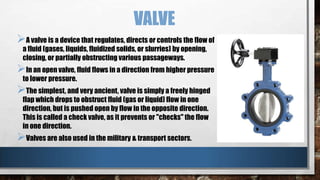
A valve is a device that regulates, directs or controls the flow of
a fluid (gases, liquids, fluidized solids, or slurries) by opening,
closing, or partially obstructing various passageways.

In an open valve, fluid flows in a direction from higher pressure
to lower pressure.

The simplest, and very ancient, valve is simply a freely hinged
flap which drops to obstruct fluid (gas or liquid) flow in one
direction, but is pushed open by flow in the opposite direction.
This is called a check valve, as it prevents or "checks" the flow
in one direction.

Valves are also used in the military & transport sectors.
CAUSES : FLANGE LEAKAGE
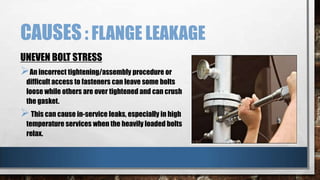
UNEVEN BOLT STRESS

An incorrect tightening/assembly procedure or

difficult access to fasteners can leave some bolts
loose while others are over tightened and can crush
the gasket.

 This can cause in-service leaks, especially in high

temperature services when the heavily loaded bolts
relax.
CAUSES: FLANGE LEAKAGES
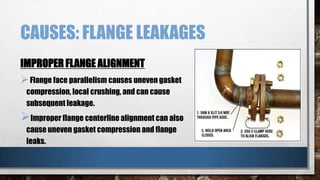
IMPROPER FLANGE ALIGNMENT
 Flange face parallelism causes uneven gasket
compression, local crushing, and can cause
subsequent leakage.

Improper flange centerline alignment can also
cause uneven gasket compression and flange
leaks.
CAUSES: FLANGE LEAKAGES
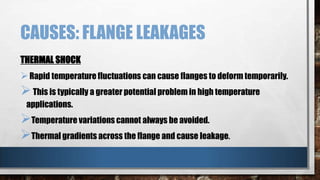
THERMAL SHOCK

 Rapid temperature fluctuations can cause flanges to deform temporarily.

 This is typically a greater potential problem in high temperature
applications.

Temperature variations cannot always be avoided.
Thermal gradients across the flange and cause leakage.
CAUSES: FLANGE LEAKAGES
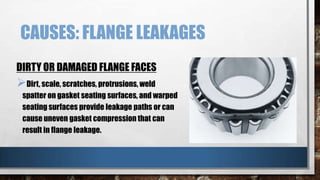
DIRTY OR DAMAGED FLANGE FACES

Dirt, scale, scratches, protrusions, weld
spatter on gasket seating surfaces, and warped
seating surfaces provide leakage paths or can
cause uneven gasket compression that can
result in flange leakage.
CAUSES: VALVE LEAKAGES
OFTEN LARGE DIAMETER BLOCK VALVES ARE STORED ON A DUSTY CONSTRUCTION
SITE WITH NO END COVERS OR ALTERNATIVE PROTECTION FROM AIRBORNE
CONTAMINANTS.

VALVE IS NOT FULLY CLOSED
THE VALVE SEALS ARE DAMAGED
SHELL'S SECOND OIL LEAK IN NORTH SEA PIPELINE CAUSED BY RELIEF VALVE
DETECTION : ACOUSTIC LEAK DETECTORS
( SUBSEA LEAK DETECTION TECHNIQUE )

WORKING PRINCIPLE

A pipeline leakage consists in the transition of a fluid from the inside pressure
to the lower external pressure.

This creates an acoustic signal due to the turbulence and to the sudden
expansion of the fluid mass.

ALD is capable to acquire and process the acoustic data in order to extract this
leakage signal from the ambient noise
DETECTION : ACOUSTIC LEAK DETECTORS
THE EQUIPMENT'S
The system is mainly composed by an underwater acoustic sensor, a POD (underwater

electronic unit), a transmission line, a receiving unit and a PC based processing and display
software.

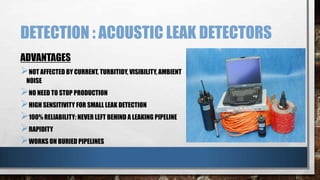
The sensor is driven along the pipeline or positioned close to a flange or connection, the
receiver puts the operator in condition of identifying an eventual leak signal.

A proprietary software allows to evaluate in real time the signal acquired and its evolution

along the track. This software performs analysis of the acquired data from statistic, energetic
and a spectral point of view.

The leak signal generated by a leak is mainly composed by ultrasound, the ALD receiver shifts
this signal to audible lower frequency generating a “virtual audio” .
DETECTION : ACOUSTIC LEAK DETECTORS
ADVANTAGES

NOT AFFECTED BY CURRENT, TURBITIDY, VISIBILITY, AMBIENT
NOISE

NO NEED TO STOP PRODUCTION
HIGH SENSITIVITY FOR SMALL LEAK DETECTION
100% RELIABILITY: NEVER LEFT BEHIND A LEAKING PIPELINE
RAPIDITY
WORKS ON BURIED PIPELINES
DETECTION : ACOUSTIC LEAK DETECTORS
HOW TO DETECT THE LEAKS?

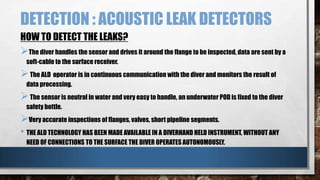
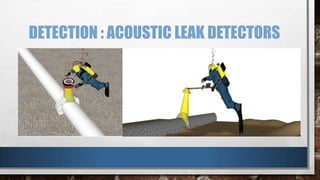
The diver handles the sensor and drives it around the flange to be inspected, data are sent by a
soft-cable to the surface receiver.

 The ALD operator is in continuous communication with the diver and monitors the result of
data processing.

 The sensor is neutral in water and very easy to handle, an underwater POD is fixed to the diver
safety bottle.

Very accurate inspections of flanges, valves, short pipeline segments.
• THE ALD TECHNOLOGY HAS BEEN MADE AVAILABLE IN A DIVERHAND HELD INSTRUMENT, WITHOUT ANY
NEED OF CONNECTIONS TO THE SURFACE THE DIVER OPERATES AUTONOMOUSLY.
DETECTION : ACOUSTIC LEAK DETECTORS
PREVENTIONS: FLANGEBELT
SPECIFICATIONS

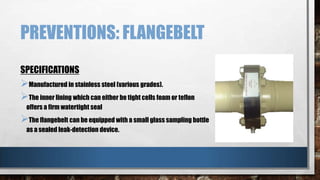
Manufactured in stainless steel (various grades).
The inner lining which can either be tight cells foam or teflon
offers a firm watertight seal

The flangebelt can be equipped with a small glass sampling bottle
as a sealed leak-detection device.
PREVENTIONS: FLANGEBELT
ADVANTAGES :

Slows down the formation of rust
No corrosion, as rust cannot develop on parts where the flange rests.
Can be used again and again after dismantling.
Long-life expectancy.
Leaks can be detected on isolated flanges
PREVENTIONS: FLANGEBELT
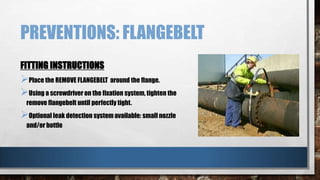
FITTING INSTRUCTIONS

Place the REMOVE FLANGEBELT around the flange.
Using a screwdriver on the fixation system, tighten the
remove flangebelt until perfectly tight.

Optional leak detection system available: small nozzle
and/or bottle
PREVENTIONS: REMOVE FLANGEBELT
PREVENTION : AUTOMATIC WATER SHUTOFF VALVE
Automatic water shutoff valves use a water sensor that is placed on the floor to detect water
seapage or leakage.

This sensor is connected to to the water valve that controls the water fow.
If a leak is detected, the water valve turns off the water valve and stops the flow of water to the
appliance or device.

The signal is actually an electrical signal from the sensing pad to the control unit that activates
a magnetic shutoff valve.
PREVENTION : AUTOMATIC WATER SHUTOFF VALVE
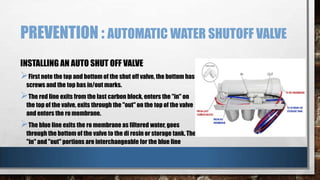
INSTALLING AN AUTO SHUT OFF VALVE

First note the top and bottom of the shut off valve, the bottom has
screws and the top has in/out marks.

The red line exits from the last carbon block, enters the "in" on

the top of the valve, exits through the "out" on the top of the valve
and enters the ro membrane.

The blue line exits the ro membrane as filtered water, goes

through the bottom of the valve to the di resin or storage tank. The
"in" and "out" portions are interchangeable for the blue line
Leakages in pipes,ppt

Leakages in pipes,ppt

  • 2.
    FLANGE A flange isan external or internal ridge, or rim (lip), for strength, or for attachment to another object, as the flange on the end of a pipe .  pipes with flanges can be assembled and disassembled easily. Some type of materials use to manufacture flanges are cast iron, carbon steel, 12mo-steel, al steel . A flange can also be a plate or ring to form a rim at the end of a pipe when fastened to the pipe.
  • 3.
    VALVE A valve isa device that regulates, directs or controls the flow of a fluid (gases, liquids, fluidized solids, or slurries) by opening, closing, or partially obstructing various passageways. In an open valve, fluid flows in a direction from higher pressure to lower pressure. The simplest, and very ancient, valve is simply a freely hinged flap which drops to obstruct fluid (gas or liquid) flow in one direction, but is pushed open by flow in the opposite direction. This is called a check valve, as it prevents or "checks" the flow in one direction. Valves are also used in the military & transport sectors.
  • 4.
    CAUSES : FLANGELEAKAGE UNEVEN BOLT STRESS An incorrect tightening/assembly procedure or difficult access to fasteners can leave some bolts loose while others are over tightened and can crush the gasket.  This can cause in-service leaks, especially in high temperature services when the heavily loaded bolts relax.
  • 5.
    CAUSES: FLANGE LEAKAGES IMPROPERFLANGE ALIGNMENT  Flange face parallelism causes uneven gasket compression, local crushing, and can cause subsequent leakage. Improper flange centerline alignment can also cause uneven gasket compression and flange leaks.
  • 6.
    CAUSES: FLANGE LEAKAGES THERMALSHOCK  Rapid temperature fluctuations can cause flanges to deform temporarily.  This is typically a greater potential problem in high temperature applications. Temperature variations cannot always be avoided. Thermal gradients across the flange and cause leakage.
  • 7.
    CAUSES: FLANGE LEAKAGES DIRTYOR DAMAGED FLANGE FACES Dirt, scale, scratches, protrusions, weld spatter on gasket seating surfaces, and warped seating surfaces provide leakage paths or can cause uneven gasket compression that can result in flange leakage.
  • 8.
    CAUSES: VALVE LEAKAGES OFTENLARGE DIAMETER BLOCK VALVES ARE STORED ON A DUSTY CONSTRUCTION SITE WITH NO END COVERS OR ALTERNATIVE PROTECTION FROM AIRBORNE CONTAMINANTS. VALVE IS NOT FULLY CLOSED THE VALVE SEALS ARE DAMAGED SHELL'S SECOND OIL LEAK IN NORTH SEA PIPELINE CAUSED BY RELIEF VALVE
  • 9.
    DETECTION : ACOUSTICLEAK DETECTORS ( SUBSEA LEAK DETECTION TECHNIQUE ) WORKING PRINCIPLE A pipeline leakage consists in the transition of a fluid from the inside pressure to the lower external pressure. This creates an acoustic signal due to the turbulence and to the sudden expansion of the fluid mass. ALD is capable to acquire and process the acoustic data in order to extract this leakage signal from the ambient noise
  • 10.
    DETECTION : ACOUSTICLEAK DETECTORS THE EQUIPMENT'S The system is mainly composed by an underwater acoustic sensor, a POD (underwater electronic unit), a transmission line, a receiving unit and a PC based processing and display software. The sensor is driven along the pipeline or positioned close to a flange or connection, the receiver puts the operator in condition of identifying an eventual leak signal. A proprietary software allows to evaluate in real time the signal acquired and its evolution along the track. This software performs analysis of the acquired data from statistic, energetic and a spectral point of view. The leak signal generated by a leak is mainly composed by ultrasound, the ALD receiver shifts this signal to audible lower frequency generating a “virtual audio” .
  • 11.
    DETECTION : ACOUSTICLEAK DETECTORS ADVANTAGES NOT AFFECTED BY CURRENT, TURBITIDY, VISIBILITY, AMBIENT NOISE NO NEED TO STOP PRODUCTION HIGH SENSITIVITY FOR SMALL LEAK DETECTION 100% RELIABILITY: NEVER LEFT BEHIND A LEAKING PIPELINE RAPIDITY WORKS ON BURIED PIPELINES
  • 12.
    DETECTION : ACOUSTICLEAK DETECTORS HOW TO DETECT THE LEAKS? The diver handles the sensor and drives it around the flange to be inspected, data are sent by a soft-cable to the surface receiver.  The ALD operator is in continuous communication with the diver and monitors the result of data processing.  The sensor is neutral in water and very easy to handle, an underwater POD is fixed to the diver safety bottle. Very accurate inspections of flanges, valves, short pipeline segments. • THE ALD TECHNOLOGY HAS BEEN MADE AVAILABLE IN A DIVERHAND HELD INSTRUMENT, WITHOUT ANY NEED OF CONNECTIONS TO THE SURFACE THE DIVER OPERATES AUTONOMOUSLY.
  • 13.
    DETECTION : ACOUSTICLEAK DETECTORS
  • 14.
    PREVENTIONS: FLANGEBELT SPECIFICATIONS Manufactured instainless steel (various grades). The inner lining which can either be tight cells foam or teflon offers a firm watertight seal The flangebelt can be equipped with a small glass sampling bottle as a sealed leak-detection device.
  • 15.
    PREVENTIONS: FLANGEBELT ADVANTAGES : Slowsdown the formation of rust No corrosion, as rust cannot develop on parts where the flange rests. Can be used again and again after dismantling. Long-life expectancy. Leaks can be detected on isolated flanges
  • 16.
    PREVENTIONS: FLANGEBELT FITTING INSTRUCTIONS Placethe REMOVE FLANGEBELT around the flange. Using a screwdriver on the fixation system, tighten the remove flangebelt until perfectly tight. Optional leak detection system available: small nozzle and/or bottle
  • 17.
  • 18.
    PREVENTION : AUTOMATICWATER SHUTOFF VALVE Automatic water shutoff valves use a water sensor that is placed on the floor to detect water seapage or leakage. This sensor is connected to to the water valve that controls the water fow. If a leak is detected, the water valve turns off the water valve and stops the flow of water to the appliance or device. The signal is actually an electrical signal from the sensing pad to the control unit that activates a magnetic shutoff valve.
  • 19.
    PREVENTION : AUTOMATICWATER SHUTOFF VALVE INSTALLING AN AUTO SHUT OFF VALVE First note the top and bottom of the shut off valve, the bottom has screws and the top has in/out marks. The red line exits from the last carbon block, enters the "in" on the top of the valve, exits through the "out" on the top of the valve and enters the ro membrane. The blue line exits the ro membrane as filtered water, goes through the bottom of the valve to the di resin or storage tank. The "in" and "out" portions are interchangeable for the blue line