Leading the Cubs
Jalisa Cleveland, Jade Tesoro, Batool Mahgoub & Shave Kivell
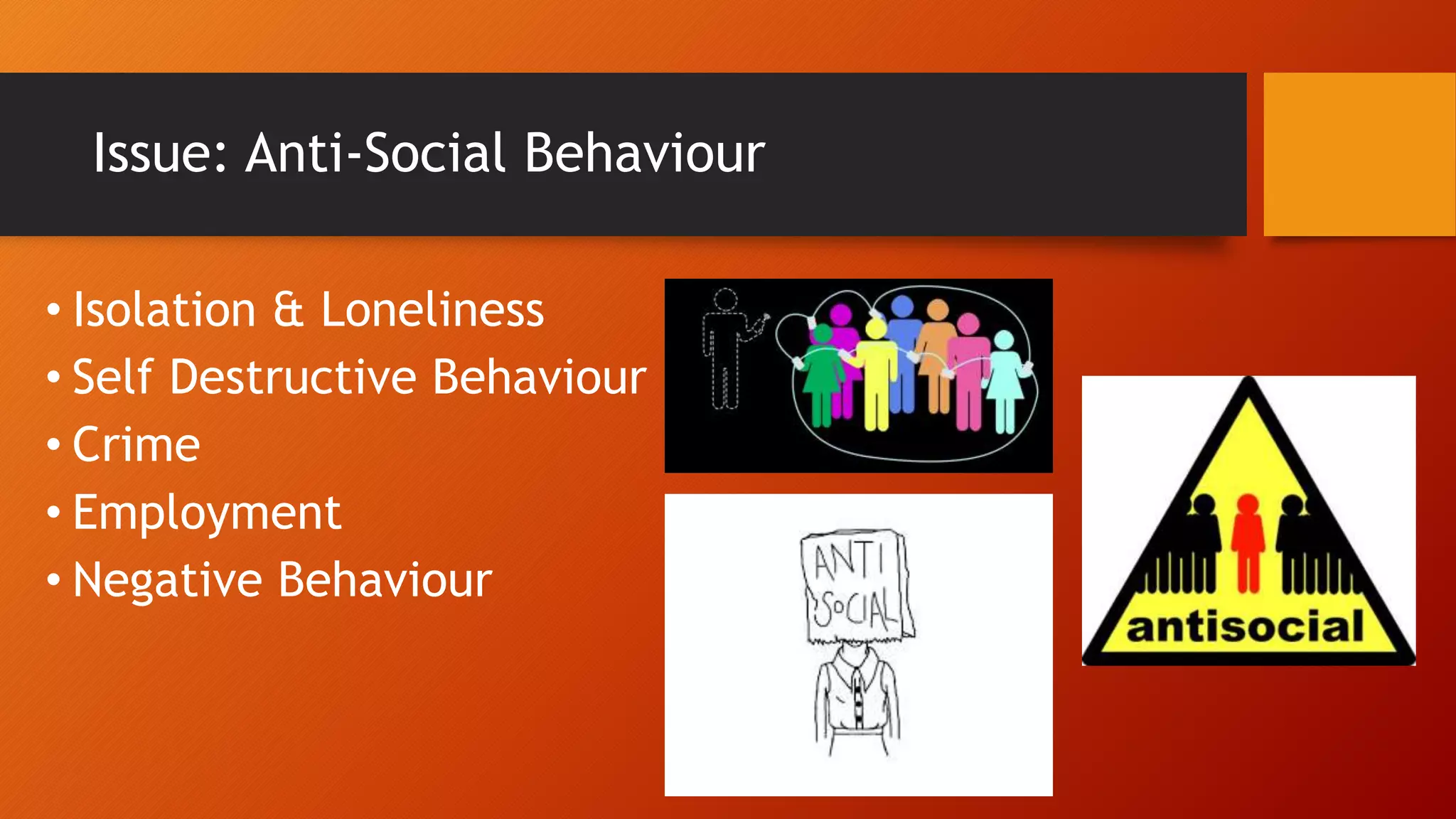
Issue: Anti-Social Behaviour
• Isolation & Loneliness
• Self Destructive Behaviour
• Crime
• Employment
• Negative Behaviour
Program – Leading the Cubs
• Mission Statement: Providing youths with opportunities to grow in all areas of
social and physical interaction through an interactive 1 on 1 leadership role.
• Program Description: Gives youth a chance at mentoring a child 1 on 1. Using
anti-social youth as a leader for children, gives the youth a chance to become
more social without feeling intimidated as oppose to interacting with youth of
the same age. The program helps improve their social interaction and overall
leadership skills through various experiences which includes
• Homework help
• Teaching a new skill
• Playing games
• Weekly field trips
Partnership
• Boys and Girls club
• Provides facility
• Business/ exposure
Program Details
• Cost: Free, monthly fundraisers,
sponsorships and donations
• Staff: Program coordinator, program
staff (1 for every 15 kids)
• Partnership: Boys and Girls Club
• Facility Requirements: Tuesday –
Boy’s and Girls Club, Friday – Field
trip
• Equipment Requirements: Depends
on day and what activities we are
doing. Boys and Girls Club will must
likely have supplies
Objectives
• Improve social interaction
• Safe environment for optimal social growth
• Leadership role to build confidence
• Reduce crime rates
• Reduce loneliness and isolation
Long-Term Effects
Don’t participate
• Anti-social behaviour will continue
• Lead to problems with employment,
relationships and recreation
• Hard time finding or keeping a job
• Increase of isolation can result in
more negative behaviour
• Causing harm if not able to express
themselves appropriately
Participation
• More confidence
• Reduce delinquency
• Negative behaviour into positive
behaviour
• Improve chances of employment
• Become socially engaged
Marketing
• Won’t advertise that’s it’s for anti-social youth
• Social media, post flyers, promote in schools/Boys and Girls Club
• Latest thing to do
• Gain community hours for graduation
• Target emotions by motivating them to change a child’s life
• Advertise as a relaxed leadership role
Rationale
• How the program will be successful?
• Network & promote
• How the program addresses the issues?
• Address issue of antisocial behaviour
• 1 on 1 interaction
• How will the program meet the needs?
• Business needs
• Youth needs
• How will the program assist the youth?
• Improve relationships
• Successful in work environment
• Reduction in anti social behaviour
References
• https://www.google.ca/search?q=boys+and+girls+club&biw=1829&bih=861&source=l
nms&tbm=isch&sa=X&sqi=2&ved=0ahUKEwii0YLrsdPQAhUp7YMKHdinB60Q_AUIBygC#
tbm=isch&q=boys+and+girls+club+of+toronto&imgrc=gjZd0s9qBxQWmM%3A
• Little, Priscilla M.D., Harris, Erin. (2003). A Review of Out-of-School Time Program
Quasi- Experimentaland Experimental Evaluation Results. Cambridge,
Massachusetts: Harvard Family Research Project.
• Sprouse, J. , & Wolf, S. (2005). Youth at Risk: Recreation and Prevention. Urbana-
Champaign, Illinois: Kinesiology and Recreation at University of Illinois

Leading the Cubs

  • 1.
    Leading the Cubs JalisaCleveland, Jade Tesoro, Batool Mahgoub & Shave Kivell
  • 2.
    Issue: Anti-Social Behaviour •Isolation & Loneliness • Self Destructive Behaviour • Crime • Employment • Negative Behaviour
  • 3.
    Program – Leadingthe Cubs • Mission Statement: Providing youths with opportunities to grow in all areas of social and physical interaction through an interactive 1 on 1 leadership role. • Program Description: Gives youth a chance at mentoring a child 1 on 1. Using anti-social youth as a leader for children, gives the youth a chance to become more social without feeling intimidated as oppose to interacting with youth of the same age. The program helps improve their social interaction and overall leadership skills through various experiences which includes • Homework help • Teaching a new skill • Playing games • Weekly field trips
  • 4.
    Partnership • Boys andGirls club • Provides facility • Business/ exposure
  • 5.
    Program Details • Cost:Free, monthly fundraisers, sponsorships and donations • Staff: Program coordinator, program staff (1 for every 15 kids) • Partnership: Boys and Girls Club • Facility Requirements: Tuesday – Boy’s and Girls Club, Friday – Field trip • Equipment Requirements: Depends on day and what activities we are doing. Boys and Girls Club will must likely have supplies
  • 6.
    Objectives • Improve socialinteraction • Safe environment for optimal social growth • Leadership role to build confidence • Reduce crime rates • Reduce loneliness and isolation
  • 7.
    Long-Term Effects Don’t participate •Anti-social behaviour will continue • Lead to problems with employment, relationships and recreation • Hard time finding or keeping a job • Increase of isolation can result in more negative behaviour • Causing harm if not able to express themselves appropriately Participation • More confidence • Reduce delinquency • Negative behaviour into positive behaviour • Improve chances of employment • Become socially engaged
  • 8.
    Marketing • Won’t advertisethat’s it’s for anti-social youth • Social media, post flyers, promote in schools/Boys and Girls Club • Latest thing to do • Gain community hours for graduation • Target emotions by motivating them to change a child’s life • Advertise as a relaxed leadership role
  • 9.
    Rationale • How theprogram will be successful? • Network & promote • How the program addresses the issues? • Address issue of antisocial behaviour • 1 on 1 interaction • How will the program meet the needs? • Business needs • Youth needs • How will the program assist the youth? • Improve relationships • Successful in work environment • Reduction in anti social behaviour
  • 10.
    References • https://www.google.ca/search?q=boys+and+girls+club&biw=1829&bih=861&source=l nms&tbm=isch&sa=X&sqi=2&ved=0ahUKEwii0YLrsdPQAhUp7YMKHdinB60Q_AUIBygC# tbm=isch&q=boys+and+girls+club+of+toronto&imgrc=gjZd0s9qBxQWmM%3A • Little,Priscilla M.D., Harris, Erin. (2003). A Review of Out-of-School Time Program Quasi- Experimentaland Experimental Evaluation Results. Cambridge, Massachusetts: Harvard Family Research Project. • Sprouse, J. , & Wolf, S. (2005). Youth at Risk: Recreation and Prevention. Urbana- Champaign, Illinois: Kinesiology and Recreation at University of Illinois