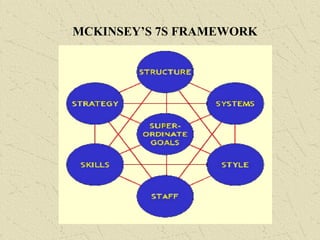
MCKINSEY’S 7S FRAMEWORK
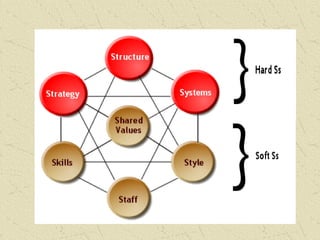
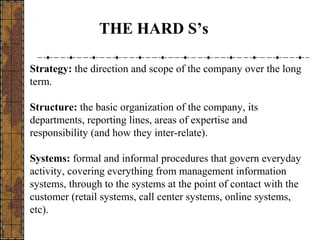
Strategy: the direction and scope of the company over the long
term.
Structure: the basic organization of the company, its
departments, reporting lines, areas of expertise and
responsibility (and how they inter-relate).
Systems: formal and informal procedures that govern everyday
activity, covering everything from management information
systems, through to the systems at the point of contact with the
customer (retail systems, call center systems, online systems,
etc).
THE HARD S’s
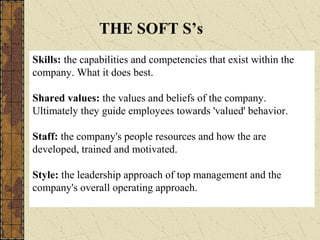
THE SOFT S’s
Skills: the capabilities and competencies that exist within the
company. What it does best.
Shared values: the values and beliefs of the company.
Ultimately they guide employees towards 'valued' behavior.
Staff: the company's people resources and how the are
developed, trained and motivated.
Style: the leadership approach of top management and the
company's overall operating approach.
MCKINSEY’S APPROACH TO
PROBLEM-SOLVING
•The problem is not always the problem
•Create structure through “M.E.C.E.”
•Don’t reinvent the wheel
•Every client is unique (no cookie cutter solutions)
•Don’t make the facts fit your solution
•Make sure your solution fits your client
•Sometimes let the solution come to you
•No problem is too tough to solve
THE 80/20 RULE
- 80% of an effect under study will be generated
by 20 of the examples analyzed
- A small fraction of elements account for a
large fraction of the effect
Examples:
• 80% of sales from 20% of sales force
• 80% of orders from 20% of customers
DON’T BOIL THE OCEAN
•Work smarter, not harder.
•There’s a lot of data out there relating to
your problem, and a lot of analyses you
could do. Ignore most of them.
Lesson: be selective and don’t try to
analyze everything.
FIND THE KEY DRIVERS
Many factors affect business.
Focus on the most important ones – the
key drivers
THE ELEVATOR TEST
Know your solution so thoroughly that you
can explain it clearly and precisely to your
client in 30 seconds.
If you can do that, then you understand
what you’re doing well enough to sell your
solution.
PLUCK THE LOW-HANGING
FRUIT
Sometimes in the middle of the problem-solving
process, opportunities arise to get an easy win,
to make immediate improvements, even before
the overall problem has been solved.
Seize those opportunities! They create little
victories for you and your team. They boost
morale and give you added credibility by
showing anybody who may be watching that
you’re on the ball and mean business.
MAKE A CHART EVERY DAY
During the problem-solving process, you
learn something new every day.
Put it down on paper. It will help you
push your thinking. You may use it, or
you may not, but once you have
crystallized it on the page, you won’t
forget it.
HIT SINGLES
You can’t do everything, so don’t try.
Just do what you’re supposed to do and
get it right.
It’s much better to get to first base
consistently than to try to hit a home run
– and strike out 9 times out of 10.
LOOK AT THE BIG PICTURE
Every now and then, take a mental step back
from whatever you’re doing. Ask yourself
some basic questions:
How does what you’re doing solve the
problems?
How does it advance your thinking?
Is it the most important thing you could be
doing right now?
If it’s not helping, why are you doing it?
JUST SAY, “I DON’T KNOW”
Professional integrity is of utmost importance
in consulting.
One aspect of professional integrity is
HONESTY – with your client, your team
members, (your professor), and yourself.
Honesty includes recognizing when you
haven’t got a clue. Admitting that is a lot
less costly than bluffing.
DON’T ACCEPT “I HAVE NO
IDEA”
People always have an idea if you
probe just a bit. Ask a few pointed
questions – you’ll be amazed at
what they know. Combine that with
some educated guessing, and you
can be well along the road to the
solution.
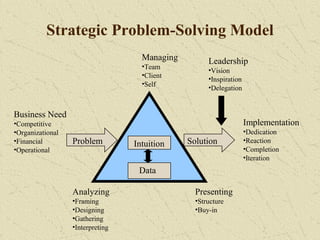
Strategic Problem-Solving Model
Data
Intuition
Managing
•Team
•Client
•Self
Leadership
•Vision
•Inspiration
•Delegation
Problem Solution
Implementation
•Dedication
•Reaction
•Completion
•Iteration
Business Need
•Competitive
•Organizational
•Financial
•Operational
Analyzing
•Framing
•Designing
•Gathering
•Interpreting
Presenting
•Structure
•Buy-in
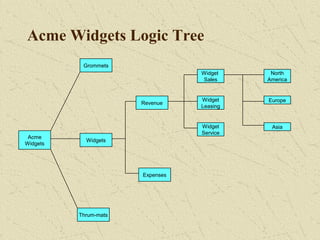
Acme Widgets Logic Tree
Acme
Widgets
Grommets
Widgets
Widget
Sales
Revenue
Expenses
Thrum-mats
Widget
Leasing
Widget
Service
North
America
Europe
Asia
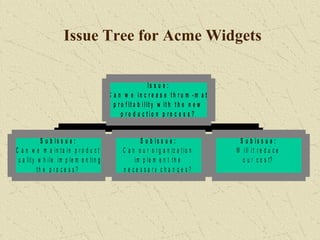
Issue Tree for Acme Widgets
S u b i s s u e :
C a n w e m a in t a in p r o d u c t
q u a lit y w h i le i m p le m e n ti n g
t h e p r o c e s s ?
S u b i s s u e :
C a n o u r o r g a n iz a t i o n
i m p le m e n t t h e
n e c e s s a r y c h a n g e s ?
S u b i s s u e :
W i ll i t r e d u c e
o u r c o s t?
I s s u e :
C a n w e i n c r e a s e t h r u m - m a t
p r o f it a b i l it y w it h t h e n e w
p r o d u c t i o n p r o c e s s ?
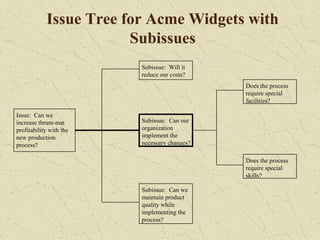
Issue Tree for Acme Widgets with
Subissues
Issue: Can we
increase thrum-mat
profitability with the
new production
process?
Subissue: Will it
reduce our costs?
Subissue: Can our
organization
implement the
necessary changes?
Subissue: Can we
maintain product
quality while
implementing the
process?
Does the process
require special
facilities?
Does the process
require special
skills?
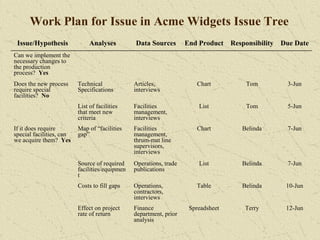
Work Plan for Issue in Acme Widgets Issue Tree
Issue/Hypothesis Analyses Data Sources End Product Responsibility Due Date
Can we implement the
necessary changes to
the production
process? Yes
Does the new process
require special
facilities? No
Technical
Specifications
Articles,
interviews
Chart Tom 3-Jun
List of facilities
that meet new
criteria
Facilities
management,
interviews
List Tom 5-Jun
If it does require
special facilities, can
we acquire them? Yes
Map of “facilities
gap”
Facilities
management,
thrum-mat line
supervisors,
interviews
Chart Belinda 7-Jun
Source of required
facilities/equipmen
t
Operations, trade
publications
List Belinda 7-Jun
Costs to fill gaps Operations,
contractors,
interviews
Table Belinda 10-Jun
Effect on project
rate of return
Finance
department, prior
analysis
Spreadsheet Terry 12-Jun

591lecturenotes

  • 1.
  • 3.
    Strategy: the directionand scope of the company over the long term. Structure: the basic organization of the company, its departments, reporting lines, areas of expertise and responsibility (and how they inter-relate). Systems: formal and informal procedures that govern everyday activity, covering everything from management information systems, through to the systems at the point of contact with the customer (retail systems, call center systems, online systems, etc). THE HARD S’s
  • 4.
    THE SOFT S’s Skills:the capabilities and competencies that exist within the company. What it does best. Shared values: the values and beliefs of the company. Ultimately they guide employees towards 'valued' behavior. Staff: the company's people resources and how the are developed, trained and motivated. Style: the leadership approach of top management and the company's overall operating approach.
  • 5.
    MCKINSEY’S APPROACH TO PROBLEM-SOLVING •Theproblem is not always the problem •Create structure through “M.E.C.E.” •Don’t reinvent the wheel •Every client is unique (no cookie cutter solutions) •Don’t make the facts fit your solution •Make sure your solution fits your client •Sometimes let the solution come to you •No problem is too tough to solve
  • 6.
    THE 80/20 RULE -80% of an effect under study will be generated by 20 of the examples analyzed - A small fraction of elements account for a large fraction of the effect Examples: • 80% of sales from 20% of sales force • 80% of orders from 20% of customers
  • 7.
    DON’T BOIL THEOCEAN •Work smarter, not harder. •There’s a lot of data out there relating to your problem, and a lot of analyses you could do. Ignore most of them. Lesson: be selective and don’t try to analyze everything.
  • 8.
    FIND THE KEYDRIVERS Many factors affect business. Focus on the most important ones – the key drivers
  • 9.
    THE ELEVATOR TEST Knowyour solution so thoroughly that you can explain it clearly and precisely to your client in 30 seconds. If you can do that, then you understand what you’re doing well enough to sell your solution.
  • 10.
    PLUCK THE LOW-HANGING FRUIT Sometimesin the middle of the problem-solving process, opportunities arise to get an easy win, to make immediate improvements, even before the overall problem has been solved. Seize those opportunities! They create little victories for you and your team. They boost morale and give you added credibility by showing anybody who may be watching that you’re on the ball and mean business.
  • 11.
    MAKE A CHARTEVERY DAY During the problem-solving process, you learn something new every day. Put it down on paper. It will help you push your thinking. You may use it, or you may not, but once you have crystallized it on the page, you won’t forget it.
  • 12.
    HIT SINGLES You can’tdo everything, so don’t try. Just do what you’re supposed to do and get it right. It’s much better to get to first base consistently than to try to hit a home run – and strike out 9 times out of 10.
  • 13.
    LOOK AT THEBIG PICTURE Every now and then, take a mental step back from whatever you’re doing. Ask yourself some basic questions: How does what you’re doing solve the problems? How does it advance your thinking? Is it the most important thing you could be doing right now? If it’s not helping, why are you doing it?
  • 14.
    JUST SAY, “IDON’T KNOW” Professional integrity is of utmost importance in consulting. One aspect of professional integrity is HONESTY – with your client, your team members, (your professor), and yourself. Honesty includes recognizing when you haven’t got a clue. Admitting that is a lot less costly than bluffing.
  • 15.
    DON’T ACCEPT “IHAVE NO IDEA” People always have an idea if you probe just a bit. Ask a few pointed questions – you’ll be amazed at what they know. Combine that with some educated guessing, and you can be well along the road to the solution.
  • 16.
    Strategic Problem-Solving Model Data Intuition Managing •Team •Client •Self Leadership •Vision •Inspiration •Delegation ProblemSolution Implementation •Dedication •Reaction •Completion •Iteration Business Need •Competitive •Organizational •Financial •Operational Analyzing •Framing •Designing •Gathering •Interpreting Presenting •Structure •Buy-in
  • 17.
    Acme Widgets LogicTree Acme Widgets Grommets Widgets Widget Sales Revenue Expenses Thrum-mats Widget Leasing Widget Service North America Europe Asia
  • 18.
    Issue Tree forAcme Widgets S u b i s s u e : C a n w e m a in t a in p r o d u c t q u a lit y w h i le i m p le m e n ti n g t h e p r o c e s s ? S u b i s s u e : C a n o u r o r g a n iz a t i o n i m p le m e n t t h e n e c e s s a r y c h a n g e s ? S u b i s s u e : W i ll i t r e d u c e o u r c o s t? I s s u e : C a n w e i n c r e a s e t h r u m - m a t p r o f it a b i l it y w it h t h e n e w p r o d u c t i o n p r o c e s s ?
  • 19.
    Issue Tree forAcme Widgets with Subissues Issue: Can we increase thrum-mat profitability with the new production process? Subissue: Will it reduce our costs? Subissue: Can our organization implement the necessary changes? Subissue: Can we maintain product quality while implementing the process? Does the process require special facilities? Does the process require special skills?
  • 20.
    Work Plan forIssue in Acme Widgets Issue Tree Issue/Hypothesis Analyses Data Sources End Product Responsibility Due Date Can we implement the necessary changes to the production process? Yes Does the new process require special facilities? No Technical Specifications Articles, interviews Chart Tom 3-Jun List of facilities that meet new criteria Facilities management, interviews List Tom 5-Jun If it does require special facilities, can we acquire them? Yes Map of “facilities gap” Facilities management, thrum-mat line supervisors, interviews Chart Belinda 7-Jun Source of required facilities/equipmen t Operations, trade publications List Belinda 7-Jun Costs to fill gaps Operations, contractors, interviews Table Belinda 10-Jun Effect on project rate of return Finance department, prior analysis Spreadsheet Terry 12-Jun