+
Dr. Philip Vaughter
Research Fellow
UNU Institute for the Advanced Study of
Sustainability (UNU-IAS)
ProSPER.Net Leadership Programme
2018 ProSPER.Net Leadership
Programme
“Leadership for Urban Sustainable
Development”
Hosted by RMIT University
Leadership Activity II –
Just Do the Right Thing! –
How to work with ethics as a
leader
+
Leadership Ethics and Sustainability
 Leadership ethics as they relate to sustainable development tend to be
shaped by the definition of the term itself
 “Sustainable Development is development that meets the needs of the
present without compromising the ability of future generations to meet their
own needs.” (Our Common Future, 1987)
 This is often combined with ethical elements of increased equity and
prosperity between people and nations
 There is an implied understanding that leadership must secure progress
for human societies, but not at the cost of destroying the environment
 Growing wealth needs to mean we don’t do it at the cost of the planet’s
ecosystems – no one is rich on a dead planet
 There is also an implied understanding that ethical considerations must
look at long term vs. short term considerations
 Securing food and water now means we don’t sacrifice that security later –
long term vs. short term thinking
13/11/2018Leadership Activity II – Melbourne, Australia
2
+
Leadership Failings and Sustainability
 However, many leaders, be they in government, civil society, or the
private sector, are not taking sustainability into account when they
make their decisions
 The pollution we create causes changes in the atmosphere, contributing
to climate change
 We are polluting water systems, threatening future supply
 We are harvesting our seas and our forests faster than they can be
replaced
 We our degrading our natural resources with the waste we generate
 Mass number of extinctions are occurring around the planet
 Economic decisions do not benefit all people equally
 And as a population – we are still growing!
13/11/2018Leadership Activity II – Melbourne, Australia
3
+
Leadership and Sustainability
13/11/2018Leadership Activity II – Melbourne, Australia
4
+
Leadership and Sustainability
13/11/2018Leadership Activity II – Melbourne, Australia
5
+
Leadership and Sustainability
13/11/2018Leadership Activity II – Melbourne, Australia
6
+
Activity Objectives
 To identify what are values held in relation to sustainability
 To present a way to thoroughly think things out in relation to
sustainable behavior before taking action
 To demonstrate how to clarify, explore, and examine all options to
arrive at ethical decisions in regards to leadership and sustainable
development in your organization
13/11/2018Leadership Activity II – Melbourne, Australia
7
+
Activity Instructions
 Step 1: Divide into groups. Each person in the group should identify 3-5 personal
standards they try to live by in relation to a sustainable lifestyle. Take brief notes to
explain why. [5 minutes]
 Step 2: Next, each person in the group should identify a time when they felt there
ethical standards in relation to sustainability were being compromised. [5 minutes]
 Step 3: Share your answers among your group. Share both your personal standards in
regards to a sustainable lifestyle and a time when you felt these standards were being
challenged. [10 minutes]
 Step 4: Now, one person at a time will discuss their ethical dilemma with the group,
going through the model on the following slide step by step. Is the model helpful, or
are there limitations depending on the situation? [30 minutes]
 Step 5: Open Discussion [10-20 minutes]:
 Did anyone have any situations you would like to share with everyone?
 Why do you feel people usually do not talk much about ethics in relation to sustainability?
 Are there ever situations where being ethical in one context means you are betraying your
ethics in another?
13/11/2018Leadership Activity II – Melbourne, Australia
8
+
Engaging with ethical decision making
 What is an ethical dilemma you have struggled with in making
sustainable decisions?
 Are your personal standards at odds with the organizational
standards you are facing?
 Why do you want to do something about this situation? Why do you
think the situation exists? As a leader, do you have responsibility to
act?
 What are optimal ways to address this issue?
 Do you need more time to consider all of your options?
 Is there anyone who can provide input of counsel?
 What are the consequences if you decide to act? Consider both long
term and short term timeframes.
13/11/2018Leadership Activity II – Melbourne, Australia
9

Leadership Activity II

  • 1.
    + Dr. Philip Vaughter ResearchFellow UNU Institute for the Advanced Study of Sustainability (UNU-IAS) ProSPER.Net Leadership Programme 2018 ProSPER.Net Leadership Programme “Leadership for Urban Sustainable Development” Hosted by RMIT University Leadership Activity II – Just Do the Right Thing! – How to work with ethics as a leader
  • 2.
    + Leadership Ethics andSustainability  Leadership ethics as they relate to sustainable development tend to be shaped by the definition of the term itself  “Sustainable Development is development that meets the needs of the present without compromising the ability of future generations to meet their own needs.” (Our Common Future, 1987)  This is often combined with ethical elements of increased equity and prosperity between people and nations  There is an implied understanding that leadership must secure progress for human societies, but not at the cost of destroying the environment  Growing wealth needs to mean we don’t do it at the cost of the planet’s ecosystems – no one is rich on a dead planet  There is also an implied understanding that ethical considerations must look at long term vs. short term considerations  Securing food and water now means we don’t sacrifice that security later – long term vs. short term thinking 13/11/2018Leadership Activity II – Melbourne, Australia 2
  • 3.
    + Leadership Failings andSustainability  However, many leaders, be they in government, civil society, or the private sector, are not taking sustainability into account when they make their decisions  The pollution we create causes changes in the atmosphere, contributing to climate change  We are polluting water systems, threatening future supply  We are harvesting our seas and our forests faster than they can be replaced  We our degrading our natural resources with the waste we generate  Mass number of extinctions are occurring around the planet  Economic decisions do not benefit all people equally  And as a population – we are still growing! 13/11/2018Leadership Activity II – Melbourne, Australia 3
  • 4.
    + Leadership and Sustainability 13/11/2018LeadershipActivity II – Melbourne, Australia 4
  • 5.
    + Leadership and Sustainability 13/11/2018LeadershipActivity II – Melbourne, Australia 5
  • 6.
    + Leadership and Sustainability 13/11/2018LeadershipActivity II – Melbourne, Australia 6
  • 7.
    + Activity Objectives  Toidentify what are values held in relation to sustainability  To present a way to thoroughly think things out in relation to sustainable behavior before taking action  To demonstrate how to clarify, explore, and examine all options to arrive at ethical decisions in regards to leadership and sustainable development in your organization 13/11/2018Leadership Activity II – Melbourne, Australia 7
  • 8.
    + Activity Instructions  Step1: Divide into groups. Each person in the group should identify 3-5 personal standards they try to live by in relation to a sustainable lifestyle. Take brief notes to explain why. [5 minutes]  Step 2: Next, each person in the group should identify a time when they felt there ethical standards in relation to sustainability were being compromised. [5 minutes]  Step 3: Share your answers among your group. Share both your personal standards in regards to a sustainable lifestyle and a time when you felt these standards were being challenged. [10 minutes]  Step 4: Now, one person at a time will discuss their ethical dilemma with the group, going through the model on the following slide step by step. Is the model helpful, or are there limitations depending on the situation? [30 minutes]  Step 5: Open Discussion [10-20 minutes]:  Did anyone have any situations you would like to share with everyone?  Why do you feel people usually do not talk much about ethics in relation to sustainability?  Are there ever situations where being ethical in one context means you are betraying your ethics in another? 13/11/2018Leadership Activity II – Melbourne, Australia 8
  • 9.
    + Engaging with ethicaldecision making  What is an ethical dilemma you have struggled with in making sustainable decisions?  Are your personal standards at odds with the organizational standards you are facing?  Why do you want to do something about this situation? Why do you think the situation exists? As a leader, do you have responsibility to act?  What are optimal ways to address this issue?  Do you need more time to consider all of your options?  Is there anyone who can provide input of counsel?  What are the consequences if you decide to act? Consider both long term and short term timeframes. 13/11/2018Leadership Activity II – Melbourne, Australia 9

Editor's Notes

  • #3 Ethics comes from the Greek word ethos – character, one’s distinguishing attitudes and beliefs. Its secondary application is concern for the community or organization. Out ethos, our character, determines how we make decisions that affect not only us, but also those around us: people in our community or place of work, our friends, our family – but also the global community and the planet itself. We do not live in isolation; we live in a connected society. All of our decisions, whether at work or in our personal lives, affect others. Therefore, we must consider this impact when we make decisions. Ethics means giving honest consideration to underlying motives and potential harm, if any, and to congruency with established values.
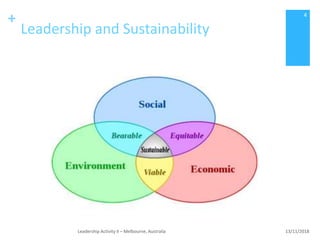
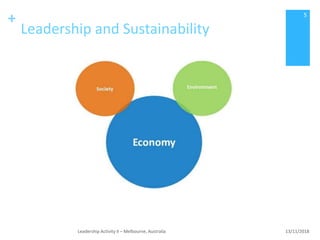
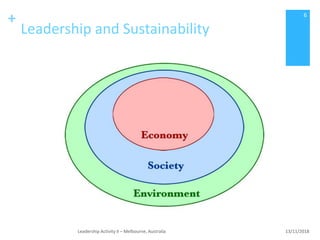
  • #5 The idea of leadership for sustainable development is that it makes environmental, social, and economic systems sustainable
  • #6 Unfortunately, this is what tends to happen…
  • #7 We need to get to here…
  • #9 Hart, L. B., & Waisman, C. S. (2005). The leadership training activity book: 50 exercises for building effective leaders. AMACOM Div American Mgmt Assn.
  • #10 Hart, L. B., & Waisman, C. S. (2005). The leadership training activity book: 50 exercises for building effective leaders. AMACOM Div American Mgmt Assn.