CollaborateUp
Accelerating Problem-Solving in the Commons
Copyright 2014
CollaborateUp
2
3
4
The Problem with Problems
 Strengths over extended
 Multi-factorial
 Right vs. right
 Slow burn
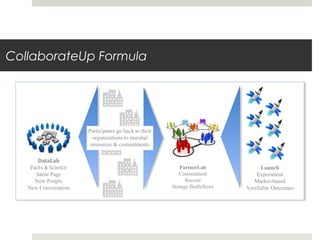
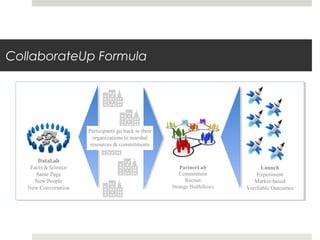
CollaborateUp Formula
DataLab
Facts & Science
Same Page
New People
New Conversation
PartnerLab
Commitment
Recruit
Strange Bedfellows
Launch
Experiment
Market-based
Verifiable Outcomes
Participants go back to their
organizations to marshal
resources & commitments
Discussion
 Problems in the Commons
 Adaptive Leadership & Empathy
 Co-Creation with Corporate Partners
 Exercise
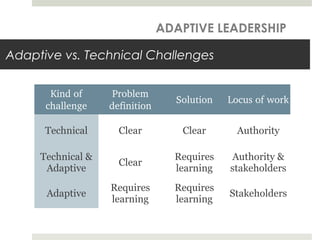
Adaptive vs. Technical Challenges
Kind of 
challenge
Problem 
definition
Solution Locus of work
Technical Clear Clear Authority
Technical &
Adaptive
Clear
Requires
learning
Authority &
stakeholders
Adaptive
Requires
learning
Requires
learning
Stakeholders
ADAPTIVE LEADERSHIP
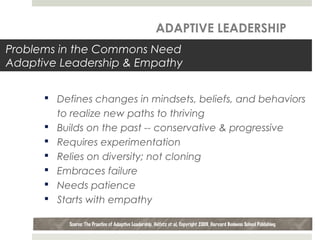
Problems in the Commons Need
Adaptive Leadership & Empathy
 Defines changes in mindsets, beliefs, and behaviors
to realize new paths to thriving
 Builds on the past -- conservative & progressive
 Requires experimentation
 Relies on diversity; not cloning
 Embraces failure
 Needs patience
 Starts with empathy
Source: The Practice of Adaptive Leadership, Heifetz et al, Copyright 2009, Harvard Business School Publishing
ADAPTIVE LEADERSHIP
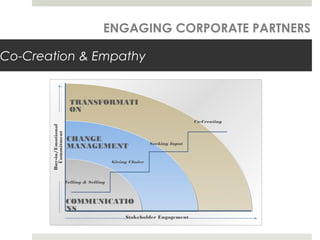
Co-Creation & Empathy
ENGAGING CORPORATE PARTNERS
TRANSFORMATI
ON
CHANGE
MANAGEMENT
COMMUNICATIO
NS
Telling & Selling
Giving Choice
Seeking Input
Co-Creating
Buy-in/Emotional
Commitment
Stakeholder Engagement
Partnering for Social Innovation
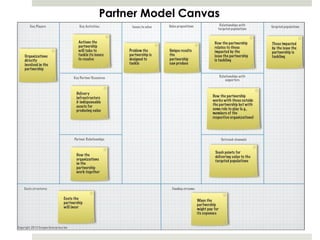
A social innovation partnership is a collaboration (the Key
Activities) between two or more parties from the civil,
private, and/or public sectors (the Key Players) to improve
the condition (the Issue to Solve and the Value Proposition)
of a target population using the assets and resources of all
the parties (the Key Partner Resources) along with other
contributions, (the Relationships with Supporters) under a
set of specified terms and conditions (the Key
Relationships).
ENGAGING CORPORATE PARTNERS
Partner Model Canvas
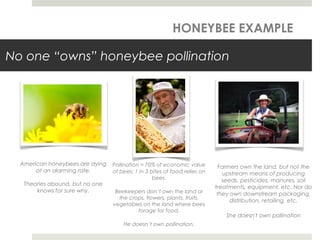
No one “owns” honeybee pollination
American honeybees are dying
at an alarming rate.
Theories abound, but no one
knows for sure why.
Pollination = 70% of economic value
of bees; 1 in 3 bites of food relies on
bees.
Beekeepers don’t own the land or
the crops, flowers, plants, fruits,
vegetables on the land where bees
forage for food.
He doesn’t own pollination.
Farmers own the land, but not the
upstream means of producing
seeds, pesticides, manures, soil
treatments, equipment, etc. Nor do
they own downstream packaging,
distribution, retailing, etc.
She doesn't own pollination
HONEYBEE EXAMPLE
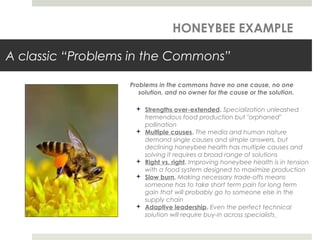
A classic “Problems in the Commons”
Problems in the commons have no one cause, no one
solution, and no owner for the cause or the solution.
 Strengths over-extended. Specialization unleashed
tremendous food production but "orphaned"
pollination
 Multiple causes. The media and human nature
demand single causes and simple answers, but
declining honeybee health has multiple causes and
solving it requires a broad range of solutions
 Right vs. right. Improving honeybee health is in tension
with a food system designed to maximize production
 Slow burn. Making necessary trade-offs means
someone has to take short term pain for long term
gain that will probably go to someone else in the
supply chain
 Adaptive leadership. Even the perfect technical
solution will require buy-in across specialists
HONEYBEE EXAMPLE
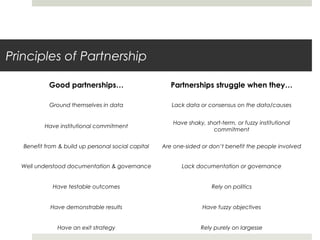
Principles of Partnership
Good partnerships… Partnerships struggle when they…
Ground themselves in data Lack data or consensus on the data/causes
Have institutional commitment
Have shaky, short-term, or fuzzy institutional
commitment
Benefit from & build up personal social capital Are one-sided or don’t benefit the people involved
Well understood documentation & governance Lack documentation or governance
Have testable outcomes Rely on politics
Have demonstrable results Have fuzzy objectives
Have an exit strategy Rely purely on largesse
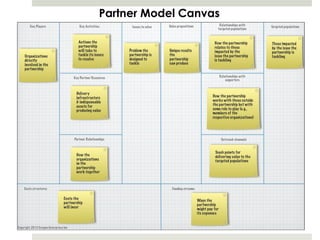
Partner Model Canvas
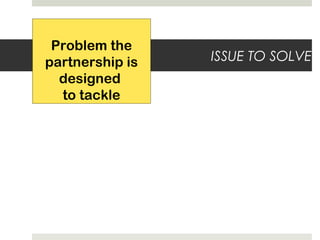
ISSUE TO SOLVE
Problem the
partnership is
designed
to tackle
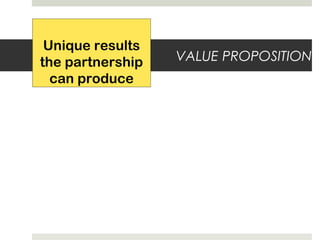
VALUE PROPOSITION
Unique results
the partnership
can produce
TARGETED POPULATIONS
Those impacted
by the issue
the partnership
is tackling
KEY PLAYERS
Organizations
directly
involved in the
partnership
RELATIONSHIPS WITH
TARGETED POPULATIONS
How the
partnership
relates to those
impacted by the
issue the
partnership is
tackling
OUTREACH CHANNELS
Touch points for
delivering value
to the targeted
populations
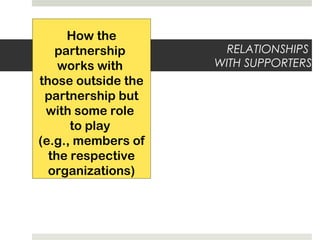
RELATIONSHIPS
WITH SUPPORTERS
How the
partnership
works with
those outside the
partnership but
with some role
to play
(e.g., members of
the respective
organizations)
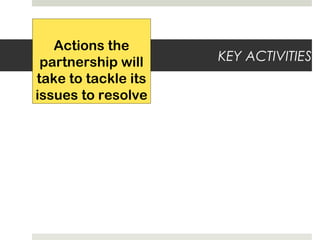
KEY ACTIVITIES
Actions the
partnership will
take to tackle its
issues to resolve
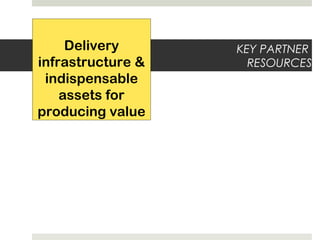
KEY PARTNER
RESOURCES
Delivery
infrastructure &
indispensable
assets for
producing value
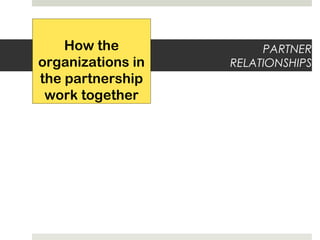
PARTNER
RELATIONSHIPS
How the
organizations in
the partnership
work together
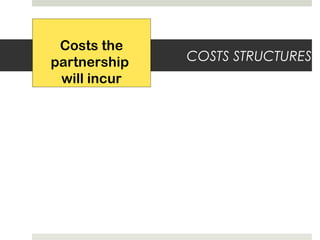
COSTS STRUCTURES
Costs the
partnership
will incur
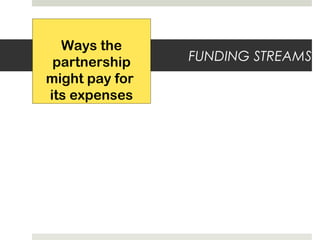
FUNDING STREAMS
Ways the
partnership
might pay for
its expenses
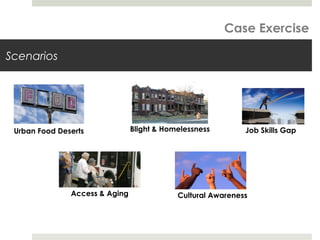
Scenarios
Case Exercise
Urban Food Deserts Blight & Homelessness Job Skills Gap
Access & Aging Cultural Awareness
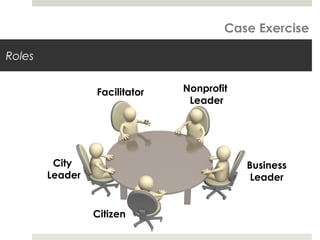
Roles
Case Exercise
Facilitator Nonprofit
Leader
Business
Leader
Citizen
City
Leader
Exercise #1: What's at Stake
 Step 1: To yourself…
 What's at stake for your character if this problem
goes unsolved?
 What's possible if it is solved?
 Step 2: Share & look for common cause
 Step 3: Report out common cause
DataLab
Break
Lunchtime
Exercise #2: What’s Possible
 Step 1: To yourself…
 Reflect on where your character has common
cause with the others
 From your character’s perspective, jot down ideas
or questions you have about each section of the
Partner Model Canvas
 Step 2: As a group, try to fill in 1-2 sentences for each
section of the Canvas
PartnerLab
Idea Sharing
What ideas did
you generate?
What was it like to work on the Canvas?
What was different about working
alone vs. as a group?
What was hard?
What came easy?
Feedback
CollaborateUp Formula
DataLab
Facts & Science
Same Page
New People
New Conversation
PartnerLab
Commitment
Recruit
Strange Bedfellows
Launch
Experiment
Market-based
Verifiable Outcomes
Participants go back to their
organizations to marshal
resources & commitments
CollaborateUp
Accelerated Problem-Solving in the Commons Tools
Copyright 2014
CollaborateUp
e: richard@collaborateup.com
t: @rjcrespin
w: www.collaborateup.com

Weekend in Boca VII - Richard Crespin - "CollaborateUP"

  • 1.
    CollaborateUp Accelerating Problem-Solving inthe Commons Copyright 2014 CollaborateUp
  • 2.
  • 3.
  • 4.
  • 5.
    The Problem withProblems  Strengths over extended  Multi-factorial  Right vs. right  Slow burn
  • 6.
    CollaborateUp Formula DataLab Facts &Science Same Page New People New Conversation PartnerLab Commitment Recruit Strange Bedfellows Launch Experiment Market-based Verifiable Outcomes Participants go back to their organizations to marshal resources & commitments
  • 7.
    Discussion  Problems inthe Commons  Adaptive Leadership & Empathy  Co-Creation with Corporate Partners  Exercise
  • 8.
    Adaptive vs. TechnicalChallenges Kind of  challenge Problem  definition Solution Locus of work Technical Clear Clear Authority Technical & Adaptive Clear Requires learning Authority & stakeholders Adaptive Requires learning Requires learning Stakeholders ADAPTIVE LEADERSHIP
  • 9.
    Problems in theCommons Need Adaptive Leadership & Empathy  Defines changes in mindsets, beliefs, and behaviors to realize new paths to thriving  Builds on the past -- conservative & progressive  Requires experimentation  Relies on diversity; not cloning  Embraces failure  Needs patience  Starts with empathy Source: The Practice of Adaptive Leadership, Heifetz et al, Copyright 2009, Harvard Business School Publishing ADAPTIVE LEADERSHIP
  • 10.
    Co-Creation & Empathy ENGAGINGCORPORATE PARTNERS TRANSFORMATI ON CHANGE MANAGEMENT COMMUNICATIO NS Telling & Selling Giving Choice Seeking Input Co-Creating Buy-in/Emotional Commitment Stakeholder Engagement
  • 11.
    Partnering for SocialInnovation A social innovation partnership is a collaboration (the Key Activities) between two or more parties from the civil, private, and/or public sectors (the Key Players) to improve the condition (the Issue to Solve and the Value Proposition) of a target population using the assets and resources of all the parties (the Key Partner Resources) along with other contributions, (the Relationships with Supporters) under a set of specified terms and conditions (the Key Relationships). ENGAGING CORPORATE PARTNERS
  • 12.
  • 13.
    No one “owns”honeybee pollination American honeybees are dying at an alarming rate. Theories abound, but no one knows for sure why. Pollination = 70% of economic value of bees; 1 in 3 bites of food relies on bees. Beekeepers don’t own the land or the crops, flowers, plants, fruits, vegetables on the land where bees forage for food. He doesn’t own pollination. Farmers own the land, but not the upstream means of producing seeds, pesticides, manures, soil treatments, equipment, etc. Nor do they own downstream packaging, distribution, retailing, etc. She doesn't own pollination HONEYBEE EXAMPLE
  • 14.
    A classic “Problemsin the Commons” Problems in the commons have no one cause, no one solution, and no owner for the cause or the solution.  Strengths over-extended. Specialization unleashed tremendous food production but "orphaned" pollination  Multiple causes. The media and human nature demand single causes and simple answers, but declining honeybee health has multiple causes and solving it requires a broad range of solutions  Right vs. right. Improving honeybee health is in tension with a food system designed to maximize production  Slow burn. Making necessary trade-offs means someone has to take short term pain for long term gain that will probably go to someone else in the supply chain  Adaptive leadership. Even the perfect technical solution will require buy-in across specialists HONEYBEE EXAMPLE
  • 15.
    Principles of Partnership Goodpartnerships… Partnerships struggle when they… Ground themselves in data Lack data or consensus on the data/causes Have institutional commitment Have shaky, short-term, or fuzzy institutional commitment Benefit from & build up personal social capital Are one-sided or don’t benefit the people involved Well understood documentation & governance Lack documentation or governance Have testable outcomes Rely on politics Have demonstrable results Have fuzzy objectives Have an exit strategy Rely purely on largesse
  • 16.
  • 17.
    ISSUE TO SOLVE Problemthe partnership is designed to tackle
  • 18.
    VALUE PROPOSITION Unique results thepartnership can produce
  • 19.
    TARGETED POPULATIONS Those impacted bythe issue the partnership is tackling
  • 20.
  • 21.
    RELATIONSHIPS WITH TARGETED POPULATIONS Howthe partnership relates to those impacted by the issue the partnership is tackling
  • 22.
    OUTREACH CHANNELS Touch pointsfor delivering value to the targeted populations
  • 23.
    RELATIONSHIPS WITH SUPPORTERS How the partnership workswith those outside the partnership but with some role to play (e.g., members of the respective organizations)
  • 24.
    KEY ACTIVITIES Actions the partnershipwill take to tackle its issues to resolve
  • 25.
  • 26.
  • 27.
  • 28.
  • 29.
    Scenarios Case Exercise Urban FoodDeserts Blight & Homelessness Job Skills Gap Access & Aging Cultural Awareness
  • 30.
  • 31.
    Exercise #1: What'sat Stake  Step 1: To yourself…  What's at stake for your character if this problem goes unsolved?  What's possible if it is solved?  Step 2: Share & look for common cause  Step 3: Report out common cause DataLab
  • 32.
  • 33.
    Exercise #2: What’sPossible  Step 1: To yourself…  Reflect on where your character has common cause with the others  From your character’s perspective, jot down ideas or questions you have about each section of the Partner Model Canvas  Step 2: As a group, try to fill in 1-2 sentences for each section of the Canvas PartnerLab
  • 34.
    Idea Sharing What ideasdid you generate?
  • 35.
    What was itlike to work on the Canvas? What was different about working alone vs. as a group? What was hard? What came easy? Feedback
  • 36.
    CollaborateUp Formula DataLab Facts &Science Same Page New People New Conversation PartnerLab Commitment Recruit Strange Bedfellows Launch Experiment Market-based Verifiable Outcomes Participants go back to their organizations to marshal resources & commitments
  • 37.
    CollaborateUp Accelerated Problem-Solving inthe Commons Tools Copyright 2014 CollaborateUp e: richard@collaborateup.com t: @rjcrespin w: www.collaborateup.com