Statement of Ethical Principles

Texas Tech University
Ethics Center
2011
“Texas Tech University is committed to ethical leadership
practices at all levels and to our tradition of community
service, both within the university community and in our
relationships with the greater community. We strive for
exemplary professional and community service through
research, creative works, and service programs that extend
beyond the university environment. We strive to provide
excellent service in a caring and friendly environment and
encourage such involvement in the community by all
faculty, students, staff, and administration.”
Texas Tech University
Statement of Ethical Principles
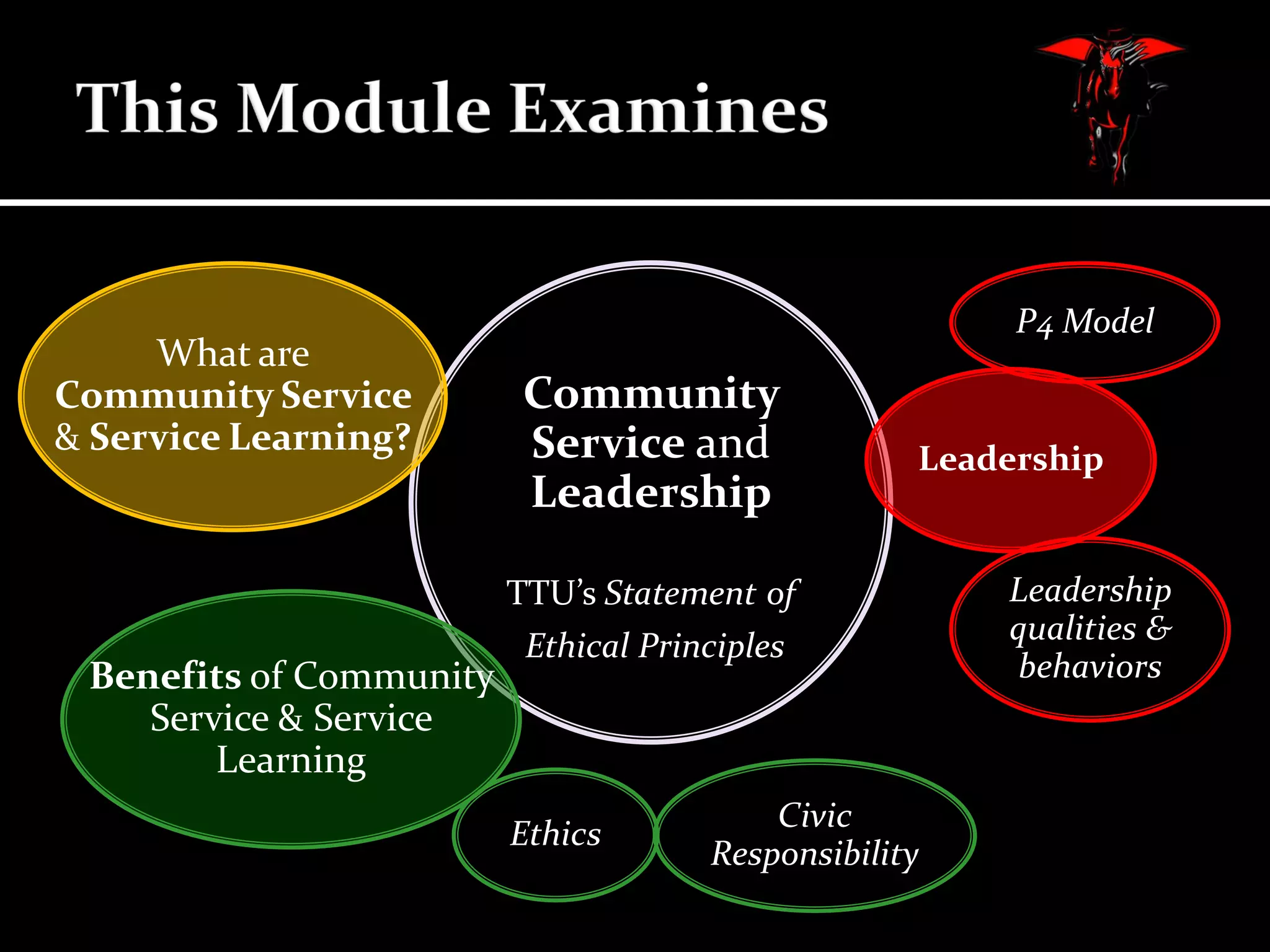
What are
Community Service
& Service Learning?

P4 Model

Community
Service and
Leadership

Leadership

TTU’s Statement of

Benefits of Community
Service & Service
Learning

Ethical Principles

Ethics

Civic
Responsibility

Leadership
qualities &
behaviors
Community Service is the application of
one’s gifts, skills, and resources to provide
value and enhance the quality of life for
people who need or desire service.

(Introduction to Service-Learning Toolkit, 2003)
Astin and Sax (1998) examined the impact of
community service on undergraduates’ development.
According to the study, students participated in service
1. to help other people
2. for personal satisfaction
3. to improve their community and society as a whole
“The fragrance always remains on the
hand that gives the rose.”
Mahatma Gandhi
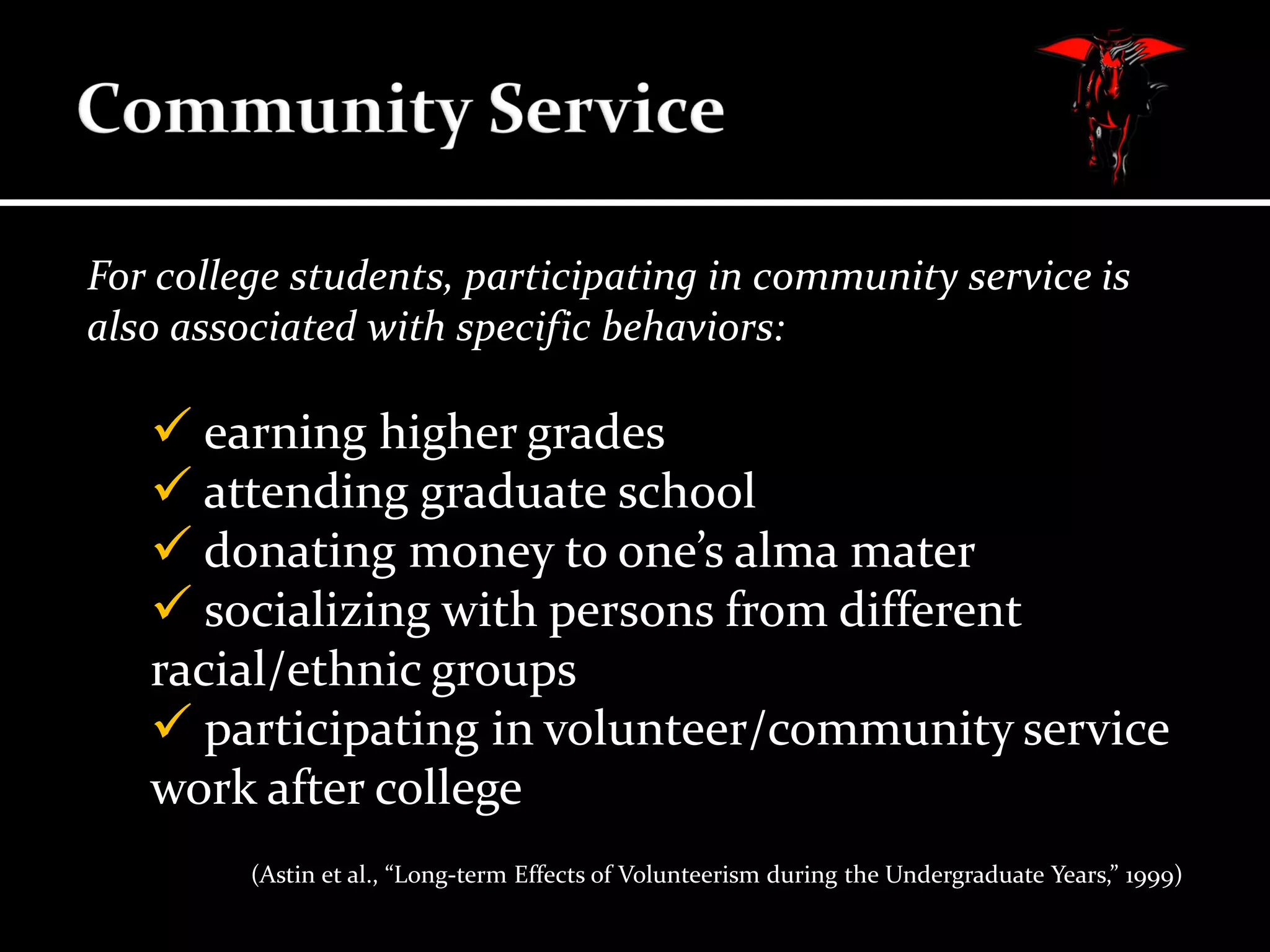
For college students, participating in community service is
also associated with specific behaviors:

 earning higher grades
 attending graduate school
 donating money to one’s alma mater
 socializing with persons from different
racial/ethnic groups
 participating in volunteer/community service
work after college
(Astin et al., “Long-term Effects of Volunteerism during the Undergraduate Years,” 1999)
 Informal learning through volunteering or

community service seems easier than classroom
learning, not because the content is simpler, but
because it is embedded in familiar activity. This
enables us to make sense of new information
(Ehrlich, 2000).
 Community Service allows the students to learn

more about a cause and which actions will ensure that
the issue is effectively addressed.
 An important part of what makes people successful

and productive is their ability to integrate their work
with their social life (Ehrlich, 2000).
 Volunteering inspires students to become more

socially responsible, committed to serving their
communities, empowered, and committed to
education (Astin et al., 1999).
Service Learning is “pedagogy that links
academic study and civic engagement
through thoughtfully organized service
that meets the needs of the community.”
(Irene Arellano, “Importance of Service,” 2009)

Service Learning experiences are reciprocally
beneficial for both the community and the students.
(Astin & Sax, 1998)
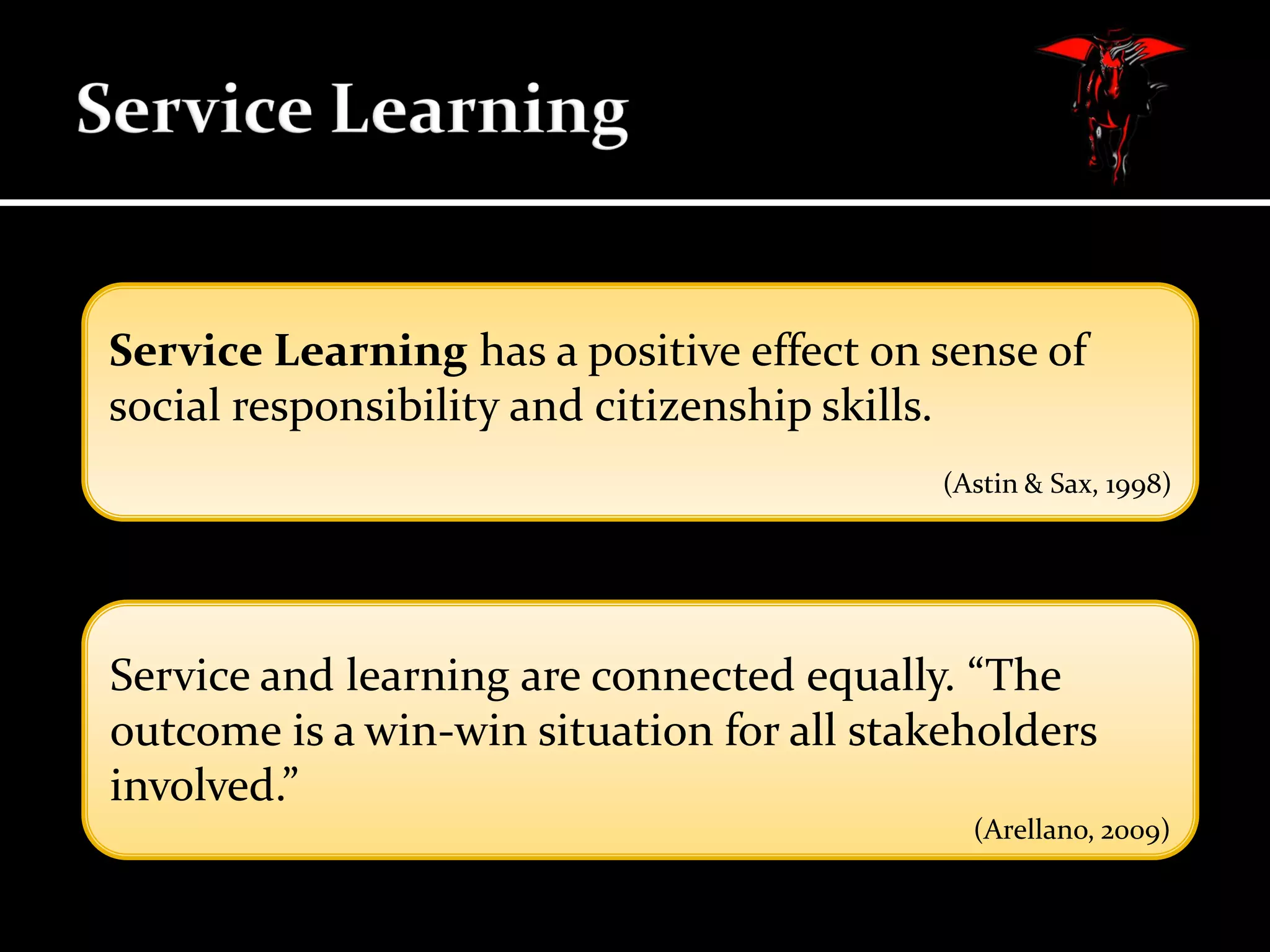
Service Learning has a positive effect on sense of
social responsibility and citizenship skills.
(Astin & Sax, 1998)

Service and learning are connected equally. “The
outcome is a win-win situation for all stakeholders
involved.”
(Arellano, 2009)
Service Learning Program - Mission statement:
TTU “provides information, support, and opportunities
concerning Service Learning to students, faculty, and
community members, fostering an appreciation of the
academic and social values of community engagement.”
(“Service Learning Strategic Plan,” http://www.tlpd.ttu.edu/servicelearning/strategic.asp)

TTU faculty members from several academic disciplines
state that “service-learning enhances their teaching and
students’ interest in course material, and connects both
faculty and students to the community.”
(“Why Service Learning,” http://www.tltc.ttu.edu/servicelearning/faculty/index.asp)
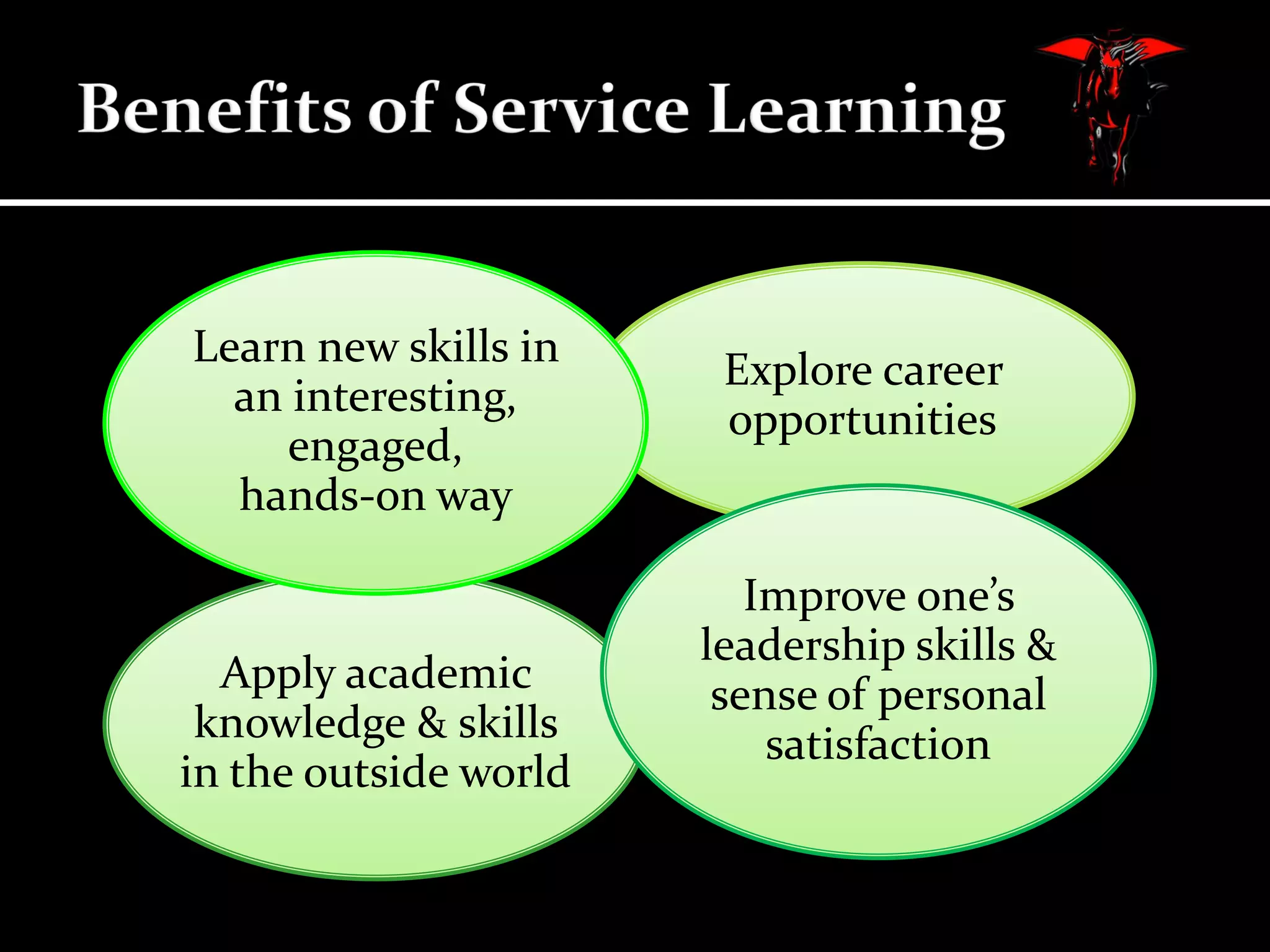
Learn new skills in
an interesting,
engaged,
hands-on way

Apply academic
knowledge & skills
in the outside world

Explore career
opportunities

Improve one’s
leadership skills &
sense of personal
satisfaction
Develop a sense of
community and
civic responsibility

Make a difference in
one’s home community

Meet and develop
relationships with people of
diverse cultures & lifestyles
Service Learning & Ethics
 Service learning offers an effective way for students to
engage the complexity of ethical issues and ambiguity of
actual situations (Colby et al, 2003).
 Service programs affect how students think about ethical
problems and how aware and concerned they are about those
less fortunate than themselves (Bok, 2006).
 Exposure to a diversity of views, both in and out of the
classroom, challenges students to abandon dogmatism and
rethink previous ethical positions (Bok, 2006).
Service learning & Civic Responsibility
 Service learning allows individuals to gain civic skills and
experience
 Service learning helps students to focus on critical and
reflective thinking as well as personal and civic responsibility.

 Service learning gives students the opportunity to address
local needs while developing their academic skills and their
commitment to their community and society.
(Introduction to Service-Learning Toolkit, 2003)
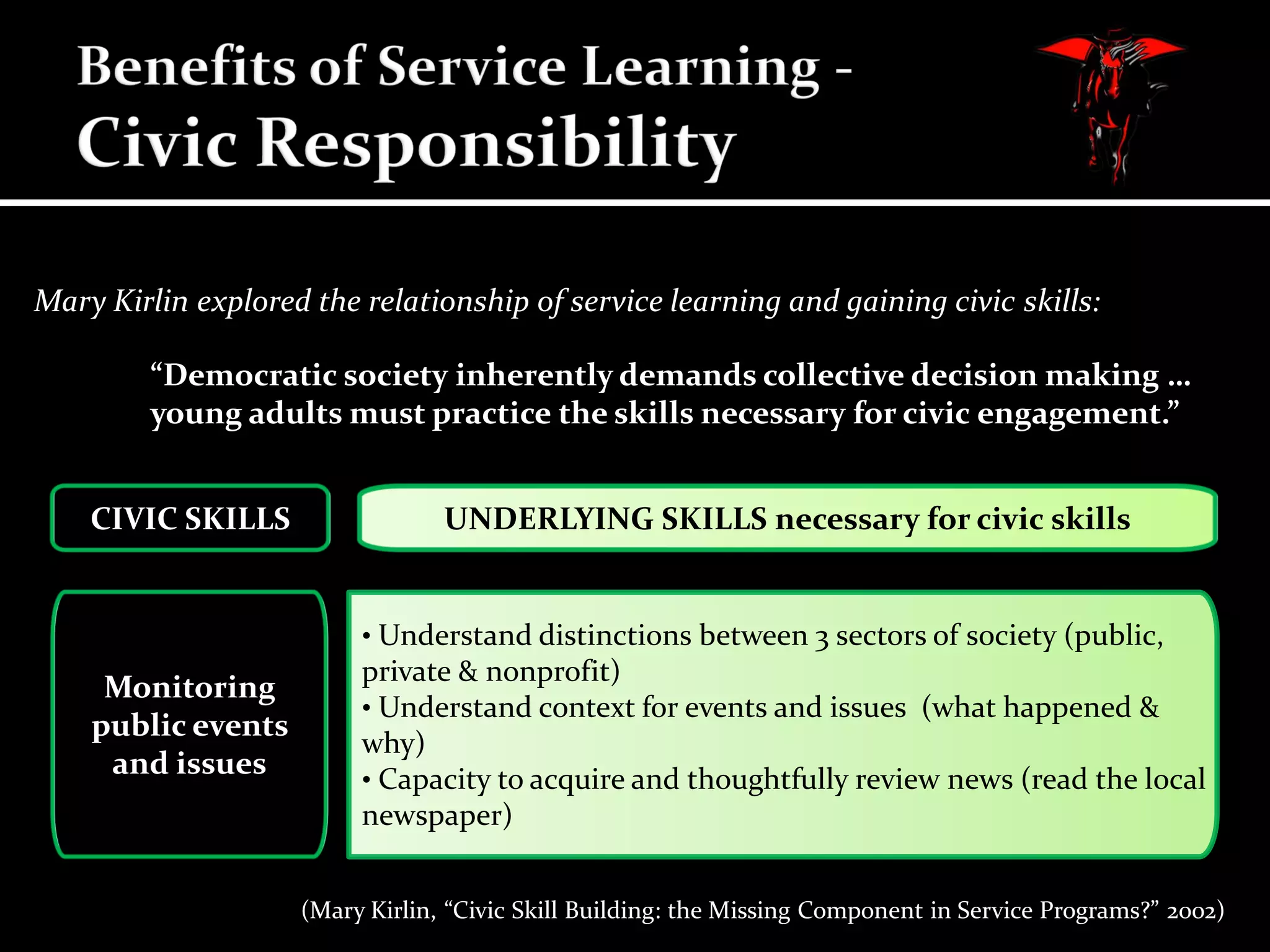
Mary Kirlin explored the relationship of service learning and gaining civic skills:
“Democratic society inherently demands collective decision making …
young adults must practice the skills necessary for civic engagement.”

CIVIC SKILLS

UNDERLYING SKILLS necessary for civic skills

• Understand distinctions between 3 sectors of society (public,

Monitoring
public events
and issues

private & nonprofit)
• Understand context for events and issues (what happened &
why)
• Capacity to acquire and thoughtfully review news (read the local
newspaper)
(Mary Kirlin, “Civic Skill Building: the Missing Component in Service Programs?” 2002)
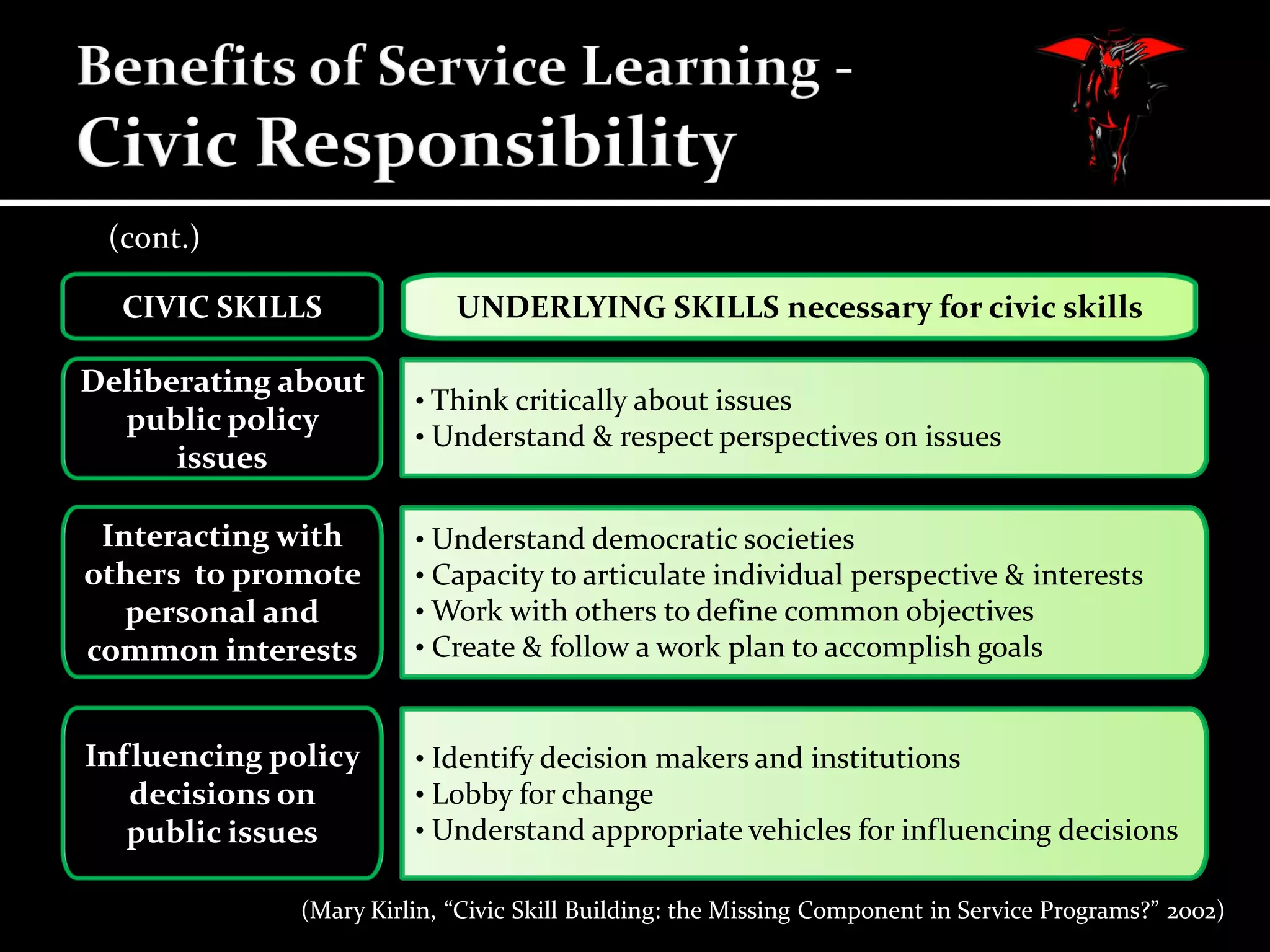
(cont.)
CIVIC SKILLS

UNDERLYING SKILLS necessary for civic skills

Deliberating about
public policy
issues

• Think critically about issues
• Understand & respect perspectives on issues

Interacting with
others to promote
personal and
common interests

• Understand democratic societies
• Capacity to articulate individual perspective & interests
• Work with others to define common objectives
• Create & follow a work plan to accomplish goals

Influencing policy
decisions on
public issues

• Identify decision makers and institutions
• Lobby for change
• Understand appropriate vehicles for influencing decisions

(Mary Kirlin, “Civic Skill Building: the Missing Component in Service Programs?” 2002)
“The world is full of strong leaders; however, leadership is a
neutral term. It can be good or bad.”
(“Five Standards of Excellence Practiced by Ethical Leaders,” Workforce Management Online, 2003)

The organization’s leadership “has a code of conduct and
ethical expectations,” and the leaders “that exhibit ethical
behavior powerfully influence the actions of others.”
(Susan M. Heathfield, “Leadership Values and Ethics,” About.com Guide, n.d.)
P4: A modern model for leadership

Purpose

Planet

Character of an
ethical
organization &
leader

People

Probity

* Probity harmonizes the other potentially conflicting aims so that the mix of
purpose, people, planet, and probity is sustainable, ethical, and successful.
(Alan Chapman, “Ethical Leadership, Decision-making, and Organisations,” www.businessballs.com, 2006-2010)
(cont.)

P4: A modern model for leadership

The aim of this model is “to reconcile the organisational
purpose (ex: cost-effective services delivery) with the
needs and feelings of people (staff, local communities,
stakeholders, etc) with proper consideration for the
planet - the world we live in (in terms of sustainability,
environment, wildlife, natural resources, our heritage,
'fair trade', other cultures, etc) and at all times acting
with probity - encompassing love, integrity,
compassion, honesty, and truth.”
(Alan Chapman, “Ethical Leadership, Decision-making, and Organisations,” www.businessballs.com, 2006-2010)
Commitment

Confidence

Compassion

Collaboration

Love
Honesty

Accountability
Trust

Examples of ethical leadership
qualities & behaviors

Service
Quality
Cultural
diversity

Integrity
Leadership is “more about serving than leading”
Good leadership requires attitudes and behaviors
that characterize and relate to humanity in a healthy way.

Ineffective leaders
believe that “the
leader must be served
by the people”

Faulty attitude: Leadership is “an
opportunity to take: to acquire
personal status, advantage, gain,
etc., at the expense of others”

Leadership is “an opportunity to give; to serve
your organization, and crucially, the people too.”
(Alan Chapman, “Leadership,” www.businessballs.com, 1995-2009)
“If I can stop one heart from breaking,
I shall not live in vain;
If I can ease one life the aching,
Or cool one pain,
Or help one fainting robin
Up to his nest again,
I shall not live in vain.”
Emily Dickinson
Acknowledgements
Irene Arellano, M.Ed.
Service Leaning Coordinator, TTU
(contributing most of the written
content for ‘community service and
service learning’)

Howie Chin,
Graduate Assistant, Ethics Center
Susan Fortney,
Interim Dean, School of Law, TTU
Angela Frisbie,
Former Graduate Assistant, Ethics
Center
Yi Hui Lee,
Sr. Editor, Ethics Center
Justin Louder,
Director, Ethics Center

Keisha McKenzie,
Graduate Assistant, Ethics Center

References

Arellano, Irene. “Importance of Service.” 2009
Astin, A. W., Sax, J. How Undergraduates Are Affected by Service Participation. Journal
of College Student Development, 1998. 39:3, 251-263. Print.
Astin, A. W., Sax, L. J., Avalos, J. Long-term Effects of Volunteerism during the
Undergraduate Years. The Review of Higher Education, 1999. 22:2, 187-202. Print.
Bok, D. Our Underachieving Colleges: A Candid Look at How Much Students Learn and
Why They Should Be Learning More. New Jersey: Princeton University Press,
2006. Print.
Chapman, Alan. “Ethical Leadership, Decision-making, and Organisations.” 2010.
Web. May 26, 2011. <
http://www.businessballs.com/ethical_management_leadership.htm>
Chapman, Alan. “Leadership.” 2009. Web. May 26, 2011. <
http://www.businessballs.com/leadership.htm>
Colby, A., Ehrlich, T., Beaumont, E., and Stephens, J. Educating Citizens: Preparing
America’s undergraduates for Lives of Moral and Civic Responsibility. San
Francisco: Jossey-Bass, 2003. Print.
Ehrlich, T. (Ed.). Civic Responsibility and Higher Education. Arizona: Oryx Press, 2000.
Print.
“Five Standards of Excellence Practiced by Ethical Leaders.” Workforce Management
Online. 2003. Web. May 25, 2011. < http://www.workforce.com/section/hrmanagement/article/five-standards-excellence-practiced-by-ethicalleaders.html>
Heathfield, Susan M. (n.d.). “Leadership Values and Ethics,” About.com Guide. Web.
May 26, 2011.
<http://humanresources.about.com/od/leadership/a/leader_values.htm>
Introduction to Service-Learning Toolkit: Readings and Resources for Faculty. Campus
Compact, 2003. Print.
Kirlin, Mary. Civic Skill Building: the Missing Component in Service Programs? Political
Science & Politics, Sep 2002. 35, 3, 571-575. Print.
Sax, L. J. The American freshman: National Norms 2004. Los Angeles: UCLA, Higher
Education Research Institute, 2005. Print.
Yates, M., Youniss, J. Community Service and Political Identity Development in
Adolescence. Journal of Social Issues, 1998. 495-512. Print.
Community Service and Leadership

Statement of Ethical Principles

Questions? Comments?
Please contact:
TTU Ethics Center
806.742.1505
www.ethics.ttu.edu

Leadership

  • 1.
    Statement of EthicalPrinciples Texas Tech University Ethics Center 2011
  • 2.
    “Texas Tech Universityis committed to ethical leadership practices at all levels and to our tradition of community service, both within the university community and in our relationships with the greater community. We strive for exemplary professional and community service through research, creative works, and service programs that extend beyond the university environment. We strive to provide excellent service in a caring and friendly environment and encourage such involvement in the community by all faculty, students, staff, and administration.” Texas Tech University Statement of Ethical Principles
  • 3.
    What are Community Service &Service Learning? P4 Model Community Service and Leadership Leadership TTU’s Statement of Benefits of Community Service & Service Learning Ethical Principles Ethics Civic Responsibility Leadership qualities & behaviors
  • 4.
    Community Service isthe application of one’s gifts, skills, and resources to provide value and enhance the quality of life for people who need or desire service. (Introduction to Service-Learning Toolkit, 2003)
  • 5.
    Astin and Sax(1998) examined the impact of community service on undergraduates’ development. According to the study, students participated in service 1. to help other people 2. for personal satisfaction 3. to improve their community and society as a whole
  • 6.
    “The fragrance alwaysremains on the hand that gives the rose.” Mahatma Gandhi
  • 7.
    For college students,participating in community service is also associated with specific behaviors:  earning higher grades  attending graduate school  donating money to one’s alma mater  socializing with persons from different racial/ethnic groups  participating in volunteer/community service work after college (Astin et al., “Long-term Effects of Volunteerism during the Undergraduate Years,” 1999)
  • 8.
     Informal learningthrough volunteering or community service seems easier than classroom learning, not because the content is simpler, but because it is embedded in familiar activity. This enables us to make sense of new information (Ehrlich, 2000).  Community Service allows the students to learn more about a cause and which actions will ensure that the issue is effectively addressed.
  • 9.
     An importantpart of what makes people successful and productive is their ability to integrate their work with their social life (Ehrlich, 2000).  Volunteering inspires students to become more socially responsible, committed to serving their communities, empowered, and committed to education (Astin et al., 1999).
  • 10.
    Service Learning is“pedagogy that links academic study and civic engagement through thoughtfully organized service that meets the needs of the community.” (Irene Arellano, “Importance of Service,” 2009) Service Learning experiences are reciprocally beneficial for both the community and the students. (Astin & Sax, 1998)
  • 11.
    Service Learning hasa positive effect on sense of social responsibility and citizenship skills. (Astin & Sax, 1998) Service and learning are connected equally. “The outcome is a win-win situation for all stakeholders involved.” (Arellano, 2009)
  • 12.
    Service Learning Program- Mission statement: TTU “provides information, support, and opportunities concerning Service Learning to students, faculty, and community members, fostering an appreciation of the academic and social values of community engagement.” (“Service Learning Strategic Plan,” http://www.tlpd.ttu.edu/servicelearning/strategic.asp) TTU faculty members from several academic disciplines state that “service-learning enhances their teaching and students’ interest in course material, and connects both faculty and students to the community.” (“Why Service Learning,” http://www.tltc.ttu.edu/servicelearning/faculty/index.asp)
  • 13.
    Learn new skillsin an interesting, engaged, hands-on way Apply academic knowledge & skills in the outside world Explore career opportunities Improve one’s leadership skills & sense of personal satisfaction
  • 14.
    Develop a senseof community and civic responsibility Make a difference in one’s home community Meet and develop relationships with people of diverse cultures & lifestyles
  • 15.
    Service Learning &Ethics  Service learning offers an effective way for students to engage the complexity of ethical issues and ambiguity of actual situations (Colby et al, 2003).  Service programs affect how students think about ethical problems and how aware and concerned they are about those less fortunate than themselves (Bok, 2006).  Exposure to a diversity of views, both in and out of the classroom, challenges students to abandon dogmatism and rethink previous ethical positions (Bok, 2006).
  • 16.
    Service learning &Civic Responsibility  Service learning allows individuals to gain civic skills and experience  Service learning helps students to focus on critical and reflective thinking as well as personal and civic responsibility.  Service learning gives students the opportunity to address local needs while developing their academic skills and their commitment to their community and society. (Introduction to Service-Learning Toolkit, 2003)
  • 17.
    Mary Kirlin exploredthe relationship of service learning and gaining civic skills: “Democratic society inherently demands collective decision making … young adults must practice the skills necessary for civic engagement.” CIVIC SKILLS UNDERLYING SKILLS necessary for civic skills • Understand distinctions between 3 sectors of society (public, Monitoring public events and issues private & nonprofit) • Understand context for events and issues (what happened & why) • Capacity to acquire and thoughtfully review news (read the local newspaper) (Mary Kirlin, “Civic Skill Building: the Missing Component in Service Programs?” 2002)
  • 18.
    (cont.) CIVIC SKILLS UNDERLYING SKILLSnecessary for civic skills Deliberating about public policy issues • Think critically about issues • Understand & respect perspectives on issues Interacting with others to promote personal and common interests • Understand democratic societies • Capacity to articulate individual perspective & interests • Work with others to define common objectives • Create & follow a work plan to accomplish goals Influencing policy decisions on public issues • Identify decision makers and institutions • Lobby for change • Understand appropriate vehicles for influencing decisions (Mary Kirlin, “Civic Skill Building: the Missing Component in Service Programs?” 2002)
  • 19.
    “The world isfull of strong leaders; however, leadership is a neutral term. It can be good or bad.” (“Five Standards of Excellence Practiced by Ethical Leaders,” Workforce Management Online, 2003) The organization’s leadership “has a code of conduct and ethical expectations,” and the leaders “that exhibit ethical behavior powerfully influence the actions of others.” (Susan M. Heathfield, “Leadership Values and Ethics,” About.com Guide, n.d.)
  • 20.
    P4: A modernmodel for leadership Purpose Planet Character of an ethical organization & leader People Probity * Probity harmonizes the other potentially conflicting aims so that the mix of purpose, people, planet, and probity is sustainable, ethical, and successful. (Alan Chapman, “Ethical Leadership, Decision-making, and Organisations,” www.businessballs.com, 2006-2010)
  • 21.
    (cont.) P4: A modernmodel for leadership The aim of this model is “to reconcile the organisational purpose (ex: cost-effective services delivery) with the needs and feelings of people (staff, local communities, stakeholders, etc) with proper consideration for the planet - the world we live in (in terms of sustainability, environment, wildlife, natural resources, our heritage, 'fair trade', other cultures, etc) and at all times acting with probity - encompassing love, integrity, compassion, honesty, and truth.” (Alan Chapman, “Ethical Leadership, Decision-making, and Organisations,” www.businessballs.com, 2006-2010)
  • 22.
    Commitment Confidence Compassion Collaboration Love Honesty Accountability Trust Examples of ethicalleadership qualities & behaviors Service Quality Cultural diversity Integrity
  • 23.
    Leadership is “moreabout serving than leading” Good leadership requires attitudes and behaviors that characterize and relate to humanity in a healthy way. Ineffective leaders believe that “the leader must be served by the people” Faulty attitude: Leadership is “an opportunity to take: to acquire personal status, advantage, gain, etc., at the expense of others” Leadership is “an opportunity to give; to serve your organization, and crucially, the people too.” (Alan Chapman, “Leadership,” www.businessballs.com, 1995-2009)
  • 24.
    “If I canstop one heart from breaking, I shall not live in vain; If I can ease one life the aching, Or cool one pain, Or help one fainting robin Up to his nest again, I shall not live in vain.” Emily Dickinson
  • 25.
    Acknowledgements Irene Arellano, M.Ed. ServiceLeaning Coordinator, TTU (contributing most of the written content for ‘community service and service learning’) Howie Chin, Graduate Assistant, Ethics Center Susan Fortney, Interim Dean, School of Law, TTU Angela Frisbie, Former Graduate Assistant, Ethics Center Yi Hui Lee, Sr. Editor, Ethics Center Justin Louder, Director, Ethics Center Keisha McKenzie, Graduate Assistant, Ethics Center References Arellano, Irene. “Importance of Service.” 2009 Astin, A. W., Sax, J. How Undergraduates Are Affected by Service Participation. Journal of College Student Development, 1998. 39:3, 251-263. Print. Astin, A. W., Sax, L. J., Avalos, J. Long-term Effects of Volunteerism during the Undergraduate Years. The Review of Higher Education, 1999. 22:2, 187-202. Print. Bok, D. Our Underachieving Colleges: A Candid Look at How Much Students Learn and Why They Should Be Learning More. New Jersey: Princeton University Press, 2006. Print. Chapman, Alan. “Ethical Leadership, Decision-making, and Organisations.” 2010. Web. May 26, 2011. < http://www.businessballs.com/ethical_management_leadership.htm> Chapman, Alan. “Leadership.” 2009. Web. May 26, 2011. < http://www.businessballs.com/leadership.htm> Colby, A., Ehrlich, T., Beaumont, E., and Stephens, J. Educating Citizens: Preparing America’s undergraduates for Lives of Moral and Civic Responsibility. San Francisco: Jossey-Bass, 2003. Print. Ehrlich, T. (Ed.). Civic Responsibility and Higher Education. Arizona: Oryx Press, 2000. Print. “Five Standards of Excellence Practiced by Ethical Leaders.” Workforce Management Online. 2003. Web. May 25, 2011. < http://www.workforce.com/section/hrmanagement/article/five-standards-excellence-practiced-by-ethicalleaders.html> Heathfield, Susan M. (n.d.). “Leadership Values and Ethics,” About.com Guide. Web. May 26, 2011. <http://humanresources.about.com/od/leadership/a/leader_values.htm> Introduction to Service-Learning Toolkit: Readings and Resources for Faculty. Campus Compact, 2003. Print. Kirlin, Mary. Civic Skill Building: the Missing Component in Service Programs? Political Science & Politics, Sep 2002. 35, 3, 571-575. Print. Sax, L. J. The American freshman: National Norms 2004. Los Angeles: UCLA, Higher Education Research Institute, 2005. Print. Yates, M., Youniss, J. Community Service and Political Identity Development in Adolescence. Journal of Social Issues, 1998. 495-512. Print.
  • 26.
    Community Service andLeadership Statement of Ethical Principles Questions? Comments? Please contact: TTU Ethics Center 806.742.1505 www.ethics.ttu.edu