LEADERSHIP
        IN COMPLEX TIMES

    Prepared for:
    FCSSAA
    “Leading the Way”
    conference
                              Mark Holmgren
    Edmonton Alberta          780 299 0780
    November 16-18 2011
                          www.markholmgren.com


1
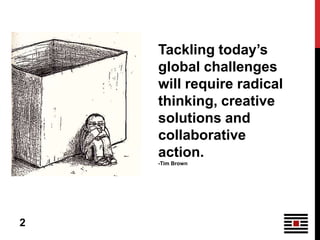
Tackling today’s
    global challenges
    will require radical
    thinking, creative
    solutions and
    collaborative
    action.
    -Tim Brown


2
Order
                Structure
                Relationship
                Purpose
Unpredictable   Independence
                Interdependence
   Order        Beauty
                Flexibility
                Variance
                Creation
                Destruction
                Renewal
                Adaptation
 3
BIG CHANGE TRENDS

BY 2031…
•   Last of the Boomers retire.
•   Age expectancy in the mid-80s.
•   Seniors increase by 120%.
•   Young people decrease by 16%.
•   Immigration drives population growth.
•   Employment Participation Declines (from
    72% to 63%)
•   Worker-Retiree ratio 2:1 (5:1 in 1981)
4
FUNDING PICTURE
•   Funding from governments and major funders is
    thin, flat, and at risk.
•   Government contracts generally do not cover all
    costs.
•   How funding is delivered will likely change.
•   Corporate giving is not an answer. Corporations
    primarily invest in large organizations.
•   Corporate Social Responsibility is creating more
    complexity
•   Social Enterprise will not save the day.

5
PHILANTHROPY
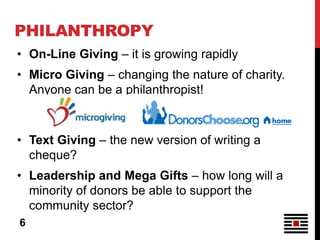
• On-Line Giving – it is growing rapidly
• Micro Giving – changing the nature of charity.
  Anyone can be a philanthropist!


• Text Giving – the new version of writing a
  cheque?
• Leadership and Mega Gifts – how long will a
  minority of donors be able to support the
  community sector?
6
PHILANTHROPY
The growing mindset:
• Global Affinities, Local Action
• Self-directed: the Demonstrable BANG “I” want
  to have
• Activism or Charity?
• Unbranded /unorganized philanthropy


7
TECHNOLOGY/INTERNET

• Social Networks
• Crowdsourcing
• Convergence & Dependence
• Increased/Decreased Connectivity
• Impatience


8
COMPLEXITY & LEADERSHIP
                    Based on the work of Brenda Zimmerman


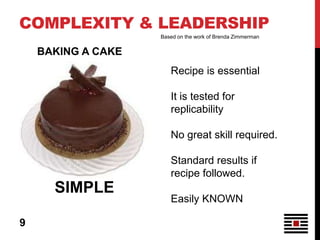
    BAKING A CAKE
                       Recipe is essential

                       It is tested for
                       replicability

                       No great skill required.

                       Standard results if
                       recipe followed.
      SIMPLE
                       Easily KNOWN

9
COMPLEXITY & LEADERSHIP
                         Based on the work of Brenda Zimmerman


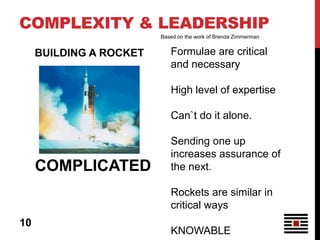
     BUILDING A ROCKET      Formulae are critical
                            and necessary

                            High level of expertise

                            Can`t do it alone.

                            Sending one up
                            increases assurance of
     COMPLICATED            the next.

                            Rockets are similar in
                            critical ways
10
                            KNOWABLE
COMPLEXITY & LEADERSHIP
                       Based on the work of Brenda Zimmerman


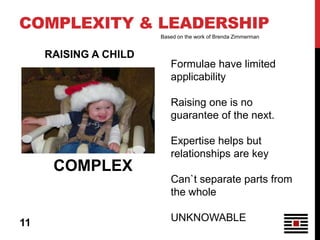
     RAISING A CHILD
                          Formulae have limited
                          applicability

                          Raising one is no
                          guarantee of the next.

                          Expertise helps but
                          relationships are key
      COMPLEX
                          Can`t separate parts from
                          the whole

11                        UNKNOWABLE
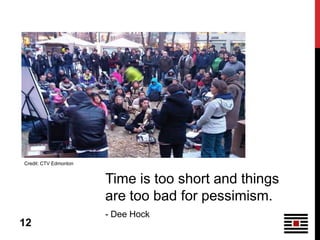
Credit: CTV Edmonton


                       Time is too short and things
                       are too bad for pessimism.
                       - Dee Hock
12
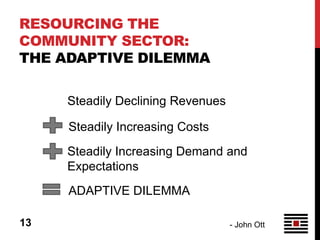
RESOURCING THE
COMMUNITY SECTOR:
THE ADAPTIVE DILEMMA

     Steadily Declining Revenues

     Steadily Increasing Costs
     Steadily Increasing Demand and
     Expectations
     ADAPTIVE DILEMMA

13                                 - John Ott
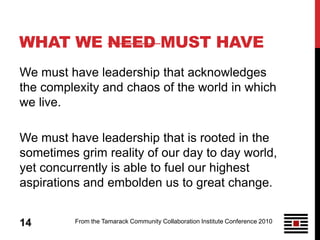
WHAT WE NEED MUST HAVE
We must have leadership that acknowledges
the complexity and chaos of the world in which
we live.

We must have leadership that is rooted in the
sometimes grim reality of our day to day world,
yet concurrently is able to fuel our highest
aspirations and embolden us to great change.


14        From the Tamarack Community Collaboration Institute Conference 2010
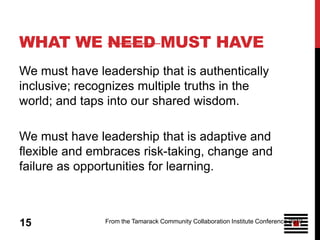
WHAT WE NEED MUST HAVE
We must have leadership that is authentically
inclusive; recognizes multiple truths in the
world; and taps into our shared wisdom.

We must have leadership that is adaptive and
flexible and embraces risk-taking, change and
failure as opportunities for learning.


15             From the Tamarack Community Collaboration Institute Conference 2010
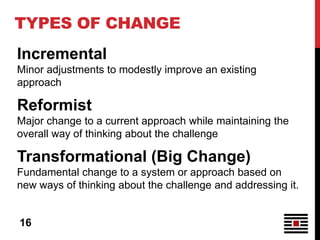
TYPES OF CHANGE
Incremental
Minor adjustments to modestly improve an existing
approach

Reformist
Major change to a current approach while maintaining the
overall way of thinking about the challenge

Transformational (Big Change)
Fundamental change to a system or approach based on
new ways of thinking about the challenge and addressing it.


16
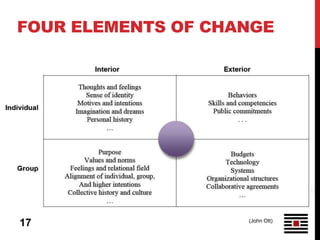
FOUR ELEMENTS OF CHANGE


17                  (John Ott)
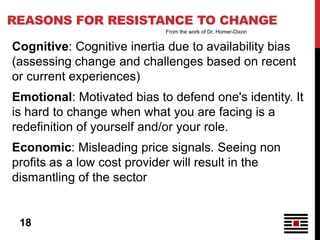
REASONS FOR RESISTANCE TO CHANGE
                            From the work of Dr. Homer-Dixon


Cognitive: Cognitive inertia due to availability bias
(assessing change and challenges based on recent
or current experiences)
Emotional: Motivated bias to defend one's identity. It
is hard to change when what you are facing is a
redefinition of yourself and/or your role.
Economic: Misleading price signals. Seeing non
profits as a low cost provider will result in the
dismantling of the sector


 18
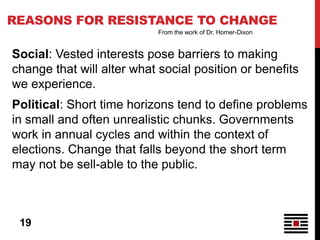
REASONS FOR RESISTANCE TO CHANGE
                            From the work of Dr. Homer-Dixon


Social: Vested interests pose barriers to making
change that will alter what social position or benefits
we experience.
Political: Short time horizons tend to define problems
in small and often unrealistic chunks. Governments
work in annual cycles and within the context of
elections. Change that falls beyond the short term
may not be sell-able to the public.


 19
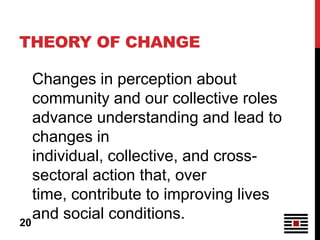
THEORY OF CHANGE

   Changes in perception about
   community and our collective roles
   advance understanding and lead to
   changes in
   individual, collective, and cross-
   sectoral action that, over
   time, contribute to improving lives
20
   and social conditions.
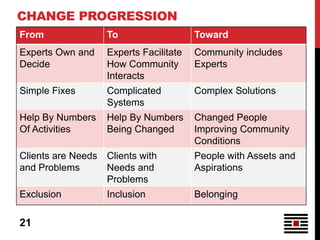
CHANGE PROGRESSION
From               To                   Toward
Experts Own and    Experts Facilitate   Community includes
Decide             How Community        Experts
                   Interacts
Simple Fixes       Complicated          Complex Solutions
                   Systems
Help By Numbers    Help By Numbers      Changed People
Of Activities      Being Changed        Improving Community
                                        Conditions
Clients are Needs Clients with          People with Assets and
and Problems      Needs and             Aspirations
                  Problems
Exclusion          Inclusion            Belonging

21
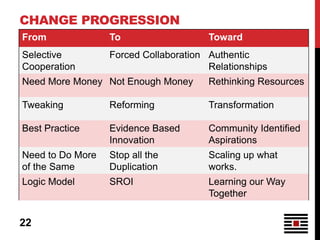
CHANGE PROGRESSION
From              To                   Toward
Selective         Forced Collaboration Authentic
Cooperation                            Relationships
Need More Money Not Enough Money       Rethinking Resources

Tweaking          Reforming            Transformation

Best Practice     Evidence Based       Community Identified
                  Innovation           Aspirations
Need to Do More   Stop all the         Scaling up what
of the Same       Duplication          works.
Logic Model       SROI                 Learning our Way
                                       Together


22
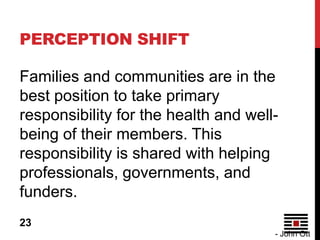
PERCEPTION SHIFT

Families and communities are in the
best position to take primary
responsibility for the health and well-
being of their members. This
responsibility is shared with helping
professionals, governments, and
funders.
23
                                      - John Ott
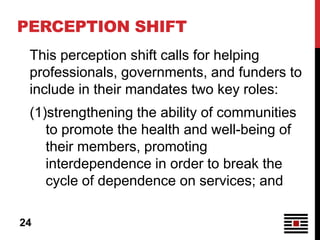
PERCEPTION SHIFT
 This perception shift calls for helping
 professionals, governments, and funders to
 include in their mandates two key roles:
 (1)strengthening the ability of communities
    to promote the health and well-being of
    their members, promoting
    interdependence in order to break the
    cycle of dependence on services; and

24
PERCEPTION SHIFT

(2) providing bridge services to people who
do not have natural communities of
support, or whose needs are beyond the
capacity of their families or communities to
meet, while helping to establish or
strengthen their ties to natural communities
of support.


25
                                        - John Ott
MUST-HAVE LEADERSHIP QUALITIES
 • Able to identify simple, complicated, and
   complex problems.
 • Able to suspend certainty and have a high
   tolerance for ambiguity.
 • Able to create conditions for experimentation
   and for creative failure.
 • Able to work with data and their stories.
 • Able to foster and champion collective wisdom
   and generative dialogue.
 • Able to ask and work with wicked or upside
 26 down questions.
MUST-HAVE LEADERSHIP QUALITIES

  • Able to welcome all that arises.
  • Skilled at seeking
    diversity, paradoxes, and contradictions.
  • Able to focus on what works and why
    (appreciative inquiry)
  • Able to foster collaborative leadership
    within a hierarchical framework.
  • Able to inspire people to make personal
    change in order to effect community
    change.
 27
THANK YOU TO THESE SOURCES


 • Dr. Thomas Homer-Dixon
 • John Ott
 • Brenda Zimmerman
 • Stat Canada
 • Imagine Canada
 • Tamarack Institute


28
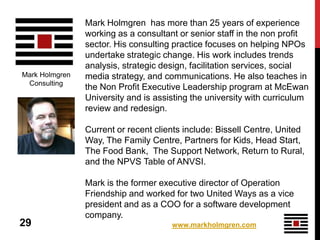
Mark Holmgren has more than 25 years of experience
                working as a consultant or senior staff in the non profit
                sector. His consulting practice focuses on helping NPOs
                undertake strategic change. His work includes trends
                analysis, strategic design, facilitation services, social
Mark Holmgren   media strategy, and communications. He also teaches in
 Consulting
                the Non Profit Executive Leadership program at McEwan
                University and is assisting the university with curriculum
                review and redesign.

                Current or recent clients include: Bissell Centre, United
                Way, The Family Centre, Partners for Kids, Head Start,
                The Food Bank, The Support Network, Return to Rural,
                and the NPVS Table of ANVSI.

                Mark is the former executive director of Operation
                Friendship and worked for two United Ways as a vice
                president and as a COO for a software development
                company.
29                                    www.markholmgren.com

Leadership in Complex Times

  • 1.
    LEADERSHIP IN COMPLEX TIMES Prepared for: FCSSAA “Leading the Way” conference Mark Holmgren Edmonton Alberta 780 299 0780 November 16-18 2011 www.markholmgren.com 1
  • 2.
    Tackling today’s global challenges will require radical thinking, creative solutions and collaborative action. -Tim Brown 2
  • 3.
    Order Structure Relationship Purpose Unpredictable Independence Interdependence Order Beauty Flexibility Variance Creation Destruction Renewal Adaptation 3
  • 4.
    BIG CHANGE TRENDS BY2031… • Last of the Boomers retire. • Age expectancy in the mid-80s. • Seniors increase by 120%. • Young people decrease by 16%. • Immigration drives population growth. • Employment Participation Declines (from 72% to 63%) • Worker-Retiree ratio 2:1 (5:1 in 1981) 4
  • 5.
    FUNDING PICTURE • Funding from governments and major funders is thin, flat, and at risk. • Government contracts generally do not cover all costs. • How funding is delivered will likely change. • Corporate giving is not an answer. Corporations primarily invest in large organizations. • Corporate Social Responsibility is creating more complexity • Social Enterprise will not save the day. 5
  • 6.
    PHILANTHROPY • On-Line Giving– it is growing rapidly • Micro Giving – changing the nature of charity. Anyone can be a philanthropist! • Text Giving – the new version of writing a cheque? • Leadership and Mega Gifts – how long will a minority of donors be able to support the community sector? 6
  • 7.
    PHILANTHROPY The growing mindset: •Global Affinities, Local Action • Self-directed: the Demonstrable BANG “I” want to have • Activism or Charity? • Unbranded /unorganized philanthropy 7
  • 8.
    TECHNOLOGY/INTERNET • Social Networks •Crowdsourcing • Convergence & Dependence • Increased/Decreased Connectivity • Impatience 8
  • 9.
    COMPLEXITY & LEADERSHIP Based on the work of Brenda Zimmerman BAKING A CAKE Recipe is essential It is tested for replicability No great skill required. Standard results if recipe followed. SIMPLE Easily KNOWN 9
  • 10.
    COMPLEXITY & LEADERSHIP Based on the work of Brenda Zimmerman BUILDING A ROCKET Formulae are critical and necessary High level of expertise Can`t do it alone. Sending one up increases assurance of COMPLICATED the next. Rockets are similar in critical ways 10 KNOWABLE
  • 11.
    COMPLEXITY & LEADERSHIP Based on the work of Brenda Zimmerman RAISING A CHILD Formulae have limited applicability Raising one is no guarantee of the next. Expertise helps but relationships are key COMPLEX Can`t separate parts from the whole 11 UNKNOWABLE
  • 12.
    Credit: CTV Edmonton Time is too short and things are too bad for pessimism. - Dee Hock 12
  • 13.
    RESOURCING THE COMMUNITY SECTOR: THEADAPTIVE DILEMMA Steadily Declining Revenues Steadily Increasing Costs Steadily Increasing Demand and Expectations ADAPTIVE DILEMMA 13 - John Ott
  • 14.
    WHAT WE NEEDMUST HAVE We must have leadership that acknowledges the complexity and chaos of the world in which we live. We must have leadership that is rooted in the sometimes grim reality of our day to day world, yet concurrently is able to fuel our highest aspirations and embolden us to great change. 14 From the Tamarack Community Collaboration Institute Conference 2010
  • 15.
    WHAT WE NEEDMUST HAVE We must have leadership that is authentically inclusive; recognizes multiple truths in the world; and taps into our shared wisdom. We must have leadership that is adaptive and flexible and embraces risk-taking, change and failure as opportunities for learning. 15 From the Tamarack Community Collaboration Institute Conference 2010
  • 16.
    TYPES OF CHANGE Incremental Minoradjustments to modestly improve an existing approach Reformist Major change to a current approach while maintaining the overall way of thinking about the challenge Transformational (Big Change) Fundamental change to a system or approach based on new ways of thinking about the challenge and addressing it. 16
  • 17.
    FOUR ELEMENTS OFCHANGE 17 (John Ott)
  • 18.
    REASONS FOR RESISTANCETO CHANGE From the work of Dr. Homer-Dixon Cognitive: Cognitive inertia due to availability bias (assessing change and challenges based on recent or current experiences) Emotional: Motivated bias to defend one's identity. It is hard to change when what you are facing is a redefinition of yourself and/or your role. Economic: Misleading price signals. Seeing non profits as a low cost provider will result in the dismantling of the sector 18
  • 19.
    REASONS FOR RESISTANCETO CHANGE From the work of Dr. Homer-Dixon Social: Vested interests pose barriers to making change that will alter what social position or benefits we experience. Political: Short time horizons tend to define problems in small and often unrealistic chunks. Governments work in annual cycles and within the context of elections. Change that falls beyond the short term may not be sell-able to the public. 19
  • 20.
    THEORY OF CHANGE Changes in perception about community and our collective roles advance understanding and lead to changes in individual, collective, and cross- sectoral action that, over time, contribute to improving lives 20 and social conditions.
  • 21.
    CHANGE PROGRESSION From To Toward Experts Own and Experts Facilitate Community includes Decide How Community Experts Interacts Simple Fixes Complicated Complex Solutions Systems Help By Numbers Help By Numbers Changed People Of Activities Being Changed Improving Community Conditions Clients are Needs Clients with People with Assets and and Problems Needs and Aspirations Problems Exclusion Inclusion Belonging 21
  • 22.
    CHANGE PROGRESSION From To Toward Selective Forced Collaboration Authentic Cooperation Relationships Need More Money Not Enough Money Rethinking Resources Tweaking Reforming Transformation Best Practice Evidence Based Community Identified Innovation Aspirations Need to Do More Stop all the Scaling up what of the Same Duplication works. Logic Model SROI Learning our Way Together 22
  • 23.
    PERCEPTION SHIFT Families andcommunities are in the best position to take primary responsibility for the health and well- being of their members. This responsibility is shared with helping professionals, governments, and funders. 23 - John Ott
  • 24.
    PERCEPTION SHIFT Thisperception shift calls for helping professionals, governments, and funders to include in their mandates two key roles: (1)strengthening the ability of communities to promote the health and well-being of their members, promoting interdependence in order to break the cycle of dependence on services; and 24
  • 25.
    PERCEPTION SHIFT (2) providingbridge services to people who do not have natural communities of support, or whose needs are beyond the capacity of their families or communities to meet, while helping to establish or strengthen their ties to natural communities of support. 25 - John Ott
  • 26.
    MUST-HAVE LEADERSHIP QUALITIES • Able to identify simple, complicated, and complex problems. • Able to suspend certainty and have a high tolerance for ambiguity. • Able to create conditions for experimentation and for creative failure. • Able to work with data and their stories. • Able to foster and champion collective wisdom and generative dialogue. • Able to ask and work with wicked or upside 26 down questions.
  • 27.
    MUST-HAVE LEADERSHIP QUALITIES • Able to welcome all that arises. • Skilled at seeking diversity, paradoxes, and contradictions. • Able to focus on what works and why (appreciative inquiry) • Able to foster collaborative leadership within a hierarchical framework. • Able to inspire people to make personal change in order to effect community change. 27
  • 28.
    THANK YOU TOTHESE SOURCES • Dr. Thomas Homer-Dixon • John Ott • Brenda Zimmerman • Stat Canada • Imagine Canada • Tamarack Institute 28
  • 29.
    Mark Holmgren hasmore than 25 years of experience working as a consultant or senior staff in the non profit sector. His consulting practice focuses on helping NPOs undertake strategic change. His work includes trends analysis, strategic design, facilitation services, social Mark Holmgren media strategy, and communications. He also teaches in Consulting the Non Profit Executive Leadership program at McEwan University and is assisting the university with curriculum review and redesign. Current or recent clients include: Bissell Centre, United Way, The Family Centre, Partners for Kids, Head Start, The Food Bank, The Support Network, Return to Rural, and the NPVS Table of ANVSI. Mark is the former executive director of Operation Friendship and worked for two United Ways as a vice president and as a COO for a software development company. 29 www.markholmgren.com

Editor's Notes

  • #5 The number of seniors will increase by nearly 120%The number of people, ages 0-24 will decrease 16%In Canada, visible minorities will grow as much as 113% (2001 to 2017). The rest of the population will grow at a rate between .7% and 6.7%In 2003, one in ten immigrants spoke English or French as their mother tongue, compared to almost one in three in 1980.