Pru Gell
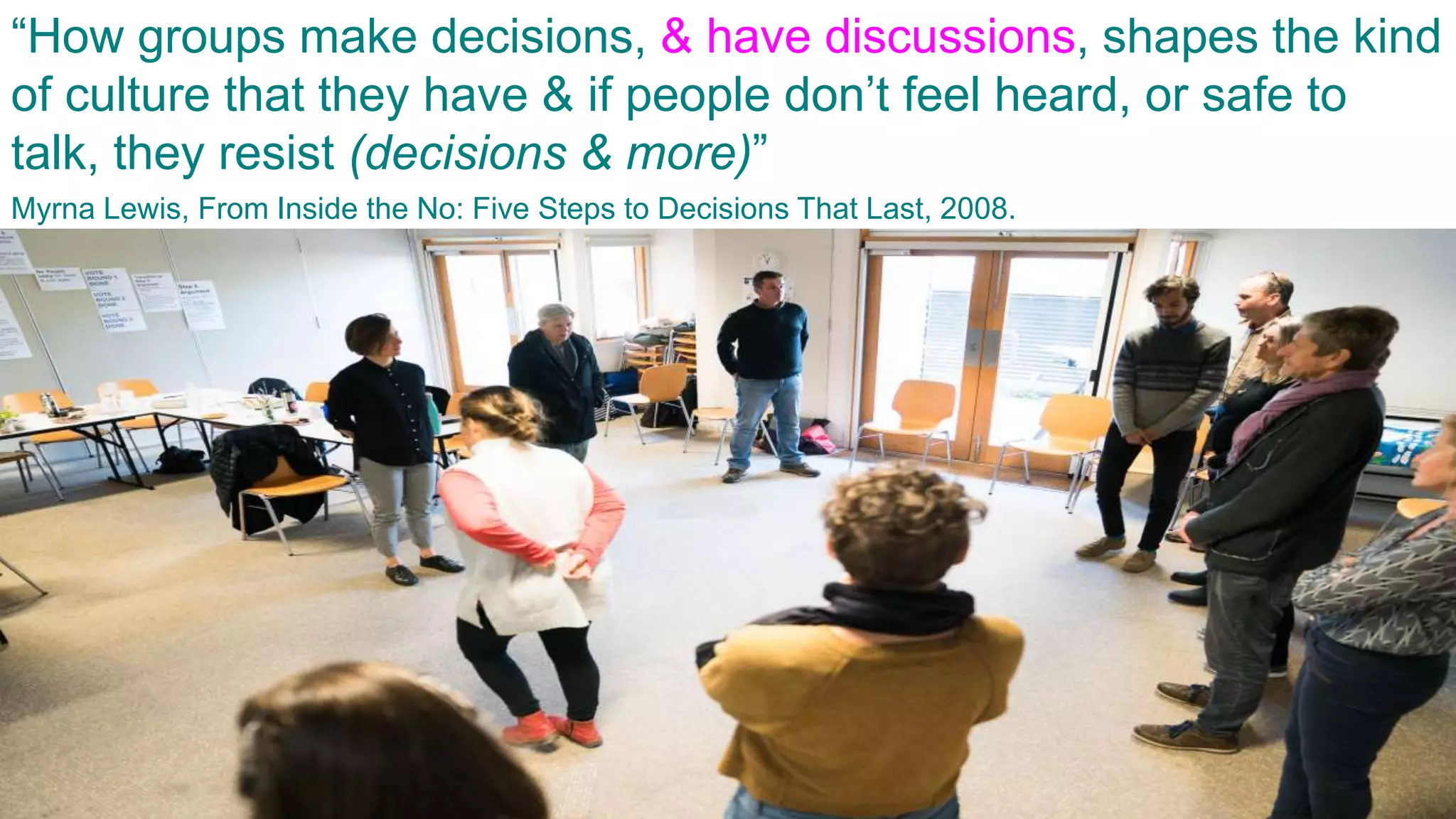
“How groups make decisions, & have discussions, shapes the kind
of culture that they have & if people don’t feel heard, or safe to
talk, they resist (decisions & more)”
Myrna Lewis, From Inside the No: Five Steps to Decisions That Last, 2008.
main purpose of Deep Democracy tools
= have a roadmap to make it safe(r) to
say what needs to be said
can be uncomfortable but it’s harder, even more uncomfortable, to
deal with consequences of not
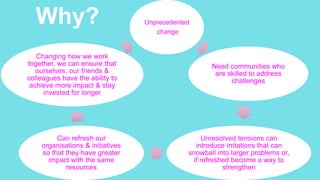
Unprecedented
change
Need communities who
are skilled to address
challenges
Unresolved tensions can
introduce irritations that can
snowball into larger problems or,
if refreshed become a way to
strengthen
Can refresh our
organisations & initiatives
so that they have greater
impact with the same
resources
Changing how we work
together, we can ensure that
ourselves, our friends &
colleagues have the ability to
achieve more impact & stay
invested for longer
Why?
1. Very experiential & not role playing
2. Present in process
• May find yourself comparing/analysing,
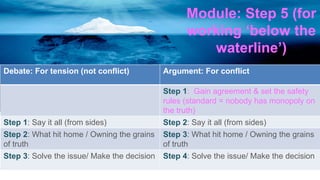
welcome, but try & stay in the
experience rather than moving out
• Hold onto questions about the process
until time to debrief & ‘take a photo’
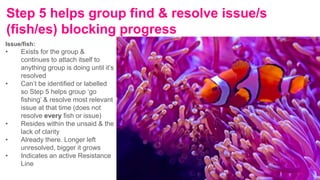
3. Timings & plan for the day
4. Encourage you to soak up opportunity
How
masterclass
will work
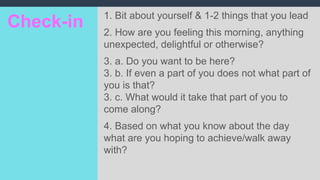
Check-in 1. Bit about yourself & 1-2 things that you lead
2. How are you feeling this morning, anything
unexpected, delightful or otherwise?
3. a. Do you want to be here?
3. b. If even a part of you does not what part of
you is that?
3. c. What would it take that part of you to
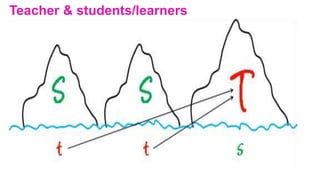
come along?
4. Based on what you know about the day
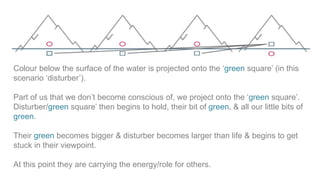
what are you hoping to achieve/walk away
with?
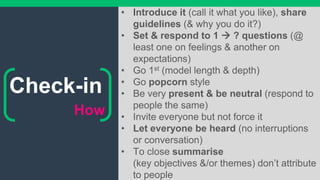
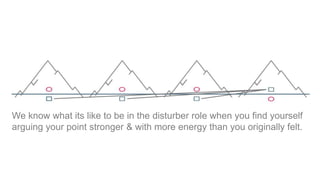
How
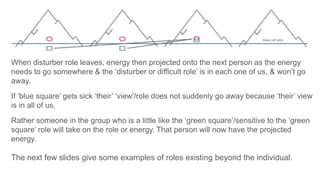
• Introduce it (call it what you like), share
guidelines (& why you do it?)
• Set & respond to 1  ? questions (@
least one on feelings & another on
expectations)
• Go 1st (model length & depth)
• Go popcorn style
• Be very present & be neutral (respond to
people the same)
• Invite everyone but not force it
• Let everyone be heard (no interruptions
or conversation)
• To close summarise
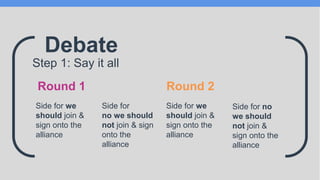
(key objectives &/or themes) don’t attribute
to people
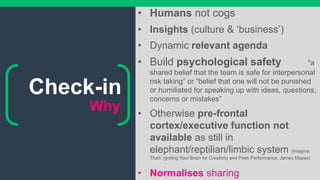
Check-in
Why
• Humans not cogs
• Insights (culture & ‘business’)
• Dynamic relevant agenda
• Build psychological safety "a
shared belief that the team is safe for interpersonal
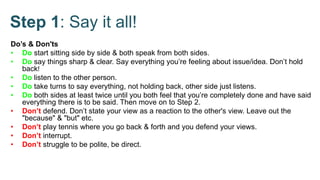
risk taking” or “belief that one will not be punished
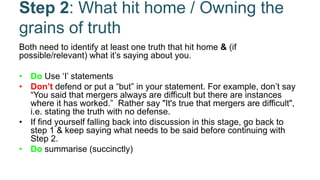
or humiliated for speaking up with ideas, questions,
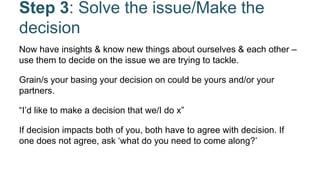
concerns or mistakes”
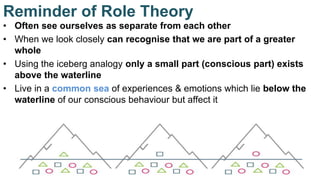
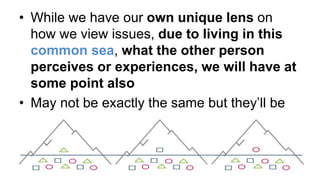
• Otherwise pre-frontal
cortex/executive function not
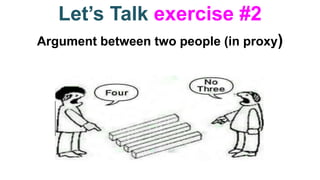
available as still in
elephant/reptilian/limbic system (Imagine
That!: Igniting Your Brain for Creativity and Peak Performance, James Mapes)
• Normalises sharing
Check-in
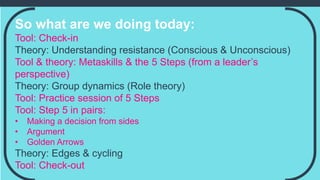
So what are we doing today:
Tool: Check-in
Theory: Understanding resistance (Conscious & Unconscious)
Tool & theory: Metaskills & the 5 Steps (from a leader’s
perspective)
Theory: Group dynamics (Role theory)
Tool: Practice session of 5 Steps
Tool: Step 5 in pairs:
• Making a decision from sides
• Argument
• Golden Arrows
Theory: Edges & cycling
Tool: Check-out
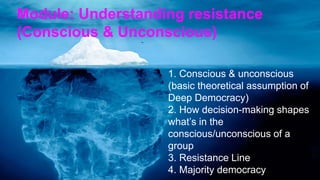
1. Conscious & unconscious
(basic theoretical assumption of
Deep Democracy)
2. How decision-making shapes
what’s in the
conscious/unconscious of a
group
3. Resistance Line
4. Majority democracy
Module: Understanding resistance
(Conscious & Unconscious)
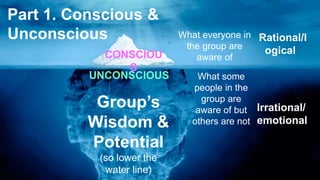
CONSCIOU
S
UNCONSCIOUS What some
people in the
group are
aware of but
others are not
What everyone in
the group are
aware of
Group’s
Wisdom &
Potential
(so lower the
water line)
Irrational/
emotional
Rational/l
ogical
Part 1. Conscious &
Unconscious
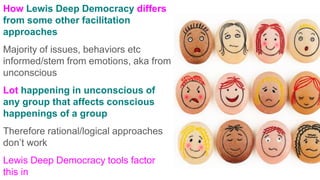
How Lewis Deep Democracy differs
from some other facilitation
approaches
Majority of issues, behaviors etc
informed/stem from emotions, aka from
unconscious
Lot happening in unconscious of
any group that affects conscious
happenings of a group
Therefore rational/logical approaches
don’t work
Lewis Deep Democracy tools factor
this in
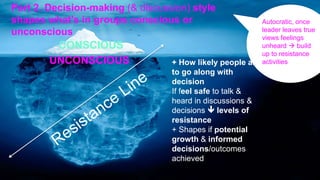
CONSCIOUS
UNCONSCIOUS + How likely people are
to go along with
decision
If feel safe to talk &
heard in discussions &
decisions  levels of
resistance
+ Shapes if potential
growth & informed
decisions/outcomes
achieved
Autocratic, once
leader leaves true
views feelings
unheard  build
up to resistance
activities
Part 2. Decision-making (& discussion) style
shapes what’s in groups conscious or
unconscious
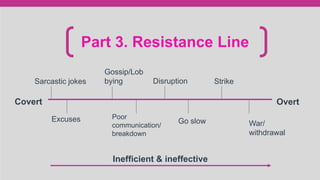
Inefficient & ineffective
Part 3. Resistance Line
Sarcastic jokes
Excuses
Gossip/Lob
bying
Poor
communication/
breakdown
Disruption
Go slow
Strike
War/
withdrawal
Covert Overt
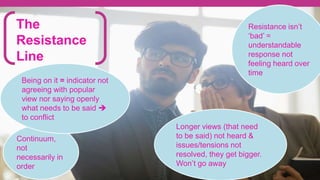
The
Resistance
Line
Continuum,
not
necessarily in
order
Resistance isn’t
‘bad’ =
understandable
response not
feeling heard over
time
Being on it = indicator not
agreeing with popular
view nor saying openly
what needs to be said 
to conflict
Longer views (that need
to be said) not heard &
issues/tensions not
resolved, they get bigger.
Won’t go away
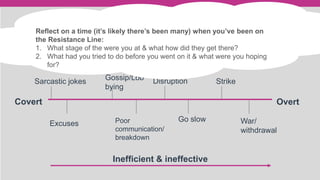
Inefficient & ineffective
Sarcastic jokes
Excuses
Gossip/Lob
bying
Poor
communication/
breakdown
Disruption
Go slow
Strike
War/
withdrawal
Covert Overt
Reflect on a time (it’s likely there’s been many) when you’ve been on
the Resistance Line:
1. What stage of the were you at & what how did they get there?
2. What had you tried to do before you went on it & what were you hoping
for?
Reflect on experiences of losing the
‘vote’, being in the minority, what do
you tend to do?
Part 4: Majority
Democracy
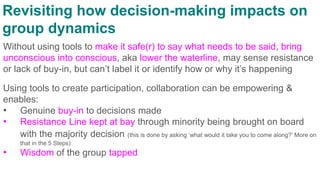
Without using tools to make it safe(r) to say what needs to be said, bring
unconscious into conscious, aka lower the waterline, may sense resistance
or lack of buy-in, but can’t label it or identify how or why it’s happening
Using tools to create participation, collaboration can be empowering &
enables:
• Genuine buy-in to decisions made
• Resistance Line kept at bay through minority being brought on board
with the majority decision (this is done by asking ‘what would it take you to come along?’ More on
that in the 5 Steps)
• Wisdom of the group tapped
Revisiting how decision-making impacts on
group dynamics
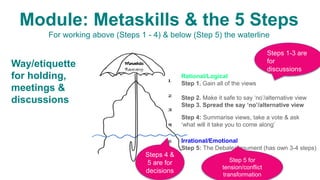
Irrational/Emotional
Step 5: The Debate/Argument (has own 3-4 steps)
Way/etiquette
for holding,
meetings &
discussions
Rational/Logical
Step 1. Gain all of the views
Step 2. Make it safe to say ‘no’/alternative view
Step 3. Spread the say ‘no’/alternative view
Step 4: Summarise views, take a vote & ask
‘what will it take you to come along’
Steps 1-3 are
for
discussions
Steps 4 &
5 are for
decisions
WWW War stories or personal experiences – give your own views.
TTT TEACH
Metaskills
Present&the&Video&or&PowerPoint,&or&add&to&Diagram&&
There are five Steps to DD; the first four are above the water line.
Module: Metaskills & the 5 Steps
For working above (Steps 1 - 4) & below (Step 5) the waterline
Step 5 for
tension/conflict
transformation
• Gain greater participation & buy in (stay on
the bus)
• Involve & empower people
• Make sounder, wiser, better decisions
• Helps leaders be less autocratic
• Minimise ineffective & inefficient decision-
making that results from people being on the
Resistance Line
Why we use the 5 Steps
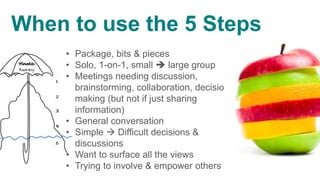
• Package, bits & pieces
• Solo, 1-on-1, small  large group
• Meetings needing discussion,
brainstorming, collaboration, decision-
making (but not if just sharing
information)
• General conversation
• Simple  Difficult decisions &
discussions
• Want to surface all the views
• Trying to involve & empower others
r personal experiences – give your own views.
s
e&Video&or&PowerPoint,&or&add&to&Diagram&&
ve Steps to DD; the first four are above the water line.
When to use the 5 Steps
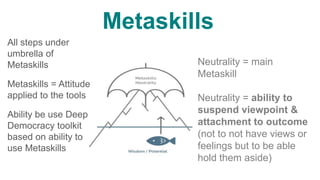
All steps under
umbrella of
Metaskills
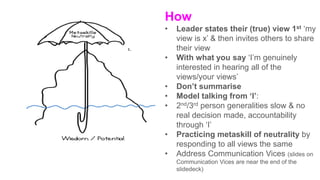
Metaskills = Attitude
applied to the tools
Ability be use Deep
Democracy toolkit
based on ability to
use Metaskills
Neutrality = main
Metaskill
Neutrality = ability to
suspend viewpoint &
attachment to outcome
(not to not have views or
feelings but to be able
hold them aside)
Metaskills
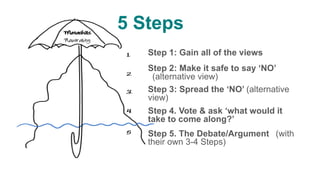
5 Steps
Step 1: Gain all of the views
Step 2: Make it safe to say ‘NO’
(alternative view)
Step 3: Spread the ‘NO’ (alternative
view)
Step 4. Vote & ask ‘what would it
take to come along?’
Step 5. The Debate/Argument (with
their own 3-4 Steps)
esent&the&Video&or&PowerPoint,&or&add&to&Diagram&&
There are five Steps to DD; the first four are above the water line.
Using the 5 Steps from the ‘leader
position’
Make it clear when you are expressing your own
personal view for example:
Lean in: When you are expressing your view
Lean out: When you are able to be ‘neutral’ &
sincerely hear & invite all the other views
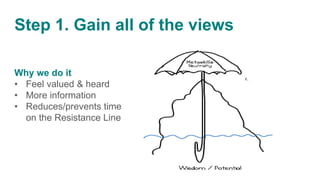
Why we do it
• Feel valued & heard
• More information
• Reduces/prevents time
on the Resistance Line
Step 1. Gain all of the views
How
• Leader states their (true) view 1st ‘my
view is x’ & then invites others to share
their view
• With what you say ‘I’m genuinely
interested in hearing all of the
views/your views’
• Don’t summarise
• Model talking from ‘I’:
• 2nd/3rd person generalities slow & no
real decision made, accountability
through ‘I’
• Practicing metaskill of neutrality by
responding to all views the same
• Address Communication Vices (slides on
Communication Vices are near the end of the
slidedeck)
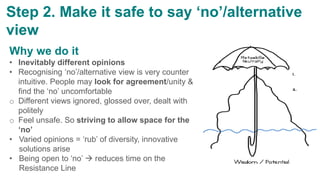
Why we do it
• Inevitably different opinions
• Recognising ‘no’/alternative view is very counter
intuitive. People may look for agreement/unity &
find the ‘no’ uncomfortable
o Different views ignored, glossed over, dealt with
politely
o Feel unsafe. So striving to allow space for the
‘no’
• Varied opinions = ‘rub’ of diversity, innovative
solutions arise
• Being open to ‘no’  reduces time on the
Resistance Line
Step 2. Make it safe to say ‘no’/alternative
view
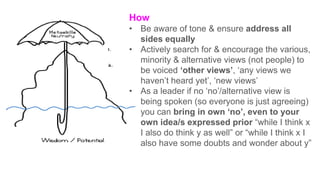
How
• Be aware of tone & ensure address all
sides equally
• Actively search for & encourage the various,
minority & alternative views (not people) to
be voiced ‘other views’, ‘any views we
haven’t heard yet’, ‘new views’
• As a leader if no ‘no’/alternative view is
being spoken (so everyone is just agreeing)
you can bring in own ‘no’, even to your
own idea/s expressed prior “while I think x
I also do think y as well” or “while I think x I
also have some doubts and wonder about y”
v
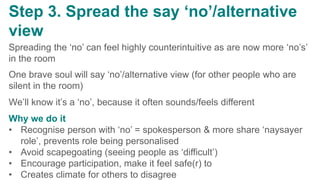
Step 3. Spread the say ‘no’/alternative
view
Spreading the ‘no’ can feel highly counterintuitive as are now more ‘no’s’
in the room
One brave soul will say ‘no’/alternative view (for other people who are
silent in the room)
We’ll know it’s a ‘no’, because it often sounds/feels different
Why we do it
• Recognise person with ‘no’ = spokesperson & more share ‘naysayer
role’, prevents role being personalised
• Avoid scapegoating (seeing people as ‘difficult’)
• Encourage participation, make it feel safe(r) to
• Creates climate for others to disagree
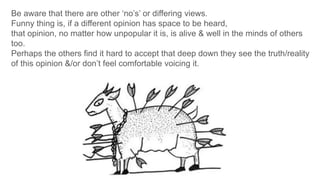
Be aware that there are other ‘no’s’ or differing views.
Funny thing is, if a different opinion has space to be heard,
that opinion, no matter how unpopular it is, is alive & well in the minds of others
too.
Perhaps the others find it hard to accept that deep down they see the truth/reality
of this opinion &/or don’t feel comfortable voicing it.
So prevent scape goating by
Encouraging those who have a
similar opinion to speak out
even if it doesn’t sound
exactly the same
v
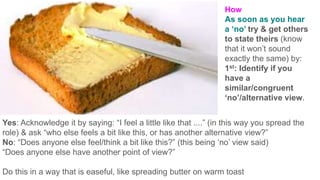
Yes: Acknowledge it by saying: “I feel a little like that ....” (in this way you spread the
role) & ask “who else feels a bit like this, or has another alternative view?”
No: “Does anyone else feel/think a bit like this?” (this being ‘no’ view said)
“Does anyone else have another point of view?”
Do this in a way that is easeful, like spreading butter on warm toast
How
As soon as you hear
a ‘no’ try & get others
to state theirs (know
that it won’t sound
exactly the same) by:
1st: Identify if you
have a
similar/congruent
‘no’/alternative view.
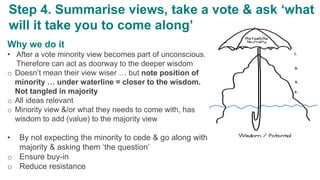
Why we do it
• After a vote minority view becomes part of unconscious.
Therefore can act as doorway to the deeper wisdom
o Doesn’t mean their view wiser … but note position of
minority … under waterline = closer to the wisdom.
Not tangled in majority
o All ideas relevant
o Minority view &/or what they needs to come with, has
wisdom to add (value) to the majority view
• By not expecting the minority to cede & go along with
majority & asking them ‘the question’
o Ensure buy-in
o Reduce resistance
Step 4. Summarise views, take a vote & ask ‘what
will it take you to come along’
• Summarise key options
• Take a hands up vote (1 person, 1 vote)
• Note if there’s a clear majority (2/3 or ¾)
• Ask the minority (1 person at a time) what would they need to go along with the decision:
“I’m sorry that you lost the vote.
However the majority will tend to have its way. That’s gravity!
However, you might have some insight/wisdom to add, & to ensure that you will come along, with
more ease than being pressured or ignored, what will you need?”
• Add wisdom back to original decision
• Vote again on modified decision
How
Find the wisdom that the ‘no’ represents
Minority have insight majoring are not seeing
Insights from the minority will add value to the majority decision
Module: Step 5 (for
working ‘below the
waterline’)
Debate: For tension (not conflict) Argument: For conflict
Step 1: Gain agreement & set the safety
rules (standard = nobody has monopoly on
the truth)
Step 1: Say it all (from sides) Step 2: Say it all (from sides)
Step 2: What hit home / Owning the grains
of truth
Step 3: What hit home / Owning the grains
of truth
Step 3: Solve the issue/ Make the decision Step 4: Solve the issue/ Make the decision
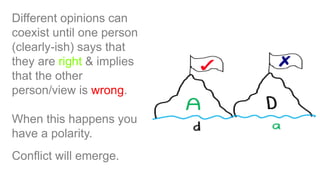
Different opinions can
coexist until one person
(clearly-ish) says that
they are right & implies
that the other
person/view is wrong.
When this happens you
have a polarity.
Conflict will emerge.
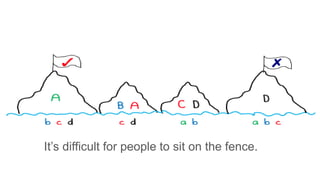
It’s difficult for people to sit on the fence.
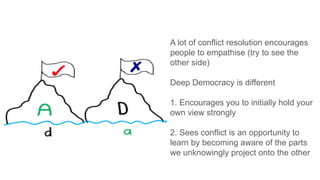
A lot of conflict resolution encourages
people to empathise (try to see the
other side)
Deep Democracy is different
1. Encourages you to initially hold your
own view strongly
2. Sees conflict is an opportunity to
learn by becoming aware of the parts
we unknowingly project onto the other
Step 5 helps group find & resolve issue/s
(fish/es) blocking progress
Issue/fish:
• Exists for the group &
continues to attach itself to
anything group is doing until it’s
resolved
• Can’t be identified or labelled
so Step 5 helps group ‘go
fishing’ & resolve most relevant
issue at that time (does not
resolve every fish or issue)
• Resides within the unsaid & the
lack of clarity
• Already there. Longer left
unresolved, bigger it grows
• Indicates an active Resistance
Line
• Step 5 aims get fish asap, so helps
people ‘say what needs to be said’
• In effect, surfacing issue/fish, & you can
bring in ‘conflict issue’ earlier than later, at
more manageable stage
• By surfacing the issue or fish you lower
the water line
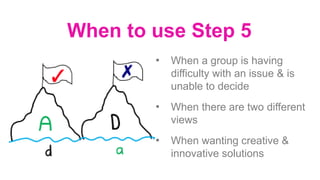
When to use Step 5
• When a group is having
difficulty with an issue & is
unable to decide
• When there are two different
views
• When wanting creative &
innovative solutions
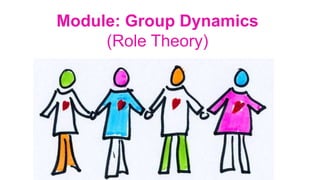
Module: Group Dynamics
(Role Theory)
Introduction
• Based on Arnold Mindell’s Process Orientated Psychology
& his version or evolution of Role Theory
• Significant shift  Moved psychology away from focusing
on the individuals to:
o Focusing on the collective
o Field & energy theory, based on new physics
• A change from Newtonian to Quantum Physics
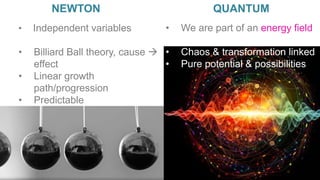
• Independent variables
• Billiard Ball theory, cause 
effect
• Linear growth
path/progression
• Predictable
NEWTON QUANTUM
• We are part of an energy field
• Don’t know what causes what
• Chaos & transformation linked
• Pure potential & possibilities
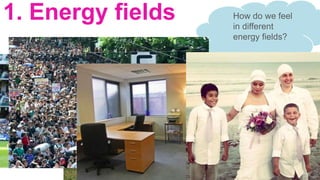
1. Energy fields How do we feel
in different
energy fields?
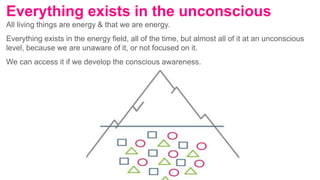
All living things are energy & that we are energy.
Everything exists in the energy field, all of the time, but almost all of it at an unconscious
level, because we are unaware of it, or not focused on it.
We can access it if we develop the conscious awareness.
Everything exists in the unconscious
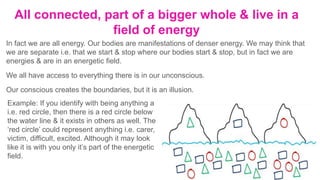
All connected, part of a bigger whole & live in a
field of energy
In fact we are all energy. Our bodies are manifestations of denser energy. We may think that
we are separate i.e. that we start & stop where our bodies start & stop, but in fact we are
energies & are in an energetic field.
We all have access to everything there is in our unconscious.
Our conscious creates the boundaries, but it is an illusion.
Example: If you identify with being anything a
i.e. red circle, then there is a red circle below
the water line & it exists in others as well. The
‘red circle’ could represent anything i.e. carer,
victim, difficult, excited. Although it may look
like it is with you only it’s part of the energetic
field.
Part 2. Fractal patterns
Fractal is a
pattern within a
pattern.
Fractal isn’t an exact
copy but the pattern is
similar.
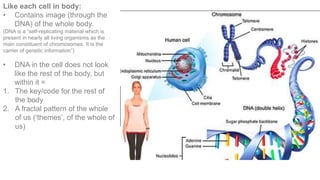
Like each cell in body:
• Contains image (through the
DNA) of the whole body.
(DNA is a “self-replicating material which is
present in nearly all living organisms as the
main constituent of chromosomes. It is the
carrier of genetic information”)
• DNA in the cell does not look
like the rest of the body, but
within it =
1. The key/code for the rest of
the body
2. A fractal pattern of the whole
of us (‘themes’, of the whole of
us)
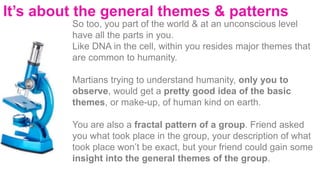
It’s about the general themes & patterns
So too, you part of the world & at an unconscious level
have all the parts in you.
Like DNA in the cell, within you resides major themes that
are common to humanity.
Martians trying to understand humanity, only you to
observe, would get a pretty good idea of the basic
themes, or make-up, of human kind on earth.
You are also a fractal pattern of a group. Friend asked
you what took place in the group, your description of what
took place won’t be exact, but your friend could gain some
insight into the general themes of the group.
3. How do these concepts (energy fields & fractals patterns)
relate to groups?
They have a very important influence on groups & help us
understand groups from a different perspective
Can think of a fractal as a role
In groups = many different sociological
roles, also known as archetypal roles
(Archetypes = pattern of behaviour that exist across
cultures that describe a complex of behaviours linked
to a function)
Looking @ roles happening in this
workshop in sociological terms i.e. ‘teacher’
& ‘learners’
Many learners in room, so say there is a
‘role of learner’ rather than an individual or
‘x is a learner’
Talk about role as ‘existing in the group’
Role of learner = A fractal of learner, not exactly
same, but a texture of the role
‘Learner’ role is in the same energy field as the
‘teacher’ therefore learner role is in me (the
‘teacher’)
Say ‘there is a role of teacher’ as opposed to
saying ‘Pru is in the teacher role’
Mindell extends the definition of a
role in role theory to include
An opinion/view/thought:
• “We should have a break”
• “These tools take too long”
• “I want to talk about x”
• “We need to set a deadline”
Feelings:
• Frustrated
• Happy
• Unsure
Symptoms
• Sore back
• Headache
Refer to role as if it was
energy & a fractal pattern
in the room.
Therefore begin to see
that the role is not linked
to the individual.
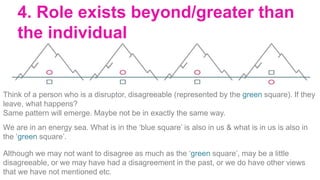
4. Role exists beyond/greater than
the individual
Think of a person who is a disruptor, disagreeable (represented by the green square). If they
leave, what happens?
Same pattern will emerge. Maybe not be in exactly the same way.
We are in an energy sea. What is in the ‘blue square’ is also in us & what is in us is also in
the ‘green square’.
Although we may not want to disagree as much as the ‘green square’, may be a little
disagreeable, or we may have had a disagreement in the past, or we do have other views
that we have not mentioned etc.
Colour below the surface of the water is projected onto the ‘green square’ (in this
scenario ‘disturber’).
Part of us that we don’t become conscious of, we project onto the ‘green square’.
Disturber/green square’ then begins to hold, their bit of green, & all our little bits of
green.
Their green becomes bigger & disturber becomes larger than life & begins to get
stuck in their viewpoint.
At this point they are carrying the energy/role for others.
We know what its like to be in the disturber role when you find yourself
arguing your point stronger & with more energy than you originally felt.
When disturber role leaves, energy then projected onto the next person as the energy
needs to go somewhere & the ‘disturber or difficult role’ is in each one of us, & won’t go
away.
If ‘blue square’ gets sick ‘their’ ‘view’/role does not suddenly go away because ‘their’ view
is in all of us.
Rather someone in the group who is a little like the ‘green square’/sensitive to the ‘green
square’ role will take on the role or energy. That person will now have the projected
energy.
The next few slides give some examples of roles existing beyond the individual.
beyond the Individual
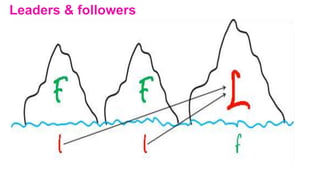
Teacher & students/learners
Leaders & followers
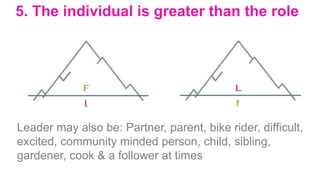
5. The individual is greater than the role
Leader may also be: Partner, parent, bike rider, difficult,
excited, community minded person, child, sibling,
gardener, cook & a follower at times
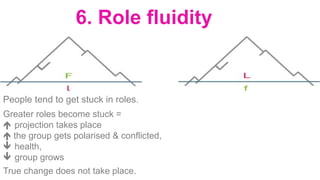
6. Role fluidity
People tend to get stuck in roles.
Greater roles become stuck =
 projection takes place
 the group gets polarised & conflicted,
 health,
 group grows
True change does not take place.
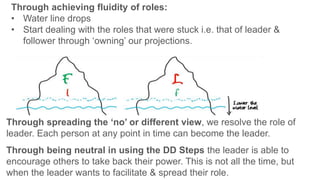
Through spreading the ‘no’ or different view, we resolve the role of
leader. Each person at any point in time can become the leader.
Through being neutral in using the DD Steps the leader is able to
encourage others to take back their power. This is not all the time, but
when the leader wants to facilitate & spread their role.
Through achieving fluidity of roles:
• Water line drops
• Start dealing with the roles that were stuck i.e. that of leader &
follower through ‘owning’ our projections.
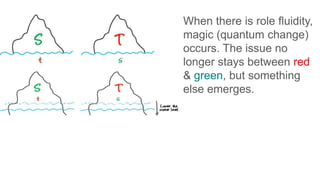
When there is role fluidity,
magic (quantum change)
occurs. The issue no
longer stays between red
& green, but something
else emerges.
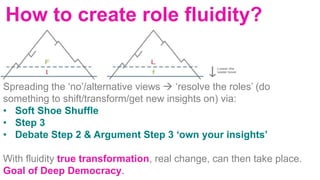
Spreading the ‘no’/alternative views  ‘resolve the roles’ (do
something to shift/transform/get new insights on) via:
• Soft Shoe Shuffle
• Step 3
• Debate Step 2 & Argument Step 3 ‘own your insights’
With fluidity true transformation, real change, can then take place.
Goal of Deep Democracy.
How to create role fluidity?
Debate Mini roadmap to make it
safe to say it all, from
sides, in 3 phases
Debate
For example sides of a
Debate topic could be:
We should join & sign
onto the alliance vs no
we should not
Debate
Transitioning into it
Ideal time to use the
Debate:
• Clear contrasting
views (polarity)
emerges
• Begun to go in circles
Seize this opportunity
Debate
• Name the two main
contrasting views you’ll
debate about
• Simply say “going to
continue conversation
but in a different way”
Transitioning into it
Debate
Do it in ‘sides’
• Say everything in
support of one side
• Say everything in
support of the other side
• Repeat
Step 1: Say it all
Round 1 Round 2
Side for no
we should
not join &
sign onto the
alliance
Side for we
should join &
sign onto the
alliance
Side for
no we should
not join & sign
onto the
alliance
Step 1: Say it all
Debate
Side for we
should join &
sign onto the
alliance
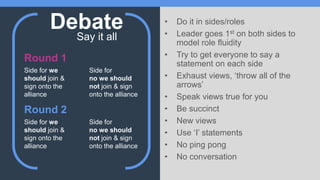
Debate • Do it in sides/roles
• Leader goes 1st on both sides to
model role fluidity
• Try to get everyone to say a
statement on each side
• Exhaust views, ‘throw all of the
arrows’
• Speak views true for you
• Be succinct
• New views
• Use ‘I’ statements
• No ping pong
• No conversation
Say it all
Round 1
Side for we
should join &
sign onto the
alliance
Side for
no we should
not join & sign
onto the alliance
Round 2
Side for we
should join &
sign onto the
alliance
Side for
no we should
not join & sign
onto the alliance
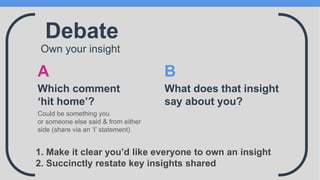
Own your insight
Own your insight
Debate
Which comment
‘hit home’?
Could be something you
or someone else said & from either
side (share via an ‘I’ statement)
B
What does that insight
say about you?
A
1. Make it clear you’d like everyone to own an insight
2. Succinctly restate key insights shared
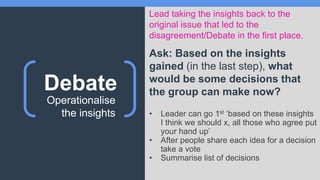
Lead taking the insights back to the
original issue that led to the
disagreement/Debate in the first place.
Ask: Based on the insights
gained (in the last step), what
would be some decisions that
the group can make now?
• Leader can go 1st ‘based on these insights
I think we should x, all those who agree put
your hand up’
• After people share each idea for a decision
take a vote
• Summarise list of decisions
Operationalise
the insights
Debate
Module: Step 5 in pairs
Introduction to Step 5 in pairs
• Based on belief ‘engaging with tension etc. =
key to growth’. Consequences of not = greater
• Simple tool for decision-making & dealing with
tension, conflict etc.
• Various adaptations depending on the
circumstances (designed for two people)
Benefits, why we do it
• Understand another person’s point of view,
& to know ourselves more deeply
• Build relationship & resolve tensions
created by misunderstandings/conflicting
interests (often swept under carpet)
• Get to the heart of things quite quickly
• If want/need have a relationship & work &
learn together, helps us do that, even if may
not want to be best friends
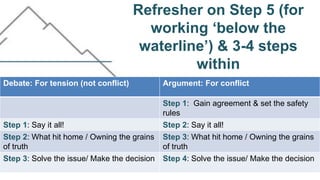
Refresher on Step 5 (for
working ‘below the
waterline’) & 3-4 steps
within
Debate: For tension (not conflict) Argument: For conflict
Step 1: Gain agreement & set the safety
rules
Step 1: Say it all! Step 2: Say it all!
Step 2: What hit home / Owning the grains
of truth
Step 3: What hit home / Owning the grains
of truth
Step 3: Solve the issue/ Make the decision Step 4: Solve the issue/ Make the decision
Let’s Talk exercise #1
From ‘sides’ (making a decision)
1. Going to do it in ‘roles’. Remember: Role = view/opinion/feeling. Each of the two ‘sides’ of
the decision = a ‘role’
2. Consider topic & who to partner with
Step 1: Say it all!
Do’s & Don'ts
• Do start sitting side by side & both speak from both sides.
• Do say things sharp & clear. Say everything you’re feeling about issue/idea. Don’t hold
back!
• Do listen to the other person.
• Do take turns to say everything, not holding back, other side just listens.
• Do both sides at least twice until you both feel that you’re completely done and have said
everything there is to be said. Then move on to Step 2.
• Don’t defend. Don’t state your view as a reaction to the other's view. Leave out the
"because" & "but" etc.
• Don’t play tennis where you go back & forth and you defend your views.
• Don’t interrupt.
• Don’t struggle to be polite, be direct.
Step 2: What hit home / Owning the
grains of truth
Both need to identify at least one truth that hit home & (if
possible/relevant) what it’s saying about you.
• Do Use ‘I’ statements
• Don’t defend or put a “but” in your statement. For example, don’t say
“You said that mergers always are difficult but there are instances
where it has worked.” Rather say "It's true that mergers are difficult",
i.e. stating the truth with no defense.
• If find yourself falling back into discussion in this stage, go back to
step 1 & keep saying what needs to be said before continuing with
Step 2.
• Do summarise (succinctly)
Step 3: Solve the issue/Make the
decision
Now have insights & know new things about ourselves & each other –
use them to decide on the issue we are trying to tackle.
Grain/s your basing your decision on could be yours and/or your
partners.
“I’d like to make a decision that we/I do x”
If decision impacts both of you, both have to agree with decision. If
one does not agree, ask ‘what do you need to come along?’
Reminder of Role Theory
• Often see ourselves as separate from each other
• When we look closely can recognise that we are part of a greater
whole
• Using the iceberg analogy only a small part (conscious part) exists
above the waterline
• Live in a common sea of experiences & emotions which lie below the
waterline of our conscious behaviour but affect it
• While we have our own unique lens on
how we view issues, due to living in this
common sea, what the other person
perceives or experiences, we will have at
some point also
• May not be exactly the same but they’ll be
similar aspects or textures
Let’s Talk exercise #2
Argument between two people (in proxy)
‘By proxy’ means that the person you’re speaking to,
having an argument with, isn’t the actual person
opposite you
Need to pick a real person in your life that you’re having an
argument/difficulty with, this is the person that you’re going to ‘talk’ to
today.
• For example in your dyads (A & B), person A may be the proxy for
an old colleague that person B still has issues with or their current
partner, whilst person B may be proxy for a boss who bullied
Person A or person A’s sister.
• If you wish can give 1 – 2 words of who they are, no need.
Talk directly to the person (you’re having an argument/difficulty with)
rather than talking about the person. i.e. ‘you do this …’ rather than
‘she always does …’
Step 1: Gain agreement & set the
safety rules
• Issue little deeper may time & is critical to set safety
rules = Significant difference between using Let’s
Talk from ‘sides’ & having an argument
• May be important to stress that we will be staying in
relationship
• Remember one implied LDD safety rule ‘no one has a
monopoly on the truth’.
• If one person does not agree ask “what will they need to
go along?”
Step 2: Say it all!
• Tend to not tell people what annoys, irritates us
etc
• Feelings build up like arrows in a quiver
• Opportunity to empty your quiver, say all the
things built up over time
• May take more time & not be as playful as exercise
#1
Step 2: Say it all!
• Decide who will go 1st
• Person A says everything they have to say to i.e. the past boss
(represented by person B)
• Other person listens & not respond
• Switch sides
• Other person (person B) goes & says everything they need, think and
feel to i.e. their old colleague (represented by person A)
• First person listens & doesn’t respond
Neither responds to the other; it’s like having two conversations going at
the same time.
Repeat at least twice but go as many times as necessary, until both feel
that you’re completely done & emptied your quiver.
Do’s & Don’ts
Very similar to in roles but adjusted to reflect there might be a
bit more heat in the argument between two people.
• Do say things sharp and clear. For example: “You are always late! It makes me angry!”
• Do take turns in saying everything you have to say, not holding back anything, while the other
side just listens.
• Do listen to the other person.
• Don’t defend. Don’t say: “I don’t finish my Reports in time because you don’t give me the data”.
Rather just state your views “You never give me the data on time!”.
• Don’t be polite. For example, don’t say: “I feel like it’s not so nice that you are not so aware of
the time”. Rather say “You are not aware of time.” or, “You are not aware of time; it annoys me.”
• Don’t go into a discussion & slide into defending.
• Don’t play tennis.
• Don’t interrupt when the other person is speaking.
Step 3: What hit home/Owning the
grains of truth
• Both people own at least one insight & what it’s
saying about you
• Use ‘I’ statements & what it’s saying about you
• Be gentle with yourself when you look at the arrow.
Take it out gently & discover what is true
If you find yourself attacking the other side again in
this stage, it means you haven’t properly finished Step
2.
Step 4: Solve the issue / Make the
decision
• Step 3 should have helped lessen the tension & have a
healing effect
• As a result of the better feelings & the new found
awarenesses, both parties can decide how to be with
one another in the future & how to tackle issues
• Any decisions you want to make based on your
awarenesses/insights? If you were doing it in real life &
not in proxy for every decision if both people don’t agree
you ask ‘what do you need to come along?’
Let’s Talk exercise #3
Golden arrows: ‘Arrows of
appreciation’/positive feedback (in the room or
in proxy) Positive arrows seem
easier to do, may be
more difficult. Why?
• Not so used to
giving & receiving
compliments.
• Embarrassed to
listen.
Stay & sit it out
Step 1: Gain agreement & set the
safety rules
• Will expose & deepen the relationship.
• Make sure that you both want to do it & timing
is appropriate.
• If one person does not agree ask “what will
they need to go along?”
Step 2: Say it all (shoot your golden
arrows)!
• One person starts & shares as much as
possible, try & empty quiver
• Second person listens then goes as if the other
hadn’t spoken – without reacting or
responding to the first person
• Repeat until quiver emptied
Step 3: What hit home/Owning the
grains of truth
• Take that arrow/s & look at it, acknowledge it
& integrate it into your self image. This may
be a fresh insight/new perspective about
yourself & your impact in the world.
• Try to own as many arrows as possible as
these Golden Arrows are helpful insights.
Step 4: Solve the issue/Take the
wisdom back
• Incorporate new learnings back into your life,
how you can further empower yourself &
maximise your true potential, & how you can
incorporate the grains into the relationship with
one another & with others.
• Any decisions you want to make based on
your awarenesses/insights?
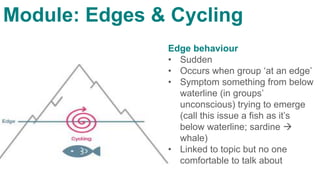
Module: Edges & Cycling
Edge behaviour
• Sudden
• Occurs when group ‘at an edge’
• Symptom something from below
waterline (in groups’
unconscious) trying to emerge
(call this issue a fish as it’s
below waterline; sardine 
whale)
• Linked to topic but no one
comfortable to talk about
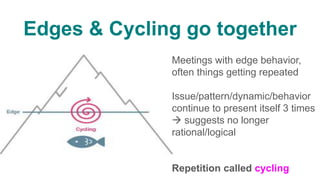
Edges & Cycling go together
Meetings with edge behavior,
often things getting repeated
Issue/pattern/dynamic/behavior
continue to present itself 3 times
 suggests no longer
rational/logical
Repetition called cycling
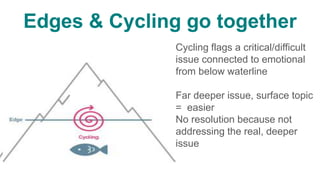
Edges & Cycling go together
Cycling flags a critical/difficult
issue connected to emotional
from below waterline
Far deeper issue, surface topic
= easier
No resolution because not
addressing the real, deeper
issue
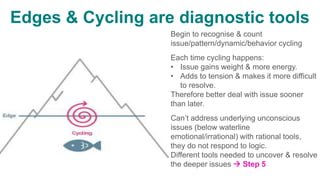
Edges & Cycling are diagnostic tools
Begin to recognise & count
issue/pattern/dynamic/behavior cycling
Each time cycling happens:
• Issue gains weight & more energy.
• Adds to tension & makes it more difficult
to resolve.
Therefore better deal with issue sooner
than later.
Can’t address underlying unconscious
issues (below waterline
emotional/irrational) with rational tools,
they do not respond to logic.
Different tools needed to uncover & resolve
the deeper issues  Step 5
1. Not being Present
This is when your body is present but your mind has left the room.
Antidote: Try to get everyone to participate, & stay in the room a) changing
tools might help + b) voting process.
2. Interruptions
Missing the point by cutting off the last part of a statement. Note, it often carries the
significant message.
Antidote:
1. Make people conscious that they are interrupting.
2. Ask the group to decide whether interrupting one another is acceptable or
not.
3. Request people to keep their comments brief (if appropriate).
Communication Vices
3. Indirect Speaking
We use vague references instead of being direct. There are 3 common ways of
being indirect.
4.1 Not speaking from the ‘I’, speaking in the 3rd person
People tend to speak in the third person, & say: “One should”  They are not saying “I
want to …”
Antidote: Encourage people to talk from the ‘I’.
4.2 Speaking generally or not addressing the person directly
This refers to people speaking in general terms, rather than expressing something
directly.
Antidote: Encourage people to address one another directly in the first person.
4.3 Angel-winging
This refers to a person speaking on behalf of someone else. “He felt x when y happened”,
Antidote: Make sure people speak for themselves.
4. Sliding rather than Deciding
Often conversations slides into different topics or change without people consciously
agreeing on the direction.
Antidote:
Make the group conscious that they may be/are sliding off the topic suggest
they decide the direction i.e. “decide not slide”.
5. Questioning
We often use questions - especially in group settings - as a way of making a
statement in a soft or cushioned way.
Antidote: Gently challenge a question that doesn’t seem to reflect a genuine
request for information: “Are you making a statement or do you genuinely not
know?”
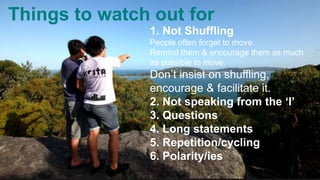
Things to watch out for
1. Not Shuffling
People often forget to move.
Remind them & encourage them as much
as possible to move.
Don’t insist on shuffling,
encourage & facilitate it.
2. Not speaking from the ‘I’
3. Questions
4. Long statements
5. Repetition/cycling
6. Polarity/ies
When there is a clear polarity
The ongoing cycling or edge suggests that
there is a clear polarity which now needs to
be resolved through Step 5 (Debate or
Argument)
Group seems on the point of making a
decision & there is a clear majority
Move into a decision & ask the people in
the minority what they need to go with?
You are now in Step 4
When to stop
1.  people feeling heard & levels of
engagement therefore people are less
drawn to act out resistant behaviours (that
when present really slows down
effectiveness)
2. Make well informed decisions that people
buy-in to (& therefore less likely to waste
time revisiting discussions & decisions
made)
3. Resolve/transform moment to moment
tension (rather than solely deal when
tensions have progressed/become really
stuck) … until the next one comes along
Benefits of
Lewis Deep
Democracy?
Leaders effective meeting masterclass full ppt

Leaders effective meeting masterclass full ppt

  • 1.
    Pru Gell “How groupsmake decisions, & have discussions, shapes the kind of culture that they have & if people don’t feel heard, or safe to talk, they resist (decisions & more)” Myrna Lewis, From Inside the No: Five Steps to Decisions That Last, 2008.
  • 2.
    main purpose ofDeep Democracy tools = have a roadmap to make it safe(r) to say what needs to be said can be uncomfortable but it’s harder, even more uncomfortable, to deal with consequences of not
  • 3.
    Unprecedented change Need communities who areskilled to address challenges Unresolved tensions can introduce irritations that can snowball into larger problems or, if refreshed become a way to strengthen Can refresh our organisations & initiatives so that they have greater impact with the same resources Changing how we work together, we can ensure that ourselves, our friends & colleagues have the ability to achieve more impact & stay invested for longer Why?
  • 4.
    1. Very experiential& not role playing 2. Present in process • May find yourself comparing/analysing, welcome, but try & stay in the experience rather than moving out • Hold onto questions about the process until time to debrief & ‘take a photo’ 3. Timings & plan for the day 4. Encourage you to soak up opportunity How masterclass will work
  • 5.
    Check-in 1. Bitabout yourself & 1-2 things that you lead 2. How are you feeling this morning, anything unexpected, delightful or otherwise? 3. a. Do you want to be here? 3. b. If even a part of you does not what part of you is that? 3. c. What would it take that part of you to come along? 4. Based on what you know about the day what are you hoping to achieve/walk away with?
  • 6.
    How • Introduce it(call it what you like), share guidelines (& why you do it?) • Set & respond to 1  ? questions (@ least one on feelings & another on expectations) • Go 1st (model length & depth) • Go popcorn style • Be very present & be neutral (respond to people the same) • Invite everyone but not force it • Let everyone be heard (no interruptions or conversation) • To close summarise (key objectives &/or themes) don’t attribute to people Check-in
  • 7.
    Why • Humans notcogs • Insights (culture & ‘business’) • Dynamic relevant agenda • Build psychological safety "a shared belief that the team is safe for interpersonal risk taking” or “belief that one will not be punished or humiliated for speaking up with ideas, questions, concerns or mistakes” • Otherwise pre-frontal cortex/executive function not available as still in elephant/reptilian/limbic system (Imagine That!: Igniting Your Brain for Creativity and Peak Performance, James Mapes) • Normalises sharing Check-in
  • 8.
    So what arewe doing today: Tool: Check-in Theory: Understanding resistance (Conscious & Unconscious) Tool & theory: Metaskills & the 5 Steps (from a leader’s perspective) Theory: Group dynamics (Role theory) Tool: Practice session of 5 Steps Tool: Step 5 in pairs: • Making a decision from sides • Argument • Golden Arrows Theory: Edges & cycling Tool: Check-out
  • 9.
    1. Conscious &unconscious (basic theoretical assumption of Deep Democracy) 2. How decision-making shapes what’s in the conscious/unconscious of a group 3. Resistance Line 4. Majority democracy Module: Understanding resistance (Conscious & Unconscious)
  • 10.
    CONSCIOU S UNCONSCIOUS What some peoplein the group are aware of but others are not What everyone in the group are aware of Group’s Wisdom & Potential (so lower the water line) Irrational/ emotional Rational/l ogical Part 1. Conscious & Unconscious
  • 11.
    How Lewis DeepDemocracy differs from some other facilitation approaches Majority of issues, behaviors etc informed/stem from emotions, aka from unconscious Lot happening in unconscious of any group that affects conscious happenings of a group Therefore rational/logical approaches don’t work Lewis Deep Democracy tools factor this in
  • 12.
    CONSCIOUS UNCONSCIOUS + Howlikely people are to go along with decision If feel safe to talk & heard in discussions & decisions  levels of resistance + Shapes if potential growth & informed decisions/outcomes achieved Autocratic, once leader leaves true views feelings unheard  build up to resistance activities Part 2. Decision-making (& discussion) style shapes what’s in groups conscious or unconscious
  • 13.
    Inefficient & ineffective Part3. Resistance Line Sarcastic jokes Excuses Gossip/Lob bying Poor communication/ breakdown Disruption Go slow Strike War/ withdrawal Covert Overt
  • 14.
    The Resistance Line Continuum, not necessarily in order Resistance isn’t ‘bad’= understandable response not feeling heard over time Being on it = indicator not agreeing with popular view nor saying openly what needs to be said  to conflict Longer views (that need to be said) not heard & issues/tensions not resolved, they get bigger. Won’t go away
  • 15.
    Inefficient & ineffective Sarcasticjokes Excuses Gossip/Lob bying Poor communication/ breakdown Disruption Go slow Strike War/ withdrawal Covert Overt Reflect on a time (it’s likely there’s been many) when you’ve been on the Resistance Line: 1. What stage of the were you at & what how did they get there? 2. What had you tried to do before you went on it & what were you hoping for?
  • 16.
    Reflect on experiencesof losing the ‘vote’, being in the minority, what do you tend to do? Part 4: Majority Democracy
  • 17.
    Without using toolsto make it safe(r) to say what needs to be said, bring unconscious into conscious, aka lower the waterline, may sense resistance or lack of buy-in, but can’t label it or identify how or why it’s happening Using tools to create participation, collaboration can be empowering & enables: • Genuine buy-in to decisions made • Resistance Line kept at bay through minority being brought on board with the majority decision (this is done by asking ‘what would it take you to come along?’ More on that in the 5 Steps) • Wisdom of the group tapped Revisiting how decision-making impacts on group dynamics
  • 18.
    Irrational/Emotional Step 5: TheDebate/Argument (has own 3-4 steps) Way/etiquette for holding, meetings & discussions Rational/Logical Step 1. Gain all of the views Step 2. Make it safe to say ‘no’/alternative view Step 3. Spread the say ‘no’/alternative view Step 4: Summarise views, take a vote & ask ‘what will it take you to come along’ Steps 1-3 are for discussions Steps 4 & 5 are for decisions WWW War stories or personal experiences – give your own views. TTT TEACH Metaskills Present&the&Video&or&PowerPoint,&or&add&to&Diagram&& There are five Steps to DD; the first four are above the water line. Module: Metaskills & the 5 Steps For working above (Steps 1 - 4) & below (Step 5) the waterline Step 5 for tension/conflict transformation
  • 19.
    • Gain greaterparticipation & buy in (stay on the bus) • Involve & empower people • Make sounder, wiser, better decisions • Helps leaders be less autocratic • Minimise ineffective & inefficient decision- making that results from people being on the Resistance Line Why we use the 5 Steps
  • 20.
    • Package, bits& pieces • Solo, 1-on-1, small  large group • Meetings needing discussion, brainstorming, collaboration, decision- making (but not if just sharing information) • General conversation • Simple  Difficult decisions & discussions • Want to surface all the views • Trying to involve & empower others r personal experiences – give your own views. s e&Video&or&PowerPoint,&or&add&to&Diagram&& ve Steps to DD; the first four are above the water line. When to use the 5 Steps
  • 21.
    All steps under umbrellaof Metaskills Metaskills = Attitude applied to the tools Ability be use Deep Democracy toolkit based on ability to use Metaskills Neutrality = main Metaskill Neutrality = ability to suspend viewpoint & attachment to outcome (not to not have views or feelings but to be able hold them aside) Metaskills
  • 22.
    5 Steps Step 1:Gain all of the views Step 2: Make it safe to say ‘NO’ (alternative view) Step 3: Spread the ‘NO’ (alternative view) Step 4. Vote & ask ‘what would it take to come along?’ Step 5. The Debate/Argument (with their own 3-4 Steps) esent&the&Video&or&PowerPoint,&or&add&to&Diagram&& There are five Steps to DD; the first four are above the water line.
  • 23.
    Using the 5Steps from the ‘leader position’ Make it clear when you are expressing your own personal view for example: Lean in: When you are expressing your view Lean out: When you are able to be ‘neutral’ & sincerely hear & invite all the other views
  • 24.
    Why we doit • Feel valued & heard • More information • Reduces/prevents time on the Resistance Line Step 1. Gain all of the views
  • 25.
    How • Leader statestheir (true) view 1st ‘my view is x’ & then invites others to share their view • With what you say ‘I’m genuinely interested in hearing all of the views/your views’ • Don’t summarise • Model talking from ‘I’: • 2nd/3rd person generalities slow & no real decision made, accountability through ‘I’ • Practicing metaskill of neutrality by responding to all views the same • Address Communication Vices (slides on Communication Vices are near the end of the slidedeck)
  • 26.
    Why we doit • Inevitably different opinions • Recognising ‘no’/alternative view is very counter intuitive. People may look for agreement/unity & find the ‘no’ uncomfortable o Different views ignored, glossed over, dealt with politely o Feel unsafe. So striving to allow space for the ‘no’ • Varied opinions = ‘rub’ of diversity, innovative solutions arise • Being open to ‘no’  reduces time on the Resistance Line Step 2. Make it safe to say ‘no’/alternative view
  • 27.
    How • Be awareof tone & ensure address all sides equally • Actively search for & encourage the various, minority & alternative views (not people) to be voiced ‘other views’, ‘any views we haven’t heard yet’, ‘new views’ • As a leader if no ‘no’/alternative view is being spoken (so everyone is just agreeing) you can bring in own ‘no’, even to your own idea/s expressed prior “while I think x I also do think y as well” or “while I think x I also have some doubts and wonder about y”
  • 28.
    v Step 3. Spreadthe say ‘no’/alternative view Spreading the ‘no’ can feel highly counterintuitive as are now more ‘no’s’ in the room One brave soul will say ‘no’/alternative view (for other people who are silent in the room) We’ll know it’s a ‘no’, because it often sounds/feels different Why we do it • Recognise person with ‘no’ = spokesperson & more share ‘naysayer role’, prevents role being personalised • Avoid scapegoating (seeing people as ‘difficult’) • Encourage participation, make it feel safe(r) to • Creates climate for others to disagree
  • 29.
    Be aware thatthere are other ‘no’s’ or differing views. Funny thing is, if a different opinion has space to be heard, that opinion, no matter how unpopular it is, is alive & well in the minds of others too. Perhaps the others find it hard to accept that deep down they see the truth/reality of this opinion &/or don’t feel comfortable voicing it.
  • 30.
    So prevent scapegoating by Encouraging those who have a similar opinion to speak out even if it doesn’t sound exactly the same
  • 31.
    v Yes: Acknowledge itby saying: “I feel a little like that ....” (in this way you spread the role) & ask “who else feels a bit like this, or has another alternative view?” No: “Does anyone else feel/think a bit like this?” (this being ‘no’ view said) “Does anyone else have another point of view?” Do this in a way that is easeful, like spreading butter on warm toast How As soon as you hear a ‘no’ try & get others to state theirs (know that it won’t sound exactly the same) by: 1st: Identify if you have a similar/congruent ‘no’/alternative view.
  • 32.
    Why we doit • After a vote minority view becomes part of unconscious. Therefore can act as doorway to the deeper wisdom o Doesn’t mean their view wiser … but note position of minority … under waterline = closer to the wisdom. Not tangled in majority o All ideas relevant o Minority view &/or what they needs to come with, has wisdom to add (value) to the majority view • By not expecting the minority to cede & go along with majority & asking them ‘the question’ o Ensure buy-in o Reduce resistance Step 4. Summarise views, take a vote & ask ‘what will it take you to come along’
  • 33.
    • Summarise keyoptions • Take a hands up vote (1 person, 1 vote) • Note if there’s a clear majority (2/3 or ¾) • Ask the minority (1 person at a time) what would they need to go along with the decision: “I’m sorry that you lost the vote. However the majority will tend to have its way. That’s gravity! However, you might have some insight/wisdom to add, & to ensure that you will come along, with more ease than being pressured or ignored, what will you need?” • Add wisdom back to original decision • Vote again on modified decision How
  • 34.
    Find the wisdomthat the ‘no’ represents Minority have insight majoring are not seeing Insights from the minority will add value to the majority decision
  • 35.
    Module: Step 5(for working ‘below the waterline’) Debate: For tension (not conflict) Argument: For conflict Step 1: Gain agreement & set the safety rules (standard = nobody has monopoly on the truth) Step 1: Say it all (from sides) Step 2: Say it all (from sides) Step 2: What hit home / Owning the grains of truth Step 3: What hit home / Owning the grains of truth Step 3: Solve the issue/ Make the decision Step 4: Solve the issue/ Make the decision
  • 36.
    Different opinions can coexistuntil one person (clearly-ish) says that they are right & implies that the other person/view is wrong. When this happens you have a polarity. Conflict will emerge.
  • 37.
    It’s difficult forpeople to sit on the fence.
  • 38.
    A lot ofconflict resolution encourages people to empathise (try to see the other side) Deep Democracy is different 1. Encourages you to initially hold your own view strongly 2. Sees conflict is an opportunity to learn by becoming aware of the parts we unknowingly project onto the other
  • 39.
    Step 5 helpsgroup find & resolve issue/s (fish/es) blocking progress Issue/fish: • Exists for the group & continues to attach itself to anything group is doing until it’s resolved • Can’t be identified or labelled so Step 5 helps group ‘go fishing’ & resolve most relevant issue at that time (does not resolve every fish or issue) • Resides within the unsaid & the lack of clarity • Already there. Longer left unresolved, bigger it grows • Indicates an active Resistance Line
  • 40.
    • Step 5aims get fish asap, so helps people ‘say what needs to be said’ • In effect, surfacing issue/fish, & you can bring in ‘conflict issue’ earlier than later, at more manageable stage • By surfacing the issue or fish you lower the water line
  • 41.
    When to useStep 5 • When a group is having difficulty with an issue & is unable to decide • When there are two different views • When wanting creative & innovative solutions
  • 42.
  • 43.
    Introduction • Based onArnold Mindell’s Process Orientated Psychology & his version or evolution of Role Theory • Significant shift  Moved psychology away from focusing on the individuals to: o Focusing on the collective o Field & energy theory, based on new physics • A change from Newtonian to Quantum Physics
  • 44.
    • Independent variables •Billiard Ball theory, cause  effect • Linear growth path/progression • Predictable NEWTON QUANTUM • We are part of an energy field • Don’t know what causes what • Chaos & transformation linked • Pure potential & possibilities
  • 45.
    1. Energy fieldsHow do we feel in different energy fields?
  • 46.
    All living thingsare energy & that we are energy. Everything exists in the energy field, all of the time, but almost all of it at an unconscious level, because we are unaware of it, or not focused on it. We can access it if we develop the conscious awareness. Everything exists in the unconscious
  • 47.
    All connected, partof a bigger whole & live in a field of energy In fact we are all energy. Our bodies are manifestations of denser energy. We may think that we are separate i.e. that we start & stop where our bodies start & stop, but in fact we are energies & are in an energetic field. We all have access to everything there is in our unconscious. Our conscious creates the boundaries, but it is an illusion. Example: If you identify with being anything a i.e. red circle, then there is a red circle below the water line & it exists in others as well. The ‘red circle’ could represent anything i.e. carer, victim, difficult, excited. Although it may look like it is with you only it’s part of the energetic field.
  • 48.
    Part 2. Fractalpatterns Fractal is a pattern within a pattern. Fractal isn’t an exact copy but the pattern is similar.
  • 49.
    Like each cellin body: • Contains image (through the DNA) of the whole body. (DNA is a “self-replicating material which is present in nearly all living organisms as the main constituent of chromosomes. It is the carrier of genetic information”) • DNA in the cell does not look like the rest of the body, but within it = 1. The key/code for the rest of the body 2. A fractal pattern of the whole of us (‘themes’, of the whole of us)
  • 50.
    It’s about thegeneral themes & patterns So too, you part of the world & at an unconscious level have all the parts in you. Like DNA in the cell, within you resides major themes that are common to humanity. Martians trying to understand humanity, only you to observe, would get a pretty good idea of the basic themes, or make-up, of human kind on earth. You are also a fractal pattern of a group. Friend asked you what took place in the group, your description of what took place won’t be exact, but your friend could gain some insight into the general themes of the group.
  • 51.
    3. How dothese concepts (energy fields & fractals patterns) relate to groups? They have a very important influence on groups & help us understand groups from a different perspective Can think of a fractal as a role In groups = many different sociological roles, also known as archetypal roles (Archetypes = pattern of behaviour that exist across cultures that describe a complex of behaviours linked to a function) Looking @ roles happening in this workshop in sociological terms i.e. ‘teacher’ & ‘learners’ Many learners in room, so say there is a ‘role of learner’ rather than an individual or ‘x is a learner’ Talk about role as ‘existing in the group’ Role of learner = A fractal of learner, not exactly same, but a texture of the role ‘Learner’ role is in the same energy field as the ‘teacher’ therefore learner role is in me (the ‘teacher’) Say ‘there is a role of teacher’ as opposed to saying ‘Pru is in the teacher role’
  • 52.
    Mindell extends thedefinition of a role in role theory to include An opinion/view/thought: • “We should have a break” • “These tools take too long” • “I want to talk about x” • “We need to set a deadline” Feelings: • Frustrated • Happy • Unsure Symptoms • Sore back • Headache Refer to role as if it was energy & a fractal pattern in the room. Therefore begin to see that the role is not linked to the individual.
  • 53.
    4. Role existsbeyond/greater than the individual Think of a person who is a disruptor, disagreeable (represented by the green square). If they leave, what happens? Same pattern will emerge. Maybe not be in exactly the same way. We are in an energy sea. What is in the ‘blue square’ is also in us & what is in us is also in the ‘green square’. Although we may not want to disagree as much as the ‘green square’, may be a little disagreeable, or we may have had a disagreement in the past, or we do have other views that we have not mentioned etc.
  • 54.
    Colour below thesurface of the water is projected onto the ‘green square’ (in this scenario ‘disturber’). Part of us that we don’t become conscious of, we project onto the ‘green square’. Disturber/green square’ then begins to hold, their bit of green, & all our little bits of green. Their green becomes bigger & disturber becomes larger than life & begins to get stuck in their viewpoint. At this point they are carrying the energy/role for others.
  • 55.
    We know whatits like to be in the disturber role when you find yourself arguing your point stronger & with more energy than you originally felt.
  • 56.
    When disturber roleleaves, energy then projected onto the next person as the energy needs to go somewhere & the ‘disturber or difficult role’ is in each one of us, & won’t go away. If ‘blue square’ gets sick ‘their’ ‘view’/role does not suddenly go away because ‘their’ view is in all of us. Rather someone in the group who is a little like the ‘green square’/sensitive to the ‘green square’ role will take on the role or energy. That person will now have the projected energy. The next few slides give some examples of roles existing beyond the individual.
  • 57.
    beyond the Individual Teacher& students/learners
  • 58.
  • 59.
    5. The individualis greater than the role Leader may also be: Partner, parent, bike rider, difficult, excited, community minded person, child, sibling, gardener, cook & a follower at times
  • 60.
    6. Role fluidity Peopletend to get stuck in roles. Greater roles become stuck =  projection takes place  the group gets polarised & conflicted,  health,  group grows True change does not take place.
  • 61.
    Through spreading the‘no’ or different view, we resolve the role of leader. Each person at any point in time can become the leader. Through being neutral in using the DD Steps the leader is able to encourage others to take back their power. This is not all the time, but when the leader wants to facilitate & spread their role. Through achieving fluidity of roles: • Water line drops • Start dealing with the roles that were stuck i.e. that of leader & follower through ‘owning’ our projections.
  • 62.
    When there isrole fluidity, magic (quantum change) occurs. The issue no longer stays between red & green, but something else emerges.
  • 63.
    Spreading the ‘no’/alternativeviews  ‘resolve the roles’ (do something to shift/transform/get new insights on) via: • Soft Shoe Shuffle • Step 3 • Debate Step 2 & Argument Step 3 ‘own your insights’ With fluidity true transformation, real change, can then take place. Goal of Deep Democracy. How to create role fluidity?
  • 64.
    Debate Mini roadmapto make it safe to say it all, from sides, in 3 phases
  • 65.
    Debate For example sidesof a Debate topic could be: We should join & sign onto the alliance vs no we should not
  • 66.
    Debate Transitioning into it Idealtime to use the Debate: • Clear contrasting views (polarity) emerges • Begun to go in circles Seize this opportunity
  • 67.
    Debate • Name thetwo main contrasting views you’ll debate about • Simply say “going to continue conversation but in a different way” Transitioning into it
  • 68.
    Debate Do it in‘sides’ • Say everything in support of one side • Say everything in support of the other side • Repeat Step 1: Say it all
  • 69.
    Round 1 Round2 Side for no we should not join & sign onto the alliance Side for we should join & sign onto the alliance Side for no we should not join & sign onto the alliance Step 1: Say it all Debate Side for we should join & sign onto the alliance
  • 70.
    Debate • Doit in sides/roles • Leader goes 1st on both sides to model role fluidity • Try to get everyone to say a statement on each side • Exhaust views, ‘throw all of the arrows’ • Speak views true for you • Be succinct • New views • Use ‘I’ statements • No ping pong • No conversation Say it all Round 1 Side for we should join & sign onto the alliance Side for no we should not join & sign onto the alliance Round 2 Side for we should join & sign onto the alliance Side for no we should not join & sign onto the alliance
  • 71.
    Own your insight Ownyour insight Debate Which comment ‘hit home’? Could be something you or someone else said & from either side (share via an ‘I’ statement) B What does that insight say about you? A 1. Make it clear you’d like everyone to own an insight 2. Succinctly restate key insights shared
  • 72.
    Lead taking theinsights back to the original issue that led to the disagreement/Debate in the first place. Ask: Based on the insights gained (in the last step), what would be some decisions that the group can make now? • Leader can go 1st ‘based on these insights I think we should x, all those who agree put your hand up’ • After people share each idea for a decision take a vote • Summarise list of decisions Operationalise the insights Debate
  • 73.
  • 74.
    Introduction to Step5 in pairs • Based on belief ‘engaging with tension etc. = key to growth’. Consequences of not = greater • Simple tool for decision-making & dealing with tension, conflict etc. • Various adaptations depending on the circumstances (designed for two people)
  • 75.
    Benefits, why wedo it • Understand another person’s point of view, & to know ourselves more deeply • Build relationship & resolve tensions created by misunderstandings/conflicting interests (often swept under carpet) • Get to the heart of things quite quickly • If want/need have a relationship & work & learn together, helps us do that, even if may not want to be best friends
  • 76.
    Refresher on Step5 (for working ‘below the waterline’) & 3-4 steps within Debate: For tension (not conflict) Argument: For conflict Step 1: Gain agreement & set the safety rules Step 1: Say it all! Step 2: Say it all! Step 2: What hit home / Owning the grains of truth Step 3: What hit home / Owning the grains of truth Step 3: Solve the issue/ Make the decision Step 4: Solve the issue/ Make the decision
  • 77.
    Let’s Talk exercise#1 From ‘sides’ (making a decision) 1. Going to do it in ‘roles’. Remember: Role = view/opinion/feeling. Each of the two ‘sides’ of the decision = a ‘role’ 2. Consider topic & who to partner with
  • 78.
    Step 1: Sayit all! Do’s & Don'ts • Do start sitting side by side & both speak from both sides. • Do say things sharp & clear. Say everything you’re feeling about issue/idea. Don’t hold back! • Do listen to the other person. • Do take turns to say everything, not holding back, other side just listens. • Do both sides at least twice until you both feel that you’re completely done and have said everything there is to be said. Then move on to Step 2. • Don’t defend. Don’t state your view as a reaction to the other's view. Leave out the "because" & "but" etc. • Don’t play tennis where you go back & forth and you defend your views. • Don’t interrupt. • Don’t struggle to be polite, be direct.
  • 79.
    Step 2: Whathit home / Owning the grains of truth Both need to identify at least one truth that hit home & (if possible/relevant) what it’s saying about you. • Do Use ‘I’ statements • Don’t defend or put a “but” in your statement. For example, don’t say “You said that mergers always are difficult but there are instances where it has worked.” Rather say "It's true that mergers are difficult", i.e. stating the truth with no defense. • If find yourself falling back into discussion in this stage, go back to step 1 & keep saying what needs to be said before continuing with Step 2. • Do summarise (succinctly)
  • 80.
    Step 3: Solvethe issue/Make the decision Now have insights & know new things about ourselves & each other – use them to decide on the issue we are trying to tackle. Grain/s your basing your decision on could be yours and/or your partners. “I’d like to make a decision that we/I do x” If decision impacts both of you, both have to agree with decision. If one does not agree, ask ‘what do you need to come along?’
  • 81.
    Reminder of RoleTheory • Often see ourselves as separate from each other • When we look closely can recognise that we are part of a greater whole • Using the iceberg analogy only a small part (conscious part) exists above the waterline • Live in a common sea of experiences & emotions which lie below the waterline of our conscious behaviour but affect it
  • 82.
    • While wehave our own unique lens on how we view issues, due to living in this common sea, what the other person perceives or experiences, we will have at some point also • May not be exactly the same but they’ll be similar aspects or textures
  • 83.
    Let’s Talk exercise#2 Argument between two people (in proxy)
  • 84.
    ‘By proxy’ meansthat the person you’re speaking to, having an argument with, isn’t the actual person opposite you Need to pick a real person in your life that you’re having an argument/difficulty with, this is the person that you’re going to ‘talk’ to today. • For example in your dyads (A & B), person A may be the proxy for an old colleague that person B still has issues with or their current partner, whilst person B may be proxy for a boss who bullied Person A or person A’s sister. • If you wish can give 1 – 2 words of who they are, no need. Talk directly to the person (you’re having an argument/difficulty with) rather than talking about the person. i.e. ‘you do this …’ rather than ‘she always does …’
  • 85.
    Step 1: Gainagreement & set the safety rules • Issue little deeper may time & is critical to set safety rules = Significant difference between using Let’s Talk from ‘sides’ & having an argument • May be important to stress that we will be staying in relationship • Remember one implied LDD safety rule ‘no one has a monopoly on the truth’. • If one person does not agree ask “what will they need to go along?”
  • 86.
    Step 2: Sayit all! • Tend to not tell people what annoys, irritates us etc • Feelings build up like arrows in a quiver • Opportunity to empty your quiver, say all the things built up over time • May take more time & not be as playful as exercise #1
  • 87.
    Step 2: Sayit all! • Decide who will go 1st • Person A says everything they have to say to i.e. the past boss (represented by person B) • Other person listens & not respond • Switch sides • Other person (person B) goes & says everything they need, think and feel to i.e. their old colleague (represented by person A) • First person listens & doesn’t respond Neither responds to the other; it’s like having two conversations going at the same time. Repeat at least twice but go as many times as necessary, until both feel that you’re completely done & emptied your quiver.
  • 88.
    Do’s & Don’ts Verysimilar to in roles but adjusted to reflect there might be a bit more heat in the argument between two people. • Do say things sharp and clear. For example: “You are always late! It makes me angry!” • Do take turns in saying everything you have to say, not holding back anything, while the other side just listens. • Do listen to the other person. • Don’t defend. Don’t say: “I don’t finish my Reports in time because you don’t give me the data”. Rather just state your views “You never give me the data on time!”. • Don’t be polite. For example, don’t say: “I feel like it’s not so nice that you are not so aware of the time”. Rather say “You are not aware of time.” or, “You are not aware of time; it annoys me.” • Don’t go into a discussion & slide into defending. • Don’t play tennis. • Don’t interrupt when the other person is speaking.
  • 89.
    Step 3: Whathit home/Owning the grains of truth • Both people own at least one insight & what it’s saying about you • Use ‘I’ statements & what it’s saying about you • Be gentle with yourself when you look at the arrow. Take it out gently & discover what is true If you find yourself attacking the other side again in this stage, it means you haven’t properly finished Step 2.
  • 90.
    Step 4: Solvethe issue / Make the decision • Step 3 should have helped lessen the tension & have a healing effect • As a result of the better feelings & the new found awarenesses, both parties can decide how to be with one another in the future & how to tackle issues • Any decisions you want to make based on your awarenesses/insights? If you were doing it in real life & not in proxy for every decision if both people don’t agree you ask ‘what do you need to come along?’
  • 91.
    Let’s Talk exercise#3 Golden arrows: ‘Arrows of appreciation’/positive feedback (in the room or in proxy) Positive arrows seem easier to do, may be more difficult. Why? • Not so used to giving & receiving compliments. • Embarrassed to listen. Stay & sit it out
  • 92.
    Step 1: Gainagreement & set the safety rules • Will expose & deepen the relationship. • Make sure that you both want to do it & timing is appropriate. • If one person does not agree ask “what will they need to go along?”
  • 93.
    Step 2: Sayit all (shoot your golden arrows)! • One person starts & shares as much as possible, try & empty quiver • Second person listens then goes as if the other hadn’t spoken – without reacting or responding to the first person • Repeat until quiver emptied
  • 94.
    Step 3: Whathit home/Owning the grains of truth • Take that arrow/s & look at it, acknowledge it & integrate it into your self image. This may be a fresh insight/new perspective about yourself & your impact in the world. • Try to own as many arrows as possible as these Golden Arrows are helpful insights.
  • 95.
    Step 4: Solvethe issue/Take the wisdom back • Incorporate new learnings back into your life, how you can further empower yourself & maximise your true potential, & how you can incorporate the grains into the relationship with one another & with others. • Any decisions you want to make based on your awarenesses/insights?
  • 96.
    Module: Edges &Cycling Edge behaviour • Sudden • Occurs when group ‘at an edge’ • Symptom something from below waterline (in groups’ unconscious) trying to emerge (call this issue a fish as it’s below waterline; sardine  whale) • Linked to topic but no one comfortable to talk about
  • 97.
    Edges & Cyclinggo together Meetings with edge behavior, often things getting repeated Issue/pattern/dynamic/behavior continue to present itself 3 times  suggests no longer rational/logical Repetition called cycling
  • 98.
    Edges & Cyclinggo together Cycling flags a critical/difficult issue connected to emotional from below waterline Far deeper issue, surface topic = easier No resolution because not addressing the real, deeper issue
  • 99.
    Edges & Cyclingare diagnostic tools Begin to recognise & count issue/pattern/dynamic/behavior cycling Each time cycling happens: • Issue gains weight & more energy. • Adds to tension & makes it more difficult to resolve. Therefore better deal with issue sooner than later. Can’t address underlying unconscious issues (below waterline emotional/irrational) with rational tools, they do not respond to logic. Different tools needed to uncover & resolve the deeper issues  Step 5
  • 100.
    1. Not beingPresent This is when your body is present but your mind has left the room. Antidote: Try to get everyone to participate, & stay in the room a) changing tools might help + b) voting process. 2. Interruptions Missing the point by cutting off the last part of a statement. Note, it often carries the significant message. Antidote: 1. Make people conscious that they are interrupting. 2. Ask the group to decide whether interrupting one another is acceptable or not. 3. Request people to keep their comments brief (if appropriate). Communication Vices
  • 101.
    3. Indirect Speaking Weuse vague references instead of being direct. There are 3 common ways of being indirect. 4.1 Not speaking from the ‘I’, speaking in the 3rd person People tend to speak in the third person, & say: “One should”  They are not saying “I want to …” Antidote: Encourage people to talk from the ‘I’. 4.2 Speaking generally or not addressing the person directly This refers to people speaking in general terms, rather than expressing something directly. Antidote: Encourage people to address one another directly in the first person. 4.3 Angel-winging This refers to a person speaking on behalf of someone else. “He felt x when y happened”, Antidote: Make sure people speak for themselves.
  • 102.
    4. Sliding ratherthan Deciding Often conversations slides into different topics or change without people consciously agreeing on the direction. Antidote: Make the group conscious that they may be/are sliding off the topic suggest they decide the direction i.e. “decide not slide”. 5. Questioning We often use questions - especially in group settings - as a way of making a statement in a soft or cushioned way. Antidote: Gently challenge a question that doesn’t seem to reflect a genuine request for information: “Are you making a statement or do you genuinely not know?”
  • 103.
    Things to watchout for 1. Not Shuffling People often forget to move. Remind them & encourage them as much as possible to move. Don’t insist on shuffling, encourage & facilitate it. 2. Not speaking from the ‘I’ 3. Questions 4. Long statements 5. Repetition/cycling 6. Polarity/ies
  • 104.
    When there isa clear polarity The ongoing cycling or edge suggests that there is a clear polarity which now needs to be resolved through Step 5 (Debate or Argument) Group seems on the point of making a decision & there is a clear majority Move into a decision & ask the people in the minority what they need to go with? You are now in Step 4 When to stop
  • 105.
    1.  peoplefeeling heard & levels of engagement therefore people are less drawn to act out resistant behaviours (that when present really slows down effectiveness) 2. Make well informed decisions that people buy-in to (& therefore less likely to waste time revisiting discussions & decisions made) 3. Resolve/transform moment to moment tension (rather than solely deal when tensions have progressed/become really stuck) … until the next one comes along Benefits of Lewis Deep Democracy?

Editor's Notes

  • #3  2 key concepts
  • #8 AMY edmondson Harvard business Novartis Professor of Leadership at Harvard Business School "a shared belief that the team is safe for interpersonal risk taking.” “belief that one will not be punished or humiliated for speaking up with ideas, questions, concerns or mistakes”   implicated in planning complex cognitive behavior, personality expression, decision making, and moderating social behavior.[3]The basic activity of this brain region is considered to be orchestration of thoughts and actions in accordance with internal goals.[4] The most typical psychological term for functions carried out by the prefrontal cortex area is executive function. Executive function relates to abilities to differentiate among conflicting thoughts, determine good and bad, better and best, same and different, future consequences of current activities, working toward a defined goal, prediction of outcomes, expectation based on actions, and social "control" (the ability to suppress urges that, if not suppressed, could lead to socially unacceptable outcomes).
  • #9  2 key concepts
  • #10 \
  • #11 \
  • #12 Emo & irr often dismissed/judged. In CR. emo & irr just exists, as does rat/log.
  • #58 Some Examples of Roles existing beyond the Individual
  • #65 D Mini roadmap slide Debate (or DC) is a mini roadmap with 3 phases to make it safe to say it all Very soon you’ll get to experience a taste of this technique in groups of 4 Want to say that with the CI I’m sure you could try and use use it on Mon. We enc you to play with D too but you may want to connect with us before you do as it’s a bit more inv. but we wanted to give you a taste anyway To make this exp possible in the conference setting like you all to imagine you’ve been in a meeting had a CI Then you begin to discuss an agenda item on ‘what is going to be the best way to approach transformation for your org’ Sidenote: there are DD techniques to begin and progress discussions but that’s for another day   So you’re in this discussion and you’ve naturally come to a point where 2 clear contrasting views have emerged on this topic. D Today’s debate
  • #66 D Today’s debate They are: “best way of approaching agile (or any) transformation is big bang (aka all at once across the organisation, flick a switch) vs no it’s not. That’s what you’re going to ‘debate’ today D Ideal time to use slide
  • #67 D Ideal time to use slide From coaching orgs to use the Debate technique I’ve learnt that the prime time to use it is As soon as when 2 clearly different views have emerged, or yr beginning to in circles. If you don’t you’ll find people begin disengage. So we seize this moment & use the Debate as it’s a real oppo to build engagement & energy & to hear all of the views. 2 ways to move into D
  • #68 2 ways to move into D So how to seize this moment? Name the two main different views Simply call out you are going to cont conversation but in a different & dynamic way, (using the DT) Enter the difference, safely knowing you have a roadmap/process that’s got your back.   D Do it in sides
  • #69 D Do it in sides 3 key phases to go through. 1st phase is ‘Say it all’ In a real life meeting you’ll stay sitting/standing where you are. Today you’re soon going to stand up   Do it in sides Not holda view Everyone speaks for one view Then everyone speaks for the other view D picture/map
  • #70 D picture/map For our exp today That’ll look like this ‘BB the way to go’, ‘BB not the way to go’ everyone speaks for both views 1 min for big bang I’ll let you know when time is up Hand up and say Please copy hand up so that the message spreads Cue to swap to 1 min to why ‘not way big bang’. Then I’ll repeat that. All things slide  
  • #71 State what the sides are Do it in roles Speak all arrows on one side, then swap Leader goes 1st on both sides to model role fluidity Exhaust views, throw all of the arrows Brief, to the point Speak only what is true for you Use ‘I’ statements People encouraged to move side to side Go to each side at least twice All things slide Here’s all the info that you need to do 1st phase: Say it all Do it in sides Really try and find at least one statement that’s true for you on both sides Encouraged to be fluid in thinking (have a view on both ‘sides’) Speak views that are true for you (even though in conf exp, it’s not a role play) Short as can be Only say new things that no one has said No ping pong across the sides. Only speak for one side until you swap No conversation (like CI just a releasing/dump) One at a time (not talking over each other) Ok stand up find a gp of 4 with people in front/behind and/or next to you Going to give you 10 secs to form your gps, say hi to each other before the time starts Jump in your time starts in now. 1 min big bang go! Own YI      
  • #72 Invite people to: Take a moment to identify an insight that hit home Share via an ‘I’ statement what it was & what it is saying about you Make it clear you’d like everyone to own an insight Share the list of insights back to the group Next phase Own Your Insight (SLOW): Stay standing In this step out of all the views shared in your group Could have been: One you said or s/one else said, From either side Doesn’t matter Most important is you connect with one Take a quiet mo by yourself to connect w/ and identify (a) which view most resonated with you, hit home, stood out Once done that (b). what might, what does, this insight say about you? Example: b) Give you few secs of quiet to identify those two things then 1 min in total to each share, in a short and sharp style in yr sm gps: insight and b) what it might say about you Sharing 1-1.5 min Ask audience hands up if you had an insight, maybe even a useful one? (summarise) What we do here is have one person very succinctly summarise/restate the insights so they’re captured clearly Take a seat please – now going to just talk you through the 3rd and final phase
  • #73 Op Your Insight If you were in a real work meeting, based just on the insights in gained in the last phase, you’d make decisions as a whole group on what to do next   How? 1. Say “now we have new insights (from phase before), just based on those insights’ what are some ideas on how we move forward on the topic ‘(the agenda item you began discussing)?” For our exp today remember that was ‘what is going to be the best way to approach transformation for your org’   2. Hear proposals for decisions and one by one vote on each proposed decision to seek active agreement.   From my experience at this last phase ideas for decisions on ways forward move really swiftly, with flow and easefully. I want to explain why through a story of how water moves. Lake: Had a topic, didn’t know what’s in it, no real ideas on people’s views, what’s lurking under the water Two clouds Droplets Snowflakes   Why and why do we do the Debate? Really links to the key offerings of DD more broadly that Andrea touched on at the start: Gives ppl a clear process/phases that makes it safe for them to say what needs to be said, Because they feel heard less likely to resist, go onto the RL, slow down or white ant, decisions made. They buy-in More innovative decisions made through tapping into wisdom in group (always there) Another one: Group takes a huge leap ahead, quantum leap ahead. Feels good. Taken through and lifted above complexity.   Silent question: Like you to take a moment to think, how many of you could imagine the benefits of using this technique in a meeting when things are getting a bit bogged down? (Summarise response and thanks)   End of Debate Stay on stage Andy joins me Pru clicks to the next slide