


Build Your Audience While
Building Your Product
Marketing for Pre-MVP Startups
Sovita Chander
VP Strategy
lesaint.ca/healthcare
Le Camp Intensive MVP Program, Quebec City, Canada
Why are we here?
No MVP? No problem.
Get started anyway.
Source: deathtothestockphoto.com
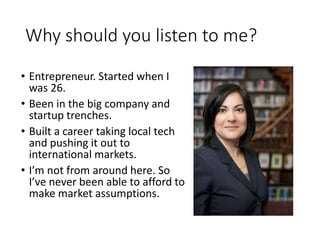
Why should you listen to me?
• Entrepreneur. Started when I
was 26.
• Been in the big company and
startup trenches.
• Built a career taking local tech
and pushing it out to
international markets.
• I’m not from around here. So
I’ve never been able to afford to
make market assumptions.
Today’s talk
Source: gratisography.com
8 things you need to put on your to do list.
And do.
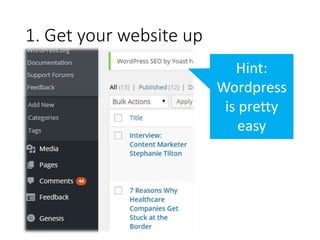
1. Get your website up
Hint:
Wordpress
is pretty
easy
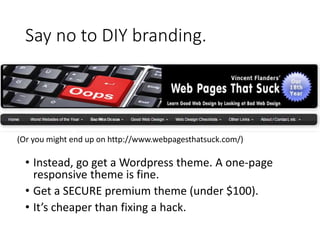
Say no to DIY branding.
• Instead, go get a Wordpress theme. A one-page
responsive theme is fine.
• Get a SECURE premium theme (under $100).
• It’s cheaper than fixing a hack.
(Or you might end up on http://www.webpagesthatsuck.com/)
2. Start marketing
Product Audience
Traction
3. Segment your market
Target your segments because,
• Limited resources (not IBM resources)
• Courir plusieurs lièvres à la fois : spend your time
and money most effectively
• Great segmentation resource: Bill Aulet’s
Disciplined Leadership
What’s a good segment?
Photo Credit: atomicShed via Compfight cc
It’s not the whole pie.
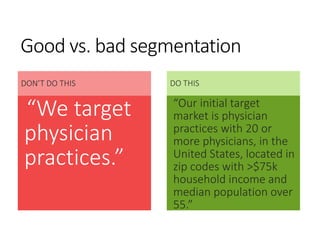
Good vs. bad segmentation
DON’T DO THIS
“We target
physician
practices.”
DO THIS
“Our initial target
market is physician
practices with 20 or
more physicians, in the
United States, located in
zip codes with >$75k
household income and
median population over
55.”
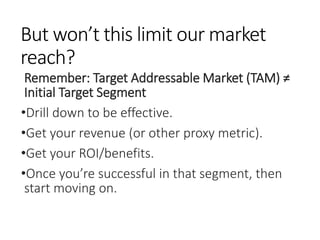
But won’t this limit our market
reach?
Remember: Target Addressable Market (TAM) ≠
Initial Target Segment
•Drill down to be effective.
•Get your revenue (or other proxy metric).
•Get your ROI/benefits.
•Once you’re successful in that segment, then
start moving on.
Bombardier v1.0
ALL about traction.
4. Build a buyer profile
• You’re in the Intensive MVP Program, so you’re
already doing customer development
• Take it one step further: document who your buyer
is
• Key questions:
• Where do they seek out info and advice? (hint: these are
good marketing channels)
• What’s going to stop them from buying your product?
Need a profile template?
Ask me @sovita.chander@lesaint.ca
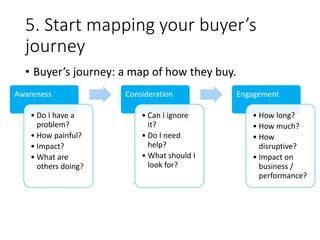
5. Start mapping your buyer’s
journey
• Buyer’s journey: a map of how they buy.
Awareness
• Do I have a
problem?
• How painful?
• Impact?
• What are
others doing?
Consideration
• Can I ignore
it?
• Do I need
help?
• What should I
look for?
Engagement
• How long?
• How much?
• How
disruptive?
• Impact on
business /
performance?
Why do this?
• Start understanding their questions, their sales
objections.
• Buyer’s journeys are different for each market –
sometimes each segment.
• Big companies ≠ SMBs or startups.
• Dads who drive BMWs in California ≠ Grandmas
who drive Subarus in Boston
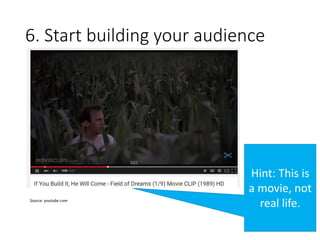
6. Start building your audience
Source: youtube.com
Hint: This is
a movie, not
real life.
“But I don’t have a marketing
budget”
I bought myself a MacBook Air instead.
Source: deathtothestockphoto.com
You still
have
options.
Source: deathtothestockphoto.com
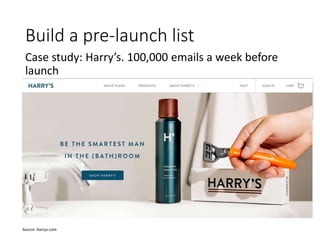
Build a pre-launch list
Case study: Harry’s. 100,000 emails a week before
launch
Source: harrys.com
Build a following (there are no
boring industries)
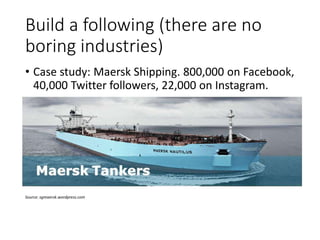
• Case study: Maersk Shipping. 800,000 on Facebook,
40,000 Twitter followers, 22,000 on Instagram.
Source: sgmaersk.wordpress.com
Get your thought leadership out
• There are no boring topics, only boring angles.
• Educate, don’t sell. (Nobody cares about the product)
• Be insanely helpful
• Or fun
• Or both
• Examples: Unbounce, Caristix, Groove
• More here: http://www.slideshare.net/Sovita/hitmc-
2015-sovita-chander-thought-leadership-content-
marketing-slideshare
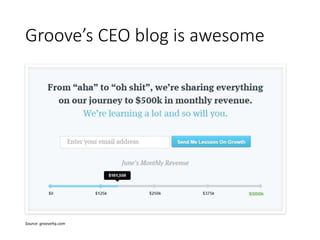
Groove’s CEO blog is awesome
Source: groovehq.com
Interested in content marketing?
Source: gratisography.com
Here’s my pitch
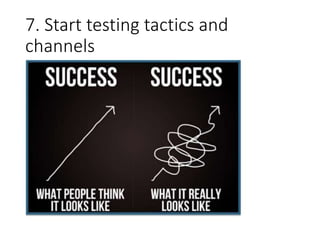
7. Start testing tactics and
channels
Best tactics resource
• Traction, by Gabriel Weinberg and Justin Mares
• 19 traction channels to consider
• Pick what makes sense for your business
8. Iterate.
Source: gratisography.com
Keep calm and carry on.
Build incremently
• It will take time.
• You will course-correct.
• It will be frustrating at times.
• Do it anyway.
Thank you!
Sovita Chander
(418) 802-2435
sovita.chander@lesaint.ca

Pre-MVP marketing for startups July 2015

  • 1.
    Build Your AudienceWhile Building Your Product Marketing for Pre-MVP Startups Sovita Chander VP Strategy lesaint.ca/healthcare Le Camp Intensive MVP Program, Quebec City, Canada
  • 2.
    Why are wehere? No MVP? No problem. Get started anyway. Source: deathtothestockphoto.com
  • 3.
    Why should youlisten to me? • Entrepreneur. Started when I was 26. • Been in the big company and startup trenches. • Built a career taking local tech and pushing it out to international markets. • I’m not from around here. So I’ve never been able to afford to make market assumptions.
  • 4.
    Today’s talk Source: gratisography.com 8things you need to put on your to do list. And do.
  • 5.
    1. Get yourwebsite up Hint: Wordpress is pretty easy
  • 6.
    Say no toDIY branding. • Instead, go get a Wordpress theme. A one-page responsive theme is fine. • Get a SECURE premium theme (under $100). • It’s cheaper than fixing a hack. (Or you might end up on http://www.webpagesthatsuck.com/)
  • 7.
    2. Start marketing ProductAudience Traction
  • 8.
    3. Segment yourmarket Target your segments because, • Limited resources (not IBM resources) • Courir plusieurs lièvres à la fois : spend your time and money most effectively • Great segmentation resource: Bill Aulet’s Disciplined Leadership
  • 9.
    What’s a goodsegment? Photo Credit: atomicShed via Compfight cc It’s not the whole pie.
  • 10.
    Good vs. badsegmentation DON’T DO THIS “We target physician practices.” DO THIS “Our initial target market is physician practices with 20 or more physicians, in the United States, located in zip codes with >$75k household income and median population over 55.”
  • 11.
    But won’t thislimit our market reach? Remember: Target Addressable Market (TAM) ≠ Initial Target Segment •Drill down to be effective. •Get your revenue (or other proxy metric). •Get your ROI/benefits. •Once you’re successful in that segment, then start moving on.
  • 12.
  • 13.
    4. Build abuyer profile • You’re in the Intensive MVP Program, so you’re already doing customer development • Take it one step further: document who your buyer is • Key questions: • Where do they seek out info and advice? (hint: these are good marketing channels) • What’s going to stop them from buying your product?
  • 14.
    Need a profiletemplate? Ask me @sovita.chander@lesaint.ca
  • 15.
    5. Start mappingyour buyer’s journey • Buyer’s journey: a map of how they buy. Awareness • Do I have a problem? • How painful? • Impact? • What are others doing? Consideration • Can I ignore it? • Do I need help? • What should I look for? Engagement • How long? • How much? • How disruptive? • Impact on business / performance?
  • 16.
    Why do this? •Start understanding their questions, their sales objections. • Buyer’s journeys are different for each market – sometimes each segment. • Big companies ≠ SMBs or startups. • Dads who drive BMWs in California ≠ Grandmas who drive Subarus in Boston
  • 17.
    6. Start buildingyour audience Source: youtube.com Hint: This is a movie, not real life.
  • 18.
    “But I don’thave a marketing budget” I bought myself a MacBook Air instead. Source: deathtothestockphoto.com
  • 19.
  • 20.
    Build a pre-launchlist Case study: Harry’s. 100,000 emails a week before launch Source: harrys.com
  • 21.
    Build a following(there are no boring industries) • Case study: Maersk Shipping. 800,000 on Facebook, 40,000 Twitter followers, 22,000 on Instagram. Source: sgmaersk.wordpress.com
  • 22.
    Get your thoughtleadership out • There are no boring topics, only boring angles. • Educate, don’t sell. (Nobody cares about the product) • Be insanely helpful • Or fun • Or both • Examples: Unbounce, Caristix, Groove • More here: http://www.slideshare.net/Sovita/hitmc- 2015-sovita-chander-thought-leadership-content- marketing-slideshare
  • 23.
    Groove’s CEO blogis awesome Source: groovehq.com
  • 24.
    Interested in contentmarketing? Source: gratisography.com Here’s my pitch
  • 25.
    7. Start testingtactics and channels
  • 26.
    Best tactics resource •Traction, by Gabriel Weinberg and Justin Mares • 19 traction channels to consider • Pick what makes sense for your business
  • 27.
  • 28.
    Build incremently • Itwill take time. • You will course-correct. • It will be frustrating at times. • Do it anyway.
  • 29.
    Thank you! Sovita Chander (418)802-2435 sovita.chander@lesaint.ca

Editor's Notes

  • #3 You don’t have a product. You still need to get started with marketing. What is the one thing you need to do? Validate your idea, validate your audience – not just your market Validate your pull. Build reflexes. Avoid “if you build it, they will come” You also need to figure it out: you will launch eventually. Do you want to launch without a safety net, an audience, or do you want to launch to a list.
  • #4 EXFO Cardinal Health Caristix Built a career taking Quebec technology or IP developed here and pushing it out to international markets. Not from around here – and addressing markets elsewhere. So that’s forced me to really question assumptions and focus on understanding first. Understanding markets and buyers before trying to sell into them.
  • #5 Get a website. Start marketing. Segment. Build a buyer profile or persona. Start mapping your buyer’s journey. Start building your audience. Start testing tactics and channels. Iterate.
  • #7 No company name yet? Start under your name. Woo Themes Studiopress Avoid Theme Forest – not the same quality control on security and updates
  • #10 Target customer: customer you can most easily acquire in the next 3 months, who are most likely to need your product. You’ve done your market validation, right? This is who you target. Not the customer you wish you could acquire. Poor segmentation: “We target physician practices” Good segmentation: “Our initial target market is physician practices with 20 or more physicians, in the United States, located in zip codes with >$75k household income and median population over 55.” Photo Credit: <a href="https://www.flickr.com/photos/57071639@N00/4434547381/">atomicShed</a> via <a href="http://compfight.com">Compfight</a> <a href="https://creativecommons.org/licenses/by-nc-nd/2.0/">cc</a>
  • #13 Here’s an example. Joseph-Armand Bombardier. He spotted a market need. He validated. He penetrated an initial target segment - the local Quebec market, municipalities, regions. Once he had traction and revenue there, that’s when he started targeting other verticals – les mines, gaz et petrol, forestieres. One segment at a time. Then later, he discovered the big demand was for petits motoneiges recreatifs – pas la taille d’un autobus. He started with traction in one segment. http://iveybusinessjournal.com/publication/achieving-growth-by-setting-new-strategies-for-new-markets/ - excerpt below: In established industries it is important to establish scale and leverage fixed costs, but in new markets companies need to be nimble so as to experiment easily.  It does no good to take the cost-efficient route to the wrong destination.  Joseph-Armand Bombardier learned this lesson well.  In 1937 he invented a tracked snowmobile bus that could be used during heavy winters in his native Québec. Rather than scale up the business with fixed costs, he fashioned the early vehicle bodies out of wood and sourced his engines from third parties.  His eponymous company was therefore able to shift quickly into the production of All Terrain Vehicles (ATVs) for the mining, oil, and forestry industries, where, as he discovered, there was demand for tracked machines.  Later, he found that the big demand for snowmobiles was not for bus-like contraptions but rather for small vehicles used largely for recreation.  Because he had kept his approach flexible, Bombardier could shift quickly into new uses for his core tracked-vehicle technology and attain strong positions in a host of new markets.
  • #15 Or use empathy maps or something – but take the time to capture your insights.
  • #19 Do you need a product to start marketing? No money, what are you going to do? http://blog.newscred.com/article/content-marketing-answers-how-do-you-do-marketing-with-no-budget/90176ab8403f9355039204fbd1902b5f?mkt_tok=3RkMMJWWfF9wsRogvqTKZKXonjHpfsX76ewkWaW1lMI
  • #20 Limited resources don’t have to be a constraint.
  • #21 http://fourhourworkweek.com/2014/07/21/harrys-prelaunchr-email/ Harry’s is a mens grooming brand. Launched with high end razors for a lot cheaper. In the week before they launched their commerce site, they set up a referral campaign that got them 100,000 emails on their list. That is amazing. For this to work for you, you have to know your audience, you need a mass market, and you need to know your referral mechanics. Full details here: Tim Ferriss’s site: http://fourhourworkweek.com/2014/07/21/harrys-prelaunchr-email/
  • #22 http://www.mckinsey.com/insights/marketing_sales/being_b2b_social_a_conversation_with_maersk_lines_head_of_social_media - if this huge company can do it, what’s stopping you? Interview with their social media manager. I wasn’t sure exactly how we’d be able to engage with people when I started, but in my first week I found our digital archive, which no one was using. It had 14,000 photos on file—mainly ships, seascapes, ports, et cetera. I knew I could share them and add stories to them. That rich history was something I could share that was unique to Maersk, and people really responded to it. Now people who don’t even know who we are take and post photos of Maersk ships. Don’t forget: Instagram, pinterest. Etc. Think about where they hang out. Moms: Pinterest Who is buying. So for instance – Hykso. They could be on Instagram or Pinterest.
  • #24 CEO blogs about his startup. His audience is small company leaders and startups. Perfect fit. High quality content. Not pushing product. But the blog actually converts. It drives traffic and converts. But it takes 6 to 20 hours a week to do this well. It’s a commitment.
  • #27 Poor distribution— not product— is the number one cause of failure. If you can get even a single distribution channel to work, you have great business. If you try for several but don’t nail one, you’re finished. Weinberg, Gabriel; Mares, Justin (2014-08-23). Traction: A Startup Guide to Getting Customers (Kindle Locations 208-209). S-curves Publishing. Kindle Edition. Weinberg, Gabriel; Mares, Justin (2014-08-23). Traction: A Startup Guide to Getting Customers (Kindle Location 209). S-curves Publishing. Kindle Edition.