
Enabling the 64 bit ecosystem
George Grey, Linaro CEO
Linaro Connect Asia - Macau
• Welcome to Qualcomm - Linaro Club member
TSC Representative: Matt Locke
New Member Announcement
• Welcome to MediaTek - Linaro Club member
TSC Representative: James Lai
New Member Announcement
• Welcome to ZTE - Linaro Club member
Acting TSC Representative: Jill Guo
New Member Announcement
• Welcome to Comcast - Linaro Group member
Founding member of LHG
LHG-SC Representative: Labeeb Ismail
Keynote: Tuesday 8.45am Sree Kotay, SVP
New Member Announcement
Welcome to Allwinner Technology - Linaro Group member
Founding member of LHG
LHG-SC Representative: To be confirmed
New Member Announcement
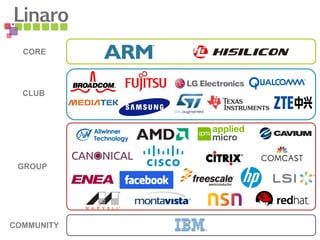
CORE
COMMUNITY
CLUB
GROUP
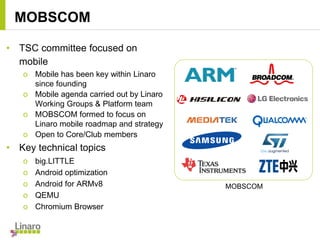
• TSC committee focused on
mobile
o Mobile has been key within Linaro
since founding
o Mobile agenda carried out by Linaro
Working Groups & Platform team
o MOBSCOM formed to focus on
Linaro mobile roadmap and strategy
o Open to Core/Club members
• Key technical topics
o big.LITTLE
o Android optimization
o Android for ARMv8
o QEMU
o Chromium Browser
MOBSCOM
MOBSCOM
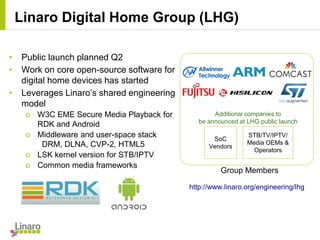
• Public launch planned Q2
• Work on core open-source software for
digital home devices has started
• Leverages Linaro’s shared engineering
model
o W3C EME Secure Media Playback for
RDK and Android
o Middleware and user-space stack
DRM, DLNA, CVP-2, HTML5
o LSK kernel version for STB/IPTV
o Common media frameworks
Linaro Digital Home Group (LHG)
Group Members
http://www.linaro.org/engineering/lhg
SoC
Vendors
STB/TV/IPTV/
Media OEMs &
Operators
Additional companies to
be announced at LHG public launch
and
Enabling the 64-bit Open Source Ecosystem
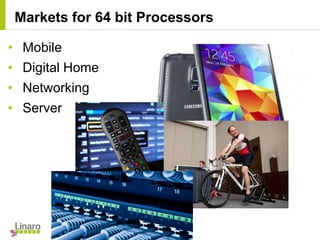
• Mobile
• Digital Home
• Networking
• Server
Markets for 64 bit Processors
• Linaro is building, validating and optimizing the key
software enablers for ARMv8-A
• Work started in 2012 using models
• Now running on 64 bit hardware
• Goal is to enable open source and
commercial ISVs to rapidly deploy
applications when ARMv8-A
hardware is publicly
available
Software Ecosystem
Time is fleeting ...
• Toolchain
• Linux Kernel and LSK
• Boot Architecture
• Security
• Virtualization
• Android 64
• Power Management & Thermal
• Middleware
• 64 bit Applications
Key Activities and Technologies
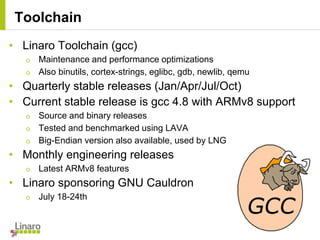
• Linaro Toolchain (gcc)
o Maintenance and performance optimizations
o Also binutils, cortex-strings, eglibc, gdb, newlib, qemu
• Quarterly stable releases (Jan/Apr/Jul/Oct)
• Current stable release is gcc 4.8 with ARMv8 support
o Source and binary releases
o Tested and benchmarked using LAVA
o Big-Endian version also available, used by LNG
• Monthly engineering releases
o Latest ARMv8 features
• Linaro sponsoring GNU Cauldron
o July 18-24th
Toolchain
• LSK - Linaro Stable Kernel
o Based on kernel.org LTS (currently Linux 3.10)
o First formal release for ARMv8 as soon as member hardware is
available for QA/validation
o Standard Linux and Android versions
o Given the amount of new technology we need to have a trusted
process for incorporating new ARMv8 support and optimizations into
the LSK, while maintaining product levels of stability
• linux-linaro Kernel
o Latest tree used by working groups
o Currently Linux 3.14 RC3
o Includes 64-bit support
• Monthly releases from Linaro
downloads page
Linux Kernel
• Standard Boot Architecture for ARMv8
o ARM Trusted Firmware
o UEFI industry standard
o ACPI system description
o PSCI Power State Coordination Interface
• LEG leading the way for servers
o SBSA (Server Base System Architecture) specification
o LEG Server kernel now delivered, booting with only UEFI and ACPI
o Critical for companies like Canonical and Red Hat to deliver a single
distribution that will work across ALL member ARMv8-A SoCs
• Linaro and ARM are working together to provide
validated reference implementations for all segments,
including Android
Boot Architecture
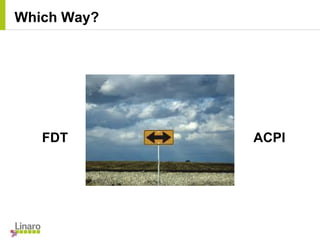
Which Way?
FDT ACPI
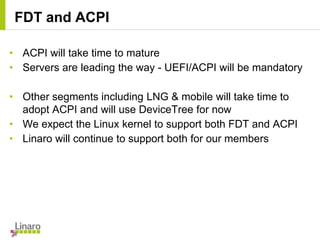
• ACPI will take time to mature
• Servers are leading the way - UEFI/ACPI will be mandatory
• Other segments including LNG & mobile will take time to
adopt ACPI and will use DeviceTree for now
• We expect the Linux kernel to support both FDT and ACPI
• Linaro will continue to support both for our members
FDT and ACPI
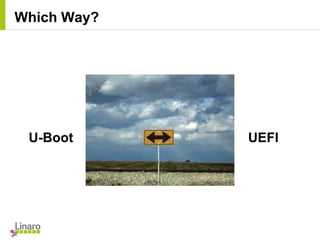
Which Way?
U-Boot UEFI
• The embedded, mobile, digital home and networking
segments are expecting to deliver ARMv8-A based products
using U-Boot and, over time, UEFI. Our members are asking
us to support both
• Linaro will therefore work on and support both U-Boot and
UEFI for our members
• Engineering projects will include continuing to work on UEFI
and ACPI upstreaming and improvements, as well as
working to avoid fragmentation in U-Boot implementations
Boot Architecture - UEFI and U-Boot
• ARM Trusted Firmware, UEFI and ACPI software are
being developed in the open
o ARM Github, Tianocore, ACPI
• We all want to avoid product forks and fragmentation
• The upstream maintainers are working with the
community of users, who are themselves working on
delivery of products at the same time
o Balance between getting it right and fragmentation risk
• Linaro is actively helping members to accelerate
development and hardening of these key components
Maintainers
• Mission to create reference open source software driven
by Mobscom and Segment Groups on member SoCs
o W3C EME secure media playback
o Secure key store
o Secure boot
• Work with open source TEEs from ST and NVIDIA, and
Trustonic TEE
• ARMv8 is a key goal
o Leverage ARM Trusted Firmware
o Work with TEE upstreams to
ensure ARMv8 support
o Keep Google informed on
our progress
Security
• Support for KVM and XEN for ARMv8
• Demonstrated at LCU-13 in Santa Clara
• Ongoing work program, largely driven by LEG to date
o Guest Migration
o PSCI support
o Improved debugging tools
o CI Loop and testing in LAVA
Virtualization
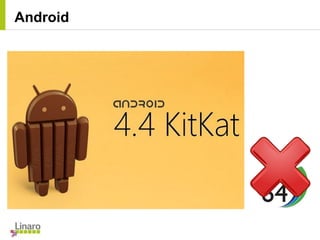
Android
Android
• No product announcement from Google as of today
• Intel have demonstrated Android running on 64 bit kernels
but Google have not yet released a version of Android for 64
bit applications
• Members want to work together in Linaro on common
Android software for ARMv8 to help accelerate deployment
once Google does release a 64 bit version of Android
• ARM and others have contributed 64 bit technology related
patches to AOSP
Android for ARMv8
• Current Linaro work
o QEMU ARMv8 model for Android SDK - delivery by end of March
o Optimized OpenSSL for ARMv8
o Test and optimize Chromium ARMv8 browser
• 64 bit Kernel and existing Android user space running on
models as tool for silicon bring-up and verification - not for
product
o Build device drivers for 64 bit now
o Available to Club and Core members under NDA
• Early hardware bringup
o No current public hardware to work on
o Landing teams can work with members under NDA
Android for ARMv8
• High priority to build 64 bit user space from AOSP and
implement in LAVA CI loop
• Key goal is to build, test, optimize and harden the 64 bit user
space software in AOSP
• ARM, Linaro & Mobscom members will work on this project
• Android team will be significantly expanded following LCA14
o Resources from Linaro
o Resources from member assignees
o Expect to have 15-20 engineers working on this
• For more information come to the Club/Core member-only
“Android on ARMv8-A” session Thurs 2-4pm
Android for ARMv8
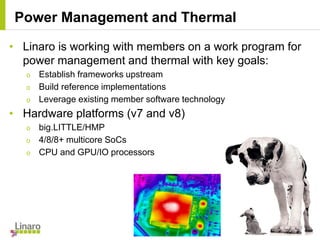
• Linaro is working with members on a work program for
power management and thermal with key goals:
o Establish frameworks upstream
o Build reference implementations
o Leverage existing member software technology
• Hardware platforms (v7 and v8)
o big.LITTLE/HMP
o 4/8/8+ multicore SoCs
o CPU and GPU/IO processors
Power Management and Thermal
• LAMP stack optimization
o LEG driven analysis and optimization of key packages
o Linaro-sponsored open source ARMv8 community effort led by Jon
“Maddog” Hall
• OpenJDK 8 for ARMv8
o Project developed in RedHat (Andrew Haley) and now a joint effort
with Linaro (Ed Nevill)
o Full high performance, enterprise class, implementation
with C1 and C2 JITs
o Demonstrated Hadoop running on ARMv8-A hardware
o Available now at openjdk.java.net
o Ongoing work on JCK testing
Middleware
• Enabling the 3rd party open source and commercial
applications software vendors
o Models will not cut it - we need available hardware
o HP Discovery Lab or LAVA based access
• More needs to be done in this area - it does not feel like
we are ready as a community
o Can Linaro help?
Applications
• Models only take us so far
• To be really effective we now need hardware to deliver
these enablers
o If necessary under NDA/LUL
• Please ensure that Linaro has early access to your
hardware - this will benefit you as key enabling software
will be delivered and validated on your own SoCs
• Now is the time to leverage Linaro and work together
What do we need
• This keynote was about the 64 bit ecosystem!
• But, Linaro is also very active in the 32 bit world
o See Roadmaps, Status and Downloads
• Sneak preview of new key topics for LCU-14
o Ongoing discussions on “small” embedded Linux
▪ Yocto/OE
▪ Targeted at appliances, embedded, wearables
o Ongoing discussions on IoT
▪ Open source software for Cortex-M series
ARMv7 and Cortex-M
Thank you
LCA14: George Grey Keynote - LCA14

LCA14: George Grey Keynote - LCA14

  • 1.
    Enabling the 64bit ecosystem George Grey, Linaro CEO Linaro Connect Asia - Macau
  • 2.
    • Welcome toQualcomm - Linaro Club member TSC Representative: Matt Locke New Member Announcement
  • 3.
    • Welcome toMediaTek - Linaro Club member TSC Representative: James Lai New Member Announcement
  • 4.
    • Welcome toZTE - Linaro Club member Acting TSC Representative: Jill Guo New Member Announcement
  • 5.
    • Welcome toComcast - Linaro Group member Founding member of LHG LHG-SC Representative: Labeeb Ismail Keynote: Tuesday 8.45am Sree Kotay, SVP New Member Announcement
  • 6.
    Welcome to AllwinnerTechnology - Linaro Group member Founding member of LHG LHG-SC Representative: To be confirmed New Member Announcement
  • 7.
  • 8.
    • TSC committeefocused on mobile o Mobile has been key within Linaro since founding o Mobile agenda carried out by Linaro Working Groups & Platform team o MOBSCOM formed to focus on Linaro mobile roadmap and strategy o Open to Core/Club members • Key technical topics o big.LITTLE o Android optimization o Android for ARMv8 o QEMU o Chromium Browser MOBSCOM MOBSCOM
  • 9.
    • Public launchplanned Q2 • Work on core open-source software for digital home devices has started • Leverages Linaro’s shared engineering model o W3C EME Secure Media Playback for RDK and Android o Middleware and user-space stack DRM, DLNA, CVP-2, HTML5 o LSK kernel version for STB/IPTV o Common media frameworks Linaro Digital Home Group (LHG) Group Members http://www.linaro.org/engineering/lhg SoC Vendors STB/TV/IPTV/ Media OEMs & Operators Additional companies to be announced at LHG public launch and
  • 10.
    Enabling the 64-bitOpen Source Ecosystem
  • 11.
    • Mobile • DigitalHome • Networking • Server Markets for 64 bit Processors
  • 12.
    • Linaro isbuilding, validating and optimizing the key software enablers for ARMv8-A • Work started in 2012 using models • Now running on 64 bit hardware • Goal is to enable open source and commercial ISVs to rapidly deploy applications when ARMv8-A hardware is publicly available Software Ecosystem
  • 13.
  • 14.
    • Toolchain • LinuxKernel and LSK • Boot Architecture • Security • Virtualization • Android 64 • Power Management & Thermal • Middleware • 64 bit Applications Key Activities and Technologies
  • 15.
    • Linaro Toolchain(gcc) o Maintenance and performance optimizations o Also binutils, cortex-strings, eglibc, gdb, newlib, qemu • Quarterly stable releases (Jan/Apr/Jul/Oct) • Current stable release is gcc 4.8 with ARMv8 support o Source and binary releases o Tested and benchmarked using LAVA o Big-Endian version also available, used by LNG • Monthly engineering releases o Latest ARMv8 features • Linaro sponsoring GNU Cauldron o July 18-24th Toolchain
  • 16.
    • LSK -Linaro Stable Kernel o Based on kernel.org LTS (currently Linux 3.10) o First formal release for ARMv8 as soon as member hardware is available for QA/validation o Standard Linux and Android versions o Given the amount of new technology we need to have a trusted process for incorporating new ARMv8 support and optimizations into the LSK, while maintaining product levels of stability • linux-linaro Kernel o Latest tree used by working groups o Currently Linux 3.14 RC3 o Includes 64-bit support • Monthly releases from Linaro downloads page Linux Kernel
  • 17.
    • Standard BootArchitecture for ARMv8 o ARM Trusted Firmware o UEFI industry standard o ACPI system description o PSCI Power State Coordination Interface • LEG leading the way for servers o SBSA (Server Base System Architecture) specification o LEG Server kernel now delivered, booting with only UEFI and ACPI o Critical for companies like Canonical and Red Hat to deliver a single distribution that will work across ALL member ARMv8-A SoCs • Linaro and ARM are working together to provide validated reference implementations for all segments, including Android Boot Architecture
  • 18.
  • 19.
    • ACPI willtake time to mature • Servers are leading the way - UEFI/ACPI will be mandatory • Other segments including LNG & mobile will take time to adopt ACPI and will use DeviceTree for now • We expect the Linux kernel to support both FDT and ACPI • Linaro will continue to support both for our members FDT and ACPI
  • 20.
  • 21.
    • The embedded,mobile, digital home and networking segments are expecting to deliver ARMv8-A based products using U-Boot and, over time, UEFI. Our members are asking us to support both • Linaro will therefore work on and support both U-Boot and UEFI for our members • Engineering projects will include continuing to work on UEFI and ACPI upstreaming and improvements, as well as working to avoid fragmentation in U-Boot implementations Boot Architecture - UEFI and U-Boot
  • 22.
    • ARM TrustedFirmware, UEFI and ACPI software are being developed in the open o ARM Github, Tianocore, ACPI • We all want to avoid product forks and fragmentation • The upstream maintainers are working with the community of users, who are themselves working on delivery of products at the same time o Balance between getting it right and fragmentation risk • Linaro is actively helping members to accelerate development and hardening of these key components Maintainers
  • 23.
    • Mission tocreate reference open source software driven by Mobscom and Segment Groups on member SoCs o W3C EME secure media playback o Secure key store o Secure boot • Work with open source TEEs from ST and NVIDIA, and Trustonic TEE • ARMv8 is a key goal o Leverage ARM Trusted Firmware o Work with TEE upstreams to ensure ARMv8 support o Keep Google informed on our progress Security
  • 24.
    • Support forKVM and XEN for ARMv8 • Demonstrated at LCU-13 in Santa Clara • Ongoing work program, largely driven by LEG to date o Guest Migration o PSCI support o Improved debugging tools o CI Loop and testing in LAVA Virtualization
  • 25.
  • 26.
    • No productannouncement from Google as of today • Intel have demonstrated Android running on 64 bit kernels but Google have not yet released a version of Android for 64 bit applications • Members want to work together in Linaro on common Android software for ARMv8 to help accelerate deployment once Google does release a 64 bit version of Android • ARM and others have contributed 64 bit technology related patches to AOSP Android for ARMv8
  • 27.
    • Current Linarowork o QEMU ARMv8 model for Android SDK - delivery by end of March o Optimized OpenSSL for ARMv8 o Test and optimize Chromium ARMv8 browser • 64 bit Kernel and existing Android user space running on models as tool for silicon bring-up and verification - not for product o Build device drivers for 64 bit now o Available to Club and Core members under NDA • Early hardware bringup o No current public hardware to work on o Landing teams can work with members under NDA Android for ARMv8
  • 28.
    • High priorityto build 64 bit user space from AOSP and implement in LAVA CI loop • Key goal is to build, test, optimize and harden the 64 bit user space software in AOSP • ARM, Linaro & Mobscom members will work on this project • Android team will be significantly expanded following LCA14 o Resources from Linaro o Resources from member assignees o Expect to have 15-20 engineers working on this • For more information come to the Club/Core member-only “Android on ARMv8-A” session Thurs 2-4pm Android for ARMv8
  • 29.
    • Linaro isworking with members on a work program for power management and thermal with key goals: o Establish frameworks upstream o Build reference implementations o Leverage existing member software technology • Hardware platforms (v7 and v8) o big.LITTLE/HMP o 4/8/8+ multicore SoCs o CPU and GPU/IO processors Power Management and Thermal
  • 30.
    • LAMP stackoptimization o LEG driven analysis and optimization of key packages o Linaro-sponsored open source ARMv8 community effort led by Jon “Maddog” Hall • OpenJDK 8 for ARMv8 o Project developed in RedHat (Andrew Haley) and now a joint effort with Linaro (Ed Nevill) o Full high performance, enterprise class, implementation with C1 and C2 JITs o Demonstrated Hadoop running on ARMv8-A hardware o Available now at openjdk.java.net o Ongoing work on JCK testing Middleware
  • 31.
    • Enabling the3rd party open source and commercial applications software vendors o Models will not cut it - we need available hardware o HP Discovery Lab or LAVA based access • More needs to be done in this area - it does not feel like we are ready as a community o Can Linaro help? Applications
  • 32.
    • Models onlytake us so far • To be really effective we now need hardware to deliver these enablers o If necessary under NDA/LUL • Please ensure that Linaro has early access to your hardware - this will benefit you as key enabling software will be delivered and validated on your own SoCs • Now is the time to leverage Linaro and work together What do we need
  • 33.
    • This keynotewas about the 64 bit ecosystem! • But, Linaro is also very active in the 32 bit world o See Roadmaps, Status and Downloads • Sneak preview of new key topics for LCU-14 o Ongoing discussions on “small” embedded Linux ▪ Yocto/OE ▪ Targeted at appliances, embedded, wearables o Ongoing discussions on IoT ▪ Open source software for Cortex-M series ARMv7 and Cortex-M
  • 34.