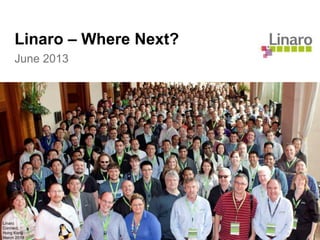
Linaro
Connect,
Hong Kong
March 2013
June 2013
Linaro – Where Next?
www.linaro.orgSlide 2
Overview
 Linaro reflections
 Trends / Chrystal ball gazing
www.linaro.orgSlide 3
Linaro – Past, Present and Future
 Why Linaro?
 The ARM partnership needs a place to do collaborative engineering
 Common engineering problems need solving efficiently
 ARM partnership needs to get better at ‘open source’
 The game is evolving, getting broader
 Now have 24 members of Linaro
 Industry groups LEG and LNG, and being asked to form more
 Wide member expertise and experience
www.linaro.orgSlide 4
Linaro – Past, Present and Future
Problems, always problems...
 Consolidation / preventing fragmentation
 New technologies
 Kernel frameworks supporting diversity
 Standards driving disaggregation
 Segment specific technologies, code bases
 Testing and validation
www.linaro.orgSlide 5
Oh, and a Common Threat
 Linaro was also formed as a response to a common threat
 You all know who I mean, Intel
 They haven’t stood still for 3 years
 Driving markets vertically via distributions (versus ARM’s horizontal,
‘enable everyone’ play)
 Was MeeGo, now Tizen (also Android)
 Very active in power management (‘race to idle’) and all market
segments
www.linaro.orgSlide 6
Oh, and a Common Threat
 The competition is not really between technologies, it’s
between business models
 Can many collaborating companies win against the monolith?
 What does this mean for software?
 Drives efficient collaboration
 A lot of software frameworks do not support ARM’s diversity
 Outside of mobile, software not always well tuned for ARMv7-A
www.linaro.orgSlide 7
Trends
 Climbing the gravity well
 Disaggregation
 Standards
 Community
www.linaro.orgSlide 8
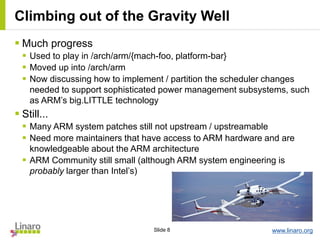
Climbing out of the Gravity Well
 Much progress
 Used to play in /arch/arm/{mach-foo, platform-bar}
 Moved up into /arch/arm
 Now discussing how to implement / partition the scheduler changes
needed to support sophisticated power management subsystems, such
as ARM’s big.LITTLE technology
 Still...
 Many ARM system patches still not upstream / upstreamable
 Need more maintainers that have access to ARM hardware and are
knowledgeable about the ARM architecture
 ARM Community still small (although ARM system engineering is
probably larger than Intel’s)
www.linaro.orgSlide 9
Trends: Disaggregation
 dis·ag·gre·gate
 v. dis·ag·gre·gat·ed, dis·ag·gre·gat·ing, dis·ag·gre·gates
 To divide into constituent parts, to break up or break apart.
 Unbundle
 break apart proprietary components, sandwiching with open source
components
 Supported by open standards
 Driven by end customers
 OpenStack is a good example...
www.linaro.orgSlide 10
OpenStack
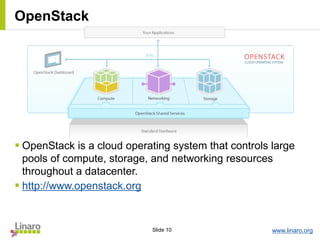
 OpenStack is a cloud operating system that controls large
pools of compute, storage, and networking resources
throughout a datacenter.
 http://www.openstack.org
www.linaro.orgSlide 11
Why is OpenStack Important to Linaro?
 Drives engineering activities in Linaro:
 Java
 PHP
 Python
 Virtualization
 Gives us a framework for testing
 Stresses the components that we’re engineering
 Gives us a framework for benchmarking
 Looking for areas to improve performance of the overall system
www.linaro.orgSlide 12
Standards
 Standards driving ARM systems
 Change from mobile, where standards are few (although you could think
of Android as a standard)
 Established markets demand standards (need to avoid a ‘me too’
approach)
 Closed standards
 Extend the status quo (and who wants that?)
 Driven by the technology producers
 Open standards support disaggregation
 Tend to be driven by the end customers
 Encourage many vendors and competition
www.linaro.orgSlide 13
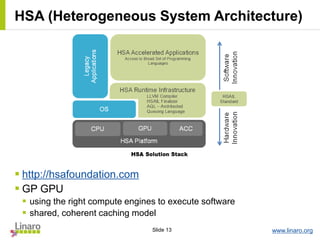
HSA (Heterogeneous System Architecture)
 http://hsafoundation.com
 GP GPU
 using the right compute engines to execute software
 shared, coherent caching model
www.linaro.orgSlide 14
Which Standards?
 Open source software can quickly adopt standards
 Google any standard and someone’s implemented it for Linux
 Open source often used to prove standards
 Which standard should we choose?
 Generally, driven by members, especially the groups
 Example #1: Networking – Data Plane Development Kit (DPDK)
 Should we adopt this for ARM based networking?
 Better ‘kit of parts’, such as openEM (open event machine)?
 Example #2: STB – Comcast RDK
 Invent our own standards?
 If needed, but generally see Linaro as the implementers of standards
www.linaro.orgSlide 15
Community
 Who is the ARM open source community?
 Systems engineers versus end users
 (Probably) more ARM engineers working on ARM platforms than Intel
has working on Intel platforms
 Availability of ARM platforms opens up
 Distribution support
 Community projects
 University research
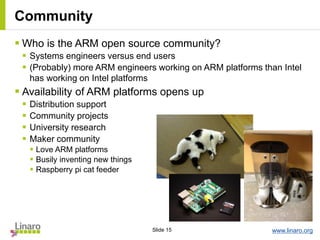
 Maker community
 Love ARM platforms
 Busily inventing new things
 Raspberry pi cat feeder
www.linaro.orgSlide 16
Finally
A huge thank you to everyone who has helped make the past 3
years successful ... and fun
Linaro
Connect,
Hong Kong
March 2013
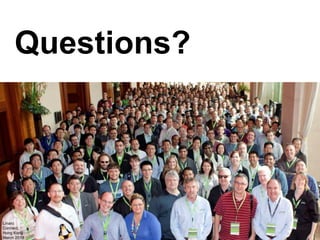
Questions?
www.linaro.orgSlide 18
Standards versus Groups
 Graphics and Multimedia
 UMM, OpenGLES, CDF, HSA
 LEG
 OpenCompute, LAMP, OpenStack, Hadoop, HipHop VM
 LNG
 DPDK
 openEM
 STB
 Comcast RDK / Android / ??
 Automotive
 Genivi
www.linaro.orgSlide 19
 Strategy
 Start working with the LLVM community (support ARM buildbots etc)
 Grow effort based on member’s input / groups
 LLVM versus GCC
 LLVM will grow in importance
 LLVM is being used to build Android
 Linaro is benchmarking LLVM and has made some fixes
 LLVM important for GP GPU:
 OpenCL
 HSA (Heterogeneous System Architecture)
LLVM Strategy
www.linaro.orgSlide 20
The Competition
 Intel are still the competition
 Their strategy is vertical, ARM’s is horizontal (and Linaro fits into
that horizontal play)
 Drive an x86 distribution into markets via top player
 Was Nokia, now Samsung
 Was Meego, now Tizan
 Subsidize the engineering effort
 Hardware is approaching ARM’s for power efficiency, but the
competition is not really between technologies, it’s between
business models
 Hardware and software
 Success and Failure
 Intel has not had a great deal of software success (MeeGo(ne))
 ARM
 A lot of great stuff has happened (reference the consolidation of the kernel)
 Outside of Linaro, companies still upstreaming a lot of duplication
 Need to avoid complacency
 Server is their turf, so expect trouble
 Gloves off in networking, clear choices
www.linaro.orgSlide 21
 Intel:
 Thermal Monitoring Technologies
 Idle States Intel® Smart Idle
 Intel® SpeedStep® Technology
 Intel® Demand Based Switching
www.linaro.orgSlide 22
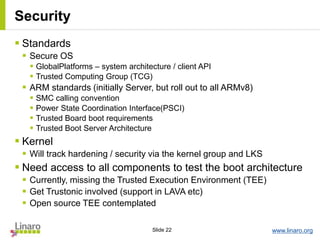
Security
 Standards
 Secure OS
 GlobalPlatforms – system architecture / client API
 Trusted Computing Group (TCG)
 ARM standards (initially Server, but roll out to all ARMv8)
 SMC calling convention
 Power State Coordination Interface(PSCI)
 Trusted Board boot requirements
 Trusted Boot Server Architecture
 Kernel
 Will track hardening / security via the kernel group and LKS
 Need access to all components to test the boot architecture
 Currently, missing the Trusted Execution Environment (TEE)
 Get Trustonic involved (support in LAVA etc)
 Open source TEE contemplated
More about Linaro: http://www.linaro.org/about/
More about Linaro engineering: http://www.linaro.org/engineering/
How to join: http://www.linaro.org/about/how-to-join
Linaro members: www.linaro.org/members
www.linaro.orgSlide 24
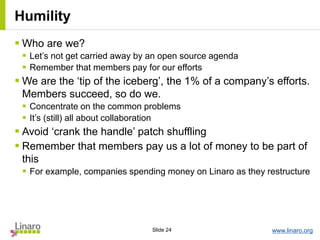
Humility
 Who are we?
 Let’s not get carried away by an open source agenda
 Remember that members pay for our efforts
 We are the ‘tip of the iceberg’, the 1% of a company’s efforts.
Members succeed, so do we.
 Concentrate on the common problems
 It’s (still) all about collaboration
 Avoid ‘crank the handle’ patch shuffling
 Remember that members pay us a lot of money to be part of
this
 For example, companies spending money on Linaro as they restructure

LCE13: Closing Keynote: David Rusling

  • 1.
    Linaro Connect, Hong Kong March 2013 June2013 Linaro – Where Next?
  • 2.
    www.linaro.orgSlide 2 Overview  Linaroreflections  Trends / Chrystal ball gazing
  • 3.
    www.linaro.orgSlide 3 Linaro –Past, Present and Future  Why Linaro?  The ARM partnership needs a place to do collaborative engineering  Common engineering problems need solving efficiently  ARM partnership needs to get better at ‘open source’  The game is evolving, getting broader  Now have 24 members of Linaro  Industry groups LEG and LNG, and being asked to form more  Wide member expertise and experience
  • 4.
    www.linaro.orgSlide 4 Linaro –Past, Present and Future Problems, always problems...  Consolidation / preventing fragmentation  New technologies  Kernel frameworks supporting diversity  Standards driving disaggregation  Segment specific technologies, code bases  Testing and validation
  • 5.
    www.linaro.orgSlide 5 Oh, anda Common Threat  Linaro was also formed as a response to a common threat  You all know who I mean, Intel  They haven’t stood still for 3 years  Driving markets vertically via distributions (versus ARM’s horizontal, ‘enable everyone’ play)  Was MeeGo, now Tizen (also Android)  Very active in power management (‘race to idle’) and all market segments
  • 6.
    www.linaro.orgSlide 6 Oh, anda Common Threat  The competition is not really between technologies, it’s between business models  Can many collaborating companies win against the monolith?  What does this mean for software?  Drives efficient collaboration  A lot of software frameworks do not support ARM’s diversity  Outside of mobile, software not always well tuned for ARMv7-A
  • 7.
    www.linaro.orgSlide 7 Trends  Climbingthe gravity well  Disaggregation  Standards  Community
  • 8.
    www.linaro.orgSlide 8 Climbing outof the Gravity Well  Much progress  Used to play in /arch/arm/{mach-foo, platform-bar}  Moved up into /arch/arm  Now discussing how to implement / partition the scheduler changes needed to support sophisticated power management subsystems, such as ARM’s big.LITTLE technology  Still...  Many ARM system patches still not upstream / upstreamable  Need more maintainers that have access to ARM hardware and are knowledgeable about the ARM architecture  ARM Community still small (although ARM system engineering is probably larger than Intel’s)
  • 9.
    www.linaro.orgSlide 9 Trends: Disaggregation dis·ag·gre·gate  v. dis·ag·gre·gat·ed, dis·ag·gre·gat·ing, dis·ag·gre·gates  To divide into constituent parts, to break up or break apart.  Unbundle  break apart proprietary components, sandwiching with open source components  Supported by open standards  Driven by end customers  OpenStack is a good example...
  • 10.
    www.linaro.orgSlide 10 OpenStack  OpenStackis a cloud operating system that controls large pools of compute, storage, and networking resources throughout a datacenter.  http://www.openstack.org
  • 11.
    www.linaro.orgSlide 11 Why isOpenStack Important to Linaro?  Drives engineering activities in Linaro:  Java  PHP  Python  Virtualization  Gives us a framework for testing  Stresses the components that we’re engineering  Gives us a framework for benchmarking  Looking for areas to improve performance of the overall system
  • 12.
    www.linaro.orgSlide 12 Standards  Standardsdriving ARM systems  Change from mobile, where standards are few (although you could think of Android as a standard)  Established markets demand standards (need to avoid a ‘me too’ approach)  Closed standards  Extend the status quo (and who wants that?)  Driven by the technology producers  Open standards support disaggregation  Tend to be driven by the end customers  Encourage many vendors and competition
  • 13.
    www.linaro.orgSlide 13 HSA (HeterogeneousSystem Architecture)  http://hsafoundation.com  GP GPU  using the right compute engines to execute software  shared, coherent caching model
  • 14.
    www.linaro.orgSlide 14 Which Standards? Open source software can quickly adopt standards  Google any standard and someone’s implemented it for Linux  Open source often used to prove standards  Which standard should we choose?  Generally, driven by members, especially the groups  Example #1: Networking – Data Plane Development Kit (DPDK)  Should we adopt this for ARM based networking?  Better ‘kit of parts’, such as openEM (open event machine)?  Example #2: STB – Comcast RDK  Invent our own standards?  If needed, but generally see Linaro as the implementers of standards
  • 15.
    www.linaro.orgSlide 15 Community  Whois the ARM open source community?  Systems engineers versus end users  (Probably) more ARM engineers working on ARM platforms than Intel has working on Intel platforms  Availability of ARM platforms opens up  Distribution support  Community projects  University research  Maker community  Love ARM platforms  Busily inventing new things  Raspberry pi cat feeder
  • 16.
    www.linaro.orgSlide 16 Finally A hugethank you to everyone who has helped make the past 3 years successful ... and fun
  • 17.
  • 18.
    www.linaro.orgSlide 18 Standards versusGroups  Graphics and Multimedia  UMM, OpenGLES, CDF, HSA  LEG  OpenCompute, LAMP, OpenStack, Hadoop, HipHop VM  LNG  DPDK  openEM  STB  Comcast RDK / Android / ??  Automotive  Genivi
  • 19.
    www.linaro.orgSlide 19  Strategy Start working with the LLVM community (support ARM buildbots etc)  Grow effort based on member’s input / groups  LLVM versus GCC  LLVM will grow in importance  LLVM is being used to build Android  Linaro is benchmarking LLVM and has made some fixes  LLVM important for GP GPU:  OpenCL  HSA (Heterogeneous System Architecture) LLVM Strategy
  • 20.
    www.linaro.orgSlide 20 The Competition Intel are still the competition  Their strategy is vertical, ARM’s is horizontal (and Linaro fits into that horizontal play)  Drive an x86 distribution into markets via top player  Was Nokia, now Samsung  Was Meego, now Tizan  Subsidize the engineering effort  Hardware is approaching ARM’s for power efficiency, but the competition is not really between technologies, it’s between business models  Hardware and software  Success and Failure  Intel has not had a great deal of software success (MeeGo(ne))  ARM  A lot of great stuff has happened (reference the consolidation of the kernel)  Outside of Linaro, companies still upstreaming a lot of duplication  Need to avoid complacency  Server is their turf, so expect trouble  Gloves off in networking, clear choices
  • 21.
    www.linaro.orgSlide 21  Intel: Thermal Monitoring Technologies  Idle States Intel® Smart Idle  Intel® SpeedStep® Technology  Intel® Demand Based Switching
  • 22.
    www.linaro.orgSlide 22 Security  Standards Secure OS  GlobalPlatforms – system architecture / client API  Trusted Computing Group (TCG)  ARM standards (initially Server, but roll out to all ARMv8)  SMC calling convention  Power State Coordination Interface(PSCI)  Trusted Board boot requirements  Trusted Boot Server Architecture  Kernel  Will track hardening / security via the kernel group and LKS  Need access to all components to test the boot architecture  Currently, missing the Trusted Execution Environment (TEE)  Get Trustonic involved (support in LAVA etc)  Open source TEE contemplated
  • 23.
    More about Linaro:http://www.linaro.org/about/ More about Linaro engineering: http://www.linaro.org/engineering/ How to join: http://www.linaro.org/about/how-to-join Linaro members: www.linaro.org/members
  • 24.
    www.linaro.orgSlide 24 Humility  Whoare we?  Let’s not get carried away by an open source agenda  Remember that members pay for our efforts  We are the ‘tip of the iceberg’, the 1% of a company’s efforts. Members succeed, so do we.  Concentrate on the common problems  It’s (still) all about collaboration  Avoid ‘crank the handle’ patch shuffling  Remember that members pay us a lot of money to be part of this  For example, companies spending money on Linaro as they restructure