BIOMEDICAL WASTE
MANAGEMENT
•TEAM LISTER-
•DR.SYED ALIM
•DR.SAMPOORNA VINOD
•DR.SNEHA KATARIA
•DR.SANGHEETA PAUL
•DR.RUPALI RASTOGI
•DR.SONAL YADAV
•DR.SHUBHAM GAUR
•DR.SHASHANK LODAWARA
BIO-MEDICAL
WASTE
• “Bio-medical waste" means any waste,
which is generated during the
diagnosis, treatment or immunization
of human beings or animals or
research activities pertaining there to
or in the production or testing of
biological or in health camps.
• The Bio-medical Waste Management rules are
applicable to all persons who generate, collect,
receive, store, transport, treat, dispose, or handle bio
medical waste in any form.
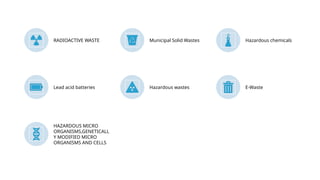
• Bio-Medical Waste rules 2016 doesn’t apply to the
following types of wastes as they are covered under
different acts enumerated below:
RADIOACTIVE WASTE Municipal Solid Wastes Hazardous chemicals
Lead acid batteries Hazardous wastes E-Waste
HAZARDOUS MICRO
ORGANISMS,GENETICALL
Y MODIFIED MICRO
ORGANISMS AND CELLS
THE MAJOR SALIENT FEATURES OF BMW MANAGEMENT RULES, 2016 INCLUDE THE
FOLLOWING:
The scope of the rules has been expanded to include vaccination camps, blood
donation camps, surgical camps or any other healthcare activity;
Phase-out the use of chlorinated plastic bags, gloves and blood bags within two years
Pre-treatment of the laboratory waste, microbiological waste, blood samples and
blood bags through disinfection sterilization on-site in the manner as prescribed by
WHO or NACO
Provide training to all its health care workers and immunize all health workers
regularly
Establish a Bar-Code System for bags or containers containing bio-medical waste
for disposal;
Report major accidents;
Existing incinerators to achieve the standards for retention time in secondary
chamber and Dioxin and Furans within two years;
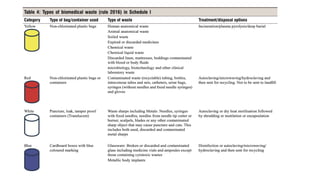
Bio-medical waste has been classified in to 4 categories instead of 10 to improve
the segregation of waste at source;
Procedure to get authorization simplified. The validity of authorization synchronized with validity
of consent orders for Bedded HCFs.
The new rules prescribe more stringent standards for incinerator to reduce the emission of
pollutants in environment;
Inclusion of emissions limits for Dioxin and furans;
No occupier shall establish on-site treatment and disposal facility, if a service of `common bio-
medical waste treatment facility is available at seventy-five kilometers.
Operator of a common bio-medical waste treatment and disposal facility to ensure the timely
collection of bio-medical waste from the Health Care Facility and assist the Health Care Facility in
conduct of training.
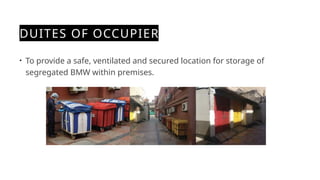
DUITES OF OCCUPIER
• To provide a safe, ventilated and secured location for storage of
segregated BMW within premises.
• Phase out use of chlorinated plastic bags, gloves and blood bags within
two years from the date of notification of these rules.
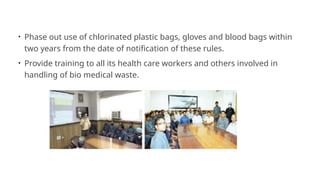
• Provide training to all its health care workers and others involved in
handling of bio medical waste.
• Immunization against Hepatitis B
and tetanus for workers.
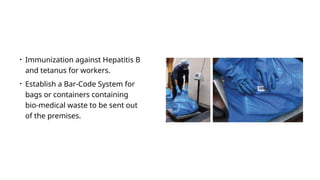
• Establish a Bar-Code System for
bags or containers containing
bio-medical waste to be sent out
of the premises.
DUTIES OF OPERATOR
Report major accidents and remedial measures to SPCB
Ensure timely collection of BMW from healthcare facilities
Handing over of recyclable waste to after treatment by autoclaving and incineration
Establish bar coding and GPS for handling within one year
Assist health care facilities in training of workers
Upgradation of existing incinerators and achievement of standards for secondary
chamber
TREATMENT AND DISPOSAL
• No healthcare facility shall setup onsite BMW treatment facilities if a
CBMWTF exists within 75 kms of distance.
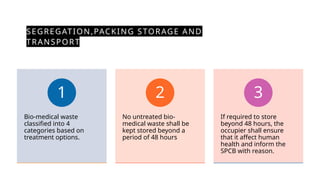
SEGREGATION,PACKING STORAGE AND
TRANSPORT
Bio-medical waste
classified into 4
categories based on
treatment options.
1
No untreated bio-
medical waste shall be
kept stored beyond a
period of 48 hours
2
If required to store
beyond 48 hours, the
occupier shall ensure
that it affect human
health and inform the
SPCB with reason.
3
AUTHORISATION
One time Authorization for Non-bedded HCFs
The validity of authorization shall be synchronized with
validity of consent orders for Bedded HCFs
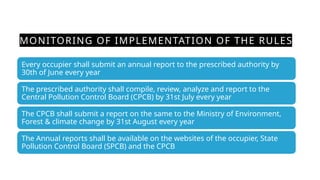
MONITORING OF IMPLEMENTATION OF THE RULES
Every occupier shall submit an annual report to the prescribed authority by
30th of June every year
The prescribed authority shall compile, review, analyze and report to the
Central Pollution Control Board (CPCB) by 31st July every year
The CPCB shall submit a report on the same to the Ministry of Environment,
Forest & climate change by 31st August every year
The Annual reports shall be available on the websites of the occupier, State
Pollution Control Board (SPCB) and the CPCB
MAINTENANCE OF RECORDS
Records in relation to generation, collection, reception, storage, transportation,
treatment and disposal shall be maintained as per rules For 5 years
Biomedical waste management website
ACCIDENT REPORTING
• In case of major accident-intimate immediately and submit a report
within 24 hours
SCHEDULE
There are 4 schedules (or parts) in the Bio-Medical Waste rules 2016:
• Schedule 1: Categorization and Management
• Schedule 2: Standards for treatment and disposal of BMW
• Schedule 3: Prescribed Authority and duties
• Schedule 4: Label of containers, bags and transportation of Bio-
Medical waste
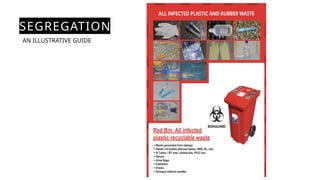
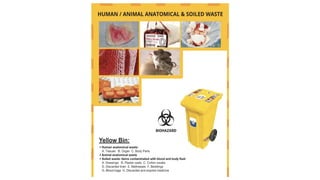
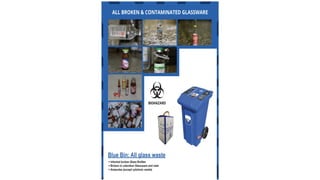
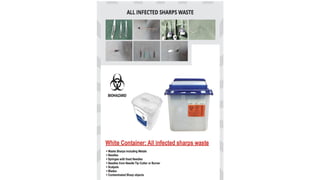
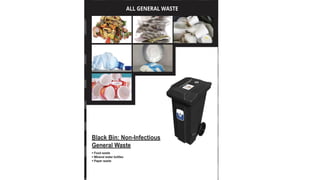
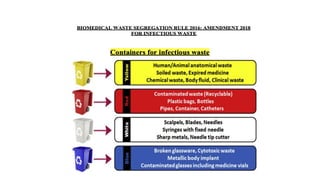
SEGREGATION
AN ILLUSTRATIVE GUIDE
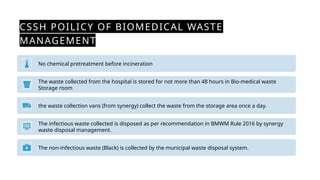
CSSH POILICY OF BIOMEDICAL WASTE
MANAGEMENT
No chemical pretreatment before incineration
The waste collected from the hospital is stored for not more than 48 hours in Bio-medical waste
Storage room
the waste collection vans (from synergy) collect the waste from the storage area once a day.
The infectious waste collected is disposed as per recommendation in BMWM Rule 2016 by synergy
waste disposal management.
The non-infectious waste (Black) is collected by the municipal waste disposal system.
GUIDELINES FOR SURGERY IN THE HIV PATIENT
All bodily fluids of all patients should be regarded as hazardous
substances.
Protective eyewear, gloves and water-impermeable gowns are essential.
Wearing two pairs of gloves reduces the risk of exposure, as 98% of blood
from the penetrating needle will be removed
Disposable equipment should be used whenever available.
• Postponing elective operations with the aim of starting the patient on
antiretroviral medication should be encouraged: operating on a
healthier patient with a lower viral load and higher CD4 count is
advantageous for both patient and surgeon.
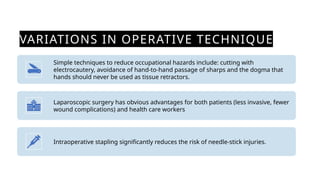
VARIATIONS IN OPERATIVE TECHNIQUE
Simple techniques to reduce occupational hazards include: cutting with
electrocautery, avoidance of hand-to-hand passage of sharps and the dogma that
hands should never be used as tissue retractors.
Laparoscopic surgery has obvious advantages for both patients (less invasive, fewer
wound complications) and health care workers
Intraoperative stapling significantly reduces the risk of needle-stick injuries.
THANK YOU

Presentation 9-3.jsjsnnsjsmmsjsndjdjjsjjsosjs

  • 1.
    BIOMEDICAL WASTE MANAGEMENT •TEAM LISTER- •DR.SYEDALIM •DR.SAMPOORNA VINOD •DR.SNEHA KATARIA •DR.SANGHEETA PAUL •DR.RUPALI RASTOGI •DR.SONAL YADAV •DR.SHUBHAM GAUR •DR.SHASHANK LODAWARA
  • 2.
    BIO-MEDICAL WASTE • “Bio-medical waste"means any waste, which is generated during the diagnosis, treatment or immunization of human beings or animals or research activities pertaining there to or in the production or testing of biological or in health camps.
  • 3.
    • The Bio-medicalWaste Management rules are applicable to all persons who generate, collect, receive, store, transport, treat, dispose, or handle bio medical waste in any form. • Bio-Medical Waste rules 2016 doesn’t apply to the following types of wastes as they are covered under different acts enumerated below:
  • 4.
    RADIOACTIVE WASTE MunicipalSolid Wastes Hazardous chemicals Lead acid batteries Hazardous wastes E-Waste HAZARDOUS MICRO ORGANISMS,GENETICALL Y MODIFIED MICRO ORGANISMS AND CELLS
  • 5.
    THE MAJOR SALIENTFEATURES OF BMW MANAGEMENT RULES, 2016 INCLUDE THE FOLLOWING: The scope of the rules has been expanded to include vaccination camps, blood donation camps, surgical camps or any other healthcare activity; Phase-out the use of chlorinated plastic bags, gloves and blood bags within two years Pre-treatment of the laboratory waste, microbiological waste, blood samples and blood bags through disinfection sterilization on-site in the manner as prescribed by WHO or NACO
  • 6.
    Provide training toall its health care workers and immunize all health workers regularly Establish a Bar-Code System for bags or containers containing bio-medical waste for disposal; Report major accidents; Existing incinerators to achieve the standards for retention time in secondary chamber and Dioxin and Furans within two years; Bio-medical waste has been classified in to 4 categories instead of 10 to improve the segregation of waste at source;
  • 8.
    Procedure to getauthorization simplified. The validity of authorization synchronized with validity of consent orders for Bedded HCFs. The new rules prescribe more stringent standards for incinerator to reduce the emission of pollutants in environment; Inclusion of emissions limits for Dioxin and furans; No occupier shall establish on-site treatment and disposal facility, if a service of `common bio- medical waste treatment facility is available at seventy-five kilometers. Operator of a common bio-medical waste treatment and disposal facility to ensure the timely collection of bio-medical waste from the Health Care Facility and assist the Health Care Facility in conduct of training.
  • 9.
    DUITES OF OCCUPIER •To provide a safe, ventilated and secured location for storage of segregated BMW within premises.
  • 10.
    • Phase outuse of chlorinated plastic bags, gloves and blood bags within two years from the date of notification of these rules. • Provide training to all its health care workers and others involved in handling of bio medical waste.
  • 11.
    • Immunization againstHepatitis B and tetanus for workers. • Establish a Bar-Code System for bags or containers containing bio-medical waste to be sent out of the premises.
  • 12.
    DUTIES OF OPERATOR Reportmajor accidents and remedial measures to SPCB Ensure timely collection of BMW from healthcare facilities Handing over of recyclable waste to after treatment by autoclaving and incineration Establish bar coding and GPS for handling within one year Assist health care facilities in training of workers Upgradation of existing incinerators and achievement of standards for secondary chamber
  • 13.
    TREATMENT AND DISPOSAL •No healthcare facility shall setup onsite BMW treatment facilities if a CBMWTF exists within 75 kms of distance.
  • 14.
    SEGREGATION,PACKING STORAGE AND TRANSPORT Bio-medicalwaste classified into 4 categories based on treatment options. 1 No untreated bio- medical waste shall be kept stored beyond a period of 48 hours 2 If required to store beyond 48 hours, the occupier shall ensure that it affect human health and inform the SPCB with reason. 3
  • 15.
    AUTHORISATION One time Authorizationfor Non-bedded HCFs The validity of authorization shall be synchronized with validity of consent orders for Bedded HCFs
  • 16.
    MONITORING OF IMPLEMENTATIONOF THE RULES Every occupier shall submit an annual report to the prescribed authority by 30th of June every year The prescribed authority shall compile, review, analyze and report to the Central Pollution Control Board (CPCB) by 31st July every year The CPCB shall submit a report on the same to the Ministry of Environment, Forest & climate change by 31st August every year The Annual reports shall be available on the websites of the occupier, State Pollution Control Board (SPCB) and the CPCB
  • 17.
    MAINTENANCE OF RECORDS Recordsin relation to generation, collection, reception, storage, transportation, treatment and disposal shall be maintained as per rules For 5 years Biomedical waste management website
  • 18.
    ACCIDENT REPORTING • Incase of major accident-intimate immediately and submit a report within 24 hours
  • 19.
    SCHEDULE There are 4schedules (or parts) in the Bio-Medical Waste rules 2016: • Schedule 1: Categorization and Management • Schedule 2: Standards for treatment and disposal of BMW • Schedule 3: Prescribed Authority and duties • Schedule 4: Label of containers, bags and transportation of Bio- Medical waste
  • 20.
  • 25.
    CSSH POILICY OFBIOMEDICAL WASTE MANAGEMENT No chemical pretreatment before incineration The waste collected from the hospital is stored for not more than 48 hours in Bio-medical waste Storage room the waste collection vans (from synergy) collect the waste from the storage area once a day. The infectious waste collected is disposed as per recommendation in BMWM Rule 2016 by synergy waste disposal management. The non-infectious waste (Black) is collected by the municipal waste disposal system.
  • 27.
    GUIDELINES FOR SURGERYIN THE HIV PATIENT All bodily fluids of all patients should be regarded as hazardous substances. Protective eyewear, gloves and water-impermeable gowns are essential. Wearing two pairs of gloves reduces the risk of exposure, as 98% of blood from the penetrating needle will be removed Disposable equipment should be used whenever available.
  • 28.
    • Postponing electiveoperations with the aim of starting the patient on antiretroviral medication should be encouraged: operating on a healthier patient with a lower viral load and higher CD4 count is advantageous for both patient and surgeon.
  • 29.
    VARIATIONS IN OPERATIVETECHNIQUE Simple techniques to reduce occupational hazards include: cutting with electrocautery, avoidance of hand-to-hand passage of sharps and the dogma that hands should never be used as tissue retractors. Laparoscopic surgery has obvious advantages for both patients (less invasive, fewer wound complications) and health care workers Intraoperative stapling significantly reduces the risk of needle-stick injuries.
  • 30.