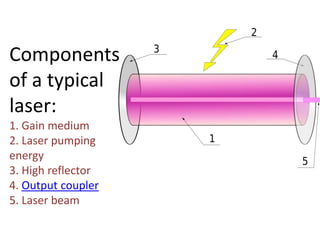
Components
of a typical
laser:
1. Gain medium
2. Laser pumping
energy
3. High reflector
4. Output coupler
5. Laser beam
A laser is a device that emits light (electromagnetic radiation)
through a process of optical amplification based on
the stimulated emission of photons. The term "laser"
originated as an acronym for Light Amplification by
Stimulated Emission of Radiation.[1][2] The emitted laser light
is notable for its high degree of spatial and
temporal coherence.
Temporal (or longitudinal) coherence implies a polarized
wave at a single frequency whose phase is correlated over a
relatively large distance (the coherence length) along the
beam.[3] A beam produced by a thermal or other incoherent
light source has an instantaneous amplitude and phase which
vary randomly with respect to time and position, and thus a
very short coherence length.
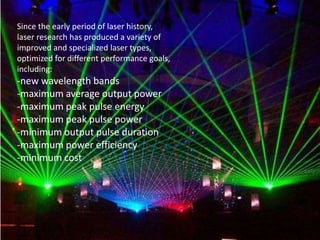
Since the early period of laser history,
laser research has produced a variety of
improved and specialized laser types,
optimized for different performance goals,
including:
-new wavelength bands
-maximum average output power
-maximum peak pulse energy
-maximum peak pulse power
-minimum output pulse duration
-maximum power efficiency
-minimum cost
Solid-state lasers
Solid-state lasers use a crystalline or glass rod
which is "doped" with ions that provide the
required energy states. For example, the first
working laser was a ruby laser, made
from ruby (chromium-doped corundum).
The population inversion is actually maintained
in the "dopant", such
as chromium orneodymium. These materials
are pumped optically using a shorter
wavelength than the lasing wavelength, often
from a flashtube or from another laser.
Dye lasers
Dye lasers use an organic dye as the gain
medium. The wide gain spectrum of available
dyes, or mixtures of dyes, allows these lasers to
be highly tunable, or to produce very short-
duration pulses (on the order of a
few femtoseconds). Although these tunable
lasers are mainly known in their liquid form,
researchers have also demonstrated narrow-
linewidth tunable emission in dispersive
oscillator configurations incorporating solid-state
dye gain media.[24] In their most prevalent form
these solid state dye lasers use dye-doped
polymers as laser media.
When lasers were invented in 1960, they were
called "a solution looking for a
problem".[30] Since then, they have become
ubiquitous, finding utility in thousands of
highly varied applications in every section of
modern society, including consumer
electronics, information technology, science,
medicine, industry, law enforcement,
entertainment, and the military.
The first use of lasers in the daily lives of the
general population was the
supermarket barcode scanner, introduced in
1974. The laserdisc player, introduced in 1978,
was the first successful consumer product to
include a laser but the compact disc player was
the first laser-equipped device to become
common, beginning in 1982 followed shortly
by laser printers.
Some other uses are:
Medicine:
- Bloodless surgery,
- laser healing, surgical treatment, kidney
stone treatment, eye treatment, dentistry
Industry:
-Cutting, welding, material heat treatment,
-marking parts, non-contact measurement of
parts
Military:
- Marking targets, guiding munitions, missile
defence,
- -electro-optical countermeasures (EOCM),
alternative to radar, blinding troops.
Law enforcement:
-used for latent fingerprint
-detection in the forensic identification field
]
Laser application in astronomical adaptive
optics imaging
Research:
- Spectroscopy, laser ablation,
- laser annealing, laser scattering, laser interferometry,
- LIDAR, laser capture microdissection, fluorescence
microscopy
Product development/commercial:
- laser printers, optical discs (e.g. CDs and the like),
- barcode scanners, thermometers,
-laser pointers, holograms,bubblegrams.
Laser lighting displays:
-Laser light shows
Cosmetic and skin treatments:
-acne treatment,
-cellulite and striae reduction
- hair removal.
Lasers

Lasers

  • 2.
    Components of a typical laser: 1.Gain medium 2. Laser pumping energy 3. High reflector 4. Output coupler 5. Laser beam
  • 3.
    A laser isa device that emits light (electromagnetic radiation) through a process of optical amplification based on the stimulated emission of photons. The term "laser" originated as an acronym for Light Amplification by Stimulated Emission of Radiation.[1][2] The emitted laser light is notable for its high degree of spatial and temporal coherence. Temporal (or longitudinal) coherence implies a polarized wave at a single frequency whose phase is correlated over a relatively large distance (the coherence length) along the beam.[3] A beam produced by a thermal or other incoherent light source has an instantaneous amplitude and phase which vary randomly with respect to time and position, and thus a very short coherence length.
  • 4.
    Since the earlyperiod of laser history, laser research has produced a variety of improved and specialized laser types, optimized for different performance goals, including: -new wavelength bands -maximum average output power -maximum peak pulse energy -maximum peak pulse power -minimum output pulse duration -maximum power efficiency -minimum cost
  • 5.
    Solid-state lasers Solid-state lasersuse a crystalline or glass rod which is "doped" with ions that provide the required energy states. For example, the first working laser was a ruby laser, made from ruby (chromium-doped corundum). The population inversion is actually maintained in the "dopant", such as chromium orneodymium. These materials are pumped optically using a shorter wavelength than the lasing wavelength, often from a flashtube or from another laser.
  • 6.
    Dye lasers Dye lasersuse an organic dye as the gain medium. The wide gain spectrum of available dyes, or mixtures of dyes, allows these lasers to be highly tunable, or to produce very short- duration pulses (on the order of a few femtoseconds). Although these tunable lasers are mainly known in their liquid form, researchers have also demonstrated narrow- linewidth tunable emission in dispersive oscillator configurations incorporating solid-state dye gain media.[24] In their most prevalent form these solid state dye lasers use dye-doped polymers as laser media.
  • 7.
    When lasers wereinvented in 1960, they were called "a solution looking for a problem".[30] Since then, they have become ubiquitous, finding utility in thousands of highly varied applications in every section of modern society, including consumer electronics, information technology, science, medicine, industry, law enforcement, entertainment, and the military. The first use of lasers in the daily lives of the general population was the supermarket barcode scanner, introduced in 1974. The laserdisc player, introduced in 1978, was the first successful consumer product to include a laser but the compact disc player was the first laser-equipped device to become common, beginning in 1982 followed shortly by laser printers.
  • 8.
    Some other usesare: Medicine: - Bloodless surgery, - laser healing, surgical treatment, kidney stone treatment, eye treatment, dentistry Industry: -Cutting, welding, material heat treatment, -marking parts, non-contact measurement of parts Military: - Marking targets, guiding munitions, missile defence, - -electro-optical countermeasures (EOCM), alternative to radar, blinding troops. Law enforcement: -used for latent fingerprint -detection in the forensic identification field ] Laser application in astronomical adaptive optics imaging
  • 9.
    Research: - Spectroscopy, laserablation, - laser annealing, laser scattering, laser interferometry, - LIDAR, laser capture microdissection, fluorescence microscopy Product development/commercial: - laser printers, optical discs (e.g. CDs and the like), - barcode scanners, thermometers, -laser pointers, holograms,bubblegrams. Laser lighting displays: -Laser light shows Cosmetic and skin treatments: -acne treatment, -cellulite and striae reduction - hair removal.