"Tell us and we will forget, show us and we may
remember, involve us and we understand
together"
- Anonymous
What Is LSIP ???
WHAT ARE LARGE SCALE INTERVENTIONS?
• Large Scale Interventions (LSI) are an
approach for organizing sustainable changes
with active involvement of all stakeholders
• Large Scale Interventions (LSI) is an approach
for change that meets those needs, because it
involves stakeholders in the processes of
change & development and creates an army of
Change-Agents.
WHAT ARE LARGE SCALE INTERVENTIONS?
Fundamental assumptions are:
Past, present and future are inseparably
connected in the organisation/community
Reality is defined by meanings as well as facts
Active participation enhances commitment to
change, learning and working together
Action learning facilitates real time change
(thinking and doing are not separated)
Meaningful experience is created by engaging
the whole person
WHY LSIP ?
WHY LARGE SCALE INTERVENTIONS?
• Because leaders and managers want faster
answers and actions.
• Because members of an organisation or
community want to be heard and want to
contribute to changes out of a feeling of
"ownership".
• Because Change needs Change Champions
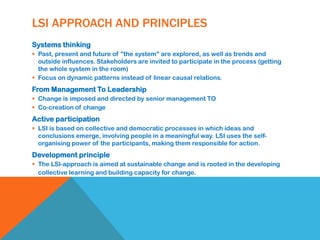
LSI APPROACH AND PRINCIPLES
Systems thinking
 Past, present and future of "the system" are explored, as well as trends and
outside influences. Stakeholders are invited to participate in the process (getting
the whole system in the room)
 Focus on dynamic patterns instead of linear causal relations.
From Management To Leadership
 Change is imposed and directed by senior management TO
 Co-creation of change
Active participation
 LSI is based on collective and democratic processes in which ideas and
conclusions emerge, involving people in a meaningful way. LSI uses the self-
organising power of the participants, making them responsible for action.
Development principle
 The LSI-approach is aimed at sustainable change and is rooted in the developing
collective learning and building capacity for change.
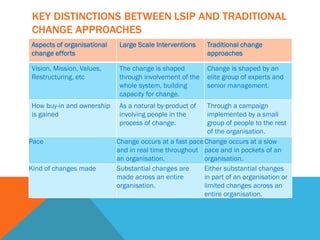
KEY DISTINCTIONS BETWEEN LSIP AND TRADITIONAL
CHANGE APPROACHES
Aspects of organisational
change efforts
Large Scale Interventions Traditional change
approaches
Vision, Mission, Values,
Restructuring, etc
The change is shaped
through involvement of the
whole system, building
capacity for change.
Change is shaped by an
elite group of experts and
senior management.
How buy-in and ownership
is gained
As a natural by-product of
involving people in the
process of change.
Through a campaign
implemented by a small
group of people to the rest
of the organisation.
Pace Change occurs at a fast pace
and in real time throughout
an organisation.
Change occurs at a slow
pace and in pockets of an
organisation.
Kind of changes made Substantial changes are
made across an entire
organisation.
Either substantial changes
in part of an organisation or
limited changes across an
entire organisation.
VARIATIONS IN LSIP
• From the
• very structured (Future Search, Conference Model®, Search Conference)
• to those that are almost open (Open Space) and
• everything in between (such as Real Time Strategic Change, World Café,
Participative Design, Simu Real)
• Remember The Principles
• Systems thinking
• From Management To Leadership
• Active participation
• Development principle
VARIATIONS OF LSIP
Future Search
 Focus on the past, by making a timeline of key events in the world and the history of the topic.
 Focus on the present, looking for trends and patterns, by using mind mapping.
 Focus on an ideal future scenarios and share them with the whole group. After looking for
common ground, action plans are made for a feasible route to a desirable future.
Open Space Technology (OST)
 OST mobilises knowledge and experiences of participants (5-1000) in a 1, 2 or 3 day conference.
 The originator, Harrison Owen’s objective was to combine the synergy and excitement present in
a good coffee break with the substantive activity and results characteristic of a good meeting?
The World Café
 In a Café-style ambiance, participants have conversations in small table groups about the theme.
 Participants don’t have a dull moment as they keep meeting "new" people, by changing tables in
several rounds. A table-host connects the successive conversations.
 After several rounds of conversations the facilitator helps to share discoveries and insights in a
whole group conversation.
ANY EXAMPLES OF LSIP
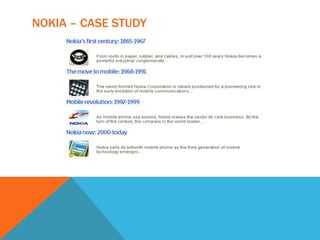
NOKIA – CASE STUDY
NOKIA – CASE STUDY
Nokia in 2006
• World's leading manufacturer of mobile devices ; World's sixth most-valued
brand (ranked by Interbrand)
• An estimated 36% share of the global device market
• Mobile device volume of 347 million units
• Net sales of EUR 41.1 billion ; Operating profit of EUR 5.5 billion
• 68,483 employees of more than 120 nationalities
• Strong R&D presence in 11 countries ; R&D investment of EUR 3.9 billion
• 21,453 people in R&D (approx. 31% of the Nokia workforce)
• 15 production facilities in nine countries ; Sales in more than 150 countries
• Europe accounted for 38% of Nokia's net sales (42% in 2005), Asia-Pacific
20% (18%), China 13% (11%), North America 7% (8%), Latin America 9%
(8%), and the Middle East and Africa 13% (13%).
NOKIA – CASE STUDY
• Times were changing
• Competition was fierce
• Nokia merged with Siemens to form NSN in 2008
• Structurally decentralization was adopted
• Moving Decision-making locally resulted in a culture better
reflecting the local market while still maintaining Nokia’s
beneficial qualities such as diverse people, financial resources
& technological expertise
• Interviews were conducted in early 2008 to understand public
perception
• Results made Nokia focus on Culture & Values
NOKIA – CASE STUDY
Challenges Solutions
Original set of values had
not been examined in over a
decade
Nokia embarked to renew
their Values by including
employees from all regions,
disciplines and levels to
create ownership
Growth in new markets and
huge influx of new
employees resulted in
cultural disconnect
How to reach out to 50,000
employees ?
Subsets of employees
through World Cafes
NOKIA – CASE STUDY
• 16 Local Cafes in India, China, Middle East, Europe, South
America and North America covering around 5000 employees
• Outputs from local Cafes fed into a Global Café
• The entire process completed in less than 60 days
• The original values from year 1992 were respect, achievement,
renewal and challenge
• Olli-Pekka Kallasvuo , CEO and his management team
participated in the last session of Global Café and reviewed
the Values.
• Video blogs of the World Cafes logged 30,000+ hits.
• 22,000+ employees participated in Photo contest
NOKIA – CASE STUDY
NOKIA – CASE STUDY
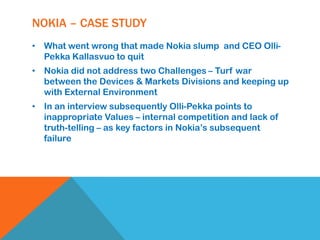
• What went wrong that made Nokia slump and CEO Olli-
Pekka Kallasvuo to quit
• Nokia did not address two Challenges – Turf war
between the Devices & Markets Divisions and keeping up
with External Environment
• In an interview subsequently Olli-Pekka points to
inappropriate Values – internal competition and lack of
truth-telling – as key factors in Nokia’s subsequent
failure
Large Scale Intervention Process (LSIP)

Large Scale Intervention Process (LSIP)

  • 2.
    "Tell us andwe will forget, show us and we may remember, involve us and we understand together" - Anonymous
  • 3.
  • 4.
    WHAT ARE LARGESCALE INTERVENTIONS? • Large Scale Interventions (LSI) are an approach for organizing sustainable changes with active involvement of all stakeholders • Large Scale Interventions (LSI) is an approach for change that meets those needs, because it involves stakeholders in the processes of change & development and creates an army of Change-Agents.
  • 5.
    WHAT ARE LARGESCALE INTERVENTIONS? Fundamental assumptions are: Past, present and future are inseparably connected in the organisation/community Reality is defined by meanings as well as facts Active participation enhances commitment to change, learning and working together Action learning facilitates real time change (thinking and doing are not separated) Meaningful experience is created by engaging the whole person
  • 6.
  • 7.
    WHY LARGE SCALEINTERVENTIONS? • Because leaders and managers want faster answers and actions. • Because members of an organisation or community want to be heard and want to contribute to changes out of a feeling of "ownership". • Because Change needs Change Champions
  • 8.
    LSI APPROACH ANDPRINCIPLES Systems thinking  Past, present and future of "the system" are explored, as well as trends and outside influences. Stakeholders are invited to participate in the process (getting the whole system in the room)  Focus on dynamic patterns instead of linear causal relations. From Management To Leadership  Change is imposed and directed by senior management TO  Co-creation of change Active participation  LSI is based on collective and democratic processes in which ideas and conclusions emerge, involving people in a meaningful way. LSI uses the self- organising power of the participants, making them responsible for action. Development principle  The LSI-approach is aimed at sustainable change and is rooted in the developing collective learning and building capacity for change.
  • 9.
    KEY DISTINCTIONS BETWEENLSIP AND TRADITIONAL CHANGE APPROACHES Aspects of organisational change efforts Large Scale Interventions Traditional change approaches Vision, Mission, Values, Restructuring, etc The change is shaped through involvement of the whole system, building capacity for change. Change is shaped by an elite group of experts and senior management. How buy-in and ownership is gained As a natural by-product of involving people in the process of change. Through a campaign implemented by a small group of people to the rest of the organisation. Pace Change occurs at a fast pace and in real time throughout an organisation. Change occurs at a slow pace and in pockets of an organisation. Kind of changes made Substantial changes are made across an entire organisation. Either substantial changes in part of an organisation or limited changes across an entire organisation.
  • 10.
    VARIATIONS IN LSIP •From the • very structured (Future Search, Conference Model®, Search Conference) • to those that are almost open (Open Space) and • everything in between (such as Real Time Strategic Change, World Café, Participative Design, Simu Real) • Remember The Principles • Systems thinking • From Management To Leadership • Active participation • Development principle
  • 11.
    VARIATIONS OF LSIP FutureSearch  Focus on the past, by making a timeline of key events in the world and the history of the topic.  Focus on the present, looking for trends and patterns, by using mind mapping.  Focus on an ideal future scenarios and share them with the whole group. After looking for common ground, action plans are made for a feasible route to a desirable future. Open Space Technology (OST)  OST mobilises knowledge and experiences of participants (5-1000) in a 1, 2 or 3 day conference.  The originator, Harrison Owen’s objective was to combine the synergy and excitement present in a good coffee break with the substantive activity and results characteristic of a good meeting? The World Café  In a Café-style ambiance, participants have conversations in small table groups about the theme.  Participants don’t have a dull moment as they keep meeting "new" people, by changing tables in several rounds. A table-host connects the successive conversations.  After several rounds of conversations the facilitator helps to share discoveries and insights in a whole group conversation.
  • 12.
  • 13.
  • 14.
    NOKIA – CASESTUDY Nokia in 2006 • World's leading manufacturer of mobile devices ; World's sixth most-valued brand (ranked by Interbrand) • An estimated 36% share of the global device market • Mobile device volume of 347 million units • Net sales of EUR 41.1 billion ; Operating profit of EUR 5.5 billion • 68,483 employees of more than 120 nationalities • Strong R&D presence in 11 countries ; R&D investment of EUR 3.9 billion • 21,453 people in R&D (approx. 31% of the Nokia workforce) • 15 production facilities in nine countries ; Sales in more than 150 countries • Europe accounted for 38% of Nokia's net sales (42% in 2005), Asia-Pacific 20% (18%), China 13% (11%), North America 7% (8%), Latin America 9% (8%), and the Middle East and Africa 13% (13%).
  • 15.
    NOKIA – CASESTUDY • Times were changing • Competition was fierce • Nokia merged with Siemens to form NSN in 2008 • Structurally decentralization was adopted • Moving Decision-making locally resulted in a culture better reflecting the local market while still maintaining Nokia’s beneficial qualities such as diverse people, financial resources & technological expertise • Interviews were conducted in early 2008 to understand public perception • Results made Nokia focus on Culture & Values
  • 16.
    NOKIA – CASESTUDY Challenges Solutions Original set of values had not been examined in over a decade Nokia embarked to renew their Values by including employees from all regions, disciplines and levels to create ownership Growth in new markets and huge influx of new employees resulted in cultural disconnect How to reach out to 50,000 employees ? Subsets of employees through World Cafes
  • 17.
    NOKIA – CASESTUDY • 16 Local Cafes in India, China, Middle East, Europe, South America and North America covering around 5000 employees • Outputs from local Cafes fed into a Global Café • The entire process completed in less than 60 days • The original values from year 1992 were respect, achievement, renewal and challenge • Olli-Pekka Kallasvuo , CEO and his management team participated in the last session of Global Café and reviewed the Values. • Video blogs of the World Cafes logged 30,000+ hits. • 22,000+ employees participated in Photo contest
  • 18.
  • 19.
    NOKIA – CASESTUDY • What went wrong that made Nokia slump and CEO Olli- Pekka Kallasvuo to quit • Nokia did not address two Challenges – Turf war between the Devices & Markets Divisions and keeping up with External Environment • In an interview subsequently Olli-Pekka points to inappropriate Values – internal competition and lack of truth-telling – as key factors in Nokia’s subsequent failure