LAPLACE TRANSFORMATION
& IT’S PROPERTIES
NAME :- AANCHAL SINGH
CLASS :- M.Sc. I YEAR (SEMESTER-I)
COLLEGE :–VMV COLLEGE,WARDHAMAN
NAGAR,NAGPUR
CONTENT
• INTRODUCTION
• LAPLACE TRANSFORMATION
• PROPERTIES
1)SHIFTING PROPERTY
2)DIVISION PROPERTY
3)TRANSFORM OF INTEGRAL
4)MULTIPLICATION PROPERTY
5)LAPLACE TRANSFORM OF A DERIVATIVE
• APPLICATION
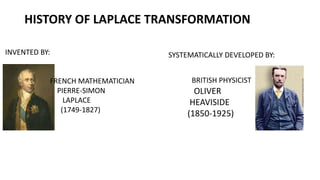
HISTORY OF LAPLACE TRANSFORMATION
SYSTEMATICALLY DEVELOPED BY:
BRITISH PHYSICIST
OLIVER
HEAVISIDE
(1850-1925)
INVENTED BY:
FRENCH MATHEMATICIAN
PIERRE-SIMON
LAPLACE
(1749-1827)
LAPLACE TRANSFORMATION
Let f(t) be a function of ‘t’defined for all positive
values of ‘t’ ,then the LAPLACE TRANSFORM of
f(t) denoted by L{f(t)} is defined by
𝐿 𝑓 𝑡 = 0
∞
𝑒−𝑠𝑡
.f(t)dt
Provided the integral exist
Where s- parameter which may be real or
complex no.
PROPERTIES
1)SHIFTING PROPERTY
If L{F(t)}=f(s) then
L{ 𝑒𝑎𝑡
. 𝐹(𝑡)} = 𝑓(𝑠 − 𝑎)
Ex: 𝑒−2𝑡
sin3t=
3
𝑠2+4𝑠+13
DIVISION PROPERTY
If L{f(t)}=f(s) then
L{
1
𝑡
.F(t)}= 𝑠
∞
𝑓 𝑠 𝑑𝑠
L{
𝑠𝑖𝑛𝑡
𝑡
}= 𝑠
∞ 1
𝑠2+1
ds
=𝑐𝑜𝑡−1
s
TRANSFORM OF INTEGRAL
If L{f(t)}=f(s) then
L{ 0
𝑡
𝐹 𝑡 𝑑𝑡} =
1
𝑆
𝑓(𝑠)
MULTIPLICATION PROPERTY
If L{f(t)}=f(s) then
L{𝑡𝑛
. 𝐹(𝑡)} = (−1)𝑛 𝑑𝑛
𝑑𝑠𝑛[f(s)]
L{t.sin3t}=(−1)1 𝑑
𝑑𝑠
(
3
𝑠2+9
)
=
6𝑠
(𝑠2+9)2
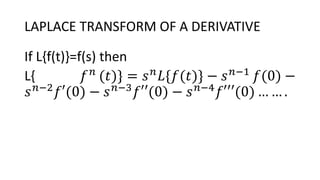
LAPLACE TRANSFORM OF A DERIVATIVE
If L{f(t)}=f(s) then
L{ 𝑓𝑛
(𝑡)} = 𝑠𝑛
𝐿{𝑓(𝑡)} − 𝑠𝑛−1
𝑓(0) −
𝑠𝑛−2𝑓′(0) − 𝑠𝑛−3𝑓′′(0) − 𝑠𝑛−4𝑓′′′(0) … … .
APPLICATION
• It is used to convert complex differential equation to a
simpler form having polynomials.
• It is used in the telecommunication field to send signals to
both the sides of the medium.
• It is also used for many engineering task such as Electrical
Circuit Analysis,Digital Signal Processing,System
Modelling,etc.
• Laplace Transform is widely used by electronic engineers to
solve quickly differential equations occurring in the analysis
of electronic circuits.
CREATED BY:-
AANCHAL SINGH

LAPLACE TRANSFORMATION.pptx

  • 1.
    LAPLACE TRANSFORMATION & IT’SPROPERTIES NAME :- AANCHAL SINGH CLASS :- M.Sc. I YEAR (SEMESTER-I) COLLEGE :–VMV COLLEGE,WARDHAMAN NAGAR,NAGPUR
  • 2.
    CONTENT • INTRODUCTION • LAPLACETRANSFORMATION • PROPERTIES 1)SHIFTING PROPERTY 2)DIVISION PROPERTY 3)TRANSFORM OF INTEGRAL 4)MULTIPLICATION PROPERTY 5)LAPLACE TRANSFORM OF A DERIVATIVE • APPLICATION
  • 3.
    HISTORY OF LAPLACETRANSFORMATION SYSTEMATICALLY DEVELOPED BY: BRITISH PHYSICIST OLIVER HEAVISIDE (1850-1925) INVENTED BY: FRENCH MATHEMATICIAN PIERRE-SIMON LAPLACE (1749-1827)
  • 4.
    LAPLACE TRANSFORMATION Let f(t)be a function of ‘t’defined for all positive values of ‘t’ ,then the LAPLACE TRANSFORM of f(t) denoted by L{f(t)} is defined by 𝐿 𝑓 𝑡 = 0 ∞ 𝑒−𝑠𝑡 .f(t)dt Provided the integral exist Where s- parameter which may be real or complex no.
  • 5.
    PROPERTIES 1)SHIFTING PROPERTY If L{F(t)}=f(s)then L{ 𝑒𝑎𝑡 . 𝐹(𝑡)} = 𝑓(𝑠 − 𝑎) Ex: 𝑒−2𝑡 sin3t= 3 𝑠2+4𝑠+13
  • 6.
    DIVISION PROPERTY If L{f(t)}=f(s)then L{ 1 𝑡 .F(t)}= 𝑠 ∞ 𝑓 𝑠 𝑑𝑠 L{ 𝑠𝑖𝑛𝑡 𝑡 }= 𝑠 ∞ 1 𝑠2+1 ds =𝑐𝑜𝑡−1 s
  • 7.
    TRANSFORM OF INTEGRAL IfL{f(t)}=f(s) then L{ 0 𝑡 𝐹 𝑡 𝑑𝑡} = 1 𝑆 𝑓(𝑠)
  • 8.
    MULTIPLICATION PROPERTY If L{f(t)}=f(s)then L{𝑡𝑛 . 𝐹(𝑡)} = (−1)𝑛 𝑑𝑛 𝑑𝑠𝑛[f(s)] L{t.sin3t}=(−1)1 𝑑 𝑑𝑠 ( 3 𝑠2+9 ) = 6𝑠 (𝑠2+9)2
  • 9.
    LAPLACE TRANSFORM OFA DERIVATIVE If L{f(t)}=f(s) then L{ 𝑓𝑛 (𝑡)} = 𝑠𝑛 𝐿{𝑓(𝑡)} − 𝑠𝑛−1 𝑓(0) − 𝑠𝑛−2𝑓′(0) − 𝑠𝑛−3𝑓′′(0) − 𝑠𝑛−4𝑓′′′(0) … … .
  • 10.
    APPLICATION • It isused to convert complex differential equation to a simpler form having polynomials. • It is used in the telecommunication field to send signals to both the sides of the medium. • It is also used for many engineering task such as Electrical Circuit Analysis,Digital Signal Processing,System Modelling,etc. • Laplace Transform is widely used by electronic engineers to solve quickly differential equations occurring in the analysis of electronic circuits.
  • 11.