Sociocultural Theory
• •Language as a socially mediated process
• • Vygotsky’s ZPD and scaffolding
• • Interaction, negotiation, collaborative
dialogue
• • Example: jigsaw tasks, peer tutoring
7.
Integrating Theories
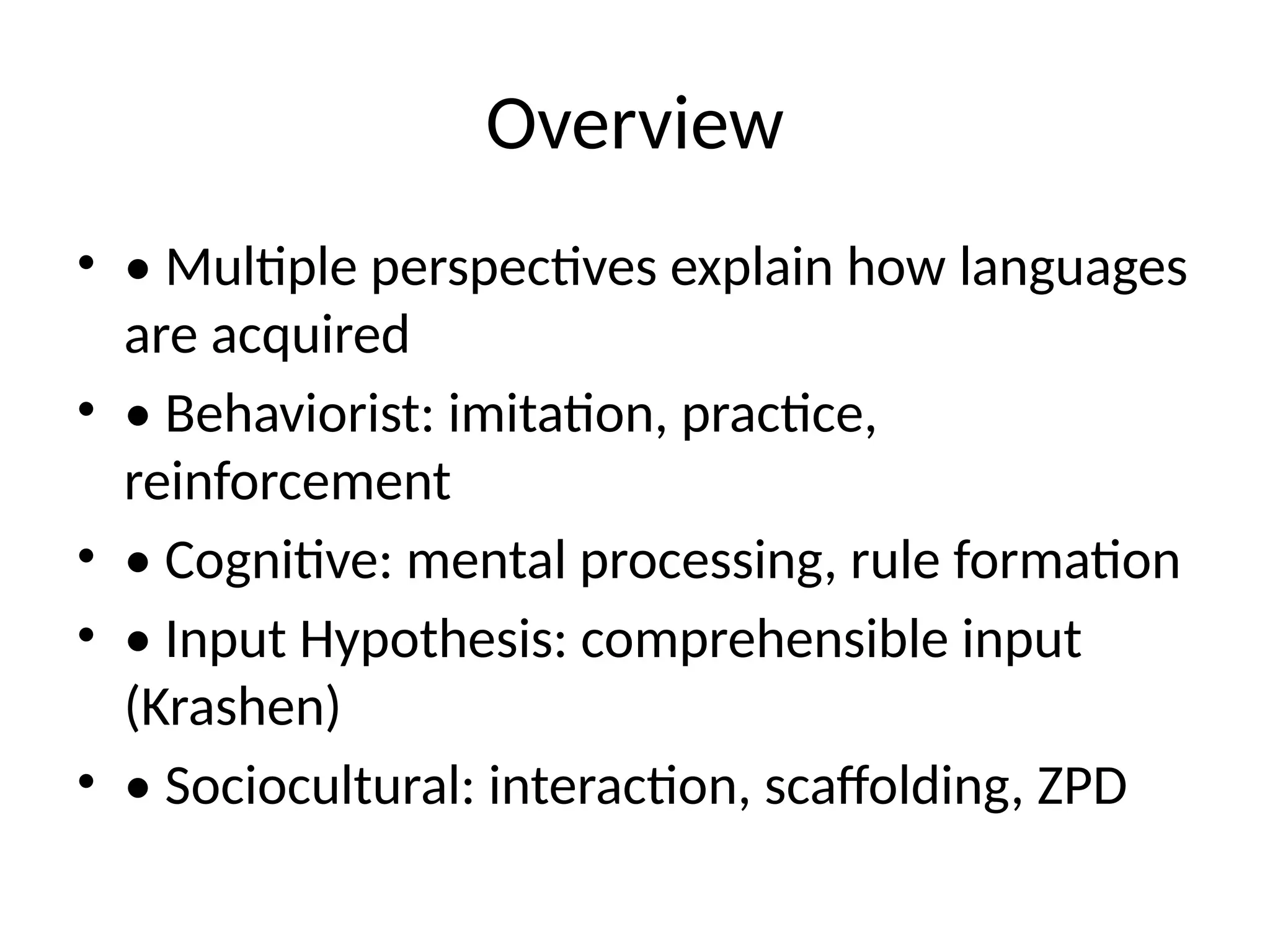
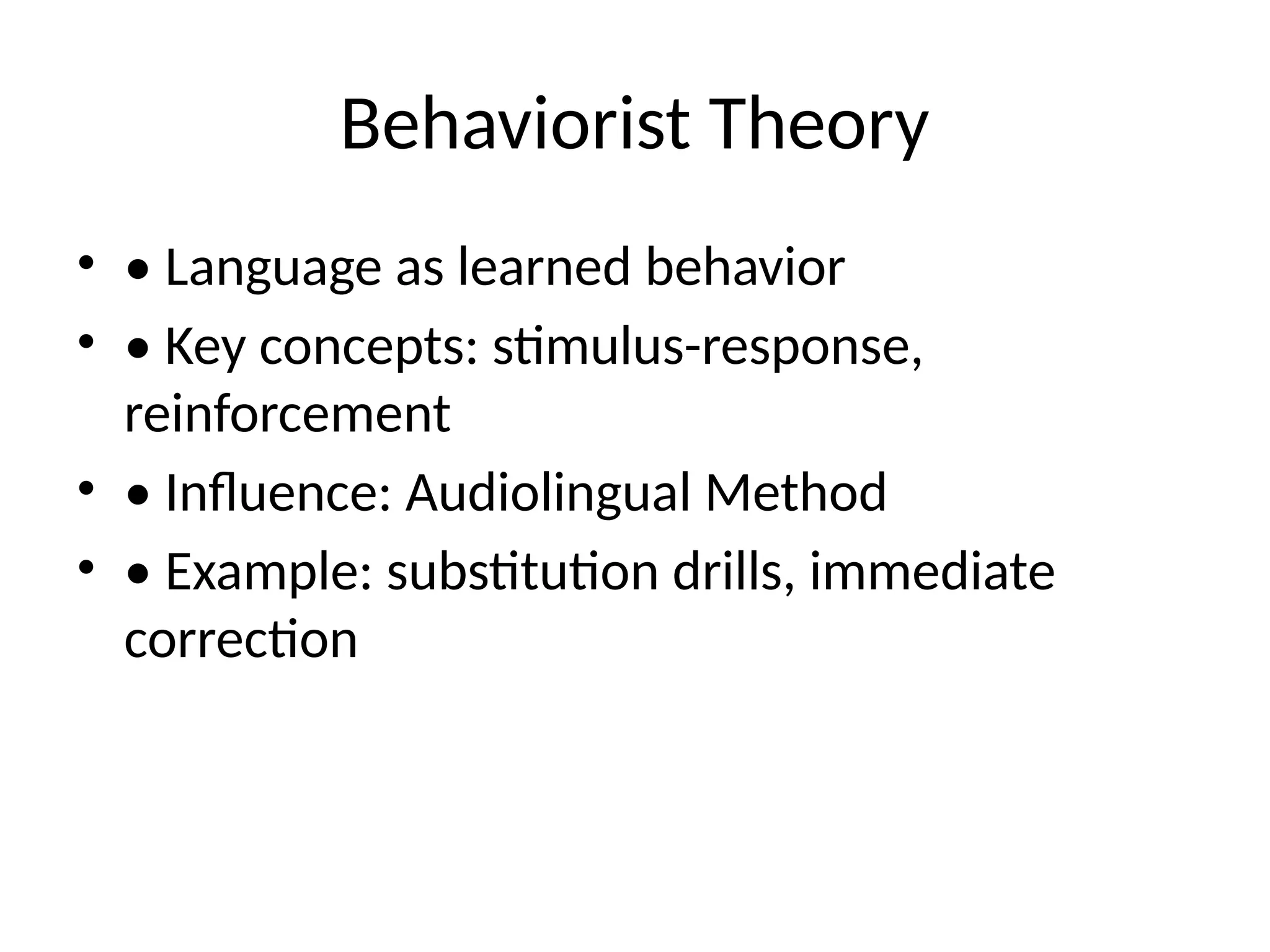
• •Behaviorist: useful for drills and practice
• • Cognitive: explains internal processing
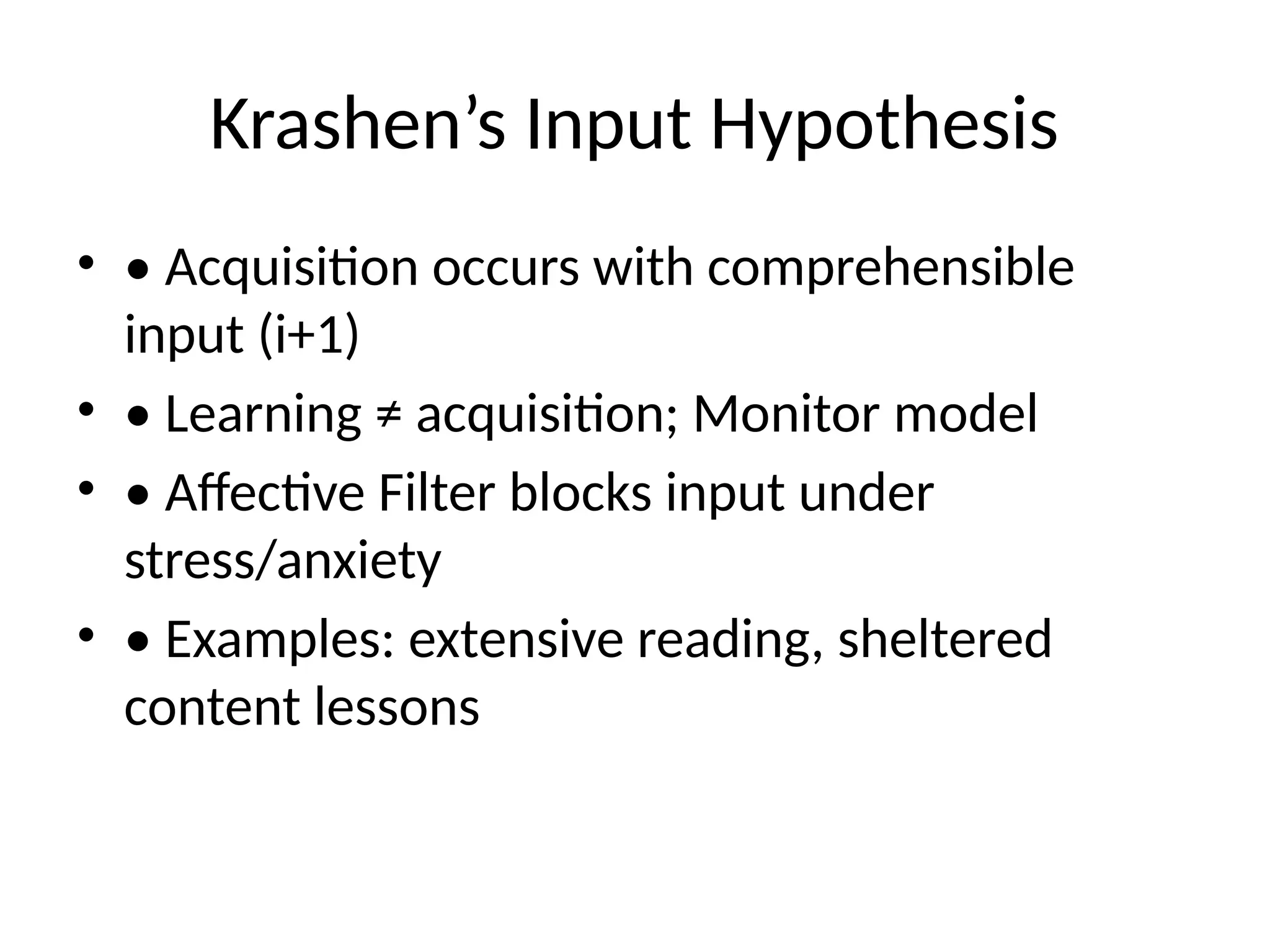
• • Krashen: emphasizes comprehensible input
• • Sociocultural: highlights interaction
• • Integrated approach = most effective
8.
Conclusion
• • Nosingle theory explains everything
• • Input, cognition, practice, and interaction all
matter
• • Teachers should combine insights for
effective instruction
Editor's Notes
#2 Teacher Prompt: Begin by asking students: 'How do you think people learn a new language? Through memorization, practice, or social interaction?'
#3 Speaker Notes: Explain Skinner’s view of language as verbal behavior. Ask students: 'Have you ever memorized phrases through repetition? Did it help you?'
#4 Speaker Notes: Highlight that errors like 'mouses' show learners are applying rules. Teacher Prompt: 'Can you think of an error you made in English that actually shows learning?'
#5 Speaker Notes: Stress importance of comprehensible input. Teacher Prompt: 'What makes language input easy or difficult for you to understand?'
#6 Speaker Notes: Explain how interaction promotes learning. Teacher Prompt: 'Have you learned something better when a peer explained it to you?'
#7 Speaker Notes: Summarize by showing complementarity. Teacher Prompt: 'Which approach do you think is most important in learning English today?'
#8 Speaker Notes: Reinforce that a holistic, integrated approach best supports learners. End by inviting students’ reflections on their own learning experiences.