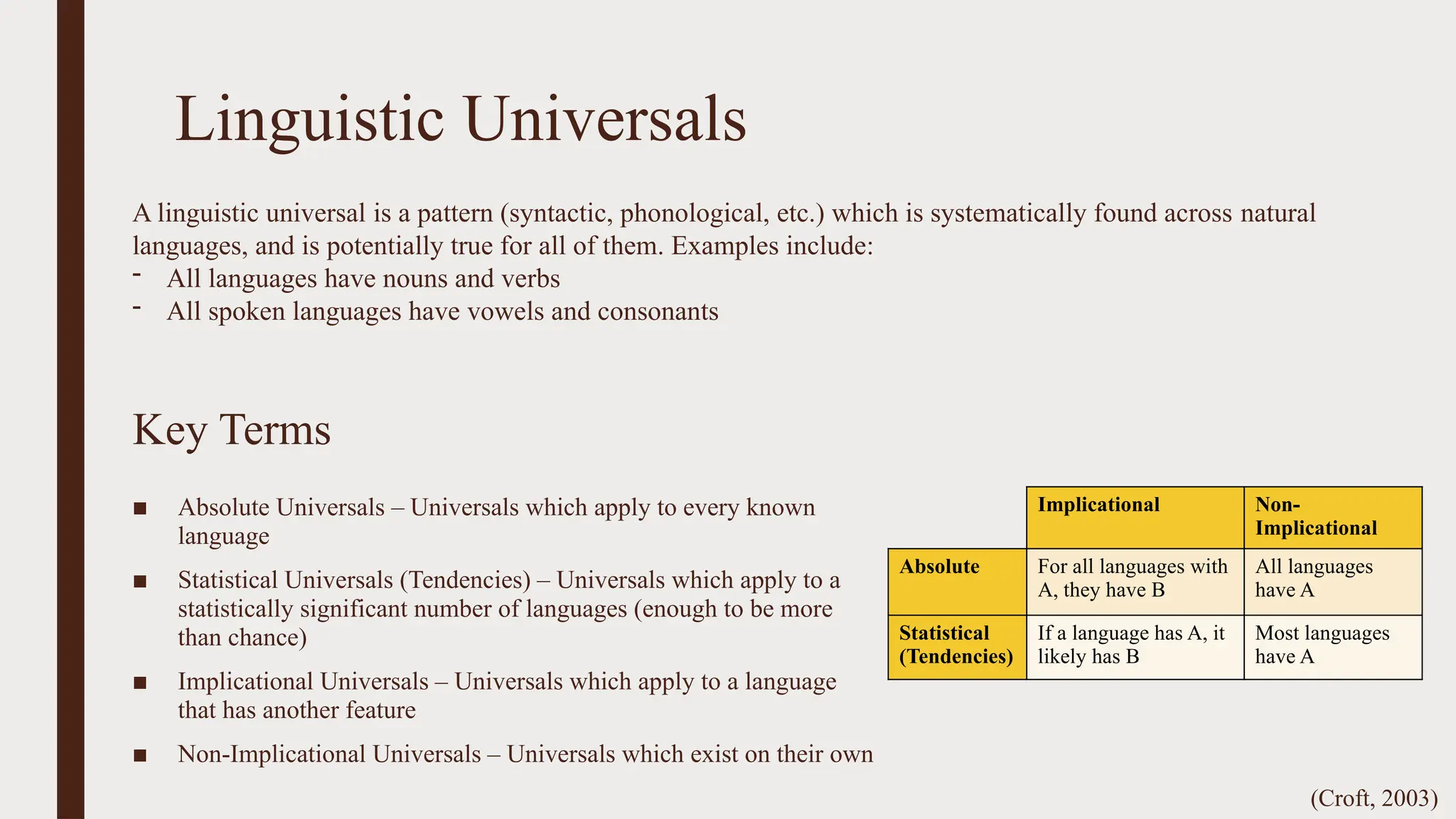
Linguistic Universals
Key Terms
■Absolute Universals – Universals which apply to every known
language
■ Statistical Universals (Tendencies) – Universals which apply to a
statistically significant number of languages (enough to be more
than chance)
■ Implicational Universals – Universals which apply to a language
that has another feature
■ Non-Implicational Universals – Universals which exist on their own
A linguistic universal is a pattern (syntactic, phonological, etc.) which is systematically found across natural
languages, and is potentially true for all of them. Examples include:
- All languages have nouns and verbs
- All spoken languages have vowels and consonants
(Croft, 2003)
Implicational Non-
Implicational
Absolute For all languages with
A, they have B
All languages
have A
Statistical
(Tendencies)
If a language has A, it
likely has B
Most languages
have A
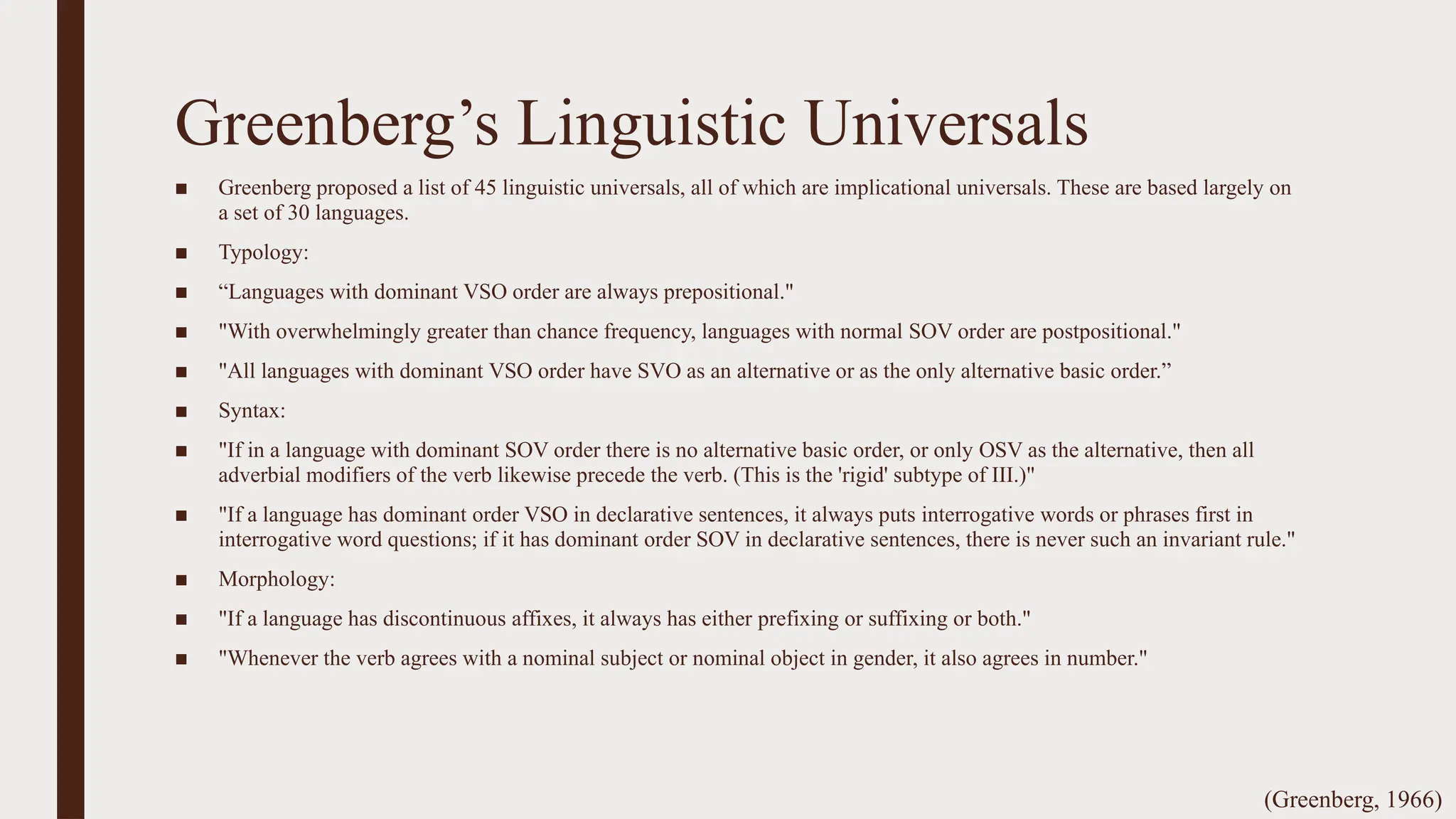
Greenberg’s Linguistic Universals
■Greenberg proposed a list of 45 linguistic universals, all of which are implicational universals. These are based largely on
a set of 30 languages.
■ Typology:
■ “Languages with dominant VSO order are always prepositional."
■ "With overwhelmingly greater than chance frequency, languages with normal SOV order are postpositional."
■ "All languages with dominant VSO order have SVO as an alternative or as the only alternative basic order.”
■ Syntax:
■ "If in a language with dominant SOV order there is no alternative basic order, or only OSV as the alternative, then all
adverbial modifiers of the verb likewise precede the verb. (This is the 'rigid' subtype of III.)"
■ "If a language has dominant order VSO in declarative sentences, it always puts interrogative words or phrases first in
interrogative word questions; if it has dominant order SOV in declarative sentences, there is never such an invariant rule."
■ Morphology:
■ "If a language has discontinuous affixes, it always has either prefixing or suffixing or both."
■ "Whenever the verb agrees with a nominal subject or nominal object in gender, it also agrees in number."
(Greenberg, 1966)
5.
Absolute Non-Implicational Universals
■Absolute universals are rare, especially non-implicational, as they are features shared across all
languages.
■ All languages have nouns and verbs.
■ All languages have subjects and objects.
■ All languages have consonants and vowels.
■ All languages can form questions.
■ It is very difficult to verify Absolute non-implicational universals as it requires verifying that they
hold true for every language.
■ This differs to Absolute Implicational universals, which are still difficult to verify but have a
smaller pool of languages which must be studied.
6.
Absolute Implicational Universals
(Greenberg,1966 pp. 73–113 )
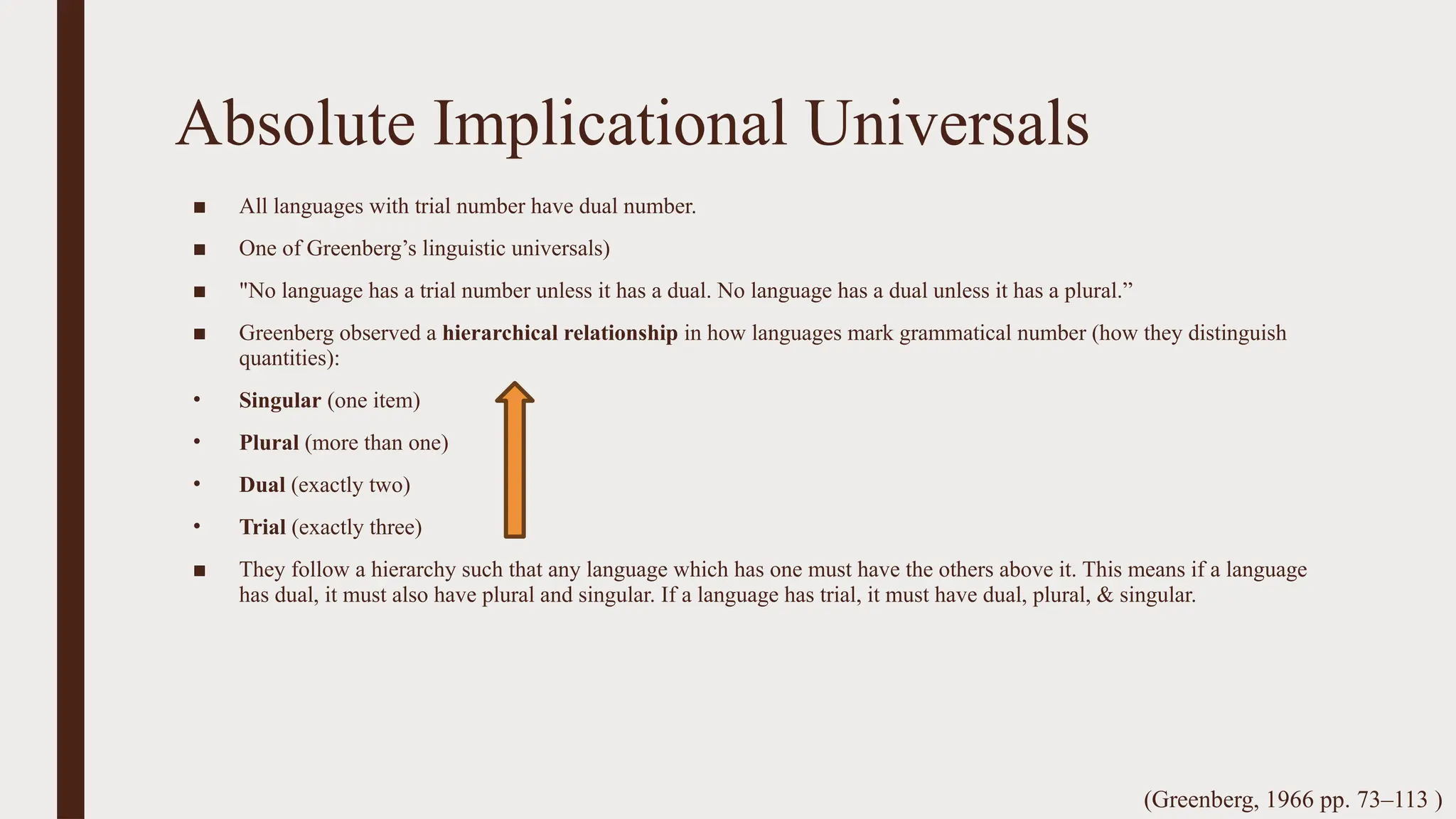
■ All languages with trial number have dual number.
■ One of Greenberg’s linguistic universals)
■ "No language has a trial number unless it has a dual. No language has a dual unless it has a plural.”
■ Greenberg observed a hierarchical relationship in how languages mark grammatical number (how they distinguish
quantities):
• Singular (one item)
• Plural (more than one)
• Dual (exactly two)
• Trial (exactly three)
■ They follow a hierarchy such that any language which has one must have the others above it. This means if a language
has dual, it must also have plural and singular. If a language has trial, it must have dual, plural, & singular.
7.
Statistical Non-Implicational Universals
(Berlin& Kay, 1969)
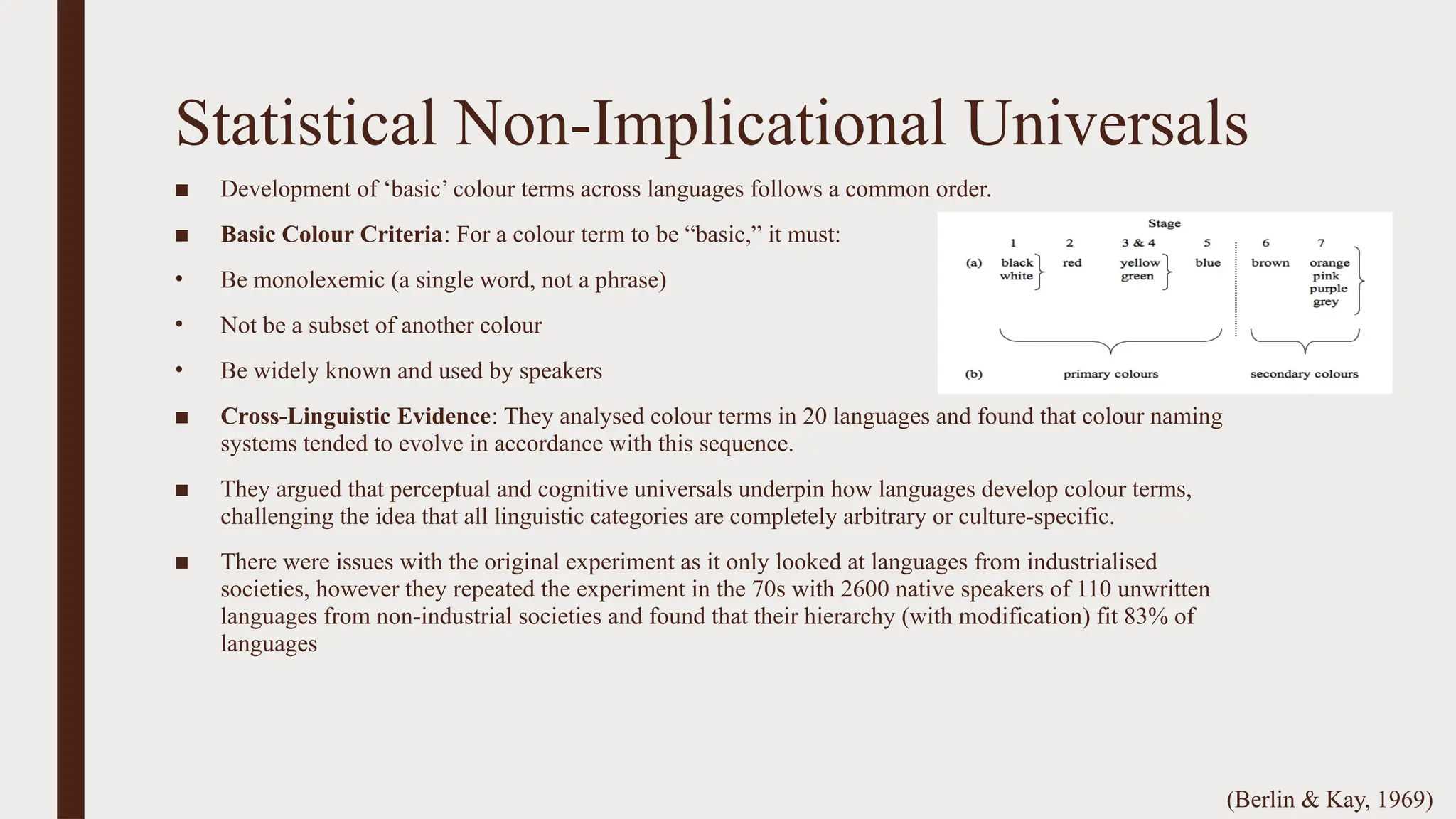
■ Development of ‘basic’ colour terms across languages follows a common order.
■ Basic Colour Criteria: For a colour term to be “basic,” it must:
• Be monolexemic (a single word, not a phrase)
• Not be a subset of another colour
• Be widely known and used by speakers
■ Cross-Linguistic Evidence: They analysed colour terms in 20 languages and found that colour naming
systems tended to evolve in accordance with this sequence.
■ They argued that perceptual and cognitive universals underpin how languages develop colour terms,
challenging the idea that all linguistic categories are completely arbitrary or culture-specific.
■ There were issues with the original experiment as it only looked at languages from industrialised
societies, however they repeated the experiment in the 70s with 2600 native speakers of 110 unwritten
languages from non-industrial societies and found that their hierarchy (with modification) fit 83% of
languages
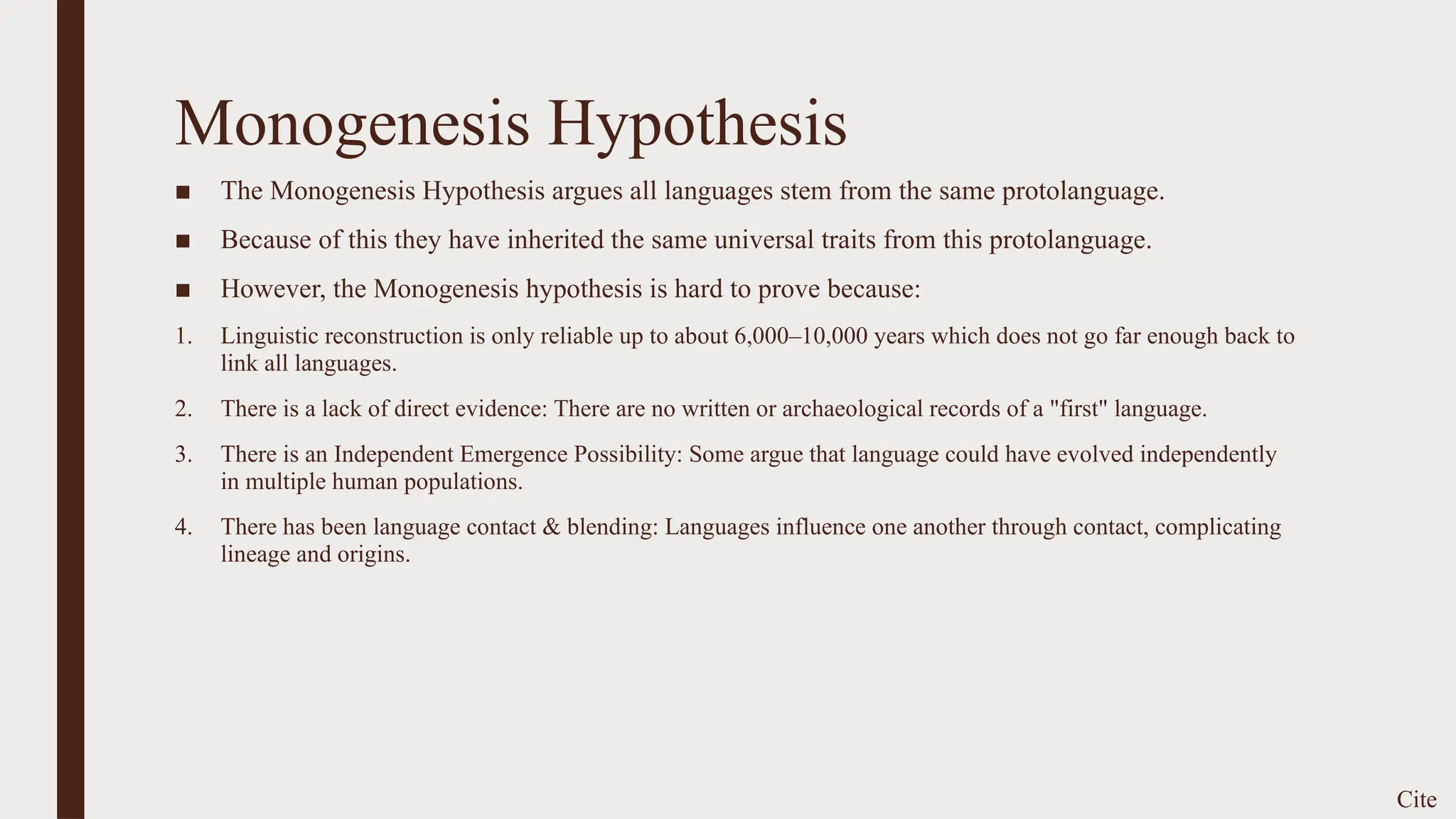
Monogenesis Hypothesis
■ TheMonogenesis Hypothesis argues all languages stem from the same protolanguage.
■ Because of this they have inherited the same universal traits from this protolanguage.
■ However, the Monogenesis hypothesis is hard to prove because:
1. Linguistic reconstruction is only reliable up to about 6,000–10,000 years which does not go far enough back to
link all languages.
2. There is a lack of direct evidence: There are no written or archaeological records of a "first" language.
3. There is an Independent Emergence Possibility: Some argue that language could have evolved independently
in multiple human populations.
4. There has been language contact & blending: Languages influence one another through contact, complicating
lineage and origins.
Cite
10.
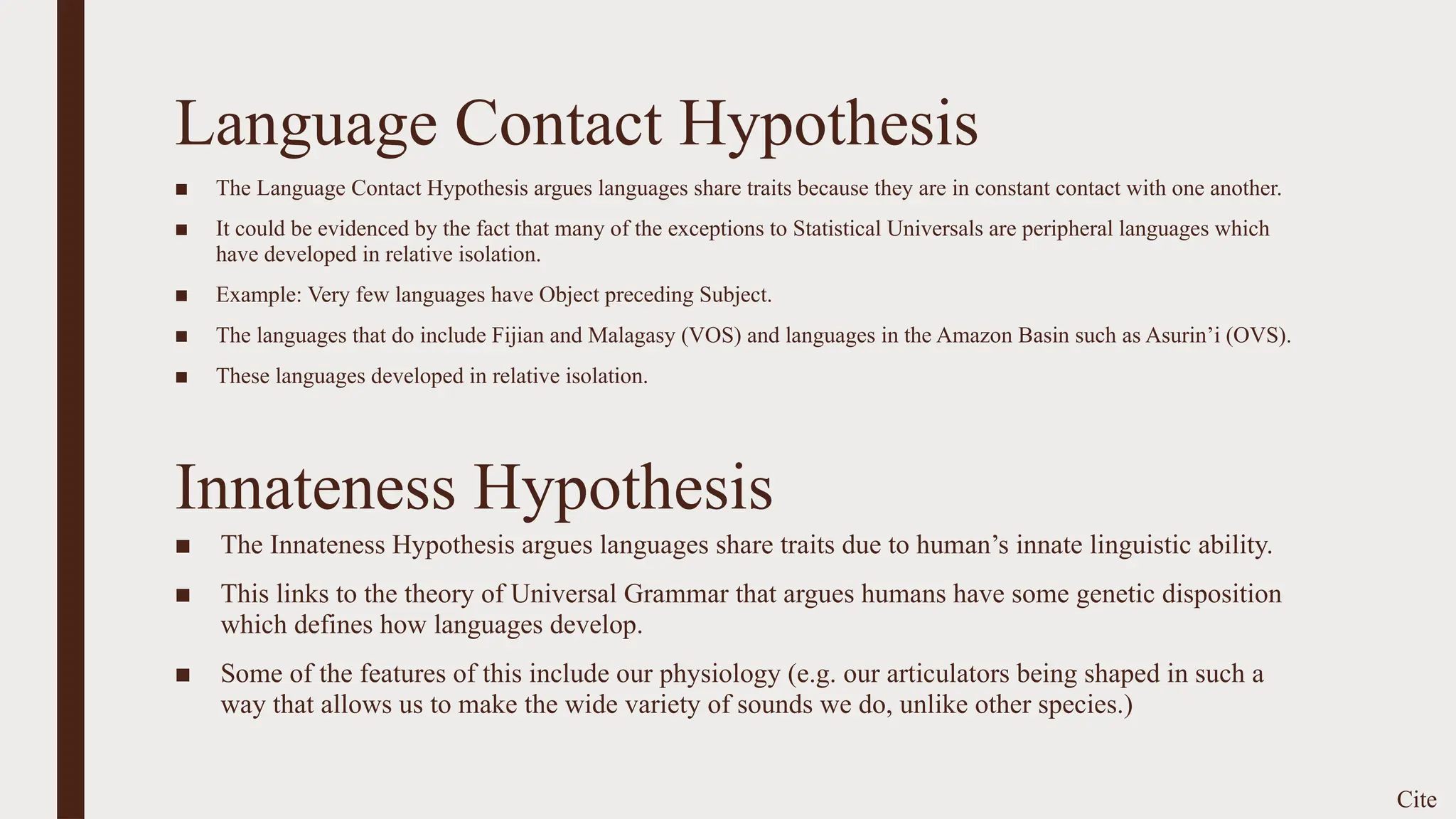
Language Contact Hypothesis
■The Language Contact Hypothesis argues languages share traits because they are in constant contact with one another.
■ It could be evidenced by the fact that many of the exceptions to Statistical Universals are peripheral languages which
have developed in relative isolation.
■ Example: Very few languages have Object preceding Subject.
■ The languages that do include Fijian and Malagasy (VOS) and languages in the Amazon Basin such as Asurin’i (OVS).
■ These languages developed in relative isolation.
Cite
Innateness Hypothesis
■ The Innateness Hypothesis argues languages share traits due to human’s innate linguistic ability.
■ This links to the theory of Universal Grammar that argues humans have some genetic disposition
which defines how languages develop.
■ Some of the features of this include our physiology (e.g. our articulators being shaped in such a
way that allows us to make the wide variety of sounds we do, unlike other species.)
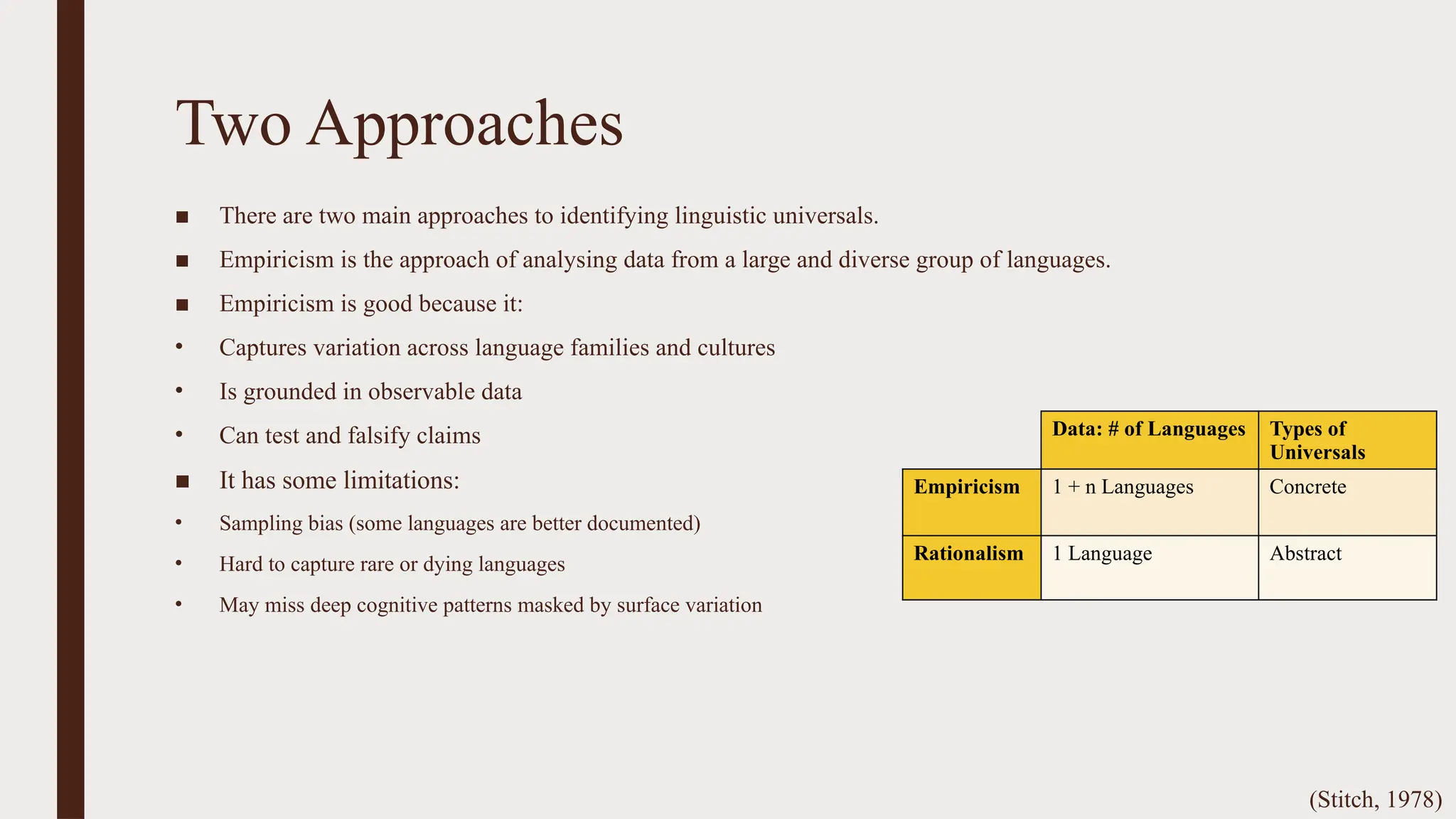
Two Approaches
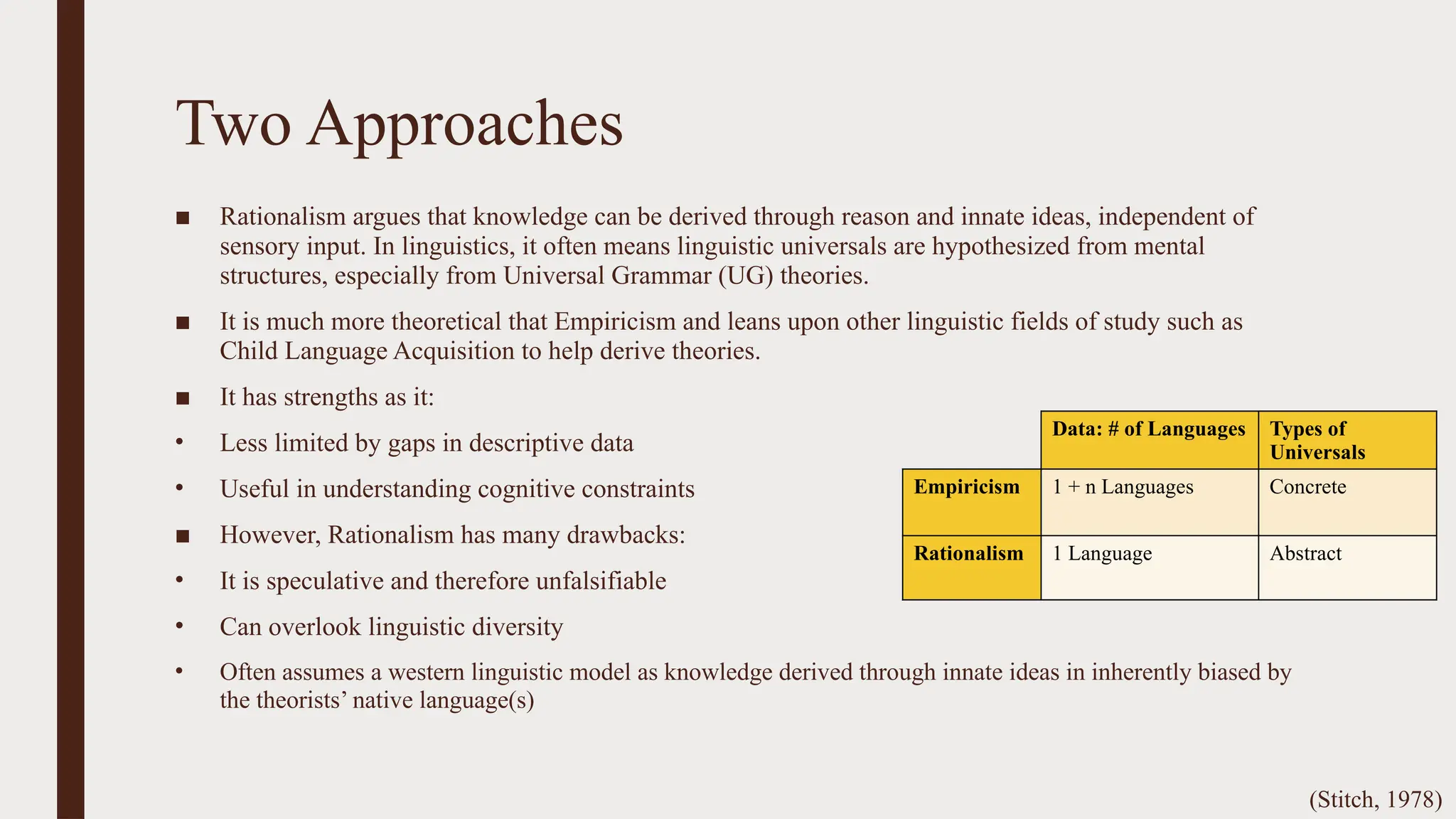
■ Thereare two main approaches to identifying linguistic universals.
■ Empiricism is the approach of analysing data from a large and diverse group of languages.
■ Empiricism is good because it:
• Captures variation across language families and cultures
• Is grounded in observable data
• Can test and falsify claims
■ It has some limitations:
• Sampling bias (some languages are better documented)
• Hard to capture rare or dying languages
• May miss deep cognitive patterns masked by surface variation
(Stitch, 1978)
Data: # of Languages Types of
Universals
Empiricism 1 + n Languages Concrete
Rationalism 1 Language Abstract
13.
Two Approaches
■ Rationalismargues that knowledge can be derived through reason and innate ideas, independent of
sensory input. In linguistics, it often means linguistic universals are hypothesized from mental
structures, especially from Universal Grammar (UG) theories.
■ It is much more theoretical that Empiricism and leans upon other linguistic fields of study such as
Child Language Acquisition to help derive theories.
■ It has strengths as it:
• Less limited by gaps in descriptive data
• Useful in understanding cognitive constraints
■ However, Rationalism has many drawbacks:
• It is speculative and therefore unfalsifiable
• Can overlook linguistic diversity
• Often assumes a western linguistic model as knowledge derived through innate ideas in inherently biased by
the theorists’ native language(s)
Data: # of Languages Types of
Universals
Empiricism 1 + n Languages Concrete
Rationalism 1 Language Abstract
(Stitch, 1978)
14.
Conclusion
Linguistic universals revealshared patterns across all human languages, suggesting that language reflects universal
aspects of human cognition. The theory of Universal Grammar builds on this idea, proposing that humans are born with
innate linguistic knowledge. Together, these concepts help explain both the diversity and common structure of
languages.
Bibliography
■ Roberts, I.G. (ed.) (2017) The Oxford handbook of universal grammar. Oxford: Oxford University Press.
■ Croft, W. (2003) Typology and universals. Second edition. Cambridge: Cambridge University Press.
■ Haspelmath, M. & Newmeyer, F. J. (2010) Comparative concepts and descriptive categories in crosslinguistic studies. Author’s reply. Language (Baltimore). 86
(3), 663–699.
■ Evans, N. & Levinson, S. C. (2009) The myth of language universals: Language diversity and its importance for cognitive science. The Behavioral and brain
sciences. [Online] 32 (5), 429–448.
■ Everett, Daniel (2012). Language the cultural tool. New York, NY: Pantheon Books.
■ Pitchford, N. and Mullen, K. (2006). THE DEVELOPMENTAL ACQUISITION OF BASIC COLOUR TERMS. [online] Available at:
https://www.mvr.mcgill.ca/Kathy/PDF-05-09/Pitchford-Mullen-2006.pdf.
■
Greenberg, Joseph H. (1966). "Some Universals of Grammar with Particular Reference to the Order of Meaningful Elements". In Greenberg, Joseph
H. (ed.). Universals of Language (2nd ed.). Cambridge, MA: M.I.T Press.
■ Stich, S.P. (1978). Empiricism, Innateness, and Linguistic Universals. Philosophical Studies: An International Journal for Philosophy in the
Analytic Tradition, [online] 33(3), pp.273–286. Available at: https://www.jstor.org/stable/4319210.
![Bibliography
■ Roberts, I. G. (ed.) (2017) The Oxford handbook of universal grammar. Oxford: Oxford University Press.
■ Croft, W. (2003) Typology and universals. Second edition. Cambridge: Cambridge University Press.
■ Haspelmath, M. & Newmeyer, F. J. (2010) Comparative concepts and descriptive categories in crosslinguistic studies. Author’s reply. Language (Baltimore). 86
(3), 663–699.
■ Evans, N. & Levinson, S. C. (2009) The myth of language universals: Language diversity and its importance for cognitive science. The Behavioral and brain
sciences. [Online] 32 (5), 429–448.
■ Everett, Daniel (2012). Language the cultural tool. New York, NY: Pantheon Books.
■ Pitchford, N. and Mullen, K. (2006). THE DEVELOPMENTAL ACQUISITION OF BASIC COLOUR TERMS. [online] Available at:
https://www.mvr.mcgill.ca/Kathy/PDF-05-09/Pitchford-Mullen-2006.pdf.
■
Greenberg, Joseph H. (1966). "Some Universals of Grammar with Particular Reference to the Order of Meaningful Elements". In Greenberg, Joseph
H. (ed.). Universals of Language (2nd ed.). Cambridge, MA: M.I.T Press.
■ Stich, S.P. (1978). Empiricism, Innateness, and Linguistic Universals. Philosophical Studies: An International Journal for Philosophy in the
Analytic Tradition, [online] 33(3), pp.273–286. Available at: https://www.jstor.org/stable/4319210.](https://image.slidesharecdn.com/linguisticuniversals-250526142413-e377d79e/75/Are-there-Linguistic-Universals-How-can-they-be-identified-16-2048.jpg)


![OTRO1]](https://cdn.slidesharecdn.com/ss_thumbnails/powerpointunit11corregidoclara20071-111229112340-phpapp01-thumbnail.jpg?width=640&height=640&fit=bounds)


