
THE SEVEN Cs—
21ST CENTURY
LIFELONG SKILLS
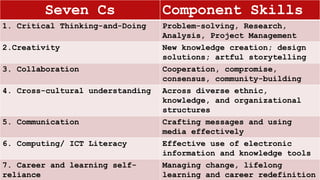
Seven Cs Component Skills
1. Critical Thinking-and-Doing Problem-solving, Research,
Analysis, Project Management
2.Creativity New knowledge creation; design
solutions; artful storytelling
3. Collaboration Cooperation, compromise,
consensus, community-building
4. Cross-cultural understanding Across diverse ethnic,
knowledge, and organizational
structures
5. Communication Crafting messages and using
media effectively
6. Computing/ ICT Literacy Effective use of electronic
information and knowledge tools
7. Career and learning self-
reliance
Managing change, lifelong
learning and career redefinition
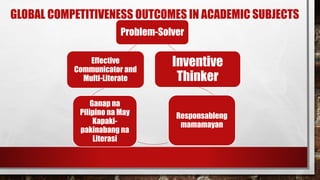
GLOBAL COMPETITIVENESS OUTCOMES IN ACADEMIC SUBJECTS
Problem-Solver
Inventive
Thinker
Responsableng
mamamayan
Ganap na
Pilipino na May
Kapaki-
pakinabang na
Literasi
Effective
Communicator and
Multi-Literate
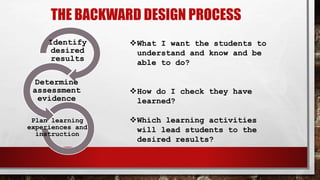
THE BACKWARD DESIGN PROCESS
Identify
desired
results
Determine
assessment
evidence
Plan learning
experiences and
instruction
What I want the students to
understand and know and be
able to do?
How do I check they have
learned?
Which learning activities
will lead students to the
desired results?
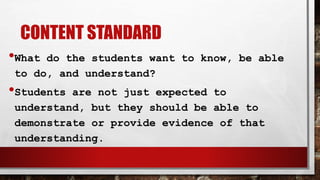
CONTENT STANDARD
•What do the students want to know, be able
to do, and understand?
•Students are not just expected to
understand, but they should be able to
demonstrate or provide evidence of that
understanding.
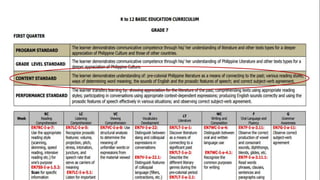
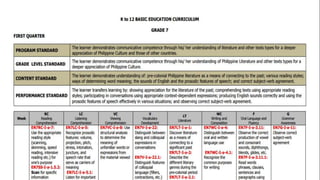
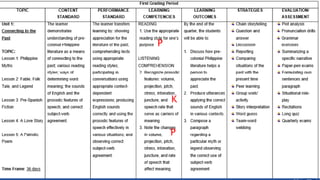
The learner demonstrates understanding
of pre-colonial Philippine literature as
a means of connecting to the past;
various reading styles; ways of
determining word meaning; the sounds of
English and the prosodic features of
speech; and correct subject-verb
agreement.
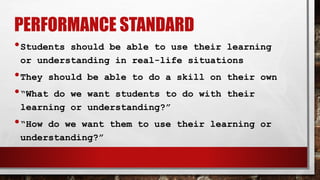
PERFORMANCE STANDARD
•Students should be able to use their learning
or understanding in real-life situations
•They should be able to do a skill on their own
•“What do we want students to do with their
learning or understanding?”
•“How do we want them to use their learning or
understanding?”
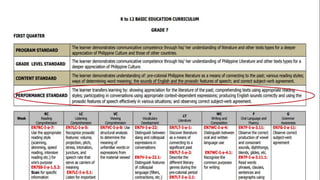
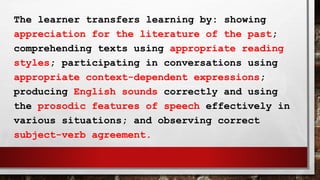
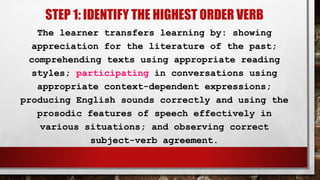
The learner transfers learning by: showing
appreciation for the literature of the past;
comprehending texts using appropriate reading
styles; participating in conversations using
appropriate context-dependent expressions;
producing English sounds correctly and using
the prosodic features of speech effectively in
various situations; and observing correct
subject-verb agreement.
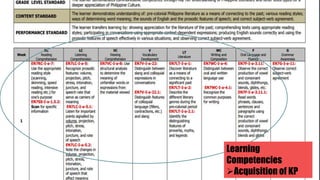
LEARNING COMPETENCIES
•ACQUISITION: Knowledge,
Process, Skills
Learning
Competencies
Acquisition of KP
P
K
P
LEVELS OF ASSESSMENT
•Knowledge – the substantive content of the curriculum,
the facts and information that the student acquires.
•Process – skills or cognitive that the student
performs on facts and information for the purpose of
constructing meanings or understandings.
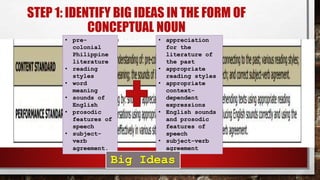
STEP 1: IDENTIFY BIG IDEAS IN THE FORM OF
CONCEPTUAL NOUN
• appreciation
for the
literature of
the past
• appropriate
reading styles
• appropriate
context-
dependent
expressions
• English sounds
and prosodic
features of
speech
• subject-verb
agreement
• pre-
colonial
Philippine
literature
• reading
styles
• word
meaning
• sounds of
English
• prosodic
features of
speech
• subject-
verb
agreement.
Big Ideas
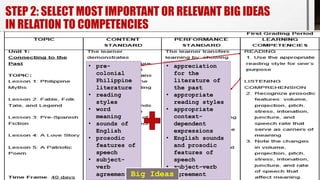
STEP 2: SELECT MOST IMPORTANT OR RELEVANT BIG IDEAS
IN RELATION TO COMPETENCIES
• pre-
colonial
Philippine
literature
• reading
styles
• word
meaning
• sounds of
English
• prosodic
features of
speech
• subject-
verb
agreement.
• appreciation
for the
literature of
the past
• appropriate
reading styles
• appropriate
context-
dependent
expressions
• English sounds
and prosodic
features of
speech
• subject-verb
agreementBig Ideas
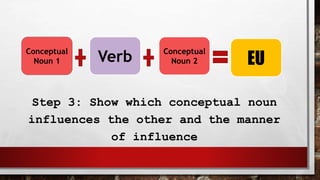
Step 3: Show which conceptual noun
influences the other and the manner
of influence
Conceptual
Noun 1 Verb Conceptual
Noun 2 EU
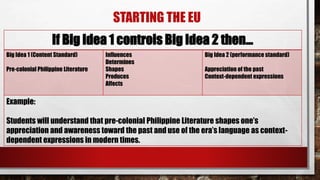
STARTING THE EU
If Big Idea 1 controls Big Idea 2 then…
Big Idea 1 (Content Standard)
Pre-colonial Philippine Literature
Influences
Determines
Shapes
Produces
Affects
Big Idea 2 (performance standard)
Appreciation of the past
Context-dependent expressions
Example:
Students will understand that pre-colonial Philippine Literature shapes one’s
appreciation and awareness toward the past and use of the era’s language as context-
dependent expressions in modern times.
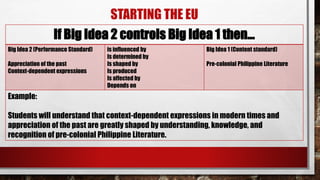
STARTING THE EU
If Big Idea 2 controls Big Idea 1 then…
Big Idea 2 (Performance Standard)
Appreciation of the past
Context-dependent expressions
is influenced by
Is determined by
Is shaped by
Is produced
Is affected by
Depends on
Big Idea 1 (Content standard)
Pre-colonial Philippine Literature
Example:
Students will understand that context-dependent expressions in modern times and
appreciation of the past are greatly shaped by understanding, knowledge, and
recognition of pre-colonial Philippine Literature.
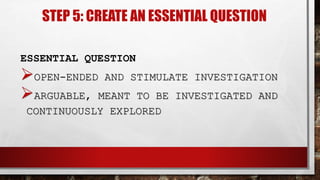
STEP 5: CREATE AN ESSENTIAL QUESTION
ESSENTIAL QUESTION
OPEN-ENDED AND STIMULATE INVESTIGATION
ARGUABLE, MEANT TO BE INVESTIGATED AND
CONTINUOUSLY EXPLORED
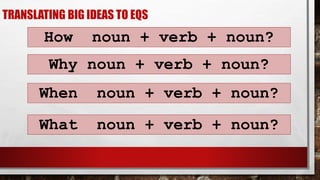
TRANSLATING BIG IDEAS TO EQS
How noun + verb + noun?
Why noun + verb + noun?
When noun + verb + noun?
What noun + verb + noun?
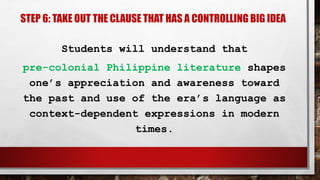
STEP 6: TAKE OUT THE CLAUSE THAT HAS A CONTROLLING BIG IDEA
Students will understand that
pre-colonial Philippine literature shapes
one’s appreciation and awareness toward
the past and use of the era’s language as
context-dependent expressions in modern
times.
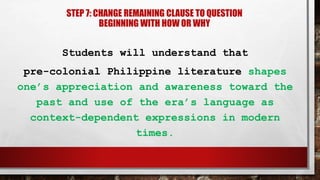
STEP 7: CHANGE REMAINING CLAUSE TO QUESTION
BEGINNING WITH HOW OR WHY
Students will understand that
pre-colonial Philippine literature shapes
one’s appreciation and awareness toward the
past and use of the era’s language as
context-dependent expressions in modern
times.
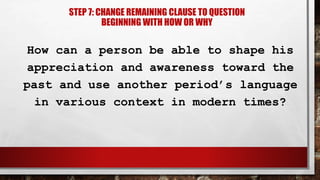
How can a person be able to shape his
appreciation and awareness toward the
past and use another period’s language
in various context in modern times?
STEP 7: CHANGE REMAINING CLAUSE TO QUESTION
BEGINNING WITH HOW OR WHY
STEP 1: IDENTIFY THE HIGHEST ORDER VERB
The learner transfers learning by: showing
appreciation for the literature of the past;
comprehending texts using appropriate reading
styles; participating in conversations using
appropriate context-dependent expressions;
producing English sounds correctly and using the
prosodic features of speech effectively in
various situations; and observing correct
subject-verb agreement.
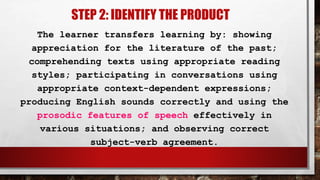
STEP 2: IDENTIFY THE PRODUCT
The learner transfers learning by: showing
appreciation for the literature of the past;
comprehending texts using appropriate reading
styles; participating in conversations using
appropriate context-dependent expressions;
producing English sounds correctly and using the
prosodic features of speech effectively in
various situations; and observing correct
subject-verb agreement.
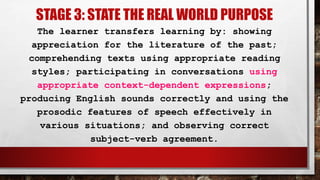
STAGE 3: STATE THE REAL WORLD PURPOSE
The learner transfers learning by: showing
appreciation for the literature of the past;
comprehending texts using appropriate reading
styles; participating in conversations using
appropriate context-dependent expressions;
producing English sounds correctly and using the
prosodic features of speech effectively in
various situations; and observing correct
subject-verb agreement.
STEP 4: COMBINE
Students, on their own and in the long
run will be able to participate and share
ideas employing the prosodic features of
speech properly to promote the use and
application of context-dependent
expressions in various situations.
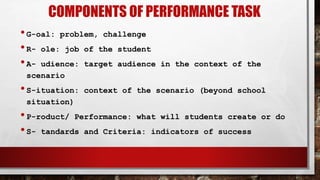
COMPONENTS OF PERFORMANCE TASK
•G-oal: problem, challenge
•R- ole: job of the student
•A- udience: target audience in the context of the
scenario
•S-ituation: context of the scenario (beyond school
situation)
•P-roduct/ Performance: what will students create or do
•S- tandards and Criteria: indicators of success
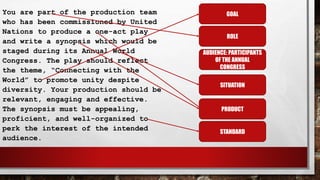
You are part of the production team
who has been commissioned by United
Nations to produce a one-act play
and write a synopsis which would be
staged during its Annual World
Congress. The play should reflect
the theme, “Connecting with the
World” to promote unity despite
diversity. Your production should be
relevant, engaging and effective.
The synopsis must be appealing,
proficient, and well-organized to
perk the interest of the intended
audience.
ROLE
GOAL
SITUATION
AUDIENCE: PARTICIPANTS
OF THE ANNUAL
CONGRESS
STANDARD
PRODUCT
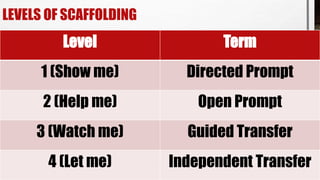
LEVELS OF SCAFFOLDING
Level Term
1 (Show me) Directed Prompt
2 (Help me) Open Prompt
3 (Watch me) Guided Transfer
4 (Let me) Independent Transfer
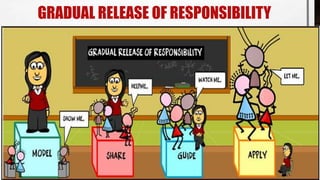
GRADUAL RELEASE OF RESPONSIBILITY
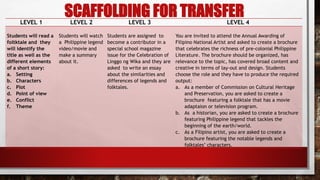
SCAFFOLDING FOR TRANSFERLEVEL 1 LEVEL 2 LEVEL 3 LEVEL 4
Students will read a
foltktale and they
will identify the
title as well as the
different elements
of a short story:
a. Setting
b. Characters
c. Plot
d. Point of view
e. Conflict
f. Theme
Students will watch
a Philippine legend
video/movie and
make a summary
about it.
Students are assigned to
become a contributor in a
special school magazine
issue for the Celebration of
Linggo ng Wika and they are
asked to write an essay
about the similarities and
differences of legends and
folktales.
You are invited to attend the Annual Awarding of
Filipino National Artist and asked to create a brochure
that celebrates the richness of pre-colonial Philippine
Literature. The brochure should be organized, has
relevance to the topic, has covered broad content and
creative in terms of lay-out and design. Students
choose the role and they have to produce the required
output:
a. As a member of Commission on Cultural Heritage
and Preservation, you are asked to create a
brochure featuring a folktale that has a movie
adaptaion or television program.
b. As a historian, you are asked to create a brochure
featuring Philippine legend that tackles the
beginning of the earth/world.
c. As a Filipino artist, you are asked to create a
brochure featuring the notable legends and
folktales’ characters.
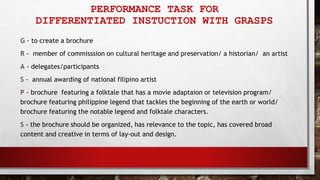
PERFORMANCE TASK FOR
DIFFERENTIATED INSTUCTION WITH GRASPS
G - to create a brochure
R - member of commisssion on cultural heritage and preservation/ a historian/ an artist
A - delegates/participants
S - annual awarding of national filipino artist
P - brochure featuring a folktale that has a movie adaptaion or television program/
brochure featuring philippine legend that tackles the beginning of the earth or world/
brochure featuring the notable legend and folktale characters.
S - the brochure should be organized, has relevance to the topic, has covered broad
content and creative in terms of lay-out and design.
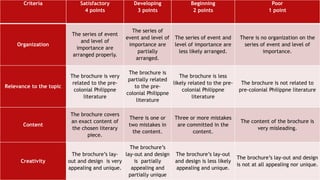
Criteria Satisfactory
4 points
Developing
3 points
Beginning
2 points
Poor
1 point
Organization
The series of event
and level of
importance are
arranged properly.
The series of
event and level of
importance are
partially
arranged.
The series of event and
level of importance are
less likely arranged.
There is no organization on the
series of event and level of
importance.
Relevance to the topic
The brochure is very
related to the pre-
colonial Philippne
literature
The brochure is
partially related
to the pre-
colonial Philippne
literature
The brochure is less
likely related to the pre-
colonial Philippne
literature
The brochure is not related to
pre-colonial Philippne literature
Content
The brochure covers
an exact content of
the chosen literary
piece.
There is one or
two mistakes in
the content.
Three or more mistakes
are committed in the
content.
The content of the brochure is
very misleading.
Creativity
The brochure’s lay-
out and design is very
appealing and unique.
The brochure’s
lay-out and design
is partially
appealing and
partially unique
The brochure’s lay-out
and design is less likely
appealing and unique.
The brochure’s lay-out and design
is not at all appealing nor unique.
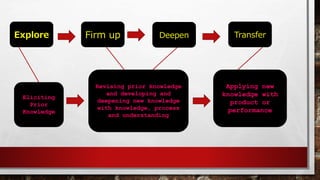
Explore Firm up Deepen Transfer
Eliciting
Prior
Knowledge
Revising prior knowledge
and developing and
deepening new knowledge
with knowledge, process
and understanding
Applying new
knowledge with
product or
performance
Junior High School INSET

Junior High School INSET

  • 1.
    THE SEVEN Cs— 21STCENTURY LIFELONG SKILLS
  • 2.
    Seven Cs ComponentSkills 1. Critical Thinking-and-Doing Problem-solving, Research, Analysis, Project Management 2.Creativity New knowledge creation; design solutions; artful storytelling 3. Collaboration Cooperation, compromise, consensus, community-building 4. Cross-cultural understanding Across diverse ethnic, knowledge, and organizational structures 5. Communication Crafting messages and using media effectively 6. Computing/ ICT Literacy Effective use of electronic information and knowledge tools 7. Career and learning self- reliance Managing change, lifelong learning and career redefinition
  • 3.
    GLOBAL COMPETITIVENESS OUTCOMESIN ACADEMIC SUBJECTS Problem-Solver Inventive Thinker Responsableng mamamayan Ganap na Pilipino na May Kapaki- pakinabang na Literasi Effective Communicator and Multi-Literate
  • 5.
    THE BACKWARD DESIGNPROCESS Identify desired results Determine assessment evidence Plan learning experiences and instruction What I want the students to understand and know and be able to do? How do I check they have learned? Which learning activities will lead students to the desired results?
  • 6.
    CONTENT STANDARD •What dothe students want to know, be able to do, and understand? •Students are not just expected to understand, but they should be able to demonstrate or provide evidence of that understanding.
  • 8.
    The learner demonstratesunderstanding of pre-colonial Philippine literature as a means of connecting to the past; various reading styles; ways of determining word meaning; the sounds of English and the prosodic features of speech; and correct subject-verb agreement.
  • 9.
    PERFORMANCE STANDARD •Students shouldbe able to use their learning or understanding in real-life situations •They should be able to do a skill on their own •“What do we want students to do with their learning or understanding?” •“How do we want them to use their learning or understanding?”
  • 11.
    The learner transferslearning by: showing appreciation for the literature of the past; comprehending texts using appropriate reading styles; participating in conversations using appropriate context-dependent expressions; producing English sounds correctly and using the prosodic features of speech effectively in various situations; and observing correct subject-verb agreement.
  • 12.
  • 13.
  • 16.
  • 17.
    LEVELS OF ASSESSMENT •Knowledge– the substantive content of the curriculum, the facts and information that the student acquires. •Process – skills or cognitive that the student performs on facts and information for the purpose of constructing meanings or understandings.
  • 19.
    STEP 1: IDENTIFYBIG IDEAS IN THE FORM OF CONCEPTUAL NOUN • appreciation for the literature of the past • appropriate reading styles • appropriate context- dependent expressions • English sounds and prosodic features of speech • subject-verb agreement • pre- colonial Philippine literature • reading styles • word meaning • sounds of English • prosodic features of speech • subject- verb agreement. Big Ideas
  • 20.
    STEP 2: SELECTMOST IMPORTANT OR RELEVANT BIG IDEAS IN RELATION TO COMPETENCIES • pre- colonial Philippine literature • reading styles • word meaning • sounds of English • prosodic features of speech • subject- verb agreement. • appreciation for the literature of the past • appropriate reading styles • appropriate context- dependent expressions • English sounds and prosodic features of speech • subject-verb agreementBig Ideas
  • 21.
    Step 3: Showwhich conceptual noun influences the other and the manner of influence Conceptual Noun 1 Verb Conceptual Noun 2 EU
  • 22.
    STARTING THE EU IfBig Idea 1 controls Big Idea 2 then… Big Idea 1 (Content Standard) Pre-colonial Philippine Literature Influences Determines Shapes Produces Affects Big Idea 2 (performance standard) Appreciation of the past Context-dependent expressions Example: Students will understand that pre-colonial Philippine Literature shapes one’s appreciation and awareness toward the past and use of the era’s language as context- dependent expressions in modern times.
  • 23.
    STARTING THE EU IfBig Idea 2 controls Big Idea 1 then… Big Idea 2 (Performance Standard) Appreciation of the past Context-dependent expressions is influenced by Is determined by Is shaped by Is produced Is affected by Depends on Big Idea 1 (Content standard) Pre-colonial Philippine Literature Example: Students will understand that context-dependent expressions in modern times and appreciation of the past are greatly shaped by understanding, knowledge, and recognition of pre-colonial Philippine Literature.
  • 24.
    STEP 5: CREATEAN ESSENTIAL QUESTION ESSENTIAL QUESTION OPEN-ENDED AND STIMULATE INVESTIGATION ARGUABLE, MEANT TO BE INVESTIGATED AND CONTINUOUSLY EXPLORED
  • 25.
    TRANSLATING BIG IDEASTO EQS How noun + verb + noun? Why noun + verb + noun? When noun + verb + noun? What noun + verb + noun?
  • 26.
    STEP 6: TAKEOUT THE CLAUSE THAT HAS A CONTROLLING BIG IDEA Students will understand that pre-colonial Philippine literature shapes one’s appreciation and awareness toward the past and use of the era’s language as context-dependent expressions in modern times.
  • 27.
    STEP 7: CHANGEREMAINING CLAUSE TO QUESTION BEGINNING WITH HOW OR WHY Students will understand that pre-colonial Philippine literature shapes one’s appreciation and awareness toward the past and use of the era’s language as context-dependent expressions in modern times.
  • 28.
    How can aperson be able to shape his appreciation and awareness toward the past and use another period’s language in various context in modern times? STEP 7: CHANGE REMAINING CLAUSE TO QUESTION BEGINNING WITH HOW OR WHY
  • 30.
    STEP 1: IDENTIFYTHE HIGHEST ORDER VERB The learner transfers learning by: showing appreciation for the literature of the past; comprehending texts using appropriate reading styles; participating in conversations using appropriate context-dependent expressions; producing English sounds correctly and using the prosodic features of speech effectively in various situations; and observing correct subject-verb agreement.
  • 31.
    STEP 2: IDENTIFYTHE PRODUCT The learner transfers learning by: showing appreciation for the literature of the past; comprehending texts using appropriate reading styles; participating in conversations using appropriate context-dependent expressions; producing English sounds correctly and using the prosodic features of speech effectively in various situations; and observing correct subject-verb agreement.
  • 32.
    STAGE 3: STATETHE REAL WORLD PURPOSE The learner transfers learning by: showing appreciation for the literature of the past; comprehending texts using appropriate reading styles; participating in conversations using appropriate context-dependent expressions; producing English sounds correctly and using the prosodic features of speech effectively in various situations; and observing correct subject-verb agreement.
  • 33.
    STEP 4: COMBINE Students,on their own and in the long run will be able to participate and share ideas employing the prosodic features of speech properly to promote the use and application of context-dependent expressions in various situations.
  • 35.
    COMPONENTS OF PERFORMANCETASK •G-oal: problem, challenge •R- ole: job of the student •A- udience: target audience in the context of the scenario •S-ituation: context of the scenario (beyond school situation) •P-roduct/ Performance: what will students create or do •S- tandards and Criteria: indicators of success
  • 36.
    You are partof the production team who has been commissioned by United Nations to produce a one-act play and write a synopsis which would be staged during its Annual World Congress. The play should reflect the theme, “Connecting with the World” to promote unity despite diversity. Your production should be relevant, engaging and effective. The synopsis must be appealing, proficient, and well-organized to perk the interest of the intended audience. ROLE GOAL SITUATION AUDIENCE: PARTICIPANTS OF THE ANNUAL CONGRESS STANDARD PRODUCT
  • 38.
    LEVELS OF SCAFFOLDING LevelTerm 1 (Show me) Directed Prompt 2 (Help me) Open Prompt 3 (Watch me) Guided Transfer 4 (Let me) Independent Transfer
  • 39.
    GRADUAL RELEASE OFRESPONSIBILITY
  • 40.
    SCAFFOLDING FOR TRANSFERLEVEL1 LEVEL 2 LEVEL 3 LEVEL 4 Students will read a foltktale and they will identify the title as well as the different elements of a short story: a. Setting b. Characters c. Plot d. Point of view e. Conflict f. Theme Students will watch a Philippine legend video/movie and make a summary about it. Students are assigned to become a contributor in a special school magazine issue for the Celebration of Linggo ng Wika and they are asked to write an essay about the similarities and differences of legends and folktales. You are invited to attend the Annual Awarding of Filipino National Artist and asked to create a brochure that celebrates the richness of pre-colonial Philippine Literature. The brochure should be organized, has relevance to the topic, has covered broad content and creative in terms of lay-out and design. Students choose the role and they have to produce the required output: a. As a member of Commission on Cultural Heritage and Preservation, you are asked to create a brochure featuring a folktale that has a movie adaptaion or television program. b. As a historian, you are asked to create a brochure featuring Philippine legend that tackles the beginning of the earth/world. c. As a Filipino artist, you are asked to create a brochure featuring the notable legends and folktales’ characters.
  • 41.
    PERFORMANCE TASK FOR DIFFERENTIATEDINSTUCTION WITH GRASPS G - to create a brochure R - member of commisssion on cultural heritage and preservation/ a historian/ an artist A - delegates/participants S - annual awarding of national filipino artist P - brochure featuring a folktale that has a movie adaptaion or television program/ brochure featuring philippine legend that tackles the beginning of the earth or world/ brochure featuring the notable legend and folktale characters. S - the brochure should be organized, has relevance to the topic, has covered broad content and creative in terms of lay-out and design.
  • 42.
    Criteria Satisfactory 4 points Developing 3points Beginning 2 points Poor 1 point Organization The series of event and level of importance are arranged properly. The series of event and level of importance are partially arranged. The series of event and level of importance are less likely arranged. There is no organization on the series of event and level of importance. Relevance to the topic The brochure is very related to the pre- colonial Philippne literature The brochure is partially related to the pre- colonial Philippne literature The brochure is less likely related to the pre- colonial Philippne literature The brochure is not related to pre-colonial Philippne literature Content The brochure covers an exact content of the chosen literary piece. There is one or two mistakes in the content. Three or more mistakes are committed in the content. The content of the brochure is very misleading. Creativity The brochure’s lay- out and design is very appealing and unique. The brochure’s lay-out and design is partially appealing and partially unique The brochure’s lay-out and design is less likely appealing and unique. The brochure’s lay-out and design is not at all appealing nor unique.
  • 44.
    Explore Firm upDeepen Transfer Eliciting Prior Knowledge Revising prior knowledge and developing and deepening new knowledge with knowledge, process and understanding Applying new knowledge with product or performance