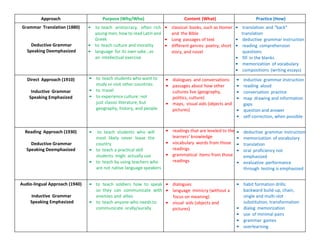
Approach Purpose (Why/Who)Content (What) Practice (How)
Grammar Translation (1880)
Deductive Grammar
Speaking Deemphasized
• to teach aristocracy, often rich
young men, how to read Latin and
Greek
• to teach culture and morality
• language for its own sake…as
an intellectual exercise
• classical books, such as Homer
and the Bible
• Long passages of text
• different genres: poetry, short
story, and novel
• translation and “back”
translation
• deductive grammar instruction
• reading comprehension
questions
• fill in the blanks
• memorization of vocabulary
• compositions (writing essays)
Direct Approach (1910)
Inductive Grammar
Speaking Emphasized
• to teach students who want to
study or visit other countries
• to travel
• to experience culture: not
just classic literature, but
geography, history, and people
• dialogues and conversations
• passages about how other
cultures live (geography,
politics, culture)
• maps, visual aids (objects and
pictures)
• inductive grammar instruction
• reading aloud
• conversation practice
• map drawing and information
gaps
• question and answer
• self-correction, when possible
Reading Approach (1930)
Deductive Grammar
Speaking Deemphasized
• to teach students who will
most likely never leave the
country
• to teach a practical skill
students might actually use
• to teach by using teachers who
are not native language speakers
• readings that are leveled to the
learners’ knowledge
• vocabulary words from those
readings
• grammatical items from those
readings
• deductive grammar instruction
• memorization of vocabulary
• translation
• oral proficiency not
emphasized
• evaluative performance
through testing is emphasized
Audio-lingual Approach (1940)
Inductive Grammar
Speaking Emphasized
• to teach soldiers how to speak
so they can communicate with
enemies and allies
• to teach anyone who needs to
communicate orally/aurally
• dialogues
• language mimicry (without a
focus on meaning)
• visual aids (objects and
pictures)
• habit formation drills:
backward build-up, chain,
single and multi-slot
substitution, transformation
• dialog memorization
• use of minimal pairs
• grammar games
• overlearning
2.
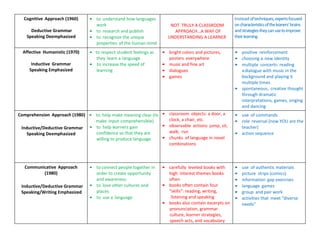
Cognitive Approach (1960)
DeductiveGrammar
Speaking Deemphasized
• to understand how languages
work
• to research and publish
• to recognize the unique
properties of the human mind
NOT TRULY A CLASSROOM
APPROACH…A WAY OF
UNDERSTANDING A LEARNER
Instead oftechniques,expertsfocused
oncharacteristicsoftheleaners’brains
andstrategiestheycanusetoimprove
theirlearning.
Affective Humanistic (1970)
Inductive Grammar
Speaking Emphasized
• to respect student feelings as
they learn a language
• ‐to increase the speed of
learning
• bright colors and pictures,
posters everywhere
• music and fine art
• dialogues
• games
• positive reinforcement
• choosing a new identity
• multiple concerts: reading
adialogue with music in the
background and playing it
multiple times
• spontaneous, creative thought
through dramatic
interpretations, games, singing
and dancing
singing and dancing
Comprehension Approach (1980)
Inductive/Deductive Grammar
Speaking Deemphasized
• to help make meaning clear (to
make input comprehensible)
• to help learners gain
confidence so that they are
willing to produce language
• classroom objects: a door, a
clock, a chair, etc.
• observable actions: jump, sit,
walk, run
• chunks of language in novel
combinations
• use of commands
• role reversal (now YOU are the
teacher)
• action sequence
Communicative Approach
(1980)
Inductive/Deductive Grammar
Speaking/Writing Emphasized
• to connect people together in
order to create opportunity
and awareness.
• to love other cultures and
places
• to use a language
• carefully leveled books with
high interest themes books
often
• books often contain four
“skills”: reading, writing,
listening and speaking
• books also contain excerpts on
pronunciation, grammar
culture, learner strategies,
speech acts, and vocabulary
learner strategies, speech acts, and
vocabulary
• use of authentic materials
• picture strips (comics)
• information gap exercises
• language games
• group and pair work
• activities that meet “diverse
needs”