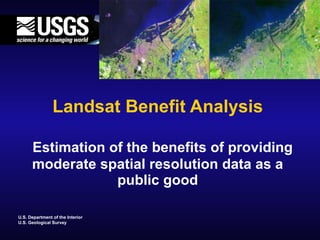
Landsat Benefit Analysis   Estimation of the benefits of providing moderate spatial resolution data as a public good
The need for an empirical analysis: “ There is a growing awareness across governments and communities of practitioners that much more attention needs to be paid to assessing the social and economic impacts of spatial data infrastructures (SDIs) …The few studies available … provide useful guidance on the range of methods available but are all characterised by a large number of assumptions the validity of which has yet to be tested. This is because they are by and large ex-ante studies undertaken to justify political and financial support, and we have yet to see enough studies of SDIs in practice able to assess the extent to which initial assumptions are valid. Moreover, work to date has focused primarily on set-up costs, and short term efficiency benefits which are relatively easier to assess, than wider measures including indirect and organisational costs, and longer term social, political and economic benefits .”  (European Commission; DG Joint Research Centre Institute for Environment and Sustainability (IES), 2006, I-21020 Ispra (VA), Italy, Editors: Max Craglia and Joanna Nowak.) “ In several published studies efficiency benefits are directly measured in terms of the number of staff hours/salary that are saved by the addition of a GIS (see for example, Korte, 1996; Baltimore County, 2001). Effectiveness benefits (sometimes called “value-added” benefits) are those that arise from improvements to existing tasks or the addition of new tasks that could not be performed prior to the implementation of the GIS… Instead, effectiveness benefits are typically treated as an important, qualitative “bonus” that can be added to the more easily quantified cost-savings resulting from the implementation of a GIS (see for example, Hardwick and Fox, 1999).  (Halsing, David L., Theissen, Kevin M. and Bernknopf, Richard L. 2004. A Cost-Benefit Analysis of  The National Map . U.S. Geological Survey Circular 1271. Menlo Park, California.)
Project Team USGS R. Bernknopf, D. Halsing, C. Hermans, W. Labiosa, B. Sleeter, A. Wein, other USGS scientists University Partners Penn Others to be determined  Consulting Experts Resources for the Future
Purpose of Analysis to conduct an empirical analysis of the benefits of moderate-resolution imagery, to conduct an economics experiment about satellite attribute preferences, and to estimate the dollar value of moderate-resolution imagery information in a series of applications
Study components: A detailed review and meta-analysis of the existing literature An analysis of user needs for the current data-collection configurations and the preferences & valuations of potential future system configurations. In-depth case studies
Study component 3 In-depth case studies (exact number to be determined) to demonstrate how moderate resolution imagery data is being used or could be used in public and private applications. The goal here is to move beyond coarse estimates of value-in-use and achieve a more rigorous sense of the its worth.

Landsat Benefit Analysis

  • 1.
    Landsat Benefit Analysis Estimation of the benefits of providing moderate spatial resolution data as a public good
  • 2.
    The need foran empirical analysis: “ There is a growing awareness across governments and communities of practitioners that much more attention needs to be paid to assessing the social and economic impacts of spatial data infrastructures (SDIs) …The few studies available … provide useful guidance on the range of methods available but are all characterised by a large number of assumptions the validity of which has yet to be tested. This is because they are by and large ex-ante studies undertaken to justify political and financial support, and we have yet to see enough studies of SDIs in practice able to assess the extent to which initial assumptions are valid. Moreover, work to date has focused primarily on set-up costs, and short term efficiency benefits which are relatively easier to assess, than wider measures including indirect and organisational costs, and longer term social, political and economic benefits .” (European Commission; DG Joint Research Centre Institute for Environment and Sustainability (IES), 2006, I-21020 Ispra (VA), Italy, Editors: Max Craglia and Joanna Nowak.) “ In several published studies efficiency benefits are directly measured in terms of the number of staff hours/salary that are saved by the addition of a GIS (see for example, Korte, 1996; Baltimore County, 2001). Effectiveness benefits (sometimes called “value-added” benefits) are those that arise from improvements to existing tasks or the addition of new tasks that could not be performed prior to the implementation of the GIS… Instead, effectiveness benefits are typically treated as an important, qualitative “bonus” that can be added to the more easily quantified cost-savings resulting from the implementation of a GIS (see for example, Hardwick and Fox, 1999). (Halsing, David L., Theissen, Kevin M. and Bernknopf, Richard L. 2004. A Cost-Benefit Analysis of The National Map . U.S. Geological Survey Circular 1271. Menlo Park, California.)
  • 3.
    Project Team USGSR. Bernknopf, D. Halsing, C. Hermans, W. Labiosa, B. Sleeter, A. Wein, other USGS scientists University Partners Penn Others to be determined Consulting Experts Resources for the Future
  • 4.
    Purpose of Analysisto conduct an empirical analysis of the benefits of moderate-resolution imagery, to conduct an economics experiment about satellite attribute preferences, and to estimate the dollar value of moderate-resolution imagery information in a series of applications
  • 5.
    Study components: Adetailed review and meta-analysis of the existing literature An analysis of user needs for the current data-collection configurations and the preferences & valuations of potential future system configurations. In-depth case studies
  • 6.
    Study component 3In-depth case studies (exact number to be determined) to demonstrate how moderate resolution imagery data is being used or could be used in public and private applications. The goal here is to move beyond coarse estimates of value-in-use and achieve a more rigorous sense of the its worth.

Editor's Notes

  • #2 Park Service issue: where should buffer lands be, how do we “get them” Our tool addresses these questions
  • #4 This work strives to incorporate input from a number of partners and experts.