By Ms. C. Enriquez
What is a
landmark?
Let’s see some examples
… they might help!!
What is this?
The
Eiffel
Tower.
In which country do
we find …
the Eiffel Tower?
France
What is this?
The
Big Ben
In which country do
we find …
the Big Ben?
England
What is this?
The
Colosseum
In which country do
we find …
the Colosseum?
Italy
What is this?
The
Statue of
Liberty
In which country do
we find …
the Statue of Liberty?
U.S.A
What are these?
The
Pyramids
In which country do
we find …
the Pyramids?
Egypt
What is this?
The
Parthenon
In which country do
we find …
Greece
the Parthenon?
What is a landmark?
A landmark is a
monument or building
that reminds you of a
country or city.
What is this?
The
Great Wall
In which country do
we find …
the Great Wall?
China
What is this?
The
Opera
House
In which country do
we find …
the Opera House?
Australia
The
Taj Mahal
What is this?
In which country do
we find …
the Taj Mahal?
India
What
Landmark
would you
choose for
the Maltese
islands?
Landmarks
The Houses of
Parliament were the
residence of the Kings of England
from the 11th to the 16th Century.
The Great Hall is the only surviving
medieval element and today it is
used by Parliament and other public
bodies.
building, which was designed by Sir
Charles Barry. The most striking
parts of Barry's design are the
river front and the 97m clock tower
famous for its bell, its unique
chimes and its precise timing.
The Westminster
complex was destroyed
by fire in 1834 and
replaced by the present
About 4,500 years ago
there lived in Cairo,
Cheops, a king of Egypt.
This king wanted to build a tomb
where he was to be buried and he
wanted this tomb to be the biggest
in the world and so it was. The body
of the pharaoh was brought by boat
down to the river Nile to be
buried in this great
tomb. The Egyptians
believed in eternal life
after death and this
could only be enjoyed if the body
was preserved. So they developed
the art of making mummies that
would lie in tombs built to last
forever. This tomb is one of about
70 in Egypt still remaining today.
The city of Rome has
always been famous for
its magnificent buildings. The
Romans built fine towns and
beautiful roads, palaces and large
squares. They loved sports and so
in the year 80 A.D. they built an
impressive oval arena surrounded by
stone seats which could
hold 50,000 people. It
was used for holding
gladiator combats wild
animal fights and other shows. We
can still see the remains of this old
beautiful building where so many
races were held and where so many
people lost their life.
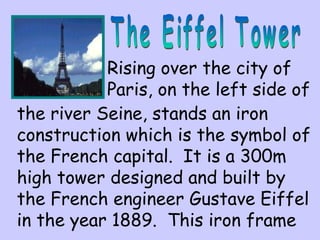
Rising over the city of
Paris, on the left side of
the river Seine, stands an iron
construction which is the symbol of
the French capital. It is a 300m
high tower designed and built by
the French engineer Gustave Eiffel
in the year 1889. This iron frame
was built on four piers
and there are three
platforms at different
levels. Each platform
can be reached either by stairways
or by elevators. A TV transmission
antenna is located at the top of the
tower.
A line of earth and brick
fortifications that
extends 2,400km across
northern China from the Gulf of
Chihli to Kansu Province. In the
late 3rd century BC the first
continuous wall was built by linking
earlier sections. This demarcates
Chinese territory It was only
partially effective in
preventing invasions
from the north. Troops,
summoned by
watchtower beacons, could race
quickly along the top to fight any
invader. Nowadays, gates through
the wall near Beijing became
centres of trade and of
contact with northern nomads.
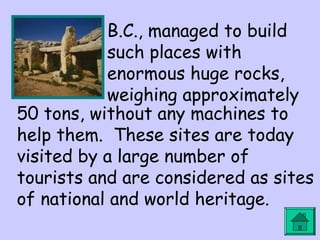
The first men in the
Maltese Islands used to
worship the goddess of fertility.
They made statues and built
temples in the shape of a fat lady,
where they could worship their
goddess. It is extraordinary how
these first men, as early as 3000
B.C., managed to build
such places with
enormous huge rocks,
weighing approximately
50 tons, without any machines to
help them. These sites are today
visited by a large number of
tourists and are considered as sites
of national and world heritage.
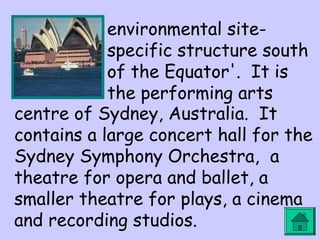
This is Sydney's most
famous building. It is
the work of the Danish architect
Jorn Utzon. It sits on a promontory
extending into the Harbour and
resembles a series of immense,
wind-filled sails. It was opened in
1973 and described as 'the biggest
environmental site-
specific structure south
of the Equator'. It is
the performing arts
centre of Sydney, Australia. It
contains a large concert hall for the
Sydney Symphony Orchestra, a
theatre for opera and ballet, a
smaller theatre for plays, a cinema
and recording studios.
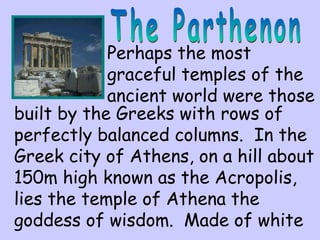
Perhaps the most
graceful temples of the
ancient world were those
built by the Greeks with rows of
perfectly balanced columns. In the
Greek city of Athens, on a hill about
150m high known as the Acropolis,
lies the temple of Athena the
goddess of wisdom. Made of white
marble the temple was
completed in the year
432 B.C. and remained in
good condition until 1687
when it was damaged by an explosion.
Today this temple is no longer for
the worship of ancient gods. Instead
its remains are crowded with tourists
who came to learn a little about life
long ago.
Standing at the entrance
of New York Harbour is
a colossal statue. It has
the form of a woman wearing
flowing robes and a spiked crown on
her head. It holds a torch in her
right hand and carries in her left
one a book on which is written July
4,1776. The 46m high statue was
designed by Gustave
Eiffel and sculpted by
Frederic Bartholdi. The
statue was given by the
French Government to the
Americans in the year 1886 to
commemorate the 100th
anniversary of America's
independence.
It is one of the most
famous buildings in the
world. A white marble
mausoleum in Agra, India, located on
the Jumna River. It was built
between the years 1632 and 1643 by
the emperor Shah Jahan in memory
of his beloved wife, Mumtaz Mahal.
It is regarded as one of the finest
example of Mogul
architecture. It is a
domed building laid in
perfect symmetry with
an area of 29 square meters. The
unique qualities of this monument lie
in the magnificent contrast between
the white marble facade of the
mausoleum and the red sandstone
of the surrounding buildings.
Landmarks

Landmarks

  • 1.
    By Ms. C.Enriquez
  • 2.
    What is a landmark? Let’ssee some examples … they might help!!
  • 3.
  • 4.
    In which countrydo we find … the Eiffel Tower? France
  • 5.
  • 6.
    In which countrydo we find … the Big Ben? England
  • 7.
  • 8.
    In which countrydo we find … the Colosseum? Italy
  • 9.
  • 10.
    In which countrydo we find … the Statue of Liberty? U.S.A
  • 11.
  • 12.
    In which countrydo we find … the Pyramids? Egypt
  • 13.
  • 14.
    In which countrydo we find … Greece the Parthenon?
  • 15.
    What is alandmark? A landmark is a monument or building that reminds you of a country or city.
  • 16.
  • 17.
    In which countrydo we find … the Great Wall? China
  • 18.
  • 19.
    In which countrydo we find … the Opera House? Australia
  • 20.
  • 21.
    In which countrydo we find … the Taj Mahal? India
  • 22.
  • 24.
  • 26.
    The Houses of Parliamentwere the residence of the Kings of England from the 11th to the 16th Century. The Great Hall is the only surviving medieval element and today it is used by Parliament and other public bodies.
  • 27.
    building, which wasdesigned by Sir Charles Barry. The most striking parts of Barry's design are the river front and the 97m clock tower famous for its bell, its unique chimes and its precise timing. The Westminster complex was destroyed by fire in 1834 and replaced by the present
  • 28.
    About 4,500 yearsago there lived in Cairo, Cheops, a king of Egypt. This king wanted to build a tomb where he was to be buried and he wanted this tomb to be the biggest in the world and so it was. The body of the pharaoh was brought by boat down to the river Nile to be
  • 29.
    buried in thisgreat tomb. The Egyptians believed in eternal life after death and this could only be enjoyed if the body was preserved. So they developed the art of making mummies that would lie in tombs built to last forever. This tomb is one of about 70 in Egypt still remaining today.
  • 30.
    The city ofRome has always been famous for its magnificent buildings. The Romans built fine towns and beautiful roads, palaces and large squares. They loved sports and so in the year 80 A.D. they built an impressive oval arena surrounded by
  • 31.
    stone seats whichcould hold 50,000 people. It was used for holding gladiator combats wild animal fights and other shows. We can still see the remains of this old beautiful building where so many races were held and where so many people lost their life.
  • 32.
    Rising over thecity of Paris, on the left side of the river Seine, stands an iron construction which is the symbol of the French capital. It is a 300m high tower designed and built by the French engineer Gustave Eiffel in the year 1889. This iron frame
  • 33.
    was built onfour piers and there are three platforms at different levels. Each platform can be reached either by stairways or by elevators. A TV transmission antenna is located at the top of the tower.
  • 34.
    A line ofearth and brick fortifications that extends 2,400km across northern China from the Gulf of Chihli to Kansu Province. In the late 3rd century BC the first continuous wall was built by linking earlier sections. This demarcates Chinese territory It was only
  • 35.
    partially effective in preventinginvasions from the north. Troops, summoned by watchtower beacons, could race quickly along the top to fight any invader. Nowadays, gates through the wall near Beijing became centres of trade and of contact with northern nomads.
  • 36.
    The first menin the Maltese Islands used to worship the goddess of fertility. They made statues and built temples in the shape of a fat lady, where they could worship their goddess. It is extraordinary how these first men, as early as 3000
  • 37.
    B.C., managed tobuild such places with enormous huge rocks, weighing approximately 50 tons, without any machines to help them. These sites are today visited by a large number of tourists and are considered as sites of national and world heritage.
  • 38.
    This is Sydney'smost famous building. It is the work of the Danish architect Jorn Utzon. It sits on a promontory extending into the Harbour and resembles a series of immense, wind-filled sails. It was opened in 1973 and described as 'the biggest
  • 39.
    environmental site- specific structuresouth of the Equator'. It is the performing arts centre of Sydney, Australia. It contains a large concert hall for the Sydney Symphony Orchestra, a theatre for opera and ballet, a smaller theatre for plays, a cinema and recording studios.
  • 40.
    Perhaps the most gracefultemples of the ancient world were those built by the Greeks with rows of perfectly balanced columns. In the Greek city of Athens, on a hill about 150m high known as the Acropolis, lies the temple of Athena the goddess of wisdom. Made of white
  • 41.
    marble the templewas completed in the year 432 B.C. and remained in good condition until 1687 when it was damaged by an explosion. Today this temple is no longer for the worship of ancient gods. Instead its remains are crowded with tourists who came to learn a little about life long ago.
  • 42.
    Standing at theentrance of New York Harbour is a colossal statue. It has the form of a woman wearing flowing robes and a spiked crown on her head. It holds a torch in her right hand and carries in her left one a book on which is written July 4,1776. The 46m high statue was
  • 43.
    designed by Gustave Eiffeland sculpted by Frederic Bartholdi. The statue was given by the French Government to the Americans in the year 1886 to commemorate the 100th anniversary of America's independence.
  • 44.
    It is oneof the most famous buildings in the world. A white marble mausoleum in Agra, India, located on the Jumna River. It was built between the years 1632 and 1643 by the emperor Shah Jahan in memory of his beloved wife, Mumtaz Mahal. It is regarded as one of the finest
  • 45.
    example of Mogul architecture.It is a domed building laid in perfect symmetry with an area of 29 square meters. The unique qualities of this monument lie in the magnificent contrast between the white marble facade of the mausoleum and the red sandstone of the surrounding buildings.
  • 46.